
📘 What’s Inside This CAT Para-Completion Question Post?
📝 Authentic CAT Para-Completion Question Practice with a real CAT Para-Completion Question from a previous CAT exam.
✅ Detailed Question with Step-by-Step Solution Each question is explained thoroughly for better understanding.
🔍 In-Depth Paragraph Analysis Gain insights through line-by-line and paragraph-wise analysis
📚 Vocabulary Enhancement: Top 5 words explained from the paragraph
Para-Completion Questions
Q.19 There is a sentence that is missing in the paragraph below. Look at the paragraph and decide where (option 1, 2, 3, or 4) the following sentence would best fit.
Sentence: Understanding central Asia’s role helps developments make more sense not only across Asia but in Europe, the Americas and Africa.
Paragraph: The nations of the Silk Roads are sometimes called ‘developing countries’, but they are actually some of the world’s most highly developed countries, the very crossroads of civilization, in advanced states of disrepair. ___(1)___. These countries lie at the centre of global affairs: they have since the beginning of history. Running across the spine of Asia, they form a web of connections fanning out in every direction, routes along which pilgrims and warriors, nomads and merchants have travelled, goods and produce have been bought and sold, and ideas exchanged, adapted and refined. ___(2)___. They have carried not only prosperity, but also death and violence, disease and disaster. ___(3)___. The Silk Roads are the world’s central nervous system, connecting otherwise far-flung peoples and places…. ___(4)___. It allows us to see patterns and links, caus
A. Option 3
B. Option 2
C. Option 1
D. Option 4
Solution with Explanation
Correct Answer: D
Detailed explanation by Wordpandit:The sentence in question moves beyond historical description and emphasizes the global implications of understanding Central Asia’s role. It suggests that insights gained from studying the Silk Roads and the Central Asian region shed light on patterns across the entire world—from Asia to Europe, Africa, and the Americas.
In the paragraph, the first three parts build a detailed historical narrative about the geographical importance and the cultural, commercial, and sometimes destructive flows along the Silk Roads. The final part of the paragraph then zooms out to reflect on the broader analytical value of studying this region. That’s where the sentence fits best—after the metaphorical comparison of the Silk Roads to a “central nervous system”.
The placement in Option 4 allows the sentence to act as a concluding insight, tying the historical and metaphorical discussions into a global framework. It explains why this region matters for understanding global developments—both past and present.
Option-wise Analysis:
- Option 1: This would break the logical flow between the first sentence, which talks about the mischaracterization of these countries as "developing," and the next sentence, which begins with “These countries…”—clearly referring to the prior idea. Inserting a broad global comment here would disrupt the local-to-global progression.
- Option 2: The sentence following this blank begins with “They have carried not only prosperity…”, referring directly to the “routes” and their impacts. Introducing a general global insight about Central Asia’s importance here would interrupt this concrete list of historical functions of the Silk Roads.
- Option 3: This option falls between two vivid and interconnected metaphors—the harmful aspects of Silk Road history (“death and violence…”) and the central nervous system metaphor that encapsulates their deep interconnectivity. Inserting the sentence here would weaken the continuity of that imagery.
- Option 4: This is the most logical placement. The metaphor of the Silk Roads as the “world’s central nervous system” naturally leads into a wider reflection on how understanding this system can illuminate global developments. The sentence provides a smooth transition from metaphor to implication, tying together the paragraph’s descriptive and analytical dimensions.
Therefore, Option D is the correcst answer.
Word 1: Developing
Context:
"The nations of the Silk Roads are sometimes called ‘developing countries’, but they are actually some of the world’s most highly developed countries, the very crossroads of civilization, in advanced states of disrepair." - Historical Commentary on Global Development
Explanatory Paragraph:
“Developing” typically refers to countries or regions that are in the process of economic growth, modernization, and improvement in living standards. These nations are often contrasted with “developed” countries, which are considered more industrialized and prosperous. However, the term can be misleading or oversimplified, as highlighted in the context, where nations labeled as “developing” have deep historical significance and cultural richness, even if they face present-day challenges. The word carries economic, political, and sometimes controversial connotations.
Meaning: In the process of growth or progress, especially in terms of economic, social, or infrastructural development (Adjective)
Pronunciation: dih-VEL-uh-ping
Difficulty Level: ⭐⭐ Beginner
Etymology: From the French *développer*, meaning “to unwrap or unfold,” adapted into English in the late 19th century with a more economic and societal focus
Prashant Sir's Notes:
“Developing” is a widely used geopolitical term, but use it carefully—it can unintentionally imply inferiority. It’s often better to consider context or use alternatives like “emerging economies” or “low and middle-income countries” depending on your audience. Also notice the irony in this context—the word is challenged directly!
Synonyms & Antonyms:
Synonyms: emerging, progressing, growing, evolving
Antonyms: developed, advanced, industrialized, matured
Usage Examples:
- Many developing countries are investing heavily in education and digital infrastructure.
- The term “developing” often hides the historical contributions of these regions to global civilization.
- Tourism can provide vital income for developing economies.
- Environmental challenges are especially pressing in many developing regions.
Cultural Reference:
The World Bank and United Nations often use the classification “developing countries,” though it's increasingly debated for being vague or outdated. Terms like “Global South” or “emerging markets” are gaining ground as alternatives.
Think About It:
Can a country be culturally or historically “developed” but still be called “developing” economically? What does that say about how we define progress?
Quick Activity:
List two countries commonly labeled “developing.” Research one major contribution each has made to global science, culture, or history.
Memory Tip:
“Developing” = still in progress or growing. Imagine a city being built: structures are going up, but it's not finished yet.
Real-World Application:
The word “developing” is used in economics, international relations, global health, and journalism. It affects how aid is distributed, how countries are perceived, and how policies are shaped on a global scale.
Word 2: Civilization
Context:
"The nations of the Silk Roads are sometimes called ‘developing countries’, but they are actually some of the world’s most highly developed countries, the very crossroads of civilization, in advanced states of disrepair." - Historical Commentary on the Silk Roads
Explanatory Paragraph:
“Civilization” refers to an advanced stage of human society marked by organized government, culture, science, and industry. It often denotes a society with cities, structured institutions, and shared cultural achievements. In the context of the Silk Roads, the term emphasizes the deep historical and cultural richness of these regions, which were once centers of commerce, knowledge, and innovation. Despite modern challenges, they are still remembered as birthplaces and crossroads of major civilizations throughout history.
Meaning: A complex society with cities, organized institutions, art, science, and a shared culture (Noun)
Pronunciation: siv-uh-luh-ZAY-shun
Difficulty Level: ⭐⭐ Beginner
Etymology: From Latin *civilis* (“civil” or “relating to citizens”), through French *civilisation*, first used in the 18th century to describe societies considered culturally advanced
Prashant Sir's Notes:
This is a foundational word in history, sociology, and anthropology. Use it when referring to large-scale, structured societies or when comparing different historical eras. Note: It can carry bias—historically used to judge cultures by Western standards—so be mindful of the context.
Synonyms & Antonyms:
Synonyms: society, culture, community, polity, empire
Antonyms: barbarism, savagery, chaos, anarchy
Usage Examples:
- Ancient Mesopotamia is considered one of the cradles of civilization.
- The Silk Roads linked some of the world’s earliest civilizations through trade and culture.
- Environmental collapse has threatened many past civilizations.
- Modern civilization relies heavily on digital infrastructure and global connectivity.
Cultural Reference:
Historian Arnold Toynbee described the rise and fall of civilizations in his 12-volume *A Study of History*, arguing that civilizations progress through challenges and responses rather than racial or geographical superiority.
Think About It:
How do we define a “civilized” society today? Is it based on technology, values, laws, or something deeper?
Quick Activity:
List three characteristics of what makes a civilization. Then, name one civilization (past or present) that fits your list and explain why.
Memory Tip:
“Civilization” comes from “civic” → relating to cities and citizens. So think of organized life in cities as the core of civilization.
Real-World Application:
The word is used in history, archaeology, international relations, and even science fiction. It shapes how we understand human progress, cultural diversity, and the values that bind or divide global communities.
Word 3: Connections
Context:
"Running across the spine of Asia, they form a web of connections fanning out in every direction, routes along which pilgrims and warriors, nomads and merchants have travelled, goods and produce have been bought and sold, and ideas exchanged, adapted and refined." - Description of the Silk Roads
Explanatory Paragraph:
“Connections” refers to the links, relationships, or associations between people, places, ideas, or things. In this context, it emphasizes the vast and intricate network of interactions created by the Silk Roads. These connections facilitated trade, cultural exchange, migration, and the spread of knowledge. The word highlights the deep interdependence and interaction among different regions and civilizations over time—making it central to understanding globalization, both past and present.
Meaning: Relationships or links between people, places, ideas, or systems (Noun – plural)
Pronunciation: kuh-NEK-shunz
Difficulty Level: ⭐ Beginner
Etymology: From Latin *connectere*, meaning “to fasten together,” from *con-* (together) + *nectere* (to tie or bind)
Prashant Sir's Notes:
“Connections” is a core vocabulary word across multiple domains—networking, history, technology, and personal relationships. Always think about what kinds of links are being described—physical (roads), emotional (friendship), intellectual (ideas), or digital (networks). In history and geography, it’s especially important when describing routes like the Silk Roads.
Synonyms & Antonyms:
Synonyms: links, ties, relationships, associations, networks
Antonyms: disconnections, separations, divisions, isolation
Usage Examples:
- The Silk Roads enabled cultural and economic connections across continents.
- She values meaningful connections with people over large social networks.
- Technological connections today are faster and more global than ever before.
- There are strong historical connections between trade, religion, and empire-building.
Cultural Reference:
Historian Peter Frankopan’s book *The Silk Roads* reimagines world history through the lens of connections formed by trade and cultural exchange, arguing that the East has always been central to global development.
Think About It:
In a hyperconnected modern world, are we more truly connected—or more fragmented and isolated?
Quick Activity:
List three types of connections that shaped the Silk Roads: one cultural, one economic, and one technological. Briefly explain their impact.
Memory Tip:
Think of plugging something into a socket: “connection” = joining two things so they work or share energy/information.
Real-World Application:
“Connections” is key in education, technology (networking), international relations, and personal development. From social media to global trade to emotional intelligence, strong connections shape modern life.
Word 4: Prosperity
Context:
"They have carried not only prosperity, but also death and violence, disease and disaster." - Historical Reflection on the Dual Nature of Trade Routes
Explanatory Paragraph:
“Prosperity” refers to the state of being successful, especially in terms of wealth, economic growth, and overall well-being. It often implies a flourishing condition marked by good fortune, stability, and progress. In this context, the word captures the positive outcomes that trade routes like the Silk Roads brought to various regions—such as increased commerce, cultural enrichment, and urban growth—while also acknowledging that this prosperity came with darker consequences like war and disease.
Meaning: A state of flourishing, success, or good fortune—especially in financial or economic terms (Noun)
Pronunciation: prah-SPAIR-ih-tee
Difficulty Level: ⭐⭐ Beginner
Etymology: From Latin *prosperitas*, from *prosperus*, meaning “favorable” or “fortunate”
Prashant Sir's Notes:
This word is widely used in economic, political, and social discussions. While it often refers to material wealth, true prosperity can also include health, education, and happiness. Be aware of contexts where it's used ironically or contrasted with suffering, as in this sentence.
Synonyms & Antonyms:
Synonyms: wealth, success, affluence, flourishing, well-being
Antonyms: poverty, hardship, decline, stagnation, misery
Usage Examples:
- The Silk Roads brought prosperity to cities along the trade routes.
- Economic prosperity often leads to better healthcare and education.
- The nation enjoyed decades of prosperity after the reforms.
- True prosperity goes beyond money—it includes freedom, purpose, and peace.
Cultural Reference:
The “American Dream” is often associated with the promise of prosperity through hard work and opportunity, though it has been increasingly critiqued for being unattainable for many.
Think About It:
Can prosperity exist for some without causing harm or deprivation for others? Is it always a sign of justice or equity?
Quick Activity:
Write down three things you believe a prosperous society must have. Then, reflect on whether these exist equally across your country or community.
Memory Tip:
Think “PROSPER” = progress + wealth → “Prosperity” is the condition where things are growing well—financially, socially, or emotionally.
Real-World Application:
“Prosperity” is a key concept in economics, international development, and politics. It's used to set goals for nations, assess well-being, and shape public policy—often featured in terms like “inclusive prosperity” or “shared prosperity.”
Word 5: Disrepair
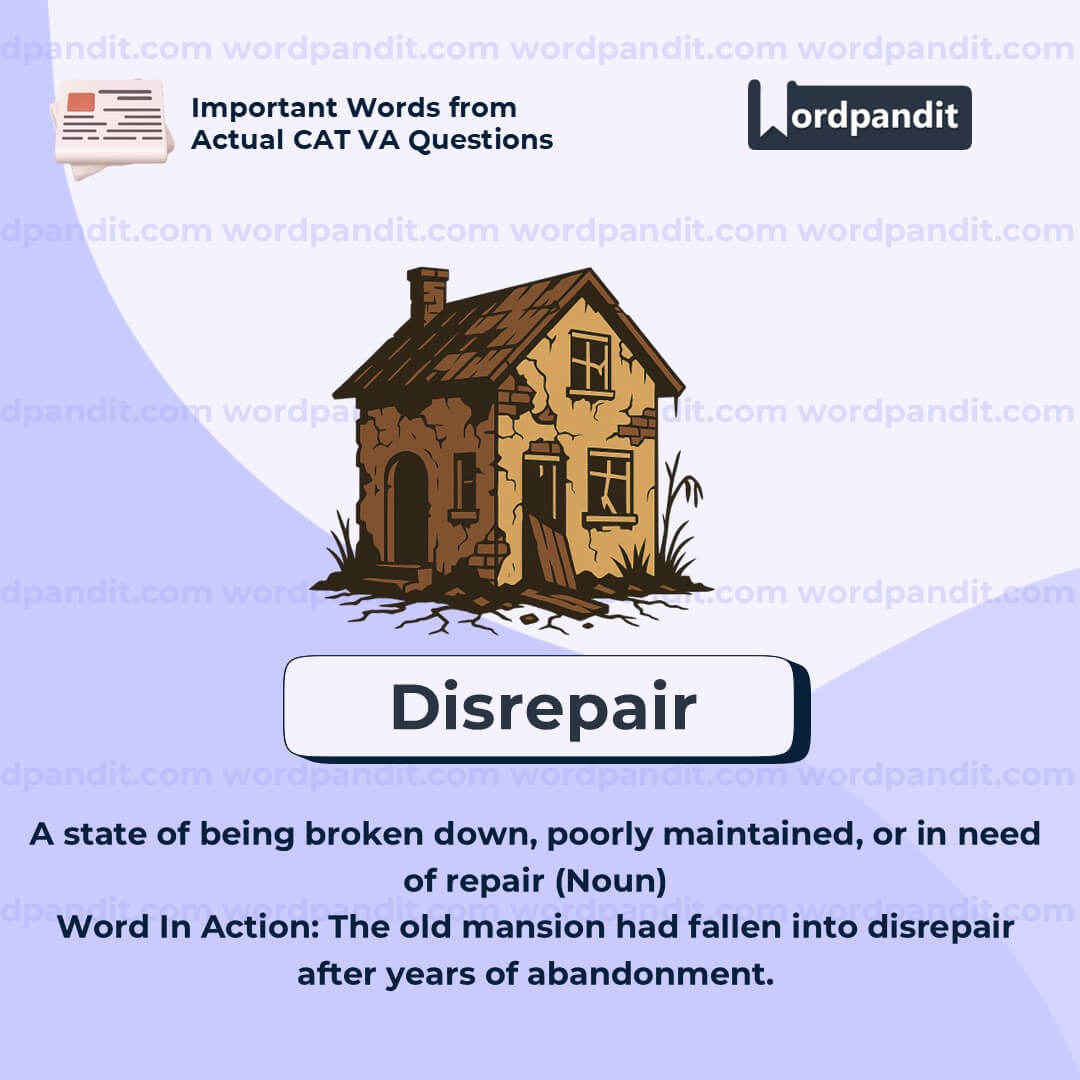
Context:
"The nations of the Silk Roads are sometimes called ‘developing countries’, but they are actually some of the world’s most highly developed countries, the very crossroads of civilization, in advanced states of disrepair." - Historical Commentary on the Silk Roads
Explanatory Paragraph:
“Disrepair” refers to a condition of deterioration or poor maintenance—when something has fallen into a damaged, broken, or neglected state. It’s often used for buildings, roads, or systems that were once in good condition but have not been cared for over time. In this context, the phrase “advanced states of disrepair” implies that while these Silk Road regions were once flourishing and central to civilization, they have now suffered neglect, decay, or decline—highlighting the contrast between their historical greatness and current condition.
Meaning: A state of being broken down, poorly maintained, or in need of repair (Noun)
Pronunciation: dis-ri-PAIR
Difficulty Level: ⭐⭐ Beginner
Etymology: From Old French *desrepairer* (“to ruin”), from Latin *reparare* (“to restore”) with the prefix *dis-* indicating reversal or negation
Prashant Sir's Notes:
This word is perfect for describing visual or structural decline. Often used for cities, infrastructure, and institutions that were once thriving. In essays, it adds weight when talking about neglect or the passage of time. The phrase “state of disrepair” is a common and powerful expression.
Synonyms & Antonyms:
Synonyms: neglect, decay, deterioration, ruin, dilapidation
Antonyms: upkeep, maintenance, restoration, renewal
Usage Examples:
- The ancient city fell into disrepair after centuries of abandonment.
- The roads in the region are in serious disrepair, making travel difficult.
- Despite its rich history, the museum building is in a visible state of disrepair.
- Public infrastructure in many areas suffers from years of disrepair and underfunding.
Cultural Reference:
The phrase “crumbling into disrepair” is often used in literature and journalism to describe the slow decline of once-great cities, such as Rome, Baghdad, or Detroit, symbolizing both physical ruin and deeper societal challenges.
Think About It:
How does physical disrepair in a country or city reflect deeper political, social, or historical issues?
Quick Activity:
Think of a place (a monument, building, or neighborhood) you know that has fallen into disrepair. Write one sentence explaining what caused its decline and one suggestion for restoring it.
Memory Tip:
“Disrepair” = *dis* (not) + *repair* → a condition where no repairs are being made = decay or neglect.
Real-World Application:
Common in urban planning, architecture, journalism, and heritage conservation, “disrepair” alerts people to the need for renewal and investment—whether in physical spaces or institutional systems.
