
📘 What’s Inside This CAT Para-Completion Question Post?
📝 Authentic CAT Para-Completion Question Practice with a real CAT Para-Completion Question from a previous CAT exam.
✅ Detailed Question with Step-by-Step Solution Each question is explained thoroughly for better understanding.
🔍 In-Depth Paragraph Analysis Gain insights through line-by-line and paragraph-wise analysis
📚 Vocabulary Enhancement: Top 5 words explained from the paragraph
Para-Completion Questions
18. There is a sentence that is missing in the paragraph below. Look at the paragraph and decide where (option 1, 2, 3, or 4) the following sentence would best fit.
Sentence: Yet each day the flock produced eggs with calcareous shells though they apparently had not ingested any calcium from land which was entirely lacking in limestone.
Paragraph: Early in this century a young Breton schoolboy who preparing himself for a scientific career began to notice a strange fact about hens in his father's poultry yard. ___(1)___. As they scratched the soil they constantly seemed to be pecking at specks of mica, a siliceous material dotting the ground. ___(2)___. No one could explain to Louis Kervran why the chickens selected the mica, or why each time a bird was killed for the family cooking pot no trace of the mica could be found in its gizzard. ___(3)___. It took Kervran many years to establish that the chickens were transmuting one element into another. ___(4)___.
A Option 1
B Option 3
C Option 2
D Option 4
Solution with Explanation
Correct Answer: B
Detailed explanation by Wordpandit:To determine where the missing sentence fits best, we must trace the logical development of the paragraph. The paragraph follows a narrative that begins with a boy’s observation, proceeds through his puzzlement about a hen's behavior, and culminates in his scientific discovery. The sentence to be inserted describes an anomaly—the hens were producing eggs with calcareous shells despite no apparent calcium intake. This anomaly is central to the mystery and provides the foundation for the eventual conclusion about transmutation.
To integrate the sentence effectively, we need to find the point in the paragraph where highlighting this unexplained event adds to the progression of the mystery and connects naturally with both the preceding and succeeding sentences. It must not introduce key information too early (before the reader knows what’s puzzling) or too late (after the mystery has been resolved).
Option-wise Analysis
- Option 1:
“Early in this century a young Breton schoolboy...”
This is the paragraph's opening line, which sets the scene and introduces the main character, Louis Kervran. Placing the sentence about egg production here would be premature—it introduces a surprising scientific observation before we even understand who is making it or why. The narrative would become jarring because the context for understanding the significance of the calcium anomaly hasn't yet been built. - Option 2:
“As they scratched the soil they constantly seemed to be pecking at specks of mica...”
This part observes the hens’ peculiar behavior—eating mica. Inserting the sentence here shifts the focus abruptly from behavior to the outcome (egg production). It would break the coherence between observation and confusion about that behavior. The reader needs more background before the detail about egg shells can deepen the mystery. - Option 3:
“No one could explain to Louis Kervran why the chickens selected the mica...”
This is the ideal spot for the sentence. The mystery is now well established: the chickens eat mica, and its traces disappear from their bodies. The inserted sentence about eggs introduces the real conundrum—how are hens producing calcium-rich eggs without an apparent source of calcium? It heightens the enigma and naturally leads to the next sentence, which reveals Kervran's long-term investigation and breakthrough. The inserted sentence acts as a pivot from mystery to scientific inquiry. - Option 4:
“It took Kervran many years to establish...”
This sentence concludes the paragraph by presenting Kervran’s solution. Introducing a new mystery here (egg production) would disrupt the flow. At this point, we should be wrapping up the narrative, not adding more unexplained phenomena. It would dilute the impact of the resolution.
Word 1: Transmuting
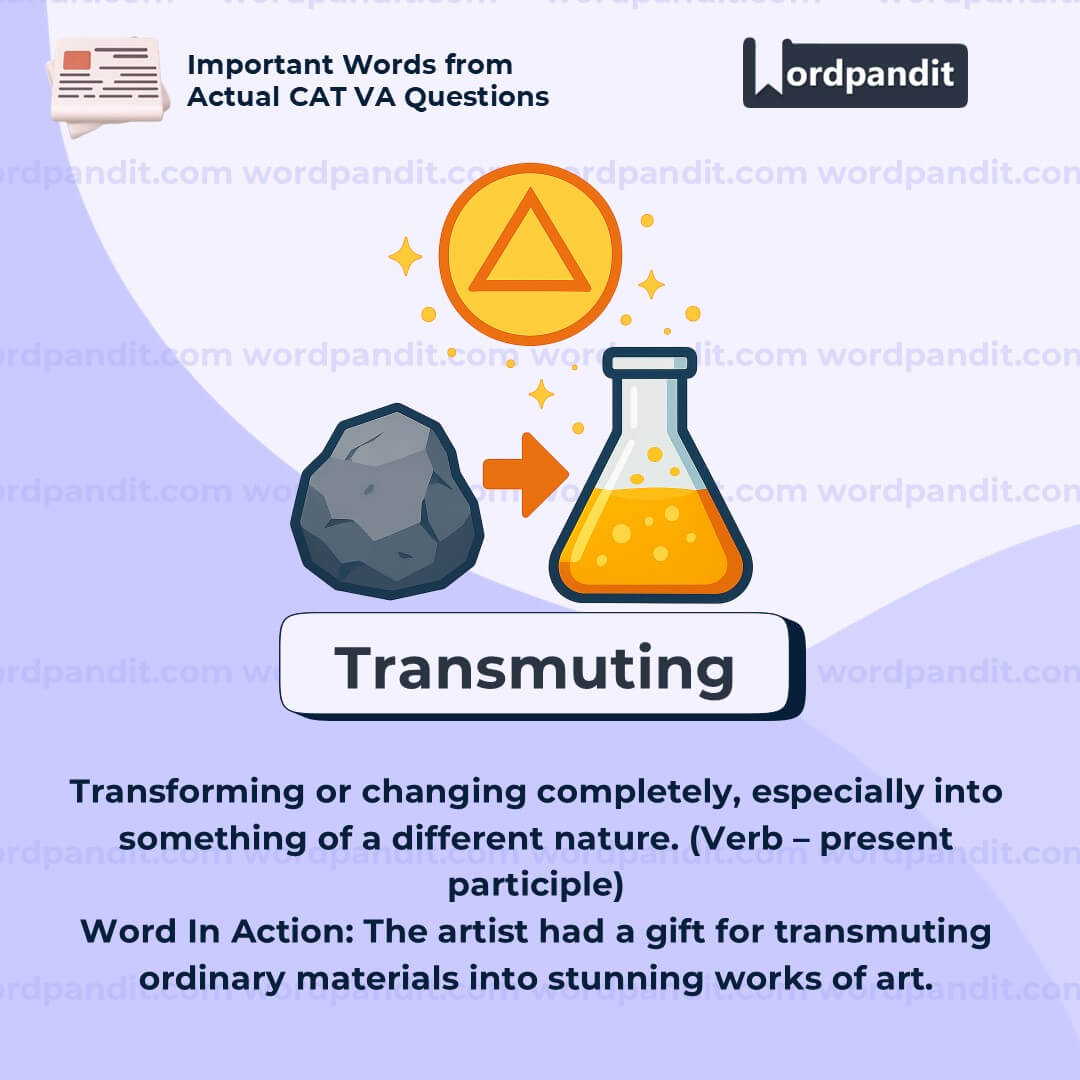
Context:
"It took Kervran many years to establish that the chickens were transmuting one element into another." - Scientific Discovery Account
Explanatory Paragraph:
“Transmuting” refers to the process of changing something from one form, substance, or nature into another. It often carries a scientific or almost magical connotation, especially when referring to changes in elements or matter. In the context given, it suggests that the chickens were somehow converting one chemical element into another, a claim that aligns more with speculative science or alchemical theories than mainstream biology. Still, the term reflects deep transformation, whether physical, chemical, or metaphorical.
Meaning: Transforming or changing completely, especially into something of a different nature. (Verb – present participle)
Pronunciation: tranz-myoo-ting
Difficulty Level: ⭐⭐⭐⭐ Advanced
Etymology: From Latin “transmutare” — “trans” (across) + “mutare” (to change), literally meaning “to change across or beyond.”
Prashant Sir's Notes:
“Transmuting” has roots in both science and mysticism. Alchemists sought to transmute base metals into gold. Today, the word is a powerful metaphor for profound change, whether in nature, personality, or thought. It’s a poetic and high-level word—use it for dramatic transformations.
Synonyms & Antonyms:
Synonyms: transform, convert, metamorphose, morph, alter
Antonyms: preserve, retain, maintain, keep
Usage Examples:
- The philosopher spoke of transmuting suffering into wisdom.
- The lead was supposedly transmuting into gold in ancient alchemical experiments.
- Her grief transmuted into strength over time.
- Some theories claim that energy can be transmuted into matter under certain conditions.
Cultural Reference:
"Alchemy is the art of transmuting the base into the noble." - Carl Jung
Think About It:
Can negative experiences be transmuted into positive growth? How?
Quick Activity:
Write a short metaphorical sentence using “transmuting” to describe a personal transformation (e.g., fear into courage).
Memory Tip:
“Trans” means across, and “mute” sounds like change—so “transmuting” = changing across or into something new.
Real-World Application:
In literature, psychology, and science, “transmuting” is used to describe deep, elemental change—whether of matter in physics, of emotion in therapy, or of character in storytelling.
Word 2: Calcareous
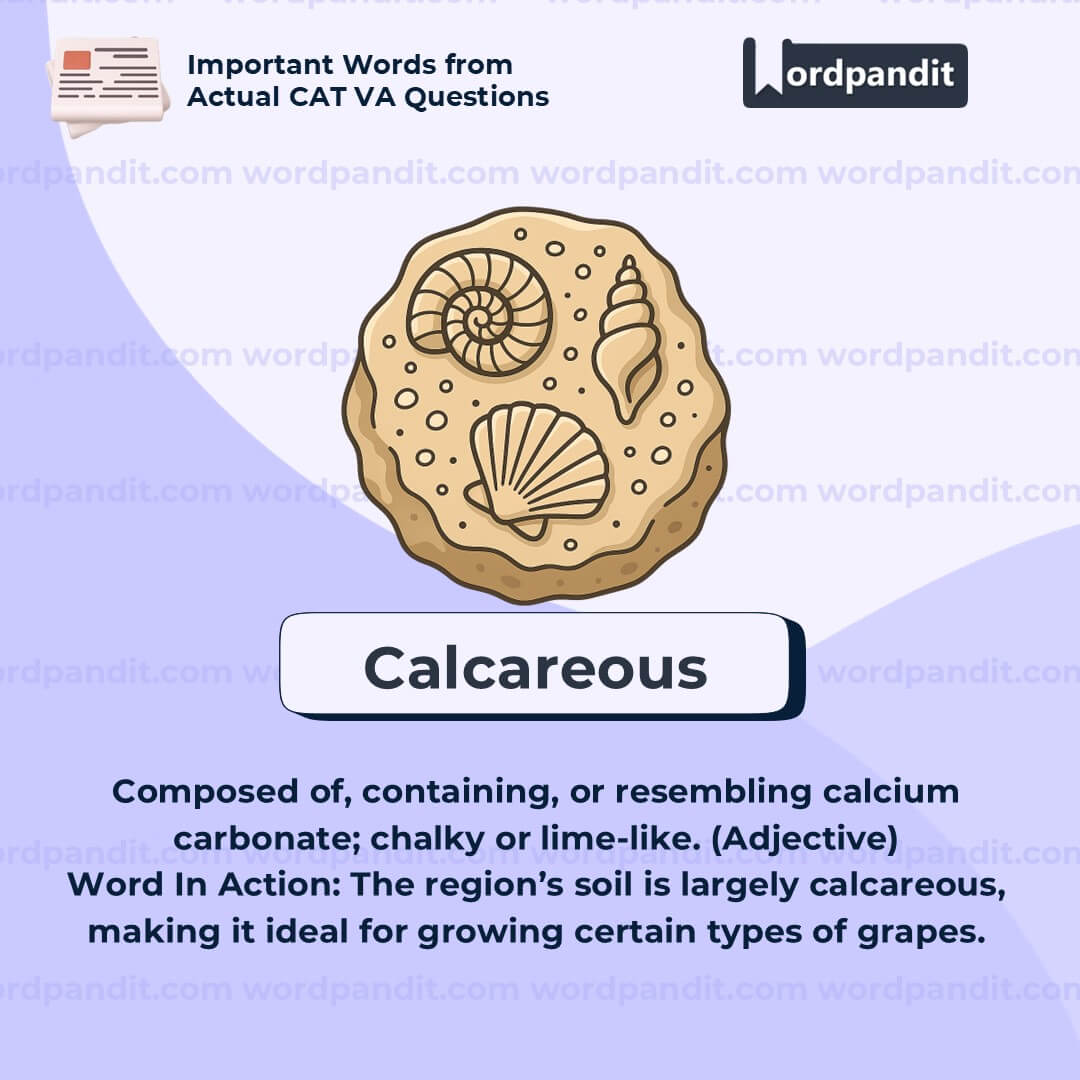
Context:
"Yet each day the flock produced eggs with calcareous shells though they apparently had not ingested any calcium from land which was entirely lacking in limestone." - Biological Observation Report
Explanatory Paragraph:
“Calcareous” is an adjective used to describe something that contains or is made of calcium carbonate or lime. It typically refers to materials like shells, rocks, or soils that are chalky or limestone-rich in nature. In the given context, it highlights a scientific curiosity—how eggshells made from calcium were being produced even though the surrounding environment lacked limestone, which is a typical source of calcium. This word is often used in geology, biology, and environmental science.
Meaning: Composed of, containing, or resembling calcium carbonate; chalky or lime-like. (Adjective)
Pronunciation: kal-kair-ee-us
Difficulty Level: ⭐⭐⭐⭐ Advanced
Etymology: From Latin “calx” meaning lime or limestone, with the suffix “-aceous” meaning pertaining to.
Prashant Sir's Notes:
This word is mostly seen in scientific contexts—especially biology (e.g., eggshells, marine organisms) and geology (e.g., calcareous rocks or soils). Just link it mentally with “calcium” to understand its meaning easily.
Synonyms & Antonyms:
Synonyms: chalky, lime-rich, limestone-based, mineralized
Antonyms: non-calcareous, acidic, lime-free, soft-bodied (in biological contexts)
Usage Examples:
- The region is known for its calcareous soil, which is excellent for grape cultivation.
- Marine snails have calcareous shells that protect them from predators.
- Scientists studied the calcareous deposits left behind by ancient sea life.
- Calcareous rocks are often used in cement production due to their high lime content.
Cultural Reference:
"Calcareous formations make up much of the white cliffs of Dover, a national symbol in Britain." - Geological Heritage Review
Think About It:
Why do you think nature has evolved to use calcium carbonate in so many biological structures like shells, bones, and eggs?
Quick Activity:
Look around your kitchen or garden—can you identify any calcareous materials? Think: eggshells, seashells, or chalk. Write them down!
Memory Tip:
Think “calcareous” = “calcium + serious” → seriously full of calcium!
Real-World Application:
Understanding calcareous materials is important in agriculture (for soil treatment), construction (cement and lime), and even nutrition (as a calcium source in foods and supplements).
Word 3: Siliceous
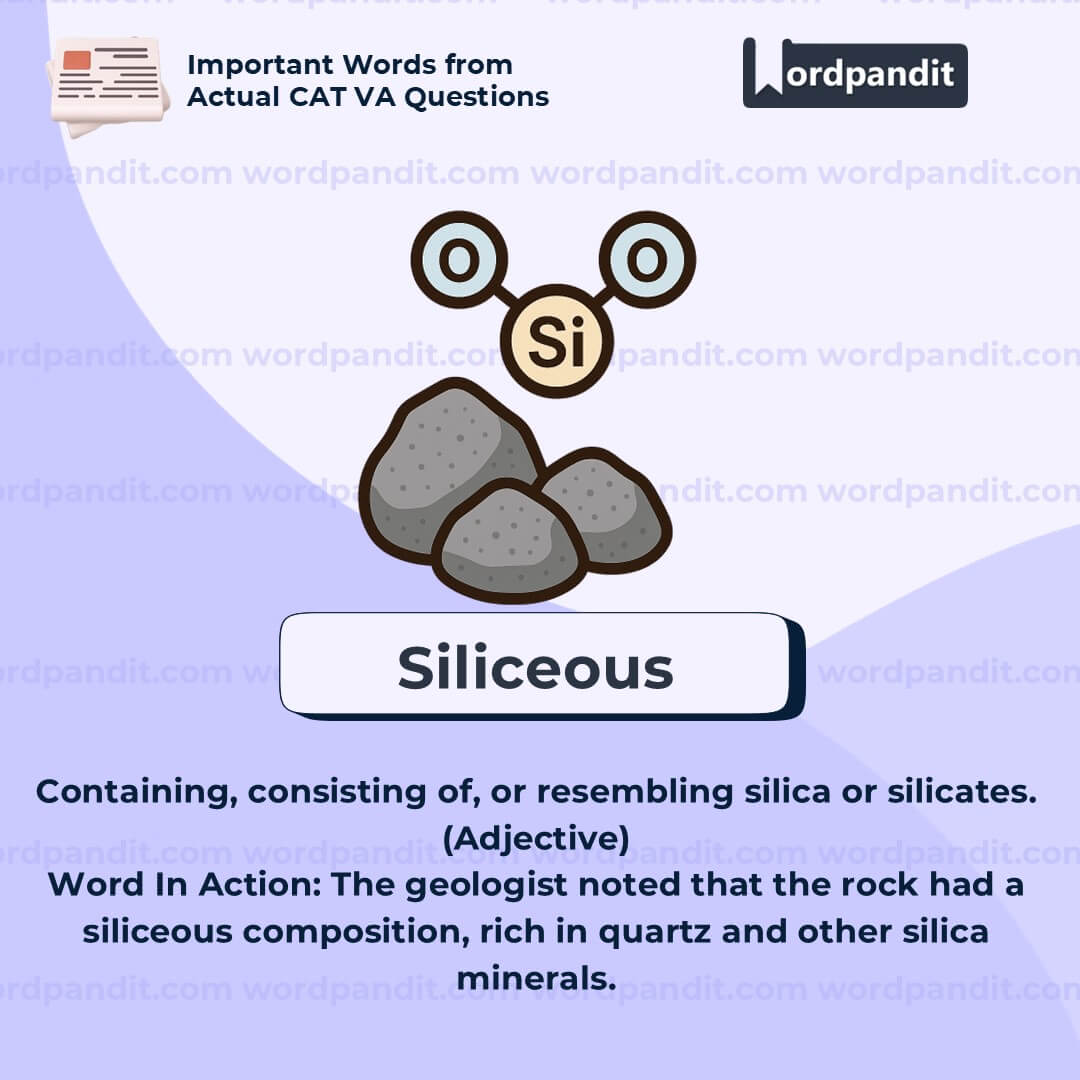
Context:
"As they scratched the soil they constantly seemed to be pecking at specks of mica, a siliceous material dotting the ground." - Scientific Field Observation
Explanatory Paragraph:
“Siliceous” is an adjective that refers to substances that contain or are made up of silica, a hard, unreactive compound found in quartz, sand, and many types of rock. In this context, the birds are seen interacting with mica, a mineral that contains silica, which is a key component of many geological materials. This word is commonly used in geology, environmental science, and materials engineering to describe rocks, soils, and sediments that are rich in silica.
Meaning: Containing, consisting of, or resembling silica or silicates. (Adjective)
Pronunciation: si-lish-us
Difficulty Level: ⭐⭐⭐⭐ Advanced
Etymology: From Latin “siliceus” meaning “flinty” or “full of flint,” from “silex” (hard stone, flint).
Prashant Sir's Notes:
Siliceous is a technical term, mainly found in scientific texts. It’s particularly useful in environmental science, geology, and botany. Just remember—it always links back to silica (sand or quartz). You can visualize it with grains of sand or glassy rocks!
Synonyms & Antonyms:
Synonyms: silica-rich, quartz-like, flinty, mineral-based
Antonyms: calcareous, organic, clay-rich, carbonate-based
Usage Examples:
- The siliceous composition of the rock made it highly resistant to weathering.
- Geologists collected siliceous samples from the sediment layers near the volcano.
- Siliceous sponges are marine animals that have skeletons made of silica.
- The glass industry relies heavily on siliceous sand as a raw material.
Cultural Reference:
"Siliceous earths were once prized by ancient artisans for making strong and heat-resistant pottery." - Archaeological Materials Journal
Think About It:
Why might materials rich in silica be important in both ancient and modern human technologies?
Quick Activity:
Pick up a small rock or grain of sand. Look at its texture and color—can you guess if it’s siliceous? Research to confirm!
Memory Tip:
Think of “siliceous” as “SILICA + delicious” (though it’s not edible!)—anything siliceous is full of silica, like glass or sand.
Real-World Application:
Siliceous materials are crucial in the manufacturing of glass, ceramics, electronics, and construction. Understanding them helps in fields like civil engineering, archaeology, and geology.
Word 4: Establish

Context:
"It took Kervran many years to establish that the chickens were transmuting one element into another." - Scientific Inquiry Report
Explanatory Paragraph:
“Establish” means to prove or show something clearly and convincingly, especially after effort or investigation. In this context, Kervran had to collect evidence over many years to confirm and prove a scientific theory. The word is often used in academic, legal, and professional contexts to indicate that something has been demonstrated, created, or confirmed as fact.
Meaning: To prove, confirm, or show something to be true; to set up or found something. (Verb)
Pronunciation: eh-stab-lish
Difficulty Level: ⭐⭐ Beginner-Intermediate
Etymology: From Old French “establir,” from Latin “stabilire” (to make stable), from “stabilis” (stable, firm).
Prashant Sir's Notes:
This is a high-frequency academic and general-purpose word. Think of it both as “to prove” and “to build.” You establish facts in research, but you also establish companies, rules, or reputations. A very versatile word!
Synonyms & Antonyms:
Synonyms: prove, confirm, demonstrate, found, create, set up
Antonyms: disprove, refute, abolish, dismantle, negate
Usage Examples:
- The researchers established a clear link between the two diseases.
- He worked hard to establish his business in a competitive market.
- The government established new safety regulations after the accident.
- It’s important to establish trust in any long-term relationship.
Cultural Reference:
"The Constitution establishes the framework for the rule of law and democratic governance in the United States." - U.S. Legal Foundations
Think About It:
Why is it often harder to establish truth in scientific research than to simply suggest a theory?
Quick Activity:
Write a sentence using “establish” in the context of a personal goal, like fitness, learning, or a habit.
Memory Tip:
Think of a “stable table”—to “establish” something is to make it stable, firm, and undeniable.
Real-World Application:
“Establish” is a core term in essays, legal arguments, scientific writing, and even everyday speech. Whether you’re building a company or proving a point, you’ll use this word often!
Word 5: Trace
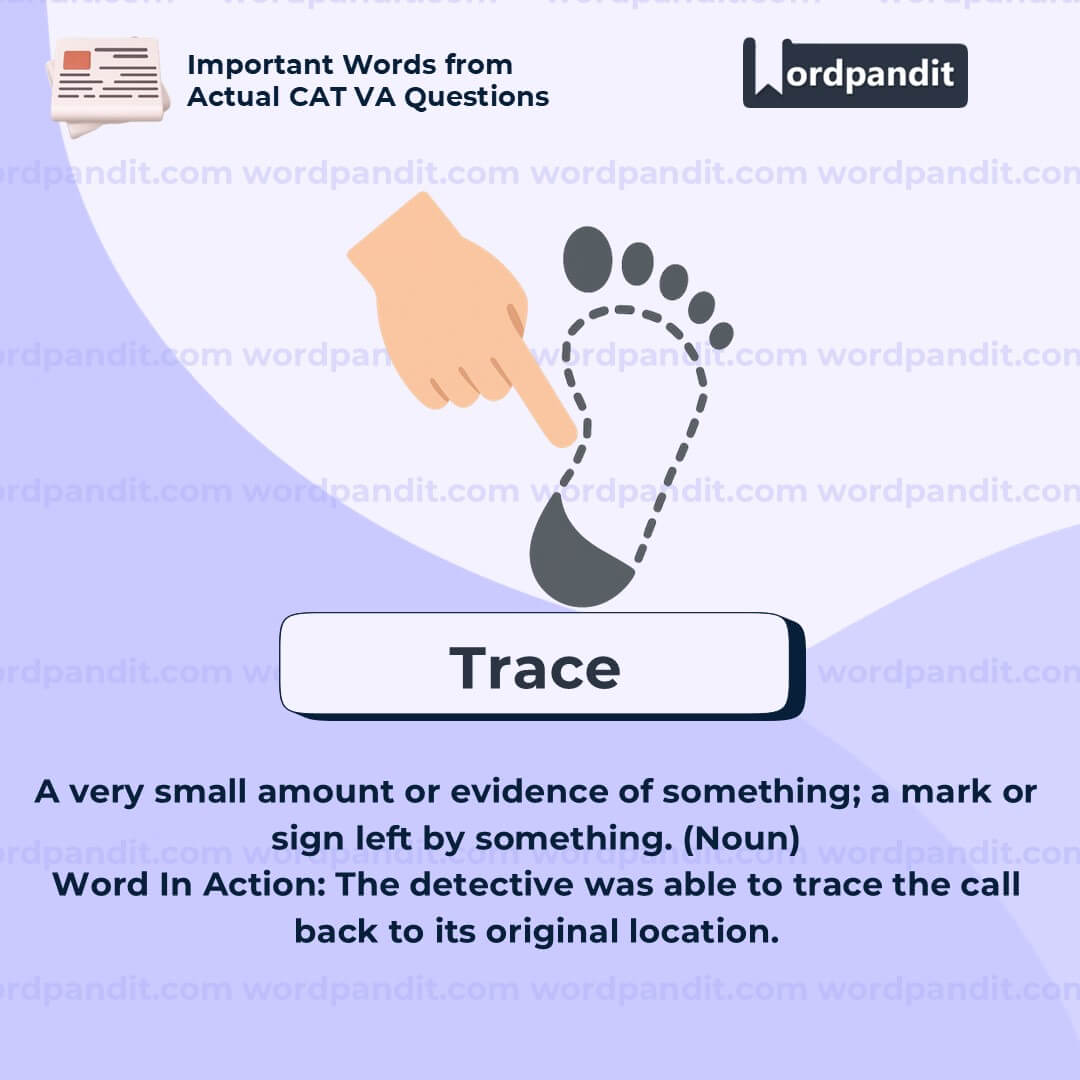
Context:
"No one could explain to Louis Kervran why the chickens selected the mica, or why each time a bird was killed for the family cooking pot no trace of the mica could be found in its gizzard." - Scientific Curiosity Narrative
Explanatory Paragraph:
“Trace” in this context means a very small amount or sign of something. It is often used when something is so minimal that it is almost invisible or undetectable. Here, it refers to the puzzling absence of any mica particles in the chickens’ gizzards, despite the birds being observed pecking at it. This word is frequently used in science, forensics, and everyday language when describing minimal remains or barely detectable elements.
Meaning: A very small amount or evidence of something; a mark or sign left by something. (Noun)
Pronunciation: trayce
Difficulty Level: ⭐⭐ Beginner-Intermediate
Etymology: From Old French “tracier” (to trace, draw), from Latin “tractus” (a dragging, drawing), from the verb “trahere” (to pull).
Prashant Sir's Notes:
“Trace” is a very flexible word—used as a noun, verb, and even adjective (as in "trace amounts"). Learn its scientific and metaphorical uses. Think of detective stories, chemistry labs, or memory trails—trace fits in all these contexts!
Synonyms & Antonyms:
Synonyms: hint, mark, remnant, residue, sign, indication
Antonyms: abundance, flood, heap, lot, overflow
Usage Examples:
- The police found no trace of the suspect at the scene.
- Only a trace amount of the chemical remained in the solution.
- There wasn’t a trace of sadness on her face—she looked completely at peace.
- Archaeologists uncovered traces of an ancient civilization beneath the ruins.
Cultural Reference:
"Every contact leaves a trace." — Edmond Locard, pioneer of forensic science (Locard's Exchange Principle)
Think About It:
What are the “traces” you leave behind in other people’s lives—through your actions, words, or presence?
Quick Activity:
Write a sentence using “trace” in both a literal and metaphorical sense (e.g., trace of dust, trace of hope).
Memory Tip:
Think of a detective with a magnifying glass looking for a tiny clue—that tiny clue is a “trace.”
Real-World Application:
“Trace” is commonly used in environmental studies (trace elements in soil), forensic science (trace evidence), health and nutrition (trace minerals), and even emotion (a trace of doubt)—making it a truly universal word.
