
📘 What’s Inside This CAT Paragraph Summary Question Post?
📝 Authentic CAT Paragraph Summary Question:Practice with a real CAT Paragraph Summary Question from a previous CAT exam.
✅ Detailed Question with Step-by-Step Solution:Each question is explained thoroughly for better understanding.
🔍 In-Depth Paragraph Analysis:Gain insights through line-by-line and paragraph-wise analysis
📚 Vocabulary Enhancement: Top 5 words explained from the paragraph
Paragraph Summary Questions
23. The passage given below is followed by four alternate summaries. Choose the option that best captures the essence of the passage.
Different from individuals, states conduct warfare operations using the DIME model— “diplomacy, information, military, and economics.” Most states do everything they can to inflict pain and confusion on their enemies before deploying the military. In fact, attacks on vectors of information are a well-worn tactic of war and usually are the first target when the charge begins. It’s common for telecom data and communications networks to be routinely monitored by governments, which is why the open data policies of the web are so concerning to many advocates of privacy and human rights. With the worldwide adoption of social media, more governments are getting involved in low-grade information warfare through the use of cyber troops. According to a study by the Oxford Internet Institute in 2020, cyber troops are “government or political party actors tasked with manipulating public opinion online.” The Oxford research group was able to identify 81 countries with active cyber troop operations utilizing many different strategies to spread false information, including spending millions on online advertising.
A. Following the DIME model, many governments have taken advantage of open data policies of the web to deploy cyber troops who manipulate domestic public opinion, using advertising and other strategies to spread false information.
B. Governments primarily use the DIME model to deploy cyber troops who practise low-grade information warfare, seeking to manipulate public opinion with the objective of inflicting pain and confusion on their enemies.
C. Using the DIME model, together with military operations, many governments simultaneously conduct information warfare with the help of cyber troops and routinely monitor telecom data and communications networks.
D. As part of conducting information warfare as per the DIME model, many governments routinely monitor telecom data and communications networks, and use cyber troops on social media to manipulate public opinion.
Solution with Explanation
Correct Answer: D
Detailed explanation by Wordpandit:
- Monitor and manipulate information networks, such as telecom systems and social media;
- Employ cyber troops to influence public opinion and destabilize adversaries digitally;
- Focus on pre-emptive action through disinformation and surveillance, before any military intervention.
The central message, therefore, revolves around the strategic use of digital tools and information systems by governments to shape and influence global conflicts, highlighting both offensive disinformation campaigns and defensive surveillance efforts.
Option-wise Analysis
- Option A This choice inaccurately emphasizes open data policies as a tool for deploying cyber troops. The passage makes no mention of open data frameworks being used in this manner. This is a misrepresentation of the passage’s focus and fails to reflect its central concerns.
- Option B While this option touches on telecom monitoring, it misses the broader scope of the passage. It does not address the central role of cyber troops, information manipulation, or the strategic use of disinformation prior to military engagement. As a result, it provides an incomplete picture.
- Option C This choice implies that military operations are conducted simultaneously with other actions. However, the passage clearly states that governments act first with non-military methods, including cyber operations, and resort to military force later. This contradiction makes the option inaccurate.
- Option D This is the most comprehensive and accurate summary. It captures all the key points: the pre-military use of the DIME framework, the focus on information systems, the monitoring of communication networks, and the role of cyber troops in spreading disinformation through social media. It reflects the full complexity of the passage without distortion or omission.
Word 1: Information
Context:
"Different from individuals, states conduct warfare operations using the DIME model—'diplomacy, information, military, and economics.'" – Geopolitical Strategy Analysis
Explanatory Paragraph:
“Information” refers to knowledge, facts, or data that are communicated or received about a particular subject. In the DIME model (Diplomacy, Information, Military, and Economics), “information” includes the use and control of communication, media, intelligence, and cyber operations in statecraft. It emphasizes the power of narrative, propaganda, surveillance, and digital tools in influencing international outcomes. While the word is very broad, in this strategic context, it is a vital tool for shaping public opinion and decision-making at national and global levels.
Meaning: Data or knowledge communicated or received about a particular fact or circumstance. (Noun)
Pronunciation: in-fer-may-shun
Difficulty Level: ⭐ Beginner
Etymology: From Latin *informatio* (outline, concept, idea), from *informare* (to inform, shape). The modern usage emerged in the late Middle Ages and expanded with the rise of communication systems.
Prashant Sir's Notes:
“Information” is one of the most commonly used academic and general-purpose words. In the DIME model, it has a sharper edge—it's not just data, but a tool of influence and control. Think media strategies, cyber warfare, intelligence gathering, and more. Learn to distinguish “information” as passive knowledge vs. “information operations” as active strategic tools.
Synonyms & Antonyms:
Synonyms: data, knowledge, intelligence, details, facts
Antonyms: misinformation, ignorance, disinformation, secrecy
Usage Examples:
- The success of cyber strategy depends on controlling information flows.
- Accurate information is crucial during emergencies and military operations.
- The government released classified information to support its claim.
- Disinformation campaigns are used to distort public perception.
Cultural Reference:
"He who controls information controls the world." — A modern adaptation of a concept popularized in discussions of media power and cyber politics.
Think About It:
In an age of digital warfare, can information be more powerful than weapons? Why or why not?
Quick Activity:
Write two sentences using “information”: one where it refers to harmless data, and another where it's used strategically or manipulatively.
Memory Tip:
“Information” informs you—it shapes what you know and believe. But beware: not all information is true!
Real-World Application:
Information is at the heart of journalism, education, politics, warfare, and even marketing. Understanding how it’s created, controlled, and used gives you the power to think critically and make informed decisions.
Word 2: Telecom
Context:
"It’s common for telecom data and communications networks to be routinely monitored by governments, which is why the open data policies of the web are so concerning to many advocates of privacy and human rights." – Digital Privacy Commentary
Explanatory Paragraph:
“Telecom” is a shortened form of “telecommunications,” referring to the industry and technologies used to transmit information over long distances. This includes telephone services, mobile networks, internet infrastructure, satellite communications, and data transfer systems. In the context of the sentence, “telecom data” includes sensitive information sent through these systems, such as phone calls, messages, and internet usage, which governments may monitor for security or surveillance purposes. The term is widely used in technology, business, and policy discussions.
Meaning: Short for telecommunications; the industry or systems involved in transmitting information over long distances. (Noun)
Pronunciation: tel-uh-kom
Difficulty Level: ⭐⭐ Beginner-Intermediate
Etymology: Abbreviation of “telecommunications,” from Greek *tele* (far) + Latin *communicare* (to share or communicate). The term became popular in the 20th century with the rise of electronic communication.
Prashant Sir's Notes:
“Telecom” is a crucial word in the digital age. Whether you’re talking about mobile phones, internet providers, or satellite connections, this word captures the entire ecosystem of long-distance communication. In essays on technology, privacy, or global infrastructure, this term gives you precise vocabulary to discuss large-scale communication systems.
Synonyms & Antonyms:
Synonyms: communications, networking, digital infrastructure, information systems
Antonyms: isolation, non-communication, offline systems (context-dependent)
Usage Examples:
- The telecom industry is rapidly evolving with the expansion of 5G networks.
- Many telecom providers are under pressure to improve data privacy standards.
- Telecom data has become a valuable resource for both corporations and governments.
- Rural areas still struggle with access to reliable telecom infrastructure.
Cultural Reference:
"The telecom revolution has connected even the remotest villages to the digital economy." — *World Bank Report on Connectivity*
Think About It:
Should governments be allowed to access telecom data for national security, even if it compromises personal privacy?
Quick Activity:
Make a list of three telecom services you use daily. How would your life change without them?
Memory Tip:
“Tele” means far and “com” stands for communication—so “telecom” = communication over distance.
Real-World Application:
Understanding “telecom” is essential in discussions about surveillance, cyber policy, digital rights, and global connectivity. It’s also a key industry in the modern economy, powering everything from your phone calls to remote work and e-learning.
Word 3: Advocates
Context:
"It’s common for telecom data and communications networks to be routinely monitored by governments, which is why the open data policies of the web are so concerning to many advocates of privacy and human rights." – Digital Privacy Commentary
Explanatory Paragraph:
“Advocates” are individuals who actively support, promote, or defend a cause, policy, or group. In the context of the sentence, these are people who champion the causes of privacy and human rights, expressing concern over how government surveillance may infringe upon them. The word implies both belief in a cause and a willingness to speak or act in its favor. “Advocates” can be professionals, activists, or even ordinary citizens committed to change or justice.
Meaning: People who publicly support or recommend a particular cause or policy. (Noun – plural)
Pronunciation: ad-vuh-kayts
Difficulty Level: ⭐⭐ Beginner-Intermediate
Etymology: From Latin *advocatus* (one called to aid), from *advocare* (to summon for support). Originally used in legal contexts, it now applies broadly to anyone who supports a cause.
Prashant Sir's Notes:
Remember, “advocates” are not just passive supporters—they speak out and often fight for change. It’s a strong word for social, legal, and political contexts. You can also use it as a verb: “to advocate for something.” In academic writing, it’s a precise alternative to words like “supporters” or “believers.”
Synonyms & Antonyms:
Synonyms: supporters, champions, defenders, campaigners, promoters
Antonyms: critics, opponents, adversaries, detractors
Usage Examples:
- Advocates of free speech argue against increased censorship on social media.
- Environmental advocates are pushing for stricter climate legislation.
- She is a tireless advocate for children’s education in rural areas.
- Human rights advocates raised concerns over mass surveillance practices.
Cultural Reference:
"Never doubt that a small group of thoughtful, committed citizens can change the world; indeed, it’s the only thing that ever has." — Margaret Mead, often cited by social advocates
Think About It:
What cause would you advocate for if you had a global platform? Why does it matter to you?
Quick Activity:
List two advocates (past or present) for human rights or social change. What made their advocacy powerful or effective?
Memory Tip:
“Advocate” comes from Latin roots meaning “to call to aid”—think of someone stepping up to speak for a cause or person who needs support.
Real-World Application:
“Advocates” are essential in law, education, politics, healthcare, and activism. Whether you're writing a persuasive essay or leading a campaign, understanding advocacy is crucial for creating social impact.
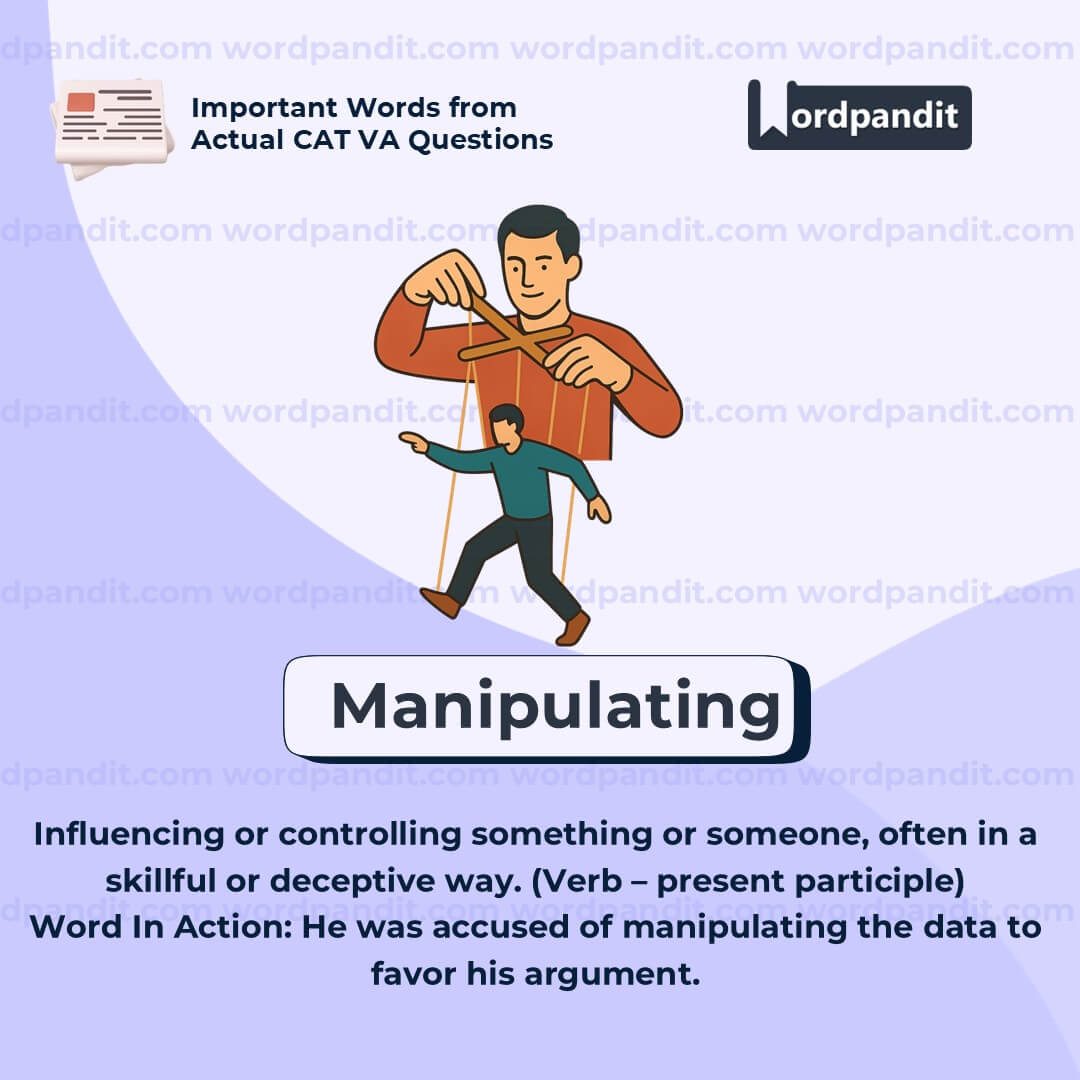
Word 4: Manipulating
Context:
"According to a study by the Oxford Internet Institute in 2020, cyber troops are 'government or political party actors tasked with manipulating public opinion online.'" – Cyber Influence Research
Explanatory Paragraph:
“Manipulating” refers to skillfully or unfairly influencing a person, situation, or system—often to achieve a specific goal, usually without the other party's full awareness. In the context of the sentence, it describes how political actors shape public opinion on the internet using deceptive or strategic tactics. This can include spreading misinformation, controlling narratives, or creating fake engagement. The word can be neutral in certain settings (e.g., manipulating tools or data), but in social or political contexts, it often carries a negative connotation.
Meaning: Influencing or controlling something or someone, often in a skillful or deceptive way. (Verb – present participle)
Pronunciation: muh-nip-yuh-lay-ting
Difficulty Level: ⭐⭐⭐ Intermediate
Etymology: From Latin *manipulus* (handful), from *manus* (hand) + *plere* (to fill). The word evolved through French into English, originally meaning "to handle" and later developing psychological and political uses.
Prashant Sir's Notes:
Use “manipulating” when referring to hidden or strategic influence, especially where ethical lines may be blurred. It’s often found in discussions on propaganda, advertising, leadership tactics, and digital misinformation. Always be aware of the tone—this word usually implies control without consent.
Synonyms & Antonyms:
Synonyms: influencing, controlling, exploiting, steering, maneuvering
Antonyms: empowering, liberating, ignoring, respecting autonomy
Usage Examples:
- The marketing campaign was accused of manipulating customer emotions to boost sales.
- He was skilled at manipulating the data to fit his narrative.
- Governments are increasingly manipulating social media platforms to sway public opinion.
- She resented how her decisions were being subtly manipulated by peer pressure.
Cultural Reference:
"The art of manipulating opinion is the cornerstone of modern propaganda." — Noam Chomsky, *Manufacturing Consent*
Think About It:
Is all manipulation harmful, or can it be justified in certain situations (e.g., therapy, negotiation, security)?
Quick Activity:
Write a short sentence using “manipulating” in a political, personal, and technological context.
Memory Tip:
“Manipulate” comes from *manus* (hand)—think of someone skillfully using their hands to control a puppet. That’s manipulation.
Real-World Application:
Understanding “manipulating” is key in media literacy, politics, and psychology. It helps identify when messages, systems, or even people are being shaped for hidden agendas—critical in today’s digital and media-rich world.
Word 5: Strategies
Context:
"The Oxford research group was able to identify 81 countries with active cyber troop operations utilizing many different strategies to spread false information, including spending millions on online advertising." – Cyber Warfare Research
Explanatory Paragraph:
“Strategies” are carefully planned methods or approaches used to achieve a particular goal. In the context of cyber operations, these strategies include deliberate techniques for manipulating online content, influencing public opinion, and disseminating disinformation. The word emphasizes not just random actions but coordinated efforts guided by specific objectives. Strategies are used in many fields—warfare, politics, business, education—and they often involve long-term thinking and systematic planning.
Meaning: Plans or methods developed to achieve specific goals, often involving long-term thinking and organization. (Noun – plural)
Pronunciation: strat-uh-jeez
Difficulty Level: ⭐⭐ Beginner-Intermediate
Etymology: From Greek *strategia* (generalship, art of the general), from *strategos* (general), combining *stratos* (army) + *agein* (to lead).
Prashant Sir's Notes:
“Strategies” go beyond simple plans—they involve foresight, analysis, and execution. In academic writing, this word is very useful in discussions related to politics, warfare, marketing, education, and even personal development. Learn to pair it with context-specific adjectives like “digital strategies,” “teaching strategies,” or “military strategies.”
Synonyms & Antonyms:
Synonyms: plans, tactics, approaches, methods, techniques
Antonyms: improvisations, guesswork, randomness, disorganization
Usage Examples:
- The campaign used social media strategies to target younger voters.
- Businesses adopt different pricing strategies depending on market conditions.
- Cybersecurity teams are developing new strategies to prevent data breaches.
- Successful teaching strategies often include active student participation.
Cultural Reference:
"Strategy without tactics is the slowest route to victory. Tactics without strategy is the noise before defeat." — Sun Tzu, *The Art of War*
Think About It:
What strategies do you use—consciously or unconsciously—in your everyday life to succeed or solve problems?
Quick Activity:
List two strategies you’ve used in school, work, or personal life that helped you achieve a goal. What made them effective?
Memory Tip:
Think “strategy = structured plan.” Whenever you’re working toward a goal in a thoughtful way, you’re using a strategy.
Real-World Application:
Whether in national defense, digital marketing, personal development, or education, strategies are essential for success. Understanding how to create and evaluate strategies can dramatically improve your ability to think critically and act effectively.
