
📘 What’s Inside This CAT Misfit Sentence/Odd One Out Question Post?
📝 Authentic CAT Misfit Sentence/Odd One Out Question: Practice with a real CAT Para-jumble Question from a previous CAT exam.
✅ Detailed Question with Step-by-Step Solution: Each question is explained thoroughly for better understanding.
📚 Vocabulary Enhancement: Top 5 words explained from the paragraph
Misfit Sentence/Odd One Out Question
Q.20 Five jumbled up sentences (labelled 1, 2, 3, 4 and 5), related to a topic, are given below. Four of them can be put together to form a coherent paragraph. Identify the odd sentence and key in the number of that sentence as your answer.
1. Part of the appeal of forecasting is not just that it seems to work, but that you don’t seem to need specialized expertise to succeed at it.
2. The tight connection between forecasting and building a model of the world helps explain why so much of the early interest in the idea came from the intelligence community.
3. This was true even though the latter had access to classified intelligence.
4. One frequently cited study found that accurate forecasters’ predictions of geopolitical events, when aggregated using standard scientific methods, were more accurate than the forecasts of members of the US intelligence community who answered the same questions in a confidential prediction market.
5. The aggregated opinions of non-experts doing forecasting have proven to be a better guide to the future than the aggregated opinions of experts.
Solution with Explanation
Answer: 2
The main theme developed across the sentences is the effectiveness of non-experts in forecasting, often surpassing experts—even when the experts have access to privileged or classified information. The passage builds an argument around the idea that forecasting doesn’t require specialized expertise, and this claim is supported by empirical research and comparisons between non-experts and members of the intelligence community.
Option-wise Analysis:
- Sentence 1: Introduces the theme—forecasting is appealing because it doesn't require expert knowledge. Sets the foundation for the argument.
- Sentence 5: Supports Sentence 1 by stating that forecasts from non-experts are often more reliable than those from experts. Advances the claim with a general observation.
- Sentence 4: Provides a well-cited study as evidence that non-expert predictions outperformed those of intelligence community members. Reinforces the main argument with data.
- Sentence 3: Adds further weight to Sentence 4 by emphasizing that this superiority held even when experts had access to classified intelligence. Sharpens the contrast between expert and non-expert forecasters.
- Sentence 2: Odd one out. Shifts the discussion toward the origins of forecasting interest in the intelligence community and its connection with model-building. While related to forecasting generally, it does not contribute directly to the core argument about forecasting accuracy and expertise.
Therefore, Sentence 2 is the odd one out.
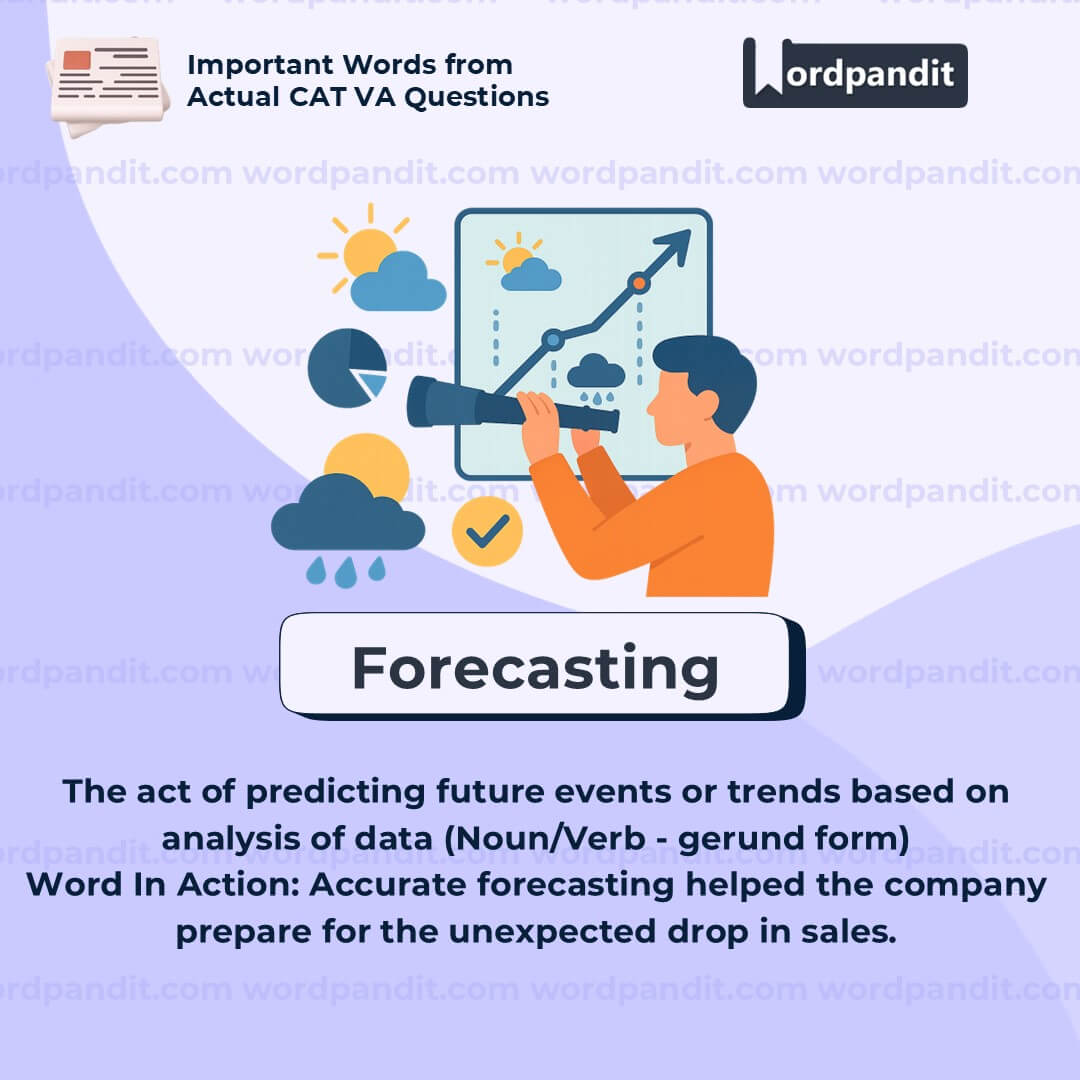
Word-1: Forecasting
Context:
"Part of the appeal of forecasting is not just that it seems to work, but that you don’t seem to need specialized expertise to succeed at it." - Source Unknown
Explanatory Paragraph:
"Forecasting" is the process of making predictions about future events based on current or past data. It’s used in many fields—like weather, finance, economics, and technology—to help guide decisions. In the given context, the word highlights how forecasting is perceived as both effective and accessible, suggesting that even non-experts can sometimes make accurate predictions using logic, pattern recognition, or common sense. It blends science with informed guesswork, making it both powerful and, at times, controversial.
Meaning: The act of predicting future events or trends based on analysis of data (Noun/Verb - gerund form)
Pronunciation: FOR-cast-ing
Difficulty Level: ⭐⭐ Easy
Etymology: From Old English *fore* (before) + *casten* (to throw or project), literally meaning "to project ahead."
Prashant Sir's Notes:
Forecasting isn’t about crystal balls—it’s about patterns, probabilities, and preparation. Whether you're planning a trip or investing in stocks, good forecasting can help you stay ahead of the curve.
Synonyms & Antonyms:
Synonyms: predicting, projecting, estimating, anticipating, prognosticating
Antonyms: guessing, ignoring, reacting, overlooking
Usage Examples:
- Weather forecasting has improved dramatically with the help of satellites and AI.
- Economic forecasting helps governments plan budgets and set interest rates.
- Accurate forecasting can be the key to a business’s success or failure.
- He became known for his skill in forecasting election results.
Cultural Reference:
In his book *Superforecasting*, Philip Tetlock explores how ordinary people, using logical reasoning and self-correction, can sometimes outperform experts in predicting political and economic events.
Think About It:
Can forecasting ever be truly accurate in a world full of randomness and uncertainty? Where do we draw the line between educated prediction and overconfidence?
Quick Activity:
Make a simple forecast: What is one thing you predict will happen in your life or in the world next week? Write a short explanation of why you believe this will happen.
Memory Tip:
“Fore” means “before” and “cast” means “to throw”—so forecasting is like “throwing your mind ahead” to see what might come.
Real-World Application:
Forecasting is central to fields like meteorology, stock trading, epidemiology (predicting disease spread), supply chain logistics, and even sports analytics. It helps individuals and institutions prepare for the future based on available evidence.
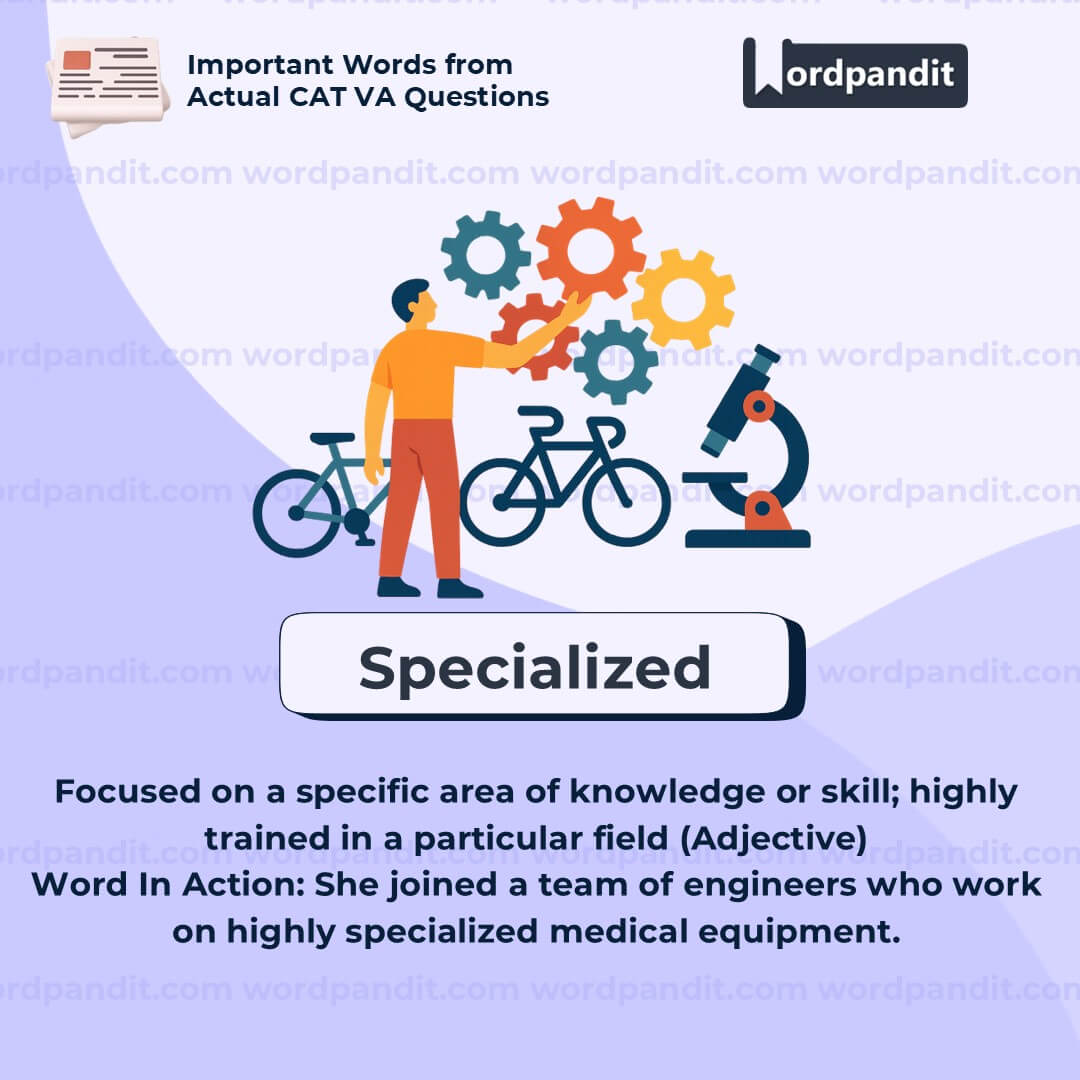
Word-2: Specialized
Context:
"Part of the appeal of forecasting is not just that it seems to work, but that you don’t seem to need specialized expertise to succeed at it." - Source Unknown
Explanatory Paragraph:
"Specialized" refers to having or requiring detailed knowledge or training in a specific area. A specialized skill or profession is one that is narrowly focused and often not easily understood or performed by the general public. In the context of forecasting, the sentence suggests that unlike some fields (like surgery or engineering), forecasting does not always demand deep, technical, or specialized expertise—making it seem more accessible and open to broader participation.
Meaning: Focused on a specific area of knowledge or skill; highly trained in a particular field (Adjective)
Pronunciation: SPEH-shuh-lized
Difficulty Level: ⭐⭐ Easy
Etymology: From Latin *species* (kind or type) + the suffix *-ize*, meaning “to make into a particular kind.” The word evolved to imply distinct or narrowly focused categories.
Prashant Sir's Notes:
“Specialized” implies expertise, precision, and depth—but also limitation. Specialized people or tools are great at one thing but may not apply broadly. This word often contrasts with "generalist."
Synonyms & Antonyms:
Synonyms: expert, trained, professional, focused, technical
Antonyms: general, broad, amateur, non-specialist, versatile
Usage Examples:
- She received specialized training in pediatric care.
- This equipment is highly specialized and used only in advanced laboratories.
- The lawyer works in a specialized field of intellectual property law.
- Forecasting is appealing because it doesn't always require specialized credentials.
Cultural Reference:
Modern economies often value specialized professionals—from surgeons to software developers—yet there’s a growing movement recognizing the value of generalists who can connect ideas across disciplines (see: David Epstein’s *Range*).
Think About It:
Is it better to be highly specialized in one field or moderately skilled in many? How does this choice affect your opportunities and adaptability?
Quick Activity:
List two professions that require specialized knowledge. Then write one advantage and one disadvantage of being highly specialized in that field.
Memory Tip:
“Specialized” comes from “special”—think of someone with a “special” skill that not everyone has.
Real-World Application:
"Specialized" is commonly used in education, healthcare, law, and industry. Specialized roles often require certification, advanced training, or deep experience—making them critical in high-stakes or technical fields.
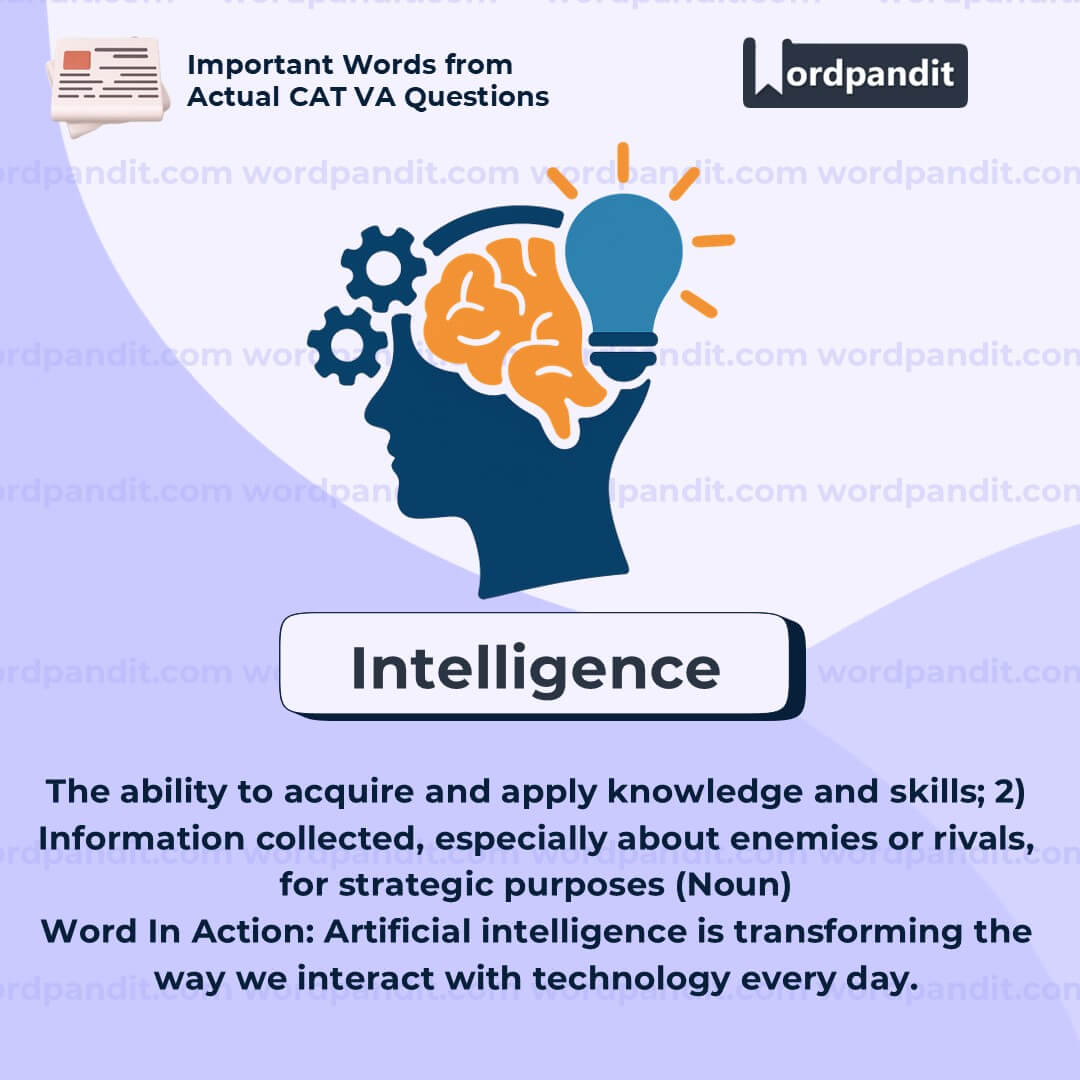
Word-3: Intelligence
Context:
"The tight connection between forecasting and building a model of the world helps explain why so much of the early interest in the idea came from the intelligence community." - Source Unknown
Explanatory Paragraph:
"Intelligence" has multiple meanings, but in this context, it refers to the gathering and analysis of information, particularly by governmental or military organizations, to assess threats and inform decisions. The intelligence community—such as national security agencies—relies on forecasting to anticipate political, military, or economic developments. More broadly, intelligence also refers to the capacity to learn, understand, and solve problems. Both meanings share the idea of using information strategically to navigate uncertainty.
Meaning: 1) The ability to acquire and apply knowledge and skills; 2) Information collected, especially about enemies or rivals, for strategic purposes (Noun)
Pronunciation: in-TEL-uh-jens
Difficulty Level: ⭐⭐ Easy
Etymology: From Latin *intelligentia*, from *intelligere* (to understand), combining *inter-* (between) + *legere* (to choose or read).
Prashant Sir's Notes:
“Intelligence” is a powerful word. It’s about both brainpower and decision-making. In national security, intelligence is information that gives you an edge. In personal development, it’s your ability to learn, adapt, and think critically.
Synonyms & Antonyms:
Synonyms: insight, acumen, wisdom, data (in military sense), knowledge
Antonyms: ignorance, stupidity, naivety, misinformation
Usage Examples:
- The agency gathered intelligence to assess potential threats in the region.
- Her emotional intelligence made her a strong leader and a compassionate listener.
- Forecasting requires not just data, but the intelligent interpretation of patterns.
- Artificial intelligence is transforming industries from healthcare to transportation.
Cultural Reference:
The CIA, MI6, and Mossad are examples of national intelligence agencies that rely on forecasting models and data analysis to predict threats and guide foreign policy decisions.
Think About It:
Is intelligence more about acquiring knowledge or knowing how and when to use it?
Quick Activity:
List the different types of intelligence you’ve heard of (e.g., emotional, logical, social, etc.). Identify which one you rely on the most in daily life, and give a brief example.
Memory Tip:
“Intelligence” shares a root with “interrogate” and “lecture”—all about learning, reasoning, and understanding information deeply.
Real-World Application:
Intelligence is used in defense, politics, psychology, business strategy, and education. Whether it’s gathering intel for security or using emotional intelligence in relationships, it’s vital for success across domains.
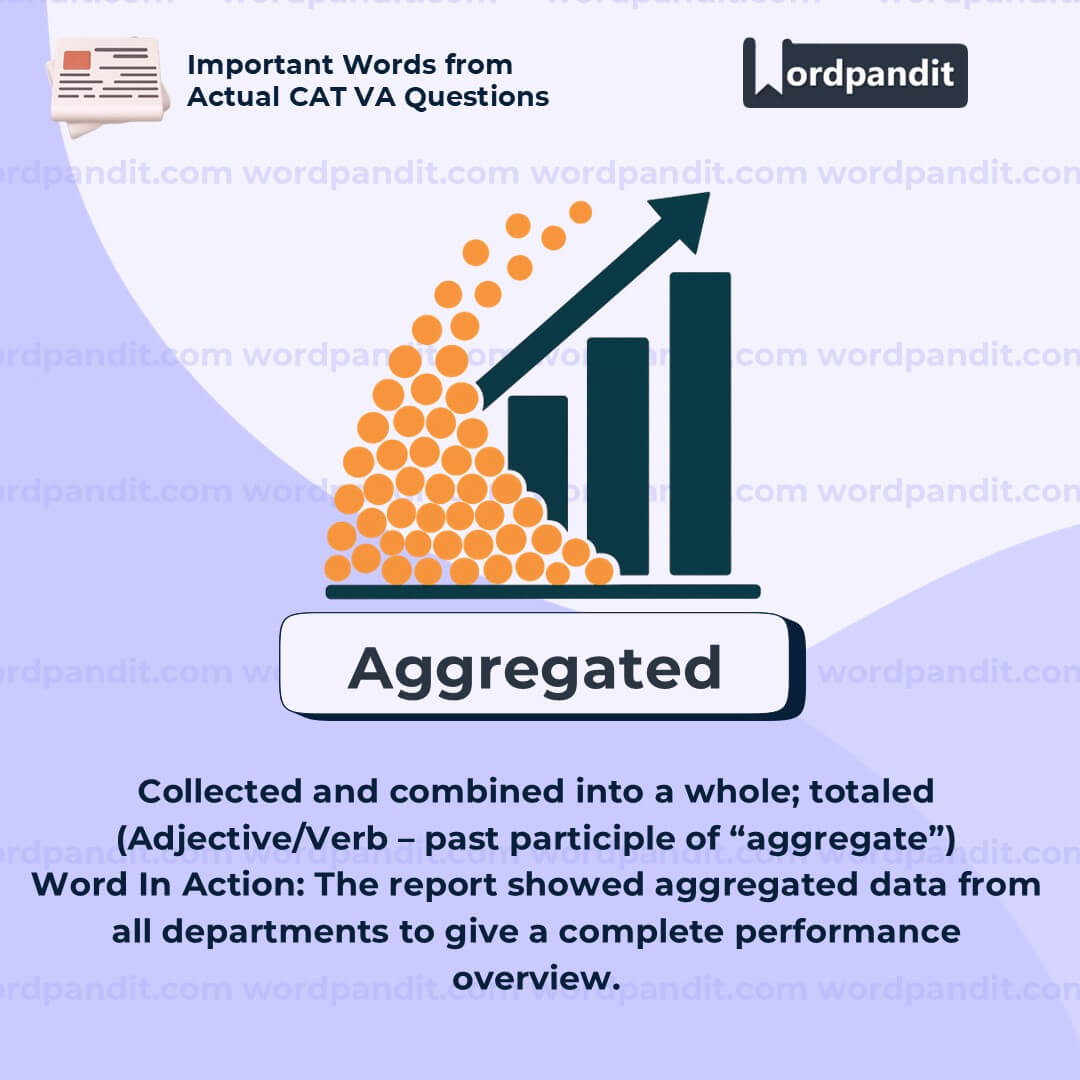
Word-4: Aggregated
Context:
"The aggregated opinions of non-experts doing forecasting have proven to be a better guide to the future than the aggregated opinions of experts." - Source Unknown
Explanatory Paragraph:
"Aggregated" refers to the process of bringing together multiple items, ideas, or pieces of data into a single whole. In the context of forecasting, it means combining the predictions or viewpoints of many individuals to form a more accurate or reliable consensus. This approach is based on the idea that while one person may be wrong, the collective judgment of many—when averaged—can often outperform individual experts. Aggregation helps minimize personal bias and random error by leveraging diversity of perspective.
Meaning: Collected and combined into a whole; totaled (Adjective/Verb – past participle of “aggregate”)
Pronunciation: AG-ri-gay-tid
Difficulty Level: ⭐⭐⭐ Intermediate
Etymology: From Latin *aggregare*, meaning “to add to,” from *ad-* (to) + *gregare* (to gather into a flock or group).
Prashant Sir's Notes:
“Aggregated” is a powerful word in data science, forecasting, and social studies. It implies that strength comes from the whole, not just the parts. It’s especially useful when describing collective patterns or group-based analysis.
Synonyms & Antonyms:
Synonyms: combined, compiled, collected, amassed, totalled
Antonyms: separated, isolated, divided, disaggregated
Usage Examples:
- The platform aggregated customer feedback to identify common pain points.
- Forecasting models often use aggregated data from multiple sources to improve accuracy.
- We aggregated survey responses to find the most popular product features.
- Aggregated predictions from diverse users often outperform those of individual experts.
Cultural Reference:
In *The Wisdom of Crowds*, James Surowiecki explores how aggregated opinions of groups—if properly structured—can be remarkably accurate, often more so than expert judgment.
Think About It:
When does aggregating opinions lead to insight, and when can it lead to conformity or groupthink?
Quick Activity:
Take a simple topic (e.g., favorite food or best way to learn) and gather opinions from 5 people. Try to “aggregate” the answers into a pattern. What insights emerge?
Memory Tip:
“Aggregate” sounds like “a great gate” that collects everything coming in—just like aggregation gathers inputs into one whole.
Real-World Application:
"Aggregated" data is used in economics, polling, health research, and social media analytics. Platforms like Google Trends and prediction markets rely on aggregation to identify patterns and forecast behavior.
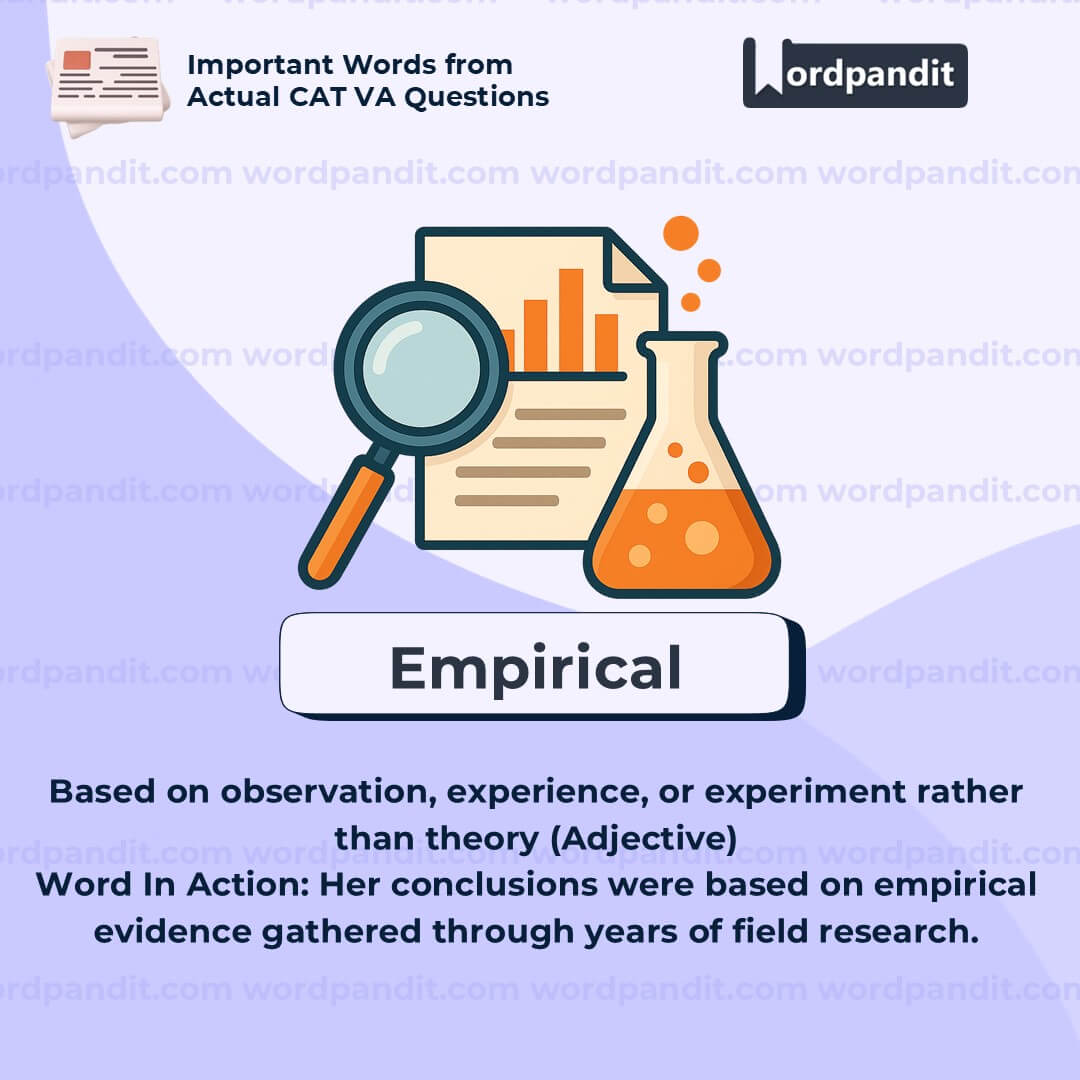
Word-5: Empirical
Context:
"Sentence 4 reinforces this with empirical evidence from a study comparing non-experts to US intelligence analysts." - Source Unknown
Explanatory Paragraph:
"Empirical" refers to knowledge or evidence that comes from direct observation, experience, or experimentation, rather than theory or pure logic. In research and decision-making, empirical evidence is considered especially reliable because it is based on actual data and outcomes. In the provided context, the phrase “empirical evidence” emphasizes that the conclusion—about the effectiveness of non-experts in forecasting—comes from a real-world study, not just speculation or assumption.
Meaning: Based on observation, experience, or experiment rather than theory (Adjective)
Pronunciation: em-PEER-ih-kul
Difficulty Level: ⭐⭐⭐ Intermediate
Etymology: From Latin *empiricus*, from Greek *empeirikos*, meaning "experienced" or "skilled through practice."
Prashant Sir's Notes:
“Empirical” is a gold-standard word in science and analysis. It means your ideas are grounded in facts—not guesswork. Always ask: Is there empirical evidence for this claim?
Synonyms & Antonyms:
Synonyms: evidence-based, factual, observed, experimental, data-driven
Antonyms: theoretical, speculative, hypothetical, abstract
Usage Examples:
- Scientists rely on empirical data to confirm their hypotheses.
- Her argument lacked empirical support and was based mainly on opinion.
- Empirical research shows that regular exercise improves mental health.
- The success of the method was confirmed through empirical observation.
Cultural Reference:
Empiricism is one of the core foundations of the scientific method, championed by thinkers like Francis Bacon, who emphasized observation and experimentation over speculation.
Think About It:
Can something be true even if it hasn’t been proven with empirical evidence? How do we balance intuition and data?
Quick Activity:
Think of a claim you've recently heard (e.g., about health, education, or productivity). Find out whether there is any empirical evidence supporting it. What did you discover?
Memory Tip:
“Empirical” sounds like “experiment”—remember it as knowledge that comes from experimenting and experiencing, not just imagining.
Real-World Application:
"Empirical" is crucial in fields like science, economics, psychology, education, and public policy. Decisions backed by empirical evidence are seen as more trustworthy and repeatable than those based on opinion or anecdote.
