Daily Vocabulary from Indian Newspapers and Publications
Welcome to Wordpandit’s Indian Vocabulary Hub
At Wordpandit, we understand the importance of staying rooted in the local context while expanding your language skills. This section focuses on enriching your vocabulary with words and phrases drawn from India’s leading newspapers and publications, ensuring you're learning vocabulary that is practical, relevant, and uniquely Indian.
Why Indian Sources Matter
We believe that the best way to master any language is by immersing yourself in local content. That’s why we carefully curate vocabulary from top Indian publications, including:
- The Hindu
- The Times of India
- The Economic Times
- Hindustan Times
- Live Mint
- The Indian Express
- And many others...
Stay Updated, Stay Relevant
With daily updates from Indian news sources, you’ll be consistently learning words that reflect the trends and shifts in Indian society and culture. Our focus is to provide vocabulary that enhances your understanding of the language in an Indian context.
How Wordpandit Supports Your Goals
Whether you’re preparing for exams, aiming to improve your professional communication, or simply want to stay connected with the latest Indian vocabulary, Wordpandit is here to guide you every step of the way.
Learn with a Practical Approach
Our interactive learning methodology includes real-world examples, engaging activities, and context-specific usage to ensure that every word becomes part of your active vocabulary.
Dive into Indian Vocabulary Today!

Why Choose Wordpandit?
Practical Learning: Focus on words you'll actually encounter in real-world reading, enhancing your comprehension and communication skills.
Diverse Content: From current affairs to scientific breakthroughs, our varied sources expose you to vocabulary across multiple domains.
Effortless Integration: Make Wordpandit a part of your daily routine. Just a few minutes each day can significantly boost your lexicon over time.
Your Path to Vocabulary Mastery
- Visit our Daily Vocabulary section regularly
- Explore new words and their usage in context
- Practice incorporating these words into your own writing and speech
- Track your progress as your vocabulary expands
Start Your Journey Today
Embark on your vocabulary enhancement journey with Wordpandit. By consistently engaging with our daily posts, you'll build a robust vocabulary that serves you well in academic, professional, and personal contexts.
Remember, a word a day keeps linguistic limitations at bay. Make Wordpandit your daily companion in the quest for vocabulary excellence!

WORD-1: Etched
Context:
"But perhaps the most devastating damage is invisible: the collective trauma etched into the psyche of every Gazan, including those tasked with healing others." - The New Indian Express
Explanatory Paragraph:
Etched meaning in English is 'to cut, carve, or impress something deeply and permanently into a surface or mind.' This word is used when describing something that has made a lasting, indelible mark—whether on physical material or in someone's memory and emotions. How to use etched effectively: it appears frequently in formal writing, news articles about lasting impacts, and competitive exam passages to convey permanence and depth of impression, making it essential vocabulary for CAT, GRE, and UPSC aspirants.
Meaning: To cut, carve, or impress deeply and permanently; to make a lasting impression (Verb/Adjective)
Pronunciation: ECHD (rhymes with "sketched")
Difficulty Level: ⭐⭐⭐ Intermediate
Etymology: Etched comes from Dutch 'etsen' meaning 'to etch or corrode with acid,' originally used in printmaking where artists used acid to carve designs into metal plates. The word evolved from its literal meaning of creating permanent marks on metal to its powerful metaphorical use describing memories, emotions, and experiences that become permanently carved into our minds and hearts.
Prashant Sir's Notes:
Many students confuse etched with 'engraved'—the difference between etched and engraved is subtle but important: etching uses acid or corrosion while engraving uses cutting tools, though both mean permanent marking. For CAT and GRE aspirants, etched frequently appears in Reading Comprehension passages describing lasting psychological impacts, historical events, or memories. What is the usage pattern? When you see "etched in/into memory" or "etched on faces," it signals permanence and deep emotional significance. In Indian English newspapers, particularly in op-eds about social issues or conflicts, you'll often encounter phrases like "memories etched in collective consciousness"—this construction emphasizes trauma or significant experiences that cannot be erased.
Synonyms & Antonyms:
Synonyms: engraved, carved, inscribed, imprinted, ingrained, impressed, embossed, stamped, seared, burned (into memory)
Antonyms: erased, forgotten, faded, removed, effaced, obliterated
Usage Examples:
- The images of the 26/11 Mumbai attacks remain etched in the nation's memory even after so many years have passed.
- Priya's face showed lines of worry etched deeply after months of caring for her ailing mother during the pandemic.
- The author's childhood experiences of poverty were etched so profoundly that they shaped every character in his novels.
- Grandfather's stories about Partition were etched into our minds, making history feel personal and immediate rather than distant.
Cultural Reference:
"The struggle of farmers is etched in the soil of this nation, visible in every calloused hand and weathered face." - Common refrain in discussions about agricultural reforms and rural India
Think About It:
What experiences from your own life are so deeply etched in your memory that they've shaped who you are today? How do collective traumas—like Partition, the Emergency, or communal riots—remain etched in a nation's psyche across generations?
Quick Activity:
Write two sentences describing a personal memory that is etched in your mind and explain why it made such a lasting impression. Try using the word in both literal (describing physical marks) and metaphorical (describing memories or emotions) contexts.
Memory Tip:
Think of "ETCHED" as "E-T-CHED" = "Eternally Traced, Can't be Erased or Deleted"—imagine someone using acid to permanently carve initials on a tree, or a traumatic memory that acid-burns itself into your brain forever. Once etched, it's there permanently.
Real-World Application:
In journalism and editorial writing, 'etched' is commonly used to describe lasting impacts of social, political, or personal events. Writers use it in phrases like "etched in memory," "etched on faces," or "etched into history" to convey permanence and emotional depth. For UPSC essay writing and CAT Reading Comprehension, recognizing 'etched' signals the author is emphasizing something unforgettable or permanently damaging. In business communication, it appears in corporate histories: "values etched into company culture" suggests deeply rooted principles.
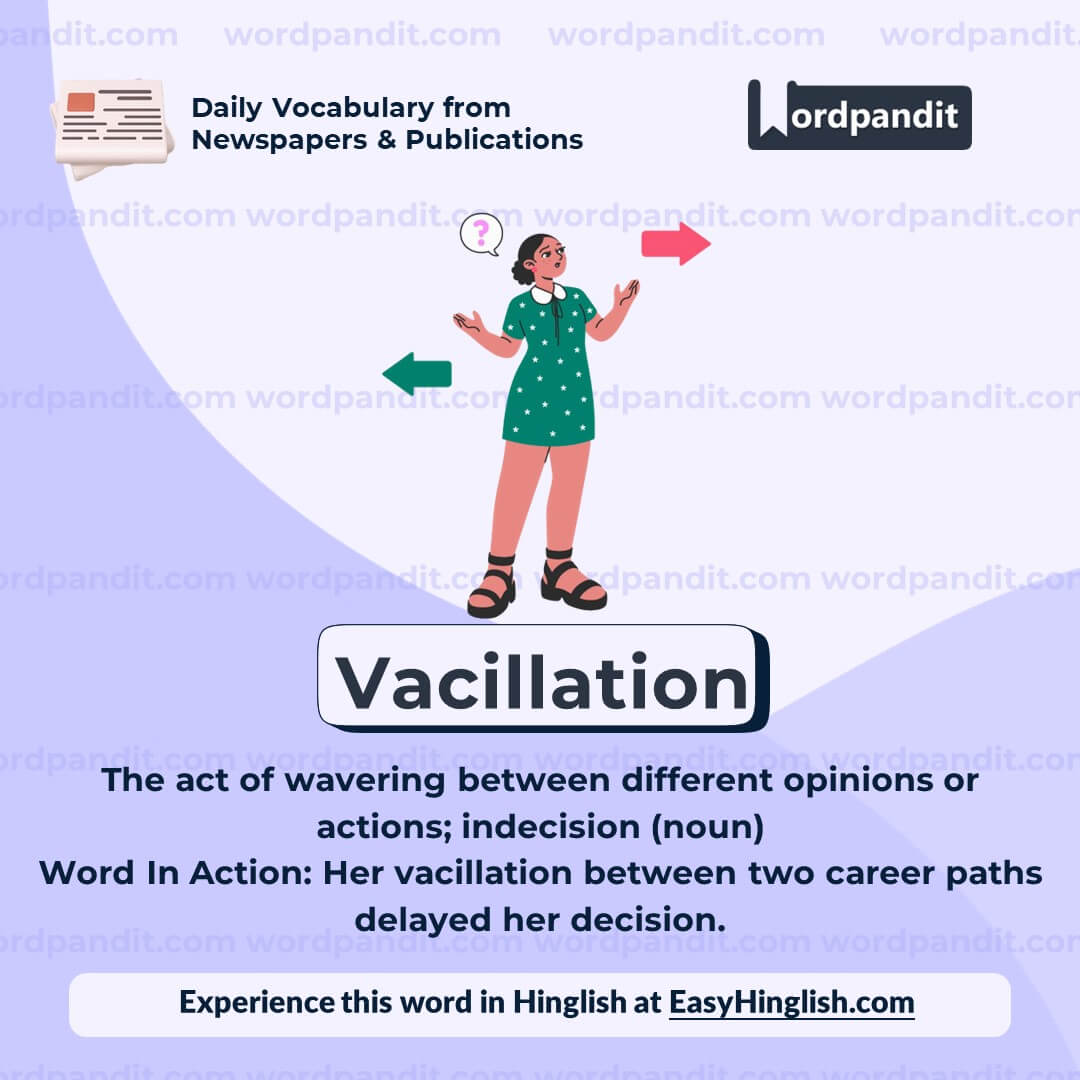
WORD-2: Vacillation
Context:
"And any 'moral support' for it from a special committee, only reiterated the MoD's persistent vacillation on critical issues with regard to military modernisation." - The Wire
Explanatory Paragraph:
Vacillation meaning in English is 'the inability to make a decision or take a firm stand, constantly wavering between different opinions or actions.' This word is used when describing indecisiveness, especially in situations requiring clear judgment or leadership. How to use vacillation correctly: it commonly appears in formal writing, political commentary, and competitive exam passages to criticize weak decision-making or highlight a pattern of hesitation, making it essential vocabulary for CAT, GRE, UPSC, and IELTS preparation.
Meaning: The state of wavering between different opinions or actions; indecision and uncertainty (Noun)
Pronunciation: vas-ih-LAY-shun
Difficulty Level: ⭐⭐⭐ Intermediate to Advanced
Etymology: Vacillation comes from Latin 'vacillare' meaning 'to sway or waver,' originally describing physical swaying or staggering. The word traveled through French 'vaciller' into English, evolving from literal physical swaying to describe mental wavering and indecision. The root connection to swaying perfectly captures the back-and-forth nature of someone who cannot make up their mind, like a person physically swaying between two directions.
Prashant Sir's Notes:
Students often ask: what is the difference between vacillation and hesitation? While both involve delay, vacillation specifically means swinging back and forth between options repeatedly, whereas hesitation is simply pausing before acting. For UPSC and CAT aspirants, vacillation frequently appears in passages criticizing government policy, corporate leadership, or political decisions—it's always negative in tone. Vacillation usage in sentences typically follows this pattern: "vacillation on/over/regarding [issue]" or "persistent/chronic vacillation." In Indian English newspapers, particularly in editorials about defense procurement, economic reforms, or foreign policy, you'll see phrases like "government's vacillation on" or "bureaucratic vacillation over"—these signal criticism of indecisive leadership that harms national interests.
Synonyms & Antonyms:
Synonyms: indecision, wavering, hesitation, irresolution, uncertainty, fluctuation, oscillation, shilly-shallying, dithering, flip-flopping (informal)
Antonyms: decisiveness, resolution, determination, firmness, certainty, steadfastness
Usage Examples:
- The government's vacillation on implementing the National Education Policy has frustrated educators and delayed crucial reforms across Indian universities.
- Rajesh's constant vacillation between engineering and medicine meant he missed admission deadlines for both courses this year.
- The CEO's vacillation regarding the merger deal cost the company valuable time and allowed competitors to gain market advantage.
- After months of vacillation over whether to study abroad or take the UPSC, Meera finally decided to pursue civil services.
Cultural Reference:
"In cricket, a captain's vacillation over field placements during crucial overs can cost the team the match—decisive leadership is what separates good captains from great ones." - Common commentary on cricket captaincy and leadership under pressure
Think About It:
Why does vacillation in leadership—whether in government, corporations, or even families—often prove more damaging than making a wrong decision decisively? Can you think of a situation where India's policy vacillation has had long-term consequences?
Quick Activity:
Identify three recent news stories where you noticed government or corporate vacillation on important issues. Write one sentence for each explaining how the indecision affected the outcome or public perception.
Memory Tip:
Break 'Vacillation' into "VACIL-NATION"—imagine an entire nation swaying like a pendulum, unable to decide which direction to move. Or think of "VASELINE-ACTION"—like something slippery that keeps sliding back and forth between your hands, never staying in one position. The Latin root 'vacillare' (to sway) helps too—picture someone physically swaying, unable to stand firm.
Real-World Application:
In editorial writing and political analysis, 'vacillation' is commonly used to criticize weak leadership or policy paralysis. Indian newspapers frequently employ it when discussing defense procurement delays, economic reform hesitation, or diplomatic uncertainty. For UPSC aspirants writing essays on governance or policy, using 'vacillation' demonstrates sophisticated vocabulary when critiquing indecisive administration. In CAT Reading Comprehension, identifying 'vacillation' helps you understand the author's negative tone toward a subject. Corporate communication uses it in annual reports or business journalism to describe management's failure to take clear strategic direction.
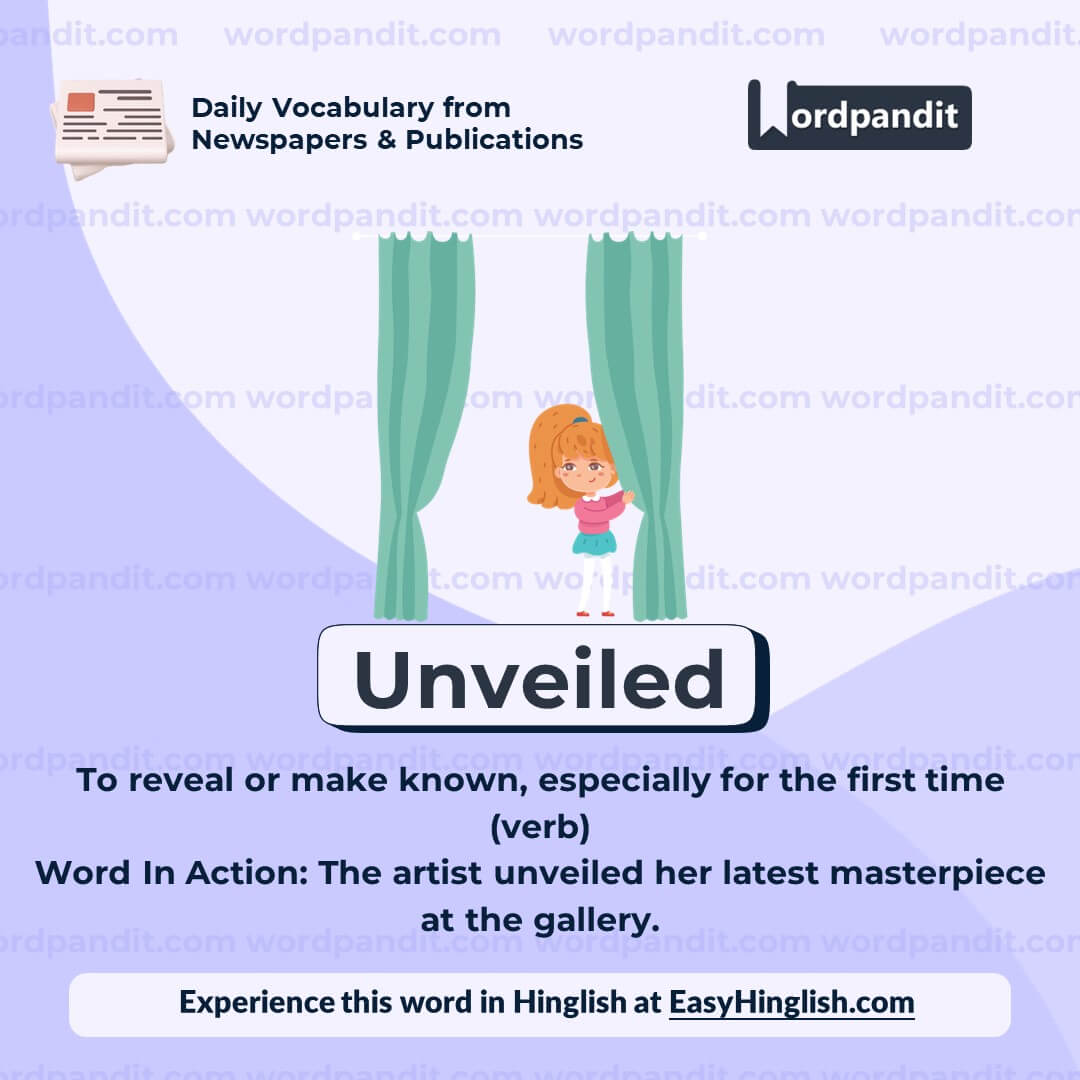
WORD-3: Unveiled
Context:
"Boxing Day China unveiled its latest advancement in military aviation: a sixth-generation fighter, unofficially designated the J-36, which features artificial intelligence, drone integration, and advanced electronic warfare capability." - The Wire
Explanatory Paragraph:
Unveiled meaning in English is 'to reveal, introduce, or make something known publicly for the first time, especially something that was previously hidden or secret.' This word is used when describing the official presentation or launch of new products, policies, plans, or discoveries. How to use unveiled effectively: it appears frequently in news reports about product launches, policy announcements, and competitive exam passages describing revelations or discoveries, making it crucial vocabulary for CAT, GRE, UPSC, and IELTS preparation.
Meaning: To remove a covering from something; to reveal or make known publicly for the first time (Verb)
Pronunciation: un-VAYLD
Difficulty Level: ⭐⭐ Basic to Intermediate
Etymology: Unveiled comes from the prefix 'un-' (meaning 'reverse action') combined with 'veil' (a covering cloth), from Latin 'velum' meaning 'sail or curtain.' Originally, the word literally meant removing a veil or cloth covering from something, particularly in ceremonies where statues or monuments were revealed. Over time, it evolved to mean any act of revealing or making public something previously hidden, maintaining the ceremonial sense of a significant revelation or announcement.
Prashant Sir's Notes:
Many students confuse unveiled with 'revealed'—while both mean showing something hidden, unveiled usage in formal writing carries more ceremony and significance, suggesting an official or planned announcement. The difference between unveiled and announced is that unveiled implies something was previously covered or secret, while announced simply means making information known. For CAT and GRE aspirants, unveiled frequently appears in business passages about product launches, technology news, and policy announcements—it always signals something new and important. In Indian English newspapers, you'll constantly see "government unveiled," "Budget unveiled," "policy unveiled," or "smartphone unveiled"—this construction is the standard way journalists report official launches and announcements, making it essential vocabulary for understanding current affairs.
Synonyms & Antonyms:
Synonyms: revealed, disclosed, introduced, launched, presented, announced, exhibited, displayed, exposed, uncovered
Antonyms: concealed, covered, hidden, veiled, masked, obscured, withheld
Usage Examples:
- The Finance Minister unveiled the Union Budget for 2025, announcing major tax reforms and infrastructure investments worth several lakh crores.
- Apple unveiled its latest iPhone model at the annual event in California, featuring advanced AI capabilities and improved camera technology.
- ISRO unveiled ambitious plans for Gaganyaan mission, marking India's entry into human spaceflight with a targeted launch in 2026.
- The Prime Minister unveiled a statue of Sardar Patel in Gujarat, commemorating his role in unifying independent India.
Cultural Reference:
"When Shah Rukh Khan unveiled the trailer of his comeback film, social media broke into celebration—the unveiling itself became a cultural event watched by millions across the country." - Reflecting Bollywood's impact on Indian popular culture
Think About It:
Why do governments, companies, and celebrities carefully orchestrate "unveiling" ceremonies rather than simply announcing things quietly? What psychological impact does a grand unveiling have on public perception and media coverage?
Quick Activity:
Browse today's newspaper headlines and identify three instances where something was "unveiled." Write sentences explaining what was unveiled and why the unveiling was significant or newsworthy.
Memory Tip:
Think of "UN-VEILED" as removing a "VEIL" (like a bride's veil at a wedding)—imagine a dramatic moment when a cloth is pulled away to reveal something new and exciting underneath. Or picture product launches where companies literally pull away a covering cloth to reveal a new phone or car. The "un" prefix simply means reversing the action of covering, so unveiled = uncovered and shown publicly.
Real-World Application:
In journalism and business communication, 'unveiled' is the standard term for reporting official launches, announcements, and revelations. Indian newspapers use it daily in headlines: "Modi unveils development projects," "Samsung unveils new flagship," "Budget unveils tax relief." For UPSC current affairs preparation, recognizing 'unveiled' helps you identify significant policy announcements and new initiatives. In CAT Reading Comprehension passages about business or technology, 'unveiled' signals important product launches or strategic reveals. Corporate press releases consistently use "We are pleased to unveil..." to announce new products, making it essential business vocabulary.
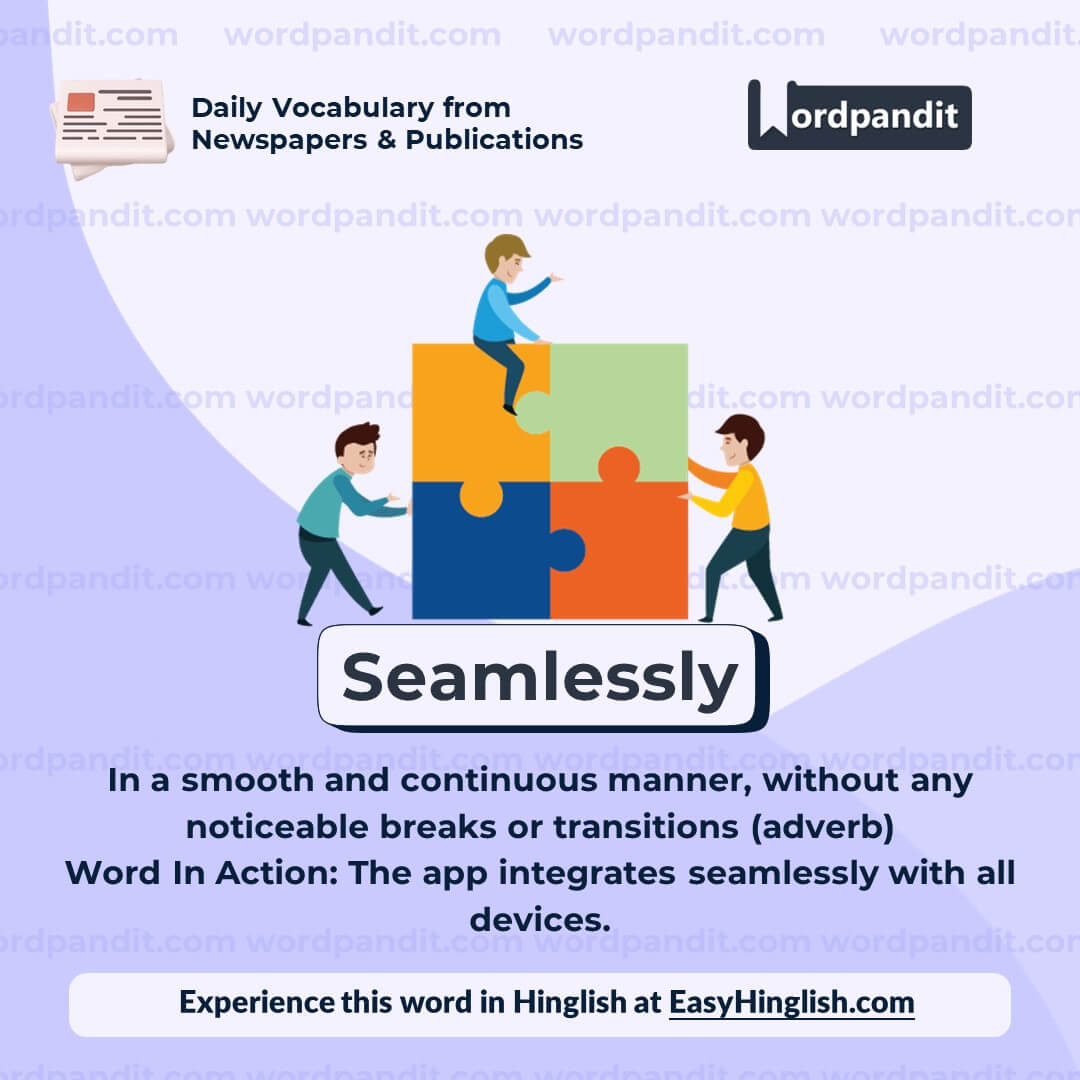
WORD-4: Seamlessly
Context:
"It did not. It carried on seamlessly, from one bombing to the next, stripping away layer upon layer of Palestinian flesh, just as the Russian aggression on Ukraine carried on, or the forgotten conflict in Sudan." - The Wire
Explanatory Paragraph:
Seamlessly meaning in English is 'smoothly and continuously without any interruption, pause, or visible joining point.' This word is used when describing processes, transitions, or actions that flow effortlessly from one state to another without breaks or difficulties. How to use seamlessly in different contexts: it appears frequently in technology writing, business communication, and competitive exam passages to indicate smooth integration or uninterrupted continuation, making it important vocabulary for CAT, GRE, UPSC, and IELTS aspirants.
Meaning: In a smooth, continuous manner without any noticeable breaks, gaps, or difficulties (Adverb)
Pronunciation: SEEM-less-lee
Difficulty Level: ⭐⭐ Basic to Intermediate
Etymology: Seamlessly derives from 'seam' (the line where two pieces of fabric are sewn together) plus the suffix '-less' (without) and '-ly' (adverb form). The word comes from Old English 'seam' meaning 'a joining.' Originally used in tailoring to describe perfectly joined fabric where the stitching is invisible, it evolved to describe any smooth transition or integration where the connection points aren't noticeable. The metaphor beautifully captures the idea of things flowing together so perfectly that you can't see where one ends and another begins.
Prashant Sir's Notes:
Many students confuse seamlessly with 'smoothly'—the difference between seamlessly and smoothly is subtle: seamlessly emphasizes the absence of visible joins or breaks, while smoothly just means without difficulty. Seamlessly usage in sentences typically describes integration, transition, or continuation: "integrated seamlessly," "transitioned seamlessly," or ironically, as in the context sentence, "carried on seamlessly" to critique something continuing without appropriate pause. For CAT and GRE aspirants, seamlessly frequently appears in technology passages about software integration, business articles about mergers, or passages describing continuous processes. In Indian English business writing, you'll often encounter "platforms that integrate seamlessly" or "services that work seamlessly across devices"—this construction has become standard in tech journalism and corporate communication, signaling smooth, effortless functionality.
Synonyms & Antonyms:
Synonyms: smoothly, continuously, effortlessly, flawlessly, uniformly, uninterruptedly, fluidly, perfectly, without a hitch
Antonyms: awkwardly, roughly, choppily, discontinuously, brokenly, jerkily, unevenly
Usage Examples:
- UPI payment systems have integrated seamlessly into Indian daily life, allowing Priya to pay her vegetable vendor digitally without any hassle.
- The new metro line connects seamlessly with existing bus routes, making Bangalore's public transport more efficient for lakhs of commuters.
- Despite changing three jobs in two years, Rohan's career progressed seamlessly because each role built naturally on previous experience.
- The film transitions seamlessly between past and present, making the complex narrative easy to follow despite multiple timelines.
Cultural Reference:
"Virat Kohli's batting flows seamlessly from defense to attack—there's no visible shift, just a natural progression that leaves bowlers bewildered." - Cricket commentary describing fluent batting technique
Think About It:
The context sentence uses "seamlessly" ironically to criticize how violence continues without pause. When should processes NOT proceed seamlessly? Are there times when interruptions, pauses, or visible breaks are morally necessary rather than something to eliminate?
Quick Activity:
Identify two technologies or services in your daily life that work seamlessly and two that don't. Write sentences contrasting their performance using 'seamlessly' for the smooth ones and appropriate antonyms for the problematic ones.
Memory Tip:
Think of "SEAM-LESS-LY" as "SEAM" (the line where cloth pieces join) + "LESS" (without) + "LY" (manner)—imagine a perfectly tailored shirt where you cannot see any stitching lines; the fabric flows continuously as if it's one piece. Or picture a relay race where the baton passes between runners so smoothly that you can't tell when one runner stops and another starts—that's seamlessly!
Real-World Application:
In technology writing and business communication, 'seamlessly' is the go-to word for describing smooth integration and user experience. Indian tech journalism constantly uses phrases like "apps that integrate seamlessly," "platforms working seamlessly across devices," or "services connecting seamlessly with existing infrastructure." For CAT Reading Comprehension passages about technology or business processes, recognizing 'seamlessly' helps you understand efficiency claims and smooth operation descriptions. In UPSC essay writing about digital India or infrastructure development, using 'seamlessly' demonstrates sophisticated vocabulary when discussing integration challenges. Corporate presentations regularly feature "Our solution integrates seamlessly with your existing systems" to emphasize ease of adoption.

WORD-5: Insatiable
Context:
"Jones indices, had discovered an insatiable, unquenchable, inextinguishable appetite for massacre. Massacres fuelled capitalism in 2024." - The Wire
Explanatory Paragraph:
Insatiable meaning in English is 'impossible to satisfy or fulfill; having an appetite or desire that cannot be quenched no matter how much is given.' This word is used when describing extreme desires, needs, or appetites that remain unfulfilled despite continuous feeding or satisfaction attempts. How to use insatiable correctly: it appears frequently in formal writing, literary contexts, and competitive exam passages to emphasize excessive or endless cravings, making it essential vocabulary for CAT, GRE, UPSC, and IELTS preparation.
Meaning: Impossible to satisfy or appease; having an endless or excessive desire that cannot be fulfilled (Adjective)
Pronunciation: in-SAY-shuh-bull
Difficulty Level: ⭐⭐⭐ Intermediate to Advanced
Etymology: Insatiable comes from Latin 'insatiabilis,' combining 'in-' (not) with 'satiare' (to fill or satisfy), which derives from 'satis' (enough). The root 'satis' gives us words like 'satisfy' and 'satiate.' The word literally means 'not able to be filled' or 'never having enough.' This etymology perfectly captures the endless hunger or desire the word describes—no matter how much you feed it, it remains hungry because it can never reach the state of 'satis' or 'enough.'
Prashant Sir's Notes:
Students often ask: what is the difference between insatiable and greedy? While greed implies wanting more than needed, insatiable emphasizes the impossibility of ever satisfying the desire—it's more extreme and absolute. Insatiable usage in sentences typically follows patterns like "insatiable appetite/desire/hunger/thirst for [something]." For CAT and GRE aspirants, insatiable frequently appears in critical passages about consumerism, power, or exploitation—it's almost always used negatively to criticize excessive behavior. In Indian English newspapers, particularly in economic and political commentary, you'll encounter phrases like "insatiable appetite for power," "insatiable demand for resources," or "insatiable corporate greed"—these constructions signal criticism of excessive, harmful desires that damage society or individuals.
Synonyms & Antonyms:
Synonyms: unquenchable, unappeasable, voracious, ravenous, rapacious, greedy, limitless, boundless, uncontrollable, never-ending
Antonyms: satisfied, satiated, content, fulfilled, moderate, temperate, satiable
Usage Examples:
- The real estate developer's insatiable appetite for land acquisition led to the displacement of hundreds of farmers in rural Maharashtra.
- Despite scoring 99 percentile in three consecutive mock tests, Arjun's insatiable desire for perfection kept him studying sixteen hours daily.
- Social media platforms have created an insatiable hunger for viral content, making users scroll endlessly without genuine satisfaction.
- The protagonist's insatiable curiosity drove her to uncover family secrets that had been buried for three generations.
Cultural Reference:
"Like Duryodhana's insatiable desire for power in the Mahabharata, which led to the destruction of entire kingdoms—when ambition knows no limits, catastrophe follows." - Common reference to unlimited desire leading to downfall
Think About It:
In a consumer-driven economy, are we all developing insatiable appetites for newer products, experiences, and validation? At what point does healthy ambition transform into insatiable greed that harms ourselves and others?
Quick Activity:
Write two sentences: one describing an insatiable desire that's positive (like thirst for knowledge) and another describing an insatiable appetite that's harmful (like hunger for power or wealth). Notice how the word's negativity depends on what follows it.
Memory Tip:
Break "IN-SATI-ABLE" into "IN" (not) + "SATI" (satisfied) + "ABLE" (capable)—literally "not capable of being satisfied." Or think of someone at a buffet who keeps eating plate after plate, never feeling full—their hunger is IN-SATI(sfied)-ABLE. Remember: "satis" means "enough" in Latin, so insatiable means "never enough," always wanting more.
Real-World Application:
In editorial writing and critical analysis, 'insatiable' is commonly used to criticize excessive behavior in politics, business, and social contexts. Indian newspapers frequently employ it in phrases like "insatiable appetite for power," "insatiable corporate greed," or "insatiable demand for natural resources." For UPSC essay writing on topics like consumerism, environmental degradation, or political corruption, using 'insatiable' adds sophisticated vocabulary to critique harmful excess. In CAT Reading Comprehension, identifying 'insatiable' helps you recognize the author's critical tone toward characters or institutions. Business journalism uses it to describe aggressive market behavior: "company's insatiable acquisition strategy" signals potentially unsustainable growth patterns.