Daily Vocabulary from Indian Newspapers and Publications
Welcome to Wordpandit’s Indian Vocabulary Hub
At Wordpandit, we understand the importance of staying rooted in the local context while expanding your language skills. This section focuses on enriching your vocabulary with words and phrases drawn from India’s leading newspapers and publications, ensuring you're learning vocabulary that is practical, relevant, and uniquely Indian.
Why Indian Sources Matter
We believe that the best way to master any language is by immersing yourself in local content. That’s why we carefully curate vocabulary from top Indian publications, including:
- The Hindu
- The Times of India
- The Economic Times
- Hindustan Times
- Live Mint
- The Indian Express
- And many others...
Stay Updated, Stay Relevant
With daily updates from Indian news sources, you’ll be consistently learning words that reflect the trends and shifts in Indian society and culture. Our focus is to provide vocabulary that enhances your understanding of the language in an Indian context.
How Wordpandit Supports Your Goals
Whether you’re preparing for exams, aiming to improve your professional communication, or simply want to stay connected with the latest Indian vocabulary, Wordpandit is here to guide you every step of the way.
Learn with a Practical Approach
Our interactive learning methodology includes real-world examples, engaging activities, and context-specific usage to ensure that every word becomes part of your active vocabulary.
Dive into Indian Vocabulary Today!

Why Choose Wordpandit?
Practical Learning: Focus on words you'll actually encounter in real-world reading, enhancing your comprehension and communication skills.
Diverse Content: From current affairs to scientific breakthroughs, our varied sources expose you to vocabulary across multiple domains.
Effortless Integration: Make Wordpandit a part of your daily routine. Just a few minutes each day can significantly boost your lexicon over time.
Your Path to Vocabulary Mastery
- Visit our Daily Vocabulary section regularly
- Explore new words and their usage in context
- Practice incorporating these words into your own writing and speech
- Track your progress as your vocabulary expands
Start Your Journey Today
Embark on your vocabulary enhancement journey with Wordpandit. By consistently engaging with our daily posts, you'll build a robust vocabulary that serves you well in academic, professional, and personal contexts.
Remember, a word a day keeps linguistic limitations at bay. Make Wordpandit your daily companion in the quest for vocabulary excellence!
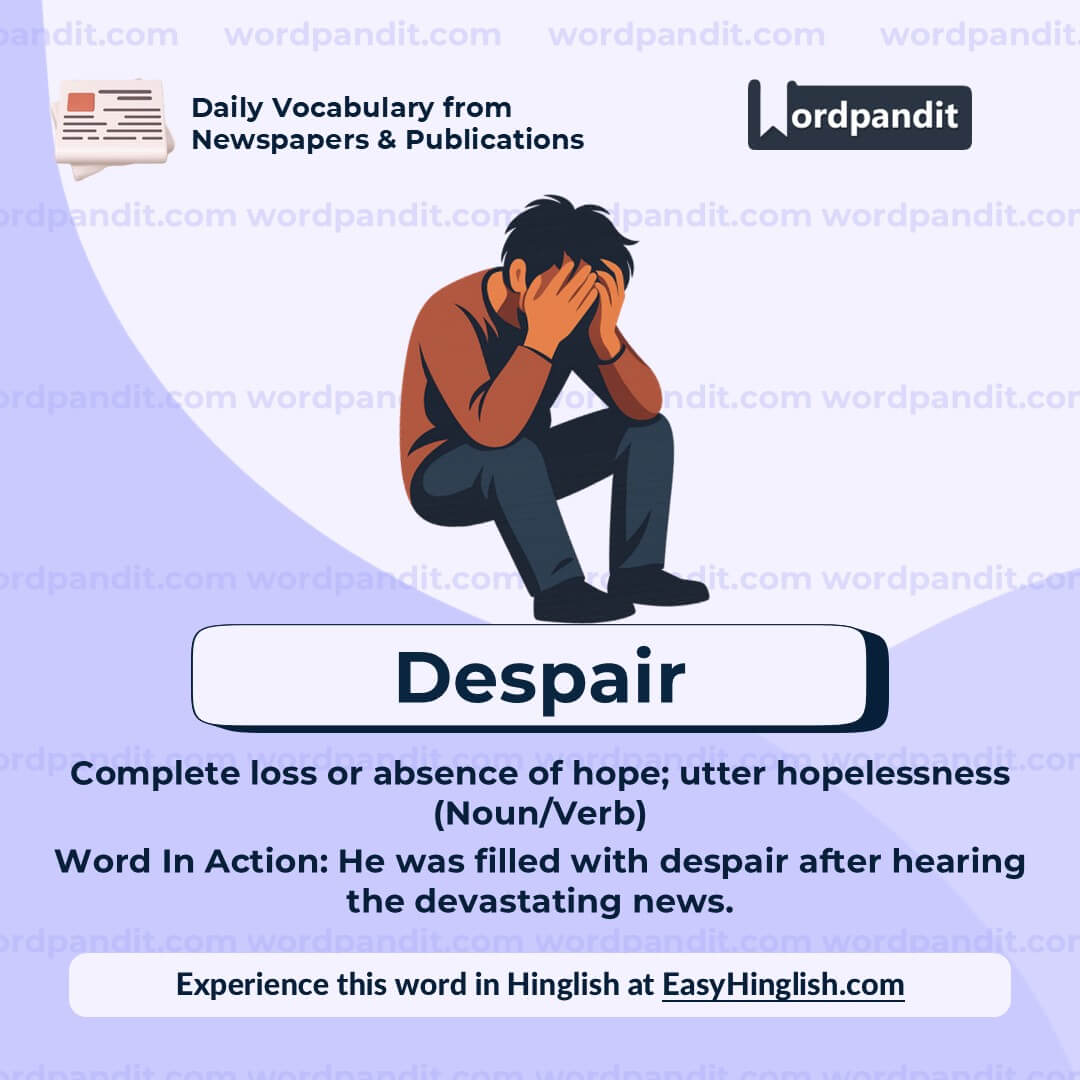
WORD-1: Despair
Context:
"...often a consequence of depression and despair..." — complete loss of hope. - Article by Tapan Susheel
Explanatory Paragraph:
Despair meaning in English is 'a complete loss or absence of hope.' This word is used when someone feels utterly hopeless about a situation, with no expectation that things will improve. How to use despair correctly depends on understanding that it represents the deepest form of hopelessness, beyond mere sadness or disappointment. Despair is commonly used in formal writing, literature, psychological contexts, and competitive exam passages to describe extreme emotional states where all optimism has vanished.
Meaning: Complete loss or absence of hope; utter hopelessness (Noun/Verb)
Pronunciation: dih-SPAIR
Difficulty Level: ⭐⭐ Basic to Intermediate
Etymology: Despair comes from Latin 'desperare' meaning 'to lose all hope,' formed from 'de-' (without) and 'sperare' (to hope). The word traveled through Old French 'desperer' before entering English in the 14th century. Throughout its journey, despair has consistently carried the meaning of complete hopelessness, representing the darkest emotional state where even the possibility of improvement seems impossible.
Prashant Sir's Notes:
Many students confuse despair with 'disappointment' or 'sadness,' but the difference between despair and disappointment is crucial for CAT and GRE reading comprehension. Disappointment is temporary dissatisfaction, while despair usage in sentences indicates complete, overwhelming hopelessness. For UPSC aspirants, despair frequently appears in passages about social issues, mental health, and human conditions. In Indian English newspapers, you'll often see phrases like "driven to despair" or "depths of despair" when discussing farmers' distress, unemployment, or social challenges. What is the difference between despair and hopelessness? While similar, despair is more active and intense—it's the anguished feeling of hopelessness, not just the absence of hope.
Synonyms & Antonyms:
Synonyms: hopelessness, desperation, anguish, despondency, dejection, melancholy, misery, gloom, desolation, discouragement
Antonyms: hope, optimism, confidence, encouragement, cheerfulness, faith
Usage Examples:
- After months of job rejections, Priya fell into despair, questioning whether she would ever find meaningful employment in her field.
- The farmer looked at his drought-stricken fields with despair, wondering how he would feed his family this year.
- Rajesh's repeated failures in the UPSC examination brought him to the brink of despair, though his family continued encouraging him.
- Don't despair over one setback—remember that even Sachin Tendulkar faced a difficult start before becoming a cricket legend.
Cultural Reference:
"In moments of despair, the human spirit either breaks or finds unexpected strength." - A theme explored in numerous Bollywood films like Taare Zameen Par and Dangal, where characters overcome seemingly hopeless situations.
Think About It:
Why do some people emerge stronger from despair while others remain trapped in it? What role does community support play in helping someone move from despair to hope?
Quick Activity:
Write two sentences describing situations where someone might feel despair—one about a personal challenge and one about a social issue. Notice how the word captures complete hopelessness rather than just disappointment.
Memory Tip:
Think of 'Despair' as 'DIS-PAIR'—imagine yourself dis-connected or separated from your pair (hope). When hope is your pair and you're separated from it, you're in despair. Or remember: 'De-spare' means you have NO spare hope left—you've used it all up.
Real-World Application:
Despair is commonly used in mental health discussions, social commentary, literary analysis, and news reporting about human suffering. In CAT and GRE reading comprehension passages, recognizing 'despair' helps identify the emotional tone and intensity of the author's message. Journalists use it when covering stories about economic hardship, natural disasters, or personal tragedies to convey the depth of human suffering. In formal writing and competitive exams, understanding despair for CAT passages helps distinguish between levels of negative emotion—from mild disappointment to complete hopelessness.
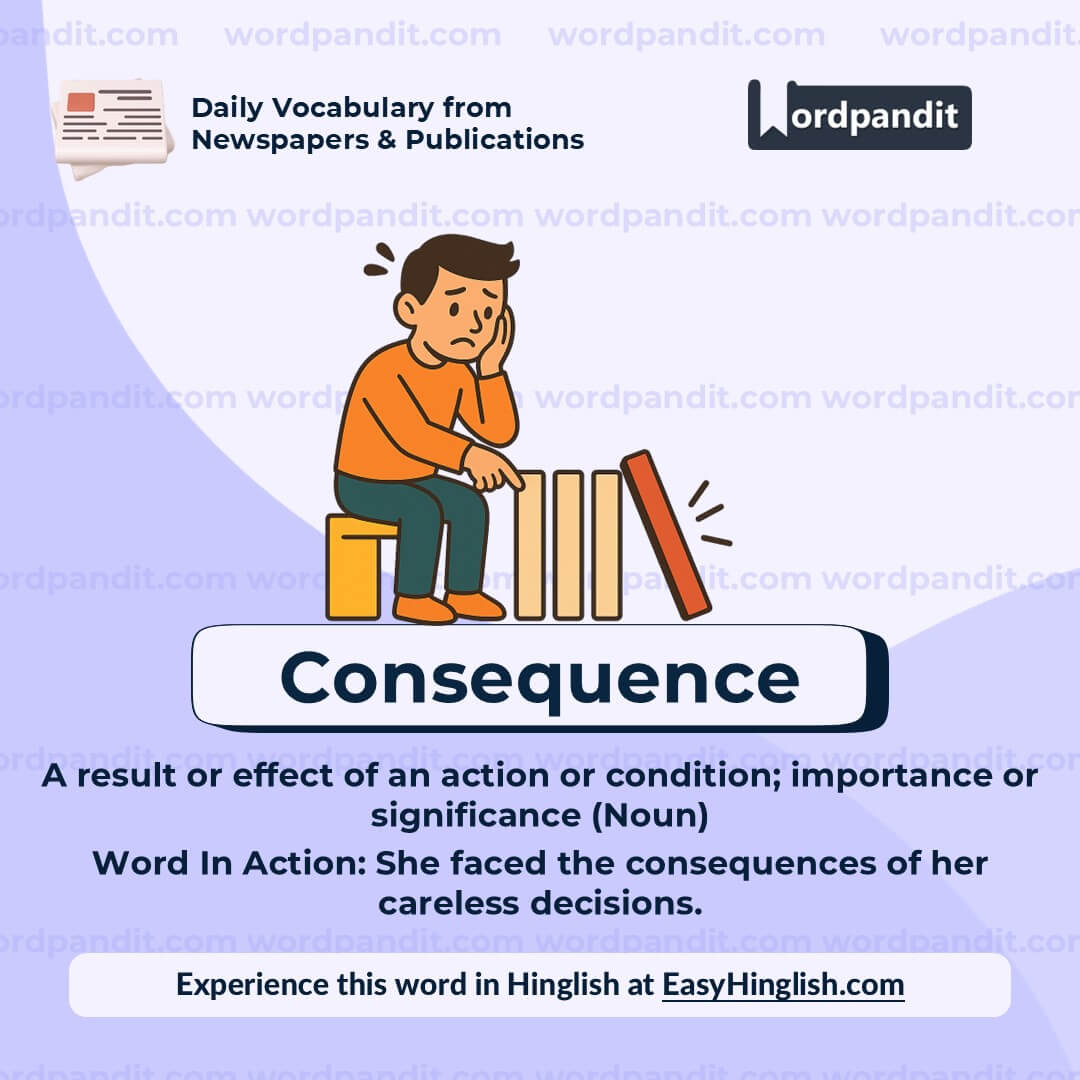
WORD-2: Consequence
Context:
"Suicide, often a consequence of depression and despair..." — result or effect of an action. - Article by Tapan Susheel
Explanatory Paragraph:
Consequence meaning in English is 'a result or effect that follows from an action or condition.' This word is used when describing outcomes that happen because of something else, whether positive or negative. How to use consequence in sentences depends on understanding cause-and-effect relationships—every action has consequences. Consequence is commonly used in formal writing, academic discussions, legal contexts, and competitive exam passages like CAT and GRE to show the relationship between actions and their outcomes.
Meaning: A result or effect of an action or condition; importance or significance (Noun)
Pronunciation: KON-sih-kwens
Difficulty Level: ⭐⭐ Basic to Intermediate
Etymology: Consequence comes from Latin 'consequentia,' derived from 'consequi' meaning 'to follow closely,' formed from 'con-' (together) and 'sequi' (to follow). The word entered English through Old French in the 14th century. Originally, consequence simply meant 'that which follows,' but over time it developed its modern meaning of a result or outcome that flows logically from a prior action or event, carrying implications of cause-and-effect relationships.
Prashant Sir's Notes:
Students often ask: what is the difference between consequence and result? While both refer to outcomes, consequence usage in formal writing specifically emphasizes the causal relationship and often carries weight or importance. For CAT and GRE aspirants, consequence frequently appears in critical reasoning questions where you must identify cause-effect relationships. The difference between consequence and outcome is subtle—consequence typically implies a direct causal link and sometimes suggests negative effects, while outcome is more neutral. In Indian English newspapers, you'll see phrases like "face the consequences" or "as a consequence of" when discussing policy decisions, climate change impacts, or social issues. How to use consequence correctly: remember it can mean both 'result' and 'importance' (as in "a person of consequence"), though the first meaning is more common in competitive exams.
Synonyms & Antonyms:
Synonyms: result, outcome, effect, aftermath, repercussion, ramification, upshot, product, corollary, implication
Antonyms: cause, origin, source, beginning, antecedent, reason
Usage Examples:
- The flooding in Mumbai was a direct consequence of poor urban planning and inadequate drainage systems across the city.
- Arun ignored his health for years, and the consequence was a serious diagnosis that forced him to completely change his lifestyle.
- As a consequence of the new GST regulations, many small businesses had to restructure their accounting processes and hire additional staff.
- Sneha's decision to skip coaching classes had predictable consequences—she struggled to solve complex problems during the CAT examination.
Cultural Reference:
"Every action has consequences—karma always finds its way back." - A principle deeply rooted in Indian philosophy and frequently referenced in Bollywood films like OMG and PK, where characters face the consequences of their choices.
Think About It:
Why do people often fail to consider the long-term consequences of their actions? How can understanding consequences help us make better decisions in our personal and professional lives?
Quick Activity:
Write three sentences using 'consequence' to describe cause-and-effect relationships you observe in daily life—perhaps related to environmental issues, social media usage, or academic choices. Notice how the word connects actions to their results.
Memory Tip:
Break 'Consequence' into 'CON-SEQUENCE'—think of it as a SEQUENCE that comes along (CON means 'with' or 'together'). Every action starts a sequence of events, and the consequence is what comes in that sequence. Or remember the Hindi phrase "परिणाम भुगतना" (parinaam bhugatna)—facing consequences.
Real-World Application:
Consequence is extensively used in legal documents, policy papers, academic research, business analysis, and ethical discussions. In CAT reading comprehension and GRE verbal reasoning, recognizing consequence for competitive exams helps identify logical relationships between events and outcomes. Journalists use it when analyzing policy decisions, climate change effects, or economic impacts. In formal business communication, understanding how to use consequence correctly is essential when discussing risk assessment, strategic planning, and decision-making processes. UPSC aspirants encounter this word frequently in essay writing and ethics papers where cause-effect analysis is crucial.
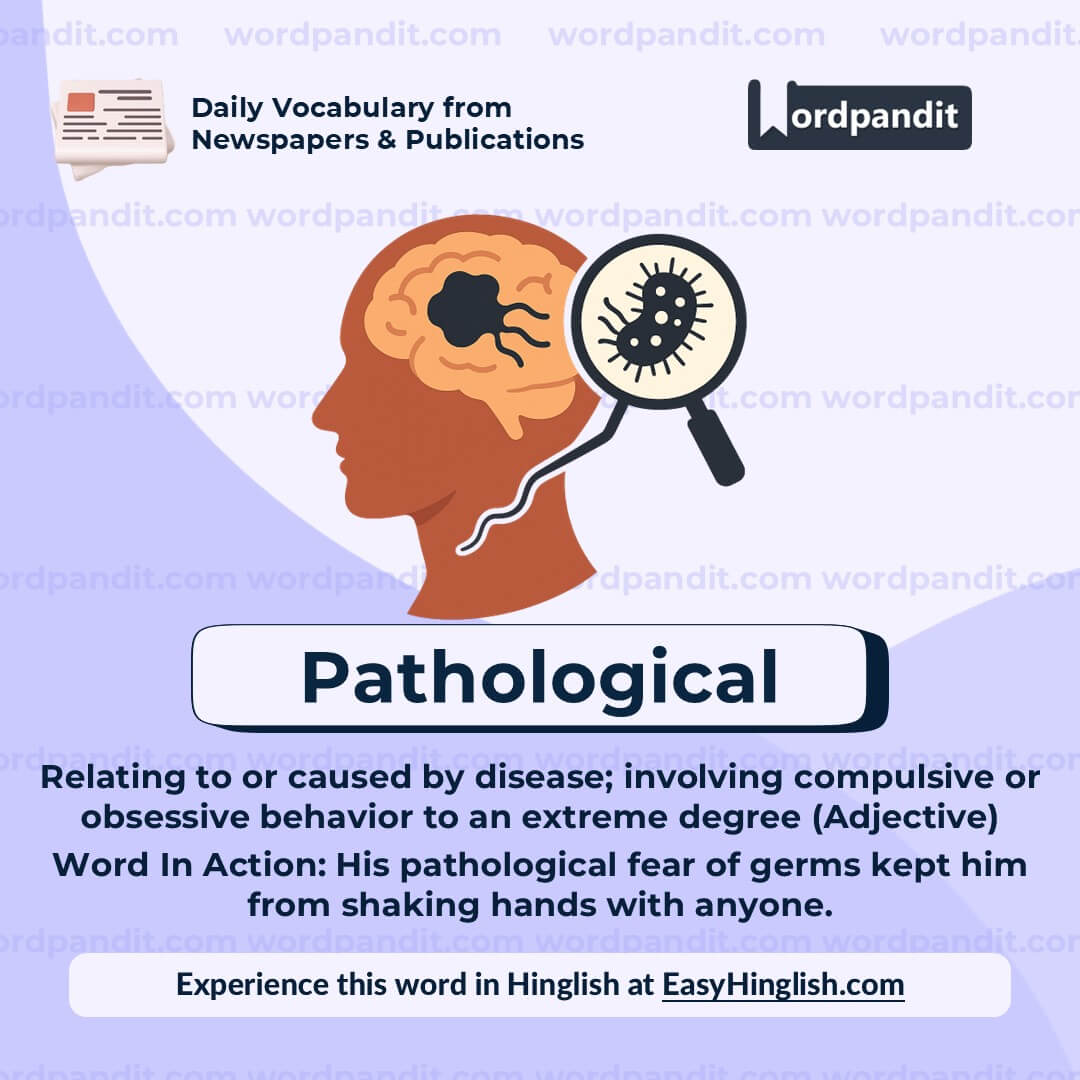
WORD-3: Pathological
Context:
"...diagnosed and treated objectively based on pathological findings..." — related to disease or abnormal conditions. - Article by Tapan Susheel
Explanatory Paragraph:
Pathological meaning in English is 'relating to disease or caused by disease; also used to describe compulsive or extreme behavior.' This word is used when referring to medical conditions involving disease processes, or metaphorically to describe behavior that is abnormal or unhealthy. How to use pathological depends on context—in medicine it describes disease-related findings, while in everyday language it describes extreme, compulsive behaviors. Pathological is commonly used in medical literature, psychological discussions, formal writing, and competitive exam passages to indicate abnormality or disease.
Meaning: Relating to or caused by disease; involving compulsive or obsessive behavior to an extreme degree (Adjective)
Pronunciation: path-uh-LOJ-ih-kuhl
Difficulty Level: ⭐⭐⭐ Intermediate
Etymology: Pathological comes from Greek 'pathologia,' formed from 'pathos' (suffering, disease) and 'logia' (study of). The word entered medical English in the 17th century as the science of diseases developed. Initially used strictly in medical contexts to describe disease processes and abnormal tissue changes, pathological gradually expanded to metaphorical usage, describing any behavior or condition that is extreme, compulsive, or unhealthy—extending the concept of 'disease' from physical to behavioral abnormalities.
Prashant Sir's Notes:
Many students confuse pathological with 'psychological,' but the difference between pathological and psychological is important for competitive exams. Psychological relates to the mind and mental processes, while pathological usage specifically indicates disease or abnormal conditions—whether physical or behavioral. For CAT and GRE aspirants, pathological appears in both scientific passages and social commentary. What is the difference between pathological and pathetic? This common confusion happens because of similar sounds—pathetic means 'arousing pity' or 'inadequate,' while pathological means 'disease-related' or 'compulsive.' In Indian English newspapers, you'll see 'pathological liar' (someone who lies compulsively) or 'pathological findings' in medical reports. How to use pathological for UPSC essays: it's perfect when discussing social issues like 'pathological corruption' or 'pathological behavior patterns' in society.
Synonyms & Antonyms:
Synonyms: morbid, diseased, unhealthy, abnormal, compulsive, obsessive, extreme, irrational (behavioral context), clinical (medical context)
Antonyms: healthy, normal, natural, balanced, rational, moderate, wholesome
Usage Examples:
- The pathological examination of tissue samples revealed cancerous cells, leading doctors at AIIMS to recommend immediate treatment for the patient.
- Ramesh exhibited pathological jealousy toward his colleagues, constantly suspecting conspiracies even when everyone genuinely tried to help him succeed.
- The forensic pathologist's report provided crucial pathological evidence that helped Mumbai police solve the mysterious death case within a week.
- Her pathological need for perfection made Priya rewrite every email five times, turning simple tasks into exhausting ordeals that affected her productivity.
Cultural Reference:
"The villain's pathological obsession with revenge drove the entire plot." - A common theme in psychological thrillers like Kahaani and Andhadhun, where characters display extreme, compulsive behaviors that become their defining traits.
Think About It:
At what point does a strong habit or preference become pathological behavior? How do we distinguish between passion and pathological obsession in our achievement-driven society?
Quick Activity:
Write two sentences using 'pathological'—one in a medical context (like test results or disease) and one describing extreme behavior (like lying, jealousy, or perfectionism). Notice how the word works in both literal and metaphorical ways.
Memory Tip:
Remember 'Pathological' through 'PATH-OLOGY'—the study of PATH (suffering/disease). Think of a path lab (pathology laboratory) where doctors study diseases. Or connect it to 'pathos' (suffering)—pathological means related to suffering or disease. In cricket terms, think of a "pathological collapse"—when a team's batting failure is so extreme and compulsive it seems like a disease!
Real-World Application:
Pathological is extensively used in medical reports, forensic investigations, psychological assessments, and academic research papers. In CAT and GRE reading comprehension, pathological for competitive exams appears in science passages discussing disease mechanisms and social commentary describing extreme behaviors. Healthcare professionals use it when discussing diagnostic findings—'pathological changes in tissue' or 'pathological test results.' In journalism and opinion pieces, writers use pathological metaphorically to describe societal issues like 'pathological corruption' or 'pathological lying in politics,' making it essential vocabulary for UPSC essay writing and current affairs discussions.
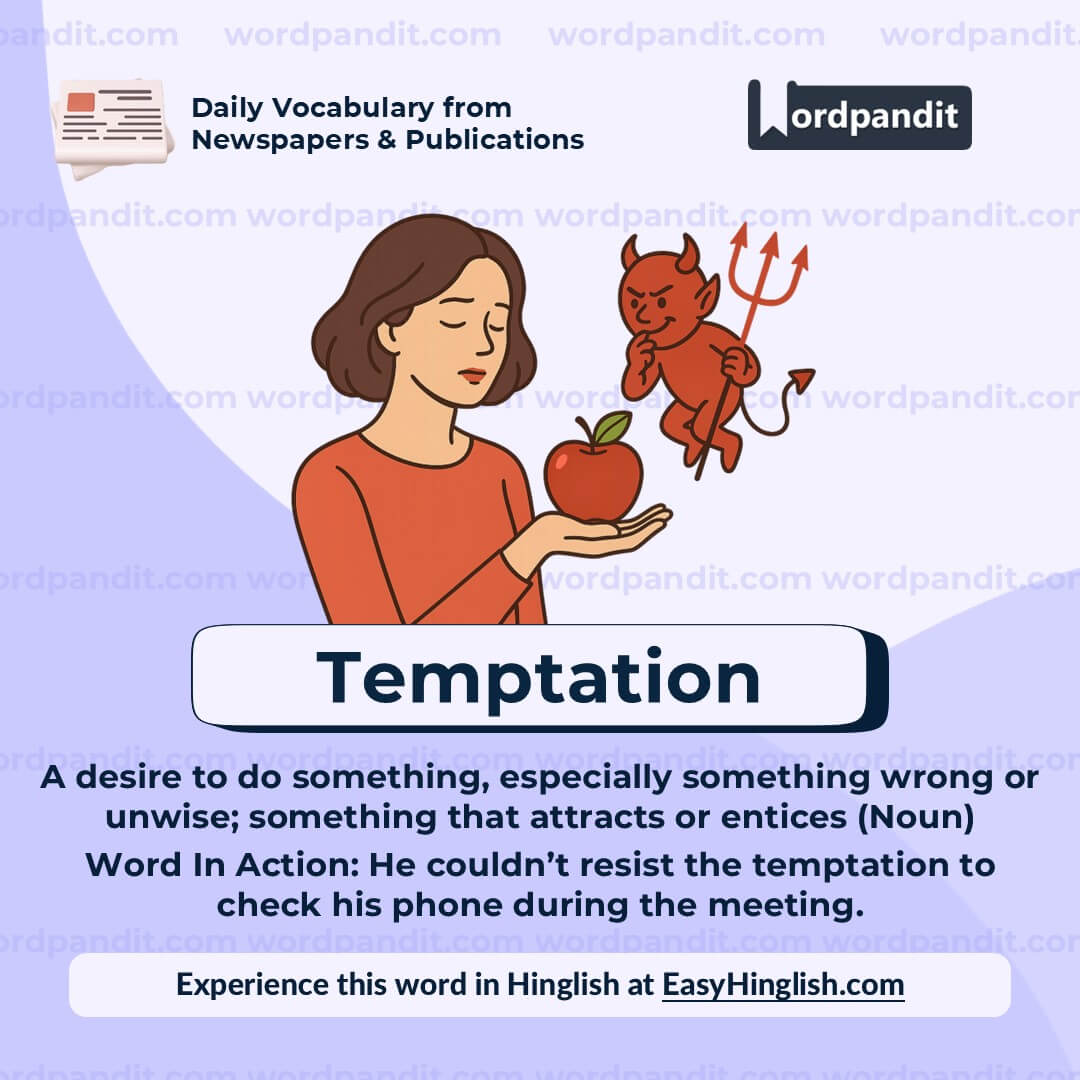
WORD-4: Temptation
Context:
"Camus argues that suicide is a natural temptation for humans." — desire to do something wrong or unwise. - Article by Tapan Susheel
Explanatory Paragraph:
Temptation meaning in English is 'a strong desire or urge to do something, especially something wrong, unwise, or pleasurable.' This word is used when describing the inner conflict between what we want to do and what we should do. How to use temptation correctly involves understanding it represents an attraction toward something that may not be beneficial or appropriate. Temptation is commonly used in moral discussions, psychological contexts, religious writings, and competitive exam passages to explore human nature, self-control, and decision-making challenges.
Meaning: A desire to do something, especially something wrong or unwise; something that attracts or entices (Noun)
Pronunciation: temp-TAY-shuhn
Difficulty Level: ⭐⭐ Basic to Intermediate
Etymology: Temptation comes from Latin 'temptationem,' derived from 'temptare' meaning 'to test, try, or entice.' The word entered English through Old French 'temptacion' in the 13th century, originally used in religious contexts to describe spiritual trials and enticements. Over centuries, temptation evolved from primarily religious usage (the devil's temptations) to broader psychological and everyday meanings, encompassing any strong urge to do something we know might be harmful, unwise, or simply indulgent—from eating dessert to making impulsive purchases.
Prashant Sir's Notes:
Students often ask: what is the difference between temptation and desire? While both involve wanting something, temptation usage specifically implies that the desired thing is wrong, unwise, or comes with negative consequences. Desire is neutral, but temptation carries moral or practical conflict. For CAT and GRE reading comprehension, temptation frequently appears in passages about ethics, psychology, and human behavior—especially when authors discuss self-control and decision-making. The difference between temptation and attraction is that temptation involves knowing something is potentially harmful yet still feeling drawn to it. In Indian English newspapers, you'll see phrases like "resist the temptation" or "succumb to temptation" when discussing corruption, consumer behavior, or policy decisions. How to use temptation for UPSC ethics papers: it's perfect when analyzing moral dilemmas where individuals face conflicts between duty and desire.
Synonyms & Antonyms:
Synonyms: enticement, allurement, attraction, lure, seduction, pull, urge, desire, craving, appeal, draw
Antonyms: deterrent, discouragement, repulsion, aversion, disinterest, indifference
Usage Examples:
- Despite the temptation to check social media during study hours, Kavya kept her phone locked away to focus on CAT preparation.
- The temptation to accept the bribe was strong, but the honest IAS officer Sharma remembered his oath and reported the incident immediately.
- Rohit resisted the temptation to buy the latest smartphone, realizing he should save money for his sister's education instead.
- For students preparing for competitive exams, Netflix offers a constant temptation that can derail months of disciplined preparation in just a few days.
Cultural Reference:
"Lead us not into temptation" remains one of the most recognized lines from the Lord's Prayer, reflecting the universal human struggle against temptation—a theme explored in countless Bollywood films like Deewar and Sarkar, where characters face moral temptations that test their principles.
Think About It:
Why do we often feel strongest temptation for things we know are harmful? Does resisting temptation make us stronger, or does constant temptation eventually wear down even the strongest willpower?
Quick Activity:
Write three sentences about temptations you face in daily life—perhaps related to food, social media, procrastination, or spending money. Reflect on which temptations are hardest to resist and why.
Memory Tip:
Think of 'Temptation' as 'TEMP-TATION'—imagine something temporarily attracting you toward a station (destination) you know you shouldn't go to. Or connect it to the Hindi word 'प्रलोभन' (pralobhan). Remember the famous devil-and-angel-on-shoulders image—the devil represents temptation, whispering "do it!" while the angel says "don't!" That's the conflict temptation creates.
Real-world Application:
Temptation is widely used in psychology, marketing, behavioral economics, ethics discussions, and self-help literature. In CAT and GRE reading comprehension passages, temptation for competitive exams appears in contexts exploring human decision-making, moral philosophy, and behavioral patterns. Marketers deliberately create temptation through advertisements and sales strategies. In UPSC ethics papers, understanding temptation is crucial when analyzing case studies about corruption, conflicts of interest, and moral dilemmas. Journalists use it when discussing policy failures, consumer behavior, or political scandals—making it essential vocabulary for current affairs analysis and essay writing about human nature and societal challenges.
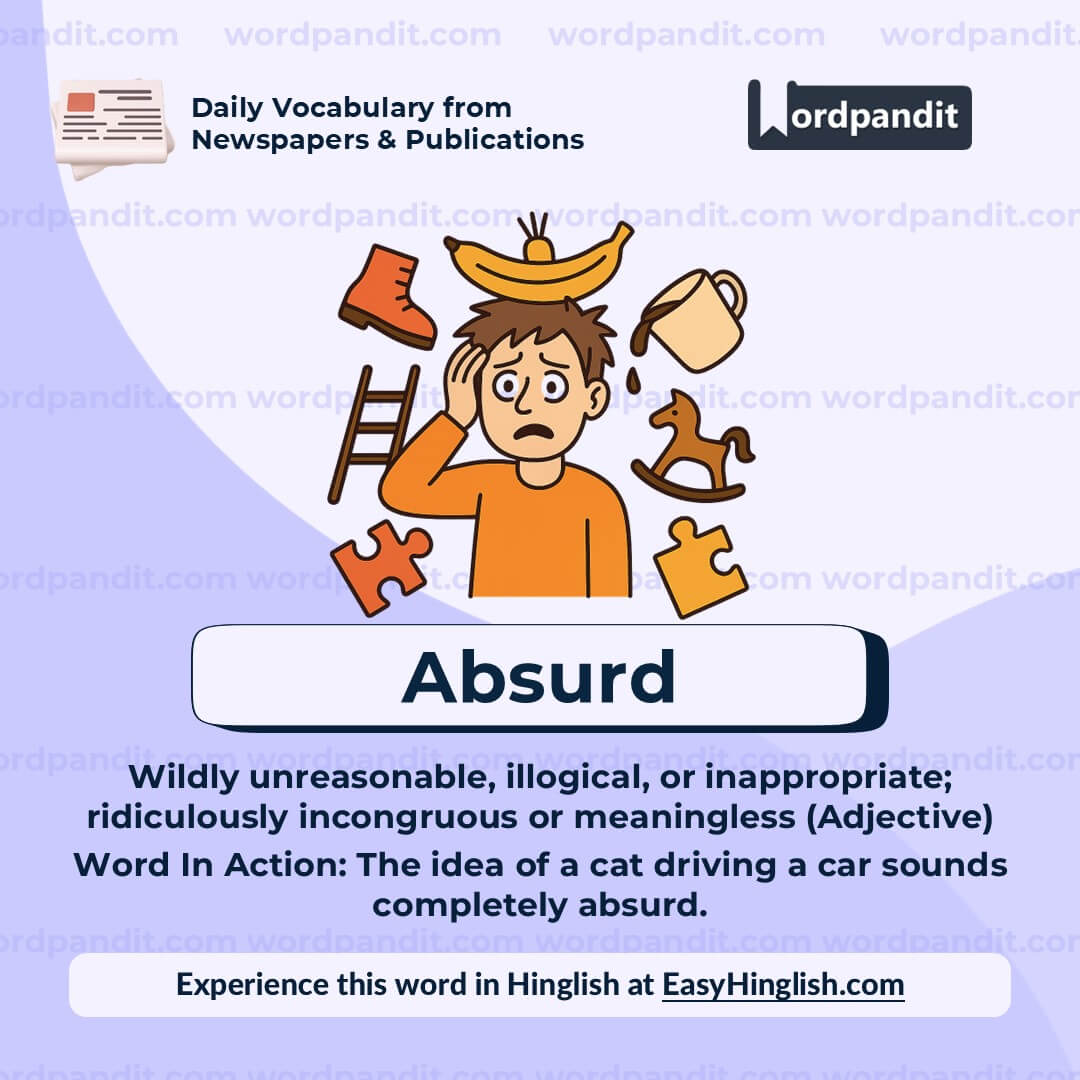
WORD-5: Absurd
Context:
"...which he broadly discussed in the framework of absurd." — illogical, meaningless, or ridiculous. - Article by Tapan Susheel
Explanatory Paragraph:
Absurd meaning in English is 'completely unreasonable, illogical, or inappropriate; ridiculously incongruous or meaningless.' This word is used when describing something that defies logic or reason to the point of being laughable or incomprehensible. How to use absurd correctly depends on recognizing when situations, ideas, or actions are so unreasonable they seem almost comical. Absurd is commonly used in philosophical discussions, literary criticism, everyday conversations, and competitive exam passages to highlight irrationality, meaninglessness, or the ridiculous nature of human existence and social situations.
Meaning: Wildly unreasonable, illogical, or inappropriate; ridiculously incongruous or meaningless (Adjective)
Pronunciation: ab-SURD or ab-ZURD
Difficulty Level: ⭐⭐ Basic to Intermediate
Etymology: Absurd comes from Latin 'absurdus' meaning 'out of tune, discordant,' formed from 'ab-' (away from) and 'surdus' (deaf, dull). The word originally described musical discord—sounds that were "deaf" to harmony. It entered English in the 16th century through French 'absurde.' Over time, absurd evolved from describing literal discord to metaphorical disharmony with reason and logic. The 20th century existentialist philosophers, particularly Albert Camus, elevated 'the absurd' to a philosophical concept describing the fundamental meaninglessness and irrationality of human existence.
Prashant Sir's Notes:
Many students confuse absurd with 'ridiculous' or 'stupid,' but understanding the difference between absurd and ridiculous helps in CAT RC passages. While both mean unreasonable, absurd usage specifically emphasizes a logical impossibility or deep incongruity—something that violates reason itself. Ridiculous simply means deserving mockery. For GRE and UPSC aspirants, absurd frequently appears in philosophical contexts, especially when discussing existentialism and 'the Theatre of the Absurd.' What is the difference between absurd and irrational? Irrational means lacking reason, while absurd suggests something so unreasonable it's almost comical or meaningless. In Indian English newspapers, you'll see phrases like "absurd bureaucratic rules" or "absurd price hikes" when writers want to emphasize not just wrongness but logical impossibility. How to use absurd for competitive exams: in RC passages about Camus or Kafka, 'the absurd' is a technical philosophical term describing the conflict between humans seeking meaning in a meaningless universe.
Synonyms & Antonyms:
Synonyms: ridiculous, ludicrous, preposterous, illogical, irrational, nonsensical, foolish, unreasonable, laughable, farcical, bizarre
Antonyms: logical, reasonable, sensible, rational, sound, practical, meaningful, coherent
Usage Examples:
- It seems absurd that in the age of instant communication, government offices still require citizens to submit physical documents in triplicate.
- Ramesh found it absurd that his company expected employees to work overtime without compensation while preaching work-life balance in official emails.
- The entire examination system became absurd when students discovered that memorizing answers mattered more than understanding concepts for cracking competitive exams.
- Priya's parents thought her dream of becoming a stand-up comedian was absurd until she won a national comedy competition and signed a contract.
Cultural Reference:
"Life is a tragedy when seen in close-up, but a comedy in long-shot." - Charlie Chaplin's observation captures the essence of the absurd, a concept brilliantly portrayed in films like PK and 3 Idiots, where societal norms and rigid systems are exposed as fundamentally absurd through humor and questioning.
Think About It:
What aspects of our education system, bureaucracy, or social customs do you find absurd when you really think about them? Why do absurd practices often persist even when everyone recognizes their irrationality?
Quick Activity:
List three situations from your daily life, news, or campus that strike you as absurd. Write one sentence for each, explaining why the situation defies logic or reason. Notice how absurdity often reveals deeper truths about systems and society.
Memory Tip:
Break 'Absurd' into 'AB-SURD'—think of something that is AB-solutely SURD (deaf to reason, as in the original Latin). Or remember it phonetically: AB-SURD sounds like "a bird" trying to reason with humans—completely illogical and ridiculous! In Hindi, connect it to 'बेतुका' (betuka) or 'निरर्थक' (nirarthak), both meaning meaningless or illogical.
Real-world Application:
Absurd is extensively used in philosophical discussions, literary criticism, social commentary, satire, and everyday conversations about unreasonable situations. In CAT and GRE reading comprehension, absurd for competitive exams appears in passages about existentialism, particularly discussing Albert Camus and 'Theatre of the Absurd' playwrights like Samuel Beckett. Journalists use it when critiquing illogical policies, bureaucratic inefficiencies, or societal contradictions—"absurd regulations" or "absurd discrepancies." For UPSC aspirants, understanding absurd is crucial for ethics papers discussing moral paradoxes and for essay writing about societal issues. In business communication, professionals use it to highlight proposals or decisions that defy basic logic, making it valuable vocabulary for critical thinking and persuasive arguments.