

Daily Vocabulary from Indian Newspapers and Publications
Welcome to Wordpandit’s Indian Vocabulary Hub
At Wordpandit, we understand the importance of staying rooted in the local context while expanding your language skills. This section focuses on enriching your vocabulary with words and phrases drawn from India’s leading newspapers and publications, ensuring you're learning vocabulary that is practical, relevant, and uniquely Indian.
Why Indian Sources Matter
We believe that the best way to master any language is by immersing yourself in local content. That’s why we carefully curate vocabulary from top Indian publications, including:
- The Hindu
- The Times of India
- The Economic Times
- Hindustan Times
- Live Mint
- The Indian Express
- And many others...
Stay Updated, Stay Relevant
With daily updates from Indian news sources, you’ll be consistently learning words that reflect the trends and shifts in Indian society and culture. Our focus is to provide vocabulary that enhances your understanding of the language in an Indian context.
How Wordpandit Supports Your Goals
Whether you’re preparing for exams, aiming to improve your professional communication, or simply want to stay connected with the latest Indian vocabulary, Wordpandit is here to guide you every step of the way.
Learn with a Practical Approach
Our interactive learning methodology includes real-world examples, engaging activities, and context-specific usage to ensure that every word becomes part of your active vocabulary.
Dive into Indian Vocabulary Today!

Why Choose Wordpandit?
Practical Learning: Focus on words you'll actually encounter in real-world reading, enhancing your comprehension and communication skills.
Diverse Content: From current affairs to scientific breakthroughs, our varied sources expose you to vocabulary across multiple domains.
Effortless Integration: Make Wordpandit a part of your daily routine. Just a few minutes each day can significantly boost your lexicon over time.
Your Path to Vocabulary Mastery
- Visit our Daily Vocabulary section regularly
- Explore new words and their usage in context
- Practice incorporating these words into your own writing and speech
- Track your progress as your vocabulary expands
Start Your Journey Today
Embark on your vocabulary enhancement journey with Wordpandit. By consistently engaging with our daily posts, you'll build a robust vocabulary that serves you well in academic, professional, and personal contexts.
Remember, a word a day keeps linguistic limitations at bay. Make Wordpandit your daily companion in the quest for vocabulary excellence!

WORD-1: Policy
Context:
"...the absence of a refugee policy document has also led to different yardsticks..." - The Hindu
Explanatory Paragraph:
Policy meaning in English is a set of principles or guidelines that direct decisions and actions within an organization or government. This word is used when discussing official rules, strategies, or frameworks that govern how institutions handle specific issues. Policy is commonly used in formal writing, government documents, news analysis, and competitive exam passages, particularly in essays about governance, administration, and public affairs.
Meaning: A course or principle of action adopted or proposed by an organization or individual (Noun)
Pronunciation: POL-uh-see
Difficulty Level: ⭐⭐ Basic to Intermediate
Etymology: Policy comes from Middle French 'police' meaning 'civil administration,' which traces back to Latin 'politia' and Greek 'polis' (city). Originally referring to governance and statecraft, the word evolved to mean any deliberate system of principles guiding decisions. By the 16th century, it had acquired its modern sense of planned courses of action in both government and business contexts.
Prashant Sir's Notes:
Many students confuse policy with law—the difference between policy and law is that policies are guidelines that can be changed by administrators, while laws are legally binding and require legislative changes. For UPSC and CAT aspirants, policy frequently appears in RC passages about governance, foreign affairs, and economics. How to use policy correctly: it always refers to deliberate, planned approaches rather than spontaneous reactions. In Indian newspapers, you'll often see terms like "foreign policy," "monetary policy," or "education policy"—these compound phrases are essential vocabulary for essay writing. Policy usage in competitive exams typically signals questions about government planning, institutional frameworks, or strategic decision-making.
Synonyms & Antonyms:
Synonyms: guideline, strategy, plan, protocol, procedure, approach, rule, directive, framework, course of action
Antonyms: improvisation, randomness, disorder, chaos, spontaneity
Usage Examples:
- The government's new education policy aims to revolutionize learning by integrating vocational training at the school level.
- Infosys revised its work-from-home policy after observing productivity trends during the pandemic years in Indian IT hubs.
- Without a clear refugee policy, India has handled asylum cases inconsistently, leading to criticism from human rights organizations.
- Priya's company has a strict no-nepotism policy, ensuring that all promotions are merit-based regardless of family connections.
Cultural Reference:
"India's economic liberalization policy of 1991 transformed the nation from a closed economy to a global player, opening doors for entrepreneurs and multinational corporations." - Common reference in Indian economic history
Think About It:
How does the absence of clear policies in crucial areas like refugees, climate change, or data privacy affect ordinary citizens and India's international reputation?
Quick Activity:
Identify three policies that directly affect your daily life—from your college, workplace, or government—and write one sentence explaining each policy's purpose.
Memory Tip:
Think of "Policy" as "POLICE-y"—just as police maintain order by following rules, a policy maintains order in organizations by setting clear guidelines everyone must follow.
Real-World Application:
Policy is essential vocabulary in business reports, government documentation, and news analysis. In corporate emails, you might reference "company policy on leaves" or "our return policy." In UPSC essays and CAT reading comprehension passages, policy appears frequently when discussing governance, economics, and administration. Journalists use it when analyzing government decisions, making phrases like "foreign policy stance" or "monetary policy changes" common in The Hindu, Indian Express, and Economic Times editorials.
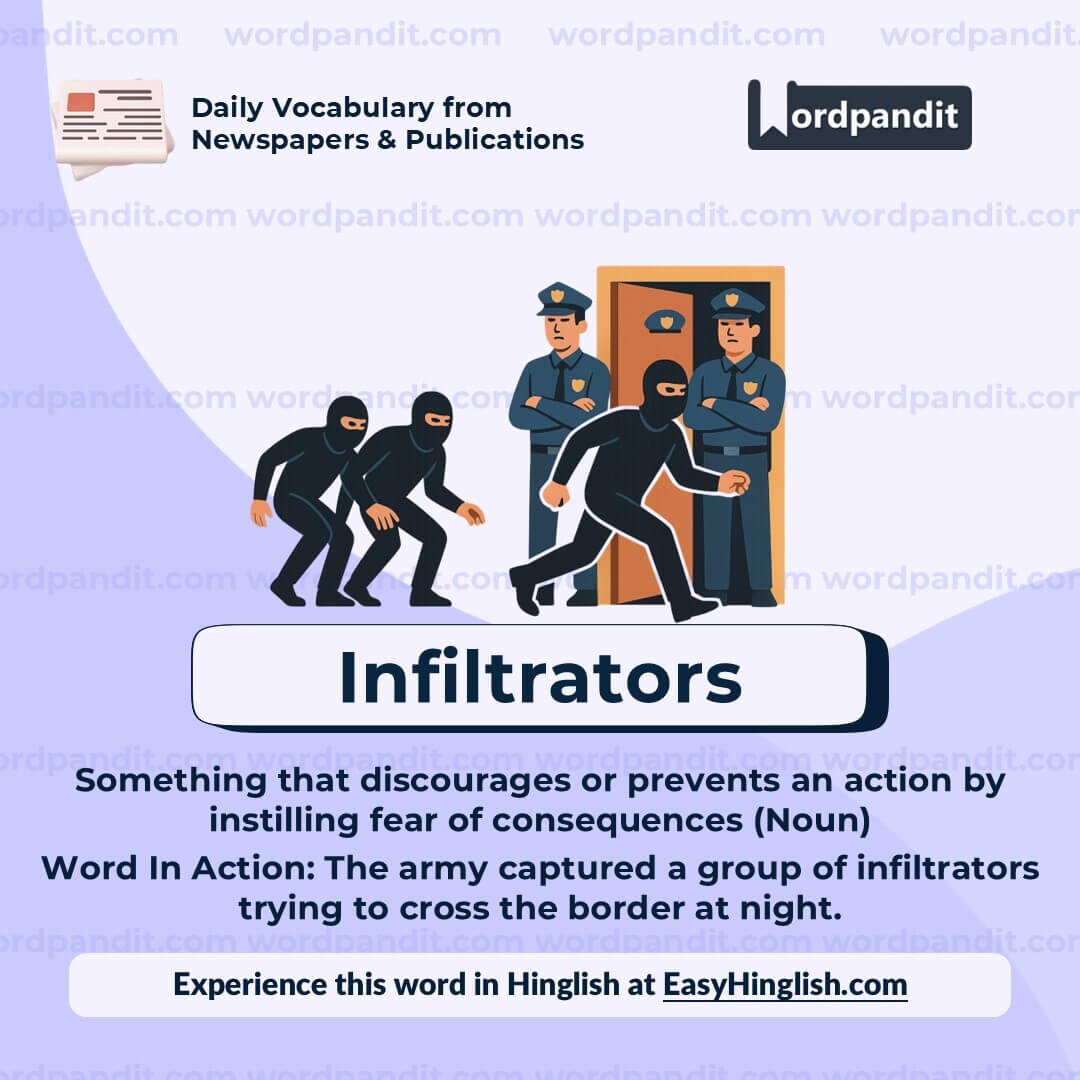
WORD-2: Infiltrators
Context:
"...the need to make a distinction between refugees and infiltrators." - The Hindu
Explanatory Paragraph:
Infiltrators meaning in English is people who secretly enter a place, organization, or country with hostile or unauthorized intentions. This word is used when describing individuals who penetrate borders, systems, or groups covertly, often for espionage, illegal activities, or subversive purposes. Infiltrators is commonly used in security discourse, military contexts, news reports about border issues, and competitive exam passages related to national security and geopolitics, making it crucial vocabulary for UPSC and SSC aspirants.
Meaning: People who enter a place, organization, or territory secretly and gradually, especially with hostile intent (Noun, Plural)
Pronunciation: IN-fil-tray-turs
Difficulty Level: ⭐⭐⭐ Intermediate
Etymology: Infiltrators comes from the verb "infiltrate," which derives from the Latin prefix 'in-' (into) and 'filtrare' (to filter), originally meaning to pass through gradually like liquid through a filter. The military and espionage sense emerged in the 18th century, describing troops or spies penetrating enemy lines secretly. By the 20th century, it gained political connotations, particularly in border security and immigration debates, referring to unauthorized or hostile entrants.
Prashant Sir's Notes:
Students often ask: what is the difference between infiltrators and refugees? Refugees flee persecution seeking safety, while infiltrators usage specifically implies unauthorized entry with potentially harmful intentions—this distinction is critical for UPSC essays on border management. For CAT and GRE aspirants, infiltrators frequently appears in RC passages about security, terrorism, and immigration policy. How to use infiltrators correctly: it always carries negative connotations of secrecy and illegitimacy, unlike neutral terms like "migrants" or "immigrants." In Indian English newspapers, especially when discussing Kashmir, Northeast borders, or Bangladesh, you'll see "terrorist infiltrators" or "illegal infiltrators"—these phrases reflect security concerns in Indian political discourse.
Synonyms & Antonyms:
Synonyms: intruders, trespassers, penetrators, spies, agents, interlopers, invaders, encroachers, unauthorized entrants, illegal entrants
Antonyms: residents, citizens, authorized personnel, legitimate visitors, legal immigrants, natives
Usage Examples:
- The BSF detected three infiltrators attempting to cross the Line of Control near Poonch sector under cover of darkness.
- Security agencies warned that infiltrators might exploit the porous border during the monsoon season when visibility drops significantly.
- The debate in Parliament centered on distinguishing genuine asylum seekers from infiltrators with criminal or terrorist backgrounds.
- Cybersecurity experts discovered that infiltrators had gained access to the company's database by posing as legitimate contractors from Bengaluru.
Cultural Reference:
"The 1999 Kargil conflict highlighted how infiltrators can threaten national security, leading to permanent changes in India's border surveillance and military preparedness." - Reference to a defining moment in India's defense history
Think About It:
How can nations balance robust security measures against infiltrators while maintaining humanitarian obligations toward genuine refugees fleeing persecution and violence?
Quick Activity:
Write two sentences using "infiltrators" in different contexts—one about physical border security and another about cybersecurity or organizational security.
Memory Tip:
Remember "Infiltrators" by breaking it into "IN-FILTER-ATORS"—imagine unwanted people filtering IN secretly, like impurities sneaking through a water filter that should block them. They're the ones who shouldn't be getting through!
Real-World Application:
Infiltrators is essential vocabulary in security studies, defense journalism, and UPSC mains answers on internal security and border management. In Indian newspapers like The Hindu and Indian Express, the term appears frequently in articles about Kashmir, Northeast insurgency, Bangladesh border issues, and counterterrorism operations. For competitive exam essays, using "infiltrators" versus neutral terms like "migrants" signals understanding of security perspectives. The word also appears in corporate contexts regarding corporate espionage, where infiltrators might penetrate organizations to steal trade secrets or sensitive information.

WORD-3: Signatory
Context:
"...India, which is not a signatory to the 1951 UN Convention..." - The Hindu
Explanatory Paragraph:
Signatory meaning in English is a person, organization, or country that has formally signed an agreement, treaty, or document, thereby agreeing to be bound by its terms. This word is used when discussing parties that have officially committed to international conventions, business contracts, or legal agreements. Signatory is commonly used in diplomatic writing, international relations, legal documentation, and competitive exam passages about treaties and agreements, making it essential vocabulary for UPSC, CAT, and GRE aspirants studying global affairs.
Meaning: A party that has signed an agreement or treaty, especially a country that has signed an international convention (Noun)
Pronunciation: SIG-nuh-tor-ee
Difficulty Level: ⭐⭐⭐ Intermediate
Etymology: Signatory comes from Latin 'signare' meaning 'to sign or mark,' derived from 'signum' (sign or seal). The term entered English through Medieval Latin 'signatorius' in the 17th century, initially used in legal contexts to denote someone authorized to sign documents. Its diplomatic usage emerged prominently in the 19th and 20th centuries with the proliferation of international treaties, where signatory nations indicated their formal commitment by affixing signatures to agreements like the Geneva Conventions or Paris Agreement.
Prashant Sir's Notes:
Many students confuse signatory with signature—signatory is the person or entity who signs, while signature is the actual mark or name written. The difference between signatory and member is subtle but important: a signatory has formally signed and committed to an agreement, whereas a member might belong to an organization without having signed specific treaties. For UPSC aspirants, signatory frequently appears in International Relations questions about India's position on various conventions—knowing that India is not a signatory to the 1951 Refugee Convention or the NPT is crucial exam knowledge. How to use signatory correctly: it's typically followed by "to" or "of" (signatory to the Paris Agreement, signatory of the treaty). In Indian newspapers covering diplomacy, you'll see phrases like "signatory nations," "India as a non-signatory," or "becoming a signatory"—these constructions are vital for essay writing on foreign policy.
Synonyms & Antonyms:
Synonyms: signer, party to an agreement, endorser, subscriber, contracting party, treaty member, ratifier, co-signer
Antonyms: non-signatory, non-participant, outsider, non-member, abstainer, non-party
Usage Examples:
- As a signatory to the Paris Climate Agreement, India has committed to reducing carbon emissions by 45 percent by 2030.
- Despite being a nuclear power, India is not a signatory to the Nuclear Non-Proliferation Treaty, maintaining its strategic autonomy.
- All signatories to the joint venture agreement must approve any changes to the company's board composition or equity structure.
- Rajesh became a co-signatory on his mother's bank account to help her manage finances during her illness.
Cultural Reference:
"India's decision to remain a non-signatory to certain international conventions reflects its principle of strategic autonomy in foreign policy, a stance dating back to the Non-Aligned Movement era." - Common theme in Indian diplomatic history
Think About It:
Why does India choose to be a non-signatory to certain international conventions like the Refugee Convention or NPT, and how does this affect its global standing and diplomatic relationships?
Quick Activity:
Research and list three major international agreements or treaties where India is a signatory and two where it is not, then write one sentence explaining India's stance on one of them.
Memory Tip:
Break "Signatory" into "SIGN-A-STORY"—imagine countries signing their names on a story they all agree to follow. Each signatory is committing to live by that shared story or agreement!
Real-World Application:
Signatory is crucial vocabulary in international relations, legal documentation, and business contracts. In UPSC mains answers on foreign policy or international organizations, correctly using "signatory" versus "member" demonstrates precision. The term appears regularly in The Hindu's diplomatic coverage, especially in articles about climate agreements, trade pacts, and human rights conventions. For CAT reading comprehension, passages about international cooperation frequently use "signatory nations" or "non-signatory status." In business contexts, signatory appears in board resolutions, partnership agreements, and banking documentation where authorized signatories have the power to bind organizations to contracts.

WORD-4: Yardsticks
Context:
"...has also led to different yardsticks for the refugee community in India." - The Hindu
Explanatory Paragraph:
Yardsticks meaning in English is standards or criteria used for measuring, judging, or comparing something, particularly quality, value, or performance. This word is used when discussing benchmarks, reference points, or measures against which things are evaluated or assessed. Yardsticks is commonly used in formal writing, business analysis, policy discussions, and competitive exam passages about evaluation frameworks and comparative assessments, making it important vocabulary for CAT, GRE, and UPSC aspirants analyzing standards and measurement systems.
Meaning: Standards or criteria by which something is judged or measured (Noun, Plural)
Pronunciation: YARD-stiks
Difficulty Level: ⭐⭐⭐ Intermediate
Etymology: Yardstick originally referred to a literal measuring stick exactly one yard (36 inches) long, used by merchants and tailors since the 16th century. The word combines "yard" (from Old English 'gerd' meaning rod or stick) and "stick." By the early 20th century, it evolved metaphorically to mean any standard of measurement or comparison. The figurative usage became popular in business and policy contexts, where abstract concepts needed measuring standards just as cloth needed physical yardsticks.
Prashant Sir's Notes:
Students often ask: what is the difference between yardsticks and criteria? While criteria are the specific factors being considered, yardsticks are the standards or measures used to evaluate those factors—think of criteria as "what" you're judging and yardsticks as "how" you're measuring it. For UPSC and CAT aspirants, yardsticks frequently appears in passages about policy inconsistencies, performance evaluation, and comparative analysis. How to use yardsticks correctly: it's always plural when referring to multiple standards (different yardsticks), and typically follows "by" or "against" (judged by different yardsticks, measured against common yardsticks). In Indian English newspapers, particularly in editorials about governance, you'll see "applying different yardsticks" or "uniform yardsticks"—these phrases signal discussions about fairness, consistency, and equal treatment in policy implementation.
Synonyms & Antonyms:
Synonyms: standards, benchmarks, criteria, measures, gauges, metrics, touchstones, reference points, parameters, measuring rods
Antonyms: randomness, inconsistency, arbitrariness, subjectivity, irregularity
Usage Examples:
- The Supreme Court criticized the government for applying different yardsticks to similar cases, undermining the principle of equality before law.
- Using GDP as the sole yardstick for development ignores crucial factors like healthcare, education, and environmental sustainability.
- Infosys and TCS use different yardsticks for employee performance evaluation, with one emphasizing client feedback and the other focusing on project completion rates.
- Critics argue that comparing Mumbai's infrastructure to Singapore's is unfair because they're measured by incompatible yardsticks given their different economic contexts.
Cultural Reference:
"In cricket, the yardstick of greatness has evolved—while Bradman's average remains legendary, modern players are judged by additional yardsticks like T20 adaptability, IPL performance, and all-format excellence." - Reflection on changing standards in Indian sports discourse
Think About It:
When governments apply different yardsticks to different communities or situations, does it reflect practical flexibility or fundamental unfairness in governance?
Quick Activity:
Identify three different yardsticks used to measure success in your field of study or work, then write one sentence explaining why using multiple yardsticks might give a more complete picture than using just one.
Memory Tip:
Think of "Yardstick" literally as a YARD-long STICK used for measuring cloth in a tailor's shop—just as tailors use physical yardsticks to measure fabric, we use metaphorical yardsticks to measure performance, quality, or fairness!
Real-World Application:
Yardsticks is essential vocabulary in policy analysis, business evaluation, and academic writing. In UPSC mains answers on governance, using "different yardsticks" effectively highlights inconsistencies in policy implementation or judicial decisions. The term appears frequently in The Hindu and Indian Express editorials discussing equality, fairness, and standardization across sectors. For CAT reading comprehension, passages about performance measurement, quality assessment, or comparative studies commonly use yardsticks. In corporate settings, yardsticks appears in performance reviews, strategic planning documents, and competitive analysis reports where companies establish benchmarks for success measurement.

WORD-5: Undocumented
Context:
"Any undocumented or overstaying refugee is regarded as an illegal migrant..." - The Hindu
Explanatory Paragraph:
Undocumented meaning in English is lacking proper official papers, records, or legal authorization, particularly referring to immigrants or migrants without valid visas, permits, or identification documents. This word is used when describing people who reside or work in a country without legal documentation or authorization from authorities. Undocumented is commonly used in immigration discourse, policy debates, legal contexts, and competitive exam passages about migration and citizenship, making it crucial vocabulary for UPSC, GRE, and CAT aspirants studying demographics and social issues.
Meaning: Not having or not recorded in the necessary official documents, especially referring to immigrants without legal authorization (Adjective)
Pronunciation: un-DOK-yoo-men-ted
Difficulty Level: ⭐⭐⭐ Intermediate
Etymology: Undocumented is formed by adding the negative prefix 'un-' to 'documented,' which comes from Latin 'documentum' meaning 'lesson, proof, or official paper,' derived from 'docere' (to teach). The term gained prominence in the late 20th century as a more neutral alternative to "illegal immigrant" or "illegal alien" in immigration debates. It emphasizes the lack of paperwork rather than criminalizing the person, reflecting evolving sensitivity in language around migration. The usage became widespread in the 1980s-90s during American immigration policy discussions and has since entered global discourse.
Prashant Sir's Notes:
Many students confuse undocumented with illegal—the difference between undocumented and illegal is subtle but significant in formal writing. "Undocumented" is considered more neutral and humanitarian, focusing on the lack of papers, while "illegal" carries criminal connotations. For UPSC aspirants, understanding this distinction is crucial when writing essays on migration, refugees, or citizenship issues. How to use undocumented correctly: it typically modifies "immigrants," "workers," or "migrants" (undocumented immigrants, undocumented workers). In Indian English newspapers covering Rohingya refugees, Bangladesh migration, or CAA debates, you'll frequently see "undocumented migrants" or "undocumented refugees"—these phrases appear in contexts requiring sensitivity to human rights concerns. Undocumented usage in competitive exams often signals questions about legal status, border management, and humanitarian policy.
Synonyms & Antonyms:
Synonyms: unauthorized, unregistered, without papers, illegal (though less preferred), unlicensed, unrecorded, unofficial, sans documentation
Antonyms: documented, authorized, legal, registered, official, legitimate, certified, licensed
Usage Examples:
- The Delhi police identified several undocumented Bangladeshi migrants living in makeshift settlements near the railway station without valid visas.
- Many undocumented workers in Mumbai's construction industry face exploitation because employers know they cannot approach authorities for protection.
- The government announced an amnesty scheme allowing undocumented refugees who arrived before 2014 to apply for regularization of their status.
- Priya discovered that her company had unknowingly hired undocumented workers through a contractor, leading to legal complications during the labor department audit.
Cultural Reference:
"The Citizenship Amendment Act sparked nationwide debates about undocumented immigrants, with protests highlighting concerns about documentation requirements and their impact on marginalized communities." - Reference to India's 2019-2020 CAA protests
Think About It:
Should undocumented immigrants who have lived peacefully in a country for decades, contributed to its economy, and raised families be given pathways to legal status, or does this undermine immigration law?
Quick Activity:
Write two sentences contrasting the situations of documented and undocumented workers in terms of rights, protections, or challenges they face in accessing services.
Memory Tip:
Remember "Undocumented" by thinking "UN-DOC-umented"—imagine someone without their DOCtor's certificate, passport, or any DOCuments. The 'UN' means 'not having,' so undocumented means not having the necessary documents or papers!
Real-World Application:
Undocumented is essential vocabulary in immigration policy discussions, human rights reporting, and legal documentation. In UPSC mains answers on internal security, citizenship, or social justice, using "undocumented" instead of harsher terms demonstrates nuanced understanding and sensitivity. The term appears regularly in The Hindu, Indian Express, and international news covering migration crises, refugee situations, and border management. For CAT and GRE reading comprehension, passages about demographics, labor economics, or humanitarian issues frequently distinguish between documented and undocumented populations. In NGO reports, legal briefs, and policy papers, "undocumented migrants" is the preferred terminology reflecting contemporary standards of respectful, accurate language.


