

Daily Vocabulary from Indian Newspapers and Publications
Welcome to Wordpandit’s Indian Vocabulary Hub
At Wordpandit, we understand the importance of staying rooted in the local context while expanding your language skills. This section focuses on enriching your vocabulary with words and phrases drawn from India’s leading newspapers and publications, ensuring you're learning vocabulary that is practical, relevant, and uniquely Indian.
Why Indian Sources Matter
We believe that the best way to master any language is by immersing yourself in local content. That’s why we carefully curate vocabulary from top Indian publications, including:
- The Hindu
- The Times of India
- The Economic Times
- Hindustan Times
- Live Mint
- The Indian Express
- And many others...
Stay Updated, Stay Relevant
With daily updates from Indian news sources, you’ll be consistently learning words that reflect the trends and shifts in Indian society and culture. Our focus is to provide vocabulary that enhances your understanding of the language in an Indian context.
How Wordpandit Supports Your Goals
Whether you’re preparing for exams, aiming to improve your professional communication, or simply want to stay connected with the latest Indian vocabulary, Wordpandit is here to guide you every step of the way.
Learn with a Practical Approach
Our interactive learning methodology includes real-world examples, engaging activities, and context-specific usage to ensure that every word becomes part of your active vocabulary.
Dive into Indian Vocabulary Today!

Why Choose Wordpandit?
Practical Learning: Focus on words you'll actually encounter in real-world reading, enhancing your comprehension and communication skills.
Diverse Content: From current affairs to scientific breakthroughs, our varied sources expose you to vocabulary across multiple domains.
Effortless Integration: Make Wordpandit a part of your daily routine. Just a few minutes each day can significantly boost your lexicon over time.
Your Path to Vocabulary Mastery
- Visit our Daily Vocabulary section regularly
- Explore new words and their usage in context
- Practice incorporating these words into your own writing and speech
- Track your progress as your vocabulary expands
Start Your Journey Today
Embark on your vocabulary enhancement journey with Wordpandit. By consistently engaging with our daily posts, you'll build a robust vocabulary that serves you well in academic, professional, and personal contexts.
Remember, a word a day keeps linguistic limitations at bay. Make Wordpandit your daily companion in the quest for vocabulary excellence!

WORD-1: Protectionist
Context:
"...and turned markedly protectionist, departing from the open, rent-seeking capitalism..." - The Hindu
Explanatory Paragraph:
Protectionist meaning in English is 'favoring policies that shield domestic industries from foreign competition through tariffs, quotas, or regulations.' This word is used when describing economic policies that prioritize local businesses over international trade openness. How to use protectionist becomes important when discussing government trade policies, import restrictions, or economic nationalism in newspapers, business reports, and competitive exam passages on economics and current affairs.
Meaning: Relating to or advocating protection of domestic industries from foreign competition (Adjective)
Pronunciation: proh-TEK-shuh-nist
Difficulty Level: ⭐⭐⭐ Intermediate
Etymology: Protectionist comes from the word 'protection' derived from Latin 'protegere' meaning 'to cover in front, protect.' The suffix '-ist' was added in the 19th century during debates over free trade versus tariff policies, creating a term to describe those who favor shielding domestic markets from foreign goods through government intervention.
Prashant Sir's Notes:
Many students confuse protectionist with patriotic—while both relate to national interests, the difference between protectionist and patriotic is that protectionist specifically refers to economic trade barriers, not general love of country. For UPSC and CAT aspirants, protectionist usage appears frequently in passages about Make in India policies, Atmanirbhar Bharat initiatives, and debates over import duties on Chinese goods. In Indian newspapers like The Hindu and Economic Times, you'll often see "protectionist measures" when discussing tariff increases or restrictions on foreign direct investment. How to use protectionist correctly: it typically describes policies, measures, or stances—not individual consumers who prefer local products.
Synonyms & Antonyms:
Synonyms: nationalist (in economic context), isolationist, restrictive, defensive, anti-free-trade, mercantilist, tariff-favoring, inward-looking
Antonyms: free-trade, open-market, liberalized, globalist, unrestricted, laissez-faire
Usage Examples:
- India's protectionist stance on agricultural imports aims to safeguard the livelihoods of millions of farmers across Punjab and Haryana.
- The government adopted protectionist measures by increasing customs duties on electronics, hoping to boost local manufacturing under the PLI scheme.
- Critics argue that protectionist policies may shield inefficient domestic industries from competition, ultimately harming consumer interests and innovation.
- Priya's uncle, who owns a textile factory in Surat, supports protectionist tariffs because cheap imported fabrics threaten his business survival.
Cultural Reference:
"Atmanirbhar Bharat represents a protectionist vision where India becomes self-reliant, reducing dependence on foreign imports while strengthening domestic manufacturing capabilities." - Commentary on India's economic policy shift
Think About It:
Does India's shift toward protectionist policies help small businesses and farmers, or does it risk isolating the economy from global innovation and competitive pricing?
Quick Activity:
Find two recent news articles discussing protectionist measures in India—one supporting such policies and one criticizing them. Note the different perspectives on economic nationalism versus globalization.
Memory Tip:
Think of "PROTECT-YOUR-NATION-IST"—someone who wants to PROTECT local industries by keeping foreign competition out, like putting a protective shield around desi businesses to save them from videshi products.
Real-World Application:
Protectionist is commonly used in business newspapers, economic policy discussions, and competitive exam passages analyzing trade relations. Writers use it to describe government tariffs, import quotas, and regulatory barriers that favor domestic producers. In UPSC essays on Indian economy or GRE reading comprehension passages about global trade, understanding protectionist helps you identify arguments about economic sovereignty versus international cooperation.

WORD-2: Reneged
Context:
"...they must not renege on the ideals of institutional freedoms within state-enabled capitalist societies." - The Hindu
Explanatory Paragraph:
Reneged meaning in English is 'to go back on a promise, commitment, or agreement.' This word is used when someone fails to honor their word or breaks a deal they previously made. Reneged is commonly used in formal writing, legal contexts, political discourse, and competitive exam passages to describe broken promises or abandoned commitments, often carrying a negative connotation of betrayal or untrustworthiness.
Meaning: Failed to fulfill a promise or obligation; went back on one's word (Verb, past tense)
Pronunciation: rih-NEGD or rih-NAYGED
Difficulty Level: ⭐⭐⭐ Intermediate
Etymology: Reneged comes from the Medieval Latin 'renegare' meaning 'to deny,' which itself derives from Latin 're-' (again) and 'negare' (to deny). The word entered English through card games in the 16th century, where reneging meant failing to follow suit when able, and evolved to mean breaking any promise or commitment in general usage.
Prashant Sir's Notes:
Students often ask: what is the difference between reneged and broke a promise? While both mean failing to keep commitments, reneged usage in formal writing specifically emphasizes deliberate backing out after making a clear agreement. For CAT and UPSC aspirants, reneged frequently appears in passages about political promises, international treaties, or business contracts. In Indian English newspapers, you'll commonly see "government reneged on its poll promises" or "company reneged on salary commitments"—this word signals betrayal of trust. How to use reneged correctly: it's always followed by 'on' (reneged on a deal, never reneged a deal). Remember, this word carries strong disapproval—you're not just changing plans, you're breaking your word.
Synonyms & Antonyms:
Synonyms: backed out, defaulted, broke one's word, went back on, withdrew from, abandoned (a commitment), betrayed (a promise), revokedm welched
Antonyms: honored, fulfilled, kept, upheld, maintained, stood by, followed through
Usage Examples:
- The builder reneged on his promise to deliver the Noida apartments by March, leaving hundreds of families in financial distress.
- After accepting the job offer from Infosys, Karan reneged at the last moment when TCS offered him a better package.
- Opposition parties accused the government of having reneged on its manifesto commitment to create two crore jobs annually.
- Meera felt betrayed when her business partner reneged on their agreement to share profits equally after the startup became successful.
Cultural Reference:
"In cricket commentary, when a player withdraws from a bilateral series after committing to play, commentators often say the player 'reneged on the agreement,' highlighting the broken trust between boards and players." - Sports journalism perspective
Think About It:
Why do political parties frequently renege on election promises once they come to power, and how does this affect public trust in democratic institutions?
Quick Activity:
Write two sentences about situations where someone reneged on a commitment—one from politics or business, and one from personal life. Notice how the word emphasizes broken trust.
Memory Tip:
Think of "RE-NEGATIVE"—when you renege, you go back (RE-) and turn your positive promise into a NEGATIVE by breaking it. Imagine Dhoni promising to play in the IPL final but then saying "nahi, negative!" at the last moment.
Real-World Application:
Reneged is commonly used in legal documents, business contracts, political analysis, and editorial columns to describe broken commitments. Journalists use it when discussing unfulfilled electoral promises, abandoned international agreements, or defaulted business deals. In CAT reading comprehension or UPSC essay writing, understanding reneged helps you identify themes of betrayal, unreliability, and broken trust in passages about governance, diplomacy, or corporate ethics.
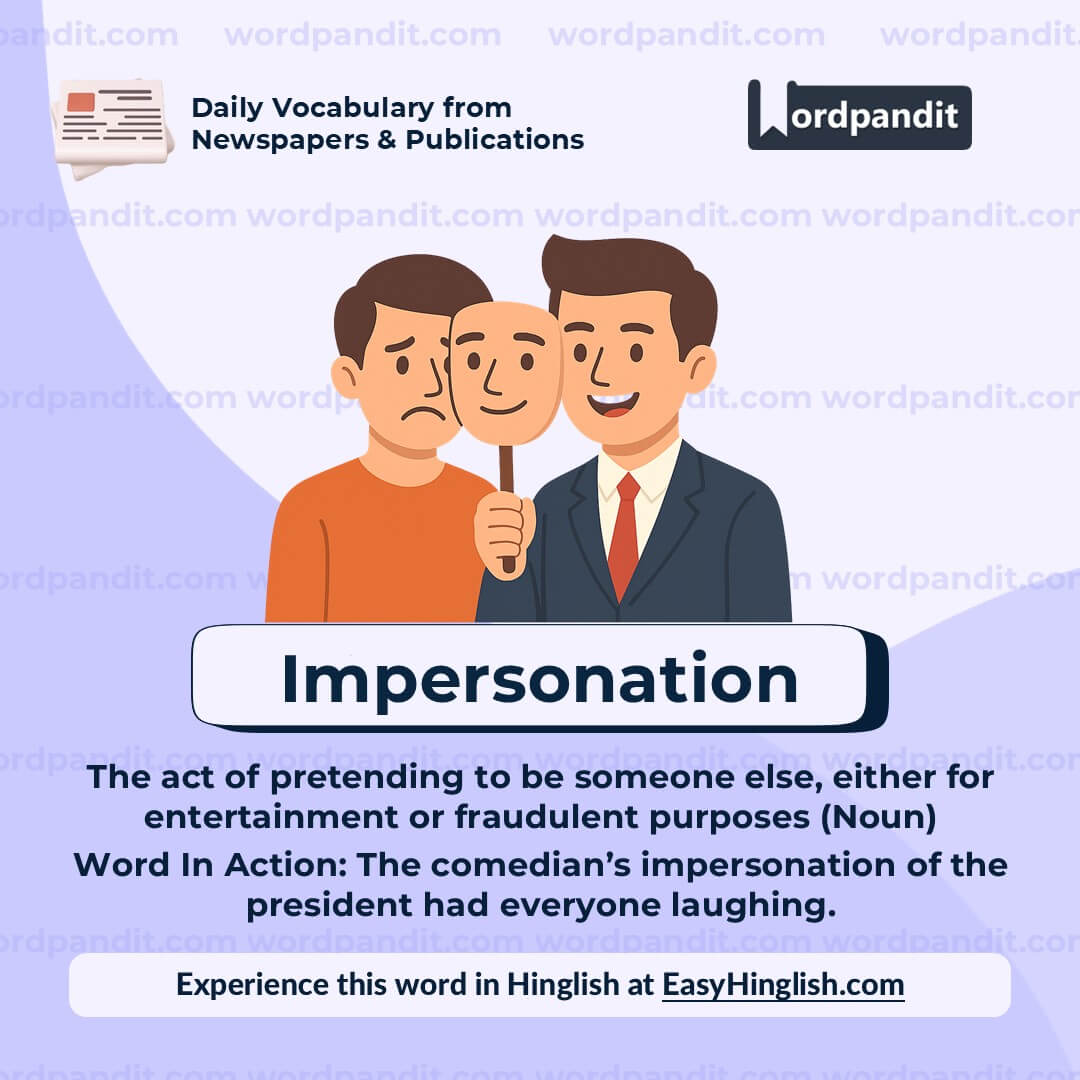
WORD-3: Impersonation
Context:
"...convincing impersonations, accelerated the speed..." - The Hindu
Explanatory Paragraph:
Impersonation meaning in English is 'the act of pretending to be another person, either for entertainment or deception.' This word is used when someone mimics another person's voice, appearance, or behavior to either entertain audiences or fraudulently assume their identity. Impersonation is commonly used in entertainment journalism, cybersecurity discussions, legal contexts, and competitive exam passages about digital fraud, identity theft, or comedy performances.
Meaning: The act of pretending to be someone else, either for entertainment or fraudulent purposes (Noun)
Pronunciation: im-pur-suh-NAY-shun
Difficulty Level: ⭐⭐ Basic to Intermediate
Etymology: Impersonation comes from the Latin 'in-' (into) and 'persona' (mask or character), literally meaning 'putting on another person's mask.' The word entered English in the 17th century through theater and performance contexts, where actors would assume different characters. It later expanded to include fraudulent identity assumption with the rise of modern legal systems and, more recently, digital impersonation in the age of social media and deepfakes.
Prashant Sir's Notes:
Many students confuse impersonation with imitation—the difference between impersonation and imitation is that impersonation specifically involves pretending to BE someone else, while imitation just means copying behavior without claiming to be that person. For CAT and GRE aspirants, impersonation usage appears in passages about cybercrime, AI-generated deepfakes, or entertainment industry contexts. In Indian newspapers, you'll frequently see "impersonation racket" or "voice impersonation scam" when discussing fraud cases where criminals pretend to be bank officials or relatives. How to use impersonation for competitive exams: recognize that it can be both harmless (comedy shows like The Kapil Sharma Show featuring celebrity impersonations) or criminal (online impersonation for financial fraud). The context determines whether it's entertainment or crime.
Synonyms & Antonyms:
Synonyms: mimicry, imitation (with identity claim), impression, masquerade, personification, pretense, portrayal, spoofing, identity fraud (criminal context)
Antonyms: authenticity, genuineness, originality, true identity, self-representation
Usage Examples:
- The comedian's impersonation of Prime Minister Modi, complete with gestures and voice modulation, had the entire audience laughing during the awards show.
- Mumbai police arrested a gang involved in voice impersonation fraud, where they pretended to be relatives asking for urgent money transfers.
- Deepfake technology has made video impersonation so realistic that distinguishing authentic footage from manipulated content has become extremely challenging.
- Rajesh's impersonation of his strict math teacher during the college farewell was so accurate that even the principal couldn't stop laughing.
Cultural Reference:
"Bollywood has a rich tradition of impersonation acts, from Johnny Lever's hilarious mimicry of Amitabh Bachchan to comedians on shows like Comedy Nights with Kapil entertaining audiences with celebrity impersonations." - Indian entertainment industry tradition
Think About It:
With AI making voice and video impersonation increasingly realistic, how can we protect ourselves from digital fraud while still enjoying entertainment-based impersonations?
Quick Activity:
List three contexts where impersonation occurs—one for entertainment, one for fraud, and one for artistic performance. Notice how the same act can be viewed differently based on intent.
Memory Tip:
Break down "IM-PERSON-ATION" as "I'M [another] PERSON now"—you're claiming to BE that person, not just copying them. Think of Ranbir Kapoor playing Sanjay Dutt in Sanju—that's impersonation because he's portraying Dutt's entire persona, not just mimicking one mannerism.
Real-World Application:
Impersonation is commonly used in entertainment reviews, cybersecurity reports, legal documents about fraud, and technology articles discussing deepfakes. Journalists use it when covering online scams, AI-generated videos, or comedy performances. In GRE reading comprehension or CAT passages about digital ethics, understanding impersonation helps you analyze arguments about authenticity, privacy, and the boundaries between harmless mimicry and criminal fraud in the digital age.

WORD-4: Proliferate
Context:
"As deepfakes proliferate, identity management can no longer be..." - The Hindu
Explanatory Paragraph:
Proliferate meaning in English is 'to increase rapidly in number or spread widely and quickly.' This word is used when describing something that multiplies or expands at a fast pace, often uncontrollably. How to use proliferate becomes essential when discussing technological growth, spread of misinformation, nuclear weapons, or any phenomenon experiencing exponential growth. Proliferate is commonly used in news articles, scientific writing, and competitive exam passages about technology, security, or environmental issues.
Meaning: To increase rapidly in number; to multiply and spread quickly (Verb)
Pronunciation: proh-LIF-uh-rayt
Difficulty Level: ⭐⭐⭐ Intermediate
Etymology: Proliferate comes from Latin 'proles' meaning 'offspring' and 'ferre' meaning 'to bear or carry,' through the French word 'prolifère.' Originally used in biology to describe rapid cell reproduction in the 19th century, the term expanded to describe any rapid multiplication or spread—from nuclear weapons proliferation during the Cold War to today's context of viral content and misinformation proliferating across social media platforms.
Prashant Sir's Notes:
Students often ask: what is the difference between proliferate and increase? While both mean growth, proliferate specifically emphasizes rapid, often uncontrolled multiplication—think viral spread rather than steady growth. For UPSC and CAT aspirants, proliferate usage appears frequently in passages about nuclear proliferation, fake news spreading, or technology adoption. In Indian English newspapers, you'll see "smartphones proliferate in rural India" or "misinformation proliferates on WhatsApp"—the word signals explosive, hard-to-control growth. How to use proliferate for competitive exams: notice it's often followed by context showing concern—proliferation is rarely seen as entirely positive because rapid, uncontrolled spread typically creates challenges. Remember, things that proliferate spread like wildfire, not like a planned garden.
Synonyms & Antonyms:
Synonyms: multiply, spread rapidly, mushroom, burgeon, escalate, snowball, explode (in growth), reproduce rapidly, increase exponentially, expand uncontrollably
Antonyms: decrease, diminish, decline, shrink, dwindle, reduce, contract, wane
Usage Examples:
- As affordable smartphones proliferate across rural Karnataka and Bihar, digital literacy programs struggle to keep pace with the technology adoption rate.
- Fake news stories about COVID-19 treatments proliferated on WhatsApp groups, prompting the government to launch fact-checking initiatives nationwide.
- Online payment platforms like Paytm and PhonePe proliferated after demonetization, fundamentally changing how Indians conduct daily transactions.
- Environmental activists warn that plastic waste will continue to proliferate unless manufacturing companies adopt sustainable packaging alternatives immediately.
Cultural Reference:
"Just as coaching centers proliferated in Kota and Delhi when IIT-JEE competition intensified, ed-tech apps like BYJU'S and Unacademy proliferated during the pandemic, transforming India's education landscape completely." - Commentary on India's education sector evolution
Think About It:
As AI tools proliferate rapidly, making content creation effortless, how can we ensure quality and authenticity don't get lost in the flood of machine-generated information?
Quick Activity:
Identify three things that have proliferated in India over the last five years—think about technology, social media trends, or consumer products. Write one sentence explaining why each proliferated so rapidly.
Memory Tip:
Think "PRO-LIFE-RATE"—things that are PRO (for) LIFE multiply at a high RATE, just like bacteria or viral videos. Imagine cockroaches proliferating in monsoon—you see one, then suddenly hundreds appear everywhere, spreading uncontrollably!
Real-World Application:
Proliferate is commonly used in technology journalism, security discussions, scientific research papers, and policy analysis to describe rapid, often concerning expansion. Writers use it when discussing nuclear weapons, cybersecurity threats, misinformation campaigns, or disruptive technologies. In CAT reading comprehension or GRE passages about technological change or global security, understanding proliferate helps you identify arguments about uncontrolled growth, regulatory challenges, and the tension between innovation and control in rapidly evolving domains.
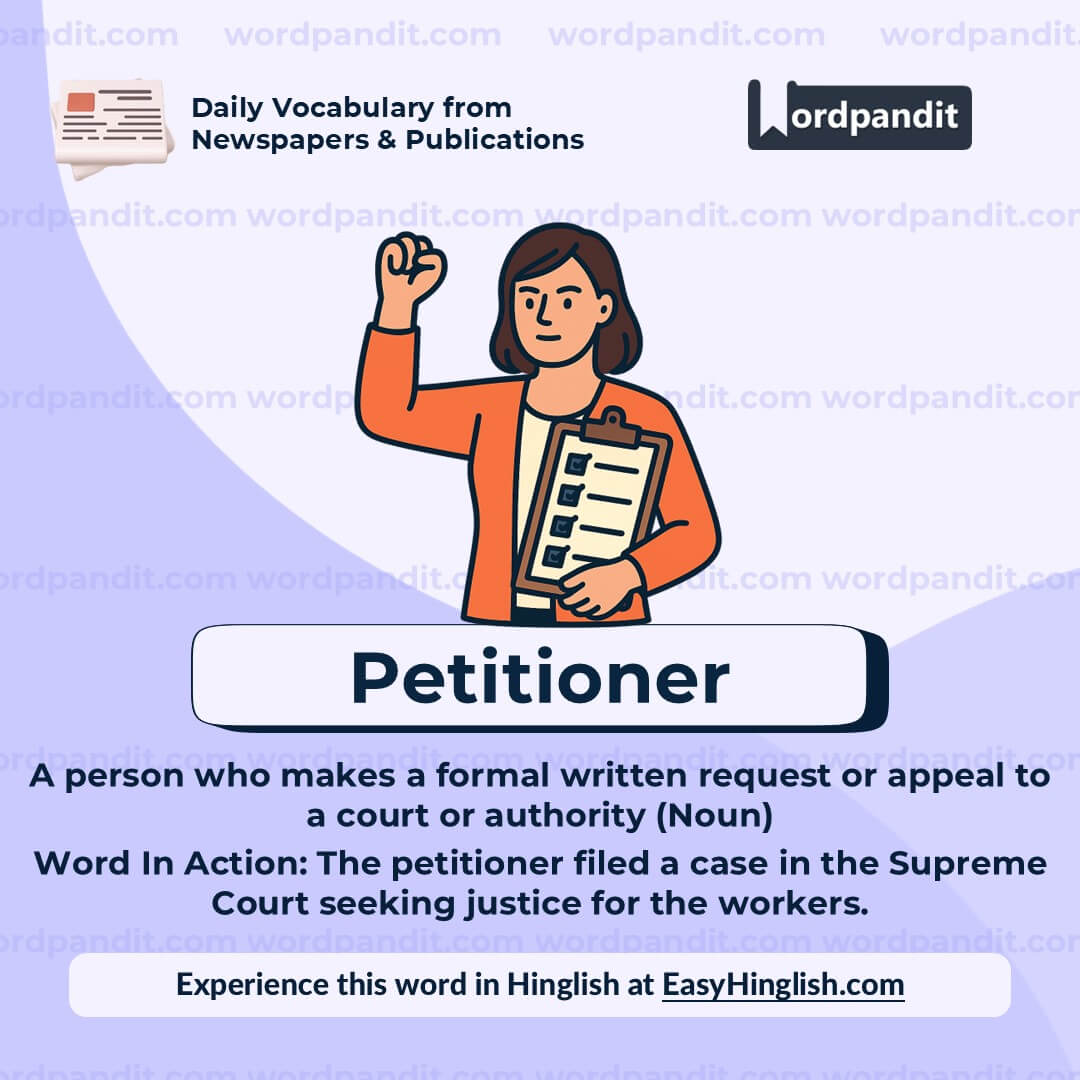
WORD-5: Petitioner
Context:
"The petitioner's counsel said the matter may be adjourned." - The Hindu
Explanatory Paragraph:
Petitioner meaning in English is 'a person who presents a formal written request or appeal to a court, authority, or government body.' This word is used when someone files a legal case or seeks official intervention through proper channels. Petitioner is commonly used in legal journalism, court proceedings, administrative contexts, and competitive exam passages related to law, judiciary, or citizens' rights. Understanding how to use petitioner is essential for reading newspaper court reports and legal affairs sections.
Meaning: A person who makes a formal written request or appeal to a court or authority (Noun)
Pronunciation: puh-TISH-uh-ner
Difficulty Level: ⭐⭐ Basic to Intermediate
Etymology: Petitioner comes from Latin 'petere' meaning 'to seek or request,' through Old French 'peticion.' The word evolved in medieval legal systems where individuals would formally petition kings or courts for justice. The '-er' suffix denotes the person performing the action. In Indian legal parlance, petitioner became standardized during British colonial rule and remains the primary term for someone initiating legal action, distinguishing them from the respondent who answers the petition.
Prashant Sir's Notes:
Many students confuse petitioner with plaintiff—what is the difference between petitioner and plaintiff? Both file cases, but petitioner is used in civil matters, writ petitions, and appeals (especially in High Courts and Supreme Court), while plaintiff is specifically used in civil suits at lower court levels. For UPSC aspirants, petitioner usage appears constantly in polity and current affairs when discussing PIL (Public Interest Litigation), where any citizen can become a petitioner seeking judicial intervention. In Indian newspapers, you'll see "the petitioner argued" or "petitioner's counsel submitted"—this language appears daily in court reporting. How to use petitioner correctly: remember there's always a respondent on the other side—petitioner versus respondent, not petitioner versus defendant (that's criminal court terminology). In Supreme Court and High Court reporting, petitioner is the standard term.
Synonyms & Antonyms:
Synonyms: appellant (in appeals), applicant, claimant, plaintiff (in civil suits), litigant, supplicant, petitioning party
Antonyms: respondent, defendant (criminal context), opposing party, accused
Usage Examples:
- The petitioner approached the Delhi High Court seeking compensation for the illegal demolition of her ancestral property in Chandni Chowk.
- Supreme Court directed the petitioner to serve notice to all respondents before the next hearing scheduled for March.
- Environmental activist Aditya filed a PIL as petitioner, challenging the government's approval of the coastal highway project near Mumbai.
- The petitioner's lawyer argued that fundamental rights under Article 21 were violated when civic authorities denied water supply to the colony.
Cultural Reference:
"In landmark cases like Vishaka versus State of Rajasthan, the petitioners successfully established guidelines against workplace sexual harassment, demonstrating how public-spirited citizens can use petitions to create nationwide legal frameworks." - Reference to strategic litigation in India
Think About It:
Why has PIL (Public Interest Litigation) made it possible for any concerned citizen to become a petitioner in India's higher courts, and how has this transformed access to justice?
Quick Activity:
Read today's newspaper court reporting section and identify three cases. Note who the petitioner is in each case and what relief they're seeking from the court.
Memory Tip:
Think "PETITION-ER"—someone who files a PETITION. Remember the simple formula: PETITIONER files petition → Court hears case → RESPONDENT must respond. It's like WhatsApp—petitioner sends the message (petition), respondent receives and must reply!
Real-World Application:
Petitioner is extensively used in legal journalism, court reporting, law textbooks, and administrative proceedings across India. Newspapers use it daily when covering Supreme Court, High Court, and tribunal cases. In UPSC Polity preparation or GRE passages about judicial systems, understanding petitioner helps you comprehend legal procedures, distinguish between different parties in litigation, and analyze arguments about access to justice. This term appears in virtually every court-related news article in The Hindu, Indian Express, and Times of India.


