

Daily Vocabulary from Indian Newspapers and Publications
Welcome to Wordpandit’s Indian Vocabulary Hub
At Wordpandit, we understand the importance of staying rooted in the local context while expanding your language skills. This section focuses on enriching your vocabulary with words and phrases drawn from India’s leading newspapers and publications, ensuring you're learning vocabulary that is practical, relevant, and uniquely Indian.
Why Indian Sources Matter
We believe that the best way to master any language is by immersing yourself in local content. That’s why we carefully curate vocabulary from top Indian publications, including:
- The Hindu
- The Times of India
- The Economic Times
- Hindustan Times
- Live Mint
- The Indian Express
- And many others...
Stay Updated, Stay Relevant
With daily updates from Indian news sources, you’ll be consistently learning words that reflect the trends and shifts in Indian society and culture. Our focus is to provide vocabulary that enhances your understanding of the language in an Indian context.
How Wordpandit Supports Your Goals
Whether you’re preparing for exams, aiming to improve your professional communication, or simply want to stay connected with the latest Indian vocabulary, Wordpandit is here to guide you every step of the way.
Learn with a Practical Approach
Our interactive learning methodology includes real-world examples, engaging activities, and context-specific usage to ensure that every word becomes part of your active vocabulary.
Dive into Indian Vocabulary Today!

Why Choose Wordpandit?
Practical Learning: Focus on words you'll actually encounter in real-world reading, enhancing your comprehension and communication skills.
Diverse Content: From current affairs to scientific breakthroughs, our varied sources expose you to vocabulary across multiple domains.
Effortless Integration: Make Wordpandit a part of your daily routine. Just a few minutes each day can significantly boost your lexicon over time.
Your Path to Vocabulary Mastery
- Visit our Daily Vocabulary section regularly
- Explore new words and their usage in context
- Practice incorporating these words into your own writing and speech
- Track your progress as your vocabulary expands
Start Your Journey Today
Embark on your vocabulary enhancement journey with Wordpandit. By consistently engaging with our daily posts, you'll build a robust vocabulary that serves you well in academic, professional, and personal contexts.
Remember, a word a day keeps linguistic limitations at bay. Make Wordpandit your daily companion in the quest for vocabulary excellence!
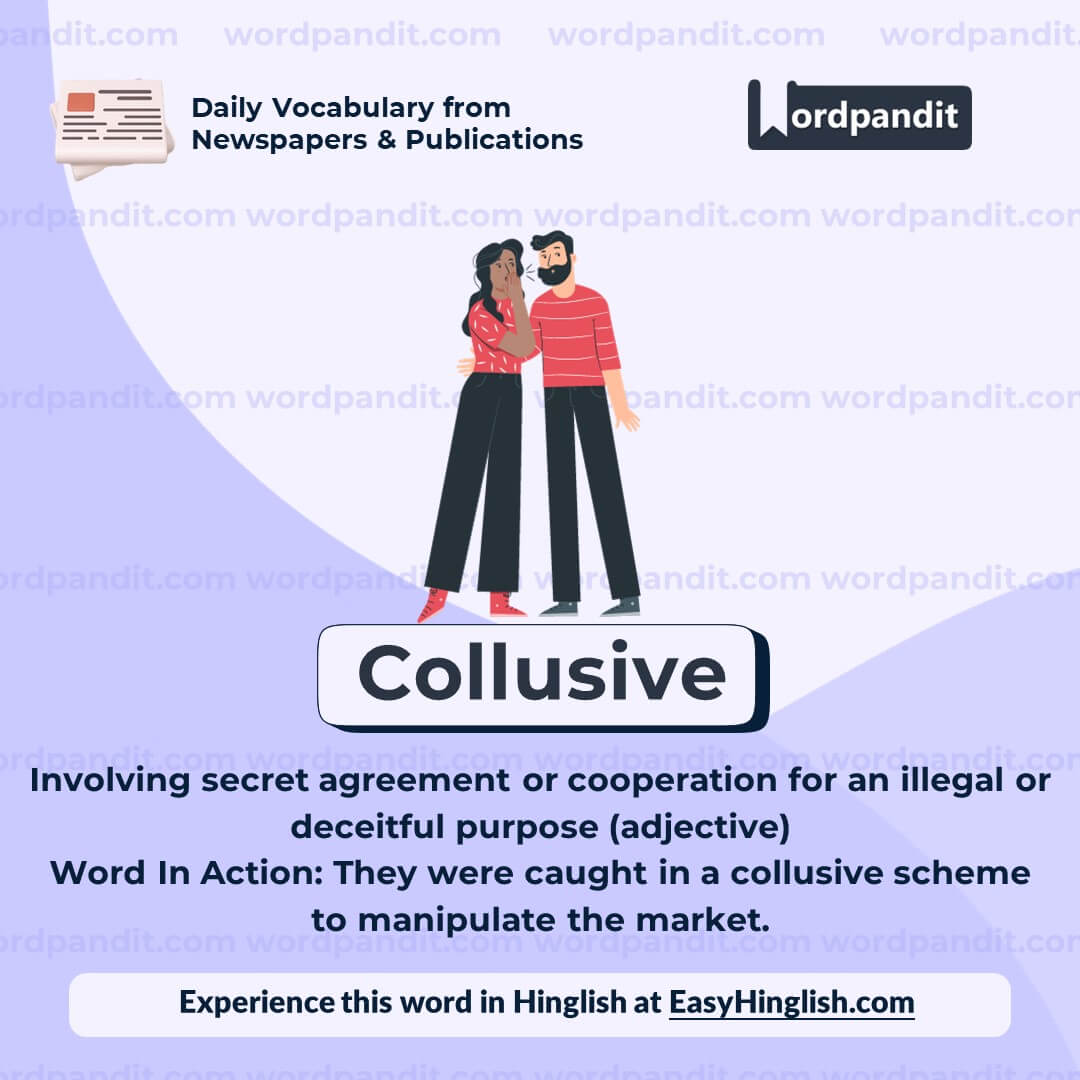
WORD-1: Collusive
Context:
"Both latter assets too were badly needed, since their prevailing numbers were grossly inadequate, compared with similar platforms operated by India's two collusive nuclear-armed rivals." - The Wire
Explanatory Paragraph:
Collusive meaning in English is 'involving secret cooperation or conspiracy between parties to deceive or gain unfair advantage.' This word is used when describing situations where two or more parties secretly work together, often to achieve something dishonest or harmful to others. How to use collusive correctly appears frequently in formal writing, especially in legal contexts, business fraud cases, international relations analysis, and competitive exam passages discussing unethical partnerships or strategic alliances.
Meaning: Involving secret agreement or cooperation, especially for fraudulent or deceitful purposes (Adjective)
Pronunciation: kuh-LOO-siv
Difficulty Level: ⭐⭐⭐ Advanced
Etymology: Collusive comes from Latin 'colludere' meaning 'to play together or conspire,' formed from 'com-' (together) and 'ludere' (to play). The word evolved through French 'collusion' into English in the 16th century, shifting from the playful sense of playing together to the darker meaning of secretly plotting together for deceptive purposes, particularly in legal and business contexts.
Prashant Sir's Notes:
Many students confuse collusive with collaborative—while both involve working together, the difference between collusive and collaborative is critical: collusive always implies secret, unethical cooperation, while collaborative is positive teamwork. For UPSC and CAT aspirants, collusive frequently appears in passages about international relations, corporate fraud, or market manipulation. In Indian newspapers, you'll often see "collusive practices" when discussing cartel behavior, bid-rigging scandals, or strategic partnerships between rival nations. The word usage in competitive exams typically signals negative intent, making it a red flag for identifying author criticism or exposing hidden agendas in comprehension passages.
Synonyms & Antonyms:
Synonyms: Conspiratorial, deceitful, fraudulent, scheming, underhand, conniving, clandestine, covert, duplicitous, treacherous
Antonyms: Transparent, honest, open, straightforward, aboveboard, genuine
Usage Examples:
- The CBI investigation revealed collusive bidding practices among telecom companies that cost the government thousands of crores in revenue.
- Priya suspected her business partners were engaging in collusive behavior when they mysteriously agreed on identical pricing strategies overnight.
- The research paper analyzed collusive arrangements between Pakistan and China regarding military technology sharing and strategic encirclement of India.
- When all shop owners in the market suddenly raised vegetable prices together, consumers complained about their collusive price-fixing tactics.
Cultural Reference:
"In the corporate thriller 'Rocket Singh,' the protagonist refuses collusive practices that his seniors engage in, choosing honest salesmanship over unethical partnerships." - Bollywood business ethics
Think About It:
How do collusive practices between businesses harm ordinary consumers in India, and what mechanisms can expose such secret cooperation?
Quick Activity:
Identify three recent news stories from Indian media where collusive behavior was alleged or proven—in politics, business, or sports—and note how the word was used to describe the secret cooperation.
Memory Tip:
Think of 'Collusive' as 'CO-ILLUSIVE'—imagine two parties creating an ILLUSION together by secretly cooperating (CO-operating) to deceive others. The 'co' reminds you of cooperation, while 'illusive' hints at the deception involved.
Real-World Application:
Collusive is commonly used in legal documents, competition law cases, investigative journalism, and international relations analysis to describe secret partnerships that harm fair competition or deceive the public. In business writing and UPSC answer sheets, using 'collusive practices' demonstrates sophisticated understanding of unethical corporate behavior, cartel formations, and strategic alliances designed to manipulate markets or geopolitical situations.
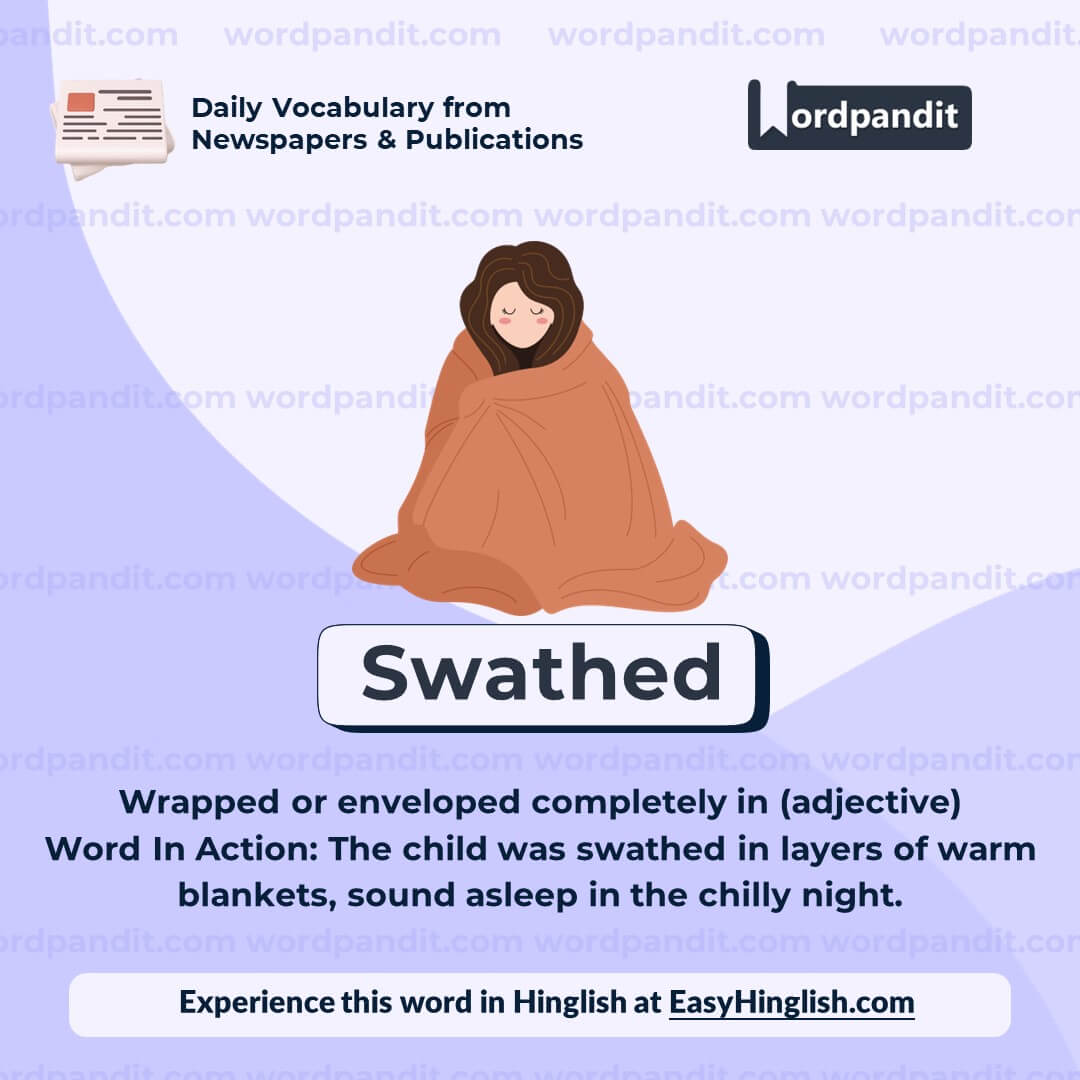
WORD-2: Swathed
Context:
"2016 acquisition of 36 Dassault Rafale fighters, he added, had been swathed in allegations of wrongdoing ahead of the 2019 Lok Sabha polls, and the BJP-led government wanted to avoid a repeat of such 'unnecessary controversies.'" - The Wire
Explanatory Paragraph:
Swathed meaning in English is 'wrapped or covered completely in layers of cloth or other material, or figuratively surrounded by something.' This word is used when describing something that is either physically wrapped up or metaphorically enveloped by circumstances, controversies, or conditions. How to use swathed appears in formal writing, literary descriptions, news articles, and competitive exam passages to create vivid imagery of complete coverage or overwhelming circumstances surrounding a person, object, or situation.
Meaning: Wrapped, covered, or surrounded completely in layers; enveloped (Verb, past tense/past participle of 'swathe')
Pronunciation: SWAYTHD (rhymes with "bathed")
Difficulty Level: ⭐⭐⭐ Intermediate to Advanced
Etymology: Swathed comes from Old English 'swathian' meaning 'to wrap or bind with bandages,' related to 'swathe' (a strip of cloth). The word has been used since medieval times to describe wrapping bodies, wounds, or objects in cloth. Over centuries, it evolved to include figurative uses, describing anything completely surrounded or enveloped by conditions, emotions, or circumstances—much like fabric wraps around an object.
Prashant Sir's Notes:
Students often ask: what is the difference between swathed and wrapped? While both mean covered, swathed usage in sentences emphasizes complete, layered covering with a more literary or dramatic tone. For CAT and GRE aspirants, swathed frequently appears in Reading Comprehension passages with figurative meaning—deals "swathed in secrecy," politicians "swathed in controversy," or mountains "swathed in mist." In Indian English newspapers, you'll commonly see "swathed in allegations" or "swathed in mystery" when describing political scandals or controversial decisions. The word signals complete envelopment, making it perfect for understanding author's emphasis on overwhelming circumstances in exam passages.
Synonyms & Antonyms:
Synonyms: Wrapped, enveloped, covered, shrouded, draped, cloaked, bundled, bandaged, enfold, enshrouded
Antonyms: Unwrapped, exposed, uncovered, revealed, bare, naked
Usage Examples:
- The Himalayan peaks were swathed in thick fog during the monsoon season, making the trekking expedition extremely dangerous for tourists.
- Amit's startup deal was swathed in secrecy until the official announcement, preventing any information leaks to competitors in the market.
- The newborn baby was swathed in soft cotton blankets by her grandmother, following traditional practices observed in many Indian families.
- The entire construction project became swathed in corruption allegations after whistleblowers revealed irregular payments to contractors and officials.
Cultural Reference:
"In countless Bollywood films, injured heroes are shown swathed in bandages after dramatic fight sequences, symbolizing their sacrifice and resilience." - Indian cinema trope
Think About It:
Why do major government deals in India often become swathed in controversy and allegations, and how does transparency help prevent such situations?
Quick Activity:
Write two sentences using 'swathed'—one describing something physically wrapped or covered, and another describing a situation figuratively surrounded by circumstances like mystery or controversy.
Memory Tip:
Think of 'Swathed' as 'SWATHE + ED' like a baby being bathed and then SWATHED (wrapped) in towels. The '-ed' ending reminds you it's past tense. Visualize a mummy completely wrapped in bandages—that's the perfect image of being swathed!
Real-World Application:
Swathed is commonly used in journalism, political analysis, and literary writing to describe both physical wrapping and metaphorical envelopment. In news articles covering Indian politics, "swathed in controversy" or "swathed in allegations" effectively conveys how scandals completely surround an issue. For competitive exam essays and formal writing, using swathed demonstrates sophisticated vocabulary, especially when describing situations overwhelmed by particular conditions or circumstances.
WORD-3: Circumscribed
Context:
"Veterans and analysts ruled out the two Russian platforms, as the ongoing war in Ukraine circumscribed Moscow's eventual ability to make good its offer." - The Wire
Explanatory Paragraph:
Circumscribed meaning in English is 'restricted, limited, or confined within certain boundaries or constraints.' This word is used when describing situations where something is restricted by specific conditions, rules, or circumstances that create clear limits. Circumscribed commonly appears in formal writing, academic texts, legal documents, and competitive exam passages to indicate how powers, abilities, rights, or options are bounded or constrained by external factors or regulations.
Meaning: Limited or restricted within defined boundaries; confined by constraints (Verb, past tense/Adjective)
Pronunciation: SUR-kum-skrybd
Difficulty Level: ⭐⭐⭐⭐ Advanced
Etymology: Circumscribed comes from Latin 'circumscribere,' formed from 'circum' (around) and 'scribere' (to write or draw). Originally, it literally meant to draw a line around something, as in geometry where a circle is drawn around a polygon. The word entered English in the 15th century and evolved to mean setting limits or boundaries around anything—powers, rights, actions, or possibilities—creating a metaphorical fence that restricts what can be done.
Prashant Sir's Notes:
Many students confuse circumscribed with prescribed—the difference between circumscribed and prescribed is crucial: circumscribed means limited or restricted, while prescribed means recommended or ordered. For UPSC and CAT aspirants, circumscribed frequently appears in passages about political powers, constitutional limitations, or geopolitical constraints. In Indian English newspapers, you'll see "circumscribed authority" when discussing how the Constitution limits government powers, or "circumscribed options" in foreign policy analysis. How to use circumscribed for competitive exams: it always signals boundaries or restrictions, making it perfect for identifying limitations in RC passages about governance, international relations, or institutional frameworks.
Synonyms & Antonyms:
Synonyms: Limited, restricted, constrained, confined, bounded, curtailed, delimited, hemmed in, restrained, curbed
Antonyms: Unlimited, unrestricted, boundless, expansive, unconstrained, free, unfettered
Usage Examples:
- The Prime Minister's powers are circumscribed by constitutional provisions, preventing any single authority from becoming too dominant in Indian democracy.
- Rahul's career options were circumscribed by his family's financial situation, forcing him to choose practical engineering over his passion for art.
- India's military procurement choices are often circumscribed by budgetary constraints, geopolitical alignments, and technology transfer requirements from foreign suppliers.
- The startup's expansion plans were circumscribed by strict regulatory requirements in the fintech sector, delaying their entry into new markets.
Cultural Reference:
"In '3 Idiots,' Farhan's dreams are circumscribed by his father's expectations—he wants to be a wildlife photographer but is forced to study engineering." - Bollywood exploration of limited choices
Think About It:
How do socioeconomic circumstances circumscribe educational and career opportunities for millions of talented students in India, and what policies can expand these boundaries?
Quick Activity:
Identify three areas in your own life where your choices or actions are circumscribed by external factors—family expectations, financial constraints, or institutional rules—and write one sentence for each.
Memory Tip:
Break 'Circumscribed' into 'CIRCUM-SCRIBED'—think of drawing a CIRCLE around something and SCRIBING (writing) a boundary line. Just as a circle creates a boundary that limits what's inside, circumscribed means restricted within definite limits. Visualize drawing a circle around your options!
Real-World Application:
Circumscribed is commonly used in legal writing, constitutional analysis, political commentary, and academic papers to describe limitations on powers, rights, or abilities. In UPSC answers and CAT essays, using circumscribed demonstrates sophisticated understanding of how external factors create boundaries—whether discussing judicial powers circumscribed by law, economic growth circumscribed by infrastructure, or diplomatic options circumscribed by geopolitical realities. The word is essential for analyzing any situation involving constraints and limitations.
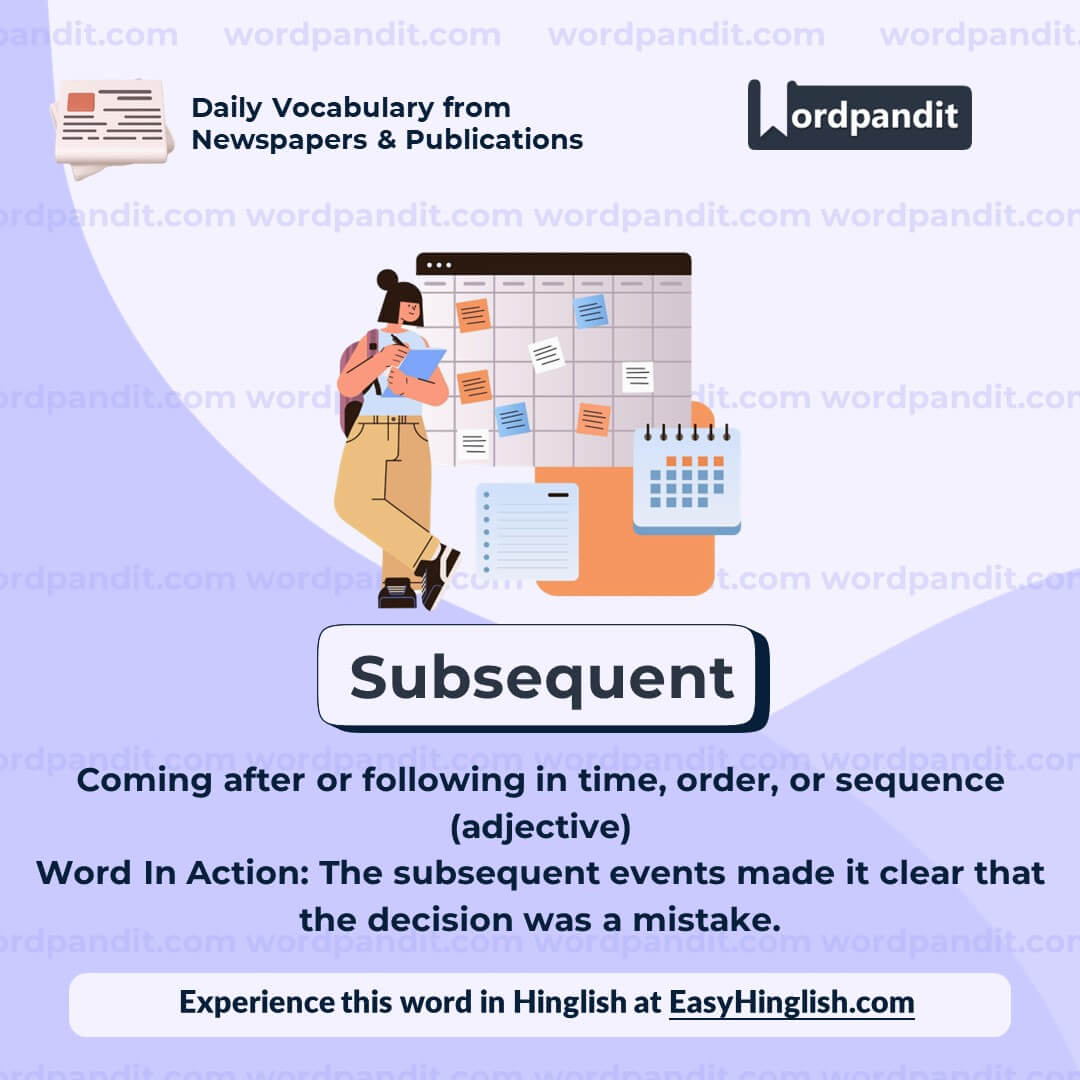
WORD-4: Subsequent
Context:
"His decade-long incarceration as a paraplegic and his subsequent death shortly after his release will remain a rising howl in the dark labyrinths of India's justice delivery." - The Wire
Explanatory Paragraph:
Subsequent meaning in English is 'coming after something in time or order; following as a result or consequence.' This word is used when referring to events, actions, or developments that occur after an earlier event, often showing a chronological sequence or causal relationship. How to use subsequent correctly appears frequently in formal writing, news reports, academic papers, legal documents, and competitive exam passages where maintaining clear temporal sequences is essential for understanding cause-and-effect relationships.
Meaning: Coming after something in time; following in sequence or as a result (Adjective)
Pronunciation: SUB-si-kwent
Difficulty Level: ⭐⭐ Intermediate
Etymology: Subsequent comes from Latin 'subsequi,' formed from 'sub' (close to, under) and 'sequi' (to follow). The word literally means 'following closely after' and entered English in the 15th century through French. Initially used in formal contexts to describe events in chronological order, it has become a standard term in legal, academic, and journalistic writing to establish clear temporal relationships between events, actions, or consequences.
Prashant Sir's Notes:
Students often ask: what is the difference between subsequent and consequent? While both indicate something following, subsequent usage in sentences simply means 'coming after in time,' while consequent implies a cause-and-effect relationship. For CAT, GRE, and UPSC aspirants, subsequent is one of those connector words that signals chronological order in Reading Comprehension passages—when you see "subsequent events" or "subsequent developments," the author is moving the timeline forward. In Indian newspapers, you'll frequently encounter "subsequent investigation revealed" or "subsequent amendments were made," indicating what happened after an initial event. This word is essential for understanding passage structure and timeline questions in competitive exams.
Synonyms & Antonyms:
Synonyms: Following, later, ensuing, succeeding, next, future, after, posterior, consequent (in some contexts), successive
Antonyms: Previous, prior, earlier, preceding, antecedent, former, initial
Usage Examples:
- The 2020 lockdown caused widespread job losses, and subsequent economic recovery took nearly two years across various sectors in India.
- Priya's initial meeting with the investors went well, and subsequent discussions led to a successful funding round for her startup.
- The Supreme Court's landmark judgment and subsequent clarifications by the government transformed privacy laws in the country fundamentally.
- After Sachin scored his first Test century in England, subsequent tours saw him dominate bowling attacks across all conditions worldwide.
Cultural Reference:
"India's 1983 Cricket World Cup victory and subsequent surge in cricket's popularity transformed the sport into a national obsession across generations." - Sports history milestone
Think About It:
How do initial policy decisions by governments shape subsequent economic and social developments in a country like India over decades?
Quick Activity:
Write three sentences about your educational journey using 'subsequent' to connect different stages—for example, your class 10 results and subsequent subject choices, or your graduation and subsequent career decisions.
Memory Tip:
Think of 'Subsequent' as 'SUB-SEQUENCE'—like episodes in a TV series, where SUB (under/after) + SEQUENCE means the next part in order. When you finish episode 5, the SUBSEQUENT episode is episode 6. It's all about what comes NEXT in the sequence!
Real-World Application:
Subsequent is essential in legal documents, research papers, news analysis, and historical accounts to establish clear chronological sequences. In business reports and project documentation, "subsequent phases" or "subsequent meetings" indicate what follows initial steps. For UPSC answer writing and CAT essays, using subsequent helps create logical flow when discussing historical events, policy implementations, or case study developments. The word is particularly valuable in cause-and-effect analysis and timeline-based questions in competitive exams.
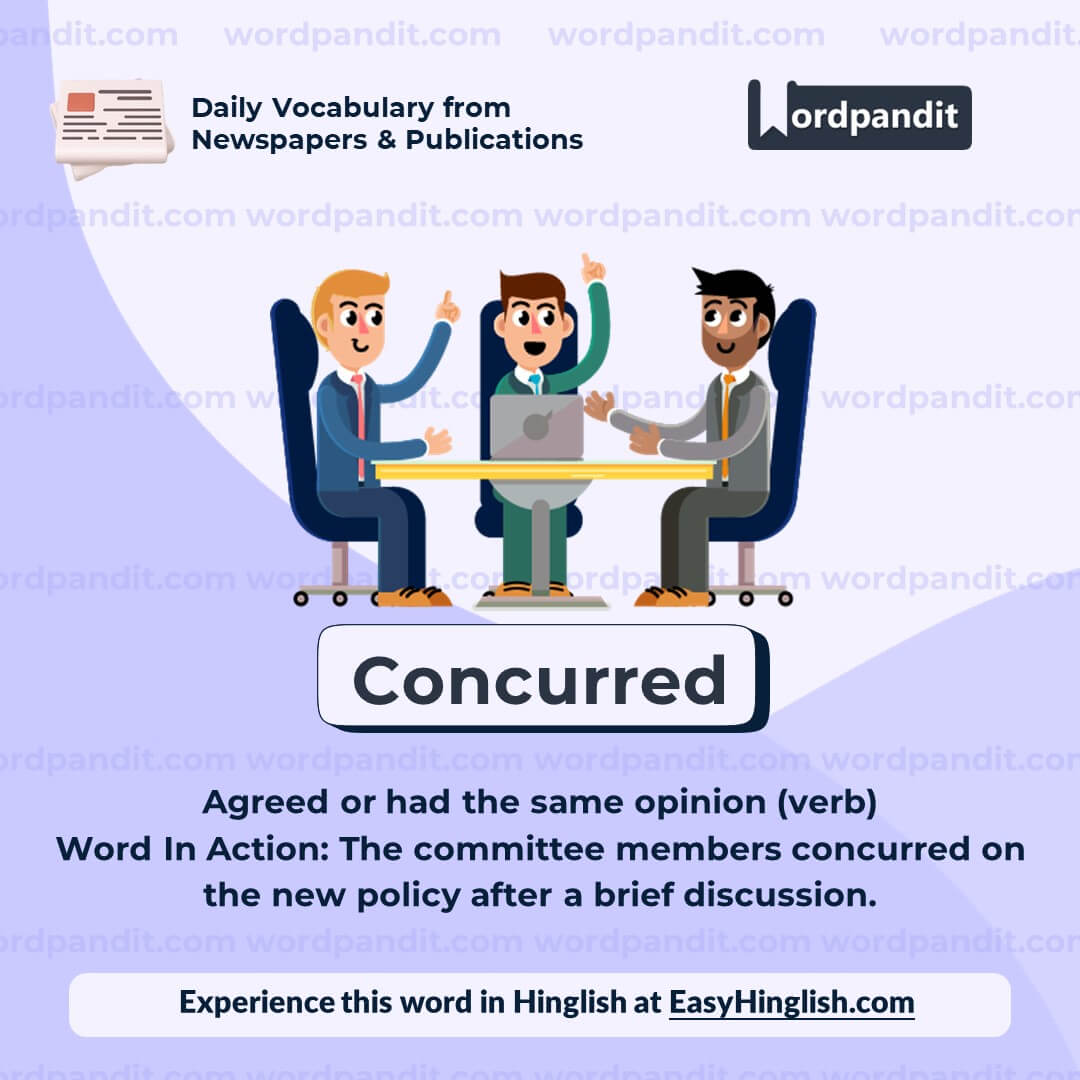
WORD-5: Concurred
Context:
"IAF veterans concurred that acquiring additional Rafales made 'commercial, logistical and operational' sense, recent media reports had ruled the French fighter out of the MRFA contest." - The Wire
Explanatory Paragraph:
Concurred meaning in English is 'agreed with someone or something; expressed the same opinion or reached the same conclusion.' This word is used when multiple people or groups reach agreement on a particular point, decision, or viewpoint after consideration. How to use concurred appears frequently in formal writing, legal judgments, official reports, academic discussions, and competitive exam passages where consensus, agreement, or shared opinions need to be expressed with professional precision and authority.
Meaning: Agreed with an opinion, decision, or judgment; expressed the same view (Verb, past tense of 'concur')
Pronunciation: kun-KURD
Difficulty Level: ⭐⭐⭐ Intermediate
Etymology: Concurred comes from Latin 'concurrere,' formed from 'con-' (together) and 'currere' (to run). The word literally meant 'to run together' or 'meet at the same point,' which evolved metaphorically to mean 'coming to the same conclusion' or 'agreeing together.' Entering English in the 15th century, it became particularly common in legal and formal contexts where judges, experts, or officials need to express agreement with formal precision rather than casual assent.
Prashant Sir's Notes:
Many students confuse concurred with agreed—while both mean expressing the same opinion, the difference between concurred and agreed lies in formality and context. Concurred is more formal and often used when experts, judges, or officials reach agreement after deliberation, while agreed is casual everyday language. For CAT and UPSC aspirants, concurred frequently appears in passages about legal judgments ("Justice Sharma concurred with the majority opinion"), expert panels, or policy discussions. In Indian English newspapers, you'll see "analysts concurred that" or "the committee concurred with" when describing professional consensus. Concurred usage in competitive exams signals authoritative agreement, making it essential for understanding how multiple viewpoints align in RC passages.
Synonyms & Antonyms:
Synonyms: Agreed, assented, consented, accorded, coincided, aligned, harmonized, approved, endorsed, supported
Antonyms: Disagreed, dissented, objected, opposed, differed, contested, disputed, contradicted
Usage Examples:
- The Supreme Court judges concurred with the Chief Justice's opinion that the constitutional amendment required stricter scrutiny and detailed examination.
- Financial experts across India concurred that the Reserve Bank's decision to maintain interest rates was prudent given current inflation trends.
- After reviewing the project proposal, all department heads concurred that additional budget allocation was necessary for successful implementation and timely completion.
- Leading economists concurred with Dr. Sen's assessment that India's GDP growth projections needed revision based on global economic uncertainties.
Cultural Reference:
"In the historic Kesavananda Bharati case, several Supreme Court judges concurred with the landmark 'basic structure' doctrine that fundamentally shaped Indian constitutional law." - Legal milestone
Think About It:
Why is it significant when multiple experts or authorities concur on a complex issue, and how does such consensus influence public policy decisions in India?
Quick Activity:
Find a recent news article where multiple experts, judges, or officials concurred on an important decision, and write two sentences explaining what they agreed upon and why their consensus mattered.
Memory Tip:
Think of 'Concurred' as 'CON-CURRENT'—imagine multiple currents (opinions) flowing CON (together) in the same direction, like rivers merging. When people CONCUR, their thoughts run together toward the same conclusion, just like water currents converging at one point!
Real-World Application:
Concurred is commonly used in legal judgments, official reports, academic papers, expert panel discussions, and formal business communications to indicate professional agreement. In Supreme Court judgments, "Justice X concurred with the majority opinion" shows alignment among judges. For UPSC answer writing, using concurred when discussing expert consensus or committee recommendations demonstrates sophisticated formal vocabulary. In CAT Reading Comprehension, recognizing when multiple viewpoints concur helps identify areas of agreement versus disagreement in complex passages.


