Daily Vocabulary from Indian Newspapers and Publications
Welcome to Wordpandit’s Indian Vocabulary Hub
At Wordpandit, we understand the importance of staying rooted in the local context while expanding your language skills. This section focuses on enriching your vocabulary with words and phrases drawn from India’s leading newspapers and publications, ensuring you're learning vocabulary that is practical, relevant, and uniquely Indian.
Why Indian Sources Matter
We believe that the best way to master any language is by immersing yourself in local content. That’s why we carefully curate vocabulary from top Indian publications, including:
- The Hindu
- The Times of India
- The Economic Times
- Hindustan Times
- Live Mint
- The Indian Express
- And many others...
Stay Updated, Stay Relevant
With daily updates from Indian news sources, you’ll be consistently learning words that reflect the trends and shifts in Indian society and culture. Our focus is to provide vocabulary that enhances your understanding of the language in an Indian context.
How Wordpandit Supports Your Goals
Whether you’re preparing for exams, aiming to improve your professional communication, or simply want to stay connected with the latest Indian vocabulary, Wordpandit is here to guide you every step of the way.
Learn with a Practical Approach
Our interactive learning methodology includes real-world examples, engaging activities, and context-specific usage to ensure that every word becomes part of your active vocabulary.
Dive into Indian Vocabulary Today!

Why Choose Wordpandit?
Practical Learning: Focus on words you'll actually encounter in real-world reading, enhancing your comprehension and communication skills.
Diverse Content: From current affairs to scientific breakthroughs, our varied sources expose you to vocabulary across multiple domains.
Effortless Integration: Make Wordpandit a part of your daily routine. Just a few minutes each day can significantly boost your lexicon over time.
Your Path to Vocabulary Mastery
- Visit our Daily Vocabulary section regularly
- Explore new words and their usage in context
- Practice incorporating these words into your own writing and speech
- Track your progress as your vocabulary expands
Start Your Journey Today
Embark on your vocabulary enhancement journey with Wordpandit. By consistently engaging with our daily posts, you'll build a robust vocabulary that serves you well in academic, professional, and personal contexts.
Remember, a word a day keeps linguistic limitations at bay. Make Wordpandit your daily companion in the quest for vocabulary excellence!
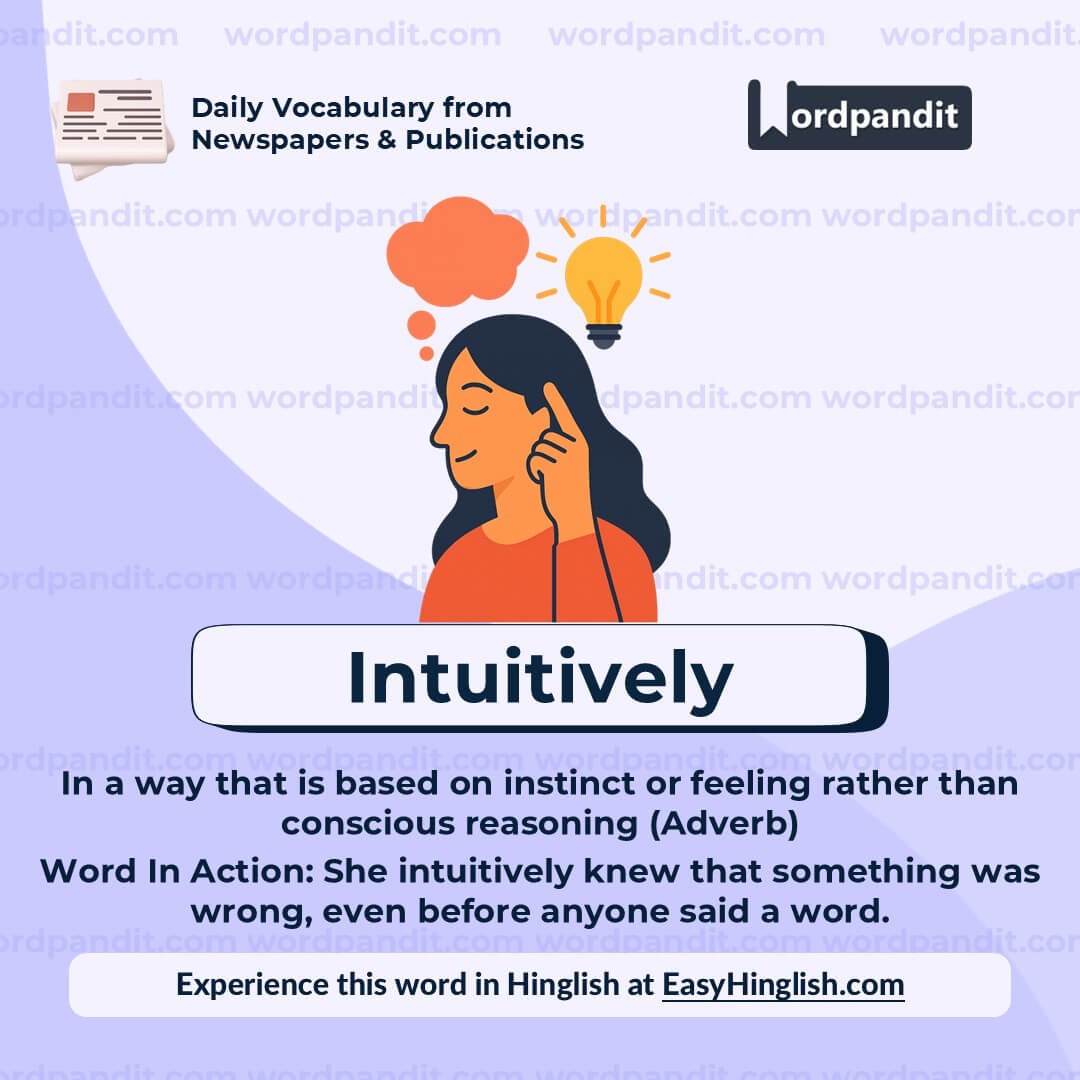
WORD-1: Intuitively
Context:
"We vibe beliefs mostly via intuitively feeling out their associations with people, other beliefs, and our personal status." - Overcoming Bias
Explanatory Paragraph:
Intuitively meaning in English is 'understanding or grasping something instinctively without needing conscious reasoning or evidence.' This word is used when someone reaches conclusions based on gut feeling or inner sense rather than logical analysis. How to use intuitively effectively: it appears frequently in formal writing, psychology discussions, competitive exam passages, and everyday conversations about decision-making and natural understanding.
Meaning: In a way that is based on instinct or feeling rather than conscious reasoning (Adverb)
Pronunciation: in-too-IT-iv-lee
Difficulty Level: ⭐⭐ Basic to Intermediate
Etymology: Intuitively comes from the Latin word 'intueri' meaning 'to look at' or 'to contemplate,' which evolved through Medieval Latin 'intuitivus.' The word developed to describe knowledge that comes from an inner vision or immediate understanding without the need for step-by-step reasoning, reflecting how we sometimes 'see' the truth of something instantly.
Prashant Sir's Notes:
Many students confuse 'intuitively' with 'instinctively'—while both involve automatic responses, the difference between intuitively and instinctively is that intuitive understanding involves some level of mental processing based on experience, while instinctive reactions are purely biological. For CAT and GRE aspirants, intuitively frequently appears in reading comprehension passages about decision-making, psychology, and human behavior. In competitive exam essays, understanding intuitively usage in sentences helps express ideas about natural comprehension: "She intuitively understood the problem" shows immediate grasp without analysis. Indian students often encounter this word in business case studies where managers make decisions that feel right without detailed data analysis.
Synonyms & Antonyms:
Synonyms: instinctively, naturally, spontaneously, automatically, innately, inherently, subconsciously, unconsciously, immediately, effortlessly
Antonyms: analytically, rationally, logically, deliberately, consciously, methodically
Usage Examples:
- Priya intuitively knew that accepting the job offer in Bangalore would be the right career move despite lower initial salary.
- The experienced doctor intuitively sensed something unusual about the patient's symptoms before any test results confirmed his suspicions.
- Children intuitively understand fairness and justice long before they learn formal rules about right and wrong behavior in school.
- Rahul intuitively grasped the complex mathematical concept that his classmates struggled to understand even after detailed explanations from the teacher.
Cultural Reference:
"In cricket, great captains like MS Dhoni make field placement changes intuitively, sensing the batsman's intentions before the shot is even played." - Common observation in cricket commentary
Think About It:
How much should we trust our intuitive feelings versus logical analysis when making important life decisions like choosing a career or life partner?
Quick Activity:
Think of three decisions you made intuitively in the past month—what did you understand without conscious reasoning? Write one sentence about each situation explaining what your intuition told you.
Memory Tip:
Think of "IN-TU-IT-ively" as "IN-side YOU-IT-comes"—the understanding comes from inside you naturally, like how you intuitively know when someone is upset just by looking at their face, without them saying anything.
Real-World Application:
Intuitively is commonly used in business reports, psychology articles, and academic papers to describe natural understanding or user-friendly design. In UX design discussions, professionals say "the interface should work intuitively" meaning users should understand it without instructions. For competitive exam essays and RC passages, recognizing intuitively helps identify arguments about natural comprehension versus learned knowledge, a frequent theme in CAT and GRE critical reasoning questions.

WORD-2: Consciously
Context:
"We analyze such beliefs by more consciously and explicitly comparing our beliefs logically to concrete analysis of relevant data and established theory." - Overcoming Bias
Explanatory Paragraph:
Consciously meaning in English is 'being fully aware and intentional about one's thoughts, actions, or decisions.' This word is used when someone deliberately pays attention to what they are doing rather than acting automatically or unconsciously. How to use consciously in writing: it appears frequently in psychology texts, self-improvement articles, competitive exam passages about human behavior, and discussions about deliberate decision-making and mindfulness.
Meaning: In a deliberate and intentional way, with full awareness (Adverb)
Pronunciation: KON-shus-lee
Difficulty Level: ⭐⭐ Basic to Intermediate
Etymology: Consciously derives from Latin 'conscius' meaning 'knowing with others' or 'aware,' formed from 'con-' (with) and 'scire' (to know). The word evolved through French into English in the 17th century, developing its modern meaning of being fully aware and intentional about one's mental state or actions, distinguishing deliberate awareness from automatic behavior.
Prashant Sir's Notes:
Students often ask: what is the difference between consciously and deliberately? While both involve intention, consciously usage emphasizes awareness and mental attention, whereas deliberately focuses on purposeful action. For UPSC and CAT aspirants, consciously frequently appears in passages about psychology, decision-making, and behavioral economics. Many students confuse 'consciously' with 'self-consciously'—the key difference is that consciously simply means 'with awareness,' while self-consciously means 'with awkward awareness of being observed.' In Indian English newspapers, you'll see phrases like "consciously avoiding communal language" or "consciously promoting diversity," where the emphasis is on deliberate, aware action rather than accidental behavior.
Synonyms & Antonyms:
Synonyms: deliberately, intentionally, purposefully, knowingly, willfully, mindfully, awarely, calculatedly, on purpose, with awareness
Antonyms: unconsciously, unintentionally, accidentally, inadvertently, automatically, unwittingly
Usage Examples:
- Meera consciously decided to reduce her screen time and spend more quality moments with her family during weekends.
- The company consciously avoided hiring practices that could lead to gender discrimination in their Pune and Mumbai offices.
- During meditation, Amit consciously focused on his breathing pattern to calm his mind before the important presentation at work.
- Indian filmmakers are now consciously creating content that challenges stereotypes rather than unconsciously perpetuating them through lazy storytelling.
Cultural Reference:
"After the 2019 World Cup semi-final loss, Virat Kohli spoke about consciously working on his mental approach to pressure situations, showing how top athletes develop awareness of their psychological patterns." - Sports psychology discussions
Think About It:
How many of your daily decisions are made consciously versus running on autopilot, and does living more consciously actually improve the quality of our choices?
Quick Activity:
For the next hour, consciously notice three automatic behaviors you usually do without thinking—like checking your phone, your posture while sitting, or your tone when speaking. Write one sentence describing what you became aware of.
Memory Tip:
Break "CON-SCIOUS-LY" into "CON (with) + SCIENCE (knowledge)"—when you act consciously, you're acting WITH full KNOWLEDGE and awareness of what you're doing, like a scientist observing their own experiment carefully.
Real-World Application:
Consciously is extensively used in professional development articles, business communication about inclusive practices, and academic writing about behavioral change. In corporate diversity initiatives, you'll find phrases like "consciously building inclusive teams" or "consciously checking biases." For CAT and GRE reading comprehension, recognizing consciously helps identify passages about intentional behavior versus automatic responses, a common theme in psychology and sociology texts that frequently appear in verbal reasoning sections.

WORD-3: Speculate
Context:
"There are reasons to speculate that this time is different, but creating silicon intelligence is not the only problem to be solved if we want to see living standards grow at 20 per cent a year." - Tim Harford
Explanatory Paragraph:
Speculate meaning in English is 'to form opinions or theories about something without having complete evidence or certainty.' This word is used when someone makes educated guesses or considers possibilities about uncertain future events or unproven situations. How to use speculate correctly: it commonly appears in news articles, financial reports, academic discussions, and competitive exam passages where authors discuss possibilities, predictions, or uncertain scenarios based on limited information.
Meaning: To form a theory or conjecture without firm evidence; to engage in risky financial transactions (Verb)
Pronunciation: SPEK-yoo-layt
Difficulty Level: ⭐⭐⭐ Intermediate
Etymology: Speculate comes from Latin 'speculari' meaning 'to spy out' or 'to observe,' derived from 'specula' (watchtower). The word originally meant to observe carefully from a distance, like a lookout scanning the horizon. Over time, it evolved to mean forming theories about things we cannot fully see or know, and later acquired its financial meaning of making risky investments based on predictions about future price movements.
Prashant Sir's Notes:
Many students confuse 'speculate' with 'assume' or 'guess'—the difference between speculate and assume is crucial for CAT and GRE reading comprehension. When you speculate, you're making an informed conjecture based on some evidence or reasoning, whereas assuming means accepting something as true without evidence. For UPSC and banking exam aspirants, speculate appears frequently in two contexts: intellectual speculation (forming theories) and financial speculation (risky investments). In Indian English newspapers, you'll often see "experts speculate that the RBI might cut interest rates" or "analysts speculate about the election outcome"—notice how speculation involves uncertainty but isn't completely baseless. The usage pattern is typically "speculate that," "speculate about," or "speculate on," and it signals the author is presenting possibilities rather than confirmed facts.
Synonyms & Antonyms:
Synonyms: conjecture, theorize, hypothesize, surmise, guess, suppose, postulate, contemplate, wonder, reflect (for intellectual meaning); gamble, venture, risk (for financial meaning)
Antonyms: know, confirm, verify, prove, establish, ascertain, determine
Usage Examples:
- Political analysts speculate that the upcoming assembly elections in Karnataka will be closely contested between the major parties.
- Investors who speculated heavily in cryptocurrency during the 2021 boom suffered significant losses when the market crashed in 2022.
- Scientists can only speculate about what conditions existed on Earth before the formation of the earliest rocks found today.
- Ravi refused to speculate about his promotion chances, preferring to wait for the official announcement rather than build false hopes.
Cultural Reference:
"After every Indian cricket team selection, former players and commentators speculate endlessly about the strategy behind including or dropping certain players, though only the selectors truly know their reasoning." - Common pattern in Indian sports media
Think About It:
In an age of information overload, how do we distinguish between informed speculation based on evidence and baseless speculation that spreads misinformation?
Quick Activity:
Open today's newspaper and find three instances where journalists or experts speculate about future events. Note what evidence they base their speculation on and whether they clearly signal uncertainty in their language.
Memory Tip:
Think of "SPEC-ulate" as "SPECTACLES-late"—when you speculate, you're looking through spectacles trying to see something that's unclear or far away, making educated guesses about what you observe but cannot fully confirm, just like watching a distant cricket match without binoculars.
Real-World Application:
Speculate is essential vocabulary in financial journalism, economic analysis, scientific papers, and opinion pieces. In business reports, you'll encounter phrases like "analysts speculate that the merger will" or "experts speculate about market trends." For competitive exams, understanding speculate for CAT and GRE helps identify passages where authors present uncertain predictions versus confirmed facts—a critical skill for inference questions. In formal writing, using speculate signals intellectual honesty, showing you're presenting possibilities rather than claiming certainty about unknown outcomes.
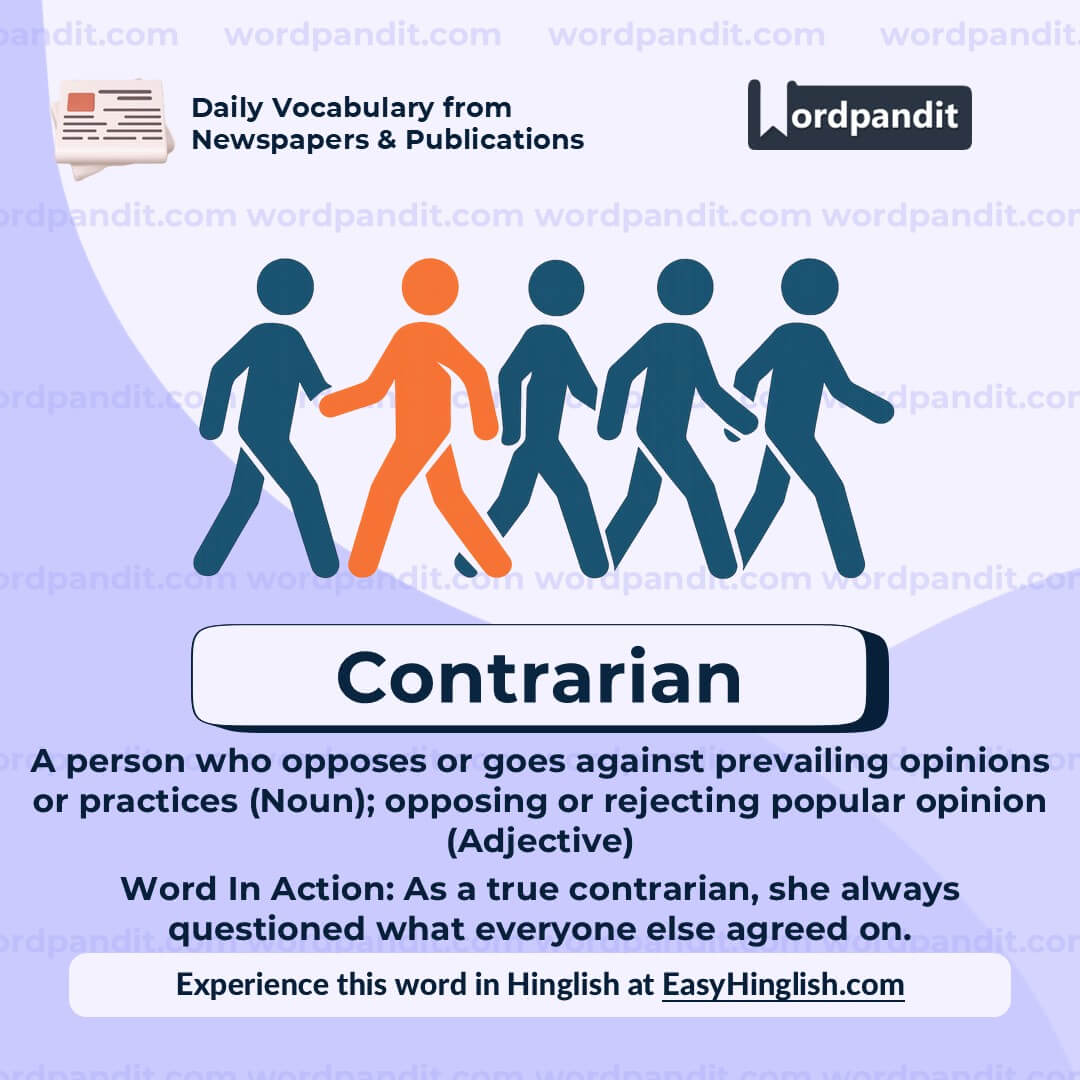
WORD-4: Contrarian
Context:
"Of course you could just not be any sort of contrarian, and embrace the most common prestigious vibes." - Overcoming Bias
Explanatory Paragraph:
Contrarian meaning in English is 'a person who opposes or rejects popular opinion, going against mainstream beliefs or trends.' This word is used when describing someone who deliberately takes positions opposite to the majority view. How to use contrarian effectively: it appears frequently in business journalism, investment discussions, opinion pieces, and competitive exam passages about independent thinking, where it describes individuals who challenge conventional wisdom rather than follow the crowd.
Meaning: A person who opposes or goes against prevailing opinions or practices (Noun); opposing or rejecting popular opinion (Adjective)
Pronunciation: kun-TRAIR-ee-un
Difficulty Level: ⭐⭐⭐ Intermediate
Etymology: Contrarian comes from the Latin 'contrarius' meaning 'opposite' or 'contrary,' which itself derives from 'contra' (against). The word entered English through legal terminology in the 16th century, initially describing someone who argued the opposite side of a case. By the 20th century, it gained popularity in financial markets to describe investors who go against market trends, and later expanded to describe anyone who habitually opposes mainstream thinking.
Prashant Sir's Notes:
Students often ask: what is the difference between contrarian and rebel? While both oppose the mainstream, contrarian usage specifically emphasizes intellectual opposition based on reasoning, while rebel implies broader defiance often with emotional or political dimensions. For CAT and GRE aspirants, contrarian frequently appears in reading comprehension passages about investment strategies, critical thinking, and innovation—Warren Buffett is the classic contrarian investor example. Many students confuse being contrarian with simply being negative, but true contrarians take opposing positions based on independent analysis, not just for the sake of disagreement. In Indian business journalism, you'll see "contrarian view" or "contrarian bet" when someone goes against market sentiment—like investing in sectors everyone else is avoiding. The key pattern: contrarians oppose popular opinion when they believe the crowd is wrong, not just to be different.
Synonyms & Antonyms:
Synonyms: nonconformist, dissenter, maverick, iconoclast, rebel, skeptic, independent thinker, challenger, opponent, heretic (in intellectual contexts)
Antonyms: conformist, follower, traditionalist, orthodox thinker, yes-man, sheep, mainstream thinker
Usage Examples:
- Rakesh Jhunjhunwala was known as a contrarian investor who made billions by buying stocks that others were selling during market panics.
- The startup founder took a contrarian approach to hiring, preferring college dropouts with passion over candidates with prestigious MBA degrees.
- Priya's contrarian opinion that remote work reduces productivity sparked heated debate in the company meeting where everyone praised work-from-home policies.
- Being contrarian just for attention is different from genuinely challenging flawed popular beliefs through careful reasoning and evidence.
Cultural Reference:
"In the film '3 Idiots,' Rancho is the ultimate contrarian student who questions rote learning and conventional definitions of success, challenging the entire education system's approach to engineering." - Analysis of Bollywood's portrayal of independent thinking
Think About It:
Is being contrarian a sign of independent thinking and courage, or can it sometimes be just another form of attention-seeking behavior disguised as intellectual bravery?
Quick Activity:
Identify one popular belief in your field or social circle that you disagree with. Write two sentences explaining your contrarian position and the reasoning behind it, ensuring it's based on analysis rather than just opposition.
Memory Tip:
Think of "CONTRA-rian" with "CONTRA" meaning "against"—a contrarian is someone who goes AGAINST the grain, like swimming against the current when everyone else floats downstream. Picture someone walking in the opposite direction on a crowded Mumbai local train platform.
Real-World Application:
Contrarian is extensively used in financial journalism, business strategy discussions, and opinion columns. In stock market analysis, "contrarian investing" refers to buying when others sell and vice versa. For CAT and GRE reading comprehension, recognizing contrarian helps identify authors who challenge mainstream views—a common passage structure in verbal reasoning sections. In professional communication, describing someone as having a "contrarian perspective" signals intellectual independence without the negative connotation of words like "stubborn" or "difficult," making it valuable for diplomatic business writing and academic discourse.

WORD-5: Profligate
Context:
"All but the most profligate governments would see their fiscal problems evaporate, the burden of the national debt vaporised by the white heat of economic growth." - Tim Harford
Explanatory Paragraph:
Profligate meaning in English is 'recklessly extravagant or wasteful, especially in the use of money or resources.' This word is used when describing excessive spending without regard for consequences or future needs. How to use profligate in formal writing: it appears frequently in economic analysis, political commentary, financial journalism, and competitive exam passages discussing fiscal irresponsibility, where it conveys strong disapproval of careless expenditure patterns by individuals, corporations, or governments.
Meaning: Recklessly extravagant or wasteful in spending; dissolute in moral behavior (Adjective)
Pronunciation: PROF-li-git or PROF-li-gayt
Difficulty Level: ⭐⭐⭐⭐ Advanced
Etymology: Profligate comes from Latin 'profligatus,' the past participle of 'profligare' meaning 'to strike down' or 'to ruin,' formed from 'pro-' (forward) and 'fligare' (to strike). Originally meaning 'overthrown' or 'ruined,' the word evolved in the 16th century to describe people who had ruined themselves through immoral or wasteful behavior. It gradually specialized to emphasize reckless extravagance, particularly financial wastefulness, while retaining connotations of moral dissolution.
Prashant Sir's Notes:
Many students confuse 'profligate' with 'extravagant'—the key difference between profligate and extravagant is that profligate carries strong moral judgment and implies reckless irresponsibility, while extravagant simply means spending more than necessary. For UPSC and CAT aspirants, profligate usage in passages often appears in discussions about government spending, corporate governance, or economic policy. In Indian English newspapers, particularly Economic Times and Business Standard, you'll encounter "profligate spending" when criticizing fiscal policies or "profligate borrowing" when discussing debt crises. The word signals not just wastefulness but dangerous, irresponsible behavior that threatens future stability. For GRE vocabulary, remember that profligate has both financial and moral dimensions—historical contexts often use it to describe dissolute lifestyles, while modern usage focuses heavily on fiscal irresponsibility.
Synonyms & Antonyms:
Synonyms: extravagant, wasteful, spendthrift, improvident, reckless, dissolute, immoderate, prodigal, lavish (with negative connotation), irresponsible, dissipated
Antonyms: frugal, thrifty, economical, prudent, careful, responsible, abstemious, parsimonious, austere
Usage Examples:
- The state government's profligate spending on non-essential projects left no funds for crucial infrastructure development in rural Maharashtra.
- Despite warnings from financial advisors, the company's profligate founder continued hosting lavish parties while employee salaries remained unpaid for months.
- Critics argue that profligate consumer behavior driven by easy credit is creating a debt crisis among young urban professionals in Indian cities.
- The opposition accused the ruling party of profligate misuse of public funds, citing the billions spent on vanity projects while education budgets were slashed.
Cultural Reference:
"Vijay Mallya's profligate lifestyle—private jets, yachts, and extravagant parties—while his airline Kingfisher accumulated massive debts became a symbol of corporate irresponsibility in Indian business history." - Business journalism on corporate excess
Think About It:
When does generous spending cross the line into profligate behavior, and who decides where that boundary lies—especially when personal freedom clashes with social responsibility?
Quick Activity:
Find two news articles from the past month discussing government or corporate spending. Identify whether the spending described could be called profligate and write one sentence explaining why or why not based on the consequences described.
Memory Tip:
Break "PROF-li-gate" into "PROFIT-LEAK-GATE"—imagine money leaking through a gate that should protect profits. A profligate person or government leaves the gate open, letting resources flow away recklessly, like water leaking from a broken tank that should store it carefully.
Real-World Application:
Profligate is essential vocabulary in economic journalism, political analysis, and financial commentary. In budget debates, opposition parties accuse governments of "profligate fiscal policies," while economists warn against "profligate consumption patterns." For competitive exams like CAT, GRE, and UPSC, understanding profligate for reading comprehension helps identify strong negative judgments about spending behavior in passages about economics, governance, or corporate ethics. In formal business writing, using profligate conveys serious criticism—it's stronger than "wasteful" and implies dangerous irresponsibility that threatens long-term sustainability.