

Daily Vocabulary from Indian Newspapers and Publications
Welcome to Wordpandit’s Indian Vocabulary Hub
At Wordpandit, we understand the importance of staying rooted in the local context while expanding your language skills. This section focuses on enriching your vocabulary with words and phrases drawn from India’s leading newspapers and publications, ensuring you're learning vocabulary that is practical, relevant, and uniquely Indian.
Why Indian Sources Matter
We believe that the best way to master any language is by immersing yourself in local content. That’s why we carefully curate vocabulary from top Indian publications, including:
- The Hindu
- The Times of India
- The Economic Times
- Hindustan Times
- Live Mint
- The Indian Express
- And many others...
Stay Updated, Stay Relevant
With daily updates from Indian news sources, you’ll be consistently learning words that reflect the trends and shifts in Indian society and culture. Our focus is to provide vocabulary that enhances your understanding of the language in an Indian context.
How Wordpandit Supports Your Goals
Whether you’re preparing for exams, aiming to improve your professional communication, or simply want to stay connected with the latest Indian vocabulary, Wordpandit is here to guide you every step of the way.
Learn with a Practical Approach
Our interactive learning methodology includes real-world examples, engaging activities, and context-specific usage to ensure that every word becomes part of your active vocabulary.
Dive into Indian Vocabulary Today!

Why Choose Wordpandit?
Practical Learning: Focus on words you'll actually encounter in real-world reading, enhancing your comprehension and communication skills.
Diverse Content: From current affairs to scientific breakthroughs, our varied sources expose you to vocabulary across multiple domains.
Effortless Integration: Make Wordpandit a part of your daily routine. Just a few minutes each day can significantly boost your lexicon over time.
Your Path to Vocabulary Mastery
- Visit our Daily Vocabulary section regularly
- Explore new words and their usage in context
- Practice incorporating these words into your own writing and speech
- Track your progress as your vocabulary expands
Start Your Journey Today
Embark on your vocabulary enhancement journey with Wordpandit. By consistently engaging with our daily posts, you'll build a robust vocabulary that serves you well in academic, professional, and personal contexts.
Remember, a word a day keeps linguistic limitations at bay. Make Wordpandit your daily companion in the quest for vocabulary excellence!
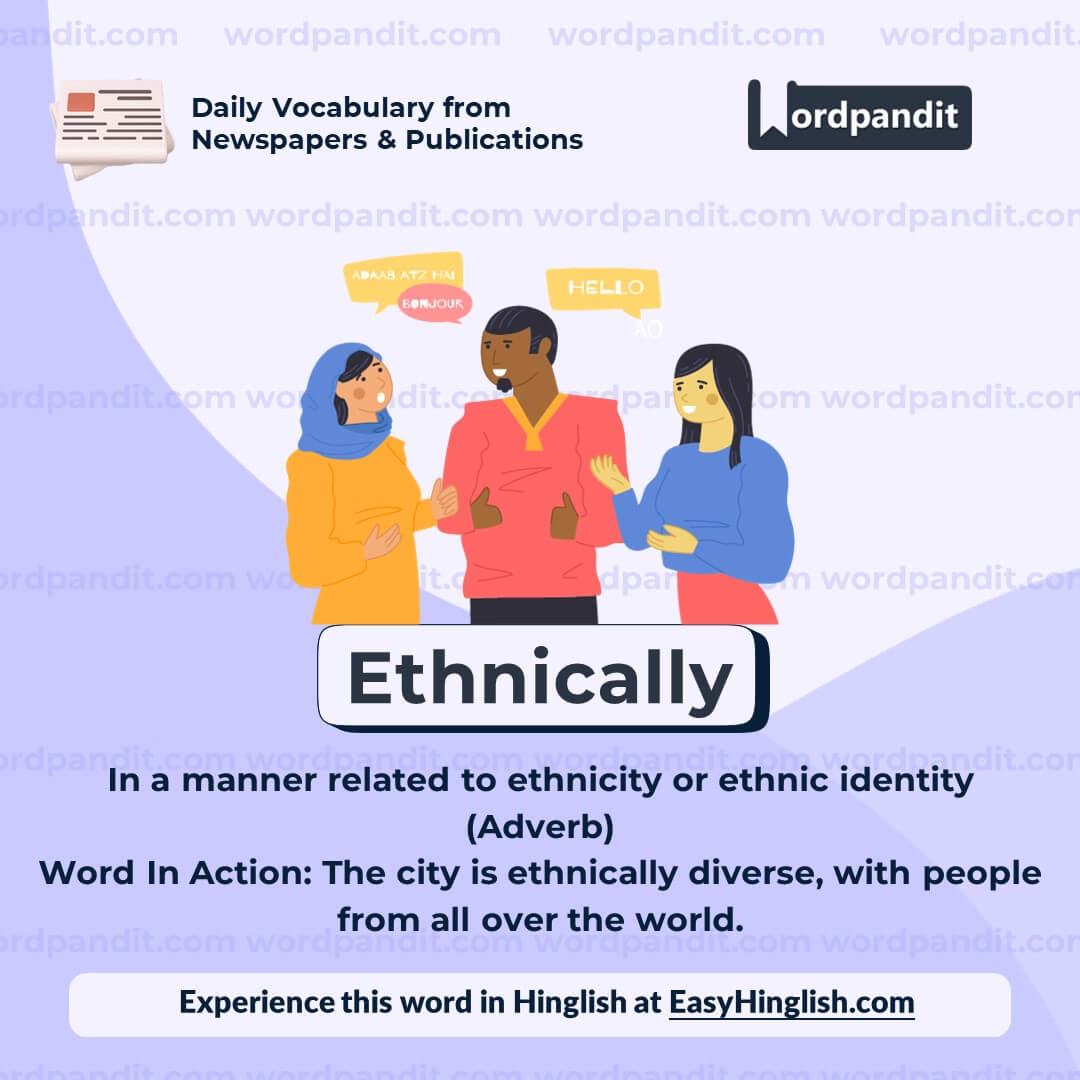
WORD-1: Ethnically
Context:
"While India has always been ethnically diverse, today, ethnicity is a major axis around which the politics of mobilization is taking place." - The Hindu
Explanatory Paragraph:
The word ethnically relates to the characteristics or qualities associated with specific cultural, racial, or social groups. It refers to the traits, customs, or heritage of a group based on shared identity, origins, or traditions.
Meaning: Relating to characteristics of a particular cultural or racial group (Adverb)
Pronunciation: eth-nik-lee
Difficulty Level: ⭐⭐⭐ Intermediate
Etymology: Derived from Greek ethnos meaning "nation, people, or race."
Prashant Sir's Notes:
The term 'ethnically' is important as it helps describe diversity in contexts such as politics, sociology, and international relations. Understand the difference between ethnicity and nationality clearly, as the former deals with cultural identity and heritage, while the latter relates to legal citizenship.
Synonyms & Antonyms:
Synonyms: culturally, racially, tribally
Antonyms: universally, globally, collectively
Usage Examples:
- The city is ethnically diverse, hosting communities from all around the globe.
- Political parties often target ethnically distinct groups during elections.
- Schools should promote harmony among ethnically varied students.
- Ethnically homogeneous societies might have less cultural friction but also less cultural enrichment.
Cultural Reference:
"Cultural differences should not separate us from each other, but rather cultural diversity brings a collective strength that can benefit all of humanity." - Robert Alan Aurthur
Think About It:
How does being ethnically diverse influence the culture and policy-making of a country?
Quick Activity:
Make a short list of ethnically diverse countries and reflect briefly on the benefits and challenges they might face.
Memory Tip:
Remember "ethnically" by linking it to "ethnic"—both referring to cultural groups or identities (ethnic + ally → ethnically).
Real-World Application:
The concept of "ethnically" often appears in demographic studies, governmental policymaking, urban planning, education, and international diplomacy to address the needs of various cultural groups.
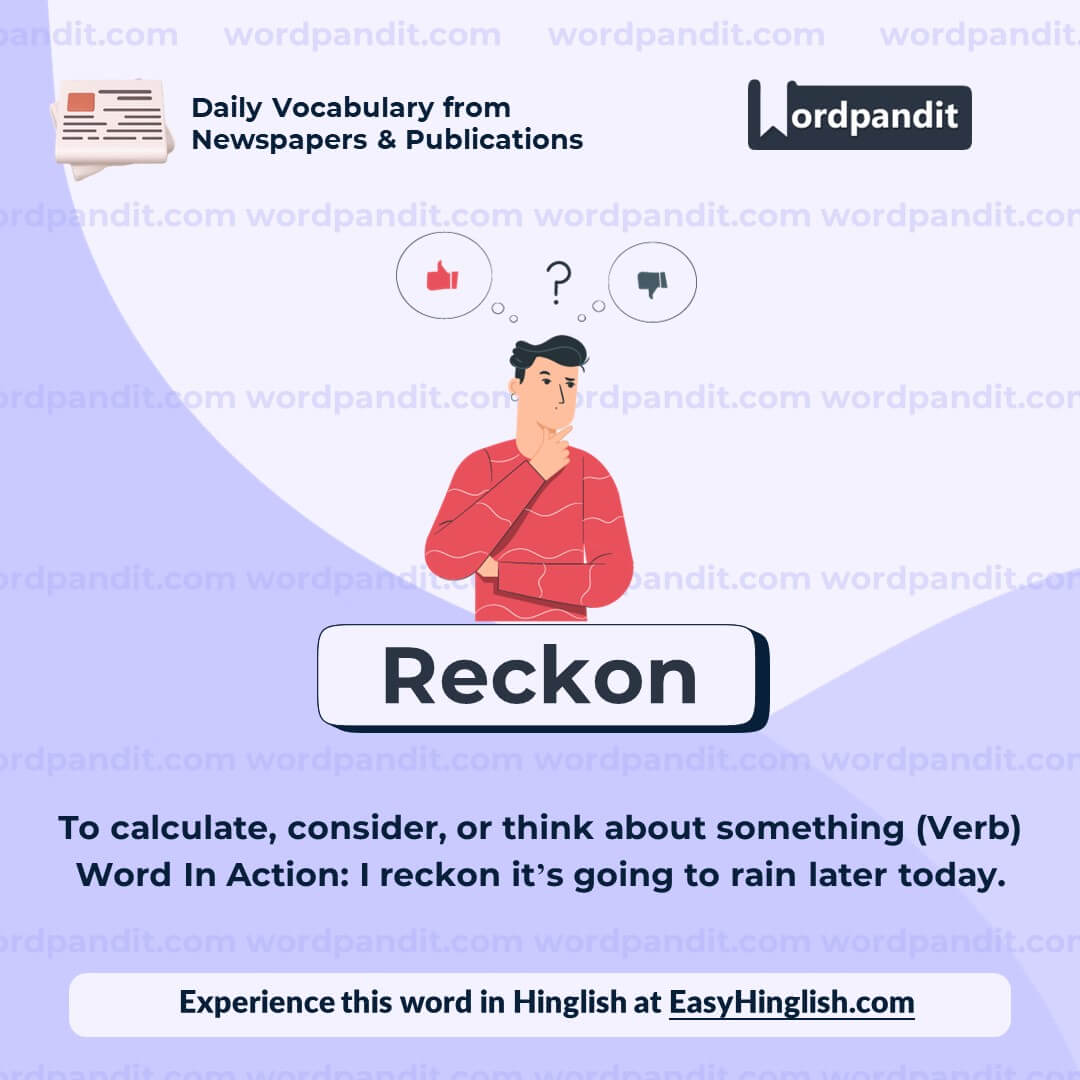
WORD-2: Reckon
Context:
"The CEO reckoned the company would achieve unprecedented growth this quarter due to increased demand and productivity." - Business Standard
Explanatory Paragraph:
The word reckon means to think, believe, or calculate something based on information available. It is commonly used to express an opinion or to estimate a situation or result.
Meaning: To consider, estimate, or think about something (Verb)
Pronunciation: rek-un
Difficulty Level: ⭐⭐ Easy to Intermediate
Etymology: Originates from Old English gerecenian, meaning "to explain, relate, or arrange in order."
Prashant Sir's Notes:
"Reckon" is informal and conversational, more commonly used in spoken English, especially in British and Southern American English. It can express calculations, judgments, opinions, or expectations depending on the context.
Synonyms & Antonyms:
Synonyms: consider, estimate, calculate, suppose, think
Antonyms: ignore, disregard, overlook, neglect
Usage Examples:
- I reckon it will rain this evening, judging by the dark clouds.
- They reckon the cost of construction will exceed their initial budget.
- She reckoned that the journey would take at least five hours.
- He reckoned the project was achievable with the available resources.
Cultural Reference:
"I reckon there's no better way to end a day than with a good book and a quiet evening." - Common colloquial expression (Southern US)
Think About It:
Why might people use informal expressions like "reckon" instead of formal alternatives such as "calculate" or "estimate"?
Quick Activity:
Try using "reckon" in three informal conversations today, paying attention to how natural or unnatural it feels to you.
Memory Tip:
Recall "reckon" as related to "reckoning," suggesting thinking or calculating carefully before deciding something.
Real-World Application:
In real-life scenarios, people use "reckon" in conversations to indicate predictions or assumptions, particularly when exact information isn't available.
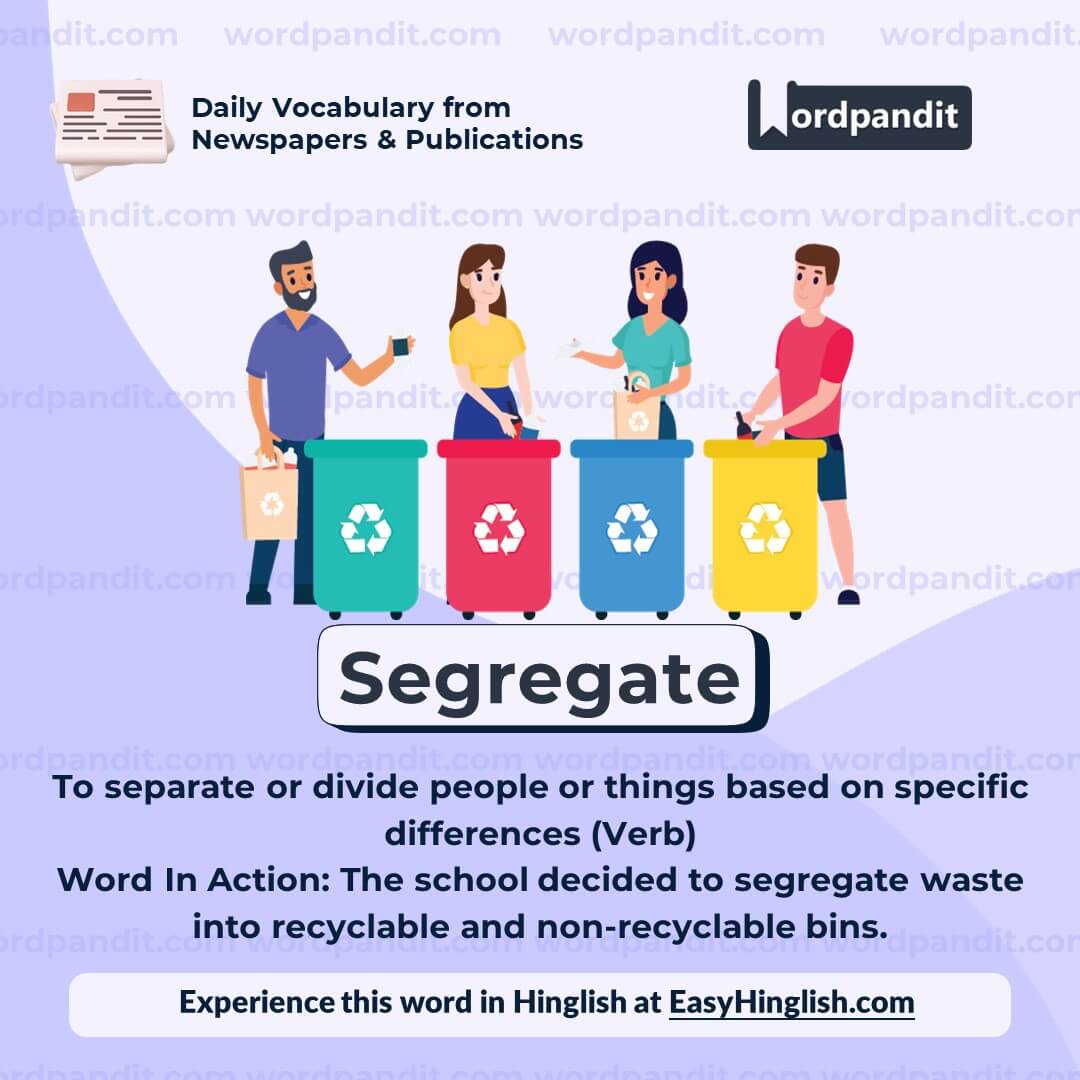
WORD-3: Segregate
Context:
"The new policy aims to segregate waste at source to improve recycling efficiency and environmental protection." - The Indian Express
Explanatory Paragraph:
Segregate means to separate or set apart people or things, usually based on certain characteristics or categories. It often indicates dividing into different groups or classifications for easier management, control, or efficiency.
Meaning: To separate or isolate one group or thing from another (Verb)
Pronunciation: seg-ri-geyt
Difficulty Level: ⭐⭐⭐ Intermediate
Etymology: Derived from Latin segregatus, meaning "separated or set apart," from se- "apart" + gregare "to gather or flock."
Prashant Sir's Notes:
"Segregate" often carries historical and social context, especially regarding racial or gender segregation. Today, it is widely used in neutral contexts like waste management, data organization, or separating distinct elements.
Synonyms & Antonyms:
Synonyms: separate, divide, isolate, detach
Antonyms: integrate, unite, combine, merge
Usage Examples:
- The factory has clearly marked bins to segregate hazardous and non-hazardous waste.
- Historically, many societies would unjustly segregate communities based on race.
- It is beneficial to segregate financial data according to department budgets.
- The experiment requires students to segregate materials by type and properties.
Cultural Reference:
"Segregation is the adultery of an illicit intercourse between injustice and immorality." - Martin Luther King Jr.
Think About It:
In what situations can segregation be beneficial, and when can it become harmful or unfair?
Quick Activity:
Identify and list three practical examples where segregation is used in your home or local community.
Memory Tip:
Think of "segregate" as "separate at the gate," clearly dividing groups as they enter or leave a place.
Real-World Application:
"Segregate" is frequently used in practical scenarios such as recycling waste, organizing data into categories, or keeping certain substances separate for safety.
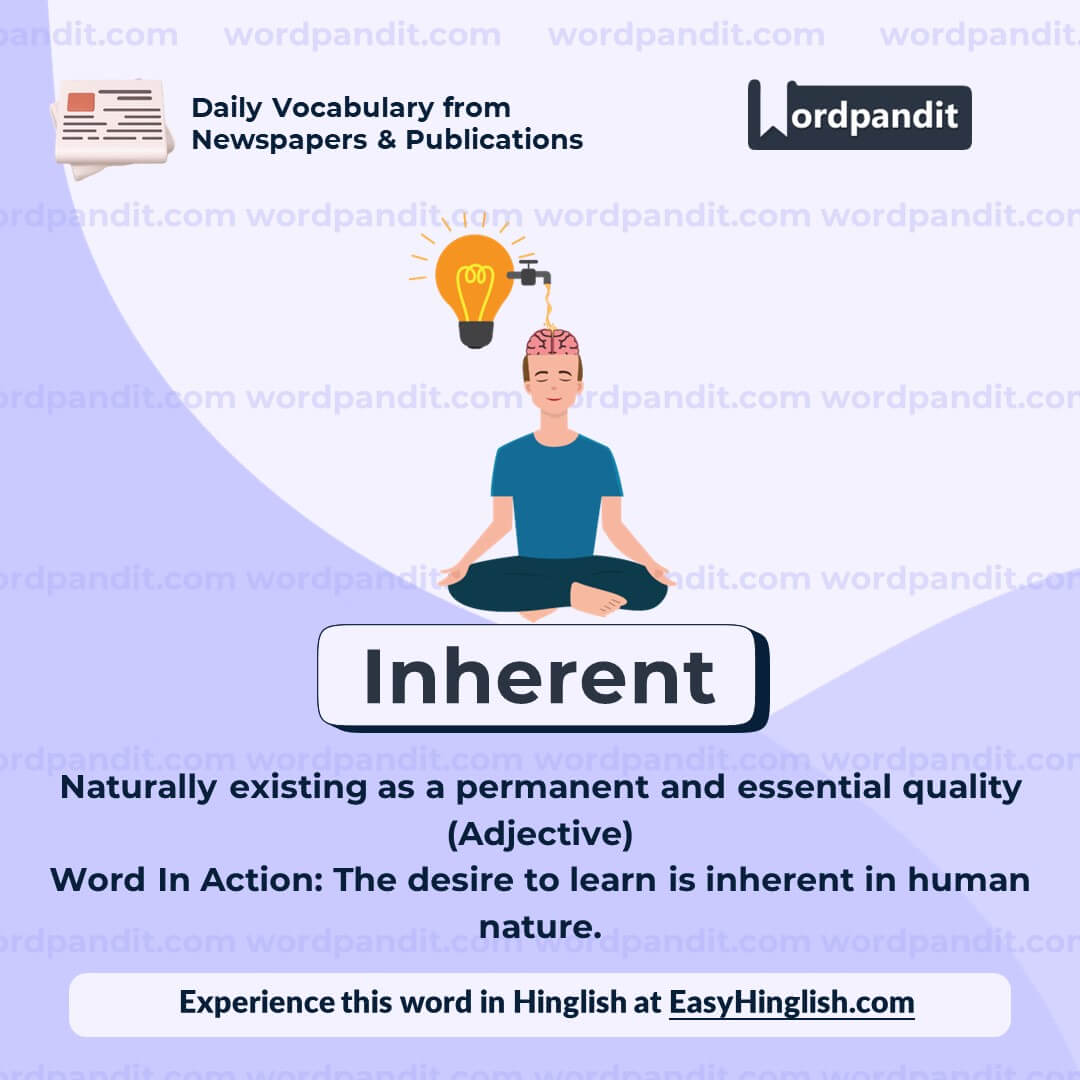
WORD-4: Inherent
Context:
"There are inherent risks associated with investing in the stock market, so investors must exercise caution and due diligence." - The Economic Times
Explanatory Paragraph:
The adjective inherent describes something that is naturally present or built-in, essentially existing as a permanent and integral quality or characteristic. It refers to attributes that are fundamentally a part of someone or something.
Meaning: Existing naturally or as an essential quality of something or someone (Adjective)
Pronunciation: in-HEER-uhnt
Difficulty Level: ⭐⭐⭐ Intermediate
Etymology: Originates from Latin inhaerentem, meaning "sticking in or adhering to."
Prashant Sir's Notes:
"Inherent" emphasizes intrinsic qualities or aspects which cannot easily be changed or removed. Recognize that inherent qualities are fundamental and distinguishable from acquired traits, which are gained through experience or environment.
Synonyms & Antonyms:
Synonyms: intrinsic, innate, essential, fundamental, built-in
Antonyms: acquired, external, superficial, extrinsic
Usage Examples:
- All human beings have inherent dignity and rights that must be respected.
- There's an inherent beauty in nature that inspires many artists and poets.
- The project has inherent difficulties that must be carefully managed.
- Team sports inherently promote teamwork and cooperation.
Cultural Reference:
"Freedom is not something that one people can bestow on another as a gift. They claim it as their own and none can keep it from them." - Kwame Nkrumah (reflecting the inherent nature of freedom and dignity)
Think About It:
Can inherent characteristics or qualities in a person or culture be significantly changed over time? Why or why not?
Quick Activity:
List five inherent qualities you see in yourself, and briefly reflect on how they have influenced your choices.
Memory Tip:
Remember "inherent" as something "in here"—something naturally existing inside a person or thing.
Real-World Application:
The term "inherent" commonly appears in discussions related to human rights, ethics, business, and legal contexts, describing qualities or risks naturally existing in a given situation or entity.
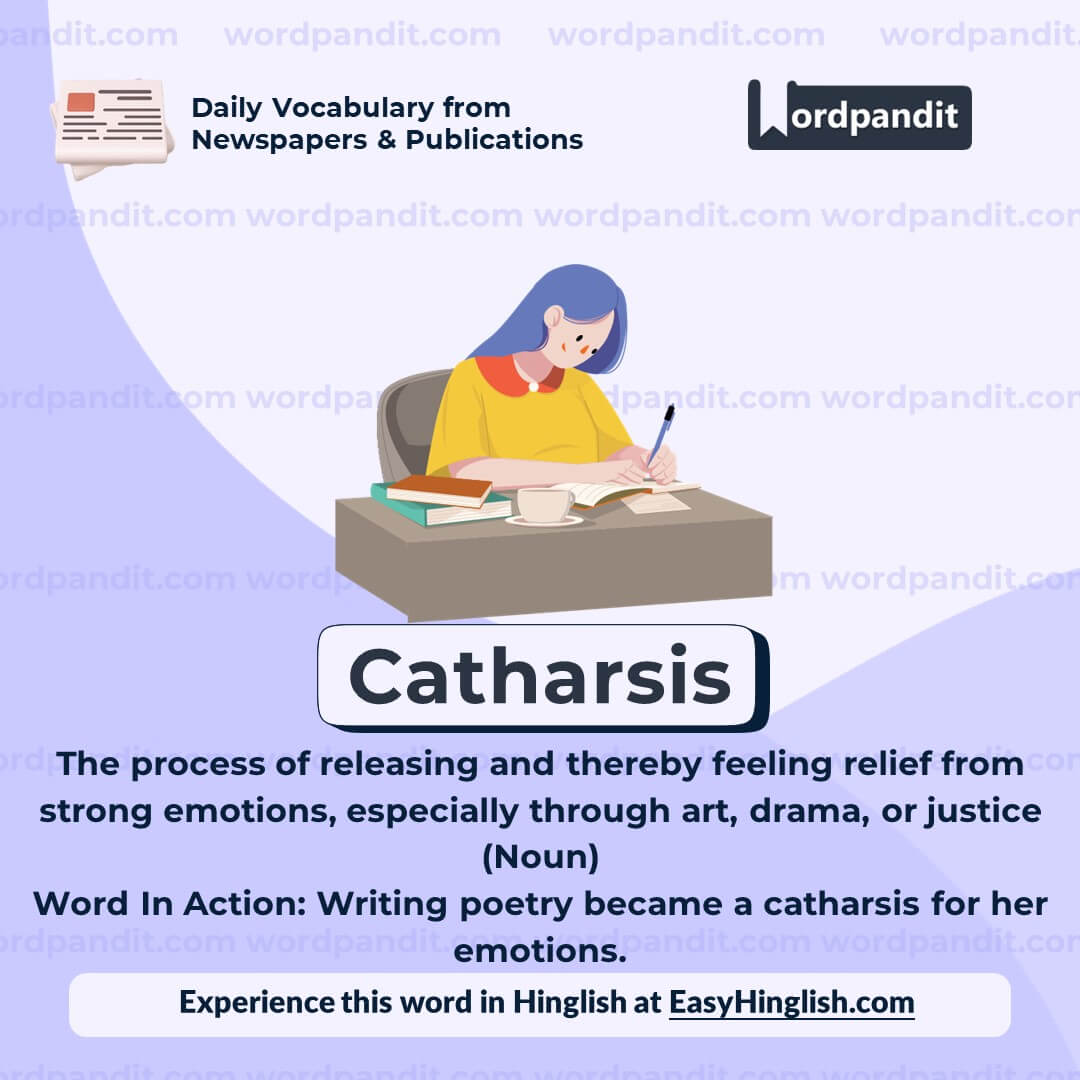
WORD-5: Catharsis
Context:
"Many viewers found a deep catharsis in the film’s emotional climax, allowing them to release pent-up feelings." - Filmfare Magazine
Explanatory Paragraph:
Catharsis refers to the emotional release or purification experienced when one expresses intense emotions. Typically associated with experiencing art, literature, or drama, it brings relief and a sense of psychological cleansing, letting go of strong or suppressed emotions.
Meaning: The process of releasing strong or repressed emotions for emotional relief (Noun)
Pronunciation: kuh-THAHR-sis
Difficulty Level: ⭐⭐⭐⭐ Advanced
Etymology: From Greek katharsis, meaning "purification" or "cleansing."
Prashant Sir's Notes:
The concept of "catharsis" is essential in psychology and literature, highlighting the significance of emotional release for mental well-being. Recognize cathartic experiences in everyday life—moments when you feel relieved after expressing or confronting your emotions.
Synonyms & Antonyms:
Synonyms: purification, cleansing, emotional release, venting, purging
Antonyms: repression, suppression, restraint, bottling up
Usage Examples:
- Writing in her journal each night provided catharsis, allowing her to process daily stress.
- He experienced catharsis after sharing his story openly with the support group.
- The tragic ending of the play served as catharsis for the audience's pent-up emotions.
- Many find catharsis in activities such as painting, music, or exercising.
Cultural Reference:
"Music has healing power. It has the ability to take people out of themselves for a few hours." - Elton John (highlighting the cathartic power of music)
Think About It:
Why is experiencing catharsis considered essential to emotional and psychological health?
Quick Activity:
Recall and describe briefly a moment when you experienced catharsis. What prompted this emotional release?
Memory Tip:
Remember catharsis as "carrying the stress out"—the emotional cleansing you feel when emotions are expressed and relieved.
Real-World Application:
"Catharsis" is frequently discussed in therapy, counseling, art therapy, literature, and theater, highlighting its relevance to mental health and emotional healing practices.


