

Daily Vocabulary from Indian Newspapers and Publications
Welcome to Wordpandit’s Indian Vocabulary Hub
At Wordpandit, we understand the importance of staying rooted in the local context while expanding your language skills. This section focuses on enriching your vocabulary with words and phrases drawn from India’s leading newspapers and publications, ensuring you're learning vocabulary that is practical, relevant, and uniquely Indian.
Why Indian Sources Matter
We believe that the best way to master any language is by immersing yourself in local content. That’s why we carefully curate vocabulary from top Indian publications, including:
- The Hindu
- The Times of India
- The Economic Times
- Hindustan Times
- Live Mint
- The Indian Express
- And many others...
Stay Updated, Stay Relevant
With daily updates from Indian news sources, you’ll be consistently learning words that reflect the trends and shifts in Indian society and culture. Our focus is to provide vocabulary that enhances your understanding of the language in an Indian context.
How Wordpandit Supports Your Goals
Whether you’re preparing for exams, aiming to improve your professional communication, or simply want to stay connected with the latest Indian vocabulary, Wordpandit is here to guide you every step of the way.
Learn with a Practical Approach
Our interactive learning methodology includes real-world examples, engaging activities, and context-specific usage to ensure that every word becomes part of your active vocabulary.
Dive into Indian Vocabulary Today!

Why Choose Wordpandit?
Practical Learning: Focus on words you'll actually encounter in real-world reading, enhancing your comprehension and communication skills.
Diverse Content: From current affairs to scientific breakthroughs, our varied sources expose you to vocabulary across multiple domains.
Effortless Integration: Make Wordpandit a part of your daily routine. Just a few minutes each day can significantly boost your lexicon over time.
Your Path to Vocabulary Mastery
- Visit our Daily Vocabulary section regularly
- Explore new words and their usage in context
- Practice incorporating these words into your own writing and speech
- Track your progress as your vocabulary expands
Start Your Journey Today
Embark on your vocabulary enhancement journey with Wordpandit. By consistently engaging with our daily posts, you'll build a robust vocabulary that serves you well in academic, professional, and personal contexts.
Remember, a word a day keeps linguistic limitations at bay. Make Wordpandit your daily companion in the quest for vocabulary excellence!

WORD-1: Coir
Context:
"Like others, Savarkar was subjected to them—solitary confinement, to stand for a week with handcuffs; chain-fetters; crossbar fetters . . . ‘work’, diabolically designed to break the prisoner—pounding coir, extracting oil as the bullock does by pushing the shaft round and round the ‘oil mill’ to the point one fainted yoked to the ‘mill’." - The Wire
Explanatory Paragraph:
"Coir" refers to the tough, fibrous material found between the hard inner shell and the outer coat of a coconut. It is traditionally used for making ropes, mats, brushes, and sacks. In the context above, "pounding coir" was a form of prison labor, designed to be physically exhausting and demoralizing. The word conveys a sense of manual toil, associated with tropical, rural, or industrial settings where coconuts are processed.
Meaning: A coarse fiber extracted from the husk of coconuts (noun)
Pronunciation: koy-er
Difficulty Level: ⭐⭐ Basic
Etymology: From Malayalam and Tamil "kayaru" meaning 'cord' or 'rope'
Prashant Sir's Notes:
Think of coir as nature’s rope — a resilient, coarse material made from coconut husks. Knowing it helps with understanding agricultural and traditional labor vocabulary, especially in colonial or tropical historical contexts.
Synonyms & Antonyms:
Synonyms: coconut fiber, husk fiber, rope fiber
Antonyms: silk, synthetic fiber, nylon
Usage Examples:
- The villagers used coir to weave sturdy mats for their homes.
- He slipped on the wet coir rug placed at the entrance.
- During his trip to Kerala, he visited a coir factory and saw how the fiber was processed.
- The prisoner’s task was to pound coir for hours, leaving his hands raw and bleeding.
Cultural Reference:
"Coir has long been an integral part of traditional crafts and industries in South India and Sri Lanka, often representing the hard work of rural communities." - Ethnographic Studies on Rural Livelihoods
Think About It:
How does the use of natural materials like coir reflect the relationship between human labor and the environment?
Quick Activity:
Make a list of five items that can be made from coir. Research which countries are top producers of coir and identify one fact about its economic significance.
Memory Tip:
Think of "coir" as “coconut rope”—both start with “co” and are related to tough, fibrous material.
Real-World Application:
Coir is widely used in making doormats, brushes, mattresses, and eco-friendly packaging. It's a sustainable alternative to synthetic fibers in many developing economies.
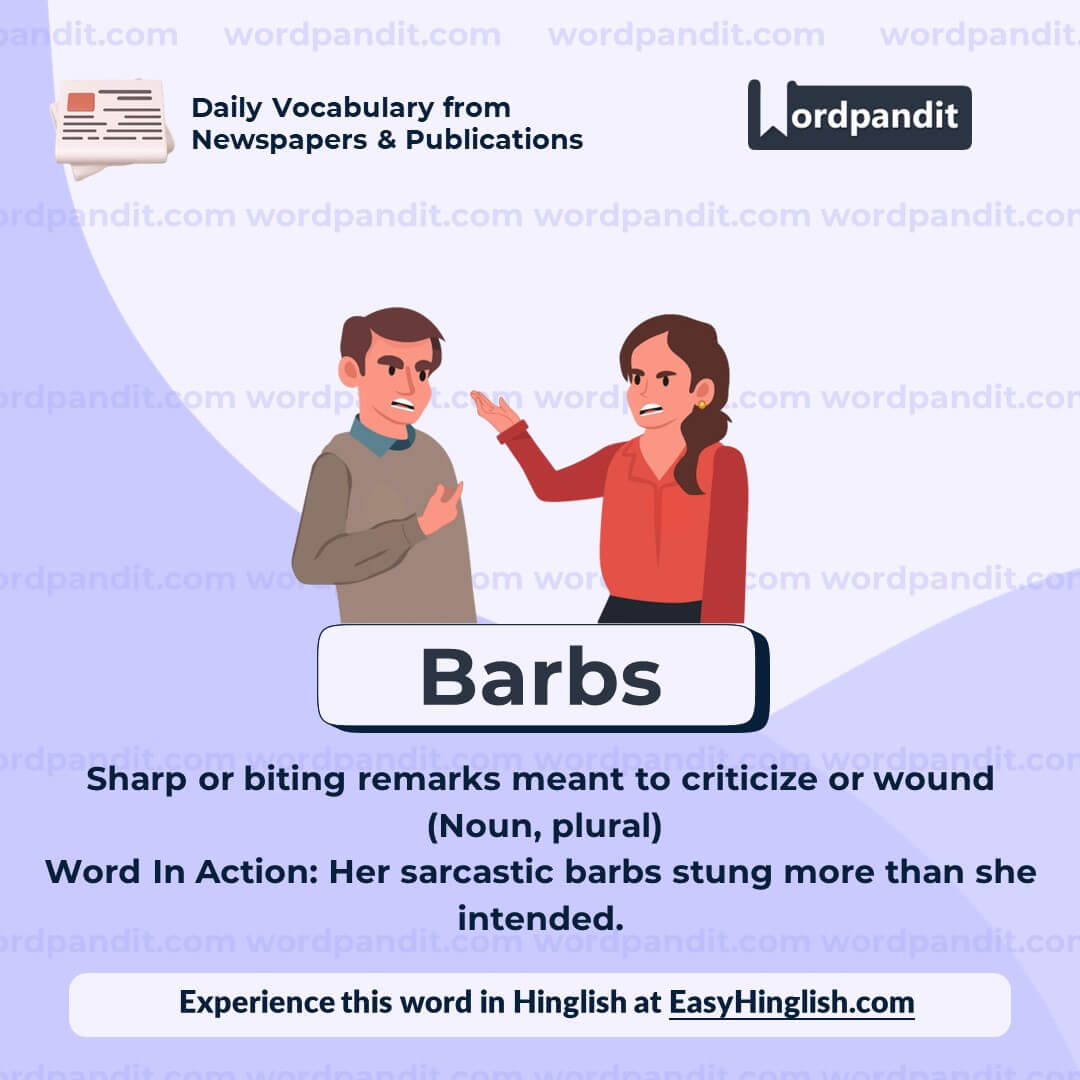
WORD-2: Barbs
Context:
"With Congress fielding barbs from partners in INDIA bloc on Delhi elections results, where many have accused it of contributing to the BJP’s victory, senior Congress leader Manickam Tagore said that the blame on the Congress is misplaced, since AAP ruled out an alliance in Delhi and that the INDIA bloc was created for 2024 general elections." - The Hindu
Explanatory Paragraph:
"Barbs" in this context refers to sharp, cutting remarks or criticisms aimed at someone, often used in political or public discourse. Just like a physical barb — a sharp point on a fishhook — verbal barbs are intended to hurt, provoke, or embarrass. Here, political allies of the Congress party are directing pointed criticisms (barbs) at it for its perceived role in election outcomes.
Meaning: Sharp or hurtful remarks; stinging criticisms (noun, plural)
Pronunciation: baarbz
Difficulty Level: ⭐⭐ Basic
Etymology: From Old French *barbe*, from Latin *barba* meaning ‘beard’ (originally referring to a sharp point on an arrow or hook)
Prashant Sir's Notes:
Think of a “barb” as a verbal sting — it’s not just criticism, it’s designed to pierce. Common in political debates, media commentary, and heated arguments. You can "throw a barb" or "face barbs" in conversation.
Synonyms & Antonyms:
Synonyms: jabs, digs, insults, taunts, slurs
Antonyms: compliments, praise, flattery, admiration
Usage Examples:
- The debate turned hostile, with both candidates exchanging barbs on live television.
- She ignored the barbs from her critics and stayed focused on her work.
- His speech was filled with subtle barbs aimed at his former colleagues.
- Social media is often a platform where people throw unnecessary barbs at others.
Cultural Reference:
"Political barbs between rivals have always been a hallmark of parliamentary debates in democracies like the UK, India, and the US." - Political Discourse and Rhetoric, Oxford Press
Think About It:
Is it ever productive to use barbs in public discourse, or do they always escalate conflict?
Quick Activity:
Write two sentences — one with a compliment and one with a barb — aimed at the same topic. Notice the difference in tone and impact.
Memory Tip:
Think of a “barb” like the barb on a fishhook — it digs in and hurts. A verbal barb does the same thing to someone’s feelings or reputation.
Real-World Application:
Understanding "barbs" is useful in interpreting media, politics, and workplace communication where subtle or overt insults are often exchanged under the guise of “debate.”
WORD-3: Ignited
Context:
"It also ignited debate over the misuse of freedom of speech and regularising content on OTT platforms." - The Indian Express
Explanatory Paragraph:
"Ignited" in this sentence is used metaphorically to mean “sparked” or “started” something — in this case, a debate. While the word literally refers to setting something on fire, it is often used figuratively to describe the beginning of intense emotions, reactions, or discussions. Here, a particular event or issue caused people to start discussing (or arguing about) the regulation of online content and freedom of speech.
Meaning: Caused something to start or become active, especially suddenly or intensely (verb, past tense)
Pronunciation: ig-ny-ted
Difficulty Level: ⭐⭐ Basic
Etymology: From Latin *ignire*, meaning ‘to set on fire’, from *ignis* meaning ‘fire’
Prashant Sir's Notes:
"Ignited" doesn’t always refer to literal fire — it’s often used to describe the beginning of emotions, conflicts, movements, or conversations. Think of it as lighting a spark that leads to bigger outcomes, especially in social or political contexts.
Synonyms & Antonyms:
Synonyms: sparked, triggered, initiated, kindled, provoked
Antonyms: extinguished, suppressed, ended, calmed
Usage Examples:
- The video ignited public outrage over the incident.
- Her passionate speech ignited hope in the hearts of the audience.
- The coach’s words ignited a new determination in the team.
- The documentary ignited discussions about climate change across social media platforms.
Cultural Reference:
"Martin Luther King Jr.’s speech ignited a nationwide civil rights movement." - American Civil Rights Archives
Think About It:
Can a single event or statement truly ignite lasting social change, or is it always a buildup of many factors?
Quick Activity:
List three things that recently ignited a reaction in public discourse—on social media, in politics, or pop culture. Briefly explain why they were impactful.
Memory Tip:
Think of the word "ignite" like lighting a match — it's the small spark that sets off something much bigger, like a fire or a debate.
Real-World Application:
"Ignited" is commonly used in journalism, public speaking, and social commentary to describe the beginning of powerful events or reactions — especially debates, protests, or movements.
WORD-4: Emissaries
Context:
"Alternating between public rebukes and backroom negotiations, the CPI(M)‘s late general secretary Sitaram Yechury and the Trinamool worked as emissaries to iron out this difficult relationship." - The Hindu
Explanatory Paragraph:
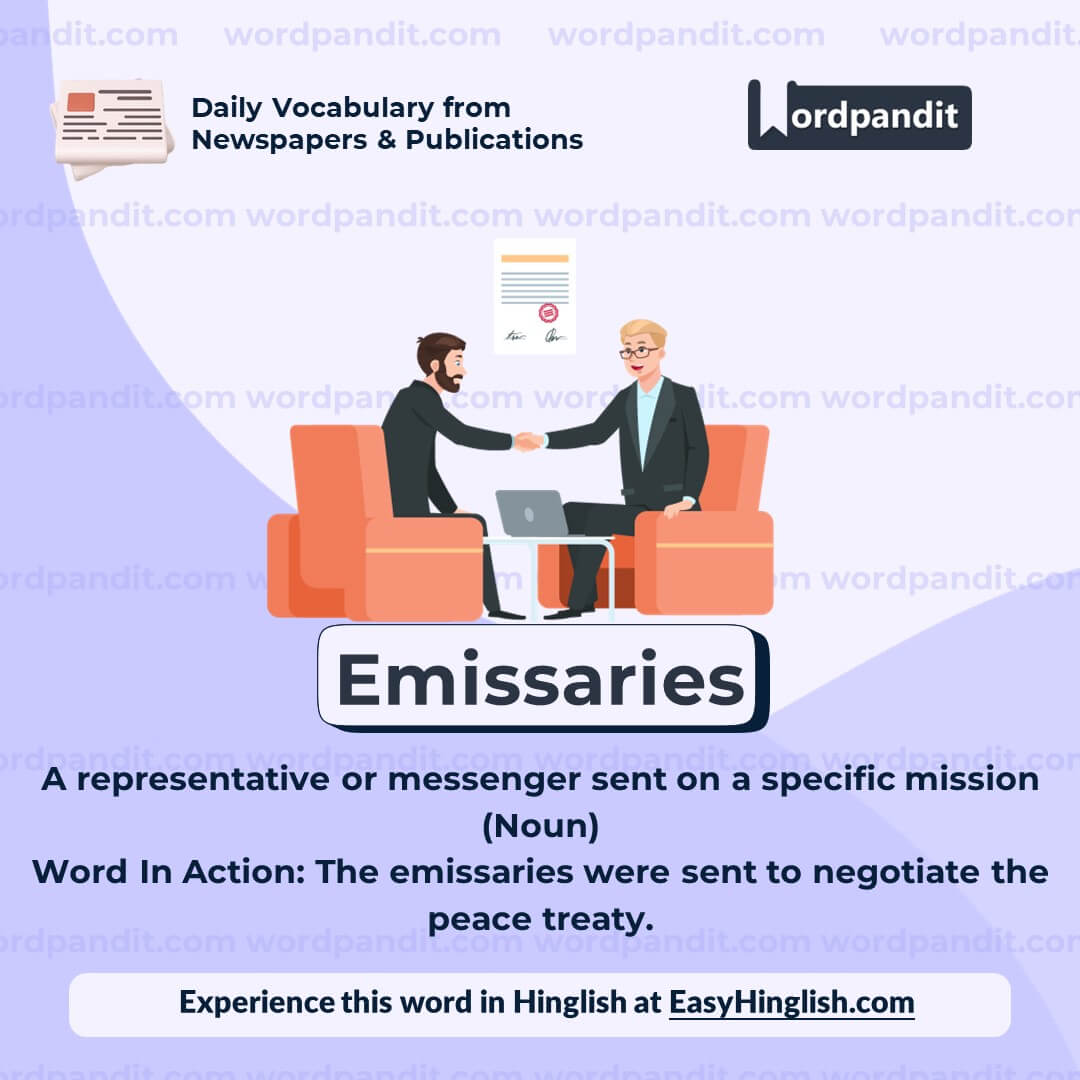
“Emissaries” refers to individuals who are sent on a specific mission, usually diplomatic or political in nature, to represent the interests of their group or organization. In the sentence above, political leaders from opposing parties acted as emissaries, meaning they took on the role of negotiators or go-betweens, trying to resolve tensions and maintain cooperation behind the scenes. The term implies a sense of trust and responsibility placed on someone to deliver messages or mediate between parties.
Meaning: People sent on a special mission, usually as diplomatic or political representatives (noun, plural)
Pronunciation: eh-miss-uh-reez
Difficulty Level: ⭐⭐⭐ Intermediate
Etymology: From Latin *emissarius*, from *emittere* meaning ‘to send out’
Prashant Sir's Notes:
Remember: emissaries are not just messengers — they’re trusted intermediaries. In diplomacy, war, politics, or even corporate negotiations, emissaries often act quietly but carry significant influence. Look for this word in formal or historical contexts.
Synonyms & Antonyms:
Synonyms: envoys, delegates, agents, representatives, intermediaries
Antonyms: opponents, adversaries, rebels
Usage Examples:
- The president sent emissaries to negotiate peace with the neighboring country.
- Corporate emissaries met with union leaders to avoid a strike.
- Ancient kings often used trusted emissaries to deliver royal commands.
- The charity sent emissaries to disaster-hit areas to assess the situation and deliver aid.
Cultural Reference:
"In traditional diplomacy, emissaries often operated in secret, shaping treaties and alliances long before public announcements were made." - The History of Diplomacy, Routledge Press
Think About It:
In today’s digital world, do we still need human emissaries, or can messages and negotiations be effectively handled online?
Quick Activity:
Imagine you're an emissary sent to resolve a conflict between two student groups. What would your main approach be? Write 2-3 bullet points outlining your strategy.
Memory Tip:
“Emissary” sounds like “emission” — think of someone being “sent out” like a message or signal. Emissaries are people who are sent out on missions.
Real-World Application:
Understanding the role of emissaries is key in politics, international relations, business negotiations, and even interpersonal conflict resolution, where intermediaries help maintain peace and cooperation.

WORD-5: Consecutive
Context:
"The fragmentation in the bloc that came to the fore after the consecutive defeats in Maharashtra and Haryana Assembly elections is expected to exacerbate further." - The Hindu
Explanatory Paragraph:
"Consecutive" refers to things that follow one after another without interruption. In the sentence above, it describes back-to-back election defeats — first in Maharashtra, then in Haryana — experienced by a political bloc. The use of this word emphasizes a continuous, unbroken sequence of losses, implying a worrying trend or pattern. It often carries a tone of seriousness when used in contexts like losses, failures, or negative events.
Meaning: Following continuously in an unbroken or logical sequence (adjective)
Pronunciation: kuhn-sek-yoo-tiv
Difficulty Level: ⭐⭐ Basic
Etymology: From Latin *consecutivus*, from *consequi* meaning ‘to follow closely’
Prashant Sir's Notes:
"Consecutive" is a great word to describe a sequence — two or more events that happen one after another, usually in time. It’s frequently used in sports (e.g., consecutive wins), academics (e.g., consecutive semesters), and politics (e.g., consecutive losses).
Synonyms & Antonyms:
Synonyms: successive, sequential, uninterrupted, continuous
Antonyms: nonconsecutive, random, intermittent, irregular
Usage Examples:
- The team suffered three consecutive defeats before finally winning a match.
- She worked for five consecutive days without a break.
- This is the company’s fourth consecutive quarter of profit growth.
- He broke the world record by winning ten consecutive races.
Cultural Reference:
"Roger Federer won five consecutive Wimbledon titles from 2003 to 2007 — a feat rarely achieved in tennis history." - Sports Illustrated
Think About It:
Does experiencing multiple consecutive failures necessarily mean future failure, or can it set the stage for a stronger comeback?
Quick Activity:
Write a sentence using the word “consecutive” in a positive context (e.g., success, achievement, improvement).
Memory Tip:
“Consecutive” sounds like “connective” — think of things that are connected in a row, one right after the other.
Real-World Application:
“Consecutive” is widely used in academic reporting (consecutive grades), business performance (consecutive profits), and sports (consecutive wins or losses), making it essential for clear, time-based communication.


