

Daily Vocabulary from Indian Newspapers and Publications
Welcome to Wordpandit’s Indian Vocabulary Hub
At Wordpandit, we understand the importance of staying rooted in the local context while expanding your language skills. This section focuses on enriching your vocabulary with words and phrases drawn from India’s leading newspapers and publications, ensuring you're learning vocabulary that is practical, relevant, and uniquely Indian.
Why Indian Sources Matter
We believe that the best way to master any language is by immersing yourself in local content. That’s why we carefully curate vocabulary from top Indian publications, including:
- The Hindu
- The Times of India
- The Economic Times
- Hindustan Times
- Live Mint
- The Indian Express
- And many others...
Stay Updated, Stay Relevant
With daily updates from Indian news sources, you’ll be consistently learning words that reflect the trends and shifts in Indian society and culture. Our focus is to provide vocabulary that enhances your understanding of the language in an Indian context.
How Wordpandit Supports Your Goals
Whether you’re preparing for exams, aiming to improve your professional communication, or simply want to stay connected with the latest Indian vocabulary, Wordpandit is here to guide you every step of the way.
Learn with a Practical Approach
Our interactive learning methodology includes real-world examples, engaging activities, and context-specific usage to ensure that every word becomes part of your active vocabulary.
Dive into Indian Vocabulary Today!

Why Choose Wordpandit?
Practical Learning: Focus on words you'll actually encounter in real-world reading, enhancing your comprehension and communication skills.
Diverse Content: From current affairs to scientific breakthroughs, our varied sources expose you to vocabulary across multiple domains.
Effortless Integration: Make Wordpandit a part of your daily routine. Just a few minutes each day can significantly boost your lexicon over time.
Your Path to Vocabulary Mastery
- Visit our Daily Vocabulary section regularly
- Explore new words and their usage in context
- Practice incorporating these words into your own writing and speech
- Track your progress as your vocabulary expands
Start Your Journey Today
Embark on your vocabulary enhancement journey with Wordpandit. By consistently engaging with our daily posts, you'll build a robust vocabulary that serves you well in academic, professional, and personal contexts.
Remember, a word a day keeps linguistic limitations at bay. Make Wordpandit your daily companion in the quest for vocabulary excellence!
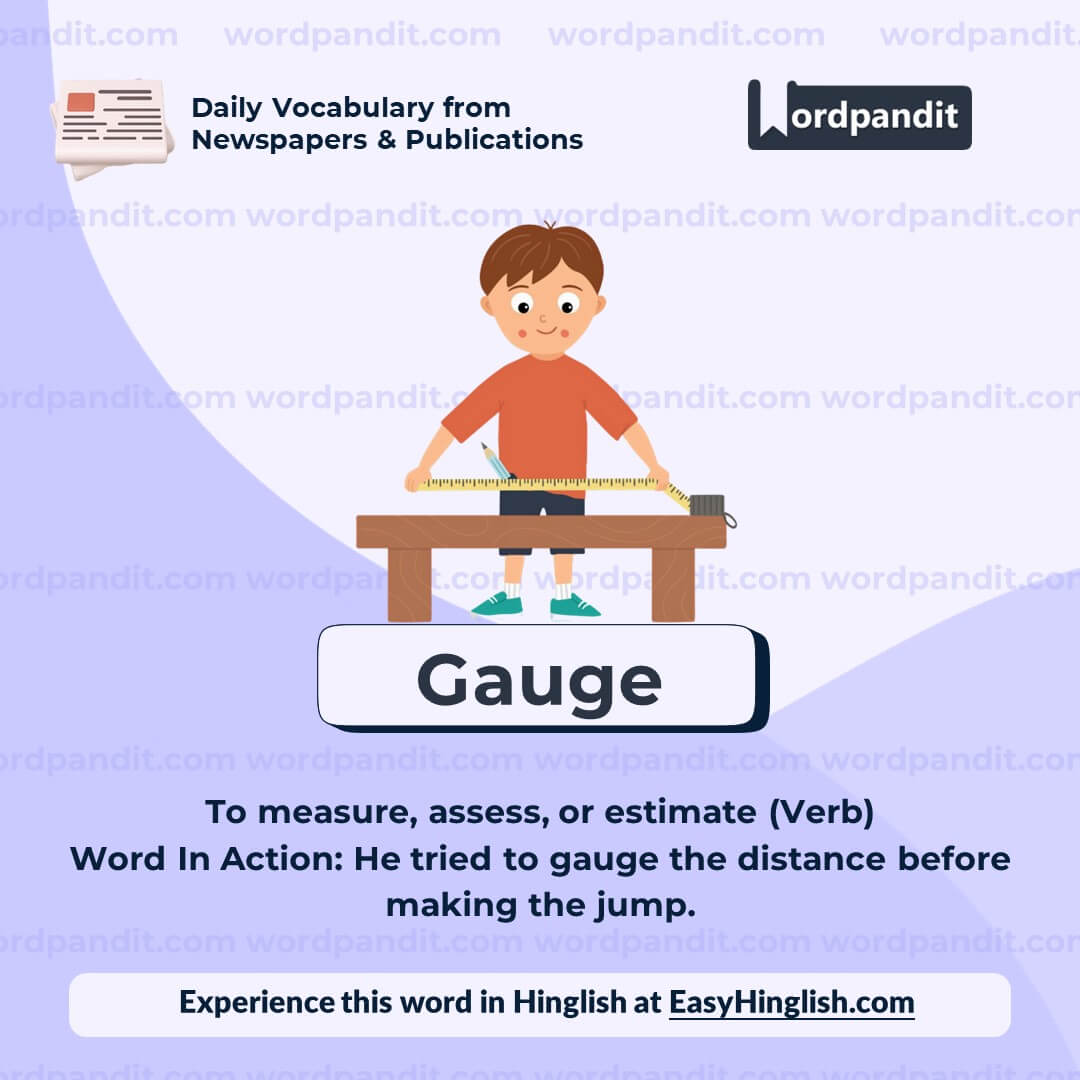
WORD-1: Gauge
Context:
"It seems he wanted to gauge the public’s reaction, especially the Sikhs." - New Indian Express
Explanatory Paragraph:
The word "gauge" refers to the act of measuring or evaluating something. In this context, it means assessing how people, particularly the Sikh community, would respond to a situation. When someone "gauges" a reaction, they’re trying to understand emotions, opinions, or likely outcomes by observing or collecting feedback.
Meaning: To measure, estimate, or assess something (Verb)
Pronunciation: gayj
Difficulty Level: ⭐⭐ Beginner
Etymology: Derived from Old French "jauge" meaning "standard measure," originally referring to measuring containers for liquids.
Prashant Sir's Notes:
Think of "gauge" as a mental or emotional thermometer. Whether you're evaluating a person's mood, public sentiment, or even the success of a product, you're essentially trying to take a measurement of something intangible. Useful for exams where tone or intention needs to be inferred.
Synonyms & Antonyms:
Synonyms: assess, evaluate, estimate, judge, measure
Antonyms: ignore, guess, overlook, neglect
Usage Examples:
- The teacher tried to gauge the students’ understanding by asking a few questions.
- Before launching the product, the company conducted surveys to gauge market demand.
- It's hard to gauge his emotions—he keeps a very straight face.
- The police used social media to gauge public sentiment during the protest.
Cultural Reference:
"Politicians often conduct opinion polls to gauge the public mood before elections." - Common media practice in democratic countries
Think About It:
How do we gauge trust in relationships, and is it always accurate?
Quick Activity:
Think of a recent situation where you tried to understand how someone was feeling. Write 2-3 sentences using the word "gauge" to describe it.
Memory Tip:
Imagine a car gauge (like a fuel gauge) that tells you how much is left — “gauge” always means to measure or check something.
Real-World Application:
In business, companies gauge customer satisfaction to improve services. In daily life, people often gauge moods, interest levels, and opinions to adjust their behavior accordingly.
WORD-2: Yoked
Context:
"Like others, Savarkar was subjected to them—solitary confinement, to stand for a week with handcuffs; chain-fetters; crossbar fetters . . . ‘work’, diabolically designed to break the prisoner—pounding coir, extracting oil as the bullock does by pushing the shaft round and round the ‘oil mill’ to the point one fainted yoked to the ‘mill’." - The Wire
Explanatory Paragraph:
"Yoked" here refers to being literally bound or fastened to something, much like animals are yoked to carts or plows to make them work. In this disturbing prison context, it evokes the image of a human being treated like a beast of burden—forced to labor under extreme conditions while physically attached to a mill. Metaphorically, the word can also mean being burdened or oppressed by something inescapable or controlling.
Meaning: To be bound, fastened, or joined, especially under oppressive or burdensome conditions (Verb - past tense)
Pronunciation: yohkt
Difficulty Level: ⭐⭐⭐ Intermediate
Etymology: From Old English "geoc," referring to a wooden frame used to harness animals, and related to Latin "iugum" meaning "a yoke" or "bond."
Prashant Sir's Notes:
The word "yoked" paints a powerful picture. Think of someone being physically or emotionally tied down. It’s often used metaphorically too—to suggest being trapped in relationships, systems, or roles that restrict freedom or individuality. This makes it useful in both historical and contemporary essays.
Synonyms & Antonyms:
Synonyms: bound, tethered, harnessed, enslaved, shackled
Antonyms: freed, liberated, unbound, released
Usage Examples:
- The prisoners were yoked together with iron chains during transport.
- Many workers feel yoked to a system that undervalues their labor.
- The oxen were yoked to the cart before the journey began.
- She felt emotionally yoked to responsibilities she never chose.
Cultural Reference:
"Take my yoke upon you... for my yoke is easy, and my burden is light." - Bible, Matthew 11:29-30. This spiritual use of "yoke" refers to shared burdens and submission to a higher calling.
Think About It:
In what ways might modern individuals be 'yoked' by social, economic, or cultural systems?
Quick Activity:
Write a sentence using "yoked" to describe a situation where someone feels emotionally or mentally burdened by expectations.
Memory Tip:
Picture a "yoke" as a heavy wooden beam placed across two oxen—when you're "yoked," you're carrying a heavy load, either physically or emotionally.
Real-World Application:
"Yoked" is commonly used in literature, history, and political discourse to describe oppression or servitude—whether physical, economic, or psychological. It's useful in both academic and creative writing.
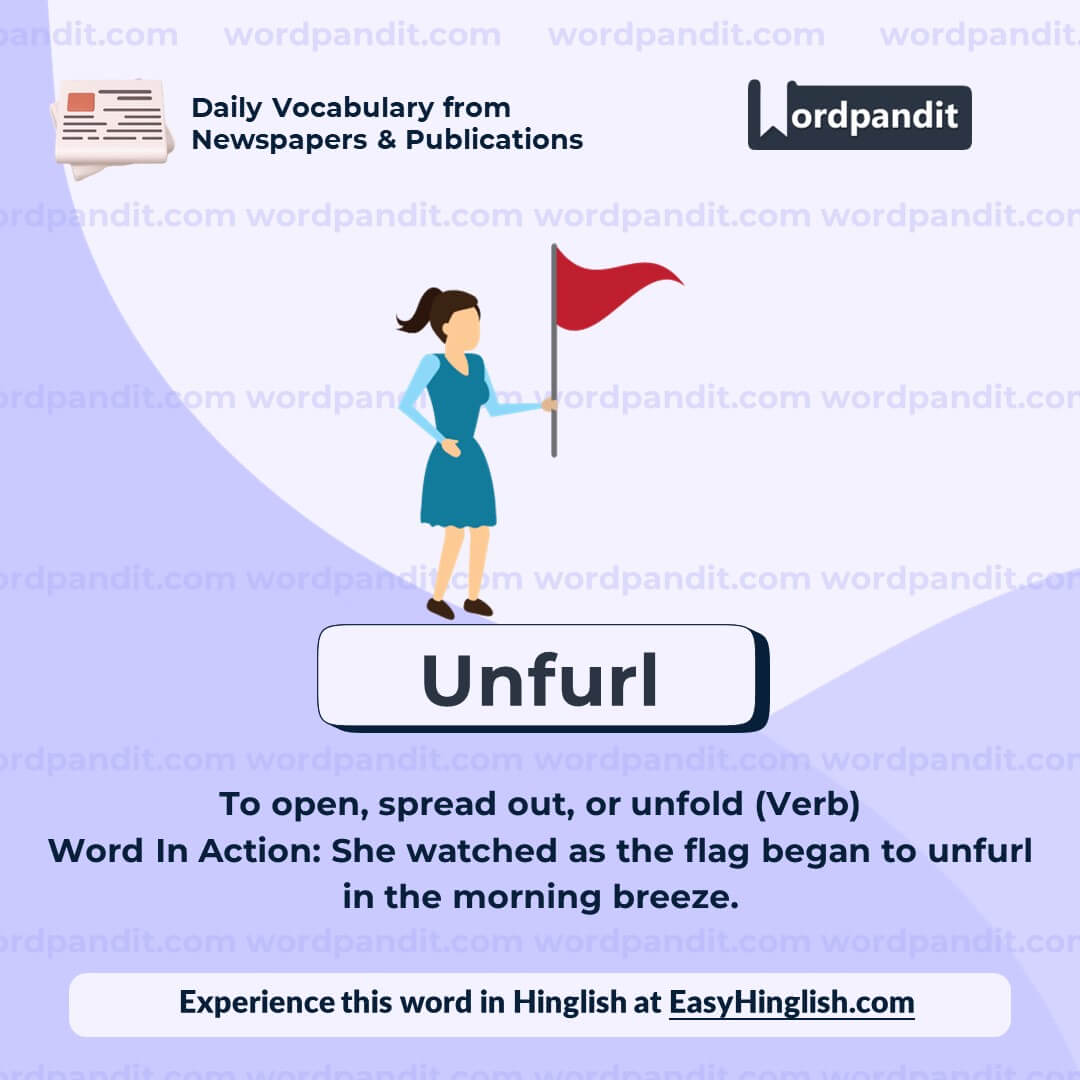
WORD-3: Unfurl
Context:
"Let us unfurl that resplendent emblem of independence openly." - The Wire
Explanatory Paragraph:
"Unfurl" means to unroll or spread out something that was previously folded or rolled up, such as a flag or a banner. In this sentence, the word is used in a symbolic sense—suggesting a proud and open display of the flag, which represents independence and freedom. It conveys both a physical action and an emotional declaration.
Meaning: To unfold or spread out something, especially a flag or scroll (Verb)
Pronunciation: un-FURL
Difficulty Level: ⭐⭐ Beginner
Etymology: From Old French "ferler" (to wrap or roll up), with "un-" added later to indicate the reverse action — to unwrap or unroll.
Prashant Sir's Notes:
"Unfurl" is often used in ceremonial or patriotic contexts, especially with flags. However, it can also be used metaphorically—to express ideas like revealing a plan or showing one's emotions. Always picture the dramatic motion of something beautiful being revealed.
Synonyms & Antonyms:
Synonyms: unfold, spread, display, extend, open
Antonyms: fold, roll up, conceal, furl, wrap
Usage Examples:
- They gathered in the square to unfurl the national flag at sunrise.
- The general unfurled the map to show the next stage of the operation.
- As the story progressed, the mystery slowly began to unfurl.
- He unfurled his plans with great enthusiasm and clarity.
Cultural Reference:
On India's Independence Day, it is customary for the Prime Minister to unfurl the tricolor flag at the Red Fort, symbolizing national pride and freedom.
Think About It:
What personal 'flags' or values do you wish to unfurl in your life—and are you doing so openly?
Quick Activity:
Write a short sentence where “unfurl” is used in a metaphorical sense—such as revealing an idea, emotion, or hidden truth.
Memory Tip:
Imagine a flag tightly rolled up and then dramatically unfurled in the wind—“unfurl” always means to open up and reveal something grand or important.
Real-World Application:
"Unfurl" is commonly used in news articles, patriotic speeches, and poetic writing to describe the ceremonial display of flags or the revealing of significant truths or actions.
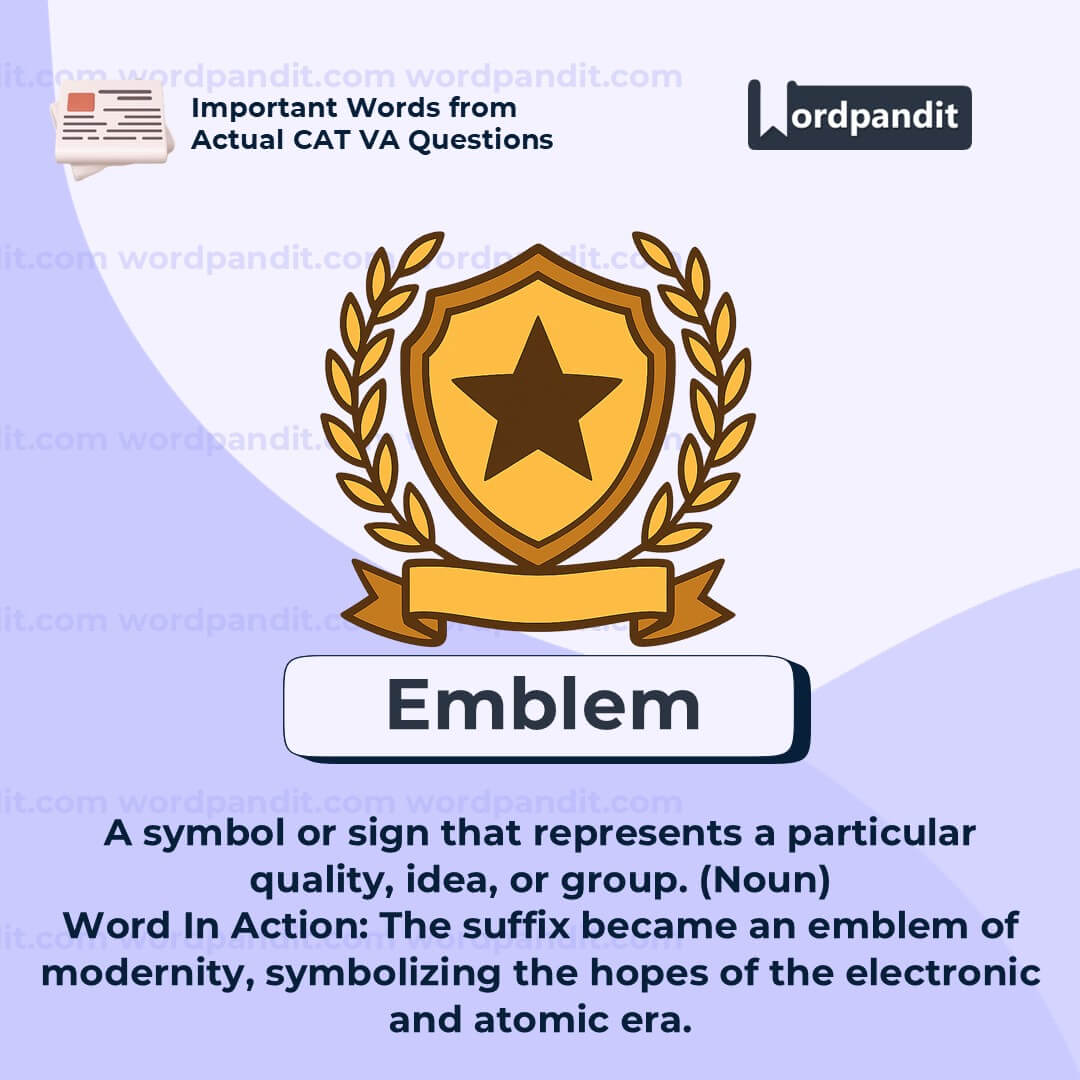
WORD-4: Emblem
Context:
"Let us unfurl that resplendent emblem of independence openly." - The Wire
Explanatory Paragraph:
An "emblem" is a symbol or object that represents a particular idea, quality, or concept. In this sentence, it refers to the national flag, which symbolizes independence and the values associated with it. Emblems are not just decorative; they carry deep meaning and are often used to represent beliefs, movements, or nations in a visual form.
Meaning: A symbolic object or design that represents a concept, nation, or idea (Noun)
Pronunciation: EM-blem
Difficulty Level: ⭐⭐ Beginner
Etymology: From Middle French *embleme*, and Latin *emblema*, meaning “inlaid ornament” or “symbol.” Originally used for designs with deeper meanings.
Prashant Sir's Notes:
Think of an "emblem" as more than just a picture—it's a compressed idea, a visual metaphor. It condenses complex emotions, history, or ideology into a single, powerful image. Flags, badges, and even certain animals (like the lion for courage) serve as emblems in various contexts.
Synonyms & Antonyms:
Synonyms: symbol, insignia, badge, crest, logo
Antonyms: reality, object, literal image, non-symbol
Usage Examples:
- The dove is often seen as an emblem of peace.
- That medal became an emblem of her courage during the war.
- The flag is an emblem of national pride and sacrifice.
- He wore a pin with the company emblem on his suit.
Cultural Reference:
The Ashoka Chakra on the Indian national flag is an emblem of dharma (righteousness), symbolizing progress and justice in the Indian context.
Think About It:
What emblem would best represent your personal values or beliefs—and why?
Quick Activity:
Draw or describe an emblem that represents your school, family, or a personal philosophy. What elements would you include and why?
Memory Tip:
Think of "emblem" as something you embed in your mind to represent a bigger idea—like a logo that speaks louder than words.
Real-World Application:
Emblems are used in everything from national flags to corporate logos. In branding, education, sports, and politics, emblems quickly convey values and identity to large audiences.
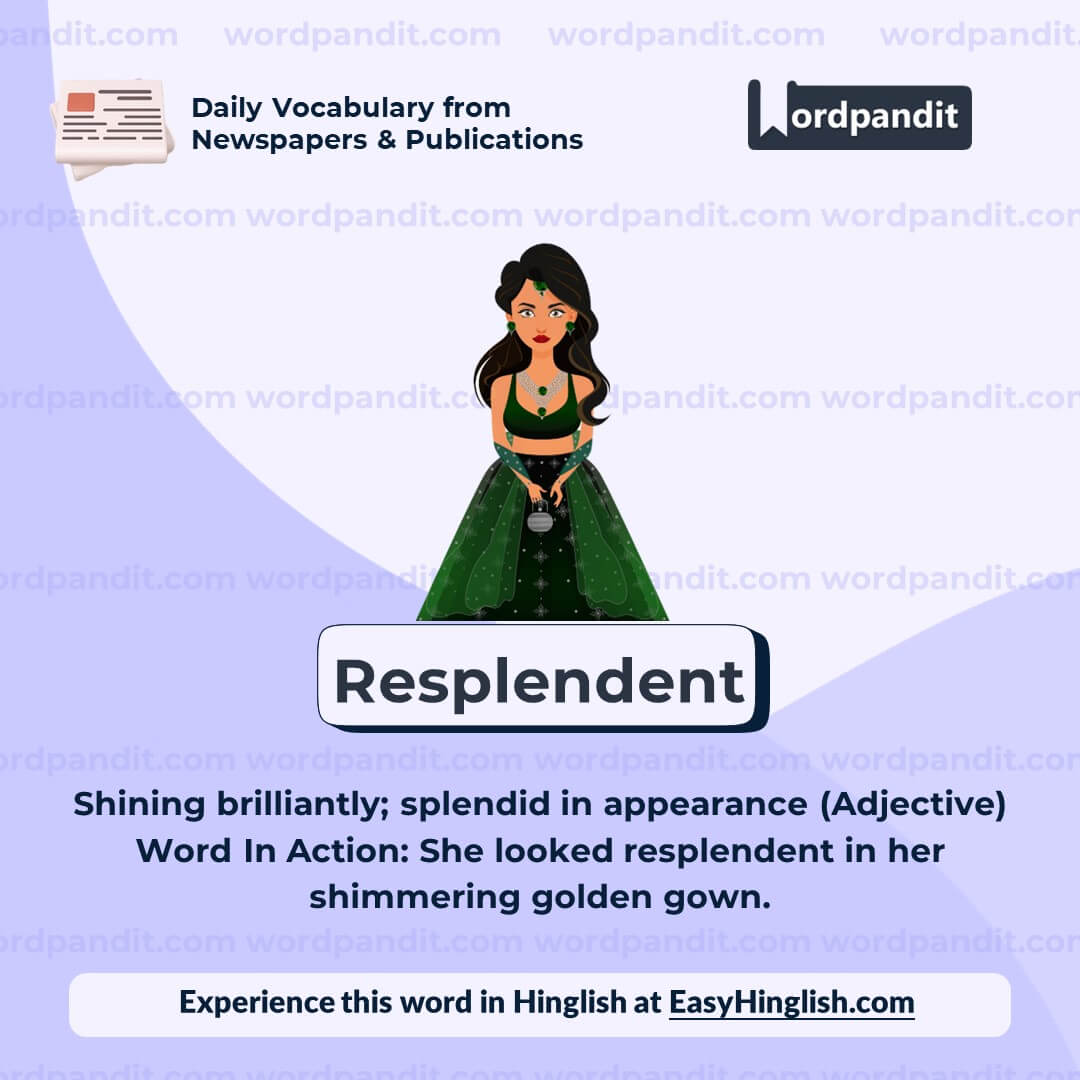
WORD-5: Resplendent
Context:
"Let us unfurl that resplendent emblem of independence openly." - The Wire
Explanatory Paragraph:
"Resplendent" describes something that is dazzlingly impressive or shining brilliantly, often because of beauty, color, or grandeur. In the context above, it emphasizes the magnificence of the flag — portraying it not just as a symbol of freedom, but as something visually and emotionally glorious. The word is commonly used to elevate the tone of a description, adding admiration and awe.
Meaning: Shining brilliantly; radiant and splendid in appearance (Adjective)
Pronunciation: ri-SPLEN-dent
Difficulty Level: ⭐⭐⭐ Intermediate
Etymology: From Latin *resplendēre* meaning "to shine brightly," formed from *re-* (intensifier) + *splendere* (to shine).
Prashant Sir's Notes:
“Resplendent” is a powerful descriptive word. Use it when you want to highlight something that dazzles the eye or stirs admiration — whether it's a sunset, a person in full attire, or an idea that shines through. Perfect for essays that need rich, evocative language.
Synonyms & Antonyms:
Synonyms: radiant, dazzling, magnificent, brilliant, glorious
Antonyms: dull, drab, gloomy, plain, lackluster
Usage Examples:
- She walked into the hall, resplendent in a crimson silk saree.
- The garden was resplendent with colorful spring blooms.
- The palace, lit by a thousand lamps, looked truly resplendent.
- The champion stood resplendent, draped in his national flag.
Cultural Reference:
The Taj Mahal is often described as resplendent, especially during sunrise or moonlight, when its marble glows with ethereal beauty.
Think About It:
Can something be resplendent in meaning or character, not just in appearance? What would that look like?
Quick Activity:
Think of a person, place, or object you find incredibly beautiful or impressive. Write one sentence using "resplendent" to describe it.
Memory Tip:
“Resplendent” sounds like “splendid” — and both describe something bright, beautiful, and admirable. Think of a sparkling crown or a sunset to remember it!
Real-World Application:
"Resplendent" is used in literature, fashion, travel writing, and ceremonial speeches to add richness and admiration to descriptions of people, events, or places.


