

Daily Vocabulary from Indian Newspapers and Publications
Welcome to Wordpandit’s Indian Vocabulary Hub
At Wordpandit, we understand the importance of staying rooted in the local context while expanding your language skills. This section focuses on enriching your vocabulary with words and phrases drawn from India’s leading newspapers and publications, ensuring you're learning vocabulary that is practical, relevant, and uniquely Indian.
Why Indian Sources Matter
We believe that the best way to master any language is by immersing yourself in local content. That’s why we carefully curate vocabulary from top Indian publications, including:
- The Hindu
- The Times of India
- The Economic Times
- Hindustan Times
- Live Mint
- The Indian Express
- And many others...
Stay Updated, Stay Relevant
With daily updates from Indian news sources, you’ll be consistently learning words that reflect the trends and shifts in Indian society and culture. Our focus is to provide vocabulary that enhances your understanding of the language in an Indian context.
How Wordpandit Supports Your Goals
Whether you’re preparing for exams, aiming to improve your professional communication, or simply want to stay connected with the latest Indian vocabulary, Wordpandit is here to guide you every step of the way.
Learn with a Practical Approach
Our interactive learning methodology includes real-world examples, engaging activities, and context-specific usage to ensure that every word becomes part of your active vocabulary.
Dive into Indian Vocabulary Today!

Why Choose Wordpandit?
Practical Learning: Focus on words you'll actually encounter in real-world reading, enhancing your comprehension and communication skills.
Diverse Content: From current affairs to scientific breakthroughs, our varied sources expose you to vocabulary across multiple domains.
Effortless Integration: Make Wordpandit a part of your daily routine. Just a few minutes each day can significantly boost your lexicon over time.
Your Path to Vocabulary Mastery
- Visit our Daily Vocabulary section regularly
- Explore new words and their usage in context
- Practice incorporating these words into your own writing and speech
- Track your progress as your vocabulary expands
Start Your Journey Today
Embark on your vocabulary enhancement journey with Wordpandit. By consistently engaging with our daily posts, you'll build a robust vocabulary that serves you well in academic, professional, and personal contexts.
Remember, a word a day keeps linguistic limitations at bay. Make Wordpandit your daily companion in the quest for vocabulary excellence!
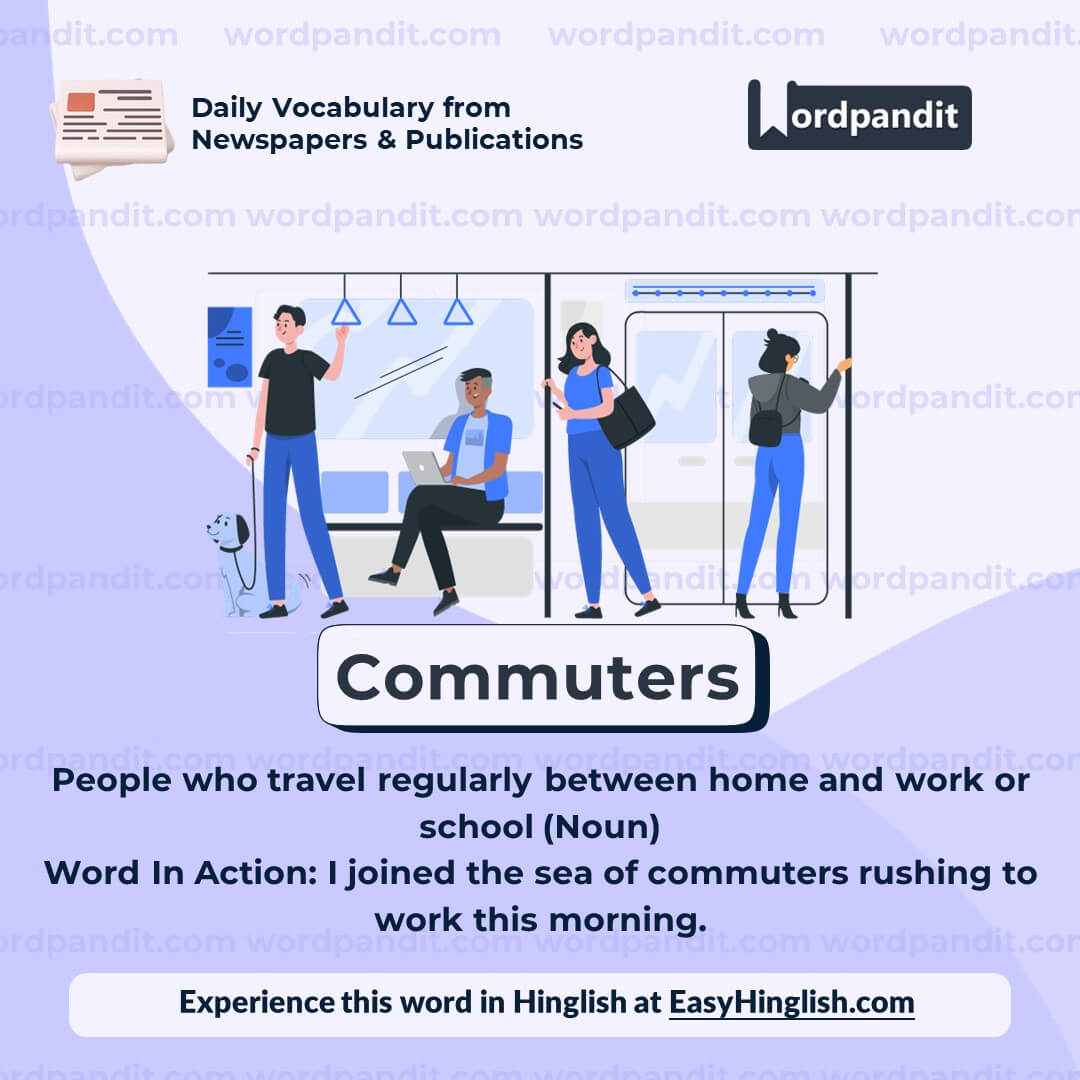
WORD-1: Commuters
Context:
"Another issue that has been a frequent hindrance to commuters and pedestrians is several cars and buses parked in a row on both narrow and broad lanes, some in unexpected spaces." - The Hindu
Explanatory Paragraph:
The word "commuters" refers to people who travel some distance from home to work or school and back on a regular basis. These individuals are often affected by public infrastructure issues such as traffic congestion, inadequate parking, or lack of pedestrian-friendly pathways. In the context above, commuters face inconvenience due to poor parking habits that obstruct their daily routes.
Meaning: People who travel regularly between home and work (Noun)
Pronunciation: kuh-MYOO-terz
Difficulty Level: ⭐⭐ Basic
Etymology: From the Latin word "commutare," meaning "to change" or "exchange", evolving in English to describe people who change locations daily for work or study.
Prashant Sir's Notes:
Focus on the root "commute"—which means to travel, especially daily. ‘Commuters’ refers to those who do it routinely. This is a very commonly encountered term in urban discussions, especially in the context of traffic and public transport systems.
Synonyms & Antonyms:
Synonyms: travelers, passengers, riders, daily travelers
Antonyms: residents, homebodies, locals (context-dependent)
Usage Examples:
- Thousands of commuters use the metro every day to avoid traffic congestion.
- Early-morning commuters were delayed due to heavy fog on the highway.
- The city plans to build a new flyover to ease the pressure on daily commuters.
- With the introduction of e-bikes, many commuters have switched from cars to greener alternatives.
Cultural Reference:
"The life of a commuter has become symbolic of modern urban existence—rushing, crowded, yet unavoidable." - Urban Studies Journal
Think About It:
How does the daily experience of commuting shape a person's productivity, mental health, and lifestyle choices?
Quick Activity:
Write a short paragraph describing the daily routine of a commuter in your city. Try using the words 'congestion', 'schedule', and 'mode of transport'.
Memory Tip:
Think: “Commute = Come + Route” — people who follow the same route every day to come to work or school.
Real-World Application:
The term "commuters" is widely used in transportation planning, urban development policies, and media reports discussing infrastructure and public transportation systems. It’s crucial when addressing the needs of working populations in cities.
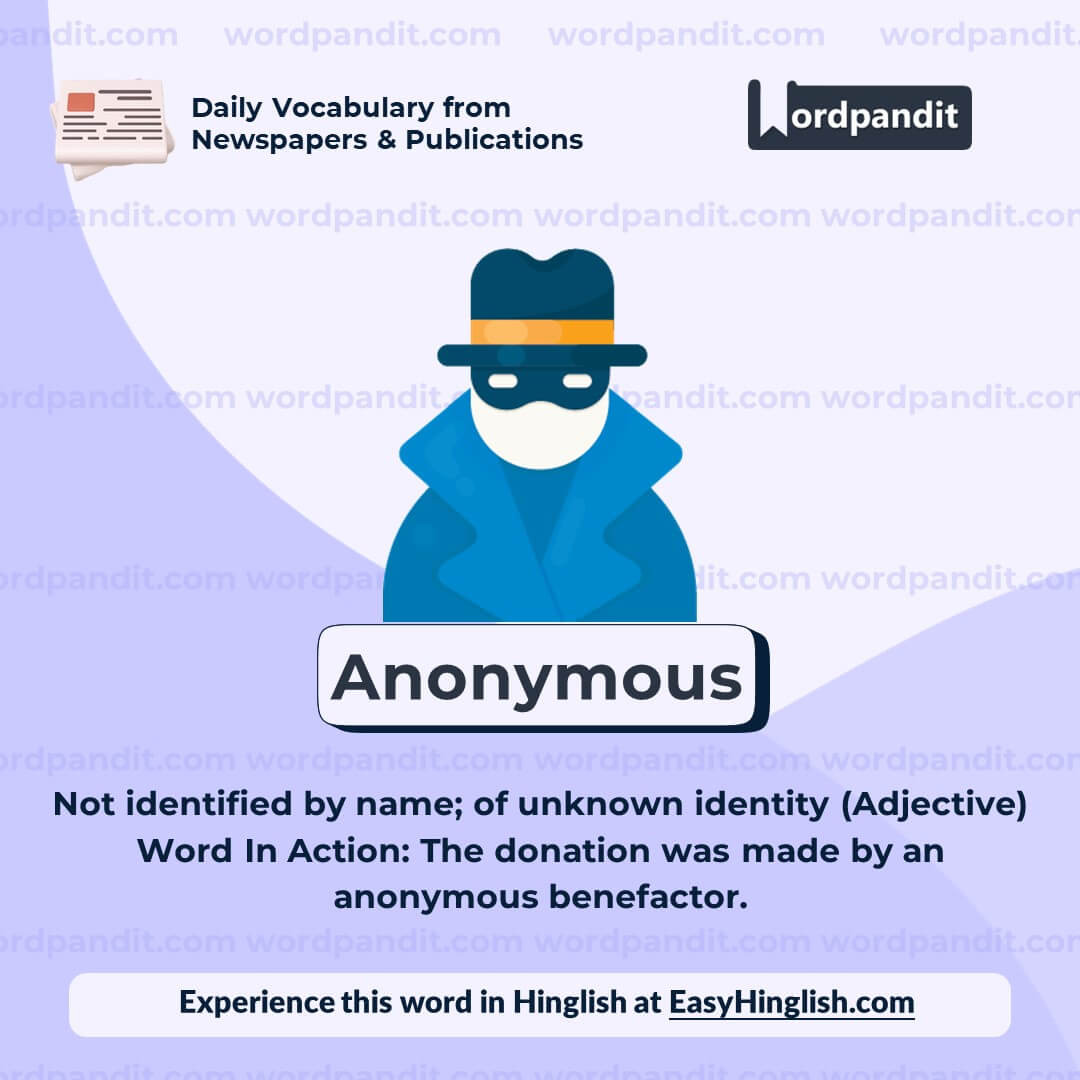
WORD-2: Anonymous
Context:
"On the other hand, a travel company owner who preferred to stay anonymous said that parking has become an issue for them too, forcing them to park at public spaces." - The Hindu
Explanatory Paragraph:
The word "anonymous" refers to someone whose name or identity is not known or not revealed. In the context above, the owner of a travel company chose to keep their identity hidden, likely for reasons of privacy or to avoid public or professional backlash. The term is often used in journalism, surveys, online posts, or whistleblowing scenarios where revealing a name might have consequences.
Meaning: Not identified by name; of unknown name (Adjective)
Pronunciation: uh-NON-uh-mus
Difficulty Level: ⭐⭐ Basic
Etymology: From Greek "anōnumos" meaning "without a name" (from "an-" = without + "onyma" = name)
Prashant Sir's Notes:
Break the word down: "An-" (without) + "onym" (name). Commonly used in news reports and online spaces. Important word in the digital era where identity can be hidden or protected. Keep in mind the tone it can convey—neutral, secretive, or protective.
Synonyms & Antonyms:
Synonyms: unnamed, unidentified, unknown, incognito, secret
Antonyms: named, identified, known, recognized
Usage Examples:
- The donor chose to remain anonymous to avoid media attention.
- An anonymous caller reported the incident to the police.
- Many online comments are posted under anonymous usernames.
- The artist initially published their work anonymously to gauge genuine reactions.
Cultural Reference:
"Anonymous" is also the name of a loosely organized group of international activists and hacktivists, often wearing Guy Fawkes masks, known for digital protests. - Global Tech Culture
Think About It:
Is anonymity on the internet a right that protects freedom, or a shield that encourages irresponsibility?
Quick Activity:
List 3 scenarios where a person might want to remain anonymous. Explain the reason in each case.
Memory Tip:
Think: "A No Name = Anonymous" — Someone with no name revealed.
Real-World Application:
"Anonymous" is a critical term in journalism, surveys, cybersecurity, and literature. It helps protect privacy and ensure honest expression, especially when revealing identity could be risky.
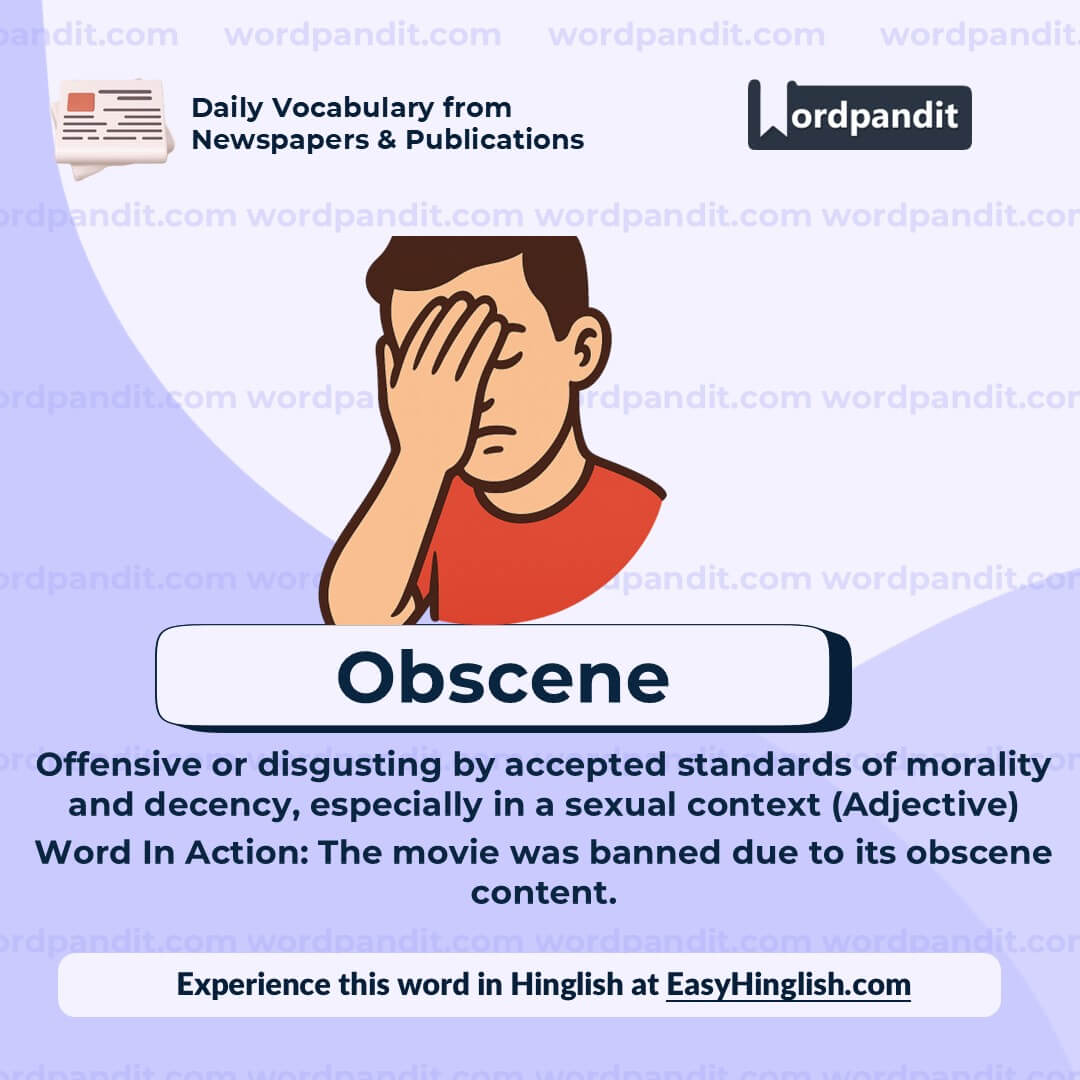
WORD-3: Obscene
Context:
"Priyank Kanoongo, member of the National Human Rights Commission (NHRC), in a letter written to YouTube has directed the social media platform to take down the ‘obscene and vulgar’ video of podcaster Ranveer Allahbadia from the show ‘India’s Got Latent’." - The Hindu
Explanatory Paragraph:
The word "obscene" is used to describe something that is offensive or disgusting by accepted standards of morality and decency—especially in terms of sexual content, language, or behavior. In the given context, a public authority has asked YouTube to remove content that is considered indecent or inappropriate for public viewing, reflecting concerns over maintaining social norms and protecting public sensibilities.
Meaning: Offensive or disgusting by moral standards, often sexually explicit or indecent (Adjective)
Pronunciation: ub-SEEN
Difficulty Level: ⭐⭐⭐ Intermediate
Etymology: From Latin “obscenus,” meaning "foul, repulsive, or indecent", often used in theatrical or public speech to refer to what is unfit for display.
Prashant Sir's Notes:
Be mindful: “obscene” carries strong connotations and legal implications in media, law, and culture. It’s frequently paired with words like “language,” “gesture,” or “material.” Not to be confused with merely rude—it refers to something grossly offensive or indecent.
Synonyms & Antonyms:
Synonyms: indecent, vulgar, lewd, offensive, crude
Antonyms: decent, modest, appropriate, respectable
Usage Examples:
- The comedian was fined for using obscene language during a live performance.
- Many people protested the billboard for being visually obscene and inappropriate for public display.
- The book was banned in several countries due to its obscene content.
- He faced criticism for making obscene gestures during the game.
Cultural Reference:
The term "obscene" has often been at the center of legal cases, such as the landmark U.S. Supreme Court ruling in *Miller v. California* (1973), which set standards for what constitutes obscenity in media. - U.S. Legal Archives
Think About It:
Where should society draw the line between freedom of expression and obscenity?
Quick Activity:
List 3 settings (e.g., school, cinema, workplace) where obscene content might be especially problematic. Explain why in each case.
Memory Tip:
Think: "Obscene = Obvious + Scene" — A scene so obviously offensive that it shocks or disgusts.
Real-World Application:
The word "obscene" is used in legal, educational, and media contexts to define and regulate content. It plays a critical role in censorship laws, broadcasting standards, and workplace conduct policies.
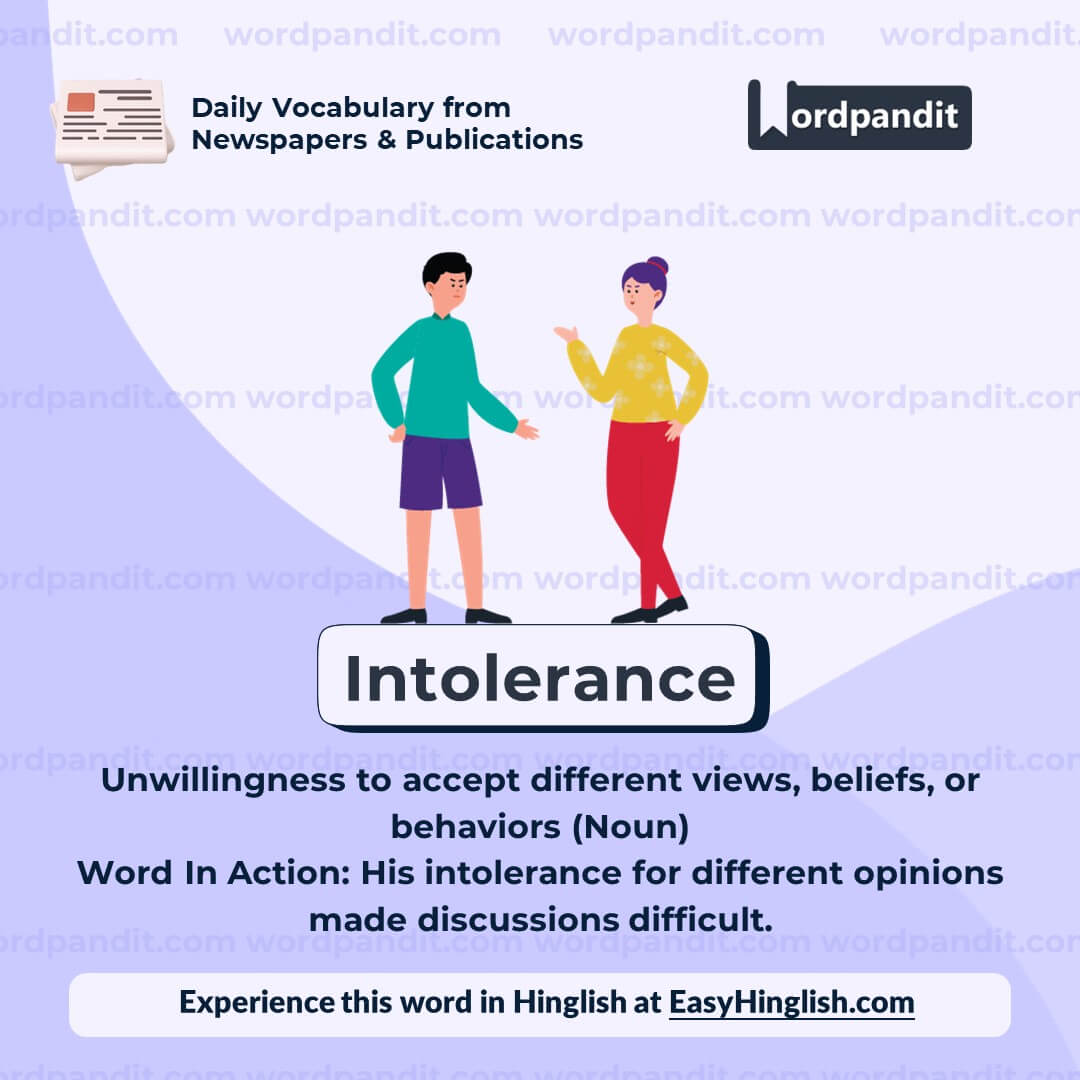
WORD-4: Intolerance
Context:
"The NHRC member claimed that the complaint highlights concerns regarding the show’s propagation of negativity, discriminatory perspectives, religious and cultural intolerance, and disrespectful and obscene ideologies, particularly towards women and children." - The Hindu
Explanatory Paragraph:
The word "intolerance" refers to an unwillingness or refusal to accept people who are different—whether in religion, culture, opinions, or beliefs. In the context above, it highlights a societal concern where a media program is perceived as promoting attitudes that show a lack of respect for religious and cultural diversity. Intolerance often fuels conflict and discrimination and is considered harmful in pluralistic societies.
Meaning: Unwillingness to accept views, beliefs, or behaviors that differ from one's own (Noun)
Pronunciation: in-TOL-uh-runss
Difficulty Level: ⭐⭐⭐ Intermediate
Etymology: From Latin "intolerantia" meaning "unbearableness"; formed by prefix “in-” (not) + “tolerantia” (endurance or patience)
Prashant Sir's Notes:
“Tolerance” means acceptance; add “in-” and it becomes the opposite. Intolerance isn’t just a personal flaw—it has societal consequences, especially in diverse societies. Look out for usage in political, religious, and cultural debates.
Synonyms & Antonyms:
Synonyms: prejudice, bigotry, narrow-mindedness, discrimination, bias
Antonyms: acceptance, open-mindedness, tolerance, inclusiveness, respect
Usage Examples:
- The country has taken legal steps to curb religious intolerance.
- Intolerance of differing opinions can weaken the fabric of a democratic society.
- Her essay explored the causes and effects of cultural intolerance in schools.
- Social media platforms are under pressure to monitor and remove posts that promote intolerance.
Cultural Reference:
India celebrates "Tolerance Day" on November 16, joining the UN in promoting peace and mutual respect across cultures—emphasizing the dangers of intolerance in a diverse nation. - UNESCO
Think About It:
Can laws alone eliminate intolerance, or does real change require shifts in personal attitudes and education?
Quick Activity:
Write down one personal or historical example of intolerance you've learned about. Then suggest one possible solution to reduce it.
Memory Tip:
Break it down: "In-" (not) + "tolerance" (acceptance) = Not accepting. Intolerance = inability to tolerate differences.
Real-World Application:
"Intolerance" is a crucial term in discussions about diversity, equity, social justice, and human rights. It appears in education policies, political speeches, and anti-discrimination laws worldwide.
WORD-5: Disseminates
Context:
"It is further alleged that, under the guise of freedom of speech, the show disseminates obscene and vulgar content along with misleading messages, thereby fostering a corrupt mindset in society." - The Hindu
Explanatory Paragraph:
The word "disseminates" means to spread or distribute something—especially information, ideas, or content—widely. In the context provided, the show is being accused of using the freedom of speech as a cover to broadcast or circulate inappropriate and misleading material to the public. The use of "disseminates" here implies a deliberate and broad distribution that potentially impacts many viewers.
Meaning: To spread or distribute information or ideas widely (Verb)
Pronunciation: dih-SEM-uh-nayts
Difficulty Level: ⭐⭐⭐ Intermediate
Etymology: From Latin "disseminare" — "dis-" (abroad) + "seminare" (to sow), meaning "to scatter like seeds"
Prashant Sir's Notes:
Imagine sowing seeds across a field—that’s how “disseminating” information works. It's not random sharing; it suggests intent and wide reach. Common in academic, media, and legal language. Watch how it's used especially in relation to propaganda or education.
Synonyms & Antonyms:
Synonyms: spread, broadcast, circulate, propagate, publicize
Antonyms: suppress, conceal, withhold, hide, contain
Usage Examples:
- The university regularly disseminates research findings through international journals.
- False rumors were disseminated rapidly through social media.
- The organization aims to disseminate awareness about climate change in rural areas.
- He was arrested for disseminating hateful material during the protests.
Cultural Reference:
The printing press revolutionized human history by enabling the rapid dissemination of knowledge, leading to the Enlightenment and modern education. - History of Communication, Oxford University
Think About It:
Does the ease of disseminating information in the digital age make it harder to distinguish truth from misinformation?
Quick Activity:
Pick a current event and write two sentences: one explaining how information about it was disseminated responsibly, and one where it may have been misused or misleading.
Memory Tip:
Think: “Disseminate = Distribute like seeds.” Just as farmers sow seeds across a field, people disseminate ideas across society.
Real-World Application:
"Disseminates" is often used in journalism, education, government, and health communication to describe how messages, information, or policies are spread to the public.


