Daily Vocabulary from Indian Newspapers and Publications
Welcome to Wordpandit’s Indian Vocabulary Hub
At Wordpandit, we understand the importance of staying rooted in the local context while expanding your language skills. This section focuses on enriching your vocabulary with words and phrases drawn from India’s leading newspapers and publications, ensuring you're learning vocabulary that is practical, relevant, and uniquely Indian.
Why Indian Sources Matter
We believe that the best way to master any language is by immersing yourself in local content. That’s why we carefully curate vocabulary from top Indian publications, including:
- The Hindu
- The Times of India
- The Economic Times
- Hindustan Times
- Live Mint
- The Indian Express
- And many others...
Stay Updated, Stay Relevant
With daily updates from Indian news sources, you’ll be consistently learning words that reflect the trends and shifts in Indian society and culture. Our focus is to provide vocabulary that enhances your understanding of the language in an Indian context.
How Wordpandit Supports Your Goals
Whether you’re preparing for exams, aiming to improve your professional communication, or simply want to stay connected with the latest Indian vocabulary, Wordpandit is here to guide you every step of the way.
Learn with a Practical Approach
Our interactive learning methodology includes real-world examples, engaging activities, and context-specific usage to ensure that every word becomes part of your active vocabulary.
Dive into Indian Vocabulary Today!

Why Choose Wordpandit?
Practical Learning: Focus on words you'll actually encounter in real-world reading, enhancing your comprehension and communication skills.
Diverse Content: From current affairs to scientific breakthroughs, our varied sources expose you to vocabulary across multiple domains.
Effortless Integration: Make Wordpandit a part of your daily routine. Just a few minutes each day can significantly boost your lexicon over time.
Your Path to Vocabulary Mastery
- Visit our Daily Vocabulary section regularly
- Explore new words and their usage in context
- Practice incorporating these words into your own writing and speech
- Track your progress as your vocabulary expands
Start Your Journey Today
Embark on your vocabulary enhancement journey with Wordpandit. By consistently engaging with our daily posts, you'll build a robust vocabulary that serves you well in academic, professional, and personal contexts.
Remember, a word a day keeps linguistic limitations at bay. Make Wordpandit your daily companion in the quest for vocabulary excellence!
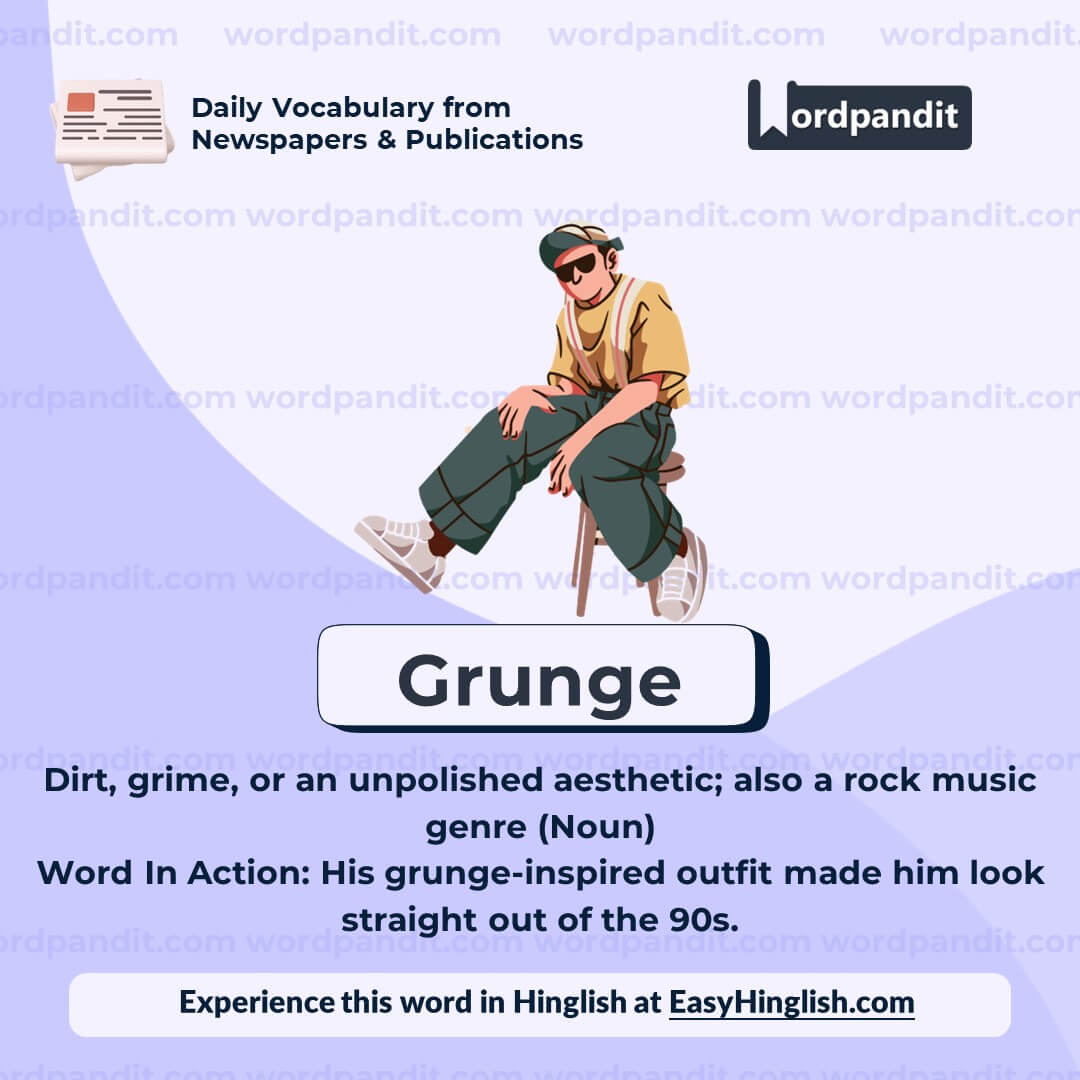
WORD-1: Grunge
Context:
"Isolated on grunge background." - The Hindu
Explanatory Paragraph:
The word "grunge" refers to a gritty, messy, or dirty appearance, often used in the context of style, art, and design. Originally associated with a music genre and subculture in the 1990s that emphasized unkempt, raw aesthetics, the term has since expanded to describe visuals that are dark, textured, and edgy. In photography or graphic design, a "grunge background" typically has rough textures, faded colors, and distressed elements to evoke a raw or rebellious mood.
Meaning: A style characterized by dirtiness, roughness, or rebellious aesthetics (noun)
Pronunciation: grunj
Difficulty Level: ⭐⭐ Beginner
Etymology: Originated in the 1960s U.S. slang, possibly from "grungy," meaning dirty or grimy; popularized by the 1990s music scene in Seattle.
Prashant Sir's Notes:
This word bridges visual aesthetics and cultural identity. Originally musical, it’s now a key word in fashion, design, and art vocabularies. Always visualize texture, grit, and rebellious rawness when you encounter "grunge."
Synonyms & Antonyms:
Synonyms: gritty, grimy, shabby, rugged, distressed
Antonyms: polished, pristine, sleek, clean, refined
Usage Examples:
- She loved the grunge style of the 90s, with its flannel shirts and ripped jeans.
- The photographer used a grunge background to highlight the model's edgy outfit.
- His room had a deliberate grunge aesthetic, filled with old posters and worn-out furniture.
- The grunge music scene revolutionized the sound of alternative rock.
Cultural Reference:
"Grunge became more than music—it became fashion, art, and an attitude." - Rolling Stone Magazine
Think About It:
Why do you think people are often drawn to "grunge" aesthetics instead of clean or polished designs?
Quick Activity:
Look up five images tagged with "grunge background" and list the textures or elements they share (e.g., rust, cracks, faded paint).
Memory Tip:
Think “grunge = grungy + grumpy + grizzly” — all messy, dirty, rough things that hint at the core of grunge style.
Real-World Application:
In graphic design, using a grunge background can give your work a raw, rebellious edge. In fashion, grunge influences streetwear and alternative clothing styles. Understanding this word helps when analyzing trends, aesthetics, or cultural identities.
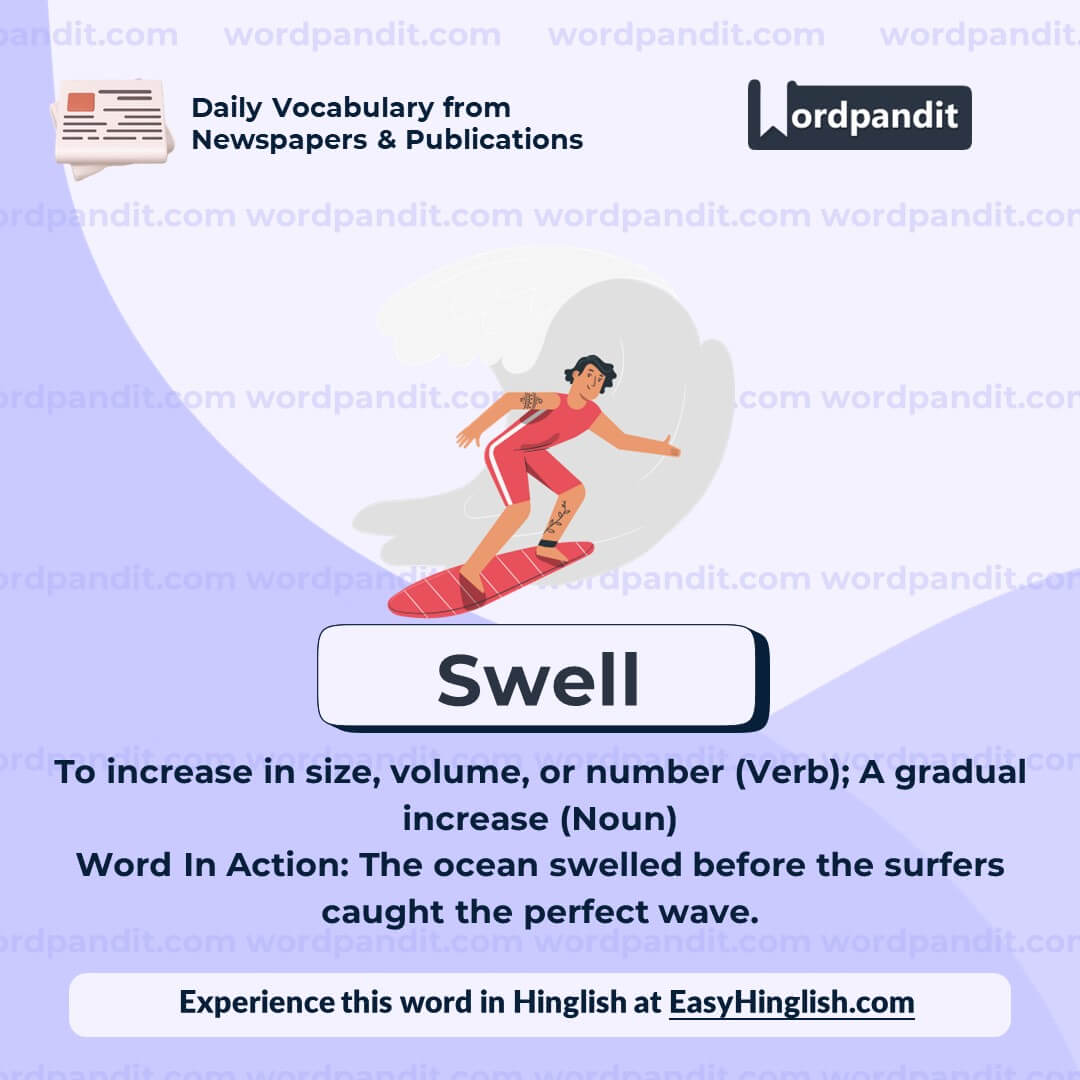
WORD-2: Swell
Context:
"The stampede was preceded by swell in crowd of passengers waiting to board trains for Prayagraj where the Maha Kumbh is underway on platform number 14 and 15 of the station." - The Hindu
Explanatory Paragraph:
The word "swell" in this context refers to a sudden or significant increase in number or volume. It is often used to describe a rising crowd, an inflating emotion, or something that grows larger or more intense over time. In the sentence from The Hindu, it indicates that the crowd grew in size before the stampede occurred — highlighting a sharp, noticeable increase in the number of people at the station.
Meaning: A gradual or sudden increase in size, volume, or number (noun/verb)
Pronunciation: swel
Difficulty Level: ⭐⭐ Beginner
Etymology: From Old English *swellan*, meaning "to grow or rise," with roots in Proto-Germanic and Proto-Indo-European languages related to growth or swelling.
Prashant Sir's Notes:
Always look at the verb–noun dual nature of "swell." It can describe both action ("the river swelled") and condition ("a swell in the crowd"). Context decides whether it is gradual or sudden — pay attention to that in reading comprehension and descriptive writing.
Synonyms & Antonyms:
Synonyms: increase, surge, rise, expand, grow
Antonyms: decrease, shrink, lessen, dwindle, reduce
Usage Examples:
- The river began to swell after days of continuous rain.
- There was a swell of support for the candidate after the debate.
- The ranks of the protestors swelled as more people joined from nearby towns.
- Her pride swelled as she watched her son graduate with honors.
Cultural Reference:
"A swell in public emotion followed the tragic incident, pushing authorities to respond swiftly." - An editorial in The Indian Express
Think About It:
Can the idea of "swell" apply to both positive and negative situations? How does the emotional tone shift based on what is swelling?
Quick Activity:
Write two sentences using "swell" — one where it means an increase in size, and another where it refers to emotion or feeling.
Memory Tip:
Think of a balloon: as you blow into it, it swells — just like a crowd or emotion that grows in size or intensity.
Real-World Application:
"Swell" is commonly used in journalism, literature, and everyday speech to describe increases — in numbers, emotions, or even physical conditions like injuries. Understanding it helps interpret both data reports and emotional narratives effectively.
WORD-3: Capitulate
Context:
"The company capitulated to the labor union to avoid a strike." - The Hindu
Explanatory Paragraph:
The word "capitulate" means to surrender or give in, especially after resisting for some time. It is often used in the context of negotiations, battles, or conflicts—whether physical, emotional, or corporate. In the sentence provided, the company eventually gave in to the demands of the labor union to prevent a strike, signaling a reluctant but necessary surrender to avoid greater consequences.
Meaning: To surrender or give in after resistance (verb)
Pronunciation: kuh-PIH-chuh-layt
Difficulty Level: ⭐⭐⭐ Intermediate
Etymology: From Late Latin capitulare, meaning "to draw up in chapters"; evolved to mean agreeing to terms or conditions—often under pressure or threat.
Prashant Sir's Notes:
Capitulate = To yield or surrender, usually after some struggle. Remember: it’s often used when there's a power imbalance—one side gives in, not always willingly, but because it has no better option. Think negotiation stand-offs or even emotional persuasion.
Synonyms & Antonyms:
Synonyms: surrender, yield, concede, submit, relent
Antonyms: resist, defy, oppose, hold out, withstand
Usage Examples:
- The army capitulated after being surrounded for weeks.
- Eventually, she capitulated to her parents' wishes and chose a safer career path.
- The government capitulated to public pressure and repealed the controversial law.
- He refused to capitulate, even when threatened with dismissal.
Cultural Reference:
"Never capitulate to fear or tyranny." — A motto often quoted in resistance movements throughout history, from Gandhi’s civil disobedience to World War II resistance forces.
Think About It:
Is capitulating always a sign of weakness, or can it sometimes be a strategic choice? When is surrender smarter than resistance?
Quick Activity:
Think of a time when a major company or government gave in under pressure. Summarize what led them to capitulate in 2–3 lines.
Memory Tip:
Capitulate has “cap” in it—imagine someone taking off their cap and bowing in defeat. A mental image of giving up or surrendering.
Real-World Application:
Capitulate is widely used in legal, business, political, and even personal relationship contexts to describe formal or informal surrender. Understanding this word sharpens your ability to interpret power dynamics in news reports, negotiations, or history texts.
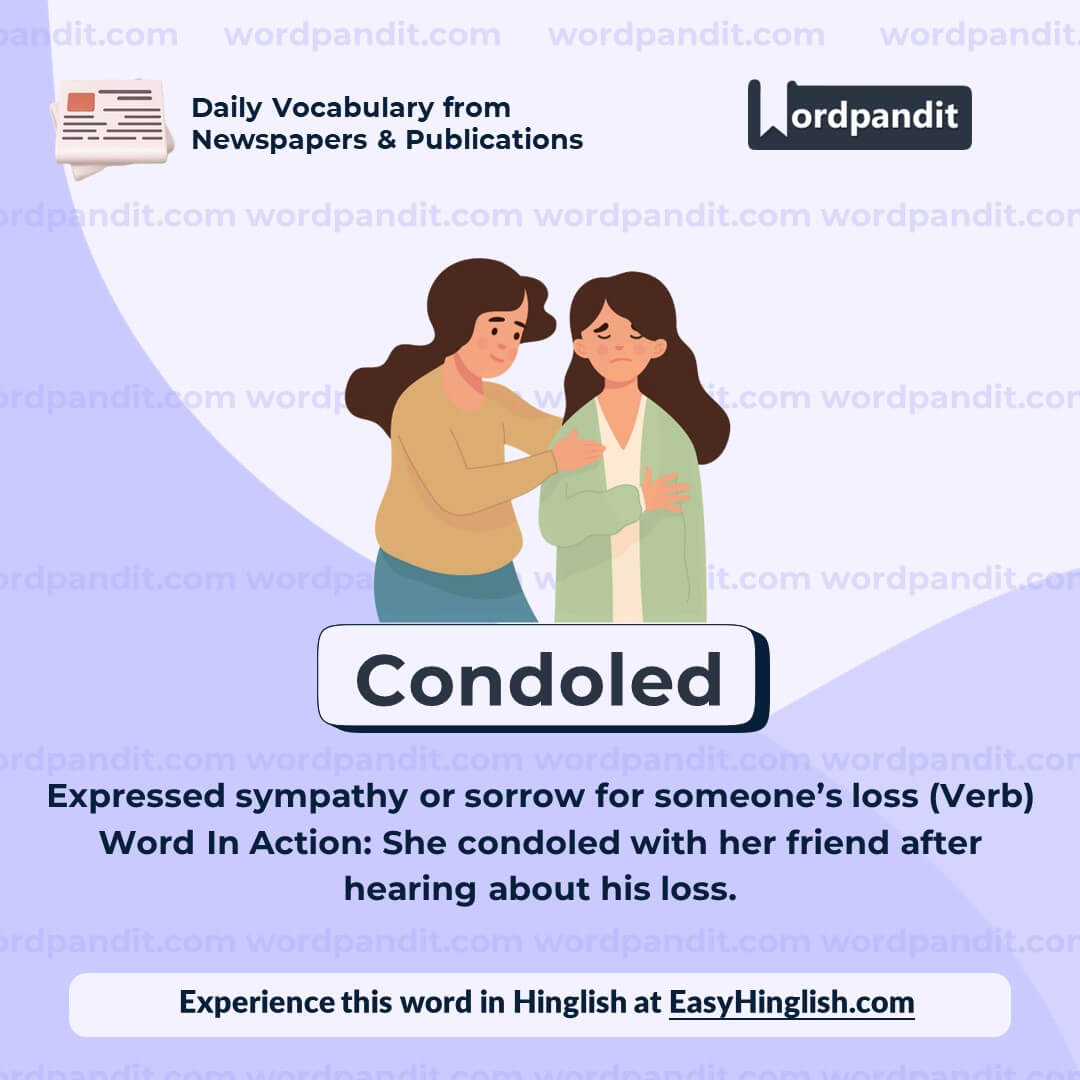
WORD-4: Condoled
Context:
"Jammu and Kashmir LT Governor Manoj Sinha and Chief Minister Omar Abdullah condoled the death of 18 people in a stampede at New Delhi Railway station." - The Hindu
Explanatory Paragraph:
The word "condoled" means to express sympathy or sorrow, especially in the context of someone’s death or misfortune. It is most commonly used when public figures or individuals formally express their condolences. In the given sentence, government leaders expressed their sympathy and support to the families of the victims who lost their lives in the tragic stampede incident.
Meaning: Expressed sympathy or sorrow for someone’s loss (verb - past tense)
Pronunciation: kun-DOLED
Difficulty Level: ⭐⭐ Beginner
Etymology: From Latin condolere, meaning “to suffer together”; from con- (together) + dolere (to grieve)
Prashant Sir's Notes:
This word is formal and often used in news reports or official statements. It is typically followed by “with” or “the death of...” and always linked to expressing grief. Remember, it’s never used casually — only in serious or somber situations.
Synonyms & Antonyms:
Synonyms: sympathized, mourned, lamented, expressed grief
Antonyms: ignored, disregarded, disrespected (contextual)
Usage Examples:
- He condoled the family for their tragic loss in the accident.
- Leaders from around the world condoled the victims of the earthquake.
- She condoled with her colleague after hearing about the bereavement.
- The president condoled the nation during his televised address.
Cultural Reference:
During national tragedies, it is customary for world leaders to issue statements where they condole the loss of lives, as a mark of respect and solidarity. For example, “The Prime Minister condoled the deaths after the Pulwama attack.”
Think About It:
Why do public expressions of condolence matter during national tragedies? Do they offer real comfort, or are they more symbolic?
Quick Activity:
Write a short condolence message (2-3 lines) that could be sent to someone who has lost a loved one in an accident.
Memory Tip:
Think: “condole = console.” Both involve offering comfort during sorrow. When someone dies, you don’t celebrate—you condole.
Real-World Application:
Understanding how and when to use “condoled” is crucial for writing formal letters, official communications, or professional statements during times of loss. It's a key term in diplomatic, journalistic, and human resources communication.
WORD-5: Abatement
Context:
"The Supreme Court on Friday (February 14, 2025) dismissed a plea filed by the legal heir of former Tamil Nadu Chief Minister J Jayalalithaa seeking the return of the properties confiscated in a case against her and said abatement of proceedings did not mean she was acquitted of the crime." - The Hindu
Explanatory Paragraph:
“Abatement” refers to the legal ending, suspension, or reduction of a judicial proceeding or penalty. In the context of court cases, if the person involved dies, the case may “abate” — meaning it comes to a stop due to the inability to continue the trial. However, this doesn’t necessarily mean the person is cleared of charges or found innocent. In the example from The Hindu, the Supreme Court clarified that the abatement of proceedings against Jayalalithaa after her death didn’t amount to a formal acquittal — the charges were not examined further, but also not nullified.
Meaning: The ending, reduction, or suspension of a process, penalty, or legal proceeding (noun)
Pronunciation: uh-BAYT-muhnt
Difficulty Level: ⭐⭐⭐ Intermediate
Etymology: From Old French abatre meaning "to beat down," and Latin battuere, meaning "to beat" — the idea of reducing or cutting short something.
Prashant Sir's Notes:
Abatement is a highly context-dependent legal term. It doesn’t mean "forgiveness" or "innocence" — it simply marks a halt. Be cautious not to confuse it with “acquittal.” It’s useful in law, taxation, and even environmental policy discussions (like “noise abatement”).
Synonyms & Antonyms:
Synonyms: suspension, reduction, termination, cessation, decline
Antonyms: continuation, escalation, intensification, extension
Usage Examples:
- The judge ordered an abatement of the lawsuit following the defendant’s death.
- There was no abatement in the crowd’s enthusiasm despite the rain.
- The tax abatement program helped small businesses recover after the pandemic.
- Environmental groups called for the abatement of industrial emissions in the city.
Cultural Reference:
Legal abatement became widely discussed in the aftermath of high-profile criminal trials where the accused passed away before judgment, such as in the Jayalalithaa DA case or certain U.S. financial fraud cases.
Think About It:
Should legal abatement automatically erase charges if a trial cannot be completed, or should public interest demand posthumous clarity?
Quick Activity:
Find and list two situations (outside of law) where the word “abatement” might be used correctly (e.g., in environmental reports or city planning).
Memory Tip:
Think of “abate” as “a-bate” — like turning down the volume. When you abate something, you’re turning it down or stopping it.
Real-World Application:
"Abatement" is used in legal, environmental, and tax contexts. Knowing this word helps in reading government reports, legal news, or real estate documents that refer to abatements of penalties, lawsuits, or taxes.