

Daily Vocabulary from Indian Newspapers and Publications
Welcome to Wordpandit’s Indian Vocabulary Hub
At Wordpandit, we understand the importance of staying rooted in the local context while expanding your language skills. This section focuses on enriching your vocabulary with words and phrases drawn from India’s leading newspapers and publications, ensuring you're learning vocabulary that is practical, relevant, and uniquely Indian.
Why Indian Sources Matter
We believe that the best way to master any language is by immersing yourself in local content. That’s why we carefully curate vocabulary from top Indian publications, including:
- The Hindu
- The Times of India
- The Economic Times
- Hindustan Times
- Live Mint
- The Indian Express
- And many others...
Stay Updated, Stay Relevant
With daily updates from Indian news sources, you’ll be consistently learning words that reflect the trends and shifts in Indian society and culture. Our focus is to provide vocabulary that enhances your understanding of the language in an Indian context.
How Wordpandit Supports Your Goals
Whether you’re preparing for exams, aiming to improve your professional communication, or simply want to stay connected with the latest Indian vocabulary, Wordpandit is here to guide you every step of the way.
Learn with a Practical Approach
Our interactive learning methodology includes real-world examples, engaging activities, and context-specific usage to ensure that every word becomes part of your active vocabulary.
Dive into Indian Vocabulary Today!

Why Choose Wordpandit?
Practical Learning: Focus on words you'll actually encounter in real-world reading, enhancing your comprehension and communication skills.
Diverse Content: From current affairs to scientific breakthroughs, our varied sources expose you to vocabulary across multiple domains.
Effortless Integration: Make Wordpandit a part of your daily routine. Just a few minutes each day can significantly boost your lexicon over time.
Your Path to Vocabulary Mastery
- Visit our Daily Vocabulary section regularly
- Explore new words and their usage in context
- Practice incorporating these words into your own writing and speech
- Track your progress as your vocabulary expands
Start Your Journey Today
Embark on your vocabulary enhancement journey with Wordpandit. By consistently engaging with our daily posts, you'll build a robust vocabulary that serves you well in academic, professional, and personal contexts.
Remember, a word a day keeps linguistic limitations at bay. Make Wordpandit your daily companion in the quest for vocabulary excellence!
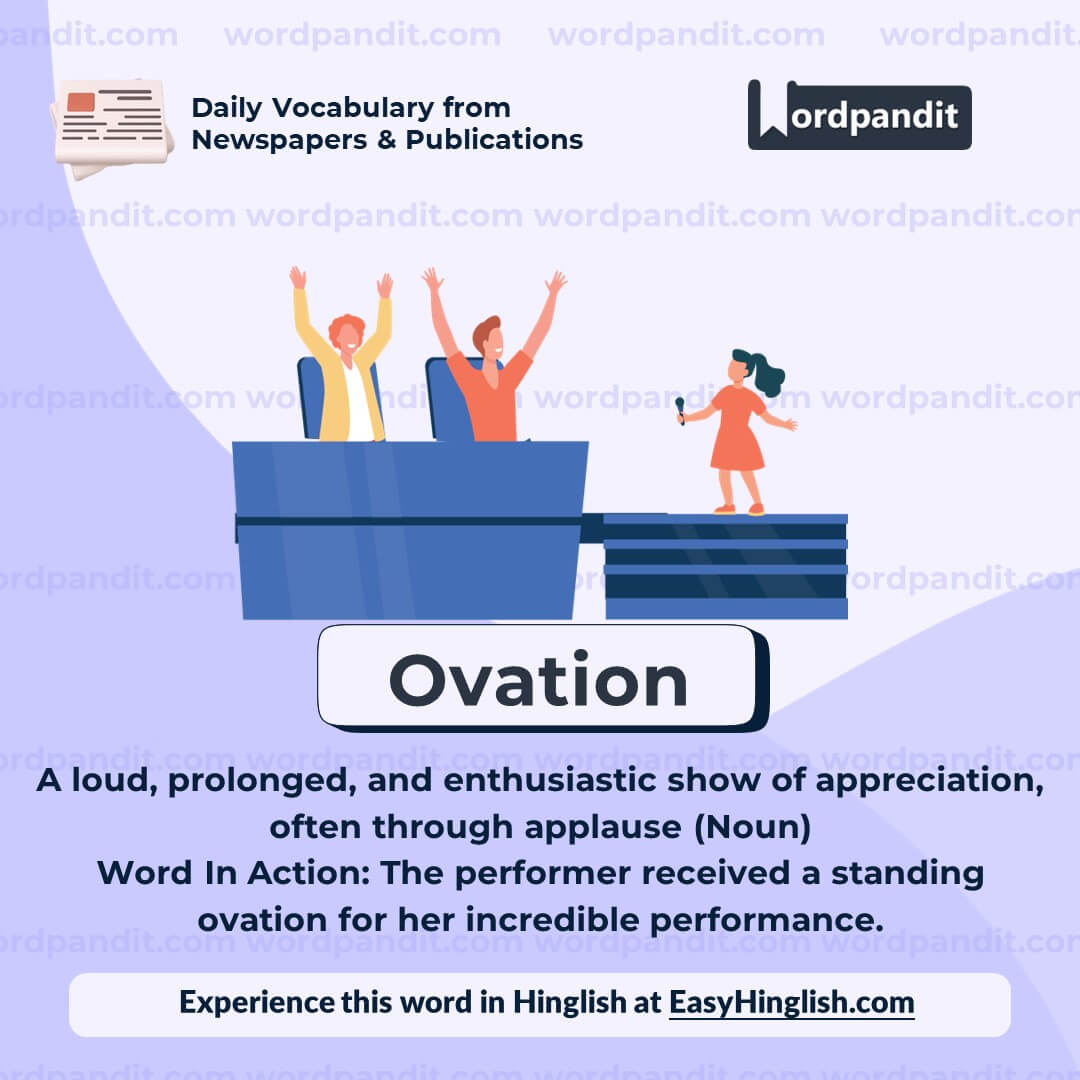
WORD-1: Ovation
Context:
"The attendees of this conference gave a 10-minute standing ovation to a team standing on the stage." - The Hindu
Explanatory Paragraph:
"Ovation" refers to a loud and enthusiastic show of appreciation from an audience, often involving clapping or cheering. When someone receives an ovation—especially a standing ovation—it means they have impressed or moved the audience deeply. This word is typically used in formal settings like award ceremonies, performances, or speeches, where appreciation is publicly expressed.
Meaning: A sustained and enthusiastic show of appreciation from an audience (Noun)
Pronunciation: oh-VAY-shun
Difficulty Level: ⭐⭐ Beginner
Etymology: From Latin "ovatio", meaning "a rejoicing" or "triumphal procession". Originally used for ceremonial applause in ancient Rome.
Prashant Sir's Notes:
This word is often associated with public applause. Think of moments that leave a strong emotional or inspirational impact—those usually get ovations. It's helpful to link it to “standing ovation,” a common and powerful phrase in English usage.
Synonyms & Antonyms:
Synonyms: applause, cheer, acclaim, tribute, accolade
Antonyms: silence, booing, criticism, disapproval
Usage Examples:
- The actor received a thunderous ovation for his heartfelt performance.
- Her speech on climate change ended with a standing ovation from the audience.
- The young athlete was visibly moved by the ovation from the home crowd.
- The conductor bowed deeply as the orchestra concluded to a grand ovation.
Cultural Reference:
"Meryl Streep received a standing ovation at the Oscars for her lifetime of excellence in film." - Academy Awards coverage
Think About It:
What kinds of actions or performances truly deserve an ovation—and how does public applause shape someone’s confidence?
Quick Activity:
Think of a moment you witnessed in person or online where someone got a standing ovation. Write two sentences explaining what made that moment so powerful.
Memory Tip:
Ovation sounds like “Oh! VAY-tion!” — imagine the crowd shouting “Oh wow!” while clapping in celebration. That’s an ovation.
Real-World Application:
Use “ovation” when writing about events, speeches, performances, or any situation where someone receives overwhelming applause or admiration from a group.
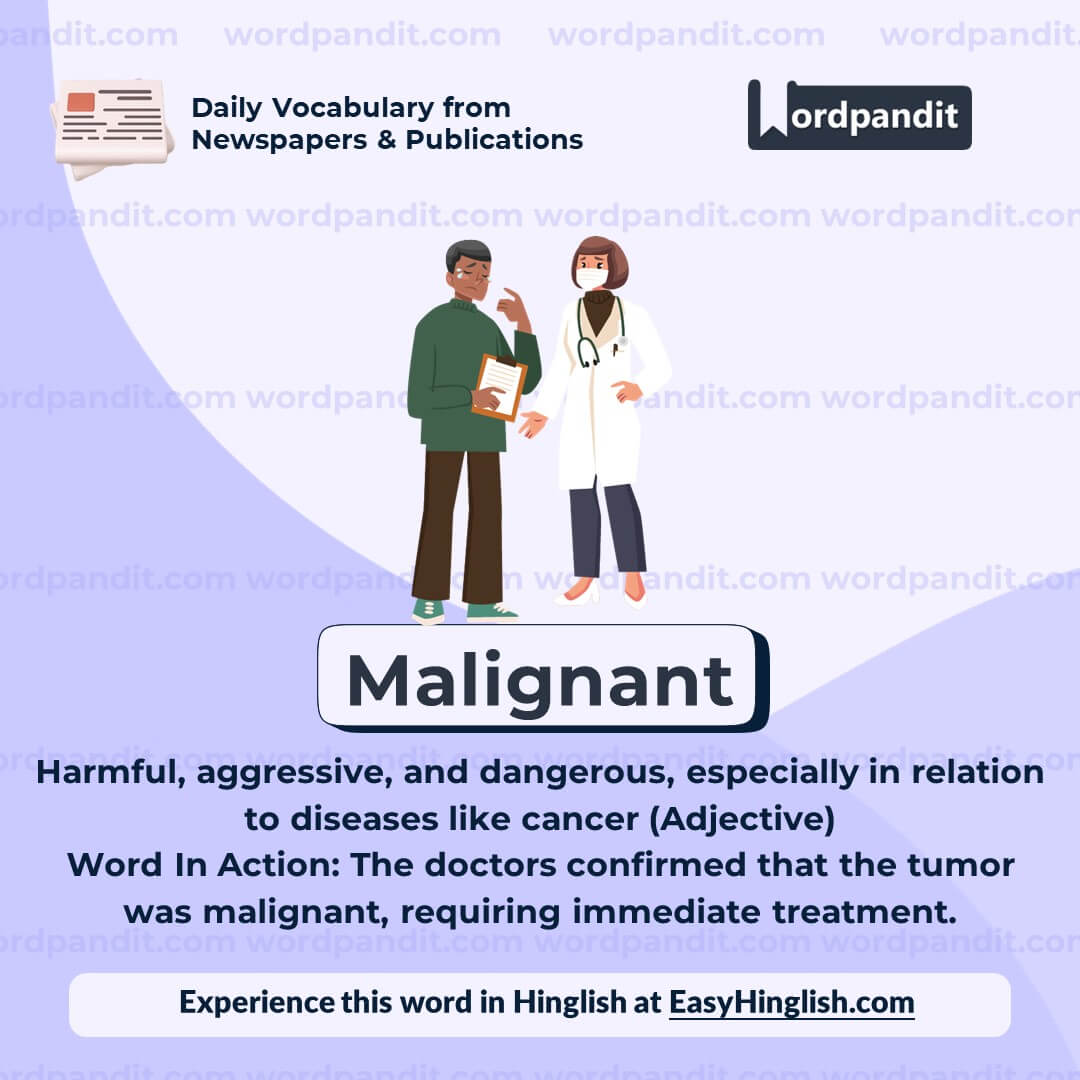
WORD-2: Malignant
Context:
"Blood sugar levels keep rising to stimulate the emergence of free radicals, which can lead to malignant tumors or cancer." - The Hindu
Explanatory Paragraph:
"Malignant" refers to something very harmful, dangerous, or likely to cause death. In medical terms, it is commonly used to describe tumors or diseases that are severe and can spread aggressively, especially cancer. Outside medicine, it can also describe someone or something that is deliberately cruel or harmful in intent. The key idea is something destructive and hard to control.
Meaning: Very harmful or dangerous, especially capable of spreading and leading to death (Adjective)
Pronunciation: muh-LIG-nuhnt
Difficulty Level: ⭐⭐⭐ Intermediate
Etymology: From Latin *malignus* meaning "bad-natured" or "wicked", from *malus* (bad) + *genus* (kind).
Prashant Sir's Notes:
This is a high-frequency word in medical contexts—especially when discussing cancer. Think of “malignant” as the opposite of “benign.” If something is malignant, it’s not just bad—it’s actively harmful and growing worse.
Synonyms & Antonyms:
Synonyms: harmful, cancerous, deadly, destructive, malicious
Antonyms: benign, harmless, kind, curable, non-threatening
Usage Examples:
- The biopsy revealed that the growth was malignant and required immediate treatment.
- He warned of the malignant influence of extremist ideologies on young minds.
- Doctors are concerned about the malignant spread of cancer cells to nearby tissues.
- Her malignant behavior caused deep distress in the workplace.
Cultural Reference:
"The malignant tumor in the character's brain was a central plot point in the medical drama *House M.D.*" - TV Reference
Think About It:
How does understanding the distinction between 'malignant' and 'benign' change how we respond emotionally and medically to a diagnosis?
Quick Activity:
Write two sentences using “malignant” — one in a medical context and one in a general emotional or psychological context.
Memory Tip:
Break it into “mal-” (bad) + “-ignant” (like ‘indignant’ or angry)—think of something dangerously bad or harmful, like a cancer that spreads quickly.
Real-World Application:
“Malignant” is crucial in medical reports, health journalism, and academic writing related to diseases, as well as in literature to describe toxic or evil characters or intentions.

WORD-3: Thesis
Context:
"While working on a thesis for my graduation, I found a new way to eliminate diabetes; the current method is discussed by many people." - The Hindu
Explanatory Paragraph:
A "thesis" is a long piece of writing or research, especially one written by a student for a college or university degree. It usually presents the author’s argument, findings, or discoveries about a specific subject. The purpose of a thesis is to contribute new ideas or solutions to a field of study. In a broader sense, "thesis" can also mean the central idea or main argument of an essay or discussion.
Meaning: A long piece of academic writing based on original research, typically submitted for a degree (Noun)
Pronunciation: THEE-sis
Difficulty Level: ⭐⭐ Beginner
Etymology: From Greek *thesis* meaning “a placing, proposition,” from the verb *tithenai*, “to place, to put forth.”
Prashant Sir's Notes:
This word is most relevant in academic settings. Students preparing for higher education—especially master's or Ph.D. degrees—must become very familiar with the idea of a thesis. It’s your personal research contribution.
Synonyms & Antonyms:
Synonyms: dissertation, research paper, argument, proposition
Antonyms: assumption, guess, question (in general contexts)
Usage Examples:
- She submitted her thesis on renewable energy solutions last semester.
- The thesis argues that modern diets are a key factor in rising diabetes rates.
- He struggled for months to collect data for his master’s thesis.
- The professor challenged the core thesis of the student’s presentation.
Cultural Reference:
"Albert Einstein’s 1905 doctoral thesis at the University of Zurich helped lay the foundation for his future work on relativity." - History of Science Archives
Think About It:
Why do you think writing a thesis is considered a crucial part of higher education? What skills does it help develop?
Quick Activity:
Think of a topic you are passionate about. Now write one sentence that could serve as a possible thesis statement for a research paper on that topic.
Memory Tip:
Think of "thesis" as your “thinking system” — it’s the structured way you present your main idea or findings.
Real-World Application:
Thesis writing is essential for postgraduate students and researchers, and understanding how to form a strong thesis is also vital in essay writing, public debates, and presenting new ideas professionally.
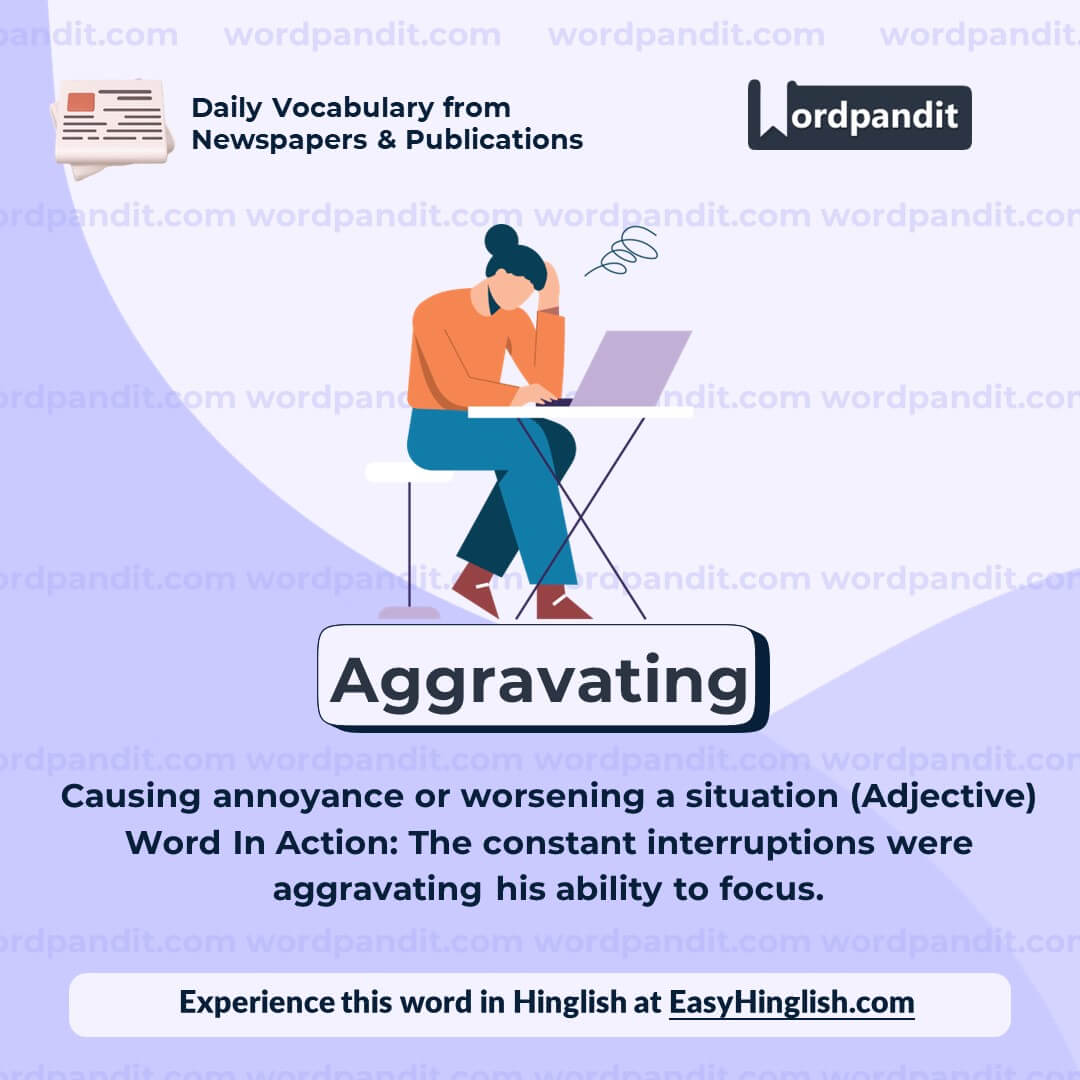
WORD-4: Aggravating
Context:
"It can be extremely aggravating." - The Hindu
Explanatory Paragraph:
"Aggravating" describes something that makes a situation worse or more intense—especially in a way that causes irritation, frustration, or annoyance. It’s often used when someone is already dealing with a problem, and something adds to the discomfort or difficulty. Whether it’s noise, behavior, or a delay, if it worsens your mood or the situation, it’s aggravating.
Meaning: Making something worse or more annoying (Adjective)
Pronunciation: AG-ruh-vay-ting
Difficulty Level: ⭐⭐ Beginner
Etymology: From Latin *aggravare*, meaning "to make heavier" or "to burden", from *ad-* (to) + *gravis* (heavy).
Prashant Sir's Notes:
This word is often confused with “annoying,” but remember: “aggravating” implies that something is already bad and is being made worse. It's a useful word when expressing frustration in formal and informal contexts alike.
Synonyms & Antonyms:
Synonyms: irritating, annoying, infuriating, exasperating, worsening
Antonyms: soothing, calming, relieving, pleasant, easing
Usage Examples:
- The aggravating noise from the construction site made it impossible to concentrate.
- It’s aggravating when people talk loudly during a movie.
- The delay in the flight was already bad, but the lack of communication made it even more aggravating.
- His aggravating attitude during the meeting tested everyone’s patience.
Cultural Reference:
"In sitcoms like *Friends*, Ross’s over-explaining is often portrayed as an aggravating habit to the other characters." - Pop Culture Linguistics
Think About It:
How can we control our reactions to aggravating situations, and what does it say about our emotional intelligence?
Quick Activity:
List three everyday situations that you find aggravating. Then write a one-line solution to deal with each calmly.
Memory Tip:
“Aggravating” contains “grave” — think of a problem becoming heavier or more serious, like digging a deeper grave for your patience!
Real-World Application:
This word is useful for describing difficult customer service experiences, frustrating delays, or irritating behaviors in personal or professional life. It helps communicate your displeasure with clarity and precision.
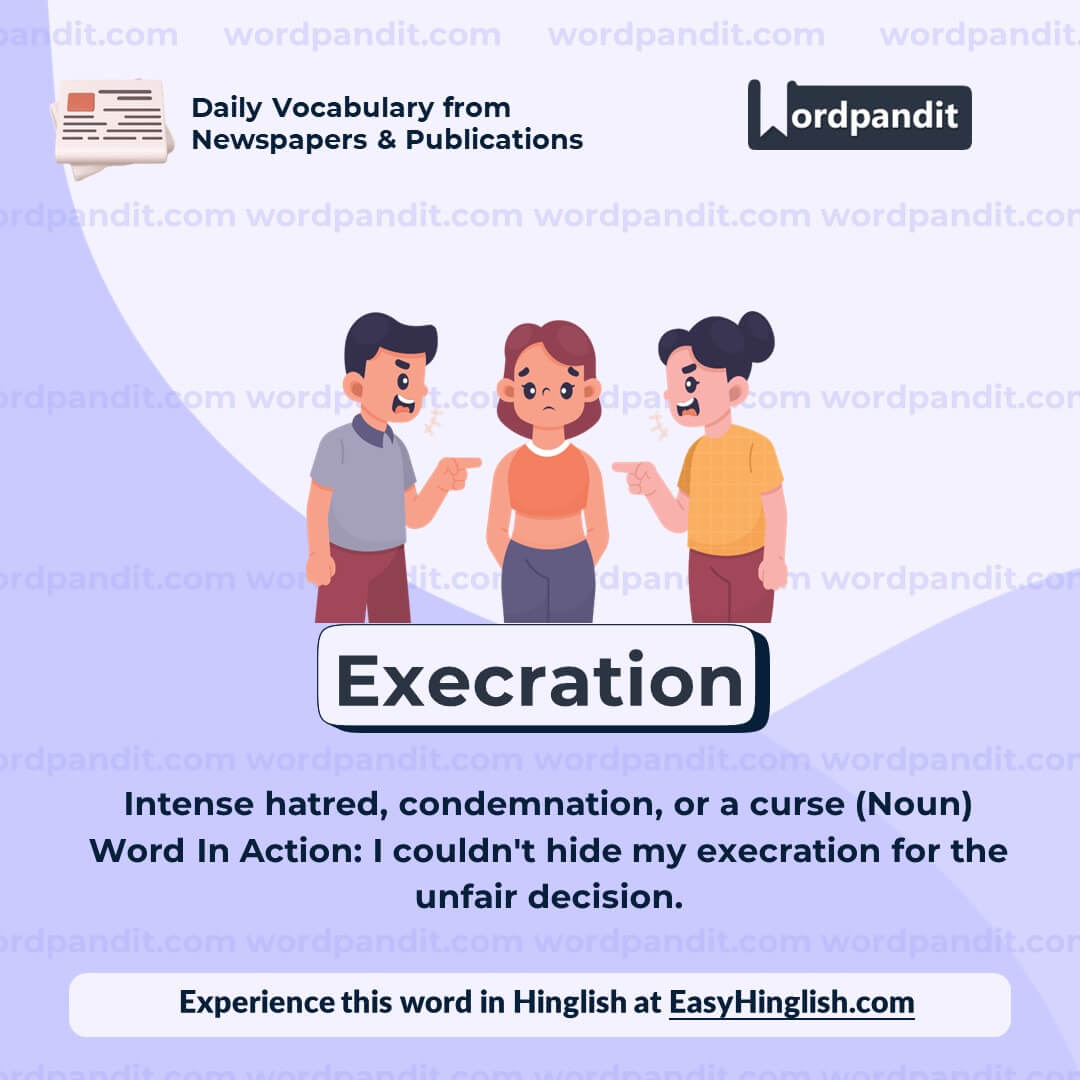
WORD-5: Execration
Context:
"A protester's furious execration of the police might end up getting her arrested." - The Hindu
Explanatory Paragraph:
"Execration" refers to the act of expressing intense hatred or strong condemnation toward someone or something. It usually involves verbal abuse, curses, or harsh criticism. The word conveys deep emotional revulsion and is typically used in contexts where a person reacts with rage or disgust—often in political, social, or religious protests. It’s a formal and powerful word for open and intense denunciation.
Meaning: The act of cursing or expressing intense hatred or loathing (Noun)
Pronunciation: ek-suh-KRAY-shun
Difficulty Level: ⭐⭐⭐⭐ Advanced
Etymology: From Latin *execratio*, from *exsecrari* meaning “to curse,” from *ex-* (out) + *sacrare* (to make sacred, devote).
Prashant Sir's Notes:
This is a powerful word, usually found in literary, religious, or political texts. It’s important to understand that “execration” goes beyond mild disapproval—it implies complete loathing, often expressed through loud protest or verbal curses. Use sparingly and precisely.
Synonyms & Antonyms:
Synonyms: denunciation, curse, damnation, vitriol, condemnation
Antonyms: praise, blessing, admiration, approval, commendation
Usage Examples:
- The dictator's name was met with loud execration during the protest rally.
- Her social media post was a fierce execration of corporate greed.
- The crowd's execration echoed through the courtroom after the unjust verdict.
- He shouted an execration so venomous that the room fell silent.
Cultural Reference:
"In Shakespeare's plays, characters often use elaborate execrations to express betrayal or fury, such as Lear cursing his daughters in *King Lear*." - Literary Classics Journal
Think About It:
Is public execration always justified in the name of protest, or does it risk escalating conflict rather than resolving it?
Quick Activity:
Write a short paragraph (2–3 sentences) that describes someone expressing execration in a fictional or historical scenario. Try to use vivid emotional language.
Memory Tip:
Think of “execration” as “ex-curse-ation”—the act of throwing a verbal curse or denunciation outward. That’s how strong the hatred is!
Real-World Application:
“Execration” is useful in academic writing (literary analysis, political commentary), formal speeches, or storytelling when describing intense public hatred or outrage—especially in protests or heated conflicts.


