

Daily Vocabulary from Indian Newspapers and Publications
Welcome to Wordpandit’s Indian Vocabulary Hub
At Wordpandit, we understand the importance of staying rooted in the local context while expanding your language skills. This section focuses on enriching your vocabulary with words and phrases drawn from India’s leading newspapers and publications, ensuring you're learning vocabulary that is practical, relevant, and uniquely Indian.
Why Indian Sources Matter
We believe that the best way to master any language is by immersing yourself in local content. That’s why we carefully curate vocabulary from top Indian publications, including:
- The Hindu
- The Times of India
- The Economic Times
- Hindustan Times
- Live Mint
- The Indian Express
- And many others...
Stay Updated, Stay Relevant
With daily updates from Indian news sources, you’ll be consistently learning words that reflect the trends and shifts in Indian society and culture. Our focus is to provide vocabulary that enhances your understanding of the language in an Indian context.
How Wordpandit Supports Your Goals
Whether you’re preparing for exams, aiming to improve your professional communication, or simply want to stay connected with the latest Indian vocabulary, Wordpandit is here to guide you every step of the way.
Learn with a Practical Approach
Our interactive learning methodology includes real-world examples, engaging activities, and context-specific usage to ensure that every word becomes part of your active vocabulary.
Dive into Indian Vocabulary Today!

Why Choose Wordpandit?
Practical Learning: Focus on words you'll actually encounter in real-world reading, enhancing your comprehension and communication skills.
Diverse Content: From current affairs to scientific breakthroughs, our varied sources expose you to vocabulary across multiple domains.
Effortless Integration: Make Wordpandit a part of your daily routine. Just a few minutes each day can significantly boost your lexicon over time.
Your Path to Vocabulary Mastery
- Visit our Daily Vocabulary section regularly
- Explore new words and their usage in context
- Practice incorporating these words into your own writing and speech
- Track your progress as your vocabulary expands
Start Your Journey Today
Embark on your vocabulary enhancement journey with Wordpandit. By consistently engaging with our daily posts, you'll build a robust vocabulary that serves you well in academic, professional, and personal contexts.
Remember, a word a day keeps linguistic limitations at bay. Make Wordpandit your daily companion in the quest for vocabulary excellence!
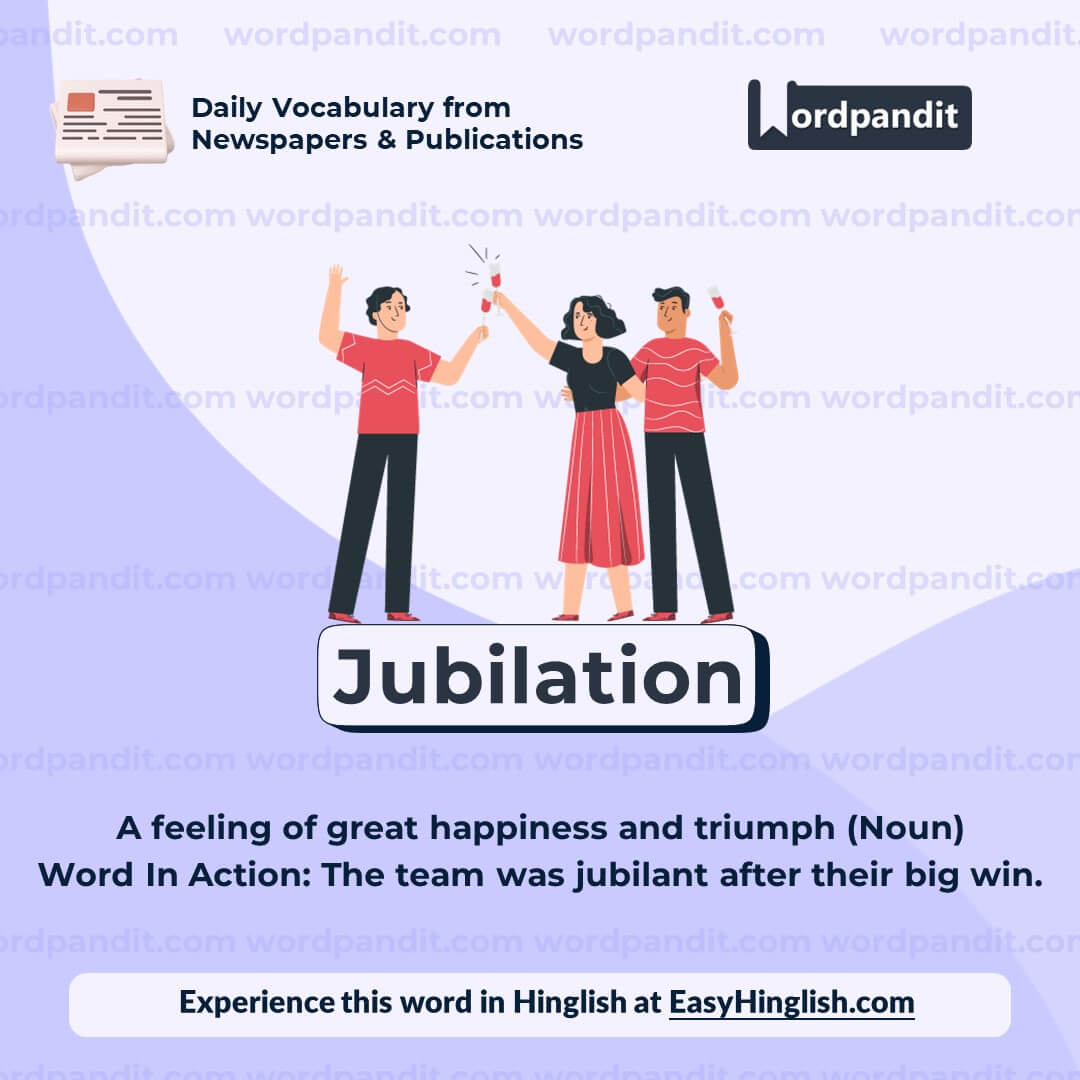
WORD-1: Jubilation
Context:
"After winning the championship, the players' faces shone with jubilation as the crowd erupted in celebration." - Sports Weekly Magazine
Explanatory Paragraph:
Jubilation is the feeling of great happiness and triumph. Imagine how excited and joyful you feel when something wonderful happens; that's jubilation.
Meaning: An overwhelming feeling of joy, happiness, or triumph (Noun)
Pronunciation: joo-buh-LAY-shuhn
Difficulty Level: ⭐⭐ Beginner to Intermediate
Etymology: From Latin "jubilatio," meaning 'a shouting for joy'.
Prashant Sir's Notes:
"Jubilation" beautifully captures extreme happiness; perfect word to express excitement after achievements or victories. Associate this with celebrations, victories, or festive moments for easy recall.
Synonyms & Antonyms:
Synonyms: joy, elation, exuberance, ecstasy, delight
Antonyms: sadness, misery, despair, gloom, melancholy
Usage Examples:
- The entire nation erupted in jubilation after the historic victory.
- Her jubilation was evident when she saw her exam results.
- The news of their safe arrival was greeted with jubilation by the family.
- The streets filled with jubilation during the festive parade.
Cultural Reference:
"Let us dance in the sun, wearing wildflowers in our hair..." – Susan Polis Schutz, illustrating the idea of jubilation through carefree joyfulness in nature.
Think About It:
What event in your life brought you the greatest sense of jubilation?
Quick Activity:
Recall and write down three moments of jubilation you have experienced recently. How did they make you feel?
Memory Tip:
Associate "jubilation" with the phrase "joyful celebration" (jubilation = joy + celebration).
Real-World Application:
"Jubilation" is commonly used to describe collective excitement during major events like sports victories, graduation ceremonies, weddings, and festive holidays.
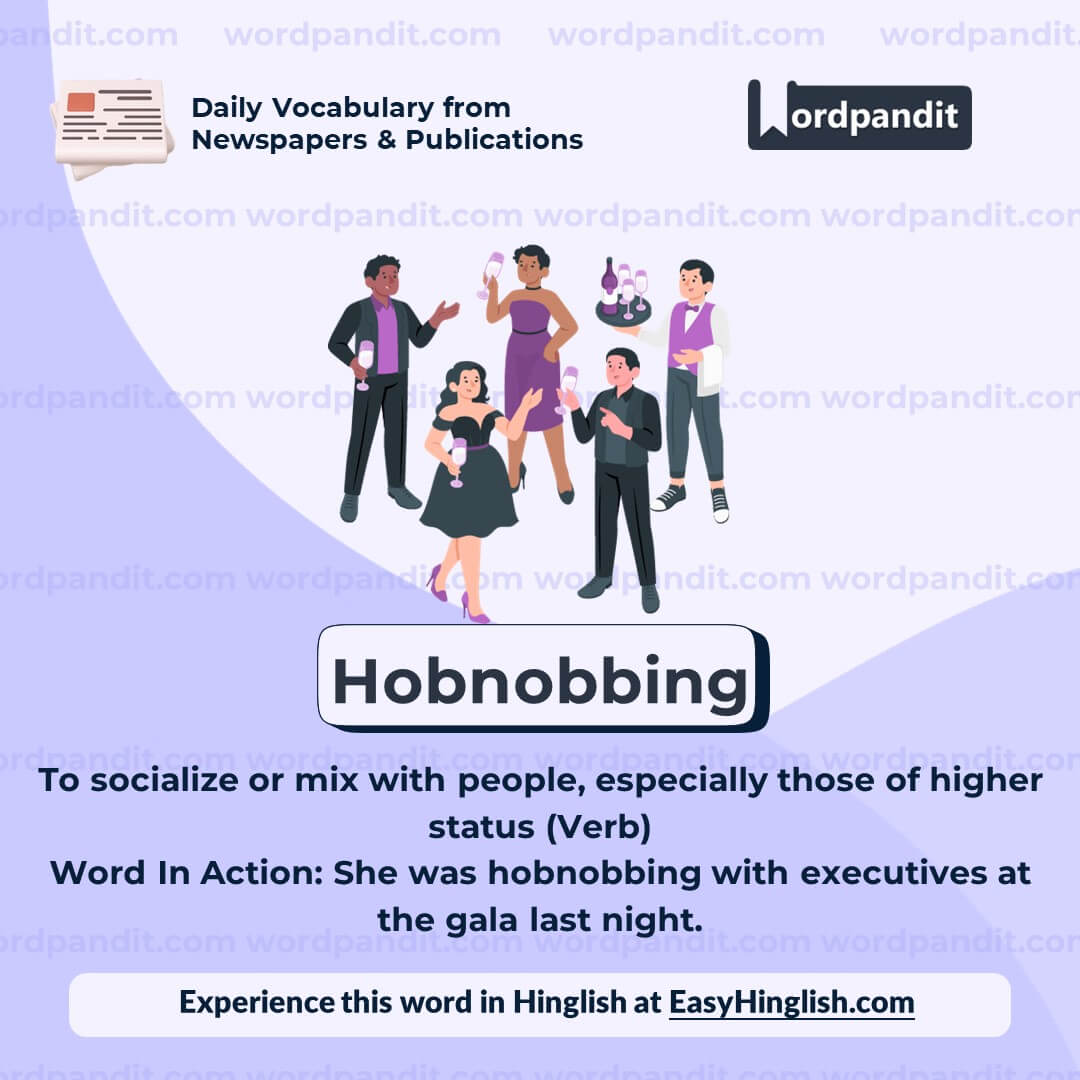
WORD-2: Hobnobbing
Context:
"At the gala event, influential businessmen and celebrities were hobnobbing effortlessly, forming connections that might shape future ventures." - Society Today Magazine
Explanatory Paragraph:
"Hobnobbing" refers to interacting socially in a friendly and informal manner, often with influential or high-status people. It involves mingling, chatting, and making connections casually at social events or gatherings.
Meaning: Engaging in friendly conversation or socializing, particularly with those of high status or influence (Verb)
Pronunciation: hob-NOB-ing
Difficulty Level: ⭐⭐⭐ Intermediate
Etymology: From English phrase "hob and nob," originally meaning "to drink together" or "give and take," derived from "hab nab" meaning "have or have not."
Prashant Sir's Notes:
"Hobnobbing" is an excellent word to describe casual interactions in high-profile situations. Think of it as informal networking or mingling comfortably with influential individuals. Visualize yourself chatting easily at a party with well-known figures to better internalize this word.
Synonyms & Antonyms:
Synonyms: socialize, mingle, fraternize, mix, associate
Antonyms: isolate, avoid, shun, withdraw, separate
Usage Examples:
- She spent the evening hobnobbing with famous artists at the exhibition.
- Politicians are often seen hobnobbing at charity dinners.
- He loves hobnobbing with executives, hoping to advance his career.
- Despite his humble background, he found himself hobnobbing comfortably with royalty.
Cultural Reference:
"Networking is not about just connecting people. It’s about connecting people with people, people with ideas, and people with opportunities." – Michele Jennae, reflecting the essence of hobnobbing in professional scenarios.
Think About It:
Have you ever had an opportunity to hobnob with influential people? How did it influence your thinking or decisions?
Quick Activity:
Imagine you're attending an important event. List down three people you'd want to hobnob with and briefly state why.
Memory Tip:
Think of "hobnob" as "hob-nod" — picturing yourself nodding and chatting casually at a social event can help you remember its meaning easily.
Real-World Application:
"Hobnobbing" is frequently used in contexts like corporate events, conferences, film festivals, and other gatherings where informal networking with influential people takes place.
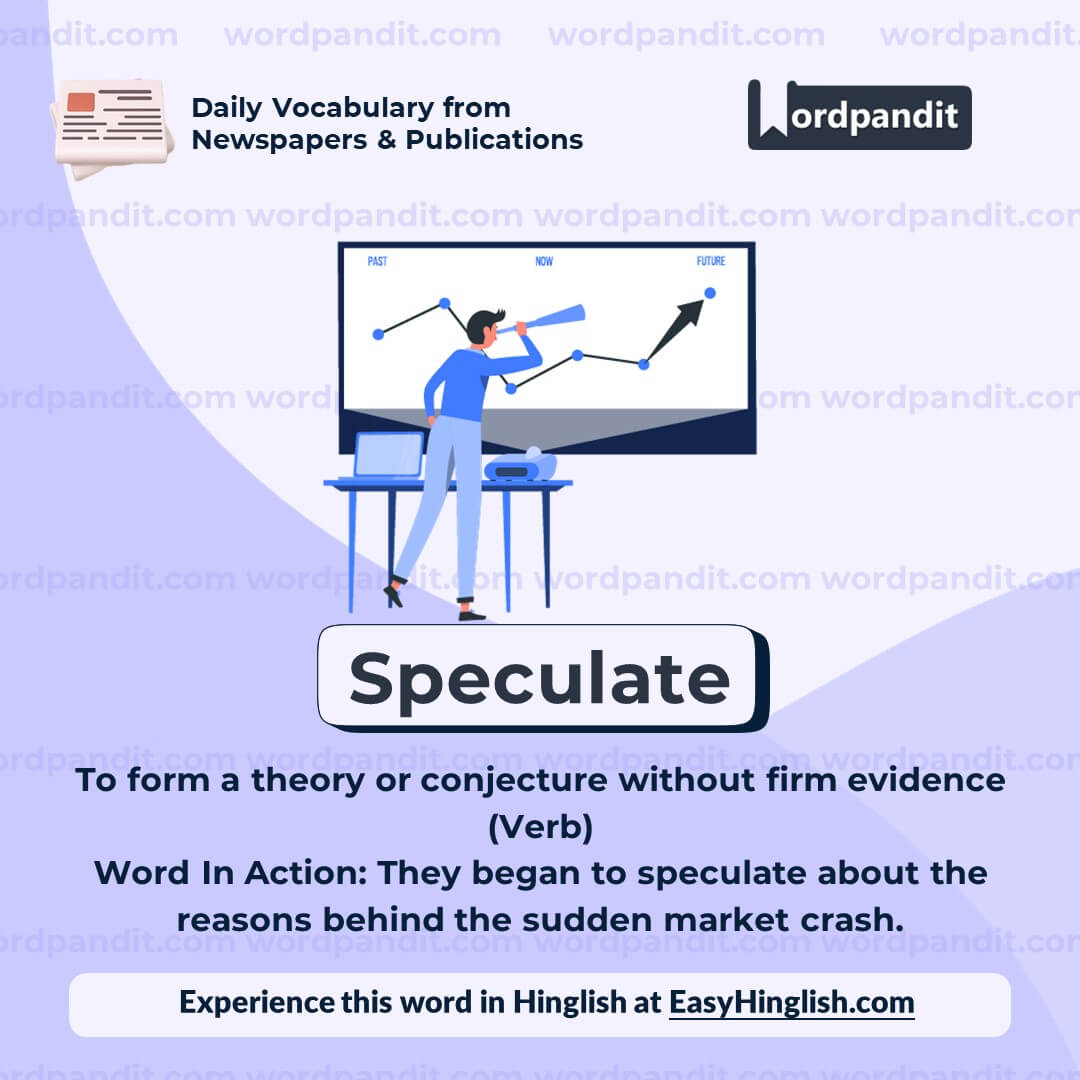
WORD-3: Speculate
Context:
"Analysts continue to speculate about the future of artificial intelligence and its potential impact on the job market." - Tech Horizon Magazine
Explanatory Paragraph:
"Speculate" means to form an idea, theory, or conclusion based on incomplete or uncertain information. It involves guessing, wondering, or theorizing without definite proof or evidence.
Meaning: To form theories or ideas without firm evidence; to make guesses (Verb)
Pronunciation: SPEK-yoo-layt
Difficulty Level: ⭐⭐ Beginner to Intermediate
Etymology: Derived from the Latin "speculatus," meaning "observed," from "specula," meaning "watchtower."
Prashant Sir's Notes:
"Speculate" is commonly used when discussing possibilities or future events without concrete information. Imagine yourself looking through binoculars from a watchtower, trying to foresee something unclear—that's speculating.
Synonyms & Antonyms:
Synonyms: guess, conjecture, hypothesize, theorize, surmise
Antonyms: prove, confirm, verify, ascertain, substantiate
Usage Examples:
- Experts speculate that the economy will recover by next year.
- Without clear data, scientists can only speculate about the planet's conditions.
- Fans continue to speculate about the actor's sudden disappearance from social media.
- We can speculate endlessly about the cause, but we need facts to reach a conclusion.
Cultural Reference:
"It is the mark of an educated mind to be able to entertain a thought without accepting it." – Aristotle, highlighting the essence of speculative thinking.
Think About It:
How often do you speculate about your future, and does it motivate or stress you?
Quick Activity:
Choose a recent news event and briefly speculate about possible outcomes or developments.
Memory Tip:
Think "speculate = spectacles" (glasses). When things aren't clear, you speculate (put on your imaginary glasses) to see possibilities clearly.
Real-World Application:
"Speculate" is widely used in finance and investment, where investors predict market trends to make informed financial decisions, despite uncertainties.
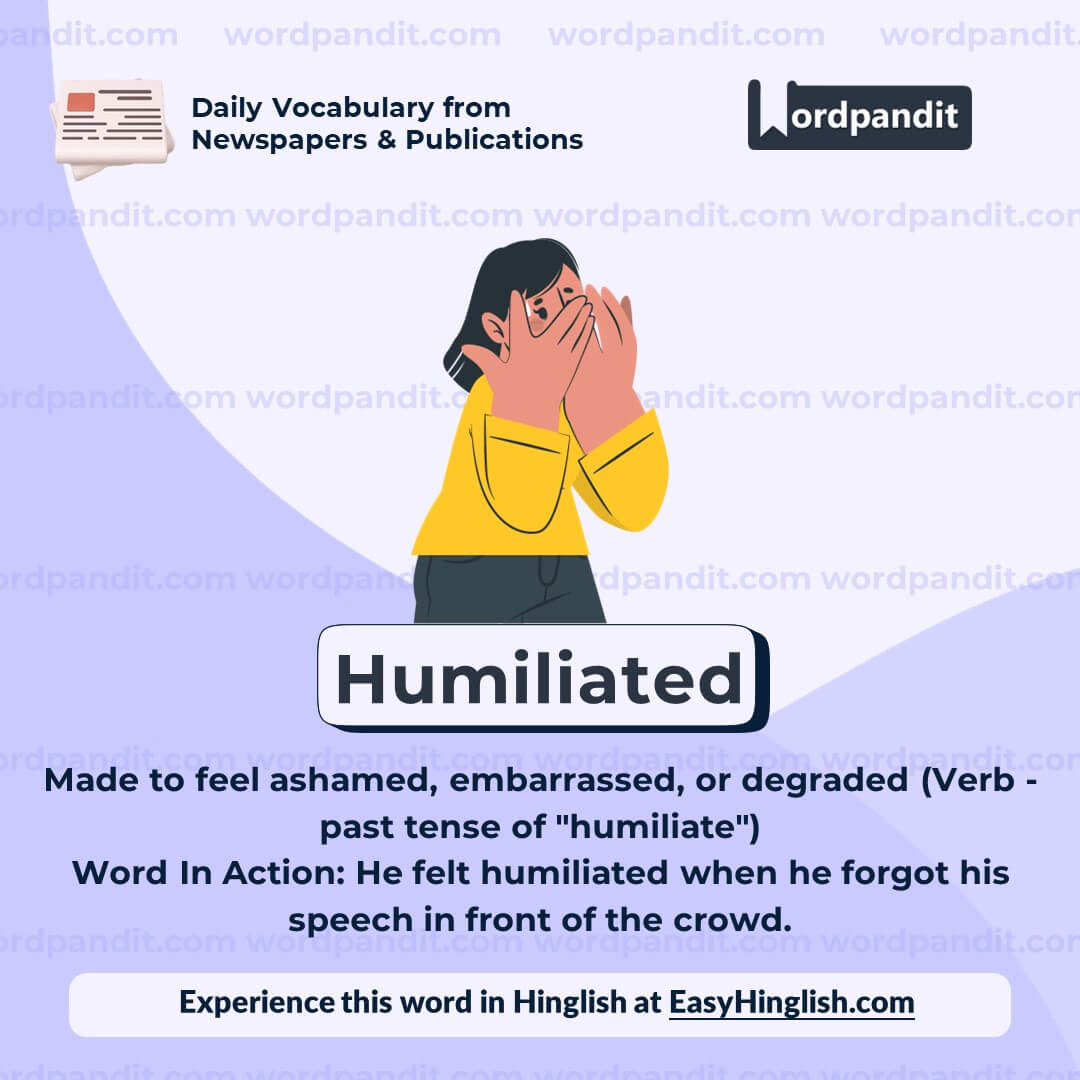
WORD-4: Humiliated
Context:
"He felt humiliated when his mistakes were openly pointed out in front of the entire class." - Student Life Journal
Explanatory Paragraph:
"Humiliated" describes the deep embarrassment and shame someone experiences when they are made to feel foolish, inferior, or disgraced, especially in front of others. It is the emotional state after a situation that lowers one's dignity or self-respect.
Meaning: Made to feel ashamed or deeply embarrassed, usually publicly (Adjective / Past Verb)
Pronunciation: hyoo-MIL-ee-ay-tid
Difficulty Level: ⭐⭐ Beginner to Intermediate
Etymology: Derived from the Latin word "humiliare," meaning "to humble or lower."
Prashant Sir's Notes:
"Humiliated" captures a profound sense of shame or embarrassment. Connect this emotion to any situation where dignity is compromised or pride hurt in front of others. Remembering such instances can strengthen recall of this term.
Synonyms & Antonyms:
Synonyms: embarrassed, shamed, disgraced, mortified, demeaned
Antonyms: proud, respected, honored, dignified, admired
Usage Examples:
- She felt humiliated after forgetting her lines on stage.
- He was humiliated by the public criticism of his project.
- The employee was humiliated when scolded in front of colleagues.
- The team felt humiliated after losing by a large margin.
Cultural Reference:
"Humiliation scars deeper than physical injuries." – A common saying emphasizing how emotional pain from humiliation can last longer and hurt more deeply than physical wounds.
Think About It:
What is the best way to overcome feelings of humiliation and regain confidence?
Quick Activity:
Think about a moment you felt humiliated. Write down how you handled it positively, or reflect on how you might handle it differently next time.
Memory Tip:
Think of "humiliated" as "human + lowered," indicating someone's sense of self-worth or dignity has been lowered.
Real-World Application:
The word "humiliated" is often used to describe feelings after embarrassing events, negative social interactions, criticism at workplaces or schools, and challenging situations where a person’s self-esteem takes a hit.

WORD-5: Racialized
Context:
"Many discussions today focus on addressing racialized experiences faced by minority groups and working towards greater social equality." - Equality Now Journal
Explanatory Paragraph:
The term "racialized" describes a situation or experience viewed through the lens of race, often highlighting the ways people or groups are treated differently because of their racial identities. It points toward the idea that certain societal outcomes and interactions are influenced or shaped by race.
Meaning: Categorized or treated differently based on perceived racial identity; influenced or shaped by race-related assumptions or prejudices (Adjective/Verb - past participle)
Pronunciation: RAY-shuh-lyzed
Difficulty Level: ⭐⭐⭐ Intermediate to Advanced
Etymology: Derived from the root "race" and the suffix "-ize," meaning "to make or treat as," thus indicating to categorize or view through the perspective of race.
Prashant Sir's Notes:
"Racialized" is essential for understanding contemporary social issues involving race and identity. Keep in mind that it emphasizes viewing individuals or events predominantly through racial identity, often leading to stereotypes or unfair treatment. Use real-world examples or recent social movements to remember its context clearly.
Synonyms & Antonyms:
Synonyms: race-based, race-conscious, ethnicity-based, racially-defined, identity-based
Antonyms: colorblind, race-neutral, inclusive, unbiased, equitable
Usage Examples:
- The report examined racialized inequalities within education systems.
- Minority communities often face racialized assumptions and stereotypes.
- Activists are striving to dismantle racialized structures in society.
- Her experiences as an immigrant were deeply racialized by societal prejudices.
Cultural Reference:
"Injustice anywhere is a threat to justice everywhere." – Martin Luther King Jr., emphasizing the importance of confronting racialized inequalities in society.
Think About It:
How can individuals contribute to reducing racialized perspectives in daily life?
Quick Activity:
Identify one racialized stereotype you've encountered. Reflect briefly on its effects and how it can be addressed constructively.
Memory Tip:
Remember "racialized" by thinking "racial + eyes," meaning looking at people or situations through the lens or eyes of race, often unfairly.
Real-World Application:
"Racialized" is frequently used in discussions on social justice, public policy, workplace diversity, and human rights to highlight issues influenced by race or ethnicity, promoting greater awareness and equitable practices.


