

Daily Vocabulary from Indian Newspapers and Publications
Welcome to Wordpandit’s Indian Vocabulary Hub
At Wordpandit, we understand the importance of staying rooted in the local context while expanding your language skills. This section focuses on enriching your vocabulary with words and phrases drawn from India’s leading newspapers and publications, ensuring you're learning vocabulary that is practical, relevant, and uniquely Indian.
Why Indian Sources Matter
We believe that the best way to master any language is by immersing yourself in local content. That’s why we carefully curate vocabulary from top Indian publications, including:
- The Hindu
- The Times of India
- The Economic Times
- Hindustan Times
- Live Mint
- The Indian Express
- And many others...
Stay Updated, Stay Relevant
With daily updates from Indian news sources, you’ll be consistently learning words that reflect the trends and shifts in Indian society and culture. Our focus is to provide vocabulary that enhances your understanding of the language in an Indian context.
How Wordpandit Supports Your Goals
Whether you’re preparing for exams, aiming to improve your professional communication, or simply want to stay connected with the latest Indian vocabulary, Wordpandit is here to guide you every step of the way.
Learn with a Practical Approach
Our interactive learning methodology includes real-world examples, engaging activities, and context-specific usage to ensure that every word becomes part of your active vocabulary.
Dive into Indian Vocabulary Today!

Why Choose Wordpandit?
Practical Learning: Focus on words you'll actually encounter in real-world reading, enhancing your comprehension and communication skills.
Diverse Content: From current affairs to scientific breakthroughs, our varied sources expose you to vocabulary across multiple domains.
Effortless Integration: Make Wordpandit a part of your daily routine. Just a few minutes each day can significantly boost your lexicon over time.
Your Path to Vocabulary Mastery
- Visit our Daily Vocabulary section regularly
- Explore new words and their usage in context
- Practice incorporating these words into your own writing and speech
- Track your progress as your vocabulary expands
Start Your Journey Today
Embark on your vocabulary enhancement journey with Wordpandit. By consistently engaging with our daily posts, you'll build a robust vocabulary that serves you well in academic, professional, and personal contexts.
Remember, a word a day keeps linguistic limitations at bay. Make Wordpandit your daily companion in the quest for vocabulary excellence!
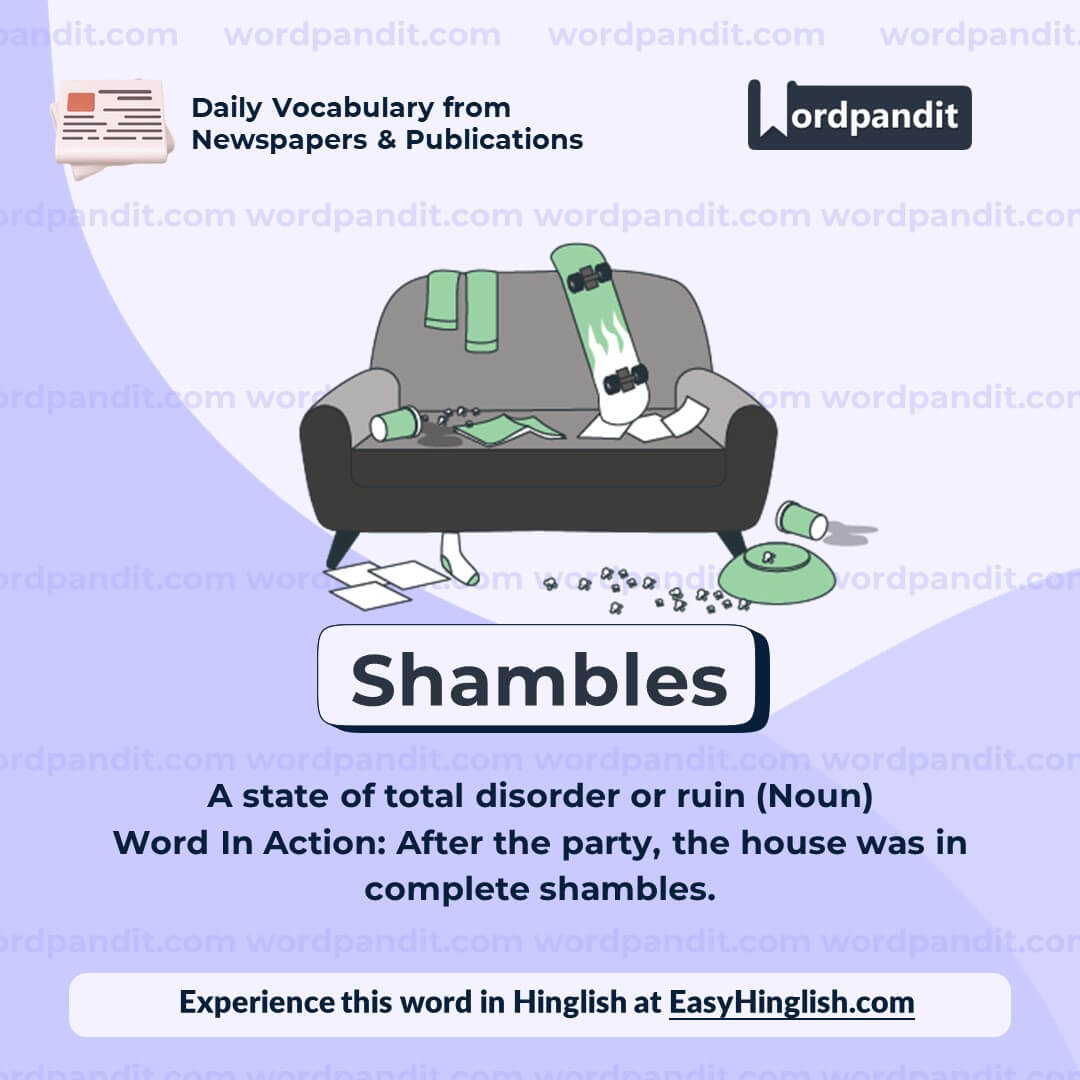
WORD-1: Shambles
Context:
"My mental, as well as physical health, was in shambles due to excess weight and in desperation, I decided to give Spikew Tummy Trimmer a try." - The Hindu
Explanatory Paragraph:
The word "shambles" refers to a state of complete disorder, confusion, or ruin. In the given context, the speaker is highlighting how both their mental and physical health were in a chaotic or broken state. It paints a vivid picture of turmoil and lack of control, often used to describe personal situations, environments, or systems that have fallen into disarray.
Meaning: A state of total disorder or mess (Noun)
Pronunciation: SHAM-buhls
Difficulty Level: ⭐⭐ Basic
Etymology: Originates from Middle English *shameles*, meaning a slaughterhouse; over time, it evolved to represent chaos, drawing on the disorganized nature of such places.
Prashant Sir's Notes:
Use "shambles" when you want to vividly express that something is a complete mess—whether it's your room, your schedule, your finances, or even your emotions. It's a strong word for dramatic breakdowns.
Synonyms & Antonyms:
Synonyms: mess, chaos, disorder, disarray, ruin, wreck
Antonyms: order, organization, neatness, structure, harmony
Usage Examples:
- After the party, the house was left in complete shambles.
- The company was in shambles after the sudden resignation of the CEO.
- His finances were in shambles due to reckless spending.
- The storm left the entire neighborhood in shambles.
Cultural Reference:
"Our democracy is in shambles" — a phrase often used in political commentary to describe governmental dysfunction or public dissatisfaction. - Common in political discourse
Think About It:
Why do you think the word "shambles," originally related to a slaughterhouse, became a metaphor for chaos and disorder?
Quick Activity:
Write a short paragraph (3–4 sentences) describing a situation in your life or studies that once was in shambles but you managed to fix. Focus on using the word effectively.
Memory Tip:
Think of "shambles" as "sham + bles" — when something is a "sham" and it "blows up," it becomes a "shambles" (i.e., a total mess).
Real-World Application:
In professional settings, the word "shambles" can be used in project debriefings to describe disorganized outcomes and highlight the need for better planning. For example, "The launch was a shambles due to lack of coordination."
WORD-2: Desperation
Context:
"My mental, as well as physical health, was in shambles due to excess weight, and in desperation, I decided to give Spikew Tummy Trimmer a try." - The Hindu
Explanatory Paragraph:
"Desperation" is a strong emotional state that occurs when someone feels hopeless or sees no better options. It often leads to taking drastic steps or making risky decisions. In the given context, the person is overwhelmed by poor health and, driven by hopelessness, tries a product out of sheer urgency, not logic or planning. Desperation can cloud judgment, making people act on impulse rather than reason.
Meaning: A state of hopelessness leading to rash or extreme behavior (Noun)
Pronunciation: des-puh-RAY-shun
Difficulty Level: ⭐⭐⭐ Intermediate
Etymology: From Latin *desperare*, meaning "to lose hope," derived from *de-* (down, away) + *sperare* (to hope).
Prashant Sir's Notes:
“Desperation” is what drives people to act outside their comfort zones. It’s important to distinguish between decisions made with clarity and those made in a state of emotional urgency. Use this word to reflect emotional pressure or lack of better options.
Synonyms & Antonyms:
Synonyms: hopelessness, urgency, distress, despair, anguish
Antonyms: hope, calm, confidence, composure, assurance
Usage Examples:
- In desperation, she called every hospital in the city looking for help.
- His desperation to succeed pushed him to work day and night.
- Out of desperation, the villagers dug their own well.
- The actor accepted the controversial role in desperation to revive his career.
Cultural Reference:
"Desperation is the raw material of drastic change." – Tony Robbins. This quote reflects how intense emotional states can trigger transformation, for better or worse.
Think About It:
Can desperation sometimes lead to positive outcomes, or does it mostly result in poor decisions?
Quick Activity:
Write two short sentences: one showing a decision made calmly and one made out of desperation. Compare their tone and implication.
Memory Tip:
Think: “When you're *desperate*, you act in *desperation*.” The words sound alike and help reinforce each other.
Real-World Application:
Understanding desperation is key in psychology, counseling, and crisis intervention. It's also useful in storytelling and analysis, as characters in desperation often drive the most intense plots and decisions.

WORD-3: Condonable
Context:
"Araya said, 'Not inviting other members of our family, my mother (Nadira Babbar), my sister (Juhi Babbar), or me could be condonable: maybe we failed him as a family, although we have never treated him as a stepbrother.'" - The Hindu
Explanatory Paragraph:
The word "condonable" refers to something that can be forgiven or overlooked, especially a wrongdoing or offense. In this context, the speaker is saying that being excluded from a family event might be forgivable — possibly because they acknowledge their own shortcomings. The word implies that while something may be wrong, it’s not beyond understanding or pardon.
Meaning: Capable of being forgiven or excused (Adjective)
Pronunciation: kuhn-DOH-nuh-buhl
Difficulty Level: ⭐⭐⭐ Intermediate
Etymology: From Latin *condonare* meaning "to forgive, remit", which passed into English via the verb *condone*.
Prashant Sir's Notes:
"Condonable" is a rare but powerful word — use it when you want to express that something, while wrong, is understandable or forgivable under certain emotional or moral circumstances. It's especially useful in nuanced writing or formal discussions.
Synonyms & Antonyms:
Synonyms: forgivable, excusable, understandable, pardonable
Antonyms: unforgivable, inexcusable, intolerable, unpardonable
Usage Examples:
- Her late arrival was condonable, given the traffic conditions.
- Some argue that his mistake was condonable due to his young age and inexperience.
- Neglecting safety protocols is not a condonable act in any profession.
- The professor found the student’s plagiarism to be anything but condonable.
Cultural Reference:
In legal and moral philosophy, "condonable" actions are often discussed in the context of mitigating circumstances — for example, crimes of passion being considered more condonable than premeditated ones. - Ethics in Law
Think About It:
What makes an act condonable in one culture or situation but unforgivable in another?
Quick Activity:
List three actions that you believe are condonable and three that are not. Briefly explain why in each case.
Memory Tip:
Remember: *Condonable* comes from *condone* — if you can *condone* it, it is *condonable*.
Real-World Application:
Understanding "condonable" is useful in law, counseling, and management. In conflict resolution, identifying which actions are condonable helps determine appropriate consequences and rebuild trust.
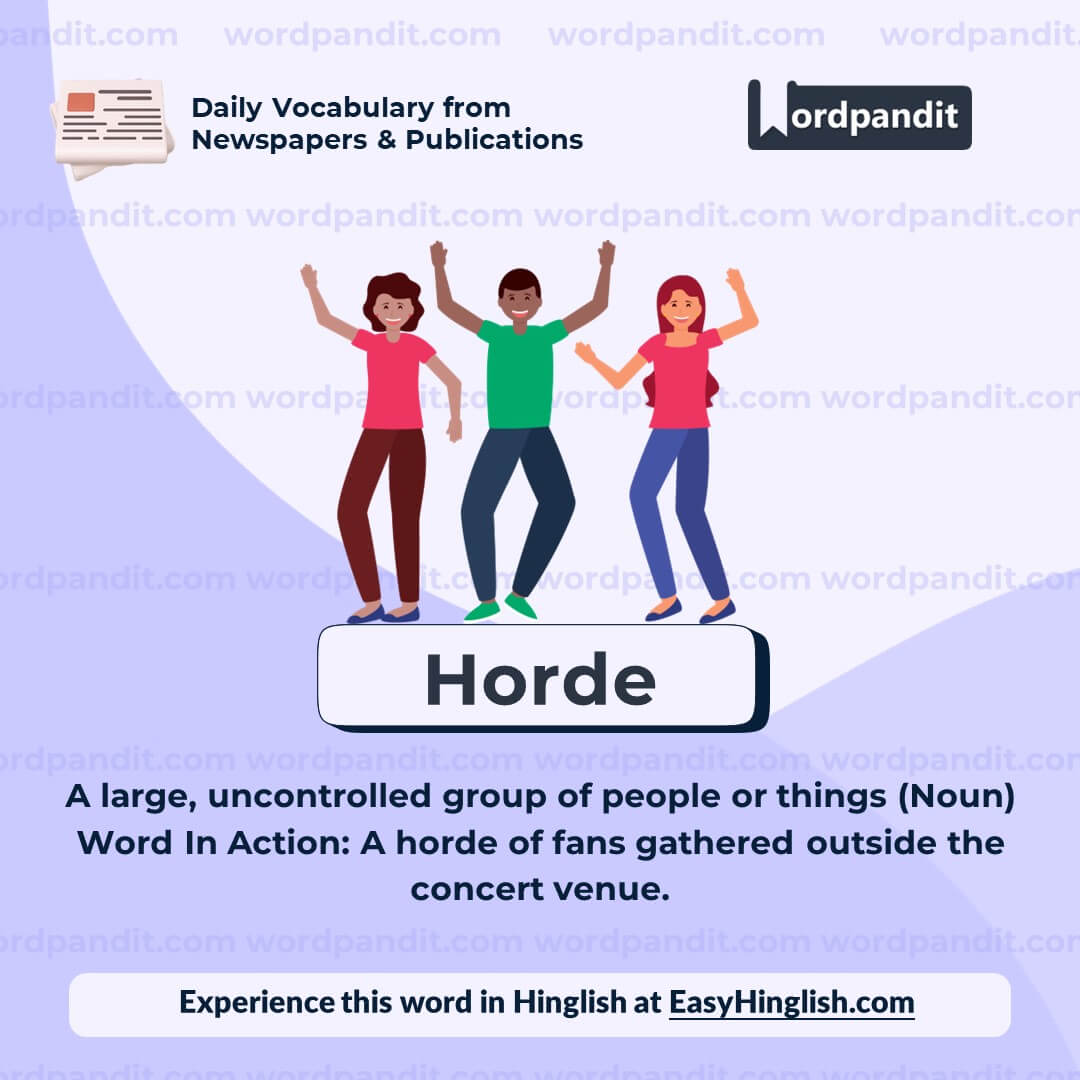
WORD-4: Horde
Context:
"The delay of two trains, a horde of passengers waiting on platform number 14, and an announcement for a special train—these factors, coupled with the alleged lack of management by the administration, led..." - The Hindu
Explanatory Paragraph:
The word "horde" is used to describe a large group of people, typically in a way that suggests crowding, noise, or chaos. In the context above, "a horde of passengers" refers to a massive crowd gathered on the train platform, emphasizing the overwhelming and potentially unmanageable nature of the situation. The term often carries a slightly negative connotation, suggesting lack of order or control.
Meaning: A large, moving crowd of people (Noun)
Pronunciation: hord
Difficulty Level: ⭐⭐ Basic
Etymology: From the Turkic word *ordu* meaning "camp" or "military group," adopted into English via Polish and French.
Prashant Sir's Notes:
"Horde" is commonly used to describe crowds that feel uncontrollable or overwhelming. It can refer to people, animals, or even metaphorical swarms like a "horde of problems." Use it carefully—it often implies negativity or disorder.
Synonyms & Antonyms:
Synonyms: throng, swarm, crowd, mass, multitude, mob
Antonyms: handful, few, trickle, small group
Usage Examples:
- A horde of tourists flooded the ancient temple at sunrise.
- Security struggled to control the horde at the concert gate.
- Every summer, a horde of mosquitoes invades the area near the lake.
- The store was overwhelmed by a horde of shoppers on opening day.
Cultural Reference:
In popular culture, especially in gaming and fantasy literature, “the Horde” is often used to describe monstrous armies, such as in *World of Warcraft* or *Lord of the Rings* (e.g., “the orc horde”).
Think About It:
How does the use of the word “horde” shape our perception of a group of people—does it dehumanize or fairly describe chaos?
Quick Activity:
Think of a recent event you attended that had a large crowd. Write one sentence using “horde” to describe it.
Memory Tip:
Picture a *horde* storming a castle—loud, chaotic, and hard to control. That image will help you remember the word’s intensity.
Real-World Application:
“Horde” is frequently used in journalism, crowd management discussions, and even in security briefings. It helps convey urgency or potential risk due to large numbers of people gathering suddenly.
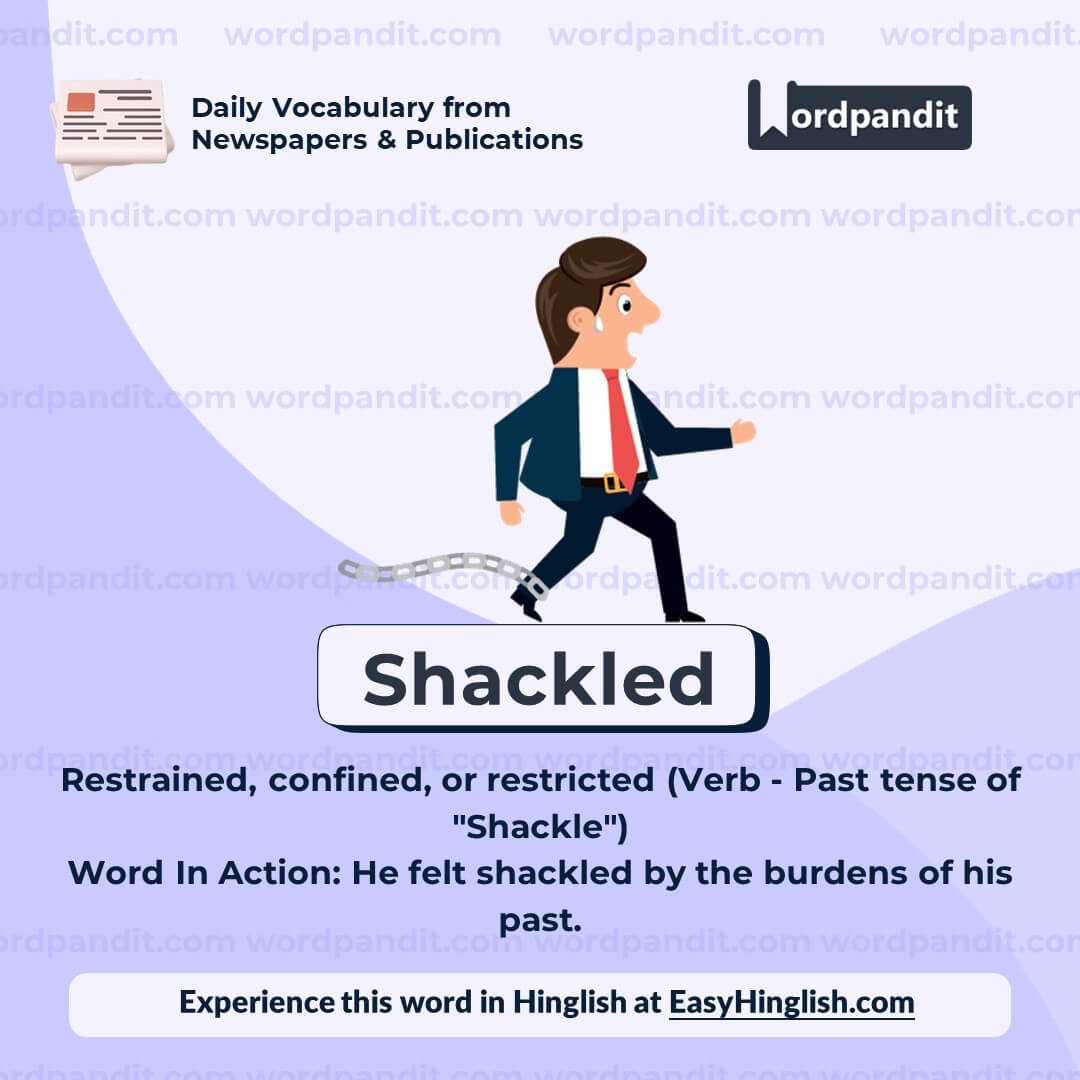
WORD-5: Shackled
Context:
"The cartoon showed Prime Minister Narendra Modi sitting shackled next to US President Donald Trump." - The Hindu
Explanatory Paragraph:
"Shackled" refers to being physically or metaphorically restrained or confined. Originally used to describe being bound by metal chains (especially at the ankles or wrists), it is now often used to express limitation of freedom, movement, or expression. In the cartoon’s context, it symbolizes Prime Minister Modi being restricted or controlled, possibly implying a lack of autonomy or subordination in the depicted scenario.
Meaning: Restrained or confined, typically by chains or limitations (Verb – past participle / Adjective)
Pronunciation: SHAK-uhld
Difficulty Level: ⭐⭐⭐ Intermediate
Etymology: From Middle English *schakelen*, derived from Old Norse *skǫkull*, meaning a loop or chain; related to the idea of restraining movement.
Prashant Sir's Notes:
Use "shackled" not just literally but also figuratively — for example, “shackled by fear,” “shackled by tradition,” or “shackled by bureaucracy.” It’s a powerful word to describe limitations, both physical and mental.
Synonyms & Antonyms:
Synonyms: chained, restrained, bound, confined, fettered
Antonyms: freed, liberated, unchained, released, unbound
Usage Examples:
- He felt shackled by the expectations of his conservative family.
- The prisoner was shackled and escorted by two guards.
- Economic reforms aim to unshackle industries from outdated regulations.
- Her creativity was shackled by self-doubt and fear of judgment.
Cultural Reference:
In civil rights literature, “shackles” are a powerful symbol of slavery and oppression. For instance, the poem “Still I Rise” by Maya Angelou alludes to the resilience of those once shackled by racism and injustice.
Think About It:
What modern-day forces — social, political, or psychological — do you think still shackle individuals or societies?
Quick Activity:
Complete the sentence: “I sometimes feel shackled by ______.” Then, explain how you could begin to “unshackle” yourself from it.
Memory Tip:
Think of “shackled” as being “stuck” or “locked” — both physically (chains) and mentally (fear, doubt). Visualize chains around ankles to reinforce the image.
Real-World Application:
"Shackled" is often used in discussions on human rights, social justice, mental health, and political commentary. Understanding it helps decode symbolic language in news, literature, and activist discourse.


