

Daily Vocabulary from Indian Newspapers and Publications
Welcome to Wordpandit’s Indian Vocabulary Hub
At Wordpandit, we understand the importance of staying rooted in the local context while expanding your language skills. This section focuses on enriching your vocabulary with words and phrases drawn from India’s leading newspapers and publications, ensuring you're learning vocabulary that is practical, relevant, and uniquely Indian.
Why Indian Sources Matter
We believe that the best way to master any language is by immersing yourself in local content. That’s why we carefully curate vocabulary from top Indian publications, including:
- The Hindu
- The Times of India
- The Economic Times
- Hindustan Times
- Live Mint
- The Indian Express
- And many others...
Stay Updated, Stay Relevant
With daily updates from Indian news sources, you’ll be consistently learning words that reflect the trends and shifts in Indian society and culture. Our focus is to provide vocabulary that enhances your understanding of the language in an Indian context.
How Wordpandit Supports Your Goals
Whether you’re preparing for exams, aiming to improve your professional communication, or simply want to stay connected with the latest Indian vocabulary, Wordpandit is here to guide you every step of the way.
Learn with a Practical Approach
Our interactive learning methodology includes real-world examples, engaging activities, and context-specific usage to ensure that every word becomes part of your active vocabulary.
Dive into Indian Vocabulary Today!

Why Choose Wordpandit?
Practical Learning: Focus on words you'll actually encounter in real-world reading, enhancing your comprehension and communication skills.
Diverse Content: From current affairs to scientific breakthroughs, our varied sources expose you to vocabulary across multiple domains.
Effortless Integration: Make Wordpandit a part of your daily routine. Just a few minutes each day can significantly boost your lexicon over time.
Your Path to Vocabulary Mastery
- Visit our Daily Vocabulary section regularly
- Explore new words and their usage in context
- Practice incorporating these words into your own writing and speech
- Track your progress as your vocabulary expands
Start Your Journey Today
Embark on your vocabulary enhancement journey with Wordpandit. By consistently engaging with our daily posts, you'll build a robust vocabulary that serves you well in academic, professional, and personal contexts.
Remember, a word a day keeps linguistic limitations at bay. Make Wordpandit your daily companion in the quest for vocabulary excellence!
WORD-1: Stalled
Context:
"Governance in Delhi suffered for the last decade because of the Bharatiya Janta Party led Union government had ensured that all decisions of the state government were stalled using the office of the lieutenant governor (LG)." - The Wire
Explanatory Paragraph:
The word "stalled" is used to describe a situation where progress is stopped or delayed, often intentionally. In the context of governance, it refers to halting the implementation or decision-making processes. When something is stalled, it remains in a state of inaction or limbo, unable to move forward due to interference, obstacles, or lack of support. It implies that while movement was expected, something (or someone) has caused it to stop temporarily or indefinitely.
Meaning: To stop or delay progress or movement (verb)
Pronunciation: stawld
Difficulty Level: ⭐⭐ Beginner
Etymology: Derived from the Middle English "stallen," meaning to place or install, which later evolved to mean a stop in movement or progress.
Prashant Sir's Notes:
Often used in political or administrative contexts to describe delay tactics or bureaucratic resistance. Can also be used in personal or technical contexts—like a car engine stalling or a project being stalled due to lack of funding.
Synonyms & Antonyms:
Synonyms: delay, obstruct, hinder, halt, suspend
Antonyms: proceed, advance, continue, progress, expedite
Usage Examples:
- The meeting was stalled due to a technical glitch in the video conferencing system.
- Negotiations between the two countries have stalled over trade disagreements.
- Her career stalled after she took a break from acting.
- The car stalled in the middle of the road, causing a traffic jam.
Cultural Reference:
"Talks on climate change policies have repeatedly stalled at international summits due to disagreements between developed and developing nations." - Global Affairs Review
Think About It:
What are some long-term consequences for a society when its political processes are constantly stalled by internal power struggles?
Quick Activity:
Write 2 sentences using “stalled” in different contexts—one political and one personal.
Memory Tip:
Think of a “stalled car” — it was moving but suddenly stops. Apply this image to ideas, actions, or plans that stop suddenly or are delayed.
Real-World Application:
“Stalled” is frequently used in news articles, especially in political, economic, and business contexts to highlight when progress is being intentionally or unintentionally blocked.
WORD-2: Stalemate
Context:
"Ten years of stalemate in the governance of the state led a section of the AAP voters to conclude that it was only prudent to seek refuge in Gabbar." - The Wire
Explanatory Paragraph:
"Stalemate" refers to a situation where no progress can be made because the parties involved are stuck in disagreement or have reached a deadlock. It's often used in politics, negotiations, or even in chess. In the context provided, the word points to a prolonged period of political inaction or powerlessness, where governance came to a standstill due to constant conflict or inability to resolve key issues. It suggests frustration, lack of movement, and the absence of meaningful outcomes.
Meaning: A situation in which further action or progress is impossible due to a deadlock (noun)
Pronunciation: stayl-mayt
Difficulty Level: ⭐⭐⭐ Intermediate
Etymology: From the game of chess, where a player cannot make a legal move and the game ends in a draw; "stale" meaning fixed or stagnant, and "mate" from "checkmate."
Prashant Sir's Notes:
"Stalemate" goes beyond chess—it applies to politics, diplomacy, business, and even relationships. It always implies a frustrating standstill where no side wins or makes progress. Look for it in editorials and political discourse.
Synonyms & Antonyms:
Synonyms: deadlock, impasse, gridlock, dead end, standstill
Antonyms: breakthrough, progress, resolution, advancement
Usage Examples:
- Talks between the two countries ended in a stalemate, with neither side willing to compromise.
- The boardroom was locked in a stalemate over the decision to merge with the competitor.
- Years of legislative stalemate had eroded public faith in the political system.
- In chess, a stalemate means the player is not in check but has no legal move to make.
Cultural Reference:
"Washington is stuck in a political stalemate again, with no agreement in sight to raise the debt ceiling." – Political Commentary, NPR
Think About It:
What factors typically lead to a stalemate in political systems, and how can such deadlocks be resolved without compromising democratic values?
Quick Activity:
Come up with a real-life situation (personal, political, or professional) where you've seen a stalemate. Write 2-3 sentences describing it.
Memory Tip:
Think of a chessboard where neither player can move—a “stale” situation where the game ends in “mate” (draw). That’s a stalemate!
Real-World Application:
"Stalemate" is commonly used in politics, international relations, legal battles, and business negotiations to describe gridlock or failure to reach consensus.
WORD-3: Coerced
Context:
"They will tell you that the voters have been coerced out of the voters as they see this as the only way out of the impasse." - The Wire
Explanatory Paragraph:
The word "coerced" refers to forcing someone to act in a certain way by using pressure, threats, or intimidation. It suggests that the action taken was not voluntary but rather done under duress. In the given context, it implies that voters may have been pressured or manipulated into making political choices they wouldn't have made freely. "Coerced" is often used in legal, political, or psychological contexts where free will is overridden by power or fear.
Meaning: To compel or force someone to act against their will, often through pressure or threats (verb, past tense)
Pronunciation: koh-urst
Difficulty Level: ⭐⭐⭐ Intermediate
Etymology: From Latin "coercere," meaning to restrain or confine; from "co-" (together) + "arcere" (to enclose or confine)
Prashant Sir's Notes:
"Coerced" is a powerful word—it’s about control and lack of choice. Often shows up in political commentary, legal cases, and human rights discussions. It's especially relevant when examining voter behavior under pressure.
Synonyms & Antonyms:
Synonyms: forced, pressured, intimidated, threatened, compelled
Antonyms: persuaded, convinced, encouraged, voluntary, willing
Usage Examples:
- The confession was invalidated because the suspect was coerced during interrogation.
- Several employees reported feeling coerced into resigning.
- She was coerced into signing the contract without fully understanding the terms.
- Analysts claim that voters were coerced through fear and misinformation campaigns.
Cultural Reference:
"The idea of consent loses its meaning when one party is coerced into agreement." – UN Human Rights Council Report
Think About It:
How can democratic societies protect citizens from being coerced into making decisions against their will?
Quick Activity:
Write one sentence each showing the use of “coerced” in a legal, political, and personal context.
Memory Tip:
Think: "Coerce sounds like ‘force’" — both have that strong, aggressive sound and meaning. When someone is coerced, they’re forced into action.
Real-World Application:
“Coerced” is widely used in human rights discussions, legal rulings, and political debates—especially when questioning the legitimacy of actions taken under pressure or fear.
WORD-4: Impasse
Context:
"They will tell you that the voters have been coerced out of the voters as they see this as the only way out of the impasse." - The Wire
Explanatory Paragraph:
The word "impasse" refers to a situation in which no progress is possible, especially because of a disagreement or a deadlock. It usually implies a frustrating or hopeless condition where all possible solutions seem blocked. In the context of governance or decision-making, an impasse suggests a standstill where opposing parties refuse to budge, resulting in no action or resolution. The sentence implies that voters may have chosen a particular political direction as a desperate escape from a prolonged period of inaction or dysfunction.
Meaning: A situation in which no progress is possible, especially due to disagreement; deadlock (noun)
Pronunciation: im-pass
Difficulty Level: ⭐⭐⭐ Intermediate
Etymology: From French “impasse,” meaning “dead end” — formed from “in-” (not) + “passer” (to pass)
Prashant Sir's Notes:
"Impasse" is a favorite word in political writing—it captures the sense of being stuck with no clear exit. Think of it as a dead-end alley, both literally and metaphorically. Also appears in business, negotiation, and even personal conflict contexts.
Synonyms & Antonyms:
Synonyms: deadlock, stalemate, standstill, gridlock, bottleneck
Antonyms: breakthrough, solution, progress, agreement
Usage Examples:
- The labor talks ended in an impasse, with neither side willing to make concessions.
- Political analysts warned that the impasse could lead to a government shutdown.
- Our relationship reached an impasse—we couldn't agree on anything anymore.
- Negotiations have been stuck in an impasse for months due to conflicting interests.
Cultural Reference:
"The Brexit negotiations hit a diplomatic impasse, with both sides blaming each other for the deadlock." – BBC News
Think About It:
When faced with an impasse, should leaders compromise their core principles to move forward, or hold firm at the risk of further stagnation?
Quick Activity:
Think of a situation in your life or in the news where progress was blocked due to an impasse. Describe it in 2–3 sentences using the word.
Memory Tip:
“Impasse” sounds like “I’m pass(ed)” — imagine hitting a wall where you literally can’t pass any further. It’s a dead end!
Real-World Application:
"Impasse" is frequently used in political discussions, labor disputes, international negotiations, and even relationship counseling to describe situations where progress halts due to fundamental disagreements.
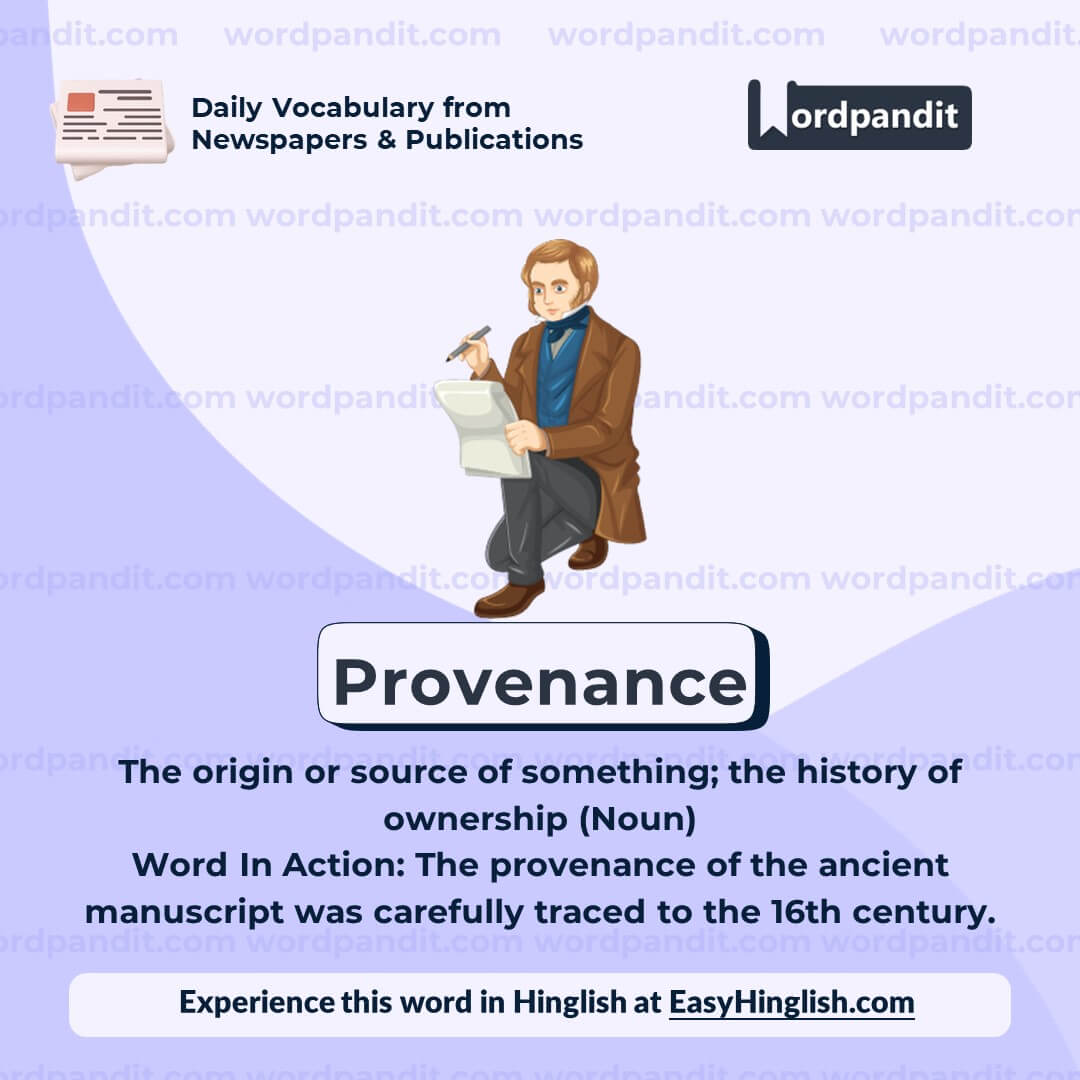
WORD-5: Provenance
Context:
"In AAP's provenance lies the reason for its defeat." - The Wire
Explanatory Paragraph:
The word "provenance" refers to the origin or source of something—where it comes from or how it began. It is often used in art and history to trace the origin or ownership of an object, but it also applies more broadly to people, ideas, or institutions. In the given context, it suggests that the roots or beginnings of the Aam Aadmi Party (AAP)—its founding principles, background, or circumstances—contain the seeds of its downfall. It implies that the party’s origin may have contributed to its current challenges or contradictions.
Meaning: The origin, source, or history of something (noun)
Pronunciation: prov-uh-nuns
Difficulty Level: ⭐⭐⭐⭐ Advanced
Etymology: From French "provenance," meaning “origin,” from "provenir" — to come forth, originate, from Latin "provenire"
Prashant Sir's Notes:
"Provenance" is a sophisticated word—often used in academic, cultural, or political analysis. It’s especially relevant in art history, but also when analyzing the ideological roots of movements or parties. It's about where something truly begins—and why that matters.
Synonyms & Antonyms:
Synonyms: origin, source, root, beginning, foundation
Antonyms: outcome, result, end, consequence
Usage Examples:
- The museum traced the painting’s provenance back to a 17th-century Dutch collector.
- Understanding the provenance of political ideologies helps explain current policy directions.
- Questions were raised about the provenance of the ancient artifact sold at auction.
- The novel’s intellectual provenance can be found in post-colonial thought.
Cultural Reference:
"In the art world, provenance is everything—it’s what makes the difference between a masterpiece and a forgery." – The Art Newspaper
Think About It:
Can understanding the provenance of a movement or institution help predict its future success or failure?
Quick Activity:
Pick any product, idea, or organization you admire. Research and write 2–3 lines on its provenance.
Memory Tip:
Think “proven-ance” = where it’s been proven to come from. It’s all about the trail back to the beginning.
Real-World Application:
"Provenance" is often used in art authentication, historical research, and journalism when verifying the origin or legitimacy of a claim, object, or idea.


