

Daily Vocabulary from Indian Newspapers and Publications
Welcome to Wordpandit’s Indian Vocabulary Hub
At Wordpandit, we understand the importance of staying rooted in the local context while expanding your language skills. This section focuses on enriching your vocabulary with words and phrases drawn from India’s leading newspapers and publications, ensuring you're learning vocabulary that is practical, relevant, and uniquely Indian.
Why Indian Sources Matter
We believe that the best way to master any language is by immersing yourself in local content. That’s why we carefully curate vocabulary from top Indian publications, including:
- The Hindu
- The Times of India
- The Economic Times
- Hindustan Times
- Live Mint
- The Indian Express
- And many others...
Stay Updated, Stay Relevant
With daily updates from Indian news sources, you’ll be consistently learning words that reflect the trends and shifts in Indian society and culture. Our focus is to provide vocabulary that enhances your understanding of the language in an Indian context.
How Wordpandit Supports Your Goals
Whether you’re preparing for exams, aiming to improve your professional communication, or simply want to stay connected with the latest Indian vocabulary, Wordpandit is here to guide you every step of the way.
Learn with a Practical Approach
Our interactive learning methodology includes real-world examples, engaging activities, and context-specific usage to ensure that every word becomes part of your active vocabulary.
Dive into Indian Vocabulary Today!

Why Choose Wordpandit?
Practical Learning: Focus on words you'll actually encounter in real-world reading, enhancing your comprehension and communication skills.
Diverse Content: From current affairs to scientific breakthroughs, our varied sources expose you to vocabulary across multiple domains.
Effortless Integration: Make Wordpandit a part of your daily routine. Just a few minutes each day can significantly boost your lexicon over time.
Your Path to Vocabulary Mastery
- Visit our Daily Vocabulary section regularly
- Explore new words and their usage in context
- Practice incorporating these words into your own writing and speech
- Track your progress as your vocabulary expands
Start Your Journey Today
Embark on your vocabulary enhancement journey with Wordpandit. By consistently engaging with our daily posts, you'll build a robust vocabulary that serves you well in academic, professional, and personal contexts.
Remember, a word a day keeps linguistic limitations at bay. Make Wordpandit your daily companion in the quest for vocabulary excellence!
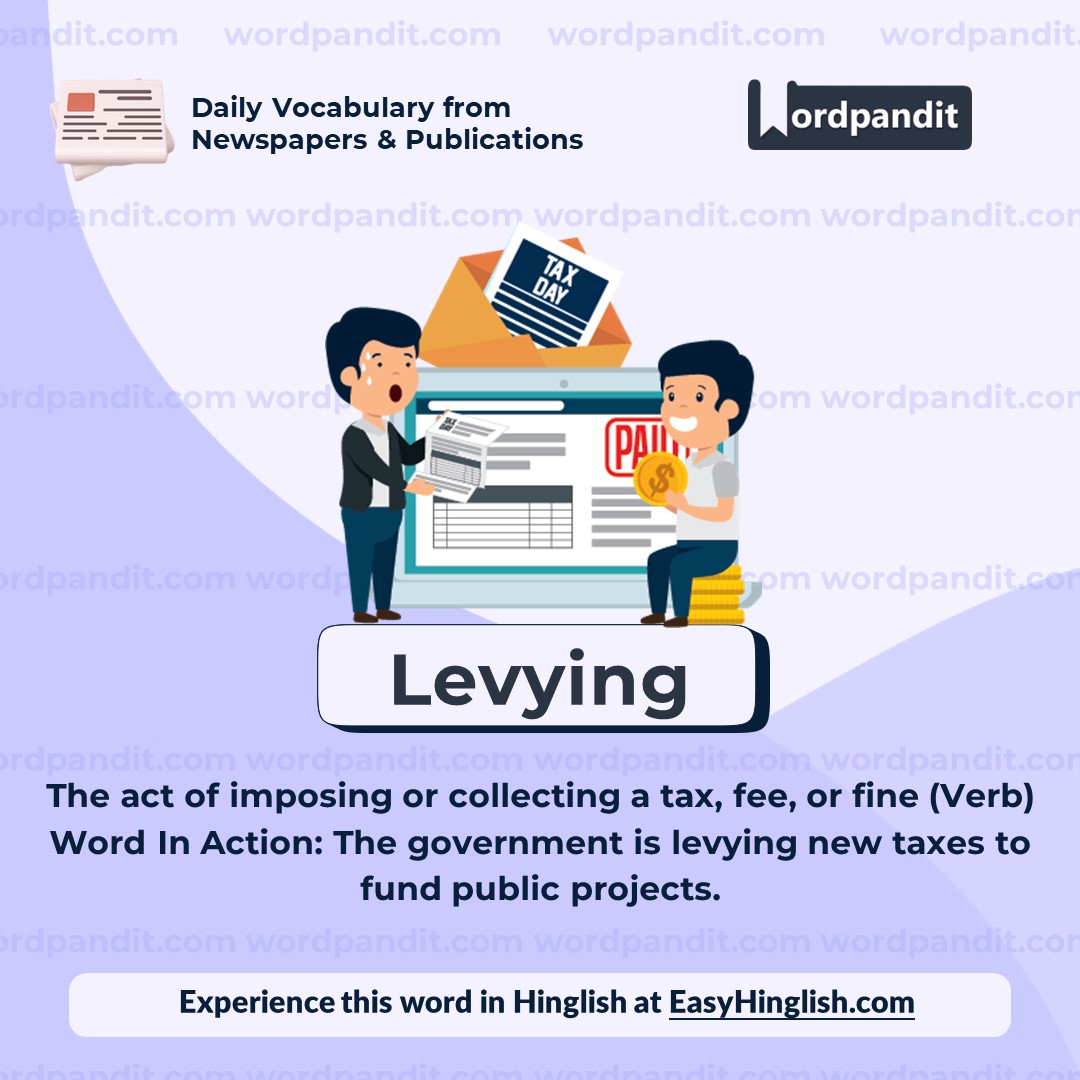
WORD-1: Levying
Context:
"ED issues order levying penalty of over ₹3.44 crore on BBC WS India for alleged FEMA violations." - The Hindu
Explanatory Paragraph:
The word "levying" refers to the act of officially imposing or collecting a charge, tax, fine, or penalty by an authority. In the context of government or regulatory bodies, it typically involves enforcing financial obligations. For instance, when an agency like the Enforcement Directorate (ED) levies a penalty, it is exercising its legal power to demand payment from an individual or organization for violating a rule or law.
Meaning: Imposing or collecting a tax, fine, or penalty by authority (Verb)
Pronunciation: LEV-ee-ing
Difficulty Level: ⭐⭐⭐ Intermediate
Etymology: From Old French "levée" (a raising), derived from Latin "levare" meaning "to raise or lift".
Prashant Sir's Notes:
"Levying" is a formal and often legal term used primarily in financial, governmental, and regulatory contexts. Remember: whenever an authority asks you to pay — be it a tax, a duty, or a fine — it is levying that amount on you.
Synonyms & Antonyms:
Synonyms: impose, charge, collect, enforce, demand
Antonyms: waive, remove, abolish, forgive
Usage Examples:
- The government is considering levying a new carbon tax to curb pollution.
- After the investigation, a fine was levied on the company for safety violations.
- Levying taxes without representation led to widespread protests in colonial America.
- The court ruled in favor of levying damages on the defendant for breach of contract.
Cultural Reference:
"No taxation without representation" was a slogan during the American Revolution protesting the British levying of taxes on the colonies without their consent. - History Textbooks
Think About It:
Should authorities have unlimited power in levying fines and taxes, or should there always be public oversight and limits?
Quick Activity:
Write a short paragraph about a situation where a penalty was levied — real or fictional. Use the word "levying" at least once.
Memory Tip:
Think of "levy" as "lift" — when the government lifts (levies) money from your pocket in the form of taxes or penalties!
Real-World Application:
The word "levying" is commonly used in legal documents, news reports, and governmental communication to describe the imposition of financial duties such as fines, taxes, and tariffs. Understanding it is essential for interpreting financial and legal policies.
WORD-2: Outrage
Context:
"The recent news about Infosys laying off freshers caused outrage in higher education circles." - The Hindu
Explanatory Paragraph:
"Outrage" refers to a strong feeling of shock, anger, or indignation caused by something perceived as unjust, offensive, or unfair. When people feel that a situation is morally or socially unacceptable, they often express their disapproval through outrage. In the context of the sentence, the decision to lay off freshers was seen as deeply unfair, triggering strong negative emotions, particularly among academic and educational stakeholders.
Meaning: A strong feeling of anger or shock caused by something wrong or unjust (Noun); to arouse anger or shock (Verb)
Pronunciation: OW-trayj
Difficulty Level: ⭐⭐ Basic
Etymology: From Old French "outrage" meaning "excess," from Latin "ultra" meaning "beyond."
Prashant Sir's Notes:
Outrage is an emotional response to injustice — it’s what you feel when something goes *way beyond* what’s acceptable. It’s often linked to public reaction and can be a powerful force in media and protests.
Synonyms & Antonyms:
Synonyms: fury, indignation, anger, resentment, wrath
Antonyms: calm, acceptance, peace, satisfaction
Usage Examples:
- The public expressed outrage over the decision to cut education funding.
- His comments sparked outrage across social media platforms.
- The politician’s actions outraged voters and critics alike.
- There was a sense of collective outrage after the unfair treatment of the workers.
Cultural Reference:
"The outrage over the George Floyd incident in 2020 led to global protests demanding racial justice." - News Archives
Think About It:
Can outrage be a productive force in society, or does it always lead to division and conflict?
Quick Activity:
Think of a recent event that caused public outrage. Write a one-sentence summary of it using the word "outrage."
Memory Tip:
Outrage = Out + Rage → When rage spills *out*, it becomes public outrage.
Real-World Application:
"Outrage" is commonly used in news reporting, political commentary, and social media to describe strong negative reactions to events, policies, or actions — especially when these are perceived as unethical or unjust.
WORD-3: Aggravated
Context:
"An FIR has been registered under Section 75(2) of the Bharatiya Nyaya Sanhita (BNS) and Section 10 (aggravated sexual assault) of the Protection of Children from Sexual Offences (POCSO) Act." - Indian Express
Explanatory Paragraph:
The word "aggravated" refers to something that has been made worse, more serious, or more severe. In legal contexts, it is used to describe crimes that have additional factors making them more serious — such as the involvement of a minor, use of a weapon, or abuse of power. In the given context, "aggravated sexual assault" refers to a form of assault that is more severe due to specific circumstances, and therefore, carries a heavier punishment under the law.
Meaning: Made more serious or severe, especially in legal or medical contexts (Adjective)
Pronunciation: AG-ruh-vay-ted
Difficulty Level: ⭐⭐⭐ Intermediate
Etymology: From Latin "aggravare" meaning "to make heavier," from "ad-" (to) + "gravis" (heavy)
Prashant Sir's Notes:
Always watch out for the context of "aggravated" — it doesn’t just mean someone is irritated or angry (as in "he was aggravated"), but in legal and formal usage, it means something has been made more serious or intensified, usually in a bad way.
Synonyms & Antonyms:
Synonyms: intensified, worsened, heightened, compounded
Antonyms: alleviated, mitigated, eased, lessened
Usage Examples:
- The presence of a weapon led to an aggravated charge of robbery.
- His actions were considered an aggravated breach of conduct due to the involvement of a minor.
- The patient’s condition was aggravated by lack of timely treatment.
- Aggravated assault carries a harsher penalty under the revised criminal code.
Cultural Reference:
"In many legal systems, crimes committed with aggravating factors — such as targeting children, using weapons, or committing the act in a particularly cruel manner — are classified as 'aggravated' offences and receive harsher penalties." - Legal Studies Textbook
Think About It:
Should "aggravated" crimes always carry significantly harsher punishments, or should context and intent be considered equally important?
Quick Activity:
List three everyday situations where something can become “aggravated” (e.g., a conflict, an illness, a traffic issue). Use the word in a sentence for one of them.
Memory Tip:
Think of "aggravated" as something that adds *gravity* — it makes a bad situation heavier or more serious.
Real-World Application:
Understanding "aggravated" is crucial in legal, medical, and formal discussions. It helps distinguish between regular and intensified forms of actions — for example, "aggravated assault" in law or "aggravated symptoms" in healthcare — where the stakes and consequences are higher.
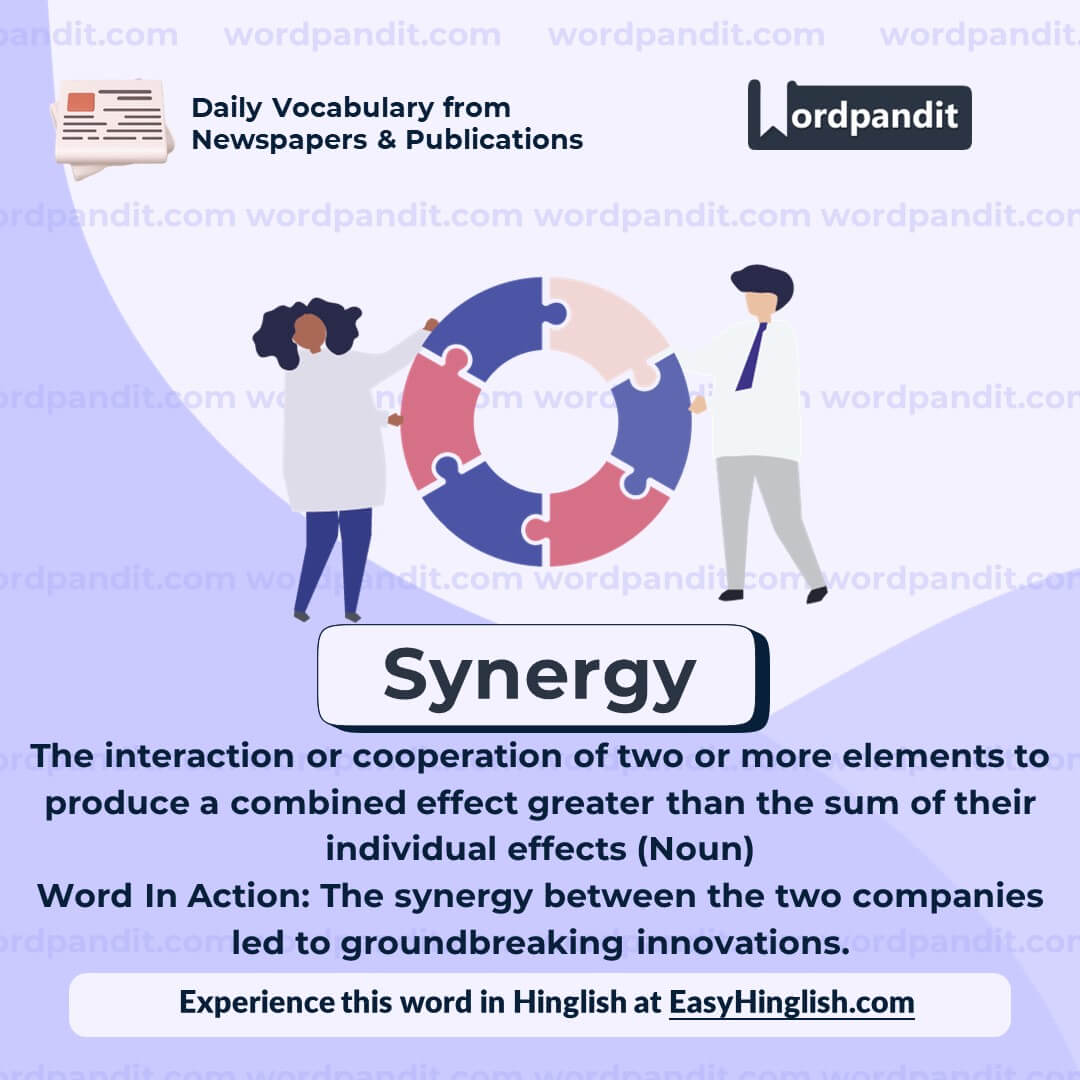
WORD-4: Synergy
Context:
"The future of programming education lies in the synergy between automated assessment platforms and human evaluation." - The Hindu
Explanatory Paragraph:
"Synergy" refers to the interaction or cooperation of two or more elements—people, systems, ideas—that produces a combined effect greater than the sum of their separate effects. In simpler terms, it's when collaboration leads to something better than what each part could achieve on its own. In the context of the sentence, the fusion of automated tools with human judgment in programming education creates a more effective learning process than either method could on its own.
Meaning: The increased effectiveness that results when two or more people or systems work together (Noun)
Pronunciation: SIN-er-jee
Difficulty Level: ⭐⭐ Basic
Etymology: From Greek "synergos" meaning "working together," from "syn" (together) + "ergon" (work)
Prashant Sir's Notes:
Synergy is a powerful idea in teamwork and innovation. Think of it as 1 + 1 = 3. When two components come together, the outcome is far more impactful than their individual contributions. This is the magic of collaboration done right!
Synonyms & Antonyms:
Synonyms: cooperation, collaboration, teamwork, alliance, harmony
Antonyms: discord, conflict, opposition, isolation
Usage Examples:
- There's a great synergy between the marketing and product teams this quarter.
- The merger aimed to create synergy between the two companies’ strengths.
- Effective teaching requires synergy between technology and human guidance.
- The success of the project was due to the synergy among diverse skill sets.
Cultural Reference:
"Synergy" became a buzzword in the corporate world during the 1990s, especially with the rise of business mergers where companies claimed that combining forces would lead to greater profitability and innovation. - Harvard Business Review Archives
Think About It:
Can true synergy happen without mutual respect and understanding, or is collaboration alone enough?
Quick Activity:
Identify two areas in your life—academic, personal, or professional—where combining efforts or tools has created synergy. Write one sentence using the word "synergy."
Memory Tip:
Think: "Syn" = together, and "energy" = power → *Synergy* = power from working together!
Real-World Application:
Synergy is a key principle in business, education, healthcare, and technology. Whether it’s a corporate partnership, a multidisciplinary research team, or humans working with AI, synergy drives progress and efficiency when elements complement each other’s strengths.
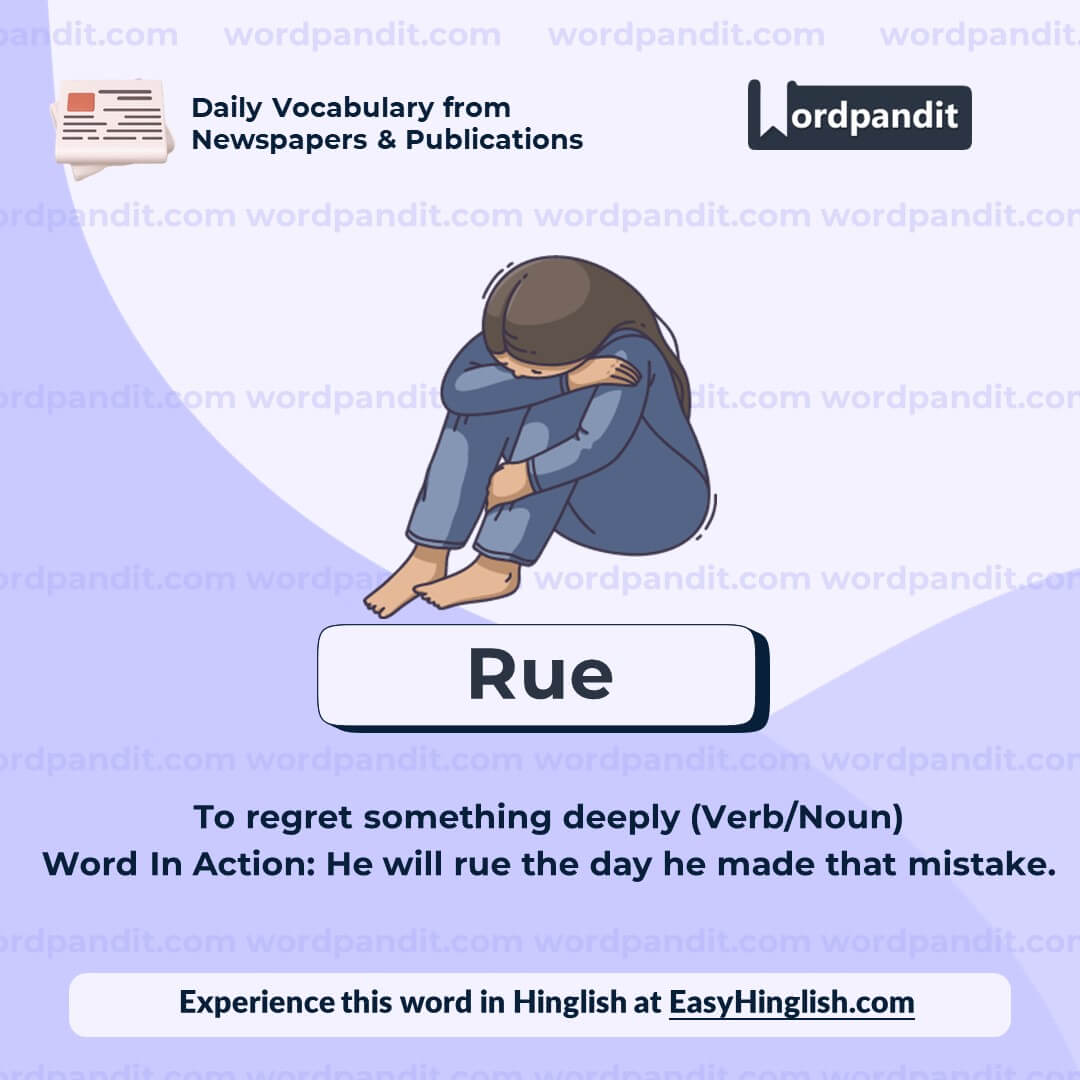
WORD-5: Rue
Context:
"He would live to rue his hasty decision as it led to unforeseen complications." - The Hindu
Explanatory Paragraph:
The word "rue" means to bitterly regret or feel sorrow over a past action or decision, especially one that led to negative consequences. It's a formal and slightly old-fashioned term, often used in literature or dramatic contexts. In the given sentence, the man made a quick decision without thinking it through, and as problems arose later, he deeply regretted it — he rued it.
Meaning: To regret bitterly or feel sorrow for something done (Verb)
Pronunciation: roo
Difficulty Level: ⭐⭐⭐ Intermediate
Etymology: From Old English "hreowan" meaning “to make sorry, grieve,” related to Old Norse "hryggja" (to sadden)
Prashant Sir's Notes:
"Rue" is a classic word of regret. It’s powerful, poetic, and often used in literature or speeches. Whenever you hear “He will rue the day...”, know that deep regret is on its way. Don’t confuse it with “rue” the herb (same spelling, different meaning).
Synonyms & Antonyms:
Synonyms: regret, lament, repent, mourn, grieve
Antonyms: celebrate, rejoice, applaud, embrace
Usage Examples:
- She rued the moment she trusted the wrong person with her secret.
- The team would later rue their missed opportunities in the final match.
- He gave a rueful smile, acknowledging his past mistakes.
- “You’ll rue the day you challenged me,” the villain said dramatically.
Cultural Reference:
In Shakespeare’s *Othello*, characters often express regret and sorrow in emotionally charged ways, embodying the concept of “rue” — though the word itself may not always appear, the emotion is central to many tragic decisions. - Classic English Literature
Think About It:
Is regret a necessary part of learning from our past, or does it sometimes hold us back from moving forward?
Quick Activity:
Write a two-line fictional dialogue using the word “rue.” Make it dramatic or emotional!
Memory Tip:
Think of "rue" as what you say when you're sad — *"Roo-hoo, I shouldn't have done that!"*
Real-World Application:
"Rue" is used in formal writing, speeches, literature, and sometimes in journalism when highlighting emotional consequences of actions. It’s less common in everyday speech but powerful for conveying deep, lasting regret.


