

Daily Vocabulary from Indian Newspapers and Publications
Welcome to Wordpandit’s Indian Vocabulary Hub
At Wordpandit, we understand the importance of staying rooted in the local context while expanding your language skills. This section focuses on enriching your vocabulary with words and phrases drawn from India’s leading newspapers and publications, ensuring you're learning vocabulary that is practical, relevant, and uniquely Indian.
Why Indian Sources Matter
We believe that the best way to master any language is by immersing yourself in local content. That’s why we carefully curate vocabulary from top Indian publications, including:
- The Hindu
- The Times of India
- The Economic Times
- Hindustan Times
- Live Mint
- The Indian Express
- And many others...
Stay Updated, Stay Relevant
With daily updates from Indian news sources, you’ll be consistently learning words that reflect the trends and shifts in Indian society and culture. Our focus is to provide vocabulary that enhances your understanding of the language in an Indian context.
How Wordpandit Supports Your Goals
Whether you’re preparing for exams, aiming to improve your professional communication, or simply want to stay connected with the latest Indian vocabulary, Wordpandit is here to guide you every step of the way.
Learn with a Practical Approach
Our interactive learning methodology includes real-world examples, engaging activities, and context-specific usage to ensure that every word becomes part of your active vocabulary.
Dive into Indian Vocabulary Today!

Why Choose Wordpandit?
Practical Learning: Focus on words you'll actually encounter in real-world reading, enhancing your comprehension and communication skills.
Diverse Content: From current affairs to scientific breakthroughs, our varied sources expose you to vocabulary across multiple domains.
Effortless Integration: Make Wordpandit a part of your daily routine. Just a few minutes each day can significantly boost your lexicon over time.
Your Path to Vocabulary Mastery
- Visit our Daily Vocabulary section regularly
- Explore new words and their usage in context
- Practice incorporating these words into your own writing and speech
- Track your progress as your vocabulary expands
Start Your Journey Today
Embark on your vocabulary enhancement journey with Wordpandit. By consistently engaging with our daily posts, you'll build a robust vocabulary that serves you well in academic, professional, and personal contexts.
Remember, a word a day keeps linguistic limitations at bay. Make Wordpandit your daily companion in the quest for vocabulary excellence!
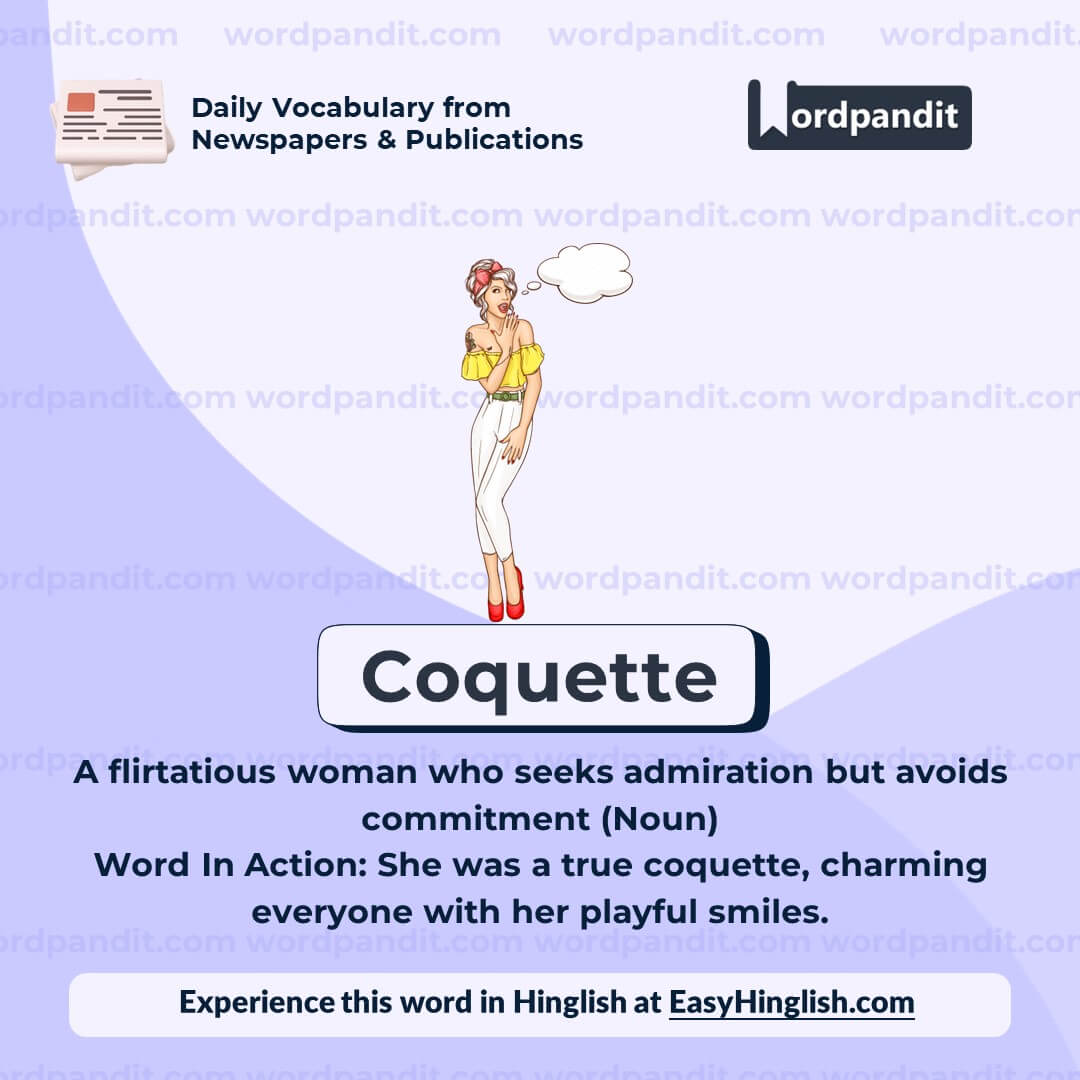
WORD-1: Coquette
Context:
"In literature, a coquette is often a female character who uses wit, beauty, and flirtation to navigate society." - The Hindu
Explanatory Paragraph:
A “coquette” is typically a woman who flirts light-heartedly with others to gain admiration or attention, without any serious intention. The word often appears in literature to describe characters who use charm, elegance, and social skill to influence those around them. While the term may carry a slightly playful or even critical tone, it also suggests confidence and control over one’s interactions.
Meaning: A woman who flirts to win admiration without serious intent (noun)
Pronunciation: koh-KET
Difficulty Level: ⭐⭐⭐ Intermediate
Etymology: From French "coquette", feminine of "coquet", meaning "flirt", derived from "coq" (rooster), symbolizing a strutting, showy attitude.
Prashant Sir's Notes:
This is a classic literary term used to describe female characters who manipulate attention and emotions through charm. It may appear in discussions of gender roles, historical fiction, or character analysis. Knowing this word helps in better interpreting such character portrayals.
Synonyms & Antonyms:
Synonyms: flirt, tease, vamp, seductress, siren
Antonyms: prude, introvert, recluse, modest person
Usage Examples:
- In the novel, she played the coquette with such finesse that no one could resist her charm.
- Though labeled a coquette, she was simply confident and enjoyed intelligent banter.
- The coquette in the film used her allure not just to entertain but to manipulate outcomes.
- He mistook her playful smile for coquetry, unaware of her sharp mind and deeper motives.
Cultural Reference:
"She was the greatest coquette of her generation — charming, elusive, and always a step ahead." - Inspired by characters like Scarlett O'Hara from *Gone with the Wind*
Think About It:
How does the portrayal of coquettes in literature reflect or challenge traditional gender roles in society?
Quick Activity:
List three literary or film characters you think embody the qualities of a coquette. Briefly explain why for each.
Memory Tip:
Think of a “cocky coquette” — both words start with “coq” and suggest showing off to get attention!
Real-World Application:
Understanding the word “coquette” helps in analyzing character behavior in novels, films, and even historical biographies, especially when examining themes of influence, gender, and societal norms.
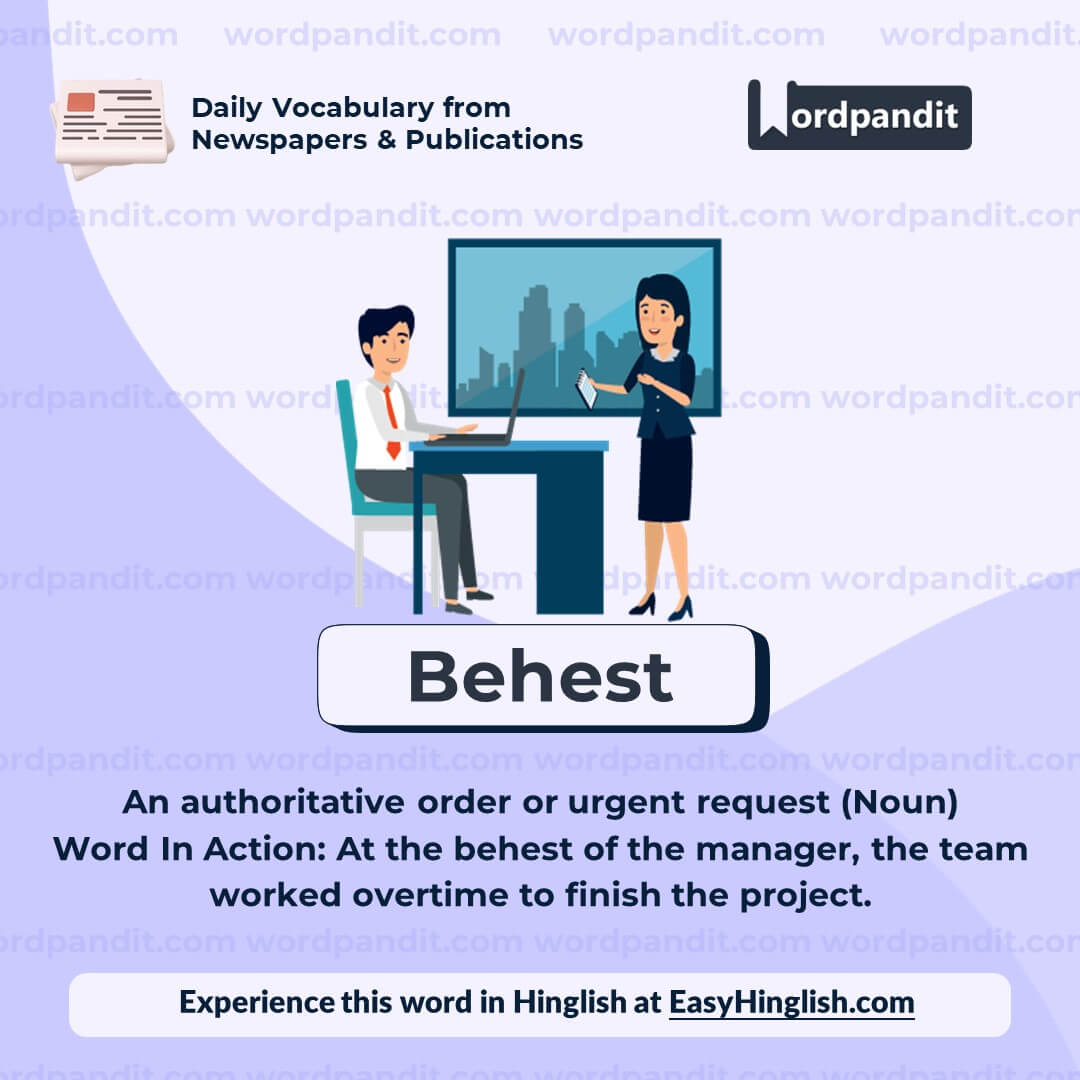
WORD-2: Behest
Context:
"As a former government lawyer noted, 'that assuming a legal heir was handed over cash after confirming and due verification to establish heir-deceased relationship, the government will always have the record, given that it is being done through government offices and officials, and not at the behest of any individual or specific political party.'" - The Hindu
Explanatory Paragraph:
The word “behest” refers to a command, order, or authoritative request made by someone in power or with influence. In the context of government or official actions, if something is done “at the behest” of someone, it means it was carried out because that person instructed or asked for it. The sentence emphasizes that the government’s action was not due to any personal or political request, but rather part of official protocol.
Meaning: A command or authoritative request (noun)
Pronunciation: buh-HEST
Difficulty Level: ⭐⭐⭐ Intermediate
Etymology: From Middle English "beheste", meaning a command or vow; derived from Old English "behæs" (a vow or promise).
Prashant Sir's Notes:
“Behest” is often seen in formal or legal contexts. When someone says an action was done “at the behest of” another, they imply that it was carried out under instruction or influence. Learn this word to better interpret legal documents, journalistic reports, and political commentary.
Synonyms & Antonyms:
Synonyms: command, order, instruction, directive, bidding
Antonyms: suggestion, request, refusal, denial
Usage Examples:
- The committee met at the behest of the Prime Minister to address the crisis.
- She acted at the behest of her manager, following the instructions precisely.
- The evacuation was ordered at the behest of safety officials after the earthquake.
- The report was prepared not at the behest of any political figure, but as part of routine auditing.
Cultural Reference:
"At the king’s behest, the knights rode out at dawn to defend the realm." – A common trope in medieval literature and fantasy fiction.
Think About It:
When actions are carried out at someone’s behest, how do we determine where responsibility and accountability truly lie?
Quick Activity:
Write a sentence using “behest” where a public policy is enacted due to someone's influence or authority.
Memory Tip:
Think of “be-HIGH-est” — as in a request or command from someone at the highest level of power.
Real-World Application:
The word “behest” is frequently used in news, law, and formal communication to clarify that an action was taken under official or influential instruction. Understanding this helps in interpreting motives and authority behind decisions.
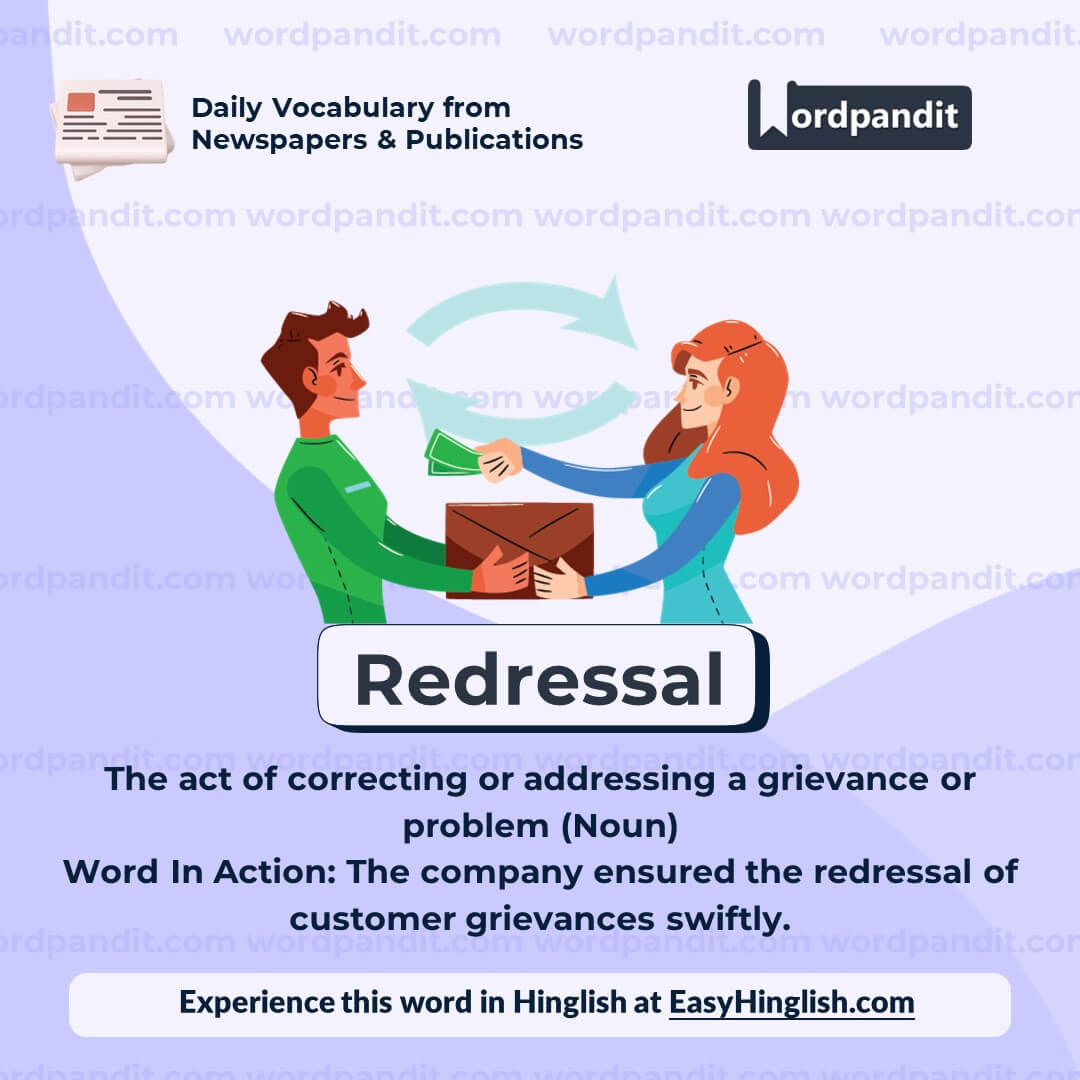
WORD-3: Redressal
Context:
"For ex-gratia payment to the next of kin of those who died during the Covid-19 pandemic, the Delhi government in January 2022, had issued detailed guidelines, listing the eligibility criteria, as well as grievance redressal committees for each of the 11 revenue districts." - Indian Express
Explanatory Paragraph:
“Redressal” refers to the act of setting right a wrong or giving a remedy for a grievance. In administrative and legal contexts, it commonly appears as “grievance redressal,” which is the process of addressing complaints or resolving issues faced by citizens or consumers. The word emphasizes correction, justice, and responsiveness in a system. In the given context, the government had set up specific mechanisms to ensure that any issues related to the payment process could be resolved fairly.
Meaning: The act of correcting a wrong or addressing a grievance (noun)
Pronunciation: ruh-DRESS-uhl
Difficulty Level: ⭐⭐ Basic
Etymology: Derived from the verb "redress", which comes from Old French *redrecier* meaning "to make straight again" or "set right".
Prashant Sir's Notes:
“Redressal” is a commonly used term in Indian administrative, legal, and public policy contexts. You’ll often find it in government schemes, notices, or complaint systems. While not as frequently used in American English (which prefers “redress”), it's essential for exams like UPSC, CLAT, and other competitive tests.
Synonyms & Antonyms:
Synonyms: remedy, correction, compensation, resolution, reparation
Antonyms: injustice, harm, damage, neglect
Usage Examples:
- The consumer court was set up to ensure quick redressal of complaints.
- The redressal mechanism failed to resolve the villagers’ issues in time.
- The policy includes a separate section on grievance redressal procedures.
- She submitted a written application seeking redressal for the faulty service.
Cultural Reference:
"Grievance redressal" is a standard term in Indian governance and public policy. The Right to Public Services Acts in several Indian states mandate time-bound redressal of citizen complaints.
Think About It:
Why is a strong redressal system essential in a democracy, and what are the consequences when it fails?
Quick Activity:
Write down two services you have used recently (e.g., bank, telecom, transport). Imagine a complaint you might have and describe how a redressal mechanism should address it.
Memory Tip:
Think of “re-dress” — like putting a new dress on a problem to make it right again!
Real-World Application:
Redressal systems are part of most customer care units, government grievance cells, and legal frameworks. Knowing this word helps you understand your rights and how to seek justice or correction when faced with issues.
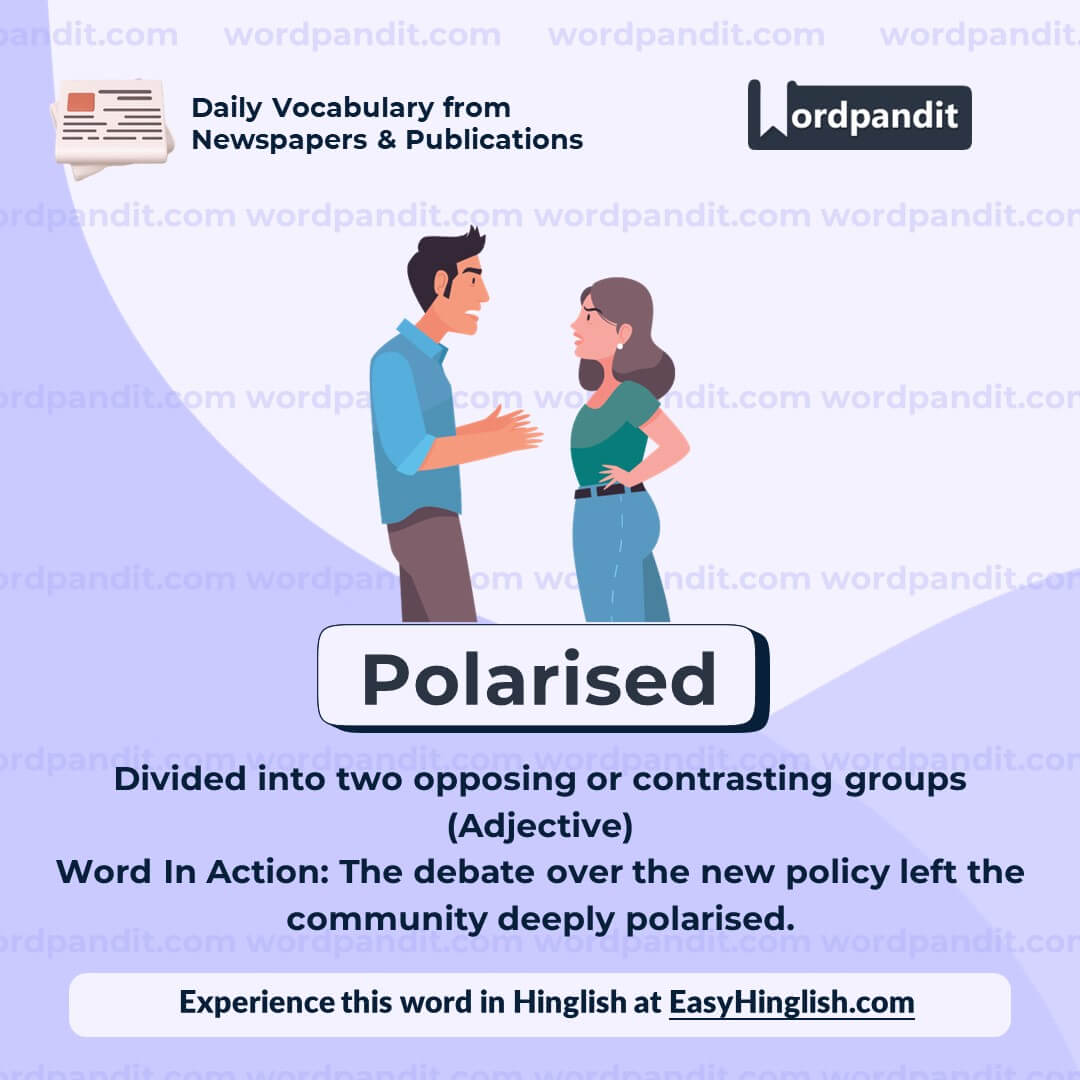
WORD-4: Polarised
Context:
"Jaishankar then emphasised that both countries had played a key role in upholding the G-20. 'We should also recognise that in a polarised global situation, our two countries have worked hard to preserve and protect the G20 as an institution.'" - The Wire
Explanatory Paragraph:
“Polarised” refers to a state where opinions, beliefs, or groups are sharply divided, often in opposition to each other. In politics or global affairs, a polarised situation means that people or nations are split into extreme camps with little middle ground or agreement. The context here refers to the global climate being marked by division and tension, and the two countries working together to maintain unity despite such challenges.
Meaning: Divided into two sharply contrasting groups or sets of opinions (adjective)
Pronunciation: POH-luh-rahyzd
Difficulty Level: ⭐⭐⭐ Intermediate
Etymology: From French *polariser*, based on Latin *polus* meaning “pole”; originally used in physics to describe light waves oriented in specific directions.
Prashant Sir's Notes:
“Polarised” is a crucial word for understanding current affairs, especially in politics, media, and international relations. It reflects a lack of consensus and rising tensions. Remember, it is often used in news to describe ideological, social, or geopolitical divides.
Synonyms & Antonyms:
Synonyms: divided, split, fragmented, opposing, antagonistic
Antonyms: united, harmonious, cooperative, balanced
Usage Examples:
- The political debate has become so polarised that compromise seems impossible.
- Social media often fuels a polarised environment by reinforcing echo chambers.
- The nation remains polarised on key policy issues such as immigration and climate change.
- The polarised nature of international alliances makes diplomacy more challenging today.
Cultural Reference:
“Polarisation” is a frequent theme in modern politics. For instance, U.S. politics is often described as polarised, with Democrats and Republicans growing further apart on almost every issue. This mirrors similar trends in many democracies worldwide.
Think About It:
What role does media (traditional and social) play in increasing or reducing societal polarisation?
Quick Activity:
List two current global or national issues that you think are highly polarised. Explain the two opposing views for each.
Memory Tip:
Think of “polarised” like two poles (north and south) — completely opposite and unable to meet in the middle.
Real-World Application:
Understanding “polarised” helps you better analyze political discourse, social trends, and international relations. It also enables you to evaluate whether discussions are constructive or merely reinforcing division.
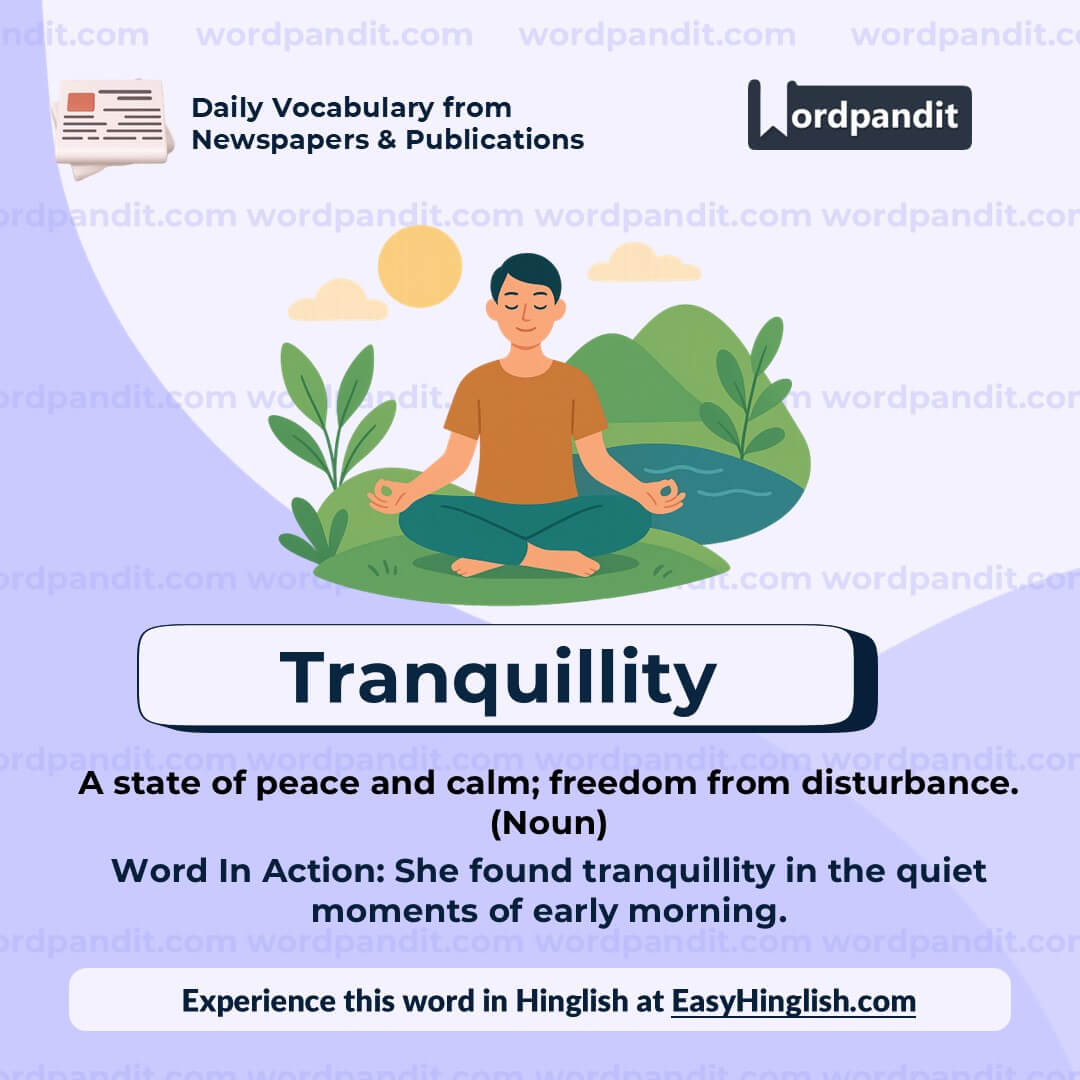
WORD-5: Tranquillity
Context:
"Ministry of External Affairs (MEA) spokesperson Randhir Jaiswal said that two ministers, in their meeting lasting half an hour, 'reviewed developments in our bilateral relationship since their last meeting in November, specifically the management of peace and tranquillity in border areas.'" - The Hindu
Explanatory Paragraph:
“Tranquillity” refers to a state of calmness, peace, and quiet, especially in a situation or environment. In diplomatic or political discussions, it often points to the absence of conflict, violence, or unrest. In the given context, “tranquillity in border areas” means maintaining peace and preventing tensions or clashes along the borders. The term carries both a literal sense of quiet and a broader sense of stability and harmony.
Meaning: A state of peace, calm, and quiet (noun)
Pronunciation: trang-KWIL-ih-tee
Difficulty Level: ⭐⭐ Basic
Etymology: From Latin *tranquillitas*, from *tranquillus* meaning “quiet, calm”
Prashant Sir's Notes:
This is a versatile word used in political diplomacy, literature, and even mindfulness contexts. Whether describing a peaceful lake or diplomatic calm, “tranquillity” captures the essence of stillness and balance. It's commonly used in phrases like “peace and tranquillity” or “inner tranquillity.”
Synonyms & Antonyms:
Synonyms: calm, peace, serenity, stillness, quiet
Antonyms: chaos, unrest, disturbance, agitation, turmoil
Usage Examples:
- The tranquillity of the mountains was a welcome escape from city noise.
- Leaders signed the treaty to ensure continued tranquillity in the region.
- She practiced meditation to cultivate inner tranquillity.
- The soldiers were stationed to preserve tranquillity along the disputed border.
Cultural Reference:
The phrase “peace and tranquillity” is famously used in constitutional and legal texts around the world, including in the U.S. Constitution’s Preamble: “...insure domestic tranquillity...”
Think About It:
Is tranquillity merely the absence of conflict, or does it also require active cooperation and understanding between individuals or nations?
Quick Activity:
Describe a place (real or imaginary) that brings you a sense of tranquillity. What elements contribute to that peaceful feeling?
Memory Tip:
Think of “tranquillity” as what you feel lying quietly by a still lake — calm, quiet, and at peace. “Tranquil = still” helps link the meaning.
Real-World Application:
“Tranquillity” is a key concept in conflict resolution, mental health, and diplomacy. Whether you're meditating or analyzing a ceasefire agreement, understanding this word helps in appreciating the value of calm environments — both internally and externally.


