

Daily Vocabulary from Indian Newspapers and Publications
Welcome to Wordpandit’s Indian Vocabulary Hub
At Wordpandit, we understand the importance of staying rooted in the local context while expanding your language skills. This section focuses on enriching your vocabulary with words and phrases drawn from India’s leading newspapers and publications, ensuring you're learning vocabulary that is practical, relevant, and uniquely Indian.
Why Indian Sources Matter
We believe that the best way to master any language is by immersing yourself in local content. That’s why we carefully curate vocabulary from top Indian publications, including:
- The Hindu
- The Times of India
- The Economic Times
- Hindustan Times
- Live Mint
- The Indian Express
- And many others...
Stay Updated, Stay Relevant
With daily updates from Indian news sources, you’ll be consistently learning words that reflect the trends and shifts in Indian society and culture. Our focus is to provide vocabulary that enhances your understanding of the language in an Indian context.
How Wordpandit Supports Your Goals
Whether you’re preparing for exams, aiming to improve your professional communication, or simply want to stay connected with the latest Indian vocabulary, Wordpandit is here to guide you every step of the way.
Learn with a Practical Approach
Our interactive learning methodology includes real-world examples, engaging activities, and context-specific usage to ensure that every word becomes part of your active vocabulary.
Dive into Indian Vocabulary Today!

Why Choose Wordpandit?
Practical Learning: Focus on words you'll actually encounter in real-world reading, enhancing your comprehension and communication skills.
Diverse Content: From current affairs to scientific breakthroughs, our varied sources expose you to vocabulary across multiple domains.
Effortless Integration: Make Wordpandit a part of your daily routine. Just a few minutes each day can significantly boost your lexicon over time.
Your Path to Vocabulary Mastery
- Visit our Daily Vocabulary section regularly
- Explore new words and their usage in context
- Practice incorporating these words into your own writing and speech
- Track your progress as your vocabulary expands
Start Your Journey Today
Embark on your vocabulary enhancement journey with Wordpandit. By consistently engaging with our daily posts, you'll build a robust vocabulary that serves you well in academic, professional, and personal contexts.
Remember, a word a day keeps linguistic limitations at bay. Make Wordpandit your daily companion in the quest for vocabulary excellence!
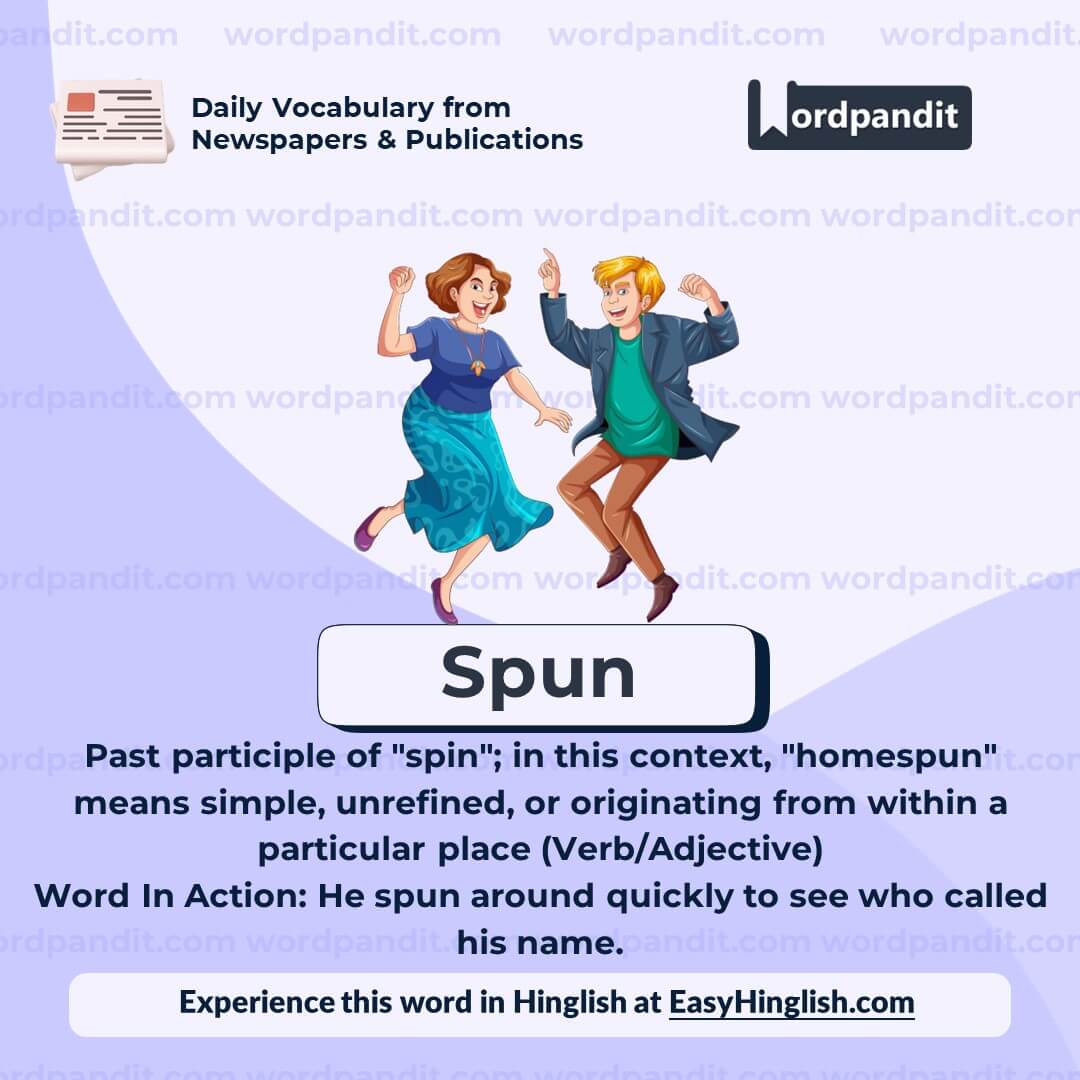
WORD-1: Spun
Context:
"India’s diplomacy problem in broad context is largely home spun, and it is a relatively new phenomenon." - The Wire
Explanatory Paragraph:
The word "spun" is the past participle of "spin," which usually refers to turning something around rapidly. However, in this context, “home spun” is an adjective form derived from “spun” and refers to something simple, made at home, or locally created without foreign influence. When describing ideas, policies, or practices, "homespun" often carries a connotation of being modest, native, or unrefined but practical. The use of “spun” here highlights the act of crafting or originating something in a particular way—especially with a local or indigenous character.
Meaning: Turned or twisted (something) around quickly; also used metaphorically to describe something that is fabricated, presented, or created in a particular way (verb, past participle)
Pronunciation: spuhn
Difficulty Level: ⭐⭐ Beginner
Etymology: Derived from Old English “spinnan,” meaning “to draw out and twist fibers into thread.”
Prashant Sir's Notes:
Here, the word "spun" appears as part of the compound adjective “homespun,” which implies something locally created or inherently native in origin. It can suggest simplicity, originality, or even lack of polish. In diplomacy, "home spun" can mean strategies that emerge from domestic thinking rather than borrowed international models.
Synonyms & Antonyms:
Synonyms: twisted, crafted, devised, fabricated, turned
Antonyms: untwisted, unwound, unchanged, unaltered
Usage Examples:
- The story was cleverly spun to highlight the company’s achievements and downplay its failures.
- The silk was spun by hand in the village using traditional tools.
- She spun the events of the meeting to make herself look like the hero.
- His homespun philosophy attracted those tired of corporate jargon and elitism.
Cultural Reference:
"Homespun wisdom" is often used in American and Indian literature to describe down-to-earth advice that comes from common experience rather than formal education. Mahatma Gandhi famously wore homespun cloth (khadi) as a symbol of self-reliance. - Cultural Context
Think About It:
Can ideas or solutions that are "homespun" be more effective than those borrowed from outside sources? What are the advantages or limitations?
Quick Activity:
Write two sentences: one using "spun" literally (as in spinning a physical object), and one using it metaphorically (as in spinning a story or idea).
Memory Tip:
Think of a spider that "spins" its web—whether literally or figuratively, "spun" involves creating or crafting something from available material.
Real-World Application:
In politics and media, "spun" is often used to describe how information is shaped or framed for public perception. Understanding how something is "spun" helps in developing critical thinking and media literacy.
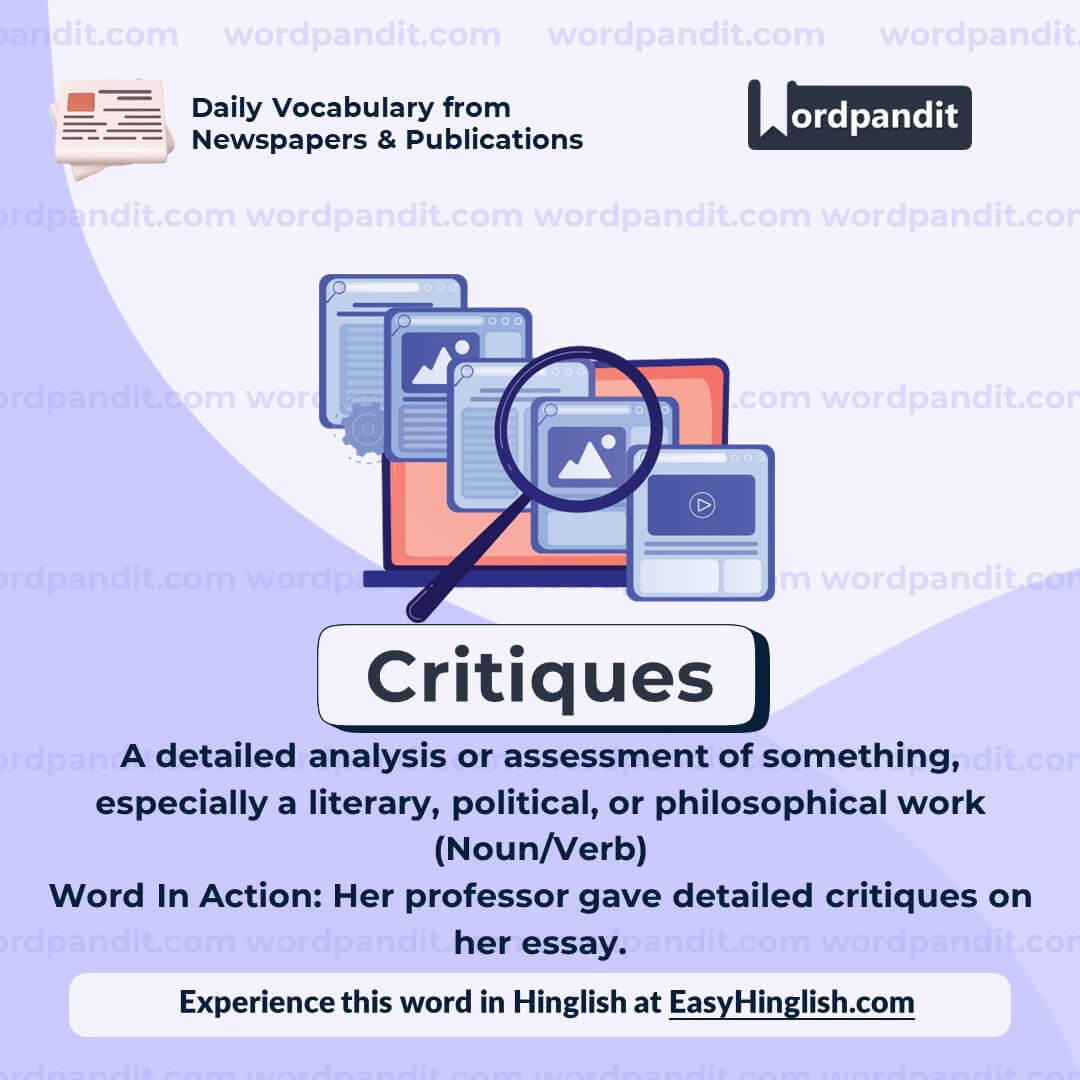
WORD-2: Critiques
Context:
"The result is an unprecedented hubris displayed by the ruling elites led by the Bharatiya Janata Party (BJP). Whosoever critiques any government policy move is summarily condemned as a ‘traitor’." - The Wire
Explanatory Paragraph:
The word "critiques" refers to acts of evaluating or analyzing something, often in a detailed and thoughtful way. It can be both a noun (a review or analysis) and a verb (to evaluate or analyze). In this context, it is used as a verb, meaning “expresses critical opinions about.” When someone critiques a policy, they are not necessarily attacking it, but examining its merits and flaws. However, the sentence implies that such critique is not tolerated and is instead met with hostility—highlighting a tension between freedom of expression and political loyalty.
Meaning: To evaluate or analyze critically (verb); a detailed analysis or assessment (noun)
Pronunciation: kri-teeks
Difficulty Level: ⭐⭐⭐ Intermediate
Etymology: From French “critique” meaning “a critical essay or review,” originally from Greek “kritikē” meaning “the art of judgment.”
Prashant Sir's Notes:
Remember, "critique" is not the same as "criticize." While criticism often has a negative tone, "critique" implies a more balanced and analytical review. It's an essential part of academic, artistic, and political discourse. In modern democratic societies, being able to critique policies is a key sign of a healthy civic environment.
Synonyms & Antonyms:
Synonyms: evaluate, review, analyze, assess, examine
Antonyms: praise (uncritically), approve, ignore, overlook
Usage Examples:
- She critiques films for an online magazine and is known for her fair yet firm reviews.
- The professor critiques each student's essay to help them improve their writing.
- Instead of attacking the proposal, he offered a thoughtful critique of its assumptions.
- In a healthy democracy, citizens are free to critique government policies without fear.
Cultural Reference:
"A critic is someone who enters the battlefield after the war is over and shoots the wounded." — Murray Kempton. This quote humorously reflects the perception of critiques, but also underlines the importance of timing and fairness in critique. - Public Discourse Culture
Think About It:
Why do societies often resist critique, even when it is constructive? What happens when critique is silenced?
Quick Activity:
Pick a recent policy, movie, or event you’ve encountered. Write a short 3-sentence critique highlighting one strength and one weakness.
Memory Tip:
Think of “critique” as “critical + technique”—it’s not about complaining, but about evaluating using clear thinking and technique.
Real-World Application:
Critiquing is an essential skill in education, journalism, and leadership. Whether you’re reviewing a project at work, analyzing a book, or responding to a policy, being able to constructively critique helps foster innovation and accountability.
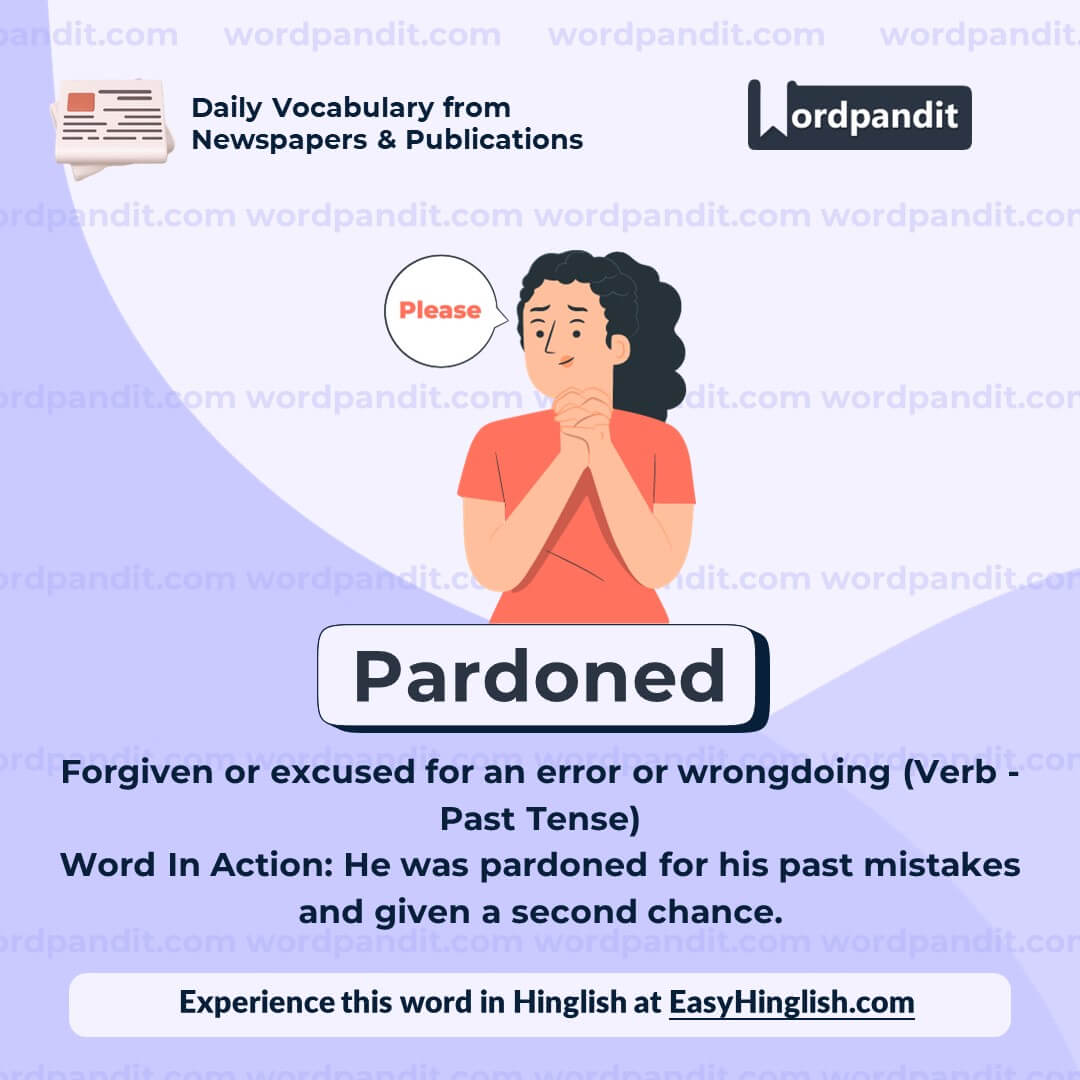
WORD-3: Pardoned
Context:
"If anyone mistook him for a moment as the US Secretary of State s/he may be pardoned." - The Wire
Explanatory Paragraph:
The word "pardoned" in this sentence is used in a figurative and somewhat humorous sense. Literally, “to pardon” means to forgive someone for an offense or error, often used in legal or moral contexts. Here, it suggests that the mistake (confusing someone for the US Secretary of State) is understandable and can easily be forgiven due to the similarity in appearance or behavior. It softens the tone and adds a touch of irony or wit, implying that the resemblance was strong enough to excuse the error.
Meaning: Forgiven or excused for a mistake or offense (verb, past participle)
Pronunciation: paar-duhnd
Difficulty Level: ⭐⭐ Beginner
Etymology: From Old French “pardoner,” and Latin “perdonare,” meaning “to grant freely” or “to forgive.”
Prashant Sir's Notes:
While “pardon” often appears in legal or moral settings, it’s also used in polite or humorous contexts. In journalism or commentary, “may be pardoned” implies that a mistake is understandable and doesn’t warrant blame. Always look at the tone—it can be sincere, ironic, or even satirical depending on the context.
Synonyms & Antonyms:
Synonyms: forgave, excused, absolved, overlooked, acquitted
Antonyms: blamed, punished, condemned, held accountable
Usage Examples:
- The president pardoned the activist for past offenses committed during protests.
- You may be pardoned for thinking she was the boss—she carried herself with authority.
- He was formally pardoned after new evidence proved his innocence.
- Pardoned mistakes in childhood can sometimes shape better adults.
Cultural Reference:
In the U.S., presidential pardons are a powerful legal tool that can forgive crimes, often sparking debates about justice and fairness. One famous example is President Gerald Ford's pardon of Richard Nixon after the Watergate scandal. - U.S. Political History
Think About It:
Should all mistakes be pardoned if they are made unknowingly? Where should the line be drawn between forgiveness and accountability?
Quick Activity:
Write a short sentence where “pardoned” is used seriously, and another where it is used humorously or ironically.
Memory Tip:
Think of “pardon” as a “pass” you’re given when you make a mistake—especially one that’s forgivable. Pardon = Pass on the Don’t-do-that list.
Real-World Application:
Understanding the word “pardoned” helps in legal studies, history, and diplomacy. It’s also useful in daily communication, especially when you want to politely excuse someone’s minor errors or misunderstandings.
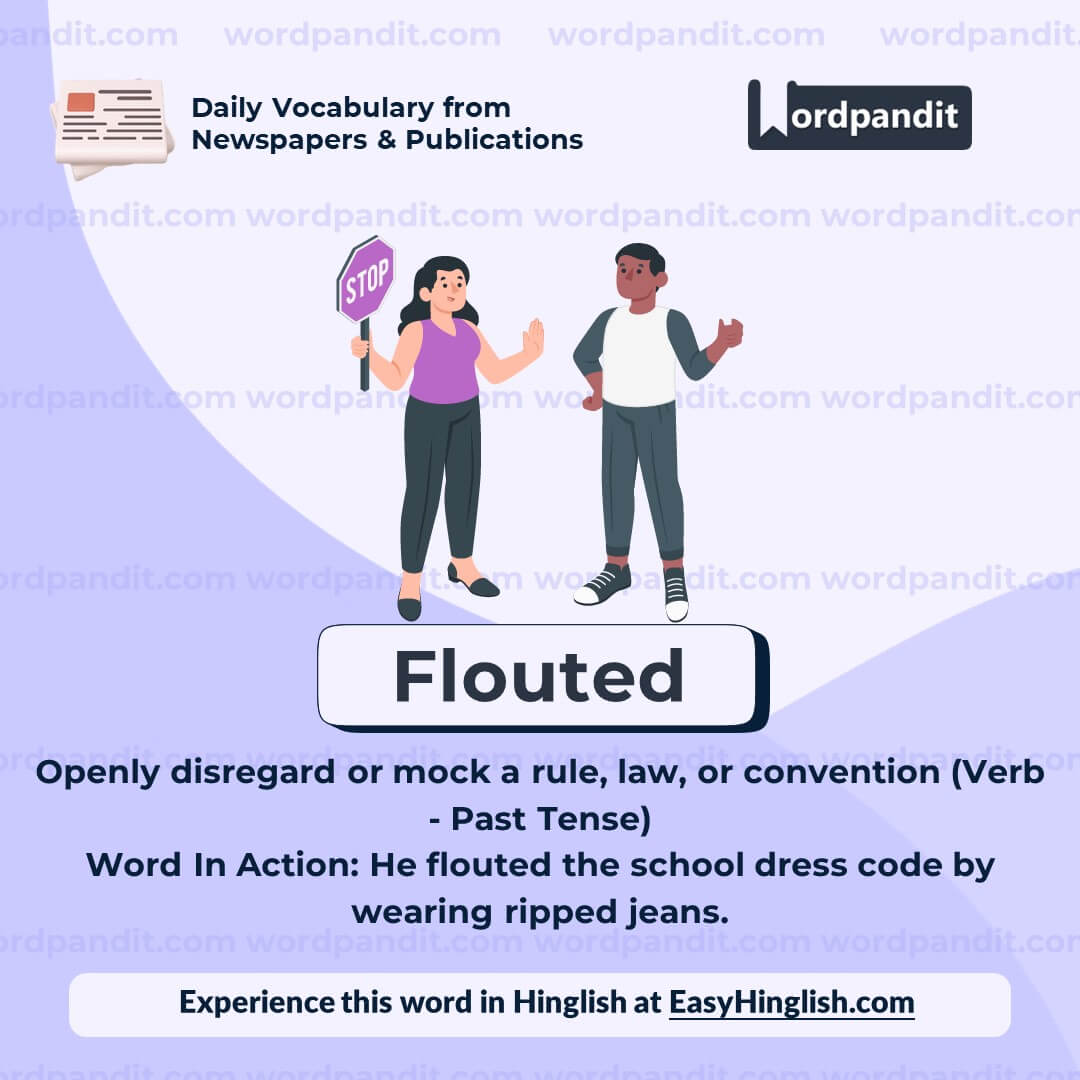
WORD-4: Flouted
Context:
"We all know that many rules are often flouted by states to suit specific diplomatic exigencies." - The Wire
Explanatory Paragraph:
The word “flouted” means to openly disregard or show contempt for a rule, law, or convention. In this context, the sentence highlights how states, or governments, sometimes intentionally ignore established rules in order to address or prioritize immediate diplomatic needs. "Flouting" goes beyond passive neglect—it implies a bold or even defiant rejection of what is expected or required. It's an important word in political and legal discussions where ethical or procedural boundaries are deliberately crossed.
Meaning: To openly disregard or show contempt for (verb)
Pronunciation: flow-tid
Difficulty Level: ⭐⭐⭐ Intermediate
Etymology: From Middle English “flouten,” meaning to mock or scorn, possibly of Scandinavian origin.
Prashant Sir's Notes:
Don’t confuse “flouted” with “flaunted.” While “flouted” means to disrespect or ignore rules, “flaunted” means to show off. The key idea with “flouted” is defiance—intentionally breaking or ignoring something one is expected to follow. In legal and political vocabulary, it often indicates serious non-compliance.
Synonyms & Antonyms:
Synonyms: defied, disregarded, disobeyed, violated, mocked
Antonyms: obeyed, respected, complied with, followed, upheld
Usage Examples:
- The company flouted environmental regulations in pursuit of profit.
- He openly flouted the dress code, wearing jeans to the formal event.
- Some states flouted international norms during the conflict.
- Flouting the law can lead to serious consequences, even if it seems minor at first.
Cultural Reference:
Throughout history, authoritarian regimes have flouted international human rights conventions, often with little consequence. This has sparked global movements pushing for stronger enforcement mechanisms. - International Law & Human Rights Discourse
Think About It:
When, if ever, is it justifiable to flout rules or laws? Should context determine whether rule-breaking is acceptable?
Quick Activity:
Write two sentences: one using “flouted” correctly, and one using “flaunted.” Identify the difference in meaning between the two.
Memory Tip:
Flouted = Flipped-off the rules. Imagine someone boldly ignoring rules and flipping them off—that's “flouting.”
Real-World Application:
“Flouted” is commonly used in news reports and legal discussions to describe violations of laws, norms, or ethics—whether by governments, corporations, or individuals. Recognizing this word helps in critically reading media and understanding power dynamics in society.
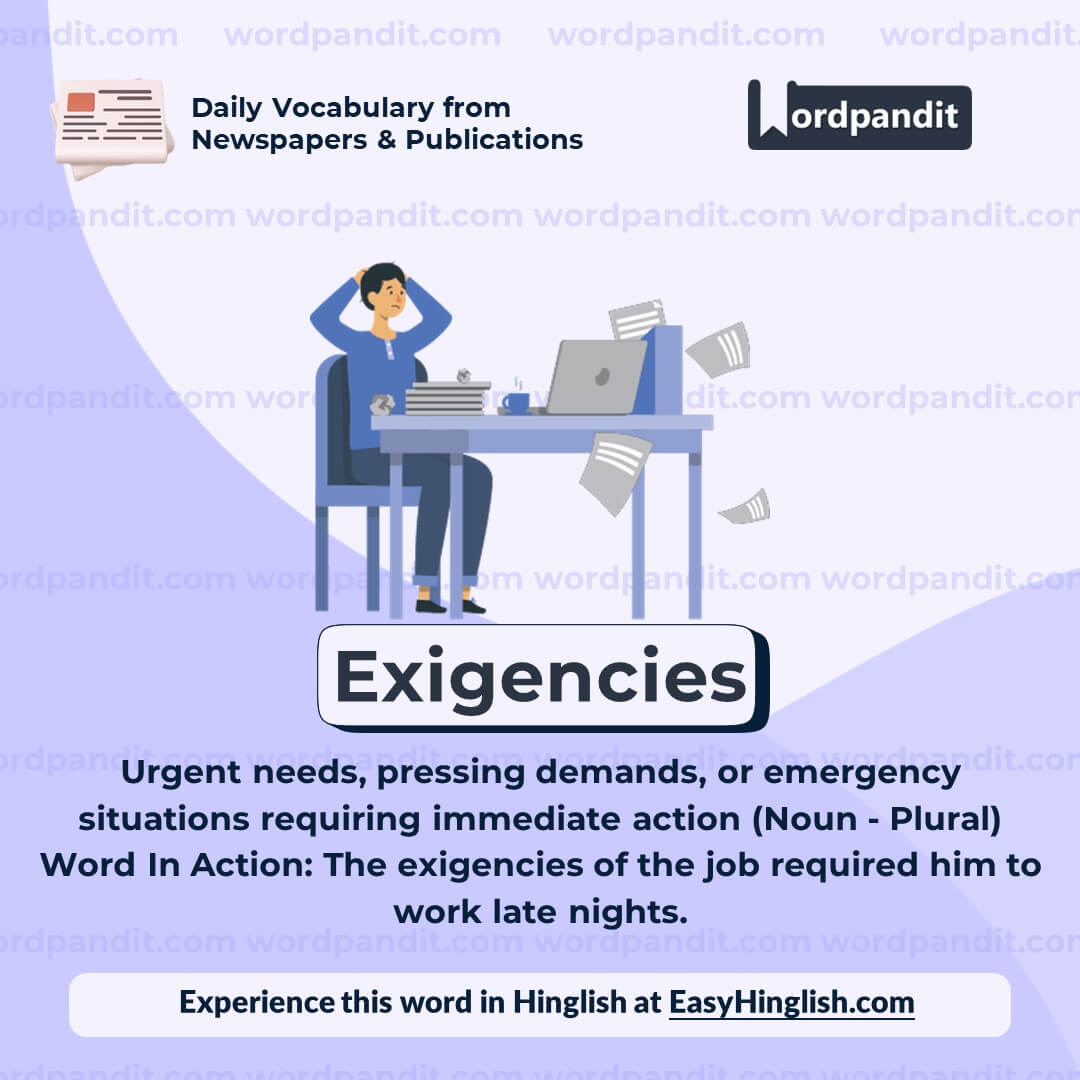
WORD-5: Exigencies
Context:
"We all know that many rules are often flouted by states to suit specific diplomatic exigencies." - The Wire
Explanatory Paragraph:
The word “exigencies” refers to urgent needs, demands, or situations that require immediate attention or action. In the given sentence, “diplomatic exigencies” suggests pressing or exceptional situations in diplomacy that compel states to override or ignore standard rules and procedures. The term often carries a sense of necessity under pressure, indicating that actions taken during exigencies may not reflect normal behavior but are shaped by the urgency of circumstances.
Meaning: Urgent needs or pressing demands, especially in challenging or emergency situations (noun, plural)
Pronunciation: ek-si-jen-seez
Difficulty Level: ⭐⭐⭐⭐ Advanced
Etymology: From Latin “exigere” meaning “to demand or enforce,” via French “exigence.”
Prashant Sir's Notes:
“Exigencies” often appears in formal or academic contexts, particularly in legal, diplomatic, or military language. It implies a situation where the normal rules or norms may be bent due to necessity. Always look for what is being justified—what’s the “urgent need” that’s being used as a reason to do something exceptional?
Synonyms & Antonyms:
Synonyms: emergencies, necessities, crises, urgencies, pressing needs
Antonyms: conveniences, luxuries, non-essentials, trivialities
Usage Examples:
- The budget was adjusted to meet the financial exigencies of the crisis.
- During war, governments often pass laws to address military exigencies.
- The manager cited scheduling exigencies as the reason for canceling the meeting.
- Exigencies of diplomacy often require states to act outside rigid protocols.
Cultural Reference:
In constitutional law, “exigencies of the state” is often used to justify emergency powers or temporary suspension of rights. This phrase has appeared in debates about national security measures, especially post-9/11. - Legal Discourse
Think About It:
Do exigencies justify breaking established rules? At what point does necessity become an excuse for abuse of power?
Quick Activity:
List two recent global or national events where exigencies were cited to justify unusual or extraordinary actions. Briefly describe whether you agree with those justifications.
Memory Tip:
Think of “exigencies” as “urgent exits”—when things go wrong, exigencies force you to take immediate and often drastic actions, like an emergency exit.
Real-World Application:
“Exigencies” is a key term in fields like governance, law, military strategy, and crisis management. Understanding it helps you interpret policy decisions, emergency actions, and crisis response more critically and accurately.


