

Daily Vocabulary from Indian Newspapers and Publications
Welcome to Wordpandit’s Indian Vocabulary Hub
At Wordpandit, we understand the importance of staying rooted in the local context while expanding your language skills. This section focuses on enriching your vocabulary with words and phrases drawn from India’s leading newspapers and publications, ensuring you're learning vocabulary that is practical, relevant, and uniquely Indian.
Why Indian Sources Matter
We believe that the best way to master any language is by immersing yourself in local content. That’s why we carefully curate vocabulary from top Indian publications, including:
- The Hindu
- The Times of India
- The Economic Times
- Hindustan Times
- Live Mint
- The Indian Express
- And many others...
Stay Updated, Stay Relevant
With daily updates from Indian news sources, you’ll be consistently learning words that reflect the trends and shifts in Indian society and culture. Our focus is to provide vocabulary that enhances your understanding of the language in an Indian context.
How Wordpandit Supports Your Goals
Whether you’re preparing for exams, aiming to improve your professional communication, or simply want to stay connected with the latest Indian vocabulary, Wordpandit is here to guide you every step of the way.
Learn with a Practical Approach
Our interactive learning methodology includes real-world examples, engaging activities, and context-specific usage to ensure that every word becomes part of your active vocabulary.
Dive into Indian Vocabulary Today!

Why Choose Wordpandit?
Practical Learning: Focus on words you'll actually encounter in real-world reading, enhancing your comprehension and communication skills.
Diverse Content: From current affairs to scientific breakthroughs, our varied sources expose you to vocabulary across multiple domains.
Effortless Integration: Make Wordpandit a part of your daily routine. Just a few minutes each day can significantly boost your lexicon over time.
Your Path to Vocabulary Mastery
- Visit our Daily Vocabulary section regularly
- Explore new words and their usage in context
- Practice incorporating these words into your own writing and speech
- Track your progress as your vocabulary expands
Start Your Journey Today
Embark on your vocabulary enhancement journey with Wordpandit. By consistently engaging with our daily posts, you'll build a robust vocabulary that serves you well in academic, professional, and personal contexts.
Remember, a word a day keeps linguistic limitations at bay. Make Wordpandit your daily companion in the quest for vocabulary excellence!
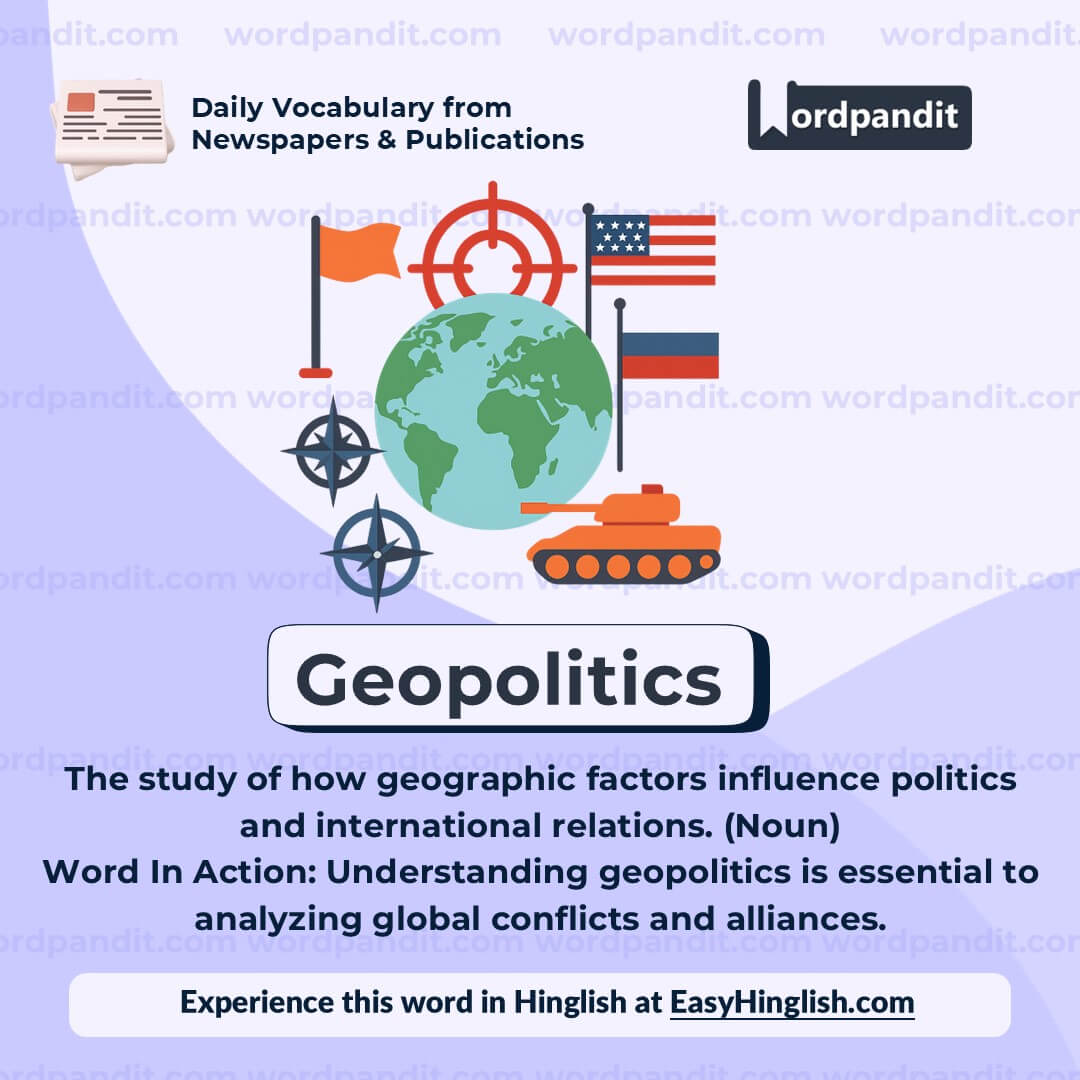
WORD-1: Geopolitics
Context:
"All geopolitics is regional. The growing redundancy of the United Nations and its affiliates is convincing countries that the future is going to be not globalism but regionalism and minilateralism. Even in the last century, despite tall claims, the real geopolitics revolved around groups and regions." - The Indian Express
Explanatory Paragraph:
Geopolitics refers to the study of how geography, resources, and location influence political power, international relations, and global strategies. It explains why certain countries or regions hold strategic importance, how alliances form, and why conflicts often emerge around borders, trade routes, or energy supplies. In simpler terms, geopolitics is about how geography shapes politics and global power plays.
Meaning: The influence of geography (location, resources, and physical environment) on politics and international relations (Noun)
Pronunciation: jee-oh-POH-li-tiks
Difficulty Level: ⭐⭐⭐⭐ Advanced
Etymology: From Greek "geo" meaning "earth" and French "politique" meaning "politics." The word emerged in the late 19th century to describe the strategic importance of geography in statecraft.
Prashant Sir's Notes:
Geopolitics is not just about international diplomacy but also about power, strategy, and control over resources. Understanding this word is essential for anyone following international relations, history, or current affairs. Think of it as the "chessboard" of global politics, where geography defines moves and strategies.
Synonyms & Antonyms:
Synonyms: international relations, global strategy, foreign affairs, world politics
Antonyms: local politics, domestic affairs
Usage Examples:
- The war in the region cannot be understood without analyzing the geopolitics of oil supply routes.
- India’s position in the Indian Ocean gives it a unique role in Asian geopolitics.
- Climate change is becoming a major factor in future geopolitics as nations fight over resources.
- The collapse of the Soviet Union reshaped the geopolitics of Europe and Central Asia.
Cultural Reference:
"Whoever controls the Heartland controls the World-Island; whoever controls the World-Island controls the world." – Halford Mackinder, a pioneer in geopolitical theory.
Think About It:
If geography plays such a dominant role in geopolitics, can technological advances like cyberspace and space exploration reduce its influence in the future?
Quick Activity:
Pick a current global conflict (e.g., Ukraine-Russia, South China Sea, or Middle East). Write down three ways geography influences the geopolitics of that conflict.
Memory Tip:
Break it down: "Geo" = Earth, "Politics" = Power and governance. Together: "Power struggles influenced by the Earth’s geography."
Real-World Application:
Geopolitics helps explain why countries form alliances, why trade routes are fiercely protected, and why global issues like energy, technology, and climate are tied to security and strategy. Journalists, policymakers, diplomats, and even business leaders use geopolitical understanding to make informed decisions.
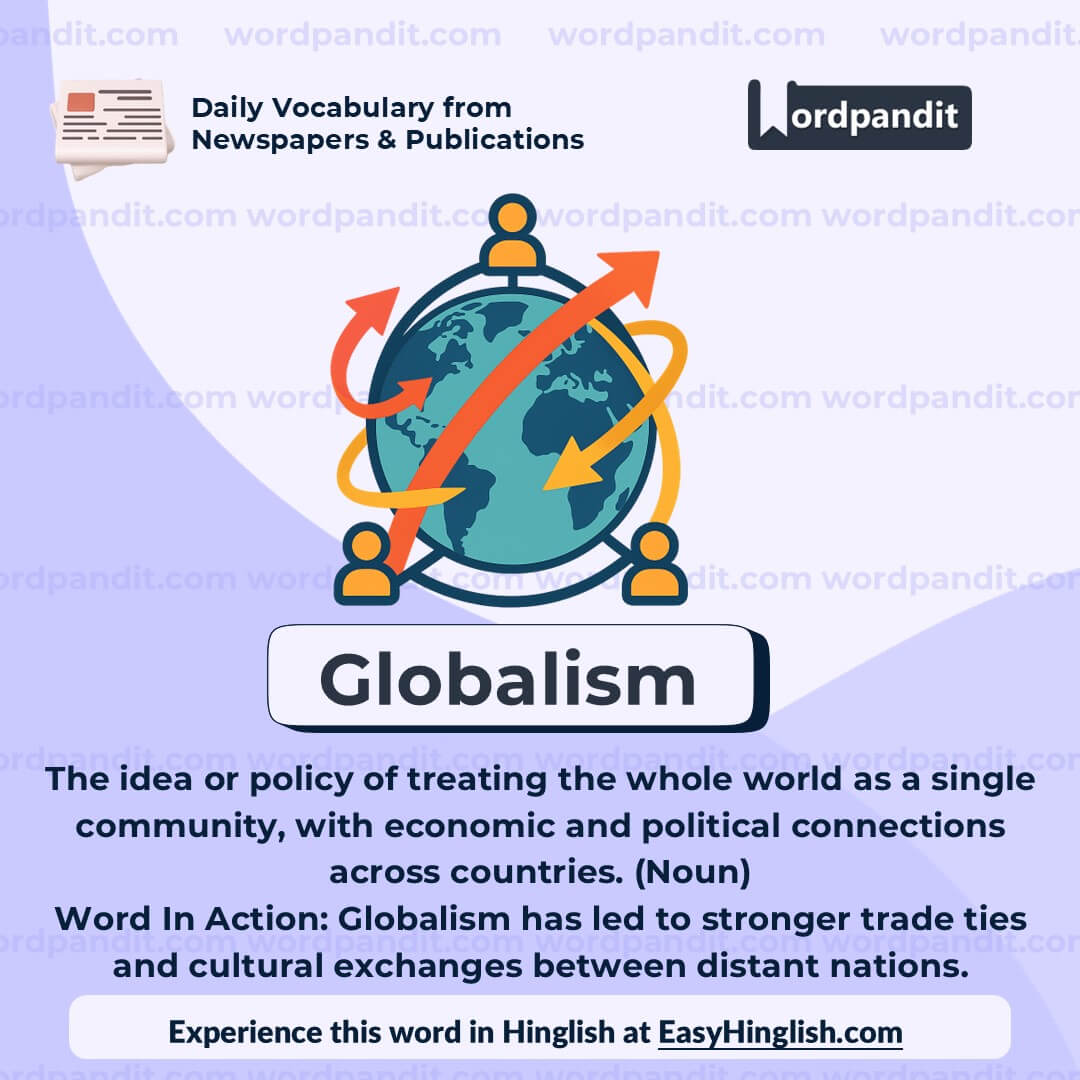
WORD-2: Globalism
Context:
"All geopolitics is regional. The growing redundancy of the United Nations and its affiliates is convincing countries that the future is going to be not globalism but regionalism and minilateralism. Even in the last century, despite tall claims, the real geopolitics revolved around groups and regions." - The Indian Express
Explanatory Paragraph:
Globalism refers to the idea that the world is interconnected and that nations should operate within a framework of international cooperation, shared markets, and collective decision-making. It emphasizes breaking down barriers between countries for trade, culture, governance, and problem-solving. In essence, globalism sees the world as a single community where challenges and opportunities are addressed together.
Meaning: The belief in or support for policies that treat the world as an interconnected whole, often favoring international cooperation and integration (Noun)
Pronunciation: GLOH-buh-liz-uhm
Difficulty Level: ⭐⭐⭐ Intermediate
Etymology: From "global" (worldwide) + suffix "-ism" (belief or system). The word became prominent in the mid-20th century, especially after World War II, as globalization and international institutions expanded.
Prashant Sir's Notes:
Globalism is not just about trade; it’s about seeing the world as a single unit where boundaries matter less. However, it is often debated because critics argue it can weaken national identity or local economies. Always connect this word to globalization, international cooperation, and worldwide interdependence.
Synonyms & Antonyms:
Synonyms: internationalism, worldwide integration, cosmopolitanism
Antonyms: nationalism, isolationism, protectionism, regionalism
Usage Examples:
- Globalism has encouraged companies to set up supply chains that span multiple continents.
- Some leaders oppose globalism, arguing it undermines local industries and traditions.
- Climate change is often cited as a problem that requires globalism to solve effectively.
- Supporters of globalism believe that shared values and cooperation reduce the risk of large-scale wars.
Cultural Reference:
Former UN Secretary-General Kofi Annan once remarked that “globalism is about shared responsibility,” reflecting the idea that the challenges of the 21st century—like poverty, climate change, and pandemics—require collective action.
Think About It:
Does globalism genuinely create fairness and shared prosperity, or does it mostly benefit powerful nations and corporations?
Quick Activity:
List three areas of your daily life (food, technology, education, etc.) that are influenced by globalism. For each, identify how international connections make an impact.
Memory Tip:
Think of “Globalism” as “One Globe, One System.” It’s about the world functioning as a connected network.
Real-World Application:
Globalism explains the rise of multinational corporations, the existence of global institutions like the UN and WTO, and the way information, goods, and ideas move across borders. It also shapes debates on immigration, trade wars, climate agreements, and technological cooperation.
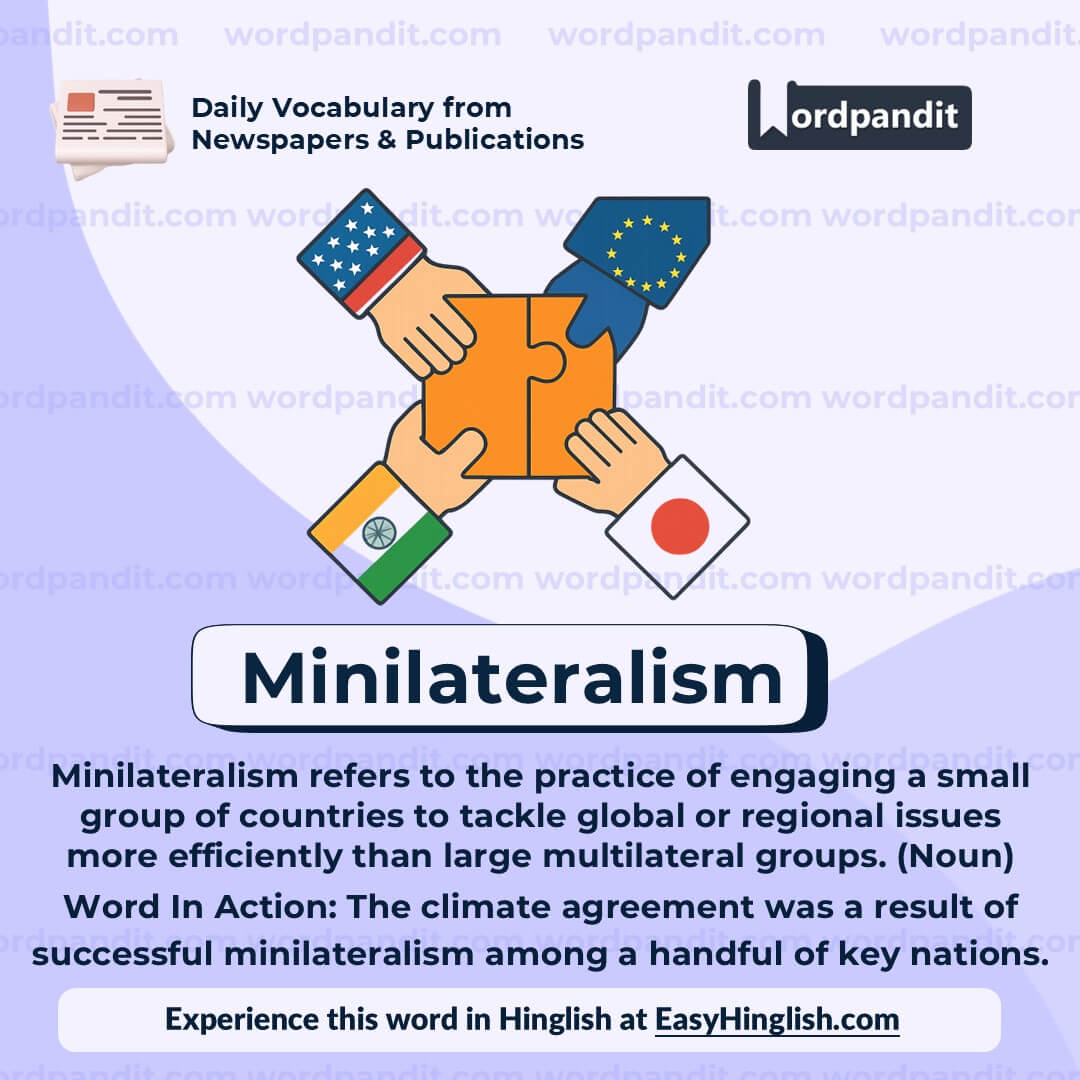
WORD-3: Minilateralism
Context:
"All geopolitics is regional. The growing redundancy of the United Nations and its affiliates is convincing countries that the future is going to be not globalism but regionalism and minilateralism. Even in the last century, despite tall claims, the real geopolitics revolved around groups and regions." - The Indian Express
Explanatory Paragraph:
Minilateralism is a diplomatic approach where a small number of countries, rather than the entire international community, come together to solve specific global or regional problems. Unlike multilateralism (involving many nations through organizations like the UN) or bilateralism (involving just two nations), minilateralism is about forming focused, flexible, and issue-specific coalitions. It is seen as more efficient and practical in today’s complex global environment where large international bodies often move too slowly.
Meaning: A form of international cooperation involving a small group of countries working together on specific issues (Noun)
Pronunciation: MIN-ih-lat-er-iz-uhm
Difficulty Level: ⭐⭐⭐⭐ Advanced
Etymology: Derived from "mini" (small) + "lateralism" (involving sides/parties in an agreement). The term gained prominence in the 21st century as an alternative to traditional large-scale diplomacy.
Prashant Sir's Notes:
Think of minilateralism as “small-group diplomacy.” It’s about efficiency—why wait for 190 countries in the UN to agree when 5–6 key players can make progress? India, for example, often participates in minilateral groups like QUAD (India, US, Japan, Australia) or trilaterals with France and Australia. Remember: fewer members, faster action.
Synonyms & Antonyms:
Synonyms: small-group diplomacy, limited coalition, targeted alliance
Antonyms: multilateralism, unilateralism, isolationism
Usage Examples:
- The QUAD is often cited as an example of minilateralism in the Indo-Pacific region.
- Minilateralism allows countries to bypass bureaucratic delays in larger organizations.
- Experts argue that minilateralism will shape the future of climate negotiations, where a handful of major emitters take the lead.
- While efficient, minilateralism sometimes excludes smaller nations from decision-making.
Cultural Reference:
Foreign policy scholar Moisés Naím once suggested that “the future of diplomacy may be minilateral,” highlighting the trend of nations solving problems in smaller, more agile groups rather than relying solely on global institutions.
Think About It:
Does minilateralism make diplomacy more effective, or does it risk sidelining smaller countries and creating power imbalances?
Quick Activity:
Identify one current global issue (climate change, cybersecurity, trade, or security). Suggest 3–5 countries that could form a minilateral group to tackle it effectively.
Memory Tip:
“Mini” = small, “lateralism” = groups of countries working together. So, minilateralism = small groups of countries cooperating.
Real-World Application:
Minilateralism is shaping modern geopolitics—whether in security (QUAD in Asia), climate change (major emitters’ summits), or trade (regional economic groupings). Businesses, policymakers, and diplomats increasingly watch these smaller, faster-moving alliances for real decisions that affect global affairs.
WORD-4: Unedifying
Context:
"Many States have seen the unedifying sight of mass defections to the ruling party just after elections, making a mockery of the democratic exercise." - The Hindu
Explanatory Paragraph:
Unedifying describes something unpleasant, disgraceful, or lacking in moral or intellectual value. Instead of inspiring respect, admiration, or learning, an unedifying event or sight is disappointing and sometimes even shameful. For example, political defections, public quarrels, or unethical behavior can all be described as unedifying because they lower the dignity of the situation.
Meaning: Unpleasant, shameful, or lacking in moral or intellectual value; not uplifting (Adjective)
Pronunciation: un-ED-uh-fy-ing
Difficulty Level: ⭐⭐⭐ Intermediate
Etymology: From "edify" (to instruct or uplift morally or intellectually) with the negative prefix "un-" making it the opposite—something that does not uplift or inspire.
Prashant Sir's Notes:
Think of “unedifying” as the opposite of “inspiring” or “worth learning from.” If a teacher’s lecture is edifying, it teaches and uplifts; if politicians fight on live TV, that is unedifying. The word is often used in political and social contexts to highlight disgraceful or morally disappointing behavior.
Synonyms & Antonyms:
Synonyms: disgraceful, shameful, degrading, humiliating, ignoble
Antonyms: inspiring, uplifting, noble, admirable
Usage Examples:
- The debate quickly turned into an unedifying spectacle of personal insults.
- Spectators were disappointed by the unedifying behavior of the players during the match.
- The corruption scandal presented an unedifying picture of governance.
- Social media often showcases the unedifying side of public discourse.
Cultural Reference:
British newspapers often use the phrase “unedifying spectacle” to describe public quarrels among politicians, highlighting the contrast between expected dignity and actual disappointing behavior.
Think About It:
Why do we often find unedifying events—like scandals or fights—more widely reported and consumed in the media than edifying, uplifting events?
Quick Activity:
Write two short sentences: one describing an “edifying” event (inspiring), and one describing an “unedifying” event (disgraceful). Compare the tone of both.
Memory Tip:
“Edify” means “to educate or uplift.” Adding “un-” makes it the opposite: something that does not uplift, but instead disappoints or disgraces.
Real-World Application:
The word “unedifying” is commonly used in news reports, political commentary, and critical writing to describe disgraceful behavior. It helps articulate disapproval without using overly harsh words, making it a subtle but powerful tool in formal expression.

WORD-5: Mockery
Context:
"Many States have seen the unedifying sight of mass defections to the ruling party just after elections, making a mockery of the democratic exercise." - The Hindu
Explanatory Paragraph:
Mockery refers to ridicule, scorn, or a situation that makes something appear foolish or meaningless. When we say something is "a mockery," it means it has been reduced to a joke, stripped of seriousness, or made worthless. For example, if a fair election is corrupted, it becomes a "mockery of democracy." The word can apply both to spoken ridicule and to actions that degrade the value of something important.
Meaning: Teasing, ridicule, or making something appear foolish or worthless (Noun)
Pronunciation: MOK-uh-ree
Difficulty Level: ⭐⭐ Basic
Etymology: From Middle English "mokerye," based on "mock" (to ridicule), which traces further back to Old French "moquer" (to deride).
Prashant Sir's Notes:
Remember that “mockery” has two uses: one is active ridicule (making fun of someone), and the other is a situation where something serious loses its value. The phrase “make a mockery of” is very common in newspapers, especially in political and social commentary.
Synonyms & Antonyms:
Synonyms: ridicule, derision, scorn, farce, parody
Antonyms: respect, seriousness, honor, admiration
Usage Examples:
- The comedian’s mockery of politicians drew both laughter and criticism.
- Cheating in exams makes a mockery of the education system.
- The referee’s biased decisions turned the game into a mockery of fair play.
- She couldn’t stand the constant mockery from her classmates.
Cultural Reference:
In George Orwell’s novel Animal Farm, the animals’ attempt at equality becomes a mockery of justice when the pigs take absolute control, showing how ideals can be corrupted.
Think About It:
Why do people often use mockery as a weapon in arguments or debates instead of logical reasoning?
Quick Activity:
Complete this phrase with your own example: “_____ makes a mockery of _____.” (e.g., “Match-fixing makes a mockery of sports.”)
Memory Tip:
Think of “mock” (to make fun of) + “-ery” (the state of). So, “mockery” = the state of making fun or reducing value.
Real-World Application:
“Mockery” is often used in politics, journalism, and everyday speech to highlight when serious institutions, systems, or values are undermined. It’s also a strong word in debates to show that something is not only wrong but also demeaning.


