

Daily Vocabulary from Indian Newspapers and Publications
Welcome to Wordpandit’s Indian Vocabulary Hub
At Wordpandit, we understand the importance of staying rooted in the local context while expanding your language skills. This section focuses on enriching your vocabulary with words and phrases drawn from India’s leading newspapers and publications, ensuring you're learning vocabulary that is practical, relevant, and uniquely Indian.
Why Indian Sources Matter
We believe that the best way to master any language is by immersing yourself in local content. That’s why we carefully curate vocabulary from top Indian publications, including:
- The Hindu
- The Times of India
- The Economic Times
- Hindustan Times
- Live Mint
- The Indian Express
- And many others...
Stay Updated, Stay Relevant
With daily updates from Indian news sources, you’ll be consistently learning words that reflect the trends and shifts in Indian society and culture. Our focus is to provide vocabulary that enhances your understanding of the language in an Indian context.
How Wordpandit Supports Your Goals
Whether you’re preparing for exams, aiming to improve your professional communication, or simply want to stay connected with the latest Indian vocabulary, Wordpandit is here to guide you every step of the way.
Learn with a Practical Approach
Our interactive learning methodology includes real-world examples, engaging activities, and context-specific usage to ensure that every word becomes part of your active vocabulary.
Dive into Indian Vocabulary Today!

Why Choose Wordpandit?
Practical Learning: Focus on words you'll actually encounter in real-world reading, enhancing your comprehension and communication skills.
Diverse Content: From current affairs to scientific breakthroughs, our varied sources expose you to vocabulary across multiple domains.
Effortless Integration: Make Wordpandit a part of your daily routine. Just a few minutes each day can significantly boost your lexicon over time.
Your Path to Vocabulary Mastery
- Visit our Daily Vocabulary section regularly
- Explore new words and their usage in context
- Practice incorporating these words into your own writing and speech
- Track your progress as your vocabulary expands
Start Your Journey Today
Embark on your vocabulary enhancement journey with Wordpandit. By consistently engaging with our daily posts, you'll build a robust vocabulary that serves you well in academic, professional, and personal contexts.
Remember, a word a day keeps linguistic limitations at bay. Make Wordpandit your daily companion in the quest for vocabulary excellence!
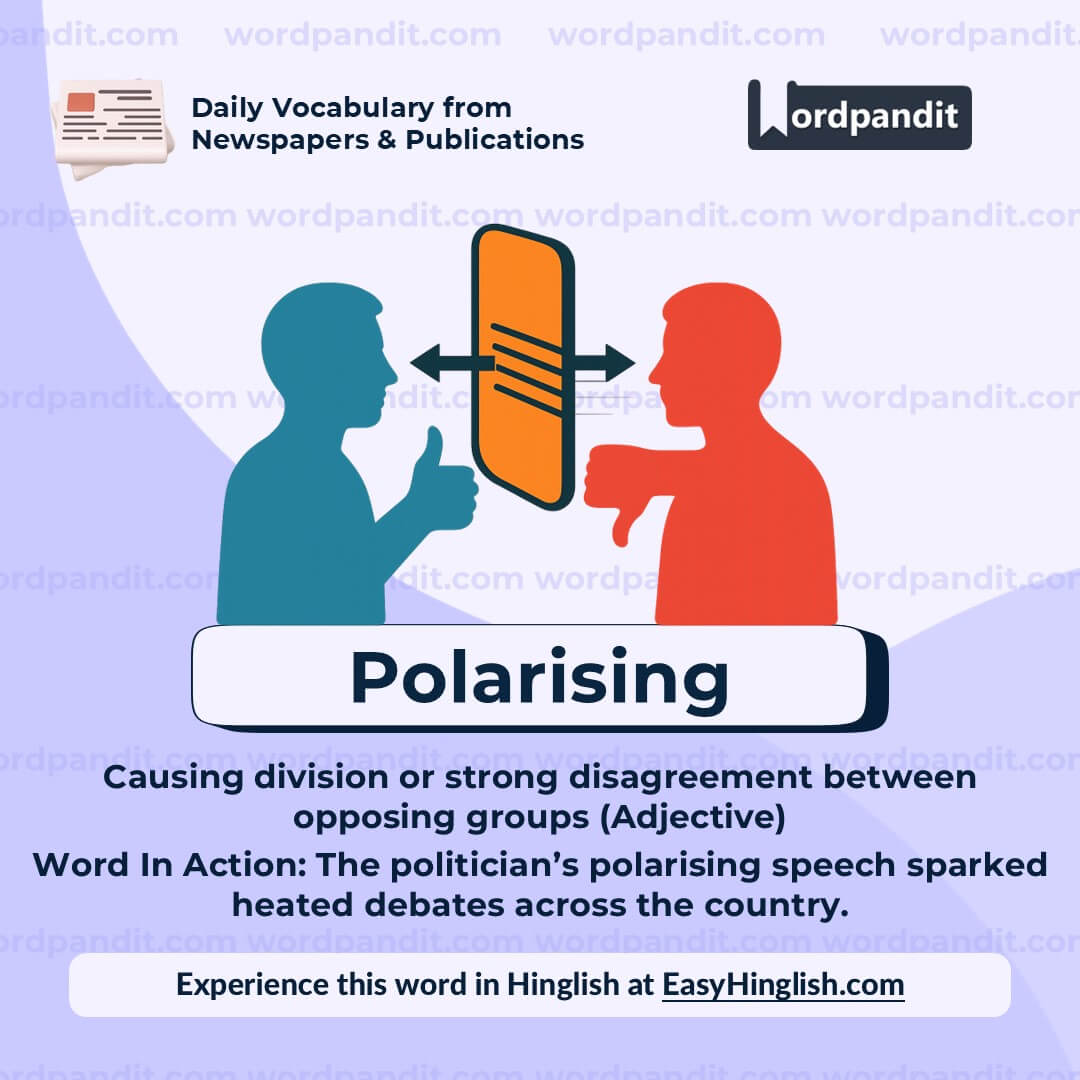
WORD-1: Polarising
Context:
"The spike in tensions with Iran coincides with a polarising Pakistan general election just weeks away." - Hindustan Times
Explanatory Paragraph:
The word "polarising" describes something that causes people to divide into opposing groups, often with strong feelings on each side. It is commonly used in political, social, and cultural contexts where opinions become sharply divided. When something is polarising, it doesn't leave much room for neutral ground — people usually fall on one side or the other.
Meaning: Causing division or strong disagreement between opposing groups (Adjective)
Pronunciation: POH-luh-ry-zing
Difficulty Level: ⭐⭐⭐ Intermediate
Etymology: From the root word "polarise" (British spelling of "polarize"), which comes from the French "polariser" and ultimately from Latin "polaris" meaning "of or relating to a pole".
Prashant Sir's Notes:
When you see "polarising," think about extreme differences in opinion. This is a great word to describe controversial leaders, topics, or policies that split people into strong for-or-against camps. Especially useful in political discussions or debates.
Synonyms & Antonyms:
Synonyms: divisive, controversial, contentious, inflammatory
Antonyms: unifying, agreeable, harmonious, conciliatory
Usage Examples:
- The leader's polarising comments sparked protests across the nation.
- Social media has become a polarising space during election seasons.
- His new policy proposals are seen as polarising by many analysts.
- The film was highly polarising — critics either loved it or hated it.
Cultural Reference:
"Kanye West has long been a polarising figure in pop culture, admired and criticized in equal measure." - Rolling Stone
Think About It:
Can polarising figures or ideas ever lead to positive change, or do they only deepen divisions?
Quick Activity:
List three polarising figures from global politics or media. For each, write one reason why people support them and one reason why they are criticized.
Memory Tip:
Think of “polarising” as creating two “poles” or sides — like the North and South Pole — with people pulled strongly in opposite directions.
Real-World Application:
"Polarising" is often used in journalism and political discourse to describe elections, leaders, or events that sharply divide public opinion — helpful when analyzing media reports or writing opinion pieces.
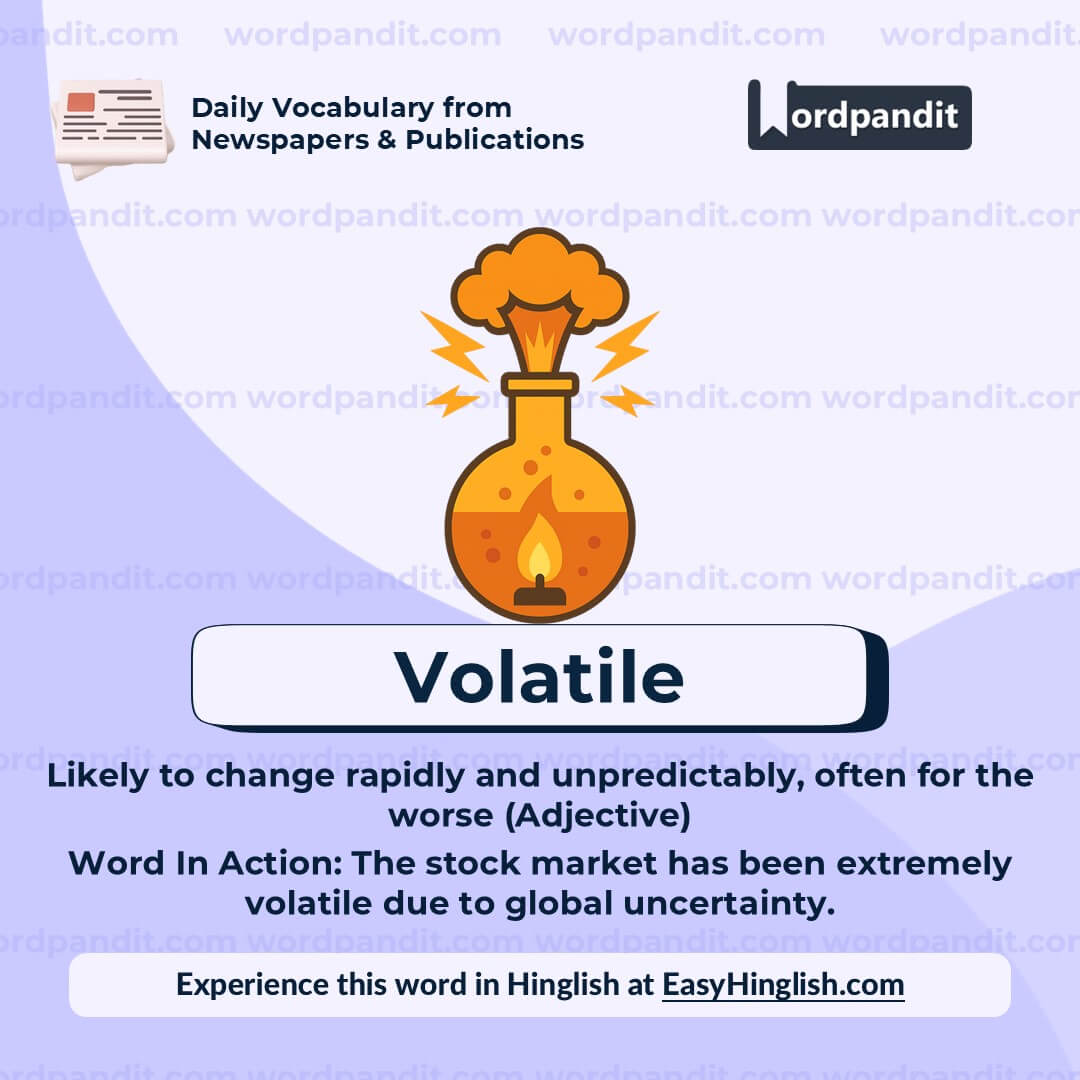
WORD-2: Volatile
Context:
"The situation is volatile also because of the wider West Asia factor." - Hindustan Times
Explanatory Paragraph:
The word "volatile" refers to something that is unstable, unpredictable, and likely to change suddenly — often in a dangerous or extreme way. It is used in contexts like politics, markets, emotions, or even chemical substances. When a situation or person is volatile, there’s a risk of sudden change, escalation, or even explosion — figuratively or literally.
Meaning: Likely to change rapidly and unpredictably, often for the worse (Adjective)
Pronunciation: VAW-luh-tyl
Difficulty Level: ⭐⭐⭐ Intermediate
Etymology: From Latin "volatilis" meaning "flying, fleeting," from "volare" meaning "to fly." Originally used to describe substances that evaporate quickly.
Prashant Sir's Notes:
"Volatile" is a highly useful word in both economics and geopolitics. Use it when describing situations that can suddenly shift — like stock markets, international tensions, or even someone’s mood. A must-have for descriptive writing.
Synonyms & Antonyms:
Synonyms: unstable, unpredictable, explosive, erratic
Antonyms: stable, steady, predictable, consistent
Usage Examples:
- The political climate remains volatile ahead of the upcoming elections.
- Investors are wary of putting money into such a volatile stock market.
- Her volatile temper made it difficult to work with her for long.
- The region has a history of volatile conflicts and sudden ceasefires.
Cultural Reference:
"The Middle East has long been considered one of the most volatile regions in the world due to its complex political dynamics." - Foreign Policy Magazine
Think About It:
Why do you think volatility often leads to fear or caution, and how can people prepare for volatile situations in life?
Quick Activity:
Write a sentence using "volatile" to describe a real-life situation (personal, economic, or political) you've heard about recently.
Memory Tip:
Think of "volatile" like a volcano — it looks calm, but can erupt suddenly. Both are unstable and dangerous when triggered!
Real-World Application:
"Volatile" is widely used in news reports, finance, international relations, and psychology to describe situations or behaviors that change rapidly and often dangerously. It helps convey urgency and instability in professional writing and analysis.

WORD-3: Unflinching
Context:
"The dazzle of AI has blinded the BJP government to the state of the bottom 20 per cent because it has the unflinching support of a steel frame called RSS." - Indian Express
Explanatory Paragraph:
"Unflinching" refers to someone’s firm, steady, and unwavering attitude, especially in the face of difficulty, fear, or opposition. A person or group that shows unflinching support or courage does not hesitate, back down, or show fear. It conveys strength, loyalty, and resolve — often seen in leaders, soldiers, activists, or devoted followers.
Meaning: Firm and not showing fear or hesitation, especially in difficult situations (Adjective)
Pronunciation: un-FLINCH-ing
Difficulty Level: ⭐⭐ Easy
Etymology: From the prefix "un-" (not) + "flinch" (to draw back or hesitate), originally from Old French "flenchir" meaning "to turn aside."
Prashant Sir's Notes:
“Unflinching” is a great word to use when describing someone’s strong support or courage. It's especially effective in speeches or essays to show admiration or inspire confidence. Pair it with words like “loyalty,” “resolve,” or “determination.”
Synonyms & Antonyms:
Synonyms: unwavering, steadfast, resolute, firm, determined
Antonyms: hesitant, wavering, fearful, timid, uncertain
Usage Examples:
- The soldier stood with unflinching courage in the face of enemy fire.
- She showed unflinching determination in her fight for justice.
- Despite criticism, the team maintained unflinching support for their leader.
- The journalist pursued the truth with unflinching honesty.
Cultural Reference:
"Malala Yousafzai is known for her unflinching advocacy of girls’ education, even after surviving a deadly attack." - BBC News
Think About It:
In what situations is unflinching support a strength, and when might it become blind loyalty?
Quick Activity:
Think of a person you admire. Write one sentence describing their unflinching quality — what do they stand for firmly and without fear?
Memory Tip:
Imagine someone not flinching — not even blinking — in the face of danger. That’s "unflinching" strength!
Real-World Application:
"Unflinching" is a powerful word to use in resumes, personal essays, and news writing to highlight courage, loyalty, or strong character. It adds a tone of admiration and strength to any description.
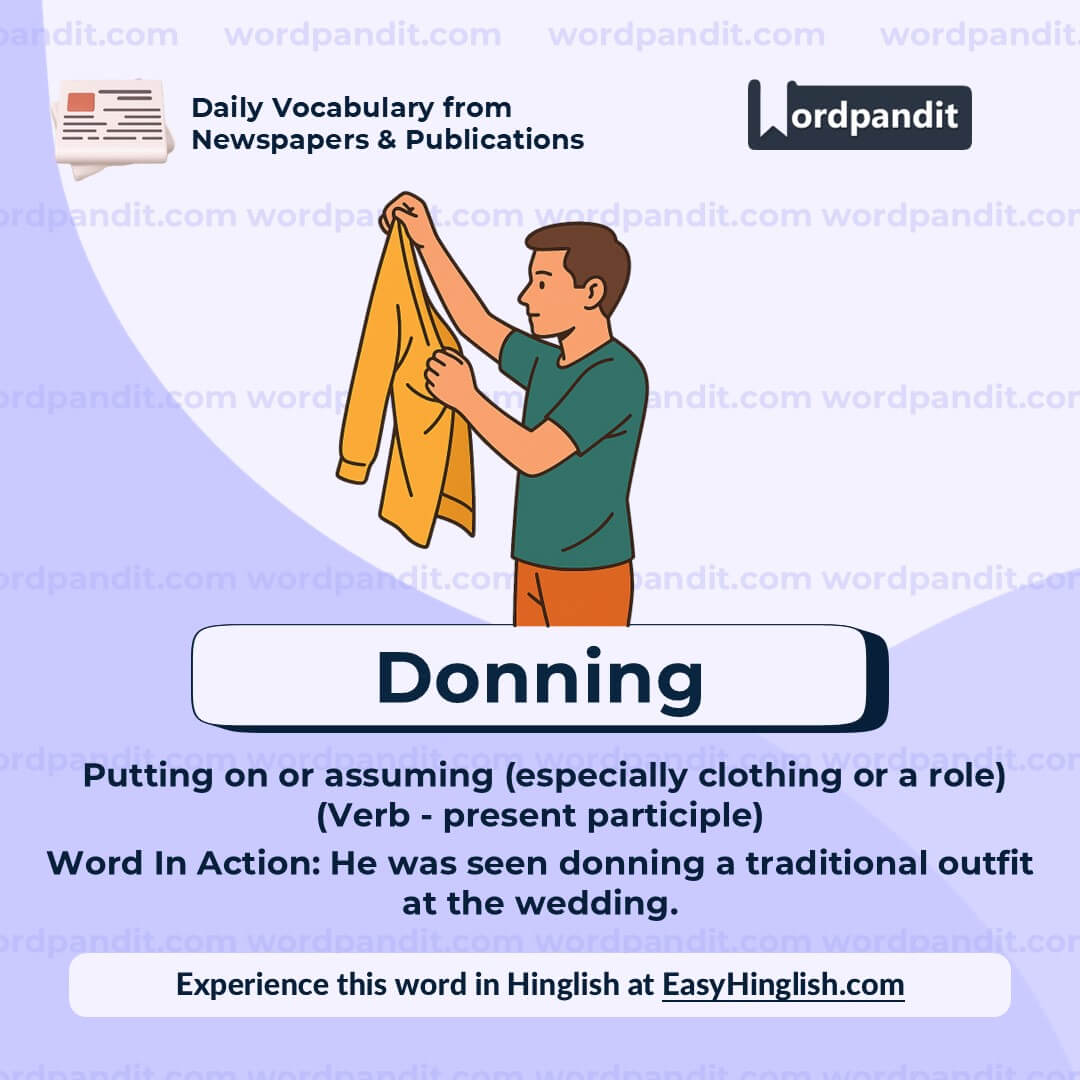
WORD-4: Donning
Context:
"Prime Minister Narendra Modi now donning the mantle of Hindu kingship, has the ability to get millions of people to play their parts for an audience of One, with all institutions, corporations, sects, civil society, media singing the same tune." - Indian Express
Explanatory Paragraph:
"Donning" means putting on or assuming something — most commonly clothing, but also roles, responsibilities, or symbolic identities. In a literal sense, one might don a jacket. In a figurative sense, someone might don a leadership role or an attitude. In the context given, it suggests Prime Minister Modi is taking on the symbolic role or image of Hindu kingship, emphasizing a deliberate adoption of a powerful persona.
Meaning: Putting on or assuming (especially clothing or a role) (Verb - present participle)
Pronunciation: DON-ning
Difficulty Level: ⭐⭐ Easy
Etymology: From Middle English "donnen," a contraction of "do on" (meaning “to put on”), first used in the 14th century.
Prashant Sir's Notes:
"Donning" is an elegant verb often used in literary and journalistic writing. It’s useful when you want to express the act of putting on clothing or symbolically adopting a role or identity. Remember: it can be both literal (donning a coat) and figurative (donning the role of a leader).
Synonyms & Antonyms:
Synonyms: putting on, wearing, assuming, adopting, dressing in
Antonyms: doffing, removing, shedding, discarding
Usage Examples:
- He was seen donning a traditional kurta at the cultural event.
- The actor donned the role of a freedom fighter with great intensity.
- She donned a confident smile before stepping onto the stage.
- Donning the uniform for the first time filled him with pride.
Cultural Reference:
"Batman is often depicted donning his cape and cowl just before heading into action, symbolizing his transformation from Bruce Wayne into the vigilante hero." - Comic Book Lore
Think About It:
What kinds of roles or identities do people 'don' in society — and how conscious are we of these changes?
Quick Activity:
List three roles you've 'donned' in your life (e.g., student, leader, sibling). Write one sentence about how each role made you feel.
Memory Tip:
Remember: "Don" = “Do On” — as in putting something *on* — whether it’s a coat or a character!
Real-World Application:
"Donning" is used frequently in journalism, literature, and even formal conversations to describe someone assuming a visible appearance or symbolic role — great for expressive writing or public speaking.
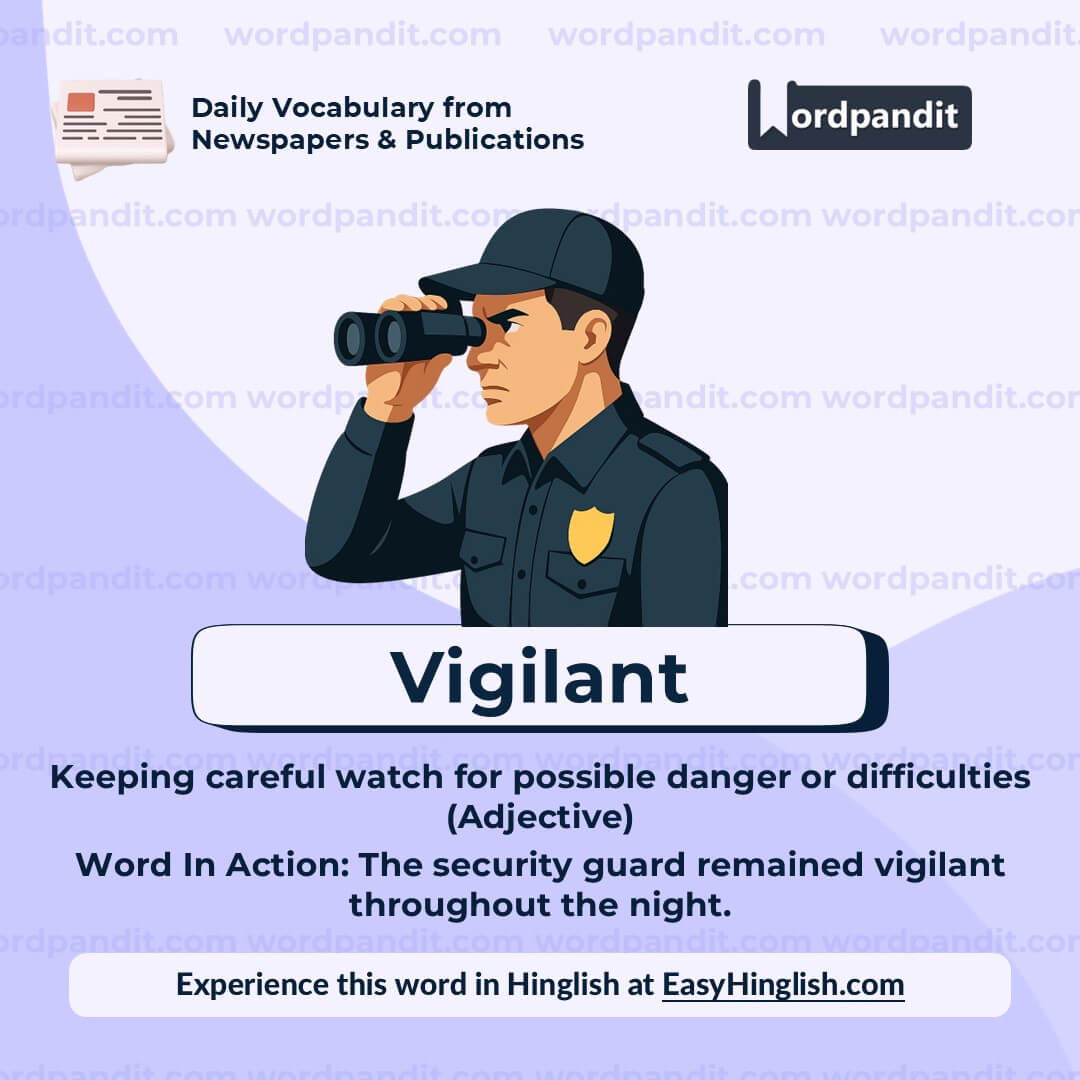
WORD-5: Vigilant
Context:
"The Opposition parties and the media may not be vigilant but the poor and middle classes — the 93 per cent — are watching and waiting." - Indian Express
Explanatory Paragraph:
"Vigilant" describes someone who is alert and watchful, especially in order to avoid danger or respond to problems. A vigilant person pays close attention to what’s happening around them and is quick to notice signs of trouble or change. This word is commonly used in contexts involving safety, politics, security, and social awareness. In the sentence provided, it highlights the attentiveness and awareness of common citizens, even when institutions fail to notice or act.
Meaning: Keeping careful watch for possible danger or difficulties (Adjective)
Pronunciation: VIJ-uh-luhnt
Difficulty Level: ⭐⭐ Easy
Etymology: From Latin "vigilantem," present participle of "vigilare" meaning "to watch, be awake."
Prashant Sir's Notes:
“Vigilant” is an excellent word to describe awareness and alertness, especially when someone is being cautious or responsible. Great to use when writing about citizens, leaders, guards, or even parents — anyone who keeps an eye on things that matter.
Synonyms & Antonyms:
Synonyms: watchful, alert, observant, attentive, cautious
Antonyms: careless, negligent, inattentive, oblivious
Usage Examples:
- Security guards must remain vigilant at all times.
- The watchdog group stayed vigilant in tracking government corruption.
- She was vigilant about her children's online activities.
- Drivers need to be especially vigilant during foggy weather.
Cultural Reference:
"Eternal vigilance is the price of liberty." – A quote often attributed to Thomas Jefferson, emphasizing the importance of staying alert to preserve freedom.
Think About It:
In a world full of distractions, what helps a person remain vigilant about the issues that truly matter?
Quick Activity:
Think of a recent situation where being vigilant helped you or someone else avoid a problem. Write one or two sentences describing what happened.
Memory Tip:
“Vigilant” sounds like “vigil” — think of someone staying up through the night, watching carefully. That’s what being vigilant is all about!
Real-World Application:
"Vigilant" is commonly used in security briefings, journalism, politics, and even health care. It’s valuable when describing someone who is responsible and paying close attention — an essential quality in leadership and citizenship.


