

Daily Vocabulary from Indian Newspapers and Publications
Welcome to Wordpandit’s Indian Vocabulary Hub
At Wordpandit, we understand the importance of staying rooted in the local context while expanding your language skills. This section focuses on enriching your vocabulary with words and phrases drawn from India’s leading newspapers and publications, ensuring you're learning vocabulary that is practical, relevant, and uniquely Indian.
Why Indian Sources Matter
We believe that the best way to master any language is by immersing yourself in local content. That’s why we carefully curate vocabulary from top Indian publications, including:
- The Hindu
- The Times of India
- The Economic Times
- Hindustan Times
- Live Mint
- The Indian Express
- And many others...
Stay Updated, Stay Relevant
With daily updates from Indian news sources, you’ll be consistently learning words that reflect the trends and shifts in Indian society and culture. Our focus is to provide vocabulary that enhances your understanding of the language in an Indian context.
How Wordpandit Supports Your Goals
Whether you’re preparing for exams, aiming to improve your professional communication, or simply want to stay connected with the latest Indian vocabulary, Wordpandit is here to guide you every step of the way.
Learn with a Practical Approach
Our interactive learning methodology includes real-world examples, engaging activities, and context-specific usage to ensure that every word becomes part of your active vocabulary.
Dive into Indian Vocabulary Today!

Why Choose Wordpandit?
Practical Learning: Focus on words you'll actually encounter in real-world reading, enhancing your comprehension and communication skills.
Diverse Content: From current affairs to scientific breakthroughs, our varied sources expose you to vocabulary across multiple domains.
Effortless Integration: Make Wordpandit a part of your daily routine. Just a few minutes each day can significantly boost your lexicon over time.
Your Path to Vocabulary Mastery
- Visit our Daily Vocabulary section regularly
- Explore new words and their usage in context
- Practice incorporating these words into your own writing and speech
- Track your progress as your vocabulary expands
Start Your Journey Today
Embark on your vocabulary enhancement journey with Wordpandit. By consistently engaging with our daily posts, you'll build a robust vocabulary that serves you well in academic, professional, and personal contexts.
Remember, a word a day keeps linguistic limitations at bay. Make Wordpandit your daily companion in the quest for vocabulary excellence!
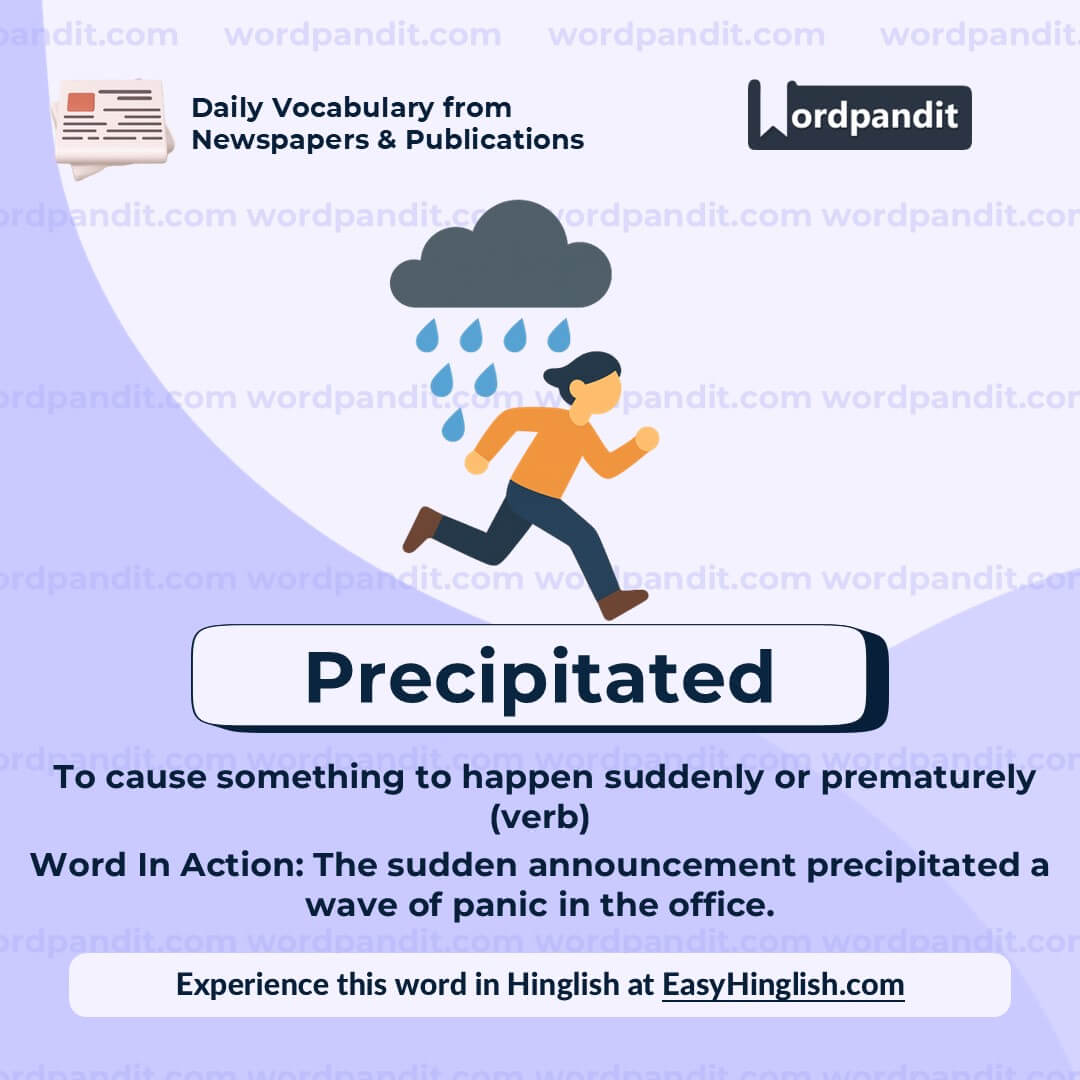
WORD-1: Precipitated
Context:
"(BJP) precipitated a crisis for Kumar via Chirag Paswan in the run-up to 2020 assembly elections." - Indian Express
Explanatory Paragraph:
To precipitate something means to cause it to happen suddenly or sooner than expected. In political or social contexts, it often refers to triggering a significant event, usually a crisis or conflict, through deliberate or unintended actions. In the sentence above, it implies that the BJP played a role in triggering or accelerating a political crisis for Kumar.
Meaning: To cause something to happen suddenly or prematurely (verb)
Pronunciation: pri-SIP-uh-tay-ted
Difficulty Level: ⭐⭐⭐ Intermediate
Etymology: From Latin "praecipitare" meaning "to throw headlong," from "praeceps" meaning "headlong."
Prashant Sir's Notes:
Focus on the idea of a trigger or sudden action. It often carries a negative or urgent connotation, like starting a crisis or worsening a situation quickly. Also note that this word can be used in scientific contexts (e.g., chemical reactions), so be aware of its versatility.
Synonyms & Antonyms:
Synonyms: trigger, provoke, hasten, instigate, accelerate
Antonyms: delay, hinder, prevent, stall, forestall
Usage Examples:
- The announcement of mass layoffs precipitated widespread panic among employees.
- His reckless comment precipitated a heated argument at the meeting.
- The collapse of the housing market precipitated a global financial crisis.
- Heavy rainfall precipitated landslides in the hilly regions.
Cultural Reference:
"The assassination of Archduke Franz Ferdinand in 1914 precipitated World War I, changing the course of history." - History Textbooks
Think About It:
Can you think of a moment in your life when a small decision precipitated a major change?
Quick Activity:
Write two sentences: one where something positive is precipitated, and another where something negative is precipitated. Compare how the word feels in each context.
Memory Tip:
Think of "precipitate" as "pressing the crisis button" — something happens fast and suddenly, just like pressing a button triggers an immediate reaction.
Real-World Application:
The word “precipitated” is widely used in political journalism, science (especially chemistry), and economics to describe cause-and-effect relationships where an event or action triggers another rapidly.
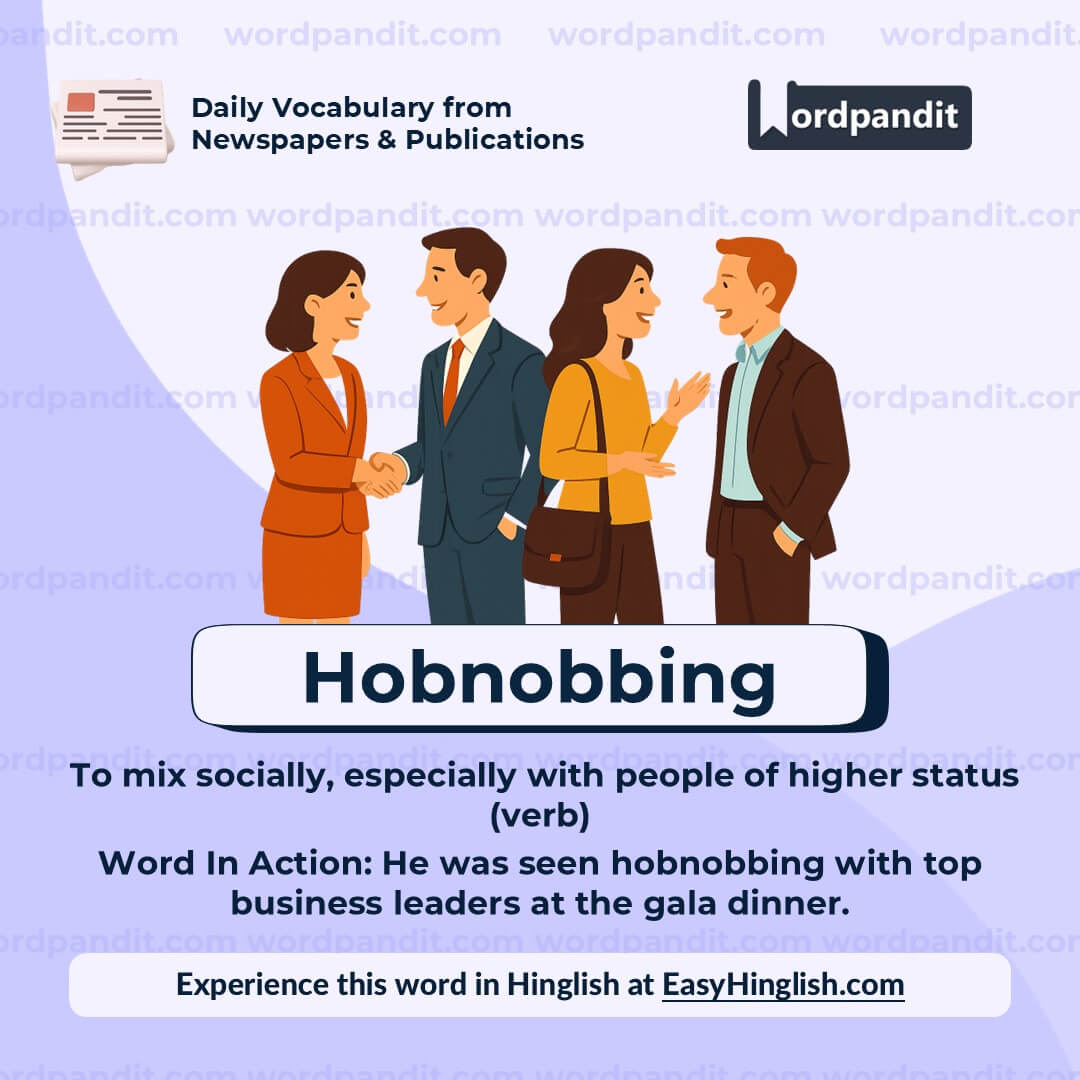
WORD-2: Hobnobbing
Context:
"There were rumours of his one-time lieutenant RCP Singh hobnobbing with the BJP." - Indian Express
Explanatory Paragraph:
“Hobnobbing” refers to spending time in a friendly or informal way with someone, often those in influential or powerful positions. It carries a slightly informal tone and may suggest socializing for mutual benefit, especially in political or elite circles. In the sentence above, the word implies that RCP Singh was casually or strategically socializing with BJP members, possibly to build political alliances or explore opportunities.
Meaning: To mix socially, especially with people of higher status (verb)
Pronunciation: HOB-nob-ing
Difficulty Level: ⭐⭐ Basic
Etymology: From the archaic phrase "hob and nob," meaning to drink together or share drinks, which later came to mean friendly socializing.
Prashant Sir's Notes:
This word is often used in political, elite, or celebrity contexts to suggest informal networking or backchannel discussions. It may carry a slightly negative or suspicious tone, especially in news or gossip contexts. Remember, it's always informal in usage.
Synonyms & Antonyms:
Synonyms: socialize, mingle, fraternize, consort, associate
Antonyms: avoid, shun, isolate, ignore, exclude
Usage Examples:
- The actor was seen hobnobbing with top political figures at the gala.
- Critics accused the minister of hobnobbing with corporate lobbyists.
- She enjoys hobnobbing with writers and artists at literary festivals.
- Journalists often hobnob at press clubs to share leads and gossip.
Cultural Reference:
"Hollywood parties are known for stars hobnobbing with producers, agents, and influencers in hopes of landing their next big project." - Entertainment Weekly
Think About It:
Is hobnobbing always harmless networking, or can it sometimes be a sign of opportunism?
Quick Activity:
Make a list of five professions where hobnobbing might be a strategic advantage. Then describe why in one sentence each.
Memory Tip:
Think of "hobnobbing" as “hobbits at a party” — small folks mingling with the powerful elves and wizards — everyone socializing informally!
Real-World Application:
Hobnobbing is common in business, politics, and entertainment, where informal connections often lead to opportunities. Understanding the nuance of this word helps interpret power dynamics in news, films, and everyday office politics.
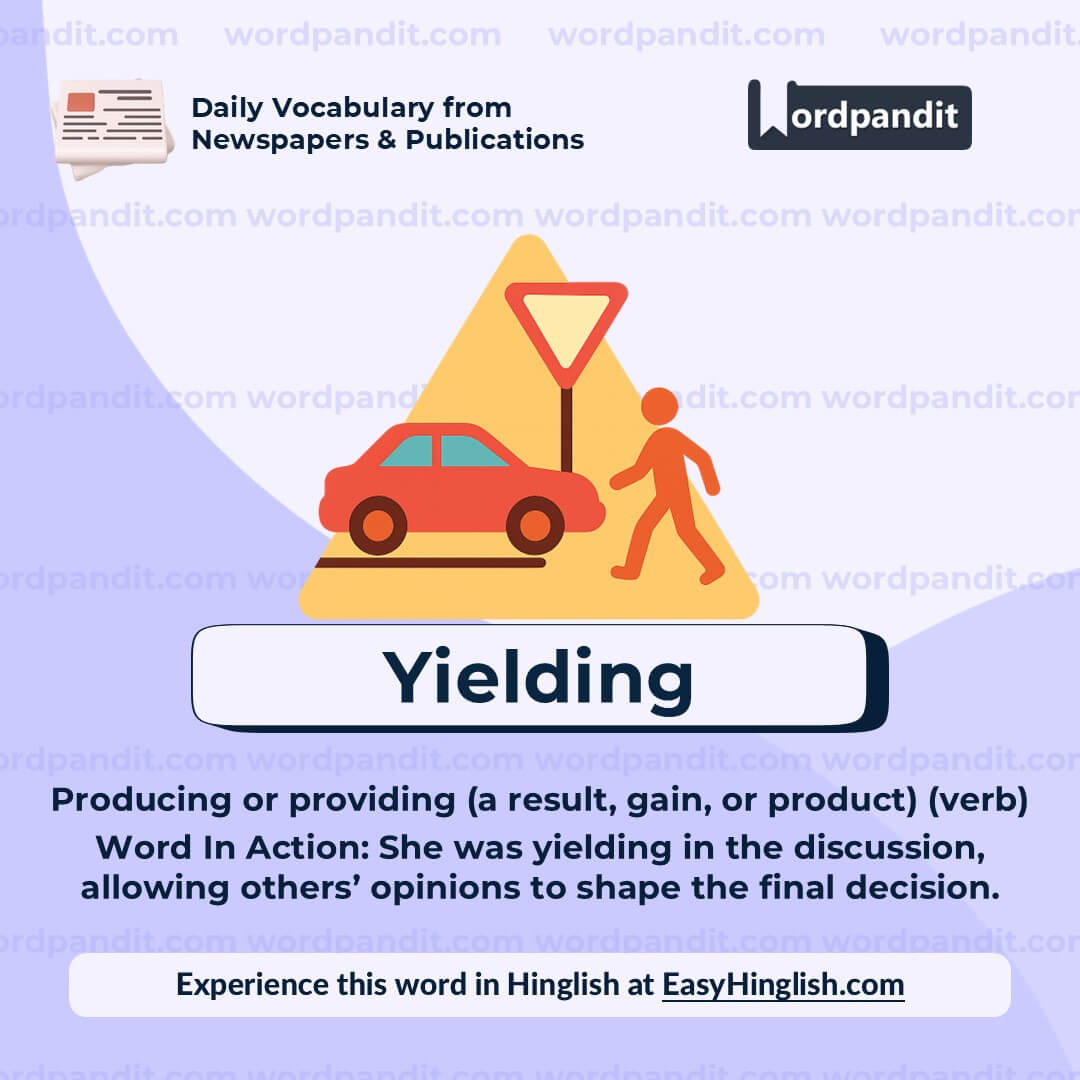
WORD-3: Yielding
Context:
"The chances of this platform yielding electoral benefits to the Congress was slim, it had not stopped the party from campaigning on this issue in the recent round of assembly elections in Madhya Pradesh, Rajasthan, and Chhattisgarh." - Indian Express
Explanatory Paragraph:
In this context, “yielding” means producing or providing something as a result. It is often used to talk about returns, results, or benefits from actions, investments, or efforts. Here, it refers to whether the Congress party’s political platform would generate or result in electoral gains. The use of the word implies a cause-and-effect relationship between the platform and the expected outcomes.
Meaning: Producing or providing (a result, gain, or product) (verb)
Pronunciation: YEEL-ding
Difficulty Level: ⭐⭐ Basic
Etymology: From Old English "gieldan," meaning "to pay, give, or reward"; later evolving into the sense of producing or resulting in something.
Prashant Sir's Notes:
“Yielding” is a very flexible word — it can refer to giving way (in traffic or argument), but in this context, it refers to producing results. This economic or strategic meaning of the word is important in politics, finance, and agriculture. Learn to read the context to get the correct meaning.
Synonyms & Antonyms:
Synonyms: producing, generating, delivering, providing, resulting in
Antonyms: withholding, preventing, failing, resisting, losing
Usage Examples:
- The new policy is yielding positive results in rural education.
- Investments in clean energy are finally yielding high returns.
- The experiment yielded unexpected data that changed the entire study.
- Despite years of effort, the project failed to yield the expected outcomes.
Cultural Reference:
"Hard work yields success" is a commonly repeated motivational phrase, emphasizing the cause-effect nature of persistent effort leading to reward.
Think About It:
Can every effort be expected to yield results, or is it sometimes more about the process than the outcome?
Quick Activity:
Think of three things you’ve done in the past month that yielded positive outcomes. Write a sentence describing the action and what it yielded.
Memory Tip:
Think of a field "yielding" crops — just like land gives harvest, actions yield results. Link it to farming for easier recall.
Real-World Application:
In economics, politics, science, and daily life, “yielding” helps describe the outcome of strategies, investments, or behavior. For example, analysts often discuss whether a policy is yielding tangible social or economic results.
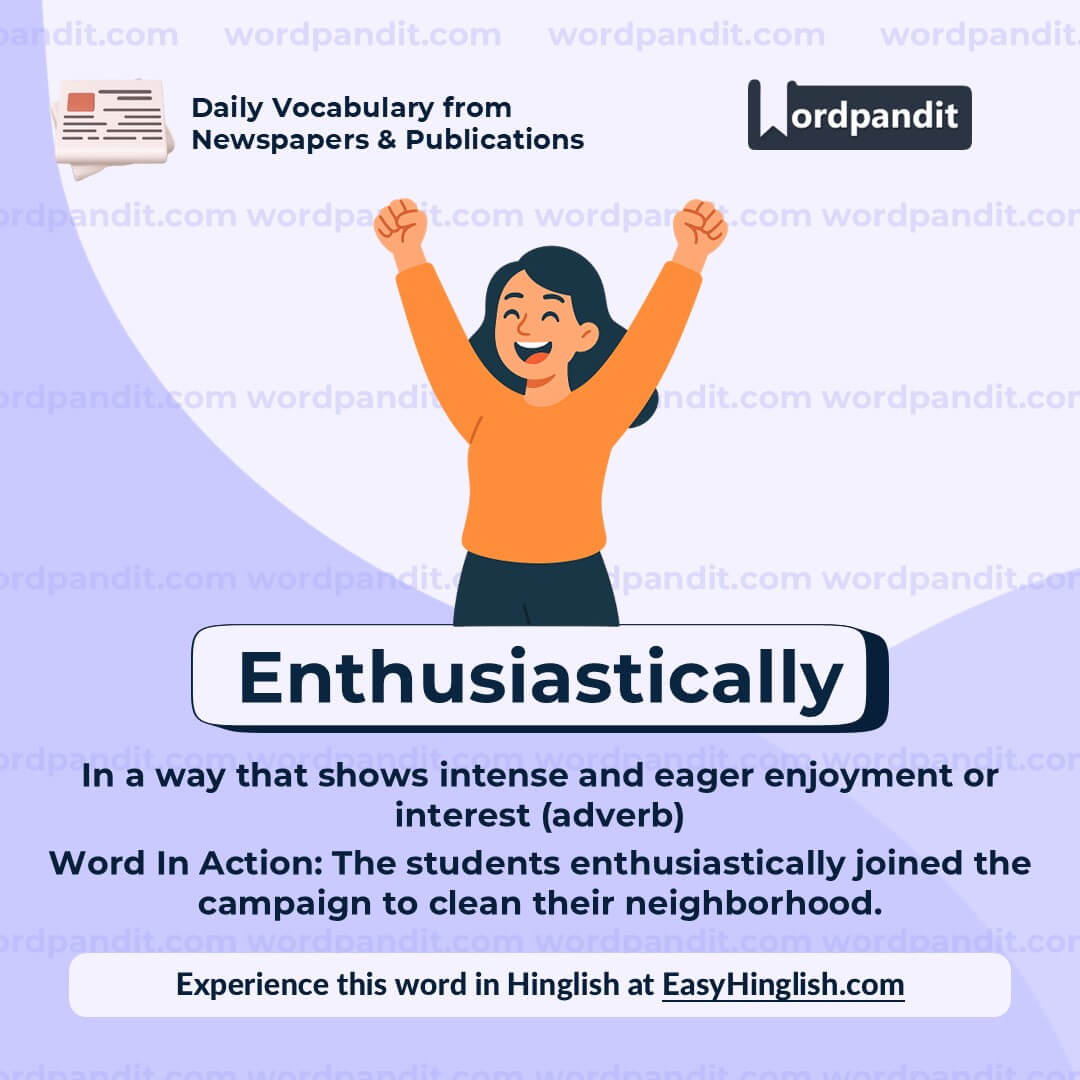
WORD-4: Enthusiastically
Context:
"Deepawali is one of the most enthusiastically celebrated festivals in the country." - Indian Express
Explanatory Paragraph:
“Enthusiastically” describes doing something with great excitement, energy, or eagerness. In the sentence above, it emphasizes the joyous and lively manner in which people celebrate Deepawali. The word adds emotional intensity, showing that people don’t just celebrate — they do so with full spirit and passion.
Meaning: In a way that shows intense and eager enjoyment or interest (adverb)
Pronunciation: en-THOO-zee-AS-ti-kuh-lee
Difficulty Level: ⭐ Basic
Etymology: From Greek “enthousiasmos,” meaning “possessed by a god” or inspired; passed into English through Latin and French, gaining the sense of passionate eagerness.
Prashant Sir's Notes:
This is a high-energy word — always linked with positive emotions. It often accompanies celebrations, achievements, and anything people are genuinely excited about. Remember its suffix “-ly” — it turns the adjective “enthusiastic” into an adverb of manner.
Synonyms & Antonyms:
Synonyms: eagerly, passionately, excitedly, exuberantly, energetically
Antonyms: reluctantly, disinterestedly, indifferently, apathetically, passively
Usage Examples:
- The students participated enthusiastically in the cultural program.
- She enthusiastically agreed to join the mountain expedition.
- Fans cheered enthusiastically as the team scored the winning goal.
- Volunteers enthusiastically supported the cleanup drive.
Cultural Reference:
“In Japan, people enthusiastically celebrate cherry blossom season by gathering under trees for picnics, music, and laughter.” - Travel Blogs
Think About It:
Can enthusiasm be cultivated, or is it something that naturally arises from within?
Quick Activity:
Write down three activities you do enthusiastically and three you do reluctantly. Reflect on what makes the difference in your attitude.
Memory Tip:
“Enthusiastically” has “enthusiasm” inside it — imagine someone saying “YES!” with sparkles in their eyes. That’s what the word feels like!
Real-World Application:
“Enthusiastically” is often used in resumes, speeches, media reports, and storytelling to show passion and energy. Whether it's describing how someone works or how a crowd reacts, this word adds emotional color to communication.
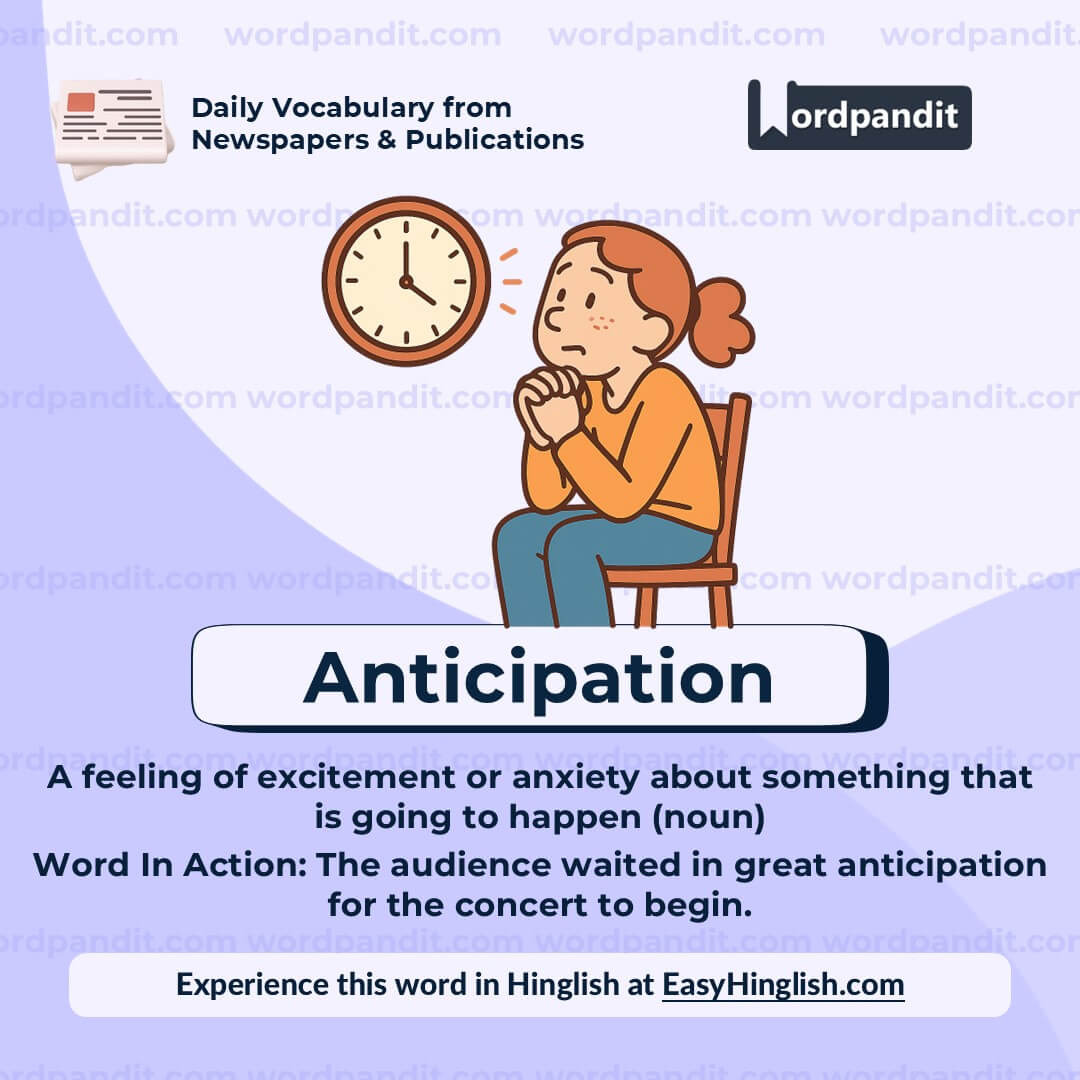
WORD-5: Anticipation
Context:
"The journey was a rollercoaster of emotions, with moments of anticipation that the ordeal would soon end followed by disappointment as tactic after tactic failed, until eventually, the mountain relented." - Indian Express
Explanatory Paragraph:
“Anticipation” refers to the feeling of looking forward to something that is expected to happen. It is a mix of hope, excitement, and sometimes anxiety about a future event. In the sentence above, the people involved in the ordeal felt hopeful and eager that their difficult journey would end soon, only to face setbacks. The word adds emotional weight by highlighting the contrast between hope and disappointment.
Meaning: A feeling of excitement or anxiety about something that is going to happen (noun)
Pronunciation: an-tis-uh-PAY-shun
Difficulty Level: ⭐⭐ Basic
Etymology: From Latin "anticipationem" meaning "preconception, foresight," from "anticipare" – to take care of ahead of time.
Prashant Sir's Notes:
This word is emotional and time-based. It always looks toward the future, whether with excitement, fear, or tension. Common collocations: “in anticipation of,” “filled with anticipation,” “nervous anticipation.” It’s a great word for both exams and storytelling.
Synonyms & Antonyms:
Synonyms: expectation, hope, suspense, excitement, eagerness
Antonyms: surprise, indifference, apathy, disinterest, disbelief
Usage Examples:
- She waited in eager anticipation for the concert to begin.
- The team trained hard in anticipation of the big match.
- There was a quiet anticipation in the room as the results were about to be announced.
- Anticipation turned into anxiety as the storm clouds gathered.
Cultural Reference:
"The final season of Game of Thrones was met with global anticipation, as fans speculated how the saga would end." - Entertainment Weekly
Think About It:
Is anticipation more powerful than the actual event? Can the hope or fear of something influence you more than the thing itself?
Quick Activity:
Write two sentences: one where anticipation is linked to a positive event (e.g., a birthday), and one where it’s linked to a negative event (e.g., an exam).
Memory Tip:
Break it down: “anti-” (before) + “cipation” (grasp/take) — so it means mentally grabbing something before it happens. Imagine standing at the edge of a diving board — that's anticipation!
Real-World Application:
Anticipation is used in marketing (e.g., teaser campaigns), in psychology (anticipatory anxiety), and in everyday expressions of emotion. Understanding the word helps in interpreting tone in news, literature, speeches, and even daily conversations.


