

Daily Vocabulary from Indian Newspapers and Publications
Welcome to Wordpandit’s Indian Vocabulary Hub
At Wordpandit, we understand the importance of staying rooted in the local context while expanding your language skills. This section focuses on enriching your vocabulary with words and phrases drawn from India’s leading newspapers and publications, ensuring you're learning vocabulary that is practical, relevant, and uniquely Indian.
Why Indian Sources Matter
We believe that the best way to master any language is by immersing yourself in local content. That’s why we carefully curate vocabulary from top Indian publications, including:
- The Hindu
- The Times of India
- The Economic Times
- Hindustan Times
- Live Mint
- The Indian Express
- And many others...
Stay Updated, Stay Relevant
With daily updates from Indian news sources, you’ll be consistently learning words that reflect the trends and shifts in Indian society and culture. Our focus is to provide vocabulary that enhances your understanding of the language in an Indian context.
How Wordpandit Supports Your Goals
Whether you’re preparing for exams, aiming to improve your professional communication, or simply want to stay connected with the latest Indian vocabulary, Wordpandit is here to guide you every step of the way.
Learn with a Practical Approach
Our interactive learning methodology includes real-world examples, engaging activities, and context-specific usage to ensure that every word becomes part of your active vocabulary.
Dive into Indian Vocabulary Today!

Why Choose Wordpandit?
Practical Learning: Focus on words you'll actually encounter in real-world reading, enhancing your comprehension and communication skills.
Diverse Content: From current affairs to scientific breakthroughs, our varied sources expose you to vocabulary across multiple domains.
Effortless Integration: Make Wordpandit a part of your daily routine. Just a few minutes each day can significantly boost your lexicon over time.
Your Path to Vocabulary Mastery
- Visit our Daily Vocabulary section regularly
- Explore new words and their usage in context
- Practice incorporating these words into your own writing and speech
- Track your progress as your vocabulary expands
Start Your Journey Today
Embark on your vocabulary enhancement journey with Wordpandit. By consistently engaging with our daily posts, you'll build a robust vocabulary that serves you well in academic, professional, and personal contexts.
Remember, a word a day keeps linguistic limitations at bay. Make Wordpandit your daily companion in the quest for vocabulary excellence!
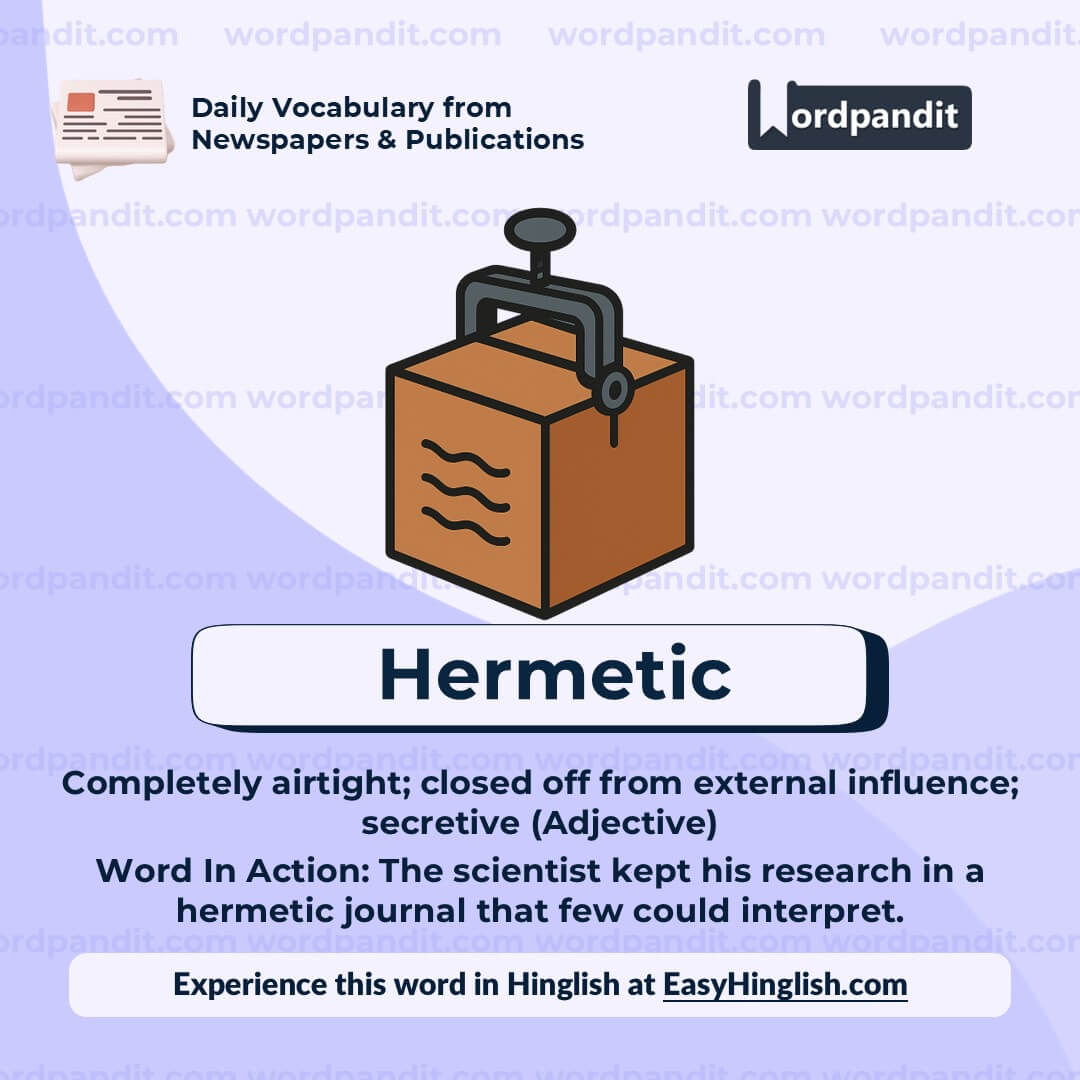
WORD-1: Hermetic
Context:
"North Korea is described as 'hermetic' because it has long kept itself isolated from the world." - Indian Express
Explanatory Paragraph:
The word "hermetic" originally referred to something sealed tightly so that no air could enter or escape. Over time, it has also come to mean being closed off, secretive, or isolated from outside influence. For example, a jar that is tightly sealed is hermetic, and so is a country or community that shuts itself away from the rest of the world.
Meaning: Completely airtight; closed off from external influence; secretive (Adjective)
Pronunciation: hur-MEH-tik
Difficulty Level: ⭐⭐⭐ Intermediate
Etymology: Derived from the name Hermes Trismegistus, a legendary figure in alchemy. The phrase "hermetically sealed" comes from the belief that alchemists could create airtight seals.
Prashant Sir's Notes:
Think of "hermetic" as tightly shut or cut off. Used for physical objects (airtight containers) and for abstract things (isolated societies, secretive groups). Connection with “hermetically sealed” makes it easier to remember.
Synonyms & Antonyms:
Synonyms: airtight, sealed, closed, isolated, secretive
Antonyms: open, accessible, transparent, exposed
Usage Examples:
- The documents were kept in a hermetic container to prevent damage from moisture.
- She lived in a hermetic world, cut off from the hustle of modern society.
- The ancient scrolls survived centuries because they were stored in a hermetically sealed jar.
- Critics say the organization is too hermetic and resists outside advice.
Cultural Reference:
"Hermetically sealed" is a common phrase in science and packaging industries, often seen on labels of food and medical products to indicate complete protection from air or contaminants.
Think About It:
Is it always harmful for a society or person to live in a hermetic way, or can isolation sometimes be beneficial?
Quick Activity:
Write two sentences using "hermetic" — one about a physical object (like a jar) and another about an abstract situation (like a lifestyle or policy).
Memory Tip:
Think of “hermetic” as “her-met-in” — everything is shut in tightly with no way out.
Real-World Application:
In real life, "hermetic" appears often in international relations (hermetic regimes like North Korea), in packaging (hermetically sealed food containers), and in philosophy to describe closed systems of thought.
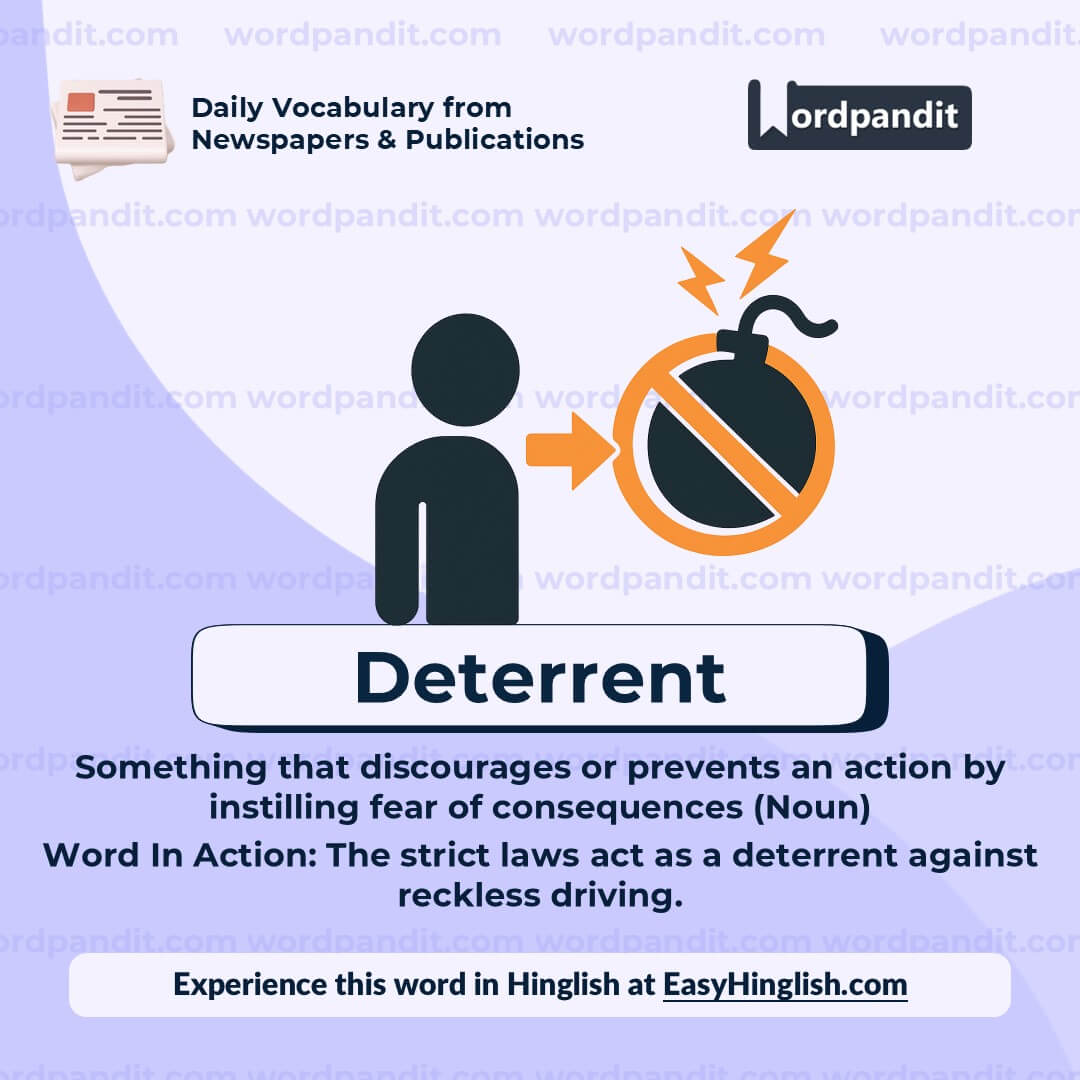
WORD-2: Deterrent
Context:
"It has developed and honed the Agni and Prithvi series of ballistic missiles, which form the delivery end of India’s nuclear deterrent." - Indian Express
Explanatory Paragraph:
A "deterrent" is something that discourages or prevents an action, often by creating fear of consequences. In military terms, a deterrent refers to weapons or systems designed to stop enemies from attacking by making the cost of aggression too high. In everyday life, it can be something like a fine, a warning sign, or even a locked gate — anything that prevents unwanted behavior.
Meaning: Something that discourages or prevents an action by instilling fear of consequences (Noun)
Pronunciation: dih-TUR-uhnt
Difficulty Level: ⭐⭐ Basic to Intermediate
Etymology: From Latin deterrere, meaning "to frighten from," composed of de- (away) + terrere (to frighten).
Prashant Sir's Notes:
A deterrent works by creating fear or hesitation. In global politics, nuclear deterrence prevents wars. In daily life, even a simple “beware of dog” sign works as a deterrent. Key idea: to discourage action before it happens.
Synonyms & Antonyms:
Synonyms: obstacle, hindrance, discouragement, preventive, restraint
Antonyms: incentive, encouragement, motivation, inducement
Usage Examples:
- High fines serve as a deterrent against breaking traffic rules.
- The security cameras act as a deterrent to potential thieves.
- Nuclear weapons are often justified as a deterrent rather than for actual use.
- The presence of a guard dog was enough of a deterrent to keep burglars away.
Cultural Reference:
The term "nuclear deterrent" became widely known during the Cold War, when both the U.S. and the Soviet Union relied on nuclear weapons not to fight, but to prevent the other side from attacking.
Think About It:
Do deterrents truly prevent negative actions, or do they only push people to find new ways to bypass them?
Quick Activity:
List three everyday deterrents you encounter (like traffic signals, warning labels, or security systems) and explain how each one prevents undesired behavior.
Memory Tip:
Think of “deter” as “do not enter” — a deterrent is something that stops you before you step forward.
Real-World Application:
Deterrents are central to law enforcement, international security, and everyday safety. From speeding fines to nuclear strategies, they shape decisions by making the risks outweigh the benefits.
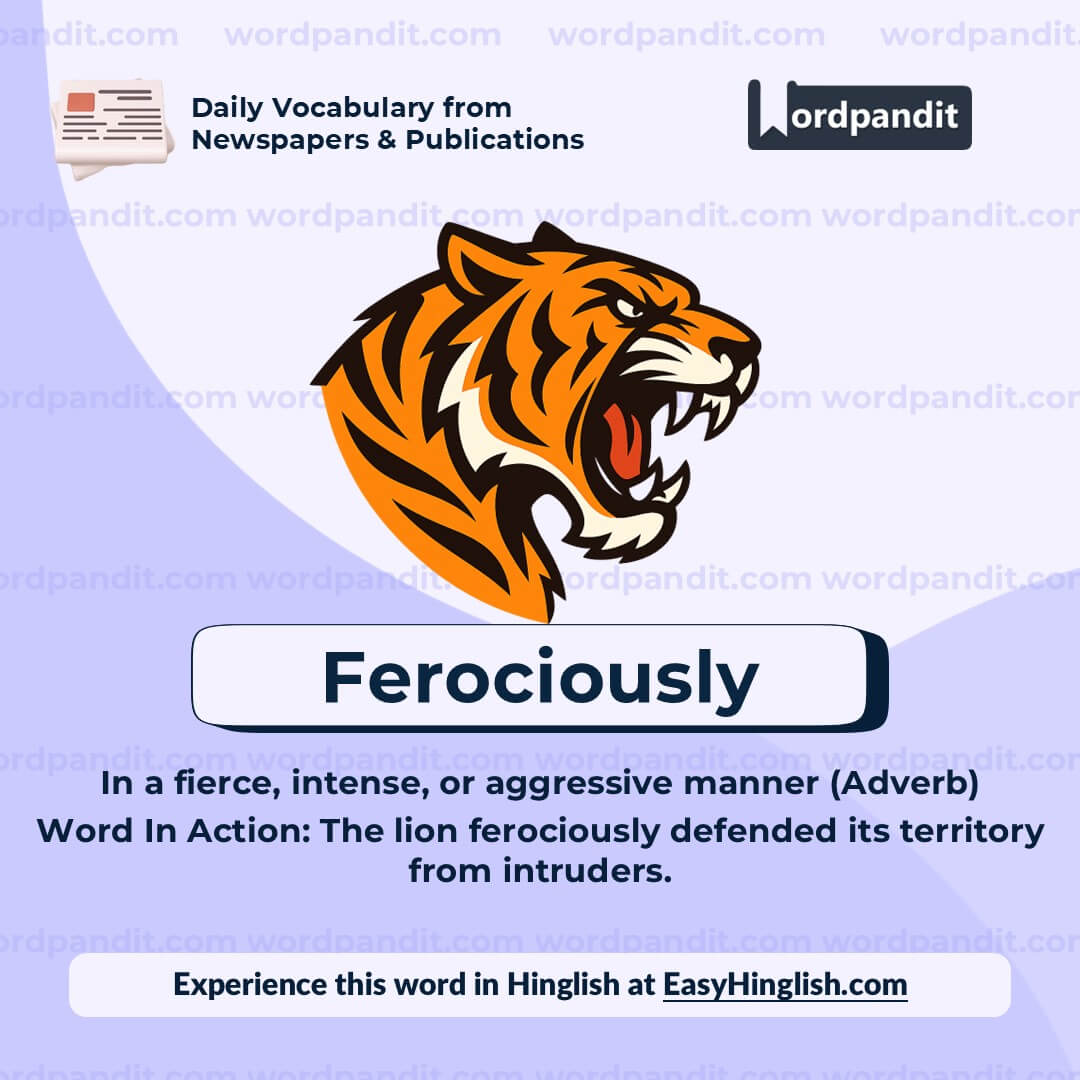
WORD-3: Ferociously
Context:
"There are always unpleasant consequences in expanding powers to police speech: partisans wield their powers to ferociously monitor what is or is not appropriate, instrumentalising agencies of the state to suppress art and political speech they do not like; citizens find themselves constantly looking over their shoulder before expressing themselves." - The Hindu
Explanatory Paragraph:
"Ferociously" describes doing something in an extremely intense, aggressive, or fierce manner. It comes from the word "ferocious," which usually refers to wild animals or violent behavior, but in everyday usage, it can also mean doing something with extreme energy, determination, or harshness. For example, someone can argue ferociously, work ferociously, or guard their privacy ferociously.
Meaning: In a fierce, intense, or aggressive manner (Adverb)
Pronunciation: fuh-ROH-shus-lee
Difficulty Level: ⭐⭐ Basic to Intermediate
Etymology: From Latin ferox (fierce, bold), which gave rise to Middle English ferocious. The adverb form "ferociously" developed later to describe the manner of action.
Prashant Sir's Notes:
Ferociously is not just about physical violence. It can mean doing anything with fierce passion, energy, or aggression. Think of it as the adverb form of "ferocious," applied to actions or attitudes.
Synonyms & Antonyms:
Synonyms: fiercely, violently, intensely, aggressively, savagely
Antonyms: gently, calmly, mildly, softly, peacefully
Usage Examples:
- The dog barked ferociously at the stranger approaching the gate.
- She worked ferociously to meet the tight deadline.
- The two leaders debated ferociously over economic policies.
- Fans cheered ferociously as their team scored the winning goal.
Cultural Reference:
In sports commentary, players are often described as "ferociously competitive," highlighting not violence but an unstoppable drive to win at any cost.
Think About It:
Is being ferocious in pursuing goals always a positive quality, or can it sometimes harm relationships and balance in life?
Quick Activity:
Write two sentences using "ferociously": one describing a physical action (like fighting or barking) and one describing a mental or emotional action (like working or arguing).
Memory Tip:
Think of “ferociously” as “fiercely + viciously” — combining both words gives the same sense of intensity and aggression.
Real-World Application:
"Ferociously" is often used in politics, journalism, and sports to describe actions carried out with great passion or hostility — such as ferociously defending freedom of speech, or ferociously attacking in a football match.
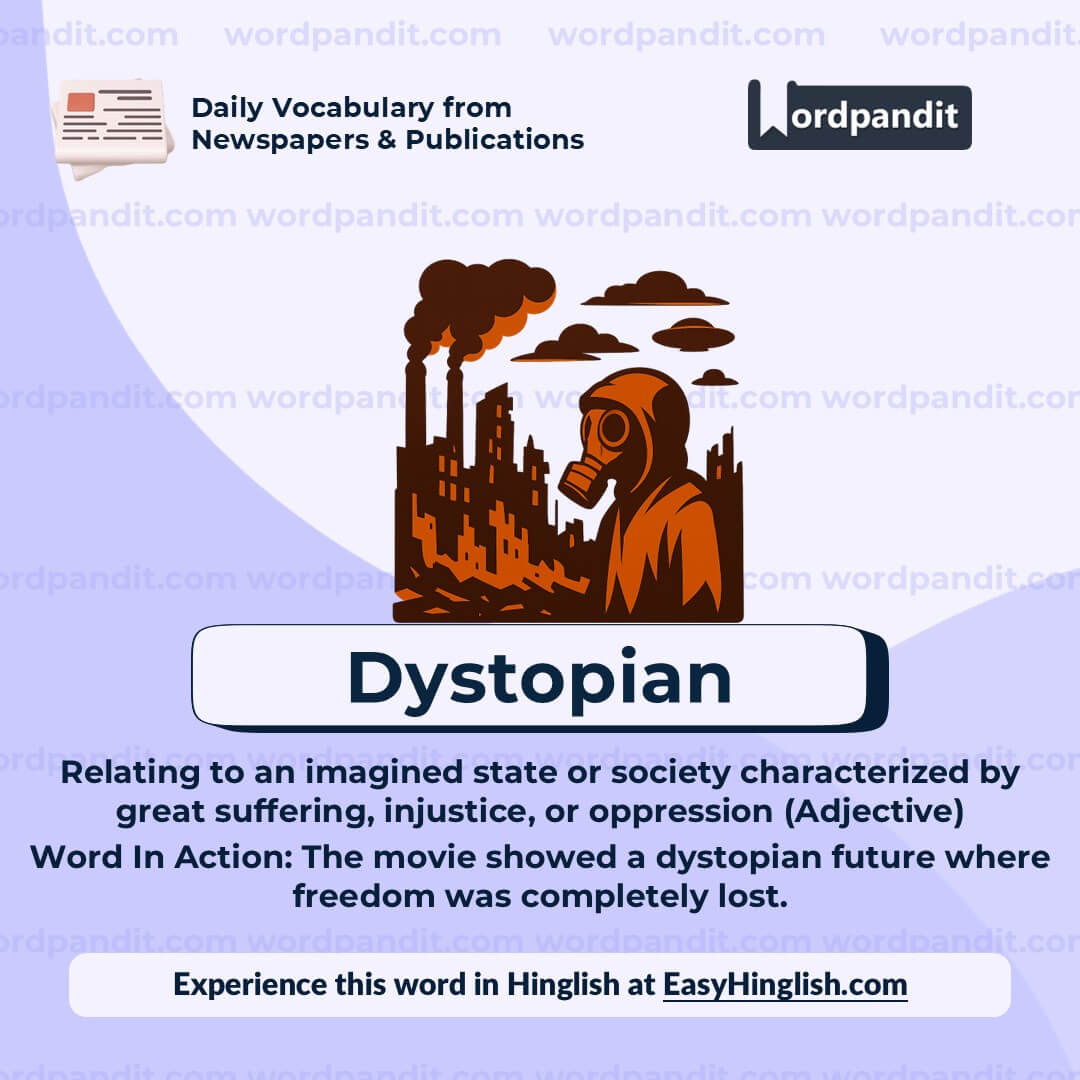
WORD-4: Dystopian
Context:
"Broadly, such science fiction predicts a dystopian future where AI surpasses human intelligence and homo sapiens are locked in a battle for survival." - Indian Express
Explanatory Paragraph:
The word "dystopian" refers to an imagined society that is frightening, oppressive, and undesirable, often marked by suffering, injustice, or lack of freedom. It is the opposite of "utopian," which means an ideal or perfect society. In literature and films, dystopian settings often show futures controlled by totalitarian governments, destructive technologies, or environmental collapse.
Meaning: Relating to an imagined state or society characterized by great suffering, injustice, or oppression (Adjective)
Pronunciation: dis-TOH-pee-uhn
Difficulty Level: ⭐⭐⭐ Intermediate
Etymology: Formed from Greek roots: dys- (bad, difficult) + topos (place). It is the opposite of "utopia," coined in the 16th century to describe an ideal world.
Prashant Sir's Notes:
Dystopian = bad world. Imagine the opposite of utopia (ideal). Often used in books, movies, and political discussions. Important to link it with real-world fears like authoritarianism, climate collapse, or uncontrolled AI.
Synonyms & Antonyms:
Synonyms: apocalyptic, nightmarish, bleak, oppressive, totalitarian
Antonyms: utopian, ideal, perfect, harmonious, visionary
Usage Examples:
- The movie portrayed a dystopian city where people had no freedom of thought.
- Writers often use dystopian themes to warn society about potential dangers.
- Some argue that unchecked climate change could lead to a dystopian future.
- George Orwell’s 1984 is a classic example of dystopian literature.
Cultural Reference:
Dystopian literature includes famous works like George Orwell’s 1984, Aldous Huxley’s Brave New World, and Suzanne Collins’ The Hunger Games, all depicting oppressive societies as cautionary tales.
Think About It:
Do dystopian stories simply entertain us, or do they act as warnings to help us avoid making the same mistakes in reality?
Quick Activity:
Think of a current global issue (like surveillance, AI, or climate change). Write a one-line dystopian prediction about what the world could look like in 50 years if that issue is not solved.
Memory Tip:
Link "dystopian" with "dysfunctional" — both start with "dys-" and refer to something bad, broken, or unpleasant.
Real-World Application:
The term "dystopian" is often used in political debates, climate discussions, and tech ethics. For instance, people describe mass surveillance or uncontrolled AI as "dystopian" scenarios we must guard against.
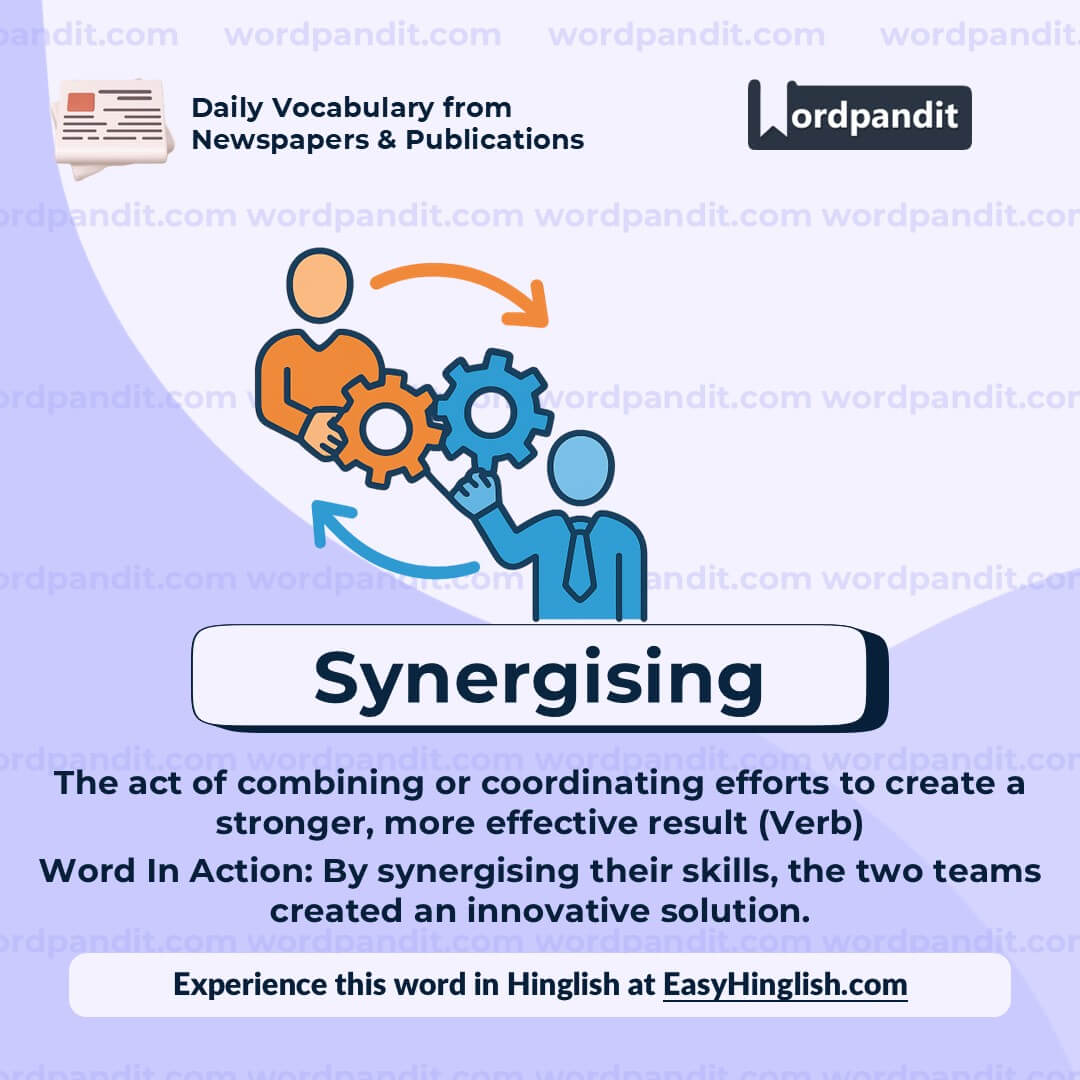
WORD-5: Synergising
Context:
"‘Synergising’ means combining multiple technologies to work together for a stronger result." - Indian Express
Explanatory Paragraph:
"Synergising" refers to the act of bringing together different parts, systems, or people so that they work more effectively in combination than they would individually. The idea is that the whole becomes greater than the sum of its parts. For example, synergising marketing and technology can create a stronger impact than using either separately.
Meaning: The act of combining or coordinating efforts to create a stronger, more effective result (Verb)
Pronunciation: SIN-er-jy-zing
Difficulty Level: ⭐⭐⭐ Intermediate
Etymology: From Greek synergos (working together), via Late Latin synergia, meaning cooperation. Root idea: collaboration that multiplies effectiveness.
Prashant Sir's Notes:
Remember the popular phrase “1 + 1 = 3” — that’s synergy. Synergising is about working together to produce a result that’s larger than individual contributions. Often used in business, management, and technology contexts.
Synonyms & Antonyms:
Synonyms: integrating, uniting, combining, collaborating, harmonising
Antonyms: separating, isolating, dividing, fragmenting
Usage Examples:
- The company is synergising its design and marketing teams to launch innovative products.
- By synergising renewable energy sources, nations can achieve a more sustainable power supply.
- The workshop focused on synergising academic research with industry needs.
- Startups are increasingly synergising AI with healthcare to improve patient outcomes.
Cultural Reference:
The concept of "synergy" became popular in management literature, especially through Stephen Covey’s The 7 Habits of Highly Effective People, where "synergize" is listed as one of the key habits of effective collaboration.
Think About It:
Do you think synergising always produces better results, or can too much collaboration sometimes slow down progress?
Quick Activity:
Write an example from your daily life where combining two efforts (like studying + group discussion, or exercise + healthy diet) produced better results than doing either alone.
Memory Tip:
Think of "synergising" as "synchronising energy" — working together in sync to create extra power.
Real-World Application:
Synergising is common in business mergers, cross-disciplinary projects, and technology integrations, where combining resources leads to innovation, efficiency, and competitive advantage.


