

Daily Vocabulary from Indian Newspapers and Publications
Welcome to Wordpandit’s Indian Vocabulary Hub
At Wordpandit, we understand the importance of staying rooted in the local context while expanding your language skills. This section focuses on enriching your vocabulary with words and phrases drawn from India’s leading newspapers and publications, ensuring you're learning vocabulary that is practical, relevant, and uniquely Indian.
Why Indian Sources Matter
We believe that the best way to master any language is by immersing yourself in local content. That’s why we carefully curate vocabulary from top Indian publications, including:
- The Hindu
- The Times of India
- The Economic Times
- Hindustan Times
- Live Mint
- The Indian Express
- And many others...
Stay Updated, Stay Relevant
With daily updates from Indian news sources, you’ll be consistently learning words that reflect the trends and shifts in Indian society and culture. Our focus is to provide vocabulary that enhances your understanding of the language in an Indian context.
How Wordpandit Supports Your Goals
Whether you’re preparing for exams, aiming to improve your professional communication, or simply want to stay connected with the latest Indian vocabulary, Wordpandit is here to guide you every step of the way.
Learn with a Practical Approach
Our interactive learning methodology includes real-world examples, engaging activities, and context-specific usage to ensure that every word becomes part of your active vocabulary.
Dive into Indian Vocabulary Today!

Why Choose Wordpandit?
Practical Learning: Focus on words you'll actually encounter in real-world reading, enhancing your comprehension and communication skills.
Diverse Content: From current affairs to scientific breakthroughs, our varied sources expose you to vocabulary across multiple domains.
Effortless Integration: Make Wordpandit a part of your daily routine. Just a few minutes each day can significantly boost your lexicon over time.
Your Path to Vocabulary Mastery
- Visit our Daily Vocabulary section regularly
- Explore new words and their usage in context
- Practice incorporating these words into your own writing and speech
- Track your progress as your vocabulary expands
Start Your Journey Today
Embark on your vocabulary enhancement journey with Wordpandit. By consistently engaging with our daily posts, you'll build a robust vocabulary that serves you well in academic, professional, and personal contexts.
Remember, a word a day keeps linguistic limitations at bay. Make Wordpandit your daily companion in the quest for vocabulary excellence!
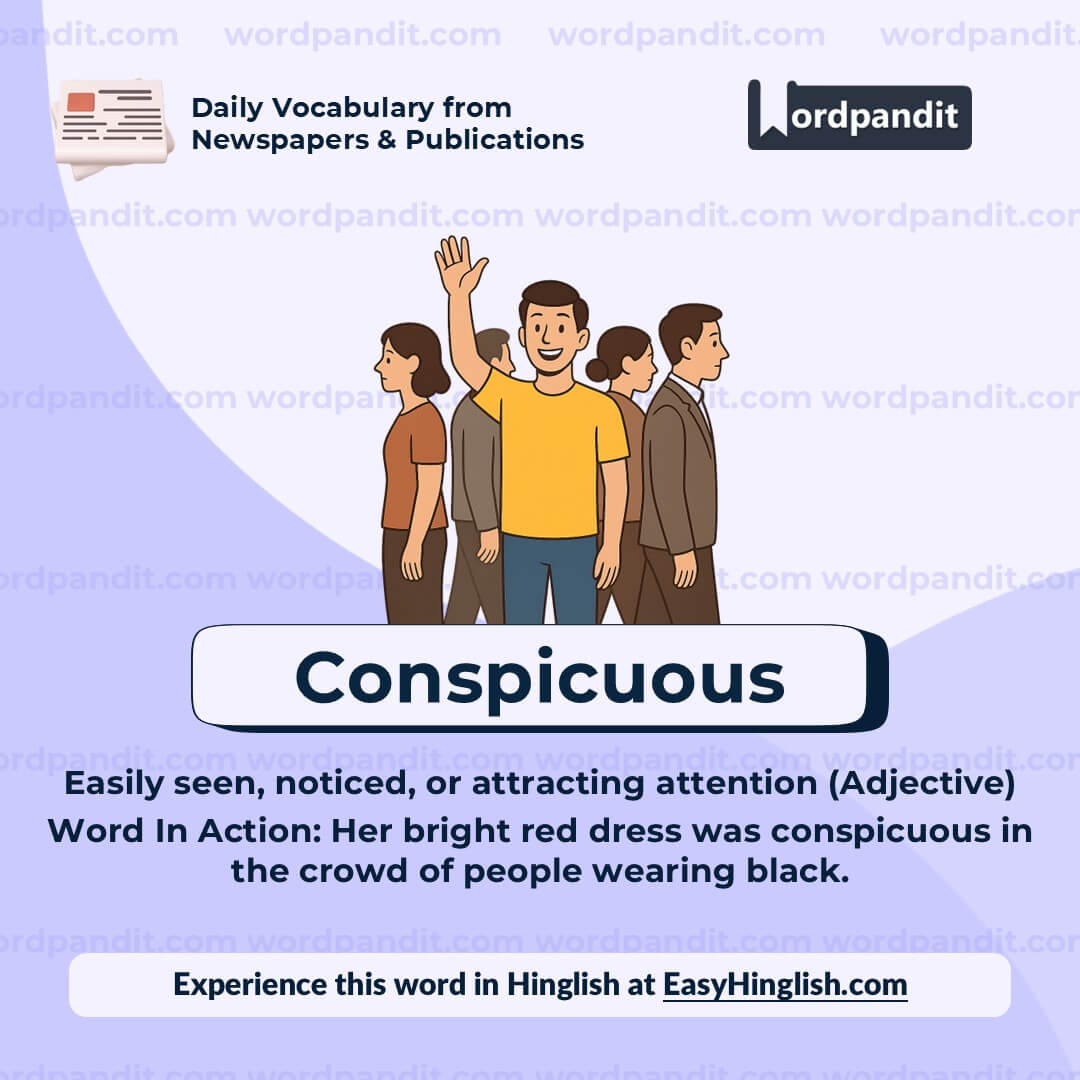
WORD-1: Conspicuous
Context:
"The most conspicuous marker is UPI, which clocked 1,868 cr transactions worth over ₹24 lakh cr in April." - Economic Times
Explanatory Paragraph:
The word conspicuous describes something that stands out in a way that is easily noticed or attracts attention. It is used when something is prominent, visible, or striking compared to everything else around it. In the given context, UPI’s massive transaction numbers are so noticeable that they become the most striking marker of growth.
Meaning: Easily seen, noticed, or attracting attention (Adjective)
Pronunciation: kun-SPIK-yoo-uhs
Difficulty Level: ⭐⭐ (Basic-Intermediate)
Etymology: From Latin conspicuus meaning “visible, remarkable,” derived from conspicere – “to look at or observe.”
Prashant Sir's Notes:
This word is often used to describe something that stands out in a crowd—whether good or bad. It can indicate visibility, prominence, or even attention-seeking behavior. A useful word for business, politics, and daily description.
Synonyms & Antonyms:
Synonyms: noticeable, prominent, striking, obvious, eye-catching
Antonyms: hidden, inconspicuous, unnoticeable, subtle
Usage Examples:
- The bright red car looked conspicuous among the line of black and grey vehicles.
- Her conspicuous talent for music earned her a scholarship at a young age.
- He made a conspicuous mistake in his calculations that everyone immediately spotted.
- The company’s conspicuous growth drew the attention of global investors.
Cultural Reference:
"In fashion, sometimes being conspicuous is intentional—designers often use bold colors and patterns to make a statement." - A commentary on style trends
Think About It:
Do you think being conspicuous is always a positive trait, or can it sometimes work against a person or brand?
Quick Activity:
Look around your room right now. Write down one object that appears conspicuous and explain why it stands out compared to others.
Memory Tip:
Break it down as con + spectacle. A spectacle is something you see easily—so conspicuous means something clearly visible or noticeable.
Real-World Application:
In marketing, making a product conspicuous through packaging, color, or placement ensures it catches the buyer’s eye instantly on a crowded shelf.
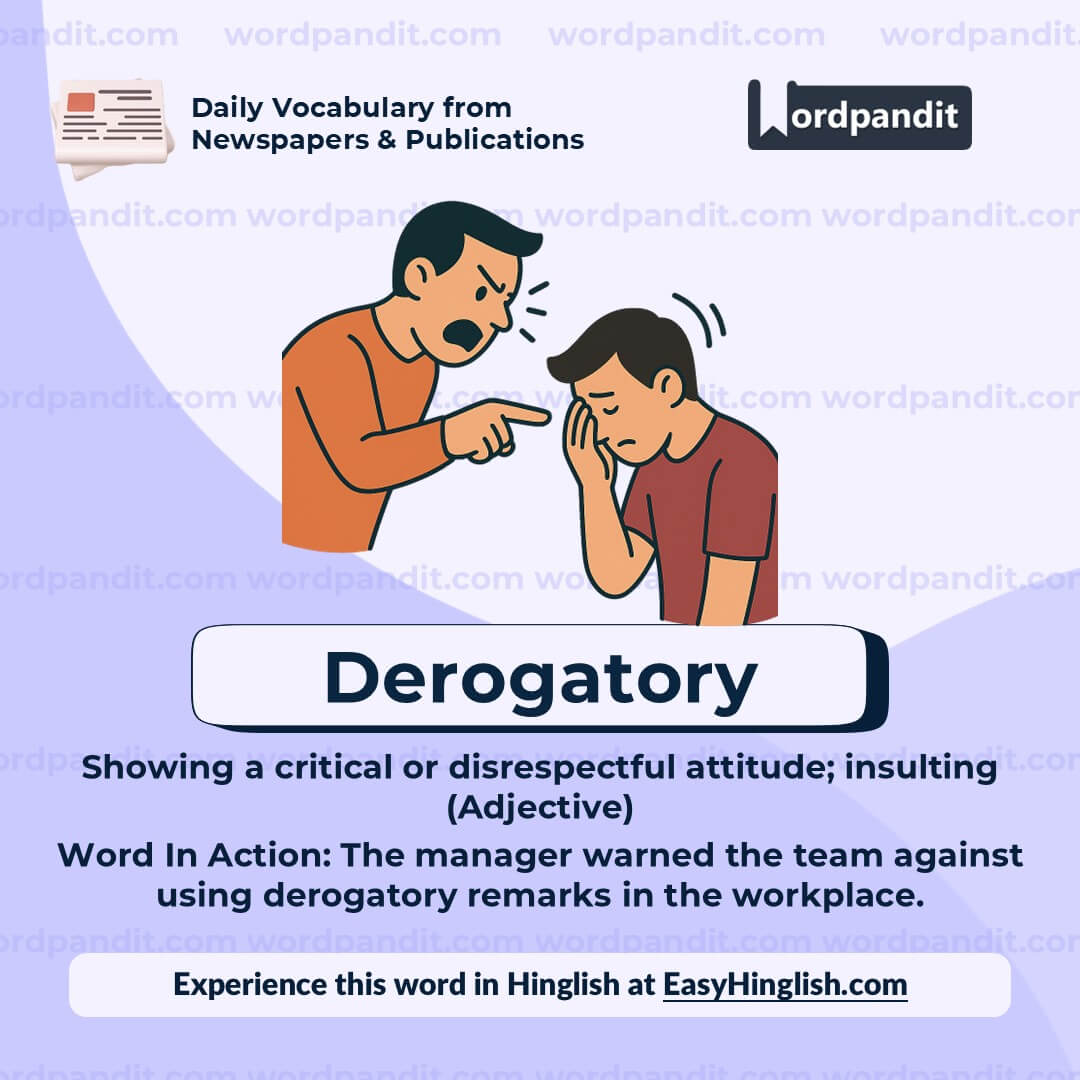
WORD-2: Derogatory
Context:
"In response to a petition by a non-profit assailing derogatory remarks by online figures against disabled persons, the Court issued instructions that further a problematic trend of the judiciary egging on the state to encroach on legal grey areas with statutory restrictions that undermine constitutionally guaranteed rights." - The Hindu
Explanatory Paragraph:
The word derogatory refers to language, remarks, or behavior that shows a lack of respect, belittles someone, or damages their reputation. It often implies insult, contempt, or disdain. In the given context, the word is used to describe insulting remarks directed at disabled persons, which are offensive and demeaning.
Meaning: Showing a critical or disrespectful attitude; insulting (Adjective)
Pronunciation: dih-ROG-uh-tor-ee
Difficulty Level: ⭐⭐⭐ (Intermediate)
Etymology: From Late Latin derogatorius, from derogare meaning “to lessen, take away from.”
Prashant Sir's Notes:
A very practical and useful word when dealing with offensive speech, workplace communication, or media commentary. It’s commonly used in law, politics, and journalism when addressing insulting or harmful language.
Synonyms & Antonyms:
Synonyms: insulting, disrespectful, demeaning, disparaging, belittling
Antonyms: complimentary, respectful, flattering, admiring
Usage Examples:
- The politician faced backlash for making derogatory comments about women.
- Using derogatory language at the workplace can lead to disciplinary action.
- He felt hurt after hearing his colleagues speak about him in a derogatory tone.
- The comedian’s derogatory jokes crossed the line and offended the audience.
Cultural Reference:
"Social media has amplified both empowering voices and derogatory remarks, making online discourse a sensitive balancing act." - A media commentary
Think About It:
Do you think freedom of speech should protect derogatory comments, or should society place limits to protect dignity and equality?
Quick Activity:
Rewrite this derogatory sentence into a respectful one: “You’re useless at this task.” → Try to make it constructive and encouraging.
Memory Tip:
Think of “de-” (down) + “rogatory” (related to request/law). So derogatory is like “bringing someone down” through words.
Real-World Application:
In HR and corporate training, identifying and avoiding derogatory language is essential to building respectful workplace communication and maintaining inclusivity.

WORD-3: Resilient
Context:
"Aatmanirbhar Bharat will need a resilient retail payments sector that serves both domestic and cross-border use cases." - Economic Times
Explanatory Paragraph:
The word resilient describes the ability to recover quickly from difficulties, adapt to challenges, and keep functioning despite stress or change. It can refer to people, systems, materials, or organizations that bounce back after setbacks. In the given context, it highlights the need for a payment system that is strong, adaptable, and able to withstand shocks while continuing to serve users reliably.
Meaning: Able to withstand or recover quickly from difficult conditions; flexible and adaptable (Adjective)
Pronunciation: ri-ZIL-yunt
Difficulty Level: ⭐⭐ (Basic-Intermediate)
Etymology: From Latin resilire meaning “to leap back, rebound.”
Prashant Sir's Notes:
This is a powerful and positive word, often used in personal development, business, and economics. Resilience is not just about survival but about bouncing back stronger. It’s one of the most important traits of both individuals and systems.
Synonyms & Antonyms:
Synonyms: strong, tough, adaptable, flexible, hardy
Antonyms: fragile, weak, vulnerable, inflexible
Usage Examples:
- Children are often more resilient than adults realize, adapting quickly to new situations.
- The resilient economy managed to recover after the financial crisis.
- Rubber is a resilient material because it bounces back after being stretched.
- She showed a resilient spirit after facing repeated failures in her startup journey.
Cultural Reference:
"The concept of resilience is celebrated in psychology as one of the key strengths that enables individuals to thrive despite adversity." - A psychology handbook
Think About It:
What builds resilience more—facing repeated challenges or having strong support systems to rely on?
Quick Activity:
Write down one difficult situation you overcame in the past. How did you show resilience in handling it?
Memory Tip:
Think of “resilient” as “re + silent bounce.” No matter what pushes you down, you bounce back quietly but strongly.
Real-World Application:
In business, being resilient means companies can handle disruptions—like pandemics or market crashes—while still serving their customers effectively.
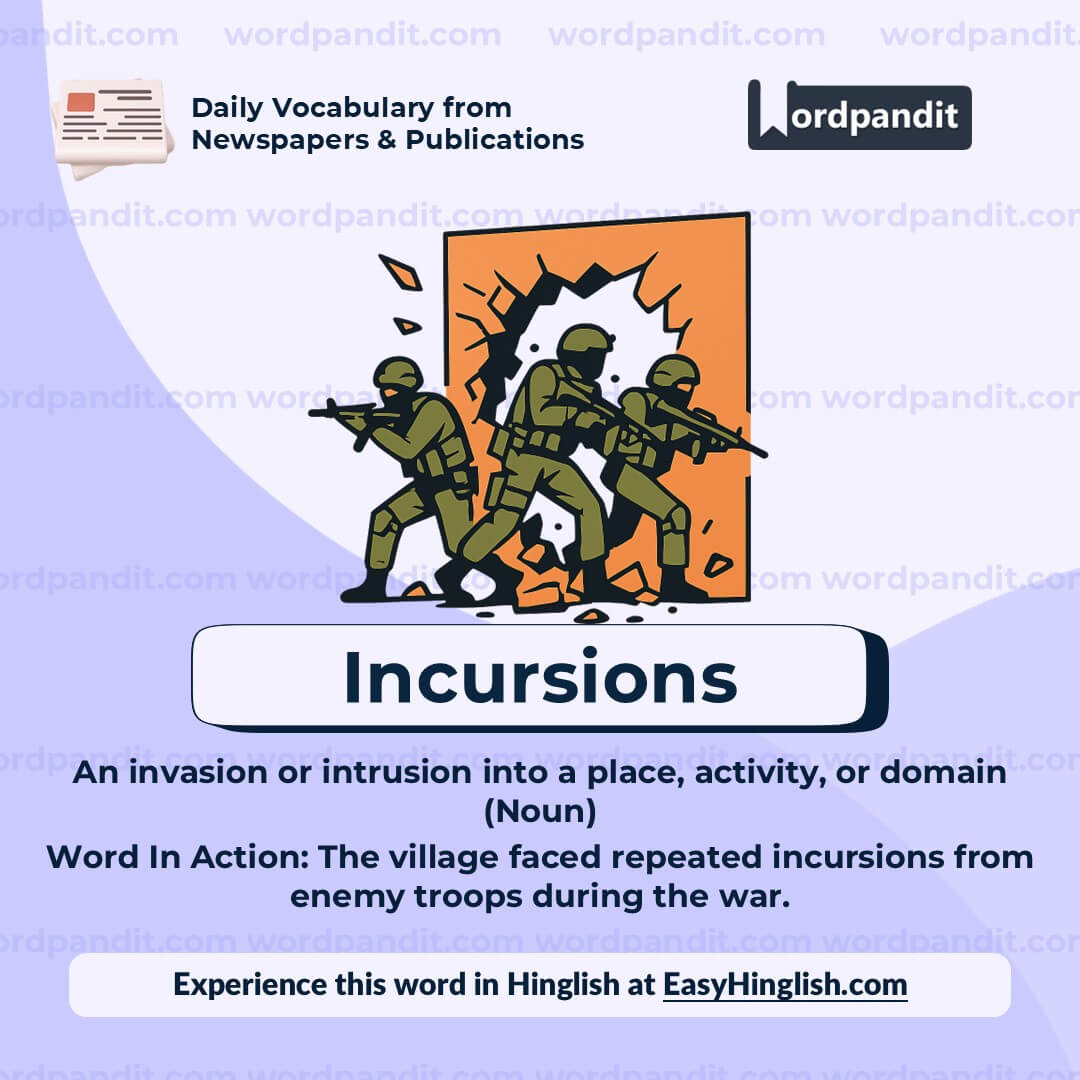
WORD-4: Incursions
Context:
"Kerala accused the Centre of making 'unwarranted and unconstitutional incursions into State territory.'" - The Hindu
Explanatory Paragraph:
The word incursions refers to sudden or brief invasions, intrusions, or entries—often into a place, area, or domain—without permission. It can be used literally, for military invasions, or figuratively, for interference in matters where someone has no authority. In the given context, it describes the central government allegedly overstepping into areas that are constitutionally reserved for the state.
Meaning: An invasion or intrusion into a place, activity, or domain (Noun)
Pronunciation: in-KUR-zhunz
Difficulty Level: ⭐⭐⭐ (Intermediate)
Etymology: From Latin incurrere meaning “to run into, attack.” Derived from in- (into) + currere (to run).
Prashant Sir's Notes:
This word is powerful in political, legal, and military contexts. It signifies forceful entry or interference, often unwanted. In exams, it may also appear in contexts related to foreign policy, business competition, or even technology.
Synonyms & Antonyms:
Synonyms: invasion, intrusion, attack, trespass, violation
Antonyms: withdrawal, retreat, respect, compliance
Usage Examples:
- The army launched sudden incursions into enemy territory.
- Many workers protested against the management’s incursions into their personal data.
- The artist resisted commercial incursions into her creative freedom.
- The court condemned the government’s incursions into citizens’ privacy rights.
Cultural Reference:
"History is filled with accounts of border incursions, where kingdoms clashed over territory and power." - A history textbook
Think About It:
Are all incursions harmful, or can some “intrusions” (like technology in daily life) actually be beneficial?
Quick Activity:
Think of a modern example of a “digital incursion” (such as a data breach). Write one sentence using the word “incursion” in that context.
Memory Tip:
Break it into “in + cursion.” Imagine someone running in where they don’t belong—this is what an incursion means.
Real-World Application:
The word is widely used in international relations to describe military invasions, and in governance to describe one authority encroaching on another’s jurisdiction.
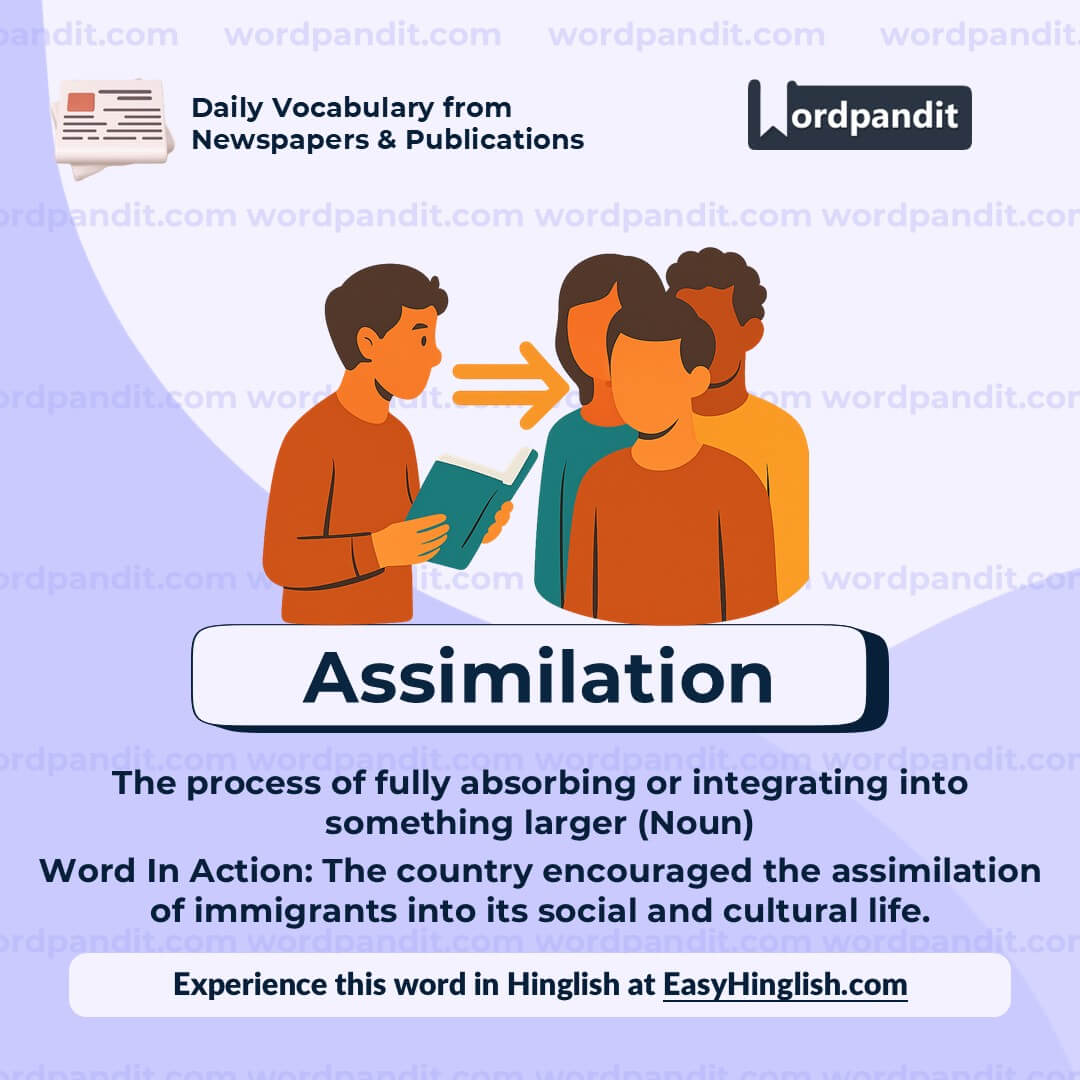
WORD-5: Assimilation
Context:
"A careful step towards not only identifying but also addressing PVTGs is necessary to facilitate social inclusion, instead of assimilation." - Indian Express
Explanatory Paragraph:
The word assimilation refers to the process of absorbing, integrating, or blending into a larger whole. It can be used in cultural, social, and biological contexts. In social sciences, assimilation often means minority groups adopting the customs, values, and behaviors of the dominant society, sometimes at the cost of losing their unique identity. In the given context, the word suggests the danger of forcing PVTGs (Particularly Vulnerable Tribal Groups) to lose their cultural identity, instead of ensuring their fair inclusion in society.
Meaning: The process of fully absorbing or integrating into something larger (Noun)
Pronunciation: uh-SIM-uh-lay-shun
Difficulty Level: ⭐⭐⭐ (Intermediate)
Etymology: From Latin assimilare meaning “to make similar,” formed from ad- (to) + similis (like).
Prashant Sir's Notes:
This word is important for social, political, and cultural discussions. It often carries a subtle warning: assimilation is not always inclusion. True inclusion values differences, while assimilation tends to erase them.
Synonyms & Antonyms:
Synonyms: absorption, integration, incorporation, adaptation
Antonyms: segregation, exclusion, separation, preservation
Usage Examples:
- The assimilation of new immigrants into urban life often takes generations.
- Language is one of the key tools for cultural assimilation.
- Critics argue that forced assimilation destroys cultural diversity.
- Children adapt quickly, making their assimilation into new schools easier.
Cultural Reference:
"In American history, Native tribes were subjected to forced assimilation policies, which suppressed their languages and traditions." - A history lecture
Think About It:
Is assimilation always negative, or can it sometimes help groups find a place in a larger society without completely losing their identity?
Quick Activity:
Think of an example where you had to assimilate into a new environment (school, workplace, city). Write one sentence describing how you adapted.
Memory Tip:
Break it into “as + similar.” Assimilation makes one group “similar” to another by blending or merging.
Real-World Application:
The term is widely used in sociology, anthropology, and politics to discuss cultural blending, migration, and policies about minority communities.


