

Daily Vocabulary from Indian Newspapers and Publications
Welcome to Wordpandit’s Indian Vocabulary Hub
At Wordpandit, we understand the importance of staying rooted in the local context while expanding your language skills. This section focuses on enriching your vocabulary with words and phrases drawn from India’s leading newspapers and publications, ensuring you're learning vocabulary that is practical, relevant, and uniquely Indian.
Why Indian Sources Matter
We believe that the best way to master any language is by immersing yourself in local content. That’s why we carefully curate vocabulary from top Indian publications, including:
- The Hindu
- The Times of India
- The Economic Times
- Hindustan Times
- Live Mint
- The Indian Express
- And many others...
Stay Updated, Stay Relevant
With daily updates from Indian news sources, you’ll be consistently learning words that reflect the trends and shifts in Indian society and culture. Our focus is to provide vocabulary that enhances your understanding of the language in an Indian context.
How Wordpandit Supports Your Goals
Whether you’re preparing for exams, aiming to improve your professional communication, or simply want to stay connected with the latest Indian vocabulary, Wordpandit is here to guide you every step of the way.
Learn with a Practical Approach
Our interactive learning methodology includes real-world examples, engaging activities, and context-specific usage to ensure that every word becomes part of your active vocabulary.
Dive into Indian Vocabulary Today!

Why Choose Wordpandit?
Practical Learning: Focus on words you'll actually encounter in real-world reading, enhancing your comprehension and communication skills.
Diverse Content: From current affairs to scientific breakthroughs, our varied sources expose you to vocabulary across multiple domains.
Effortless Integration: Make Wordpandit a part of your daily routine. Just a few minutes each day can significantly boost your lexicon over time.
Your Path to Vocabulary Mastery
- Visit our Daily Vocabulary section regularly
- Explore new words and their usage in context
- Practice incorporating these words into your own writing and speech
- Track your progress as your vocabulary expands
Start Your Journey Today
Embark on your vocabulary enhancement journey with Wordpandit. By consistently engaging with our daily posts, you'll build a robust vocabulary that serves you well in academic, professional, and personal contexts.
Remember, a word a day keeps linguistic limitations at bay. Make Wordpandit your daily companion in the quest for vocabulary excellence!
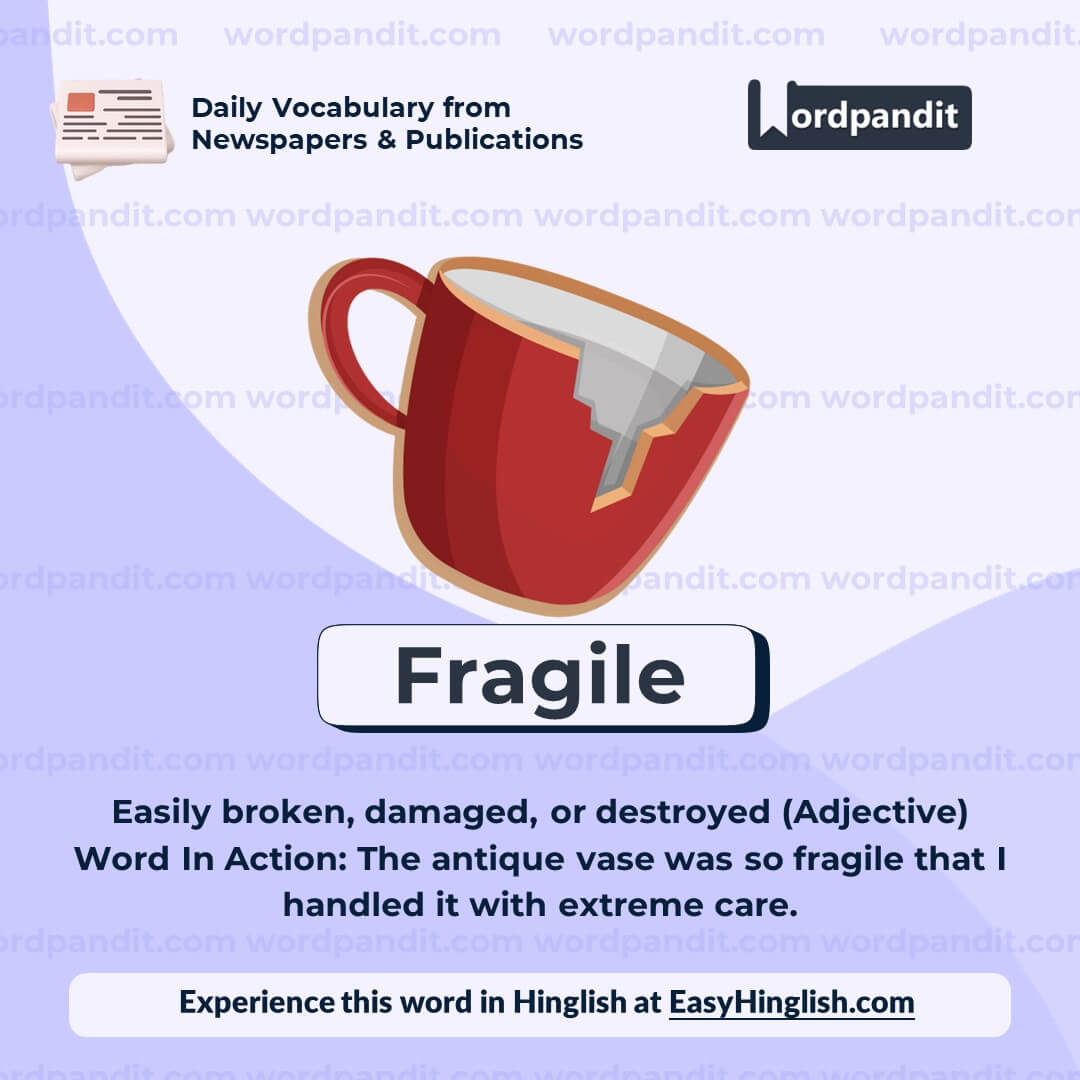
WORD-1: Fragile
Context:
"The economy is showing signs of recovery, but it remains fragile and vulnerable to global shocks." - Financial Times
Explanatory Paragraph:
The word "fragile" refers to something that is delicate, easily broken, or not strong or stable. It can describe physical objects, such as glassware, or abstract ideas like relationships, health, or the economy. When something is fragile, it requires special care and attention because it could be damaged easily or fall apart under pressure.
Meaning: Easily broken, damaged, or weakened (Adjective)
Pronunciation: FRA-jil
Difficulty Level: ⭐ Beginner
Etymology: From Latin *fragilis*, from *frangere* meaning "to break".
Prashant Sir's Notes:
"Fragile" is an important word that is often used metaphorically in academic writing, especially in discussions around mental health, economic policy, or diplomacy. Always think beyond the physical meaning.
Synonyms & Antonyms:
Synonyms: delicate, breakable, frail, flimsy, brittle
Antonyms: strong, sturdy, durable, resilient, tough
Usage Examples:
- The vase was so fragile that it shattered with a single touch.
- She has a fragile heart and takes criticism very personally.
- The ceasefire created a fragile peace between the two nations.
- Handle the package carefully—it contains fragile items.
Cultural Reference:
"Fragile" is the title of a famous 1987 song by Sting, which explores the vulnerability of human life and the futility of violence. - Music History Archive
Think About It:
What does it mean when we describe a human emotion or a relationship as "fragile"? Can something fragile still be valuable or powerful?
Quick Activity:
List three things in your life (physical or abstract) that you consider fragile, and write one sentence for each explaining why.
Memory Tip:
Think of "fragile" as related to "fragment"—both deal with something that can break. If it can fragment, it’s fragile.
Real-World Application:
"Fragile" is commonly used in business and political news to describe unstable conditions. For example, a "fragile alliance" or a "fragile economy" indicates that things could quickly deteriorate without careful handling.
WORD-2: Unbowed
Context:
"He emerged from years of imprisonment unbowed, with his spirit and convictions stronger than ever." - BBC News
Explanatory Paragraph:
"Unbowed" describes someone who remains strong, dignified, or defiant despite challenges, suffering, or pressure. It’s often used to emphasize resilience and an unbroken will. If a person is unbowed, they refuse to give in to hardship or defeat. The term evokes an image of someone standing tall in the face of adversity.
Meaning: Not defeated or made to feel ashamed; unyielding (Adjective)
Pronunciation: un-BOWD (rhymes with "loud")
Difficulty Level: ⭐⭐ Moderate
Etymology: From the prefix "un-" (not) + "bowed", from Old English *bugan*, meaning "to bend".
Prashant Sir's Notes:
“Unbowed” is a power word—used in speeches, biographies, and political rhetoric. Look out for its emotional undertone; it’s often used to describe heroes, activists, or survivors.
Synonyms & Antonyms:
Synonyms: defiant, resilient, unbroken, unyielding, steadfast
Antonyms: defeated, submissive, bowed, crushed, yielding
Usage Examples:
- Despite intense criticism, the scientist remained unbowed in defending her research.
- He stood unbowed before the tribunal, refusing to apologize for his beliefs.
- The city, though battered by storms, was unbowed in spirit.
- She walked out of the courtroom unbowed, proud of her truth.
Cultural Reference:
“Unbowed” is the title of the memoir of South African activist and Nobel laureate Wangari Maathai, chronicling her lifelong environmental and political activism. - Penguin Books
Think About It:
Can being unbowed ever become a weakness? Is there a difference between resilience and stubbornness?
Quick Activity:
Write a short paragraph describing a historical or fictional character who remained unbowed in the face of adversity.
Memory Tip:
Visualize someone trying to force you to “bow down,” and you refuse—that’s being "unbowed."
Real-World Application:
"Unbowed" is frequently used in journalism, speeches, and biographies to highlight courage and determination. It's an excellent word for essays and speeches about perseverance.

WORD-3: Thoroughfare
Context:
"The city plans to widen the main thoroughfare to reduce traffic congestion and improve commute times." - The Guardian
Explanatory Paragraph:
"Thoroughfare" refers to a road or path that connects one place to another and is used regularly by traffic or pedestrians. It's typically a major public route—like a busy street or highway—that people travel through to reach various destinations. The word can also be used more figuratively to describe channels of movement or access, like the thoroughfare of ideas or communication.
Meaning: A main road or public highway that allows passage through an area (Noun)
Pronunciation: THUR-oh-fair
Difficulty Level: ⭐⭐ Moderate
Etymology: From Middle English *thurghfare*, from *thurgh* (through) + *fare* (journey, passage)
Prashant Sir's Notes:
This word comes up often in urban planning and civil services vocabulary. Remember that "thoroughfare" isn't just any road—it’s usually significant, used for through traffic, not a dead-end or small lane.
Synonyms & Antonyms:
Synonyms: passage, road, boulevard, avenue, route
Antonyms: dead-end, cul-de-sac, alley (in specific contexts)
Usage Examples:
- The bustling thoroughfare was lined with shops, cafés, and street performers.
- Emergency vehicles often use the main thoroughfare to respond quickly to incidents.
- The hotel is conveniently located just off a major thoroughfare.
- Pedestrians were advised not to block the public thoroughfare during the protest.
Cultural Reference:
New York’s Broadway is one of the world’s most famous thoroughfares—known for its theaters, lights, and history as a central artery of culture and traffic. - NYC Historical Society
Think About It:
How does the design and use of a city’s thoroughfares impact the daily lives and mental well-being of its residents?
Quick Activity:
Draw or describe a map of your town or city, marking at least one major thoroughfare. How does traffic flow through it?
Memory Tip:
Think of “thoroughfare” as a “thorough” (complete) + “fare” (a journey)—a complete road that people pass through.
Real-World Application:
Urban planners and traffic engineers regularly use the term “thoroughfare” when designing city infrastructure. It's useful in conversations about transportation, city development, and public safety.

WORD-4: Ordnance
Context:
"The military base is equipped with advanced ordnance, including missiles and armored vehicles." - Defense Weekly
Explanatory Paragraph:
"Ordnance" refers to military weapons, ammunition, and related equipment used in warfare. This includes everything from small arms and bullets to large-scale weapon systems like tanks and missiles. The term is often used in military contexts to discuss logistics, supply chains, or the type of armament a force possesses. It's not to be confused with “ordinance,” which refers to laws or regulations.
Meaning: Military weapons, ammunition, and equipment (Noun)
Pronunciation: ORD-nuns
Difficulty Level: ⭐⭐⭐ Intermediate
Etymology: From Middle English *ordenaunce*, meaning arrangement or preparation, from Old French, related to “order” or equipment
Prashant Sir's Notes:
This word is frequently tested in exams due to its confusion with "ordinance" (a rule/law). Always associate “ordnance” with “arms and ammunition.” A helpful trick: "ORDNANCE = ORDNARMS".
Synonyms & Antonyms:
Synonyms: weaponry, munitions, armament, artillery, arms
Antonyms: disarmament, demilitarization, peacekeeping supplies
Usage Examples:
- The airstrike targeted an enemy ordnance facility in the desert.
- The truck was carrying live ordnance and required an escort.
- Specialists were called in to defuse unexploded ordnance found near the village.
- They trained extensively in ordnance handling and safety procedures.
Cultural Reference:
The British Royal Ordnance was once a major manufacturer of weapons and munitions, playing a key role during both World Wars. - UK National Archives
Think About It:
What ethical considerations should guide the development and use of ordnance in modern warfare?
Quick Activity:
Research and list three types of ordnance used in the last major conflict your country was involved in. What were their purposes?
Memory Tip:
Remember: “ORDnance” has to do with “ORDer to fire weapons.” Think of “ORD” = military order, and “NANCE” rhyming with “advance.”
Real-World Application:
Understanding "ordnance" is essential in defense studies, international relations, journalism covering conflict zones, and disaster management—especially when dealing with unexploded bombs or war remnants.
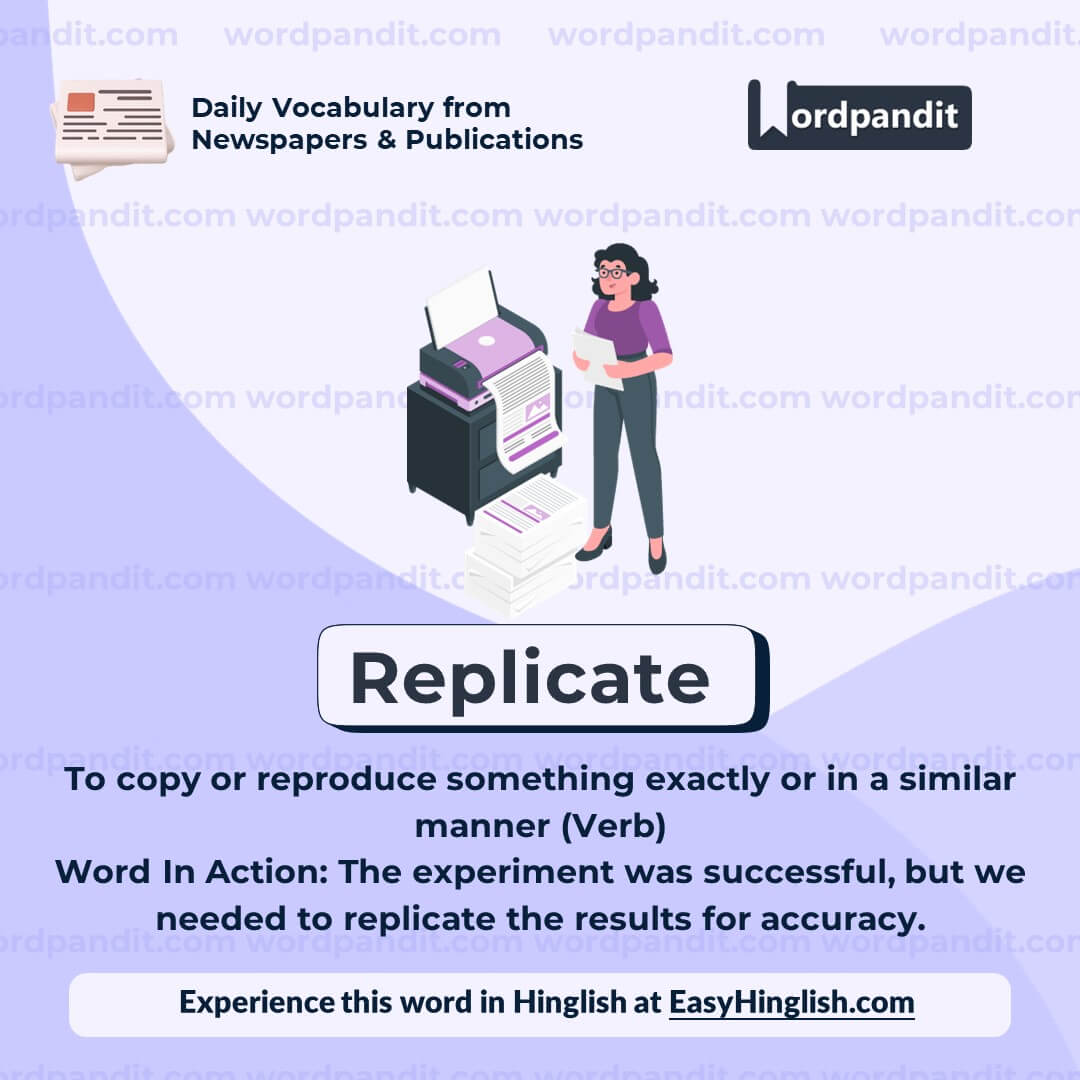
WORD-5: Replicate
Context:
"Scientists were able to replicate the experiment successfully, confirming the original findings." - Nature Journal
Explanatory Paragraph:
"Replicate" means to copy, repeat, or reproduce something, especially in a way that is accurate and consistent with the original. The word is commonly used in scientific, technological, and academic contexts, where repeatability ensures the reliability of results. It can also refer more generally to mimicking or duplicating anything—like a process, behavior, or object.
Meaning: To duplicate, reproduce, or repeat (Verb)
Pronunciation: REP-li-kate
Difficulty Level: ⭐⭐ Moderate
Etymology: From Latin *replicare*, meaning “to fold back” or “repeat”
Prashant Sir's Notes:
"Replicate" is often a favorite in research methodology and computer science. In exams, students confuse it with 'duplicate', but remember: 'replicate' is not just copying—it implies testing or verification.
Synonyms & Antonyms:
Synonyms: duplicate, reproduce, imitate, copy, mirror
Antonyms: innovate, originate, deviate, differ, create (in context)
Usage Examples:
- The software is designed to replicate human conversation patterns.
- The artist tried to replicate the style of Renaissance painters.
- Researchers failed to replicate the results, raising doubts about the theory.
- Factories aim to replicate successful production models across locations.
Cultural Reference:
In the sci-fi film *Blade Runner*, "replicants" are bioengineered beings nearly identical to humans—raising deep questions about what it means to replicate life. - Film Review Archive
Think About It:
Can a perfect replication ever truly capture the original? What might be lost—or gained—in the process?
Quick Activity:
Choose a simple activity (like drawing a shape or solving a math problem) and ask a friend to replicate it. Compare the two versions—how close are they?
Memory Tip:
Think: "RE-Plicate = REpeat precisely." The “RE” in “replicate” hints at doing something again, exactly.
Real-World Application:
"Replicate" is crucial in fields like scientific research, software development, data backup systems, and even manufacturing—where ensuring consistency and reliability is key.


