

Daily Vocabulary from Indian Newspapers and Publications
Welcome to Wordpandit’s Indian Vocabulary Hub
At Wordpandit, we understand the importance of staying rooted in the local context while expanding your language skills. This section focuses on enriching your vocabulary with words and phrases drawn from India’s leading newspapers and publications, ensuring you're learning vocabulary that is practical, relevant, and uniquely Indian.
Why Indian Sources Matter
We believe that the best way to master any language is by immersing yourself in local content. That’s why we carefully curate vocabulary from top Indian publications, including:
- The Hindu
- The Times of India
- The Economic Times
- Hindustan Times
- Live Mint
- The Indian Express
- And many others...
Stay Updated, Stay Relevant
With daily updates from Indian news sources, you’ll be consistently learning words that reflect the trends and shifts in Indian society and culture. Our focus is to provide vocabulary that enhances your understanding of the language in an Indian context.
How Wordpandit Supports Your Goals
Whether you’re preparing for exams, aiming to improve your professional communication, or simply want to stay connected with the latest Indian vocabulary, Wordpandit is here to guide you every step of the way.
Learn with a Practical Approach
Our interactive learning methodology includes real-world examples, engaging activities, and context-specific usage to ensure that every word becomes part of your active vocabulary.
Dive into Indian Vocabulary Today!

Why Choose Wordpandit?
Practical Learning: Focus on words you'll actually encounter in real-world reading, enhancing your comprehension and communication skills.
Diverse Content: From current affairs to scientific breakthroughs, our varied sources expose you to vocabulary across multiple domains.
Effortless Integration: Make Wordpandit a part of your daily routine. Just a few minutes each day can significantly boost your lexicon over time.
Your Path to Vocabulary Mastery
- Visit our Daily Vocabulary section regularly
- Explore new words and their usage in context
- Practice incorporating these words into your own writing and speech
- Track your progress as your vocabulary expands
Start Your Journey Today
Embark on your vocabulary enhancement journey with Wordpandit. By consistently engaging with our daily posts, you'll build a robust vocabulary that serves you well in academic, professional, and personal contexts.
Remember, a word a day keeps linguistic limitations at bay. Make Wordpandit your daily companion in the quest for vocabulary excellence!
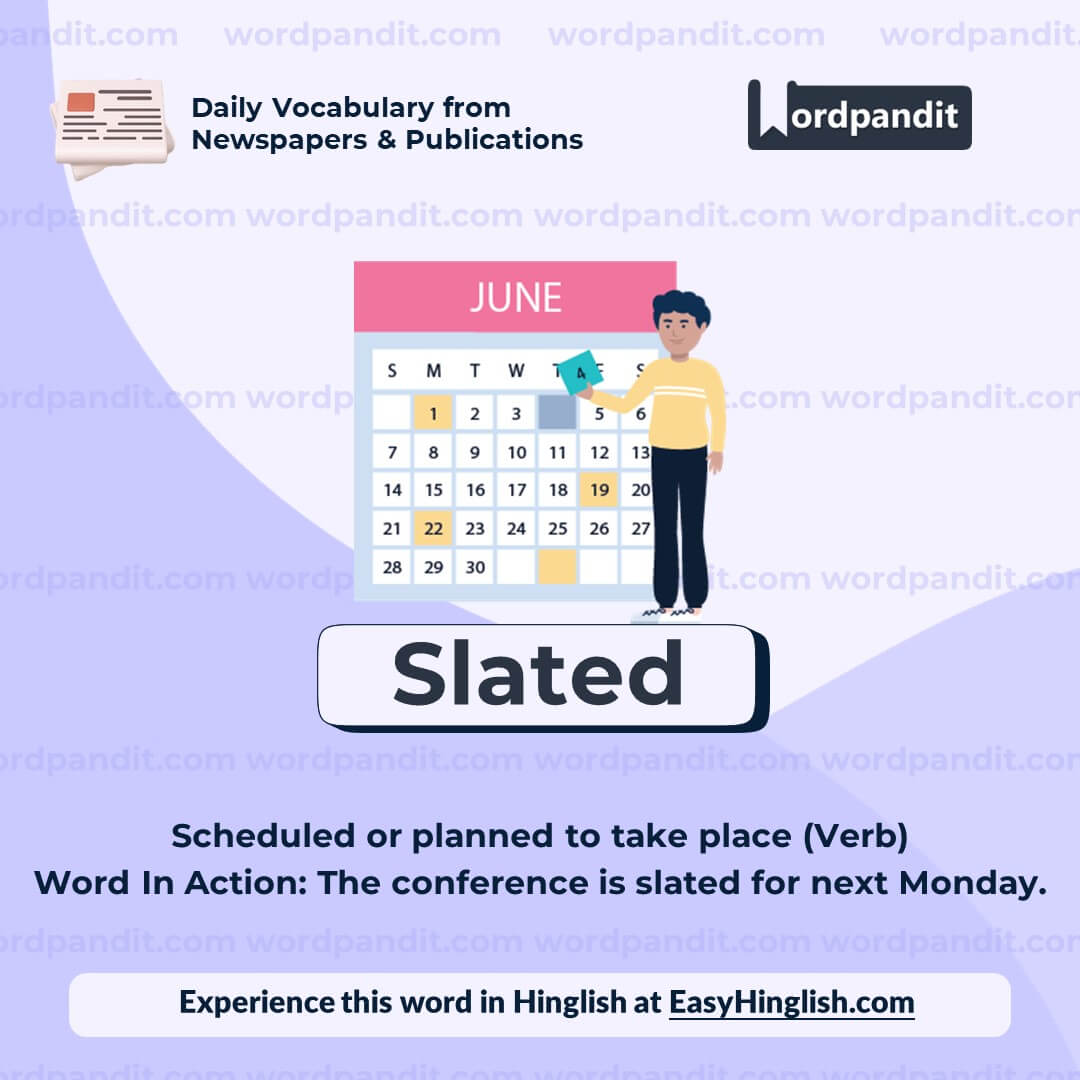
WORD-1: Slated
Context:
"Trump's tariffs against Canada and China were still slated to go into effect Tuesday, but uncertainty remained about the durability of any deals and whether the tariffs were a harbinger of a broader trade war, as Trump has promised more import taxes to come." - Telegraph India
Explanatory Paragraph:
The word "slated" in this context means something that has been officially scheduled or planned to happen. It is often used in news reports or formal communication to indicate that a particular event is expected to occur at a designated time in the future. Here, it refers to the tariffs that were scheduled to be implemented on a specific date. The term carries a sense of formality and anticipation.
Meaning: Scheduled or planned to happen (Verb – usually in passive form)
Pronunciation: SLAY-tid
Difficulty Level: ⭐⭐ Beginner to Intermediate
Etymology: Derived from the British slang "slate," meaning to nominate or plan for a role or event; originally from the use of a slate board to list planned items or candidates.
Prashant Sir's Notes:
Pay attention to how "slated" is often used in formal or political reporting to indicate something scheduled. It’s typically used in passive voice—e.g., "is slated to happen." Remember this usage pattern.
Synonyms & Antonyms:
Synonyms: scheduled, planned, programmed, arranged, intended
Antonyms: canceled, postponed, unplanned, unscheduled
Usage Examples:
- The concert is slated to begin at 8 p.m. sharp.
- The new policy is slated for implementation next month.
- She is slated to appear in court on Friday.
- Construction of the new bridge is slated to start in early 2026.
Cultural Reference:
"The film was originally slated for a summer release, but due to production delays, it was postponed to December." - A common phrase in entertainment journalism
Think About It:
How does the passive structure of "is slated to" affect the tone or formality of a statement compared to just saying "will happen"?
Quick Activity:
Write two sentences using "slated" in different contexts—one about a future event, and one about a scheduled person or group (e.g., "The team is slated to meet...").
Memory Tip:
Think of a "slate board" used in classrooms or meetings to write down what's next—if it's on the slate, it's planned. So, “slated” means it’s on the list to happen.
Real-World Application:
Professionals often use "slated" in emails, press releases, and presentations to formally indicate upcoming actions or deadlines. For example: “The product launch is slated for Q4 2025.”
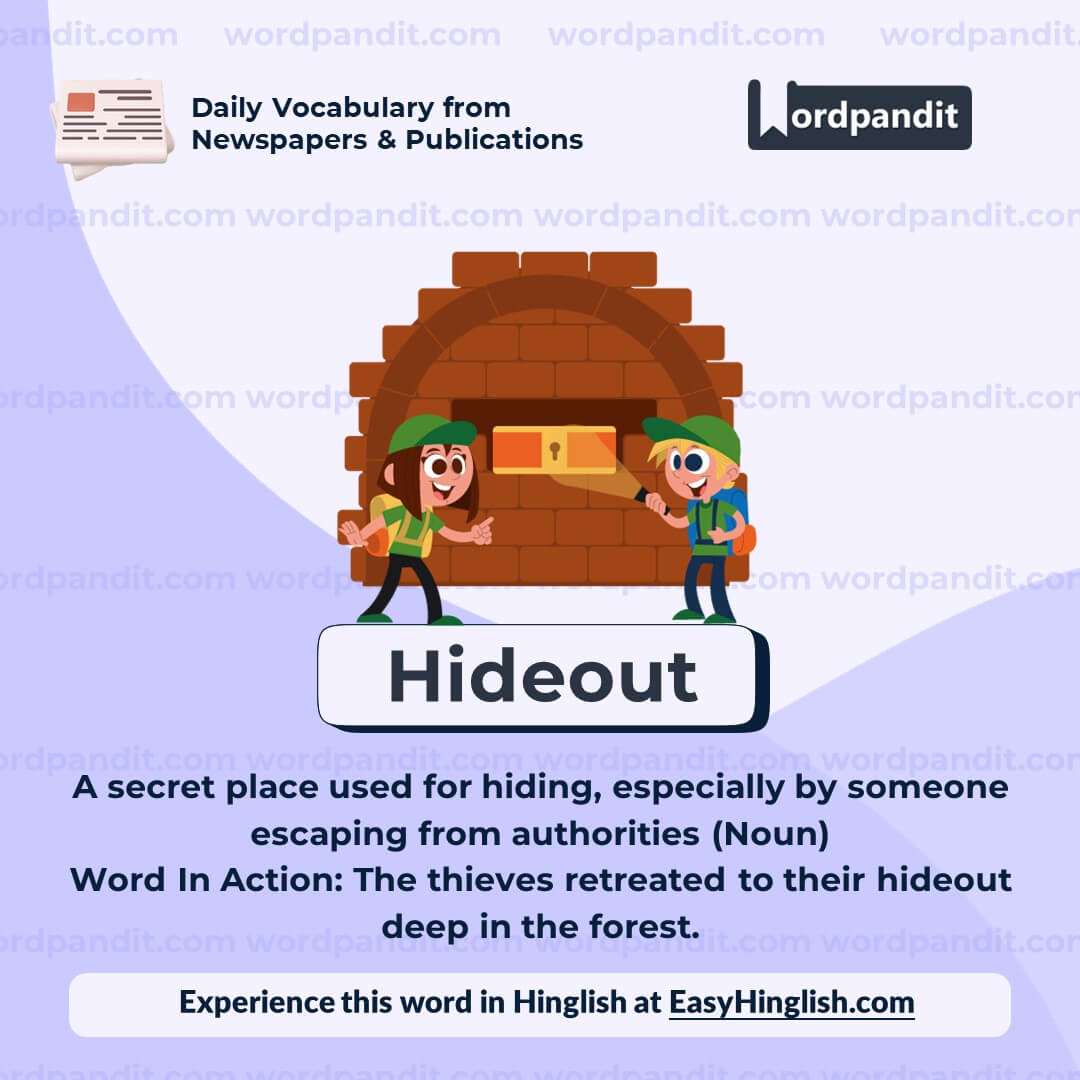
WORD-2: Hideout
Context:
"On January 20, an army soldier was critically injured in a firefight in north Kashmir when security forces acting on specific inputs about a suspected militant hideout in Gujjarpati area of Zaloora came under fire from militants." - The Wire
Explanatory Paragraph:
The word "hideout" refers to a secret place where someone hides or seeks shelter, especially to avoid detection by authorities or enemies. It is often associated with criminals, fugitives, or militants who wish to remain unseen. In this context, it denotes a concealed location suspected of being used by militants to evade security forces. The term often implies a sense of secrecy, danger, or illegality.
Meaning: A secret place used for hiding by someone trying to avoid capture (Noun)
Pronunciation: HIDE-out
Difficulty Level: ⭐⭐ Beginner to Intermediate
Etymology: From the verb "hide" + the suffix "out," popularized in American English during the 19th century in the context of outlaws and fugitives.
Prashant Sir's Notes:
"Hideout" is a useful word when describing secretive or suspicious locations. Often seen in journalism and crime reports, it's worth noting how the word evokes imagery of secrecy and confrontation. Keep it in your toolkit for both literal and figurative use.
Synonyms & Antonyms:
Synonyms: refuge, shelter, lair, den, sanctuary, safehouse
Antonyms: public place, open area, headquarters, center
Usage Examples:
- The police discovered the gang’s hideout in an abandoned warehouse.
- The fugitives took refuge in a mountain hideout.
- Detectives staked out the hideout for days before making their move.
- He built a secret hideout in the forest as a child’s playhouse.
Cultural Reference:
"The Batcave serves as Batman’s iconic hideout, where he stores his gadgets and plans his next move." - Comic Book Lore
Think About It:
What does the existence of a hideout suggest about the person or group using it? Can the term ever carry a positive or neutral connotation?
Quick Activity:
Write a short story (2–3 sentences) involving someone discovering a hidden hideout. Try to include a sense of mystery or danger.
Memory Tip:
Think of “hide + out” — it’s a place where someone is hiding out from the world, often in secret or danger.
Real-World Application:
"Hideout" is commonly used in news reports related to military operations, crime investigations, or even metaphorically in psychological or emotional contexts (e.g., "a mental hideout from reality").
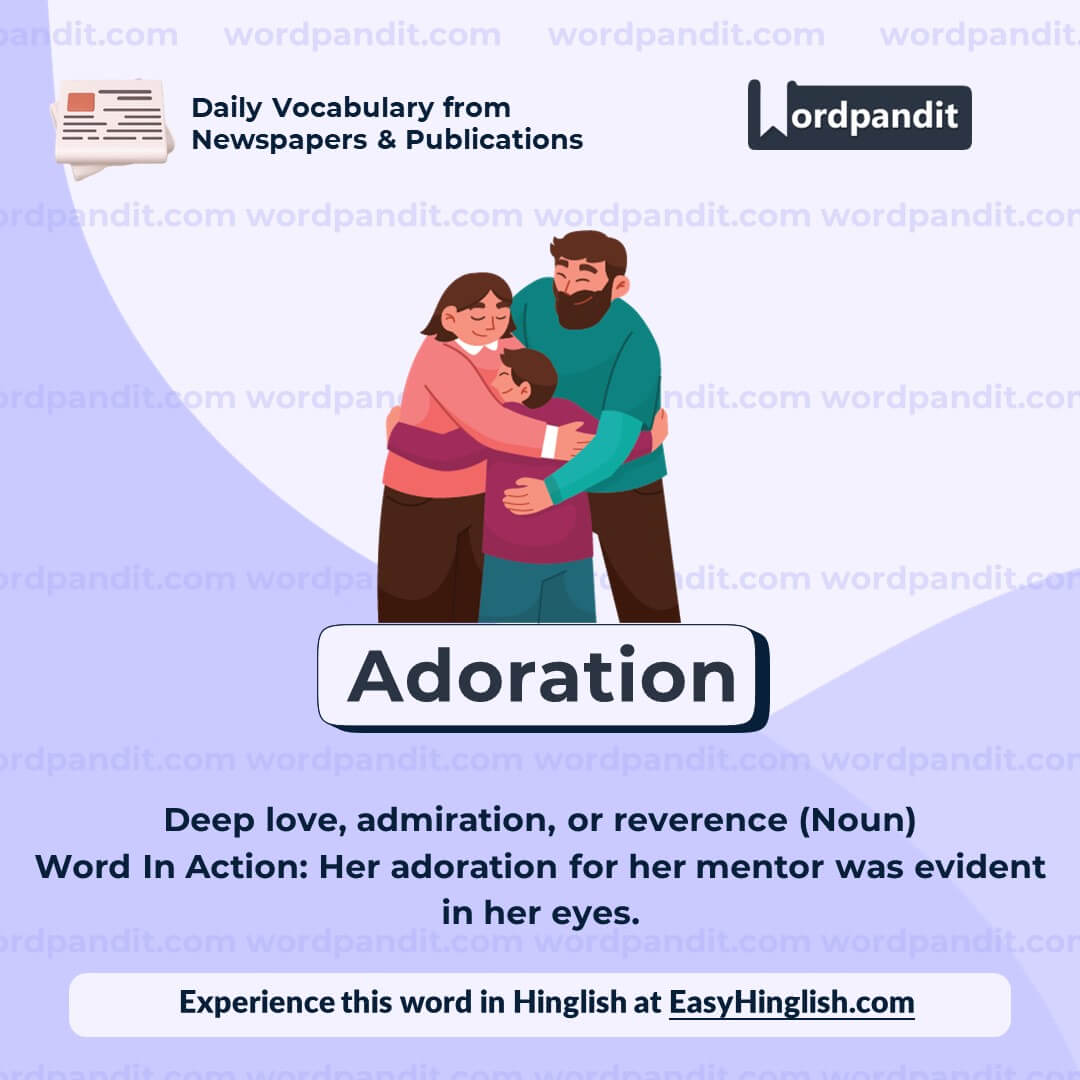
WORD-3: Adoration
Context:
"But the outlook reflected a deep uncertainty about a Republican president who has talked with adoration about tariffs, even saying the U.S. government made a mistake in 1913 by switching to income taxes as its primary revenue source." - Telegraph India
Explanatory Paragraph:
"Adoration" refers to a strong feeling of love, admiration, or deep respect toward someone or something. In the context of the sentence, the word is used somewhat ironically or critically to suggest that the speaker expressed excessive or passionate admiration for tariffs, a topic not typically associated with emotional reverence. The term can describe both sincere and exaggerated forms of love or devotion.
Meaning: Deep love, admiration, or respect (Noun)
Pronunciation: uh-doh-RAY-shun
Difficulty Level: ⭐⭐ Beginner to Intermediate
Etymology: From Latin *adoratio*, meaning “worship,” derived from *adorare* ("to adore"), combining *ad-* ("to") and *orare* ("to speak, pray").
Prashant Sir's Notes:
"Adoration" is often linked to religious or romantic contexts but can also be used sarcastically in political or economic commentary. Pay attention to tone when interpreting this word—adoration isn’t always praise-worthy; sometimes it suggests blind admiration.
Synonyms & Antonyms:
Synonyms: admiration, reverence, devotion, worship, fondness
Antonyms: disdain, contempt, scorn, dislike, indifference
Usage Examples:
- The fans watched the actor with pure adoration as he stepped onto the stage.
- Her adoration for her grandmother was evident in the way she spoke about her.
- The child looked at the puppy with eyes full of adoration.
- Some economists criticized the leader’s adoration of outdated policies.
Cultural Reference:
"Adoration of the Magi" is a famous biblical scene and artistic motif depicting the three wise men offering gifts to the infant Jesus—an ultimate expression of reverent admiration. – Art & Religion
Think About It:
Can adoration ever become dangerous or counterproductive? When does love or admiration cross the line into blind devotion?
Quick Activity:
Write two sentences: one using "adoration" in a sincere way (e.g., romantic or familial), and one where it hints at irony or exaggeration (e.g., politics or celebrity culture).
Memory Tip:
Think of “adore” + “-tion” = the act of adoring. Imagine someone gazing lovingly at a poster of their idol—that’s adoration in action.
Real-World Application:
"Adoration" is commonly used in speeches, literature, and media to express deep affection or, at times, to critique exaggerated enthusiasm. Understanding its tone—whether sincere or sarcastic—is crucial to grasping the speaker’s intent.
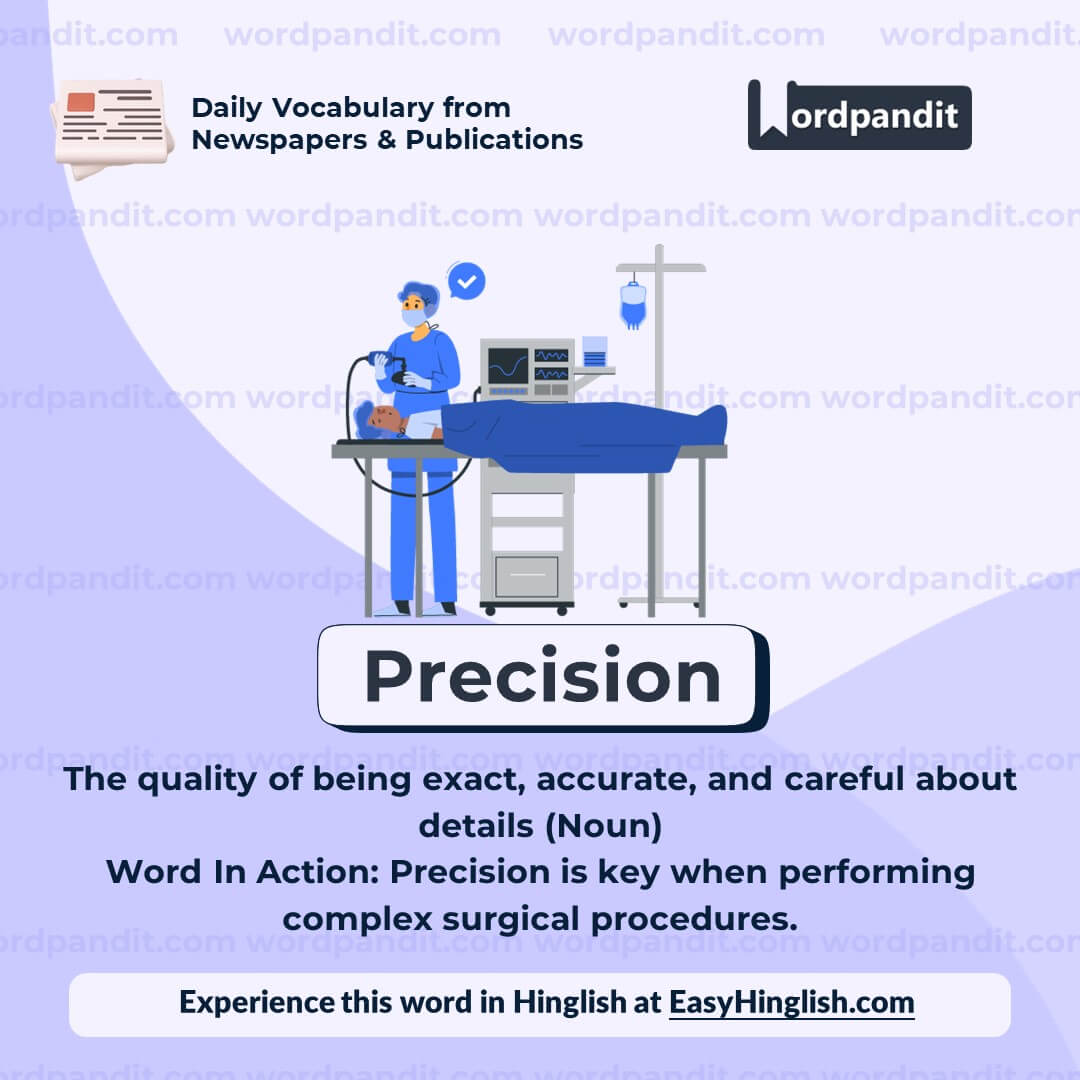
WORD-4: Precision
Context:
"The real power of this app that sets it apart from others is an advanced AI algorithm that analyzes thousands of such signals every minute and is able to predict with extreme precision what to buy and sell at the right time to achieve maximum profit." - The Wire
Explanatory Paragraph:
"Precision" refers to the quality of being exact, accurate, and carefully detailed. In scientific, technological, or financial contexts, precision is vital because even small errors can lead to significant consequences. In the given sentence, the word emphasizes how accurately the AI algorithm can determine the right moments to buy and sell for maximum profitability, suggesting a high level of performance and trustworthiness.
Meaning: The quality of being exact, accurate, or clearly defined (Noun)
Pronunciation: pruh-SIH-zhun
Difficulty Level: ⭐⭐⭐ Intermediate
Etymology: From Latin *praecisio*, meaning "cutting off," derived from *prae-* ("before") + *caedere* ("to cut"), later evolving to mean "exactness" in French and English.
Prashant Sir's Notes:
Precision is a critical word in academic writing, STEM fields, and business. Don’t confuse it with “accuracy”—while related, precision emphasizes consistency and exactness in outcomes. Use it when you want to stress fine detail and reliability.
Synonyms & Antonyms:
Synonyms: accuracy, exactness, meticulousness, rigor, correctness
Antonyms: inaccuracy, vagueness, approximation, imprecision, looseness
Usage Examples:
- The surgeon performed the procedure with incredible precision.
- In mathematics, every step must be done with precision to avoid errors.
- The watchmaker is known for crafting gears with microscopic precision.
- His words were chosen with such precision that no one misunderstood his message.
Cultural Reference:
"Swiss watches are renowned for their precision and craftsmanship, setting a global standard for timekeeping." – International Watch Journal
Think About It:
Is precision always preferable to creativity? In which fields do you think precision is more valuable than imagination?
Quick Activity:
Pick a daily task (like cooking or typing) and write two sentences: one describing it being done with precision, and one without precision. Observe the contrast.
Memory Tip:
Think of a “precise” laser cutting through metal—clean, exact, no errors. Precision is about cutting through chaos with clarity and accuracy.
Real-World Application:
Precision is essential in fields like medicine, engineering, finance, and data science. Whether it’s a financial forecast, a GPS coordinate, or a dosage calculation—precision ensures safety, success, and efficiency.
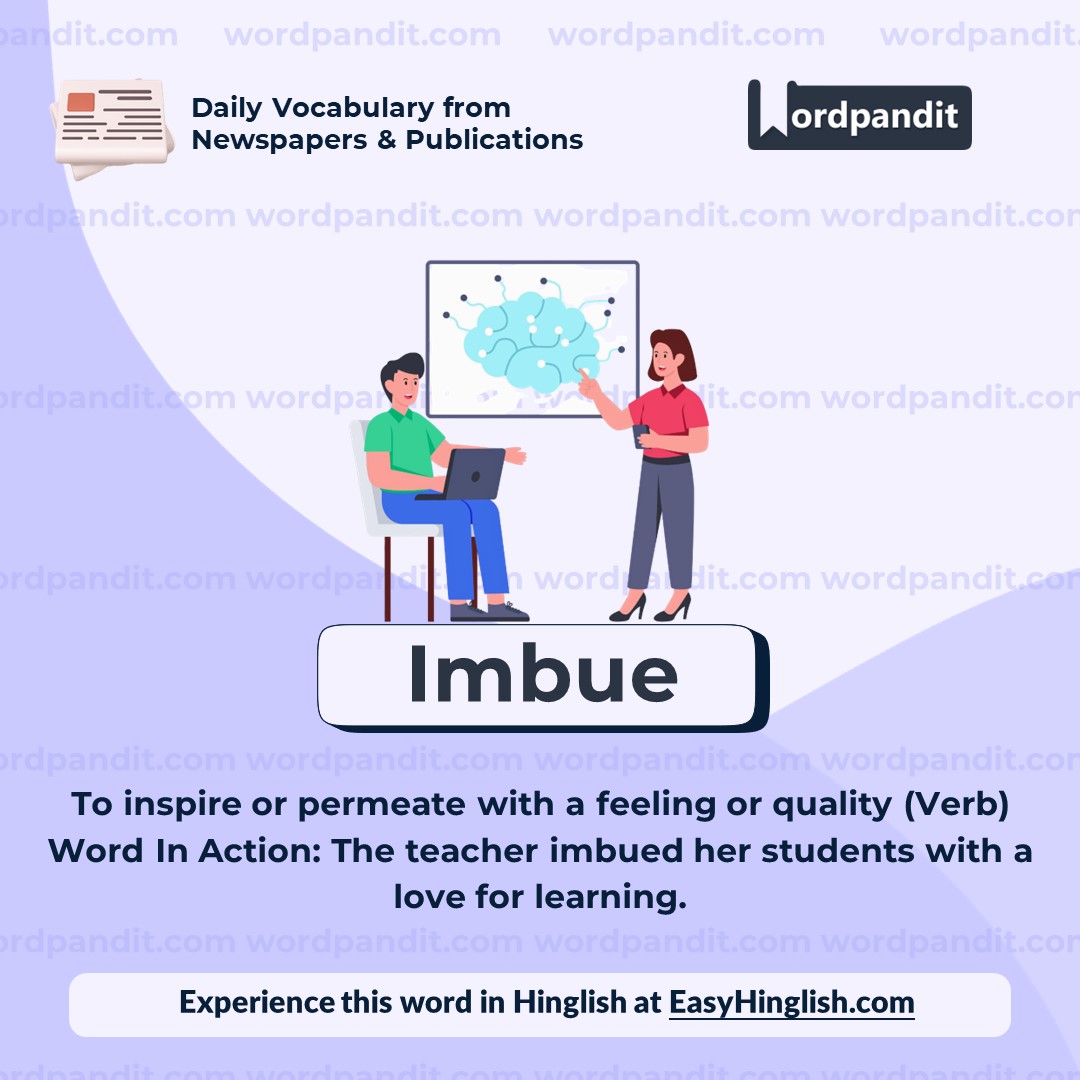
WORD-5: Imbue
Context:
"His war experiences imbued in him a strong sense of patriotism." - Telegraph India
Explanatory Paragraph:
"Imbue" means to deeply inspire or influence someone or something with a particular feeling, quality, or value. It often suggests a gradual, internal infusion, rather than something sudden or superficial. In the context provided, the man's experiences during war instilled in him — or filled him deeply — with a strong feeling of patriotism, shaping his character and beliefs over time.
Meaning: To inspire or permeate deeply with a feeling, quality, or idea (Verb)
Pronunciation: im-BYOO
Difficulty Level: ⭐⭐⭐ Intermediate
Etymology: From Latin *imbuere*, meaning “to moisten, soak, or steep,” later evolving to the figurative sense of mentally or emotionally soaking something in.
Prashant Sir's Notes:
"Imbue" is a beautiful, high-level word often used in literature, essays, or speeches. It's frequently used in the passive voice — e.g., "He was imbued with courage." Use it when describing the inner influence of deep experiences or ideals.
Synonyms & Antonyms:
Synonyms: instill, infuse, inspire, saturate, permeate
Antonyms: drain, deprive, empty, strip
Usage Examples:
- Her writing is imbued with warmth and compassion.
- The teacher imbued her students with a passion for science.
- The architecture is imbued with classical elegance.
- Years of hardship had imbued him with quiet resilience.
Cultural Reference:
"Martin Luther King Jr.’s speeches were imbued with hope, justice, and moral clarity that moved a nation." – Civil Rights Archive
Think About It:
What life experiences or people have imbued you with your core beliefs or values?
Quick Activity:
Write a sentence describing how a place, book, or person has imbued you with a specific feeling or mindset.
Memory Tip:
Think of a sponge soaking up water—just like that, a person can be “soaked” or “imbued” with feelings or values over time.
Real-World Application:
"Imbue" is used in reflective writing, leadership talks, and critiques—ideal when discussing how art, culture, or personal experience influences thoughts, decisions, or identity.


