

Daily Vocabulary from Indian Newspapers and Publications
Welcome to Wordpandit’s Indian Vocabulary Hub
At Wordpandit, we understand the importance of staying rooted in the local context while expanding your language skills. This section focuses on enriching your vocabulary with words and phrases drawn from India’s leading newspapers and publications, ensuring you're learning vocabulary that is practical, relevant, and uniquely Indian.
Why Indian Sources Matter
We believe that the best way to master any language is by immersing yourself in local content. That’s why we carefully curate vocabulary from top Indian publications, including:
- The Hindu
- The Times of India
- The Economic Times
- Hindustan Times
- Live Mint
- The Indian Express
- And many others...
Stay Updated, Stay Relevant
With daily updates from Indian news sources, you’ll be consistently learning words that reflect the trends and shifts in Indian society and culture. Our focus is to provide vocabulary that enhances your understanding of the language in an Indian context.
How Wordpandit Supports Your Goals
Whether you’re preparing for exams, aiming to improve your professional communication, or simply want to stay connected with the latest Indian vocabulary, Wordpandit is here to guide you every step of the way.
Learn with a Practical Approach
Our interactive learning methodology includes real-world examples, engaging activities, and context-specific usage to ensure that every word becomes part of your active vocabulary.
Dive into Indian Vocabulary Today!

Why Choose Wordpandit?
Practical Learning: Focus on words you'll actually encounter in real-world reading, enhancing your comprehension and communication skills.
Diverse Content: From current affairs to scientific breakthroughs, our varied sources expose you to vocabulary across multiple domains.
Effortless Integration: Make Wordpandit a part of your daily routine. Just a few minutes each day can significantly boost your lexicon over time.
Your Path to Vocabulary Mastery
- Visit our Daily Vocabulary section regularly
- Explore new words and their usage in context
- Practice incorporating these words into your own writing and speech
- Track your progress as your vocabulary expands
Start Your Journey Today
Embark on your vocabulary enhancement journey with Wordpandit. By consistently engaging with our daily posts, you'll build a robust vocabulary that serves you well in academic, professional, and personal contexts.
Remember, a word a day keeps linguistic limitations at bay. Make Wordpandit your daily companion in the quest for vocabulary excellence!
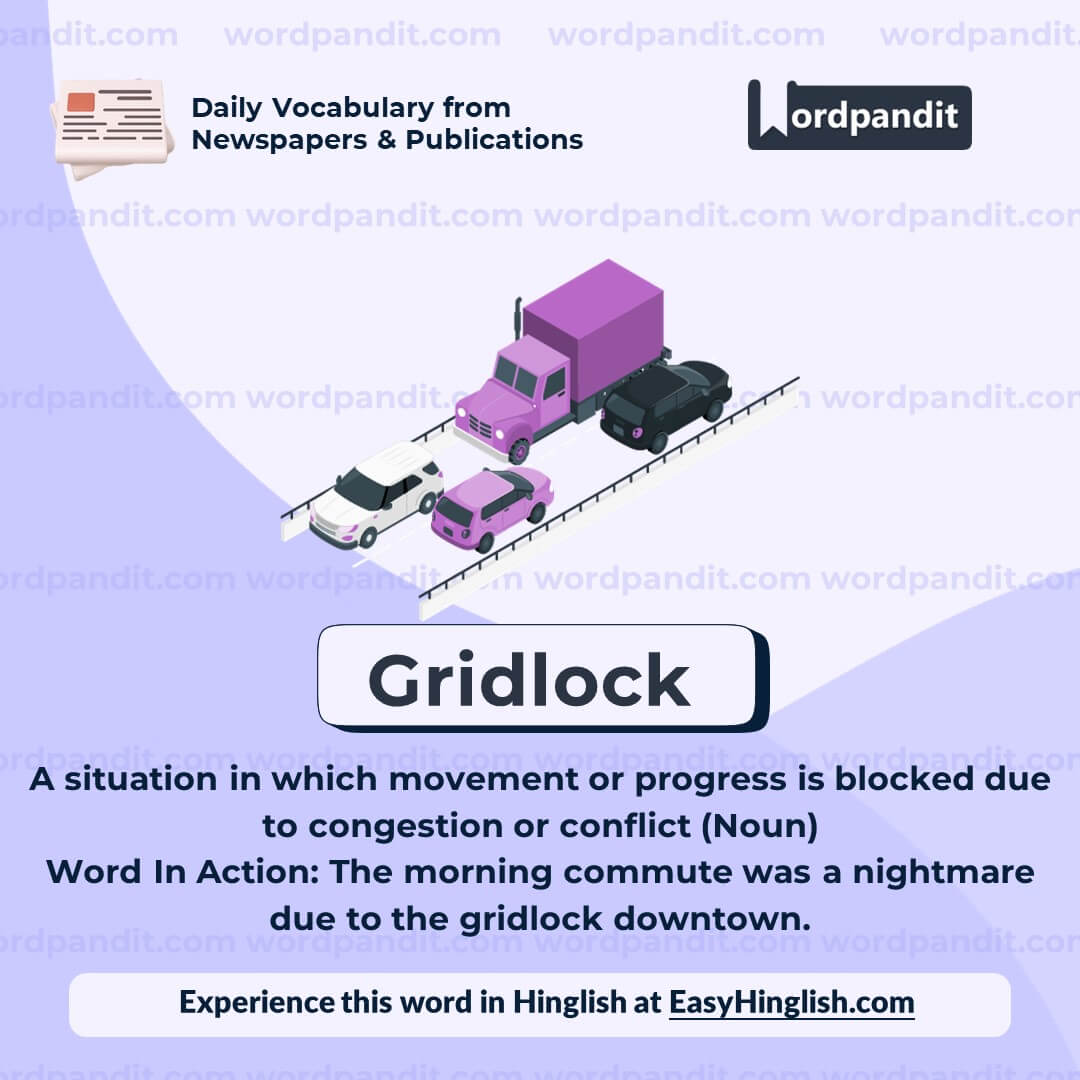
WORD-1: Gridlock
Context:
"The administration, on its part, allowed the crowd freer movement across most of the Mela area, avoiding the gridlock of roadblocks that had worsened the crush on Wednesday and set the stage for the stampede." - The Wire
Explanatory Paragraph:
The word "gridlock" refers to a situation where movement is completely halted due to overcrowding or congestion. Originally used to describe traffic jams where vehicles are stuck and cannot move in any direction, it has also come to describe any situation — political, logistical, or social — where progress is blocked. In the context above, "gridlock" describes the immobility caused by too many people and physical barriers, which contributed to a dangerous crowd situation.
Meaning: A situation of severe congestion or complete standstill, especially in traffic or processes (noun)
Pronunciation: GRID-lok
Difficulty Level: ⭐⭐ Beginner to Intermediate
Etymology: Coined in the early 1980s in the U.S., combining “grid” (a network of streets) and “lock” (immobilize).
Prashant Sir's Notes:
This is a powerful metaphor for not just traffic, but also for any kind of systemic blockage — whether in governance, meetings, or technology. Think of gridlock as a deadlock in motion.
Synonyms & Antonyms:
Synonyms: jam, stalemate, bottleneck, deadlock, congestion
Antonyms: flow, clearance, movement, progress
Usage Examples:
- After the accident on the highway, the entire city was caught in a gridlock that lasted hours.
- Negotiations between the two countries reached a gridlock, with neither side willing to compromise.
- The old IT system created a gridlock in processing applications during peak hours.
- The protest led to a gridlock in front of the parliament building, stopping all traffic.
Cultural Reference:
"Washington is experiencing legislative gridlock, with Congress unable to pass even basic funding bills." - A common phrase in U.S. political discourse
Think About It:
Have you ever been part of a situation — in a group or system — where things were stuck? What caused that ‘gridlock,’ and what broke it?
Quick Activity:
Think of a recent news story involving traffic or politics. Try to describe it using the word "gridlock" in a sentence.
Memory Tip:
Imagine cars in a "grid" (city street map) being "locked" in place. Grid + lock = stuck in place.
Real-World Application:
Urban planners, politicians, and project managers often use "gridlock" to describe stalled progress — whether on roads, policies, or pipelines. Understanding the word helps articulate challenges in complex systems.
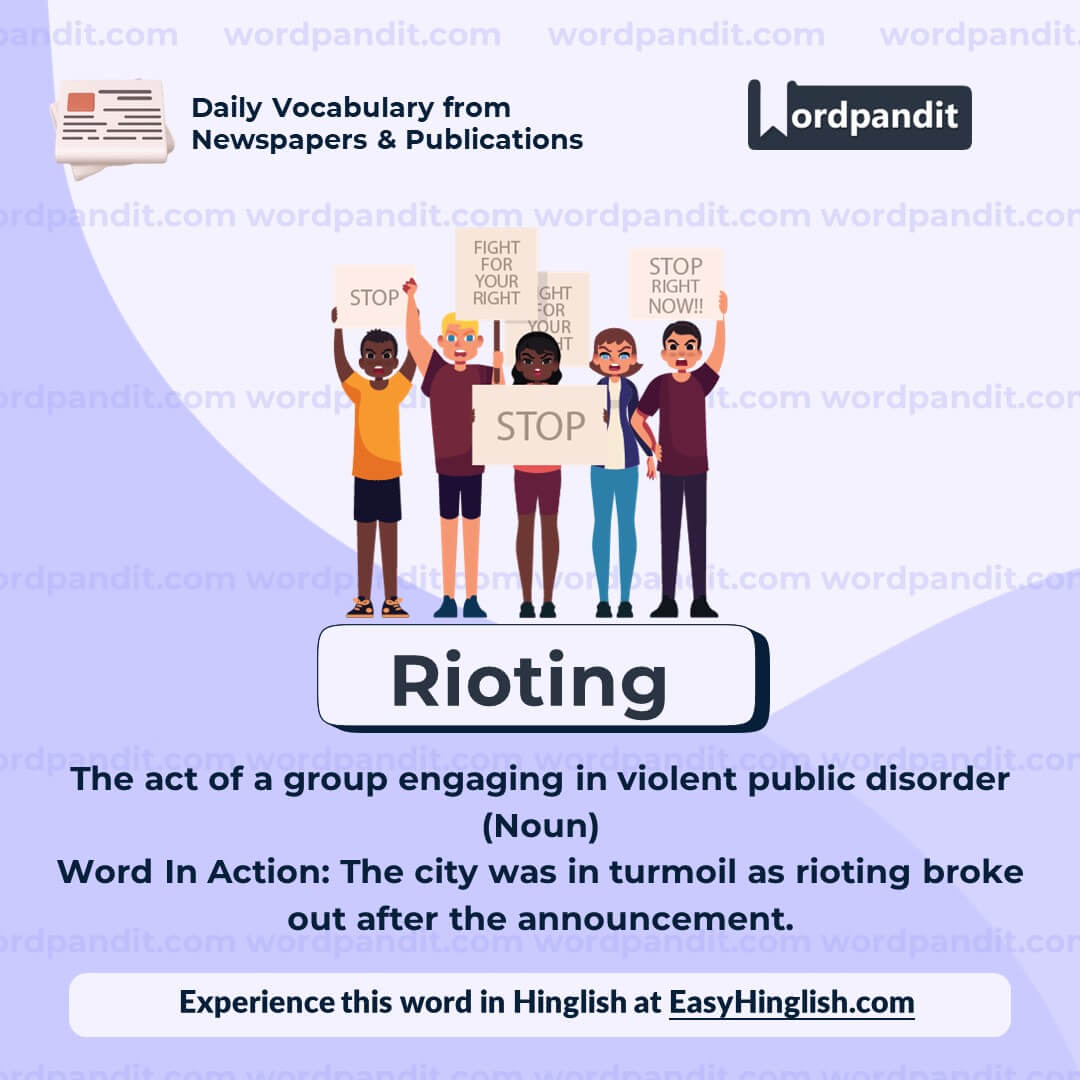
WORD-2: Rioting
Context:
"This was not a case of rioting or murder." - The Wire
Explanatory Paragraph:
“Rioting” refers to a violent public disturbance involving a group of people who engage in destructive or unlawful behavior. Riots often arise from political protests, social unrest, or extreme emotional responses and can include acts like looting, vandalism, or clashing with authorities. In the given sentence, the speaker is clarifying that the incident in question did not involve a public outburst of violence, separating it from criminal acts like murder or mass upheaval.
Meaning: Violent or disorderly public behavior by a crowd (noun)
Pronunciation: RY-uh-ting
Difficulty Level: ⭐⭐ Intermediate
Etymology: Derived from the Old French word “riote,” meaning ‘dispute’ or ‘quarrel’; evolved into Middle English “riote,” referring to noisy or unruly behavior.
Prashant Sir's Notes:
Think of rioting as chaos in motion — it’s not just a protest, but a breakdown of public order. Always remember: protesting is legal; rioting is criminal.
Synonyms & Antonyms:
Synonyms: upheaval, unrest, mayhem, insurrection, turmoil
Antonyms: peace, order, calm, harmony
Usage Examples:
- The city was placed under curfew after a night of rioting left several buildings damaged.
- Videos of the rioting went viral, raising questions about police response.
- Authorities blamed social media for fueling the rioting across multiple districts.
- Although the protest began peacefully, it quickly escalated into rioting when clashes broke out.
Cultural Reference:
"The 1992 Los Angeles riots, sparked by the acquittal of police officers in the Rodney King case, remain one of the most infamous examples of modern American rioting." - History.com
Think About It:
What distinguishes a protest from a riot? At what point does public anger cross into criminality?
Quick Activity:
Write two sentences: one using "protest" and one using "rioting." Compare the tone and intensity of both.
Memory Tip:
Remember: "Riot" has the word “riot” in "riotous” — wild, chaotic, loud. So “rioting” means the act of causing such wild disorder.
Real-World Application:
Understanding the term “rioting” is crucial in media literacy and civic education. It helps differentiate between lawful dissent and unlawful disorder, especially when analyzing news, history, or law enforcement actions.
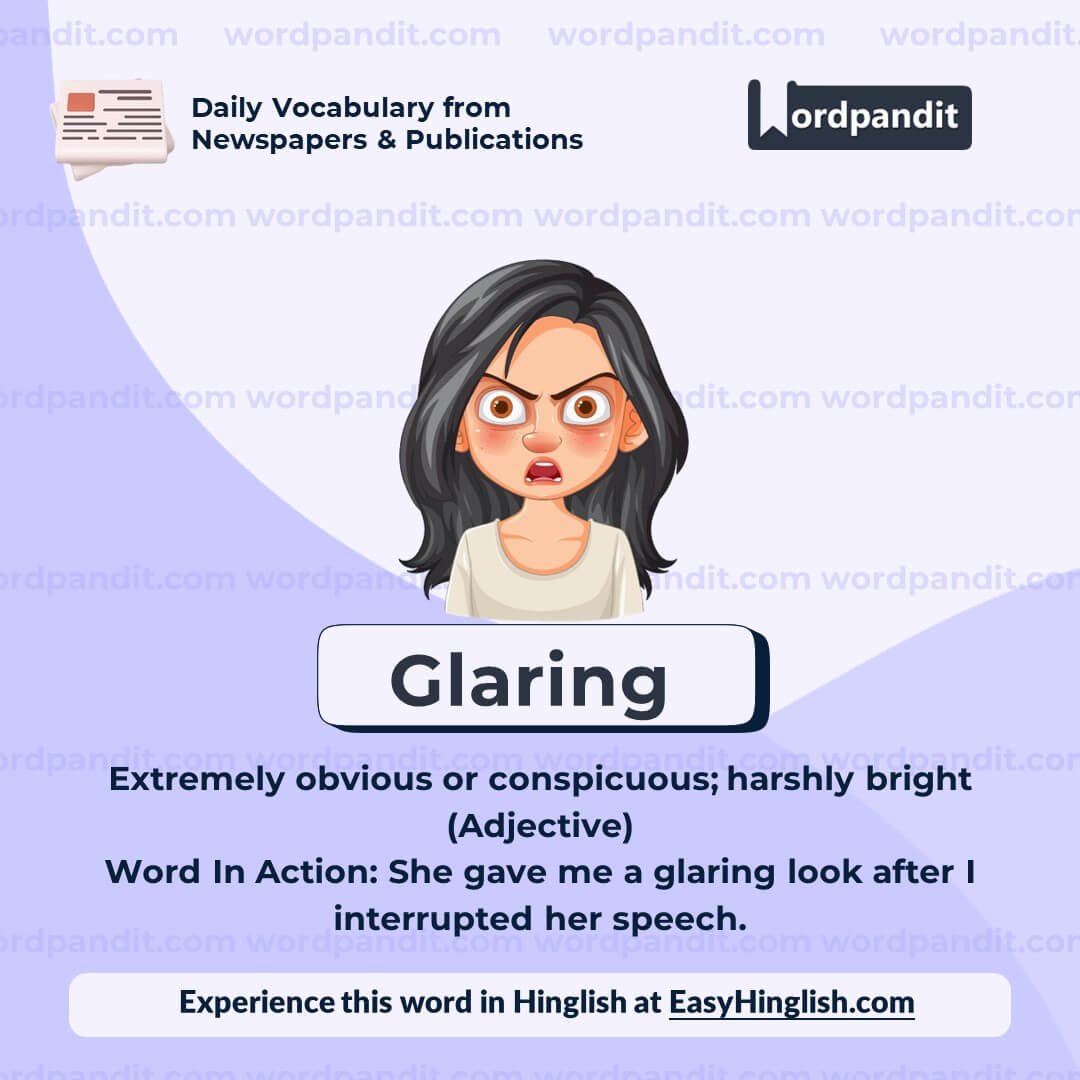
WORD-3: Glaring
Context:
"It was only after eight days, after an enquiry had also found glaring evidence of the assault, that a case was registered." - The Wire
Explanatory Paragraph:
The word “glaring” in this context means something very obvious, impossible to ignore, or so clear that it demands attention — often used with a negative or serious connotation. When we say “glaring evidence,” we mean evidence that is so apparent and undeniable that it almost shines like a bright light. The word can also be used literally, to describe something intensely bright or shining. Here, it emphasizes how clear and compelling the proof of assault was, making the delay in registering a case even more striking.
Meaning: Very obvious or conspicuous, often in a negative way (adjective)
Pronunciation: GLAIR-ing
Difficulty Level: ⭐⭐ Intermediate
Etymology: From the verb “glare,” meaning to shine with a strong, harsh light or to stare angrily; Middle English origin, from Old Norse “glára.”
Prashant Sir's Notes:
“Glaring” is often used to describe flaws, errors, or truths that cannot be hidden. Think of a spotlight exposing something that was trying to remain in the shadows — that's a glaring fact.
Synonyms & Antonyms:
Synonyms: obvious, blatant, unmistakable, flagrant, conspicuous
Antonyms: subtle, hidden, faint, inconspicuous
Usage Examples:
- The report contained glaring mistakes that anyone could notice.
- Her glaring disapproval was evident in the way she stared at him.
- There was a glaring gap in the company’s safety procedures.
- Despite the glaring sunlight, he refused to wear sunglasses.
Cultural Reference:
"The most glaring flaw in the system is not the laws, but the lack of will to enforce them." - A frequent critique in political commentary
Think About It:
Why do glaring truths sometimes get ignored, even when they’re right in front of us?
Quick Activity:
Identify a situation from your life or current events where something was so obvious it couldn’t be ignored. Write a sentence using the word “glaring.”
Memory Tip:
Think of “glaring” like a flashlight in your face — it’s impossible to ignore. So is glaring evidence or a glaring mistake.
Real-World Application:
The word “glaring” is often used in journalism, legal writing, and critique — especially to highlight mistakes, oversights, or truths that are too evident to be denied. Recognizing this tone can help in interpreting opinion pieces and investigative reports.
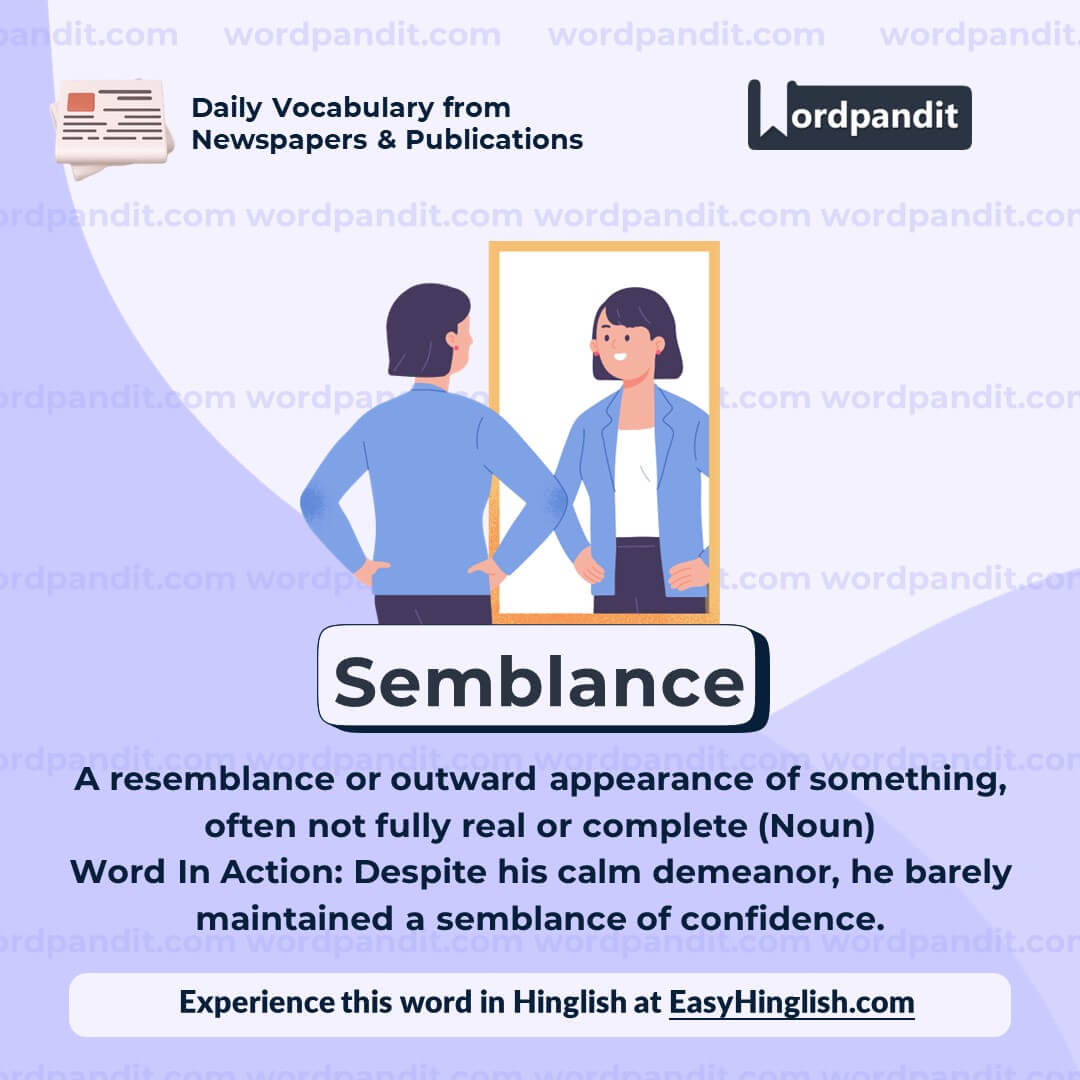
WORD-4: Semblance
Context:
"Hamas security officials have also re-emerged to assert a semblance of order across the territory, stopping and screening vehicles and trying to defuse unexploded ordnance." - Telegraph India
Explanatory Paragraph:
The word “semblance” refers to the appearance or outward form of something, which may not fully reflect the reality. It is often used to describe a situation where things seem to be under control or normal, even if that control or normalcy is incomplete or superficial. In the context above, "a semblance of order" suggests that the security forces are trying to give the impression that order has been restored, even if the situation remains tense or unstable underneath.
Meaning: The outward appearance or apparent form of something, especially when the reality is different (noun)
Pronunciation: SEM-bluns
Difficulty Level: ⭐⭐⭐ Intermediate to Advanced
Etymology: From Old French *semblance* meaning "appearance," and from Latin *simulare*, meaning "to imitate" or "pretend."
Prashant Sir's Notes:
“Semblance” is a useful word when talking about illusions, surface-level appearances, or situations where things seem stable or real, but aren't completely. It’s often used in journalism and literature to signal that reality might be different from what is visible.
Synonyms & Antonyms:
Synonyms: appearance, illusion, facade, impression, guise
Antonyms: reality, truth, authenticity, genuineness
Usage Examples:
- Even during the crisis, the leader maintained a semblance of calm to reassure the citizens.
- Her smile gave the semblance of happiness, but her eyes told a different story.
- The old building was cleaned up to create a semblance of respectability for the event.
- Although the company was failing, the CEO projected a semblance of success to investors.
Cultural Reference:
"All that glitters is not gold" — this classic line from Shakespeare captures the idea behind “semblance,” where something looks valuable or real but may not be so underneath.
Think About It:
Can appearances be trusted? How often do people or institutions maintain a semblance of control to hide chaos?
Quick Activity:
Think of a news story or personal experience where things looked under control but were actually not. Describe it using the word “semblance.”
Memory Tip:
Remember: “Semblance” sounds like “resemblance” — both deal with appearances. If something gives a semblance of truth, it just looks like the truth, not necessarily the real thing.
Real-World Application:
Understanding “semblance” helps in analyzing media, politics, and personal interactions — especially when distinguishing between perception and reality. It’s a key word in critical thinking and emotional intelligence.
WORD-5: Palatable
Context:
"The soup was too bland for my taste, so I added some salt and pepper to make it palatable." - Telegraph India
Explanatory Paragraph:
“Palatable” refers to something that is pleasant or acceptable to taste — in a literal sense, it means food or drink that tastes good. However, it can also be used metaphorically to describe something that is mentally or emotionally acceptable. In the sentence above, it is used in its literal sense — the soup was too tasteless, and needed seasoning to become enjoyable or “palatable.” The word is often used to express whether something is agreeable or tolerable, either to the tongue or to the mind.
Meaning: Pleasant to taste; acceptable or agreeable (adjective)
Pronunciation: PAL-uh-tuh-bul
Difficulty Level: ⭐⭐ Intermediate
Etymology: From Late Latin *palatabilis*, from *palatum* meaning "palate" (the roof of the mouth), combined with the suffix "-able."
Prashant Sir's Notes:
Use “palatable” beyond food — ideas, plans, or even compromises can be palatable if they are acceptable. Always link it with the idea of “can I accept or digest this?”
Synonyms & Antonyms:
Synonyms: tasty, appetizing, agreeable, acceptable, flavorful
Antonyms: unpalatable, bland, distasteful, unpleasant, revolting
Usage Examples:
- The chef used herbs and spices to make the dish more palatable.
- She found the proposal more palatable once the financial risks were explained clearly.
- The idea of downsizing was unpalatable to most employees.
- His honest feedback, though harsh, was made palatable by his kind tone.
Cultural Reference:
In food critique shows like *MasterChef*, judges often say a dish is “not palatable” when it’s poorly seasoned or has off-putting flavors, highlighting how central this word is to culinary vocabulary.
Think About It:
What makes something — a food, an idea, or even a truth — more palatable to us? Is it the content, or the way it is delivered?
Quick Activity:
Choose a difficult truth you’ve had to accept recently. Write a sentence describing how someone made it more palatable for you.
Memory Tip:
Think of “palatable” as related to your “palate” — if your palate likes it, it’s palatable! Easy to accept, whether it’s food or an idea.
Real-World Application:
In everyday communication, making your message palatable — through tone, empathy, or clarity — can lead to better understanding and less resistance. This word is especially useful in negotiation, communication, and leadership contexts.


