

Daily Vocabulary from Indian Newspapers and Publications
Welcome to Wordpandit’s Indian Vocabulary Hub
At Wordpandit, we understand the importance of staying rooted in the local context while expanding your language skills. This section focuses on enriching your vocabulary with words and phrases drawn from India’s leading newspapers and publications, ensuring you're learning vocabulary that is practical, relevant, and uniquely Indian.
Why Indian Sources Matter
We believe that the best way to master any language is by immersing yourself in local content. That’s why we carefully curate vocabulary from top Indian publications, including:
- The Hindu
- The Times of India
- The Economic Times
- Hindustan Times
- Live Mint
- The Indian Express
- And many others...
Stay Updated, Stay Relevant
With daily updates from Indian news sources, you’ll be consistently learning words that reflect the trends and shifts in Indian society and culture. Our focus is to provide vocabulary that enhances your understanding of the language in an Indian context.
How Wordpandit Supports Your Goals
Whether you’re preparing for exams, aiming to improve your professional communication, or simply want to stay connected with the latest Indian vocabulary, Wordpandit is here to guide you every step of the way.
Learn with a Practical Approach
Our interactive learning methodology includes real-world examples, engaging activities, and context-specific usage to ensure that every word becomes part of your active vocabulary.
Dive into Indian Vocabulary Today!
Why Choose Wordpandit?
Practical Learning: Focus on words you'll actually encounter in real-world reading, enhancing your comprehension and communication skills.
Diverse Content: From current affairs to scientific breakthroughs, our varied sources expose you to vocabulary across multiple domains.
Effortless Integration: Make Wordpandit a part of your daily routine. Just a few minutes each day can significantly boost your lexicon over time.
Your Path to Vocabulary Mastery
- Visit our Daily Vocabulary section regularly
- Explore new words and their usage in context
- Practice incorporating these words into your own writing and speech
- Track your progress as your vocabulary expands
Start Your Journey Today
Embark on your vocabulary enhancement journey with Wordpandit. By consistently engaging with our daily posts, you'll build a robust vocabulary that serves you well in academic, professional, and personal contexts.
Remember, a word a day keeps linguistic limitations at bay. Make Wordpandit your daily companion in the quest for vocabulary excellence!
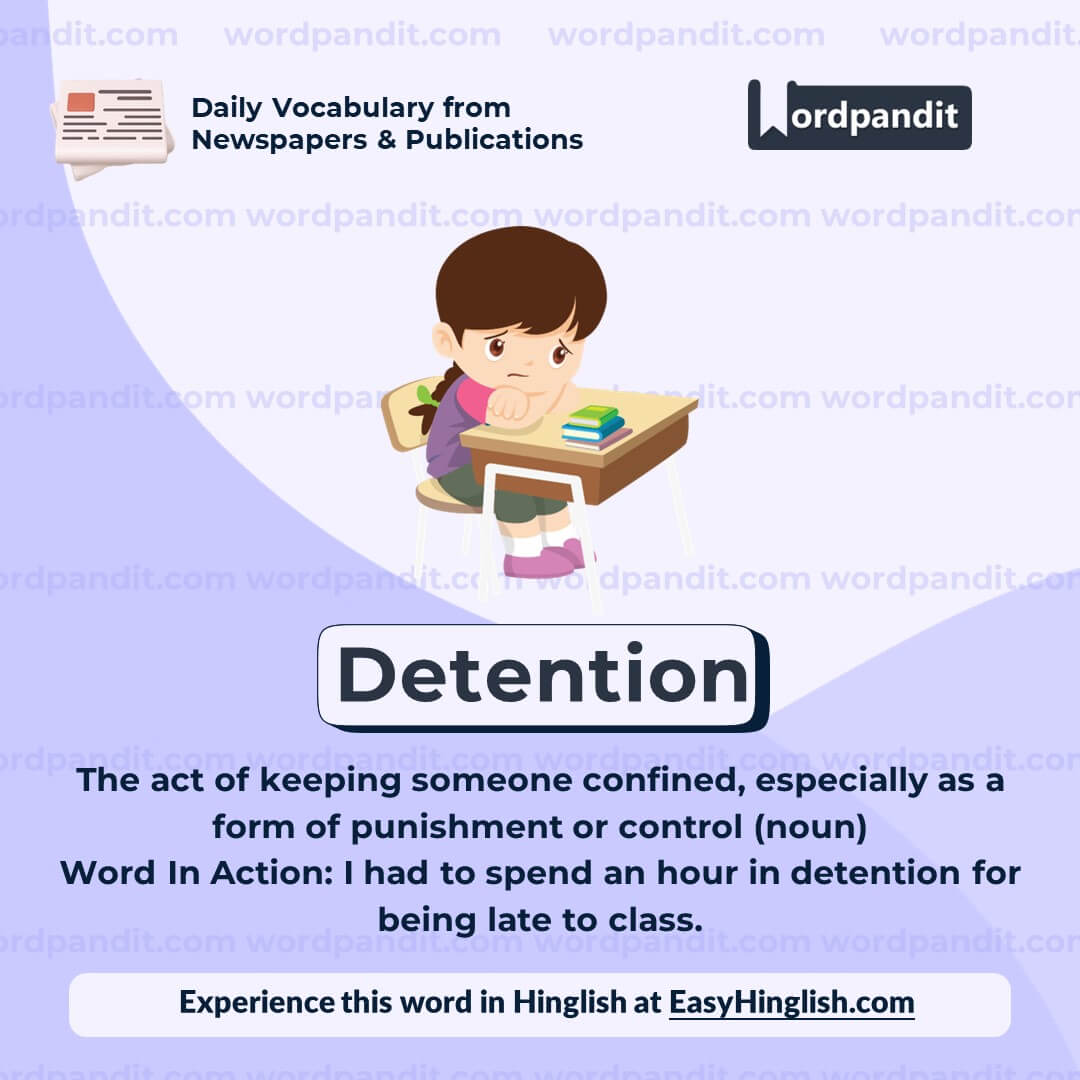
WORD-1: Detention
Context:
"To stop any further arbitrary detention of Rohingya refugees”. Also, for “diplomatic discussions” between Myanmar, the United States, India, and ASEAN and SAARC nations for “ceasing genocidal violence on the Rohingya people”." - The Wire
Explanatory Paragraph:
The word "detention" refers to the act of holding someone in custody, typically by legal or governmental authority. It is often used in contexts involving law enforcement, immigration, or national security. In the sentence above, it highlights concerns about refugees being confined without due process. Detention can be temporary or prolonged and may or may not involve criminal charges. In human rights discussions, "arbitrary detention" refers to imprisonment without proper legal justification.
Meaning: The act of keeping someone in custody, often as a legal or punitive measure (Noun)
Pronunciation: dih-TEN-shuhn
Difficulty Level: ⭐⭐ Basic
Etymology: From Latin *detentio*, meaning "a keeping back or withholding", from *detinere*, "to detain"
Prashant Sir's Notes:
"Detention" is frequently used in news and legal documents, especially regarding arrests, immigration issues, or protests. Watch for its use in both negative and neutral contexts depending on legality and justification.
Synonyms & Antonyms:
Synonyms: confinement, imprisonment, custody, incarceration, restraint
Antonyms: release, freedom, liberation, discharge
Usage Examples:
- The student was placed in after-school detention for repeatedly breaking classroom rules.
- The journalist's detention sparked international outcry over press freedom.
- Many asylum seekers faced prolonged detention while their paperwork was being processed.
- The court ruled that the detention of the protesters was unlawful.
Cultural Reference:
"You mess with the bull, you get the horns." — said by the principal in *The Breakfast Club* (1985), a film set almost entirely in a high school detention room. - Universal Pictures
Think About It:
How can we balance national security concerns with human rights when it comes to the detention of individuals?
Quick Activity:
Write a short paragraph using the word “detention” in a legal, school, and international context. Try to vary the tone and formality in each.
Memory Tip:
Think of “detention” as “de-tension” — but only for your freedom! You lose freedom and gain tension when you're in detention.
Real-World Application:
"Detention" is commonly used in discussions on law enforcement, refugee crises, student discipline, and immigration policy. Understanding its implications is vital in debates on justice and governance.
WORD-2: Exemplified
Context:
"Following the incident, the nation reverted to a well-documented pattern. A harrowing incident occurs, triggering grave and sudden outrage, often accompanied by demands for harsher punishments for the accused, as exemplified by the Aparajita Bill." - The Wire
Explanatory Paragraph:
The word "exemplified" means to serve as a typical or clear example of something. In the sentence above, it is used to show how the Aparajita Bill represents or illustrates the general pattern of public and political reaction following a tragic incident. When something is exemplified, it becomes a model or case that makes a broader concept easier to understand through concrete illustration.
Meaning: To illustrate or serve as an example of something (Verb - past tense)
Pronunciation: ig-ZEM-pluh-fied
Difficulty Level: ⭐⭐⭐ Intermediate
Etymology: From Latin *exemplum* meaning "example" and *facere* meaning "to make or do"
Prashant Sir's Notes:
"Exemplified" is commonly used in formal and academic writing to highlight a case or example that clarifies or supports an argument. It's especially useful in analytical essays and critical discussions.
Synonyms & Antonyms:
Synonyms: illustrated, demonstrated, represented, embodied, symbolized
Antonyms: obscured, misrepresented, confused, concealed
Usage Examples:
- Her leadership was exemplified during the crisis when she took swift and decisive action.
- The architecture of the museum exemplified minimalist design principles.
- The athlete's dedication to training exemplified true discipline and focus.
- That case exemplified the dangers of ignoring early warning signs.
Cultural Reference:
"Martin Luther King Jr. exemplified the power of peaceful protest." - Often cited in civil rights literature and history education.
Think About It:
Can one single event truly exemplify a broader societal pattern, or do we risk oversimplifying complex issues when we generalize?
Quick Activity:
Write three original sentences using "exemplified" to describe different areas: a person, a policy, and a historical event.
Memory Tip:
“Exemplified” contains “example” — just think of it as “made into an example.” That’s what it means!
Real-World Application:
"Exemplified" is frequently used in academic writing, news analysis, presentations, and legal arguments to highlight specific cases that represent broader trends or principles.
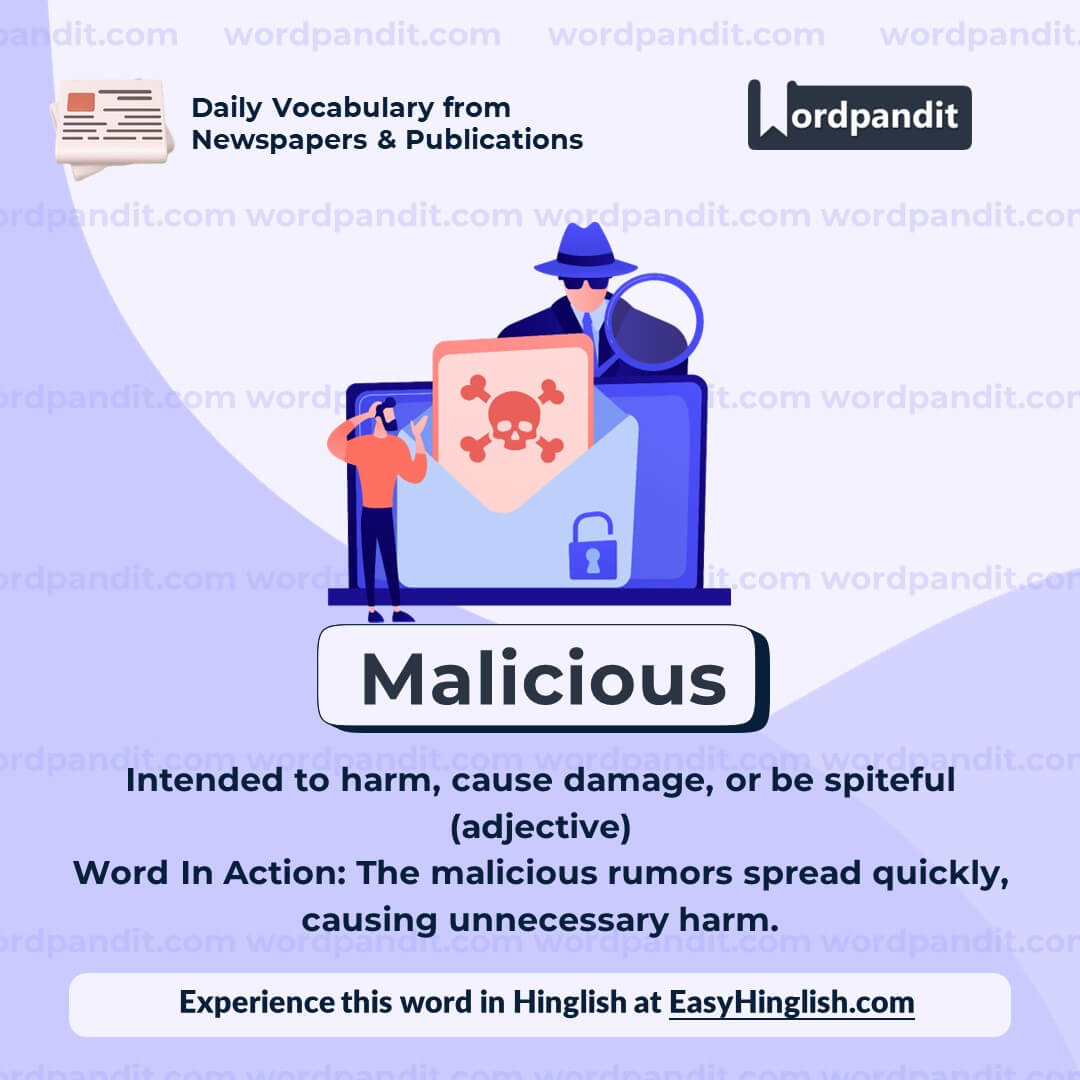
WORD-3: Malicious
Context:
"PLA focused on five capabilities, namely, land-based missiles to meet the challenge of western combat fighters; cyber to insert malware (malicious software) or software weapons to disrupt and destroy data or information passing through cyberspace in enemy’s information and communication systems." - The Wire
Explanatory Paragraph:
"Malicious" describes something that is intended to cause harm, damage, or suffering—either physically, emotionally, or digitally. In the context of cyber warfare, malicious software (or malware) refers to programs designed to infiltrate, damage, or disrupt computer systems. The word implies deliberate ill-intent or hostility, whether in human behavior or technological tools. It's often used in legal, cybersecurity, and everyday emotional contexts.
Meaning: Intending or intended to do harm (Adjective)
Pronunciation: muh-LISH-uhs
Difficulty Level: ⭐⭐⭐ Intermediate
Etymology: From Old French *malicious*, from Latin *malitiosus* meaning "wicked" or "full of bad intent", from *malitia* (malice)
Prashant Sir's Notes:
"Malicious" is not just about physical harm—it often shows up in emotional, verbal, and cyber contexts. The key is intention: if the action is meant to harm or deceive, it is malicious. Also, note how commonly it's used in cybersecurity discussions today.
Synonyms & Antonyms:
Synonyms: harmful, spiteful, malevolent, vindictive, hostile
Antonyms: kind, benevolent, helpful, supportive, friendly
Usage Examples:
- He spread malicious rumors to damage her reputation.
- The malicious code crashed thousands of systems worldwide.
- Her comment was not just rude—it was intentionally malicious.
- Authorities warned users about a new malicious app stealing personal data.
Cultural Reference:
"Maleficent," the villain from *Sleeping Beauty*, is the embodiment of a malicious character—powerful, vengeful, and driven by spite. - Disney
Think About It:
Can malicious intent ever be justified if the outcome benefits the majority? Does the end ever justify the means?
Quick Activity:
Write down five real-life or fictional situations where an action could be labeled as malicious. Identify whether the intent was emotional, physical, or digital.
Memory Tip:
Think of “malicious” as containing “mal-” (bad) and “-icious” like “vicious” — together, they mean “bad and vicious.”
Real-World Application:
"Malicious" is frequently used in law, cybersecurity, psychology, and journalism to describe harmful behavior or technology. Recognizing malicious intent helps in preventing manipulation, scams, and digital threats.
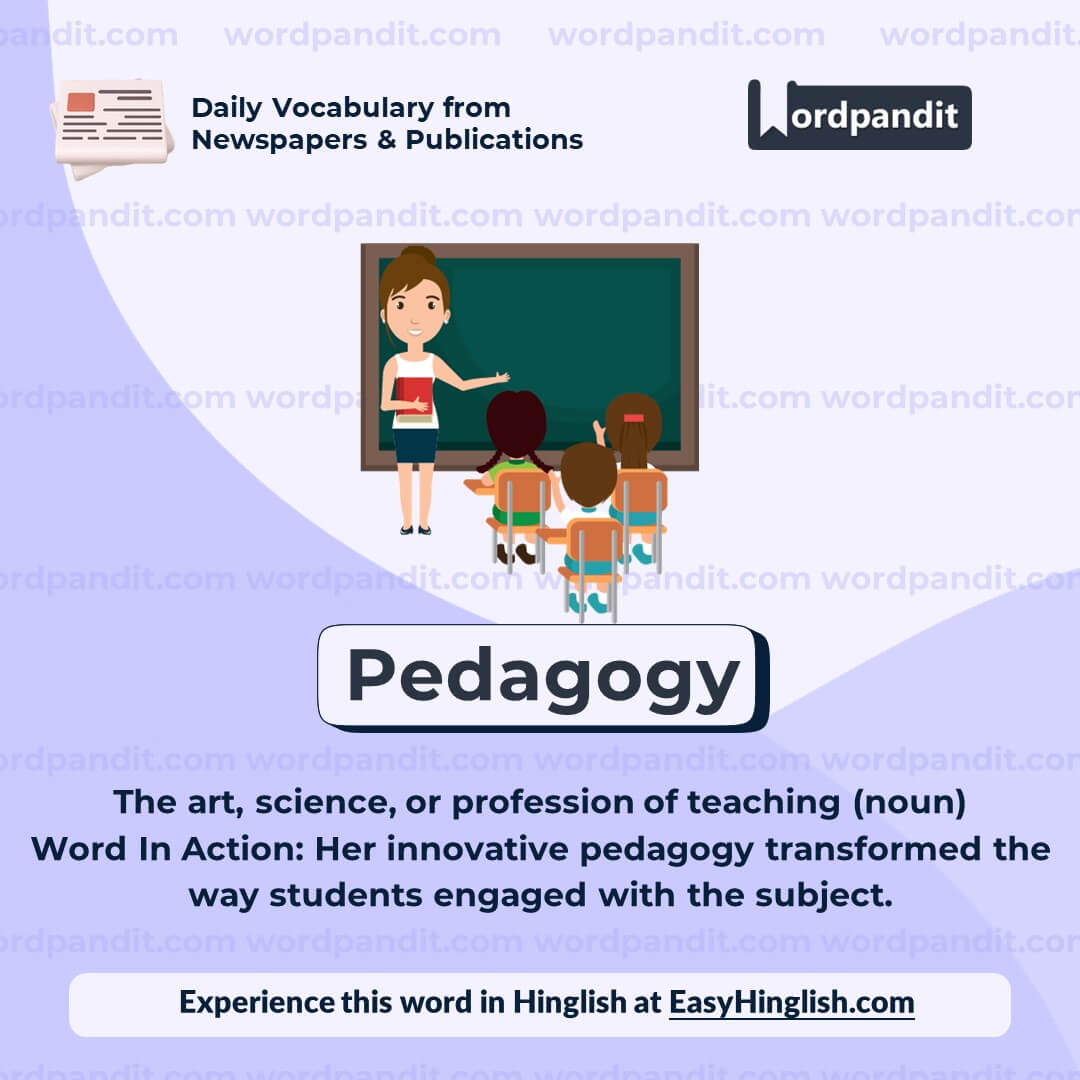
WORD-4: Pedagogy
Context:
"New painting is perhaps a product of Project Udbhav, which is a collaborative endeavour of the Indian Army and the United Services Institution of India, seeking to ‘integrate age-old wisdom with contemporary military pedagogy’." - The Wire
Explanatory Paragraph:
"Pedagogy" refers to the art, science, or method of teaching. It goes beyond simply delivering information—it includes strategies, philosophies, and techniques that educators use to help others learn. In this context, "military pedagogy" relates to the structured approach used in military training and education, blending traditional principles with modern instructional methods. The term is widely used in both academic and professional training environments.
Meaning: The method and practice of teaching, especially as an academic subject or theoretical concept (Noun)
Pronunciation: PED-uh-goh-jee
Difficulty Level: ⭐⭐⭐ Intermediate
Etymology: From Greek *paidagōgia*, meaning "instruction of children", from *pais* (child) + *agōgos* (leader or guide)
Prashant Sir's Notes:
"Pedagogy" is a key term in education and training fields. It refers not just to what is taught, but *how* it is taught. It's useful to distinguish it from "curriculum" (what is taught) and "andragogy" (methods of teaching adults).
Synonyms & Antonyms:
Synonyms: teaching method, instructional approach, educational theory, didactics
Antonyms: miseducation, ignorance, unstructured learning
Usage Examples:
- The professor introduced a new pedagogy to make complex topics more accessible.
- Online education has significantly changed traditional pedagogies.
- Effective pedagogy includes both the content and the way it is delivered.
- Military pedagogy often emphasizes discipline, repetition, and scenario-based learning.
Cultural Reference:
"Pedagogy of the Oppressed" by Paulo Freire is a landmark book that reshaped educational thinking by focusing on liberating education. - Education and Critical Theory
Think About It:
Should pedagogy evolve to match technological changes, or should core teaching principles remain the same across time and platforms?
Quick Activity:
Think of a teacher or coach you admired. Write down what you believe was unique about their pedagogy—how did their teaching methods help you learn better?
Memory Tip:
Break it down: “Ped” (child) + “gogy” (leading/teaching) = teaching children. Think of a teacher gently guiding a child forward.
Real-World Application:
"Pedagogy" is used in educational policy, teacher training programs, military instruction, and corporate learning environments to design effective teaching and learning experiences.
WORD-5: Rendering
Context:
"Train to win in the new cognitive warfare where the focus was not on killings, but on rendering the enemy deaf and blind by snapping his communication nodes and free flow of data and information." - The Wire
Explanatory Paragraph:
"Rendering" in this context means causing someone to be in a particular state or condition. It often appears in formal or military language to describe the effect of an action. Here, "rendering the enemy deaf and blind" refers to disabling the enemy’s ability to hear (gather intelligence) or see (receive information), effectively paralyzing their situational awareness. More broadly, "rendering" can also mean producing, delivering, or presenting something, depending on the context.
Meaning: To cause someone or something to be in a particular state; to provide or deliver something (Verb - present participle)
Pronunciation: REN-duh-ring
Difficulty Level: ⭐⭐⭐ Intermediate
Etymology: From Old French *rendre*, meaning "to give back", and Latin *reddere*, "to return or restore"
Prashant Sir's Notes:
"Rendering" is a versatile word. In military or strategic writing, it usually refers to changing a state or condition (e.g., rendering useless or powerless). In creative fields, it means producing or delivering (e.g., a musical rendering or a digital rendering of a building).
Synonyms & Antonyms:
Synonyms: causing, making, delivering, presenting, transforming
Antonyms: withholding, neglecting, concealing, preserving (in context of causing harm)
Usage Examples:
- The virus rendered the security systems useless within minutes.
- Her emotional rendering of the song brought the audience to tears.
- Cyber attacks aim at rendering critical infrastructure inoperative.
- The artist’s rendering of the cityscape captured every tiny detail.
Cultural Reference:
In 3D animation and film, "rendering" refers to the process of generating an image from a model. For example, Pixar’s highly detailed rendering of characters gives them lifelike emotions. - Pixar Animation Studios
Think About It:
Can a non-violent tactic that renders an enemy powerless be more ethical, or is the impact just as destructive as physical warfare?
Quick Activity:
Use the word “rendering” in three different contexts: military/strategic, creative/artistic, and technological.
Memory Tip:
Think of “rendering” as “re-shaping” or “re-making” something into a new state—like a blender rendering fruits into juice or code rendering into an image.
Real-World Application:
"Rendering" is commonly used in military, cybersecurity, architecture, legal, and creative industries. Understanding its varied uses helps you adapt your vocabulary across disciplines—from disabling a network to presenting a visual model.


