

Daily Vocabulary from Indian Newspapers and Publications
Welcome to Wordpandit’s Indian Vocabulary Hub
At Wordpandit, we understand the importance of staying rooted in the local context while expanding your language skills. This section focuses on enriching your vocabulary with words and phrases drawn from India’s leading newspapers and publications, ensuring you're learning vocabulary that is practical, relevant, and uniquely Indian.
Why Indian Sources Matter
We believe that the best way to master any language is by immersing yourself in local content. That’s why we carefully curate vocabulary from top Indian publications, including:
- The Hindu
- The Times of India
- The Economic Times
- Hindustan Times
- Live Mint
- The Indian Express
- And many others...
Stay Updated, Stay Relevant
With daily updates from Indian news sources, you’ll be consistently learning words that reflect the trends and shifts in Indian society and culture. Our focus is to provide vocabulary that enhances your understanding of the language in an Indian context.
How Wordpandit Supports Your Goals
Whether you’re preparing for exams, aiming to improve your professional communication, or simply want to stay connected with the latest Indian vocabulary, Wordpandit is here to guide you every step of the way.
Learn with a Practical Approach
Our interactive learning methodology includes real-world examples, engaging activities, and context-specific usage to ensure that every word becomes part of your active vocabulary.
Dive into Indian Vocabulary Today!
Why Choose Wordpandit?
Practical Learning: Focus on words you'll actually encounter in real-world reading, enhancing your comprehension and communication skills.
Diverse Content: From current affairs to scientific breakthroughs, our varied sources expose you to vocabulary across multiple domains.
Effortless Integration: Make Wordpandit a part of your daily routine. Just a few minutes each day can significantly boost your lexicon over time.
Your Path to Vocabulary Mastery
- Visit our Daily Vocabulary section regularly
- Explore new words and their usage in context
- Practice incorporating these words into your own writing and speech
- Track your progress as your vocabulary expands
Start Your Journey Today
Embark on your vocabulary enhancement journey with Wordpandit. By consistently engaging with our daily posts, you'll build a robust vocabulary that serves you well in academic, professional, and personal contexts.
Remember, a word a day keeps linguistic limitations at bay. Make Wordpandit your daily companion in the quest for vocabulary excellence!

WORD-1: Deferential
Context:
"Although many imagine that to be a more deferential era, some of the squibs were more vulgar and cruel than anything that would appear in the mainstream media today." - The Wire
Explanatory Paragraph:
The word "deferential" describes behavior or attitudes that show respect or submission to someone else's authority, wishes, or opinions. If you are being deferential, you are putting someone else's needs or judgments ahead of your own, often because you recognize their higher status or expertise. It’s a polite way of showing admiration or respect through words, tone, or actions.
Meaning: Showing respectful submission or yielding to the judgment, opinion, or will of another (Adjective)
Pronunciation: def-uh-REN-shuhl
Difficulty Level: ⭐⭐⭐ Intermediate
Etymology: Derived from the noun "deference," which comes from the Latin word "deferre" meaning "to yield."
Prashant Sir's Notes:
This word is especially useful when describing respectful or submissive behavior, particularly in formal or hierarchical contexts—think of students to teachers, employees to bosses, or citizens to respected leaders. Use it wisely: being deferential is respectful, but excessive deference may be viewed as sycophancy.
Synonyms & Antonyms:
Synonyms: respectful, obedient, submissive, humble, reverent
Antonyms: disrespectful, insolent, defiant, rude, insubordinate
Usage Examples:
- The intern spoke in a deferential tone when addressing the company CEO.
- She gave a deferential nod to the professor before asking her question.
- The butler maintained a deferential manner throughout the entire evening.
- In traditional societies, younger people are often more deferential toward elders.
Cultural Reference:
"Japanese culture is known for its highly deferential customs, where bowing is a common gesture of respect." - Cultural Atlas
Think About It:
Can being too deferential prevent individuals from standing up for what is right?
Quick Activity:
Write two short dialogues: one showing deferential behavior and one showing defiant behavior. Compare the tone and outcome in each.
Memory Tip:
Think of “defer” as “to defer to someone’s opinion,” meaning to give way or yield. Add “-ential” and you get an adjective that describes someone who yields out of respect.
Real-World Application:
"Deferential" is useful in professional emails or formal communication. For instance, expressing a deferential tone in a cover letter shows respect for the organization you're applying to.
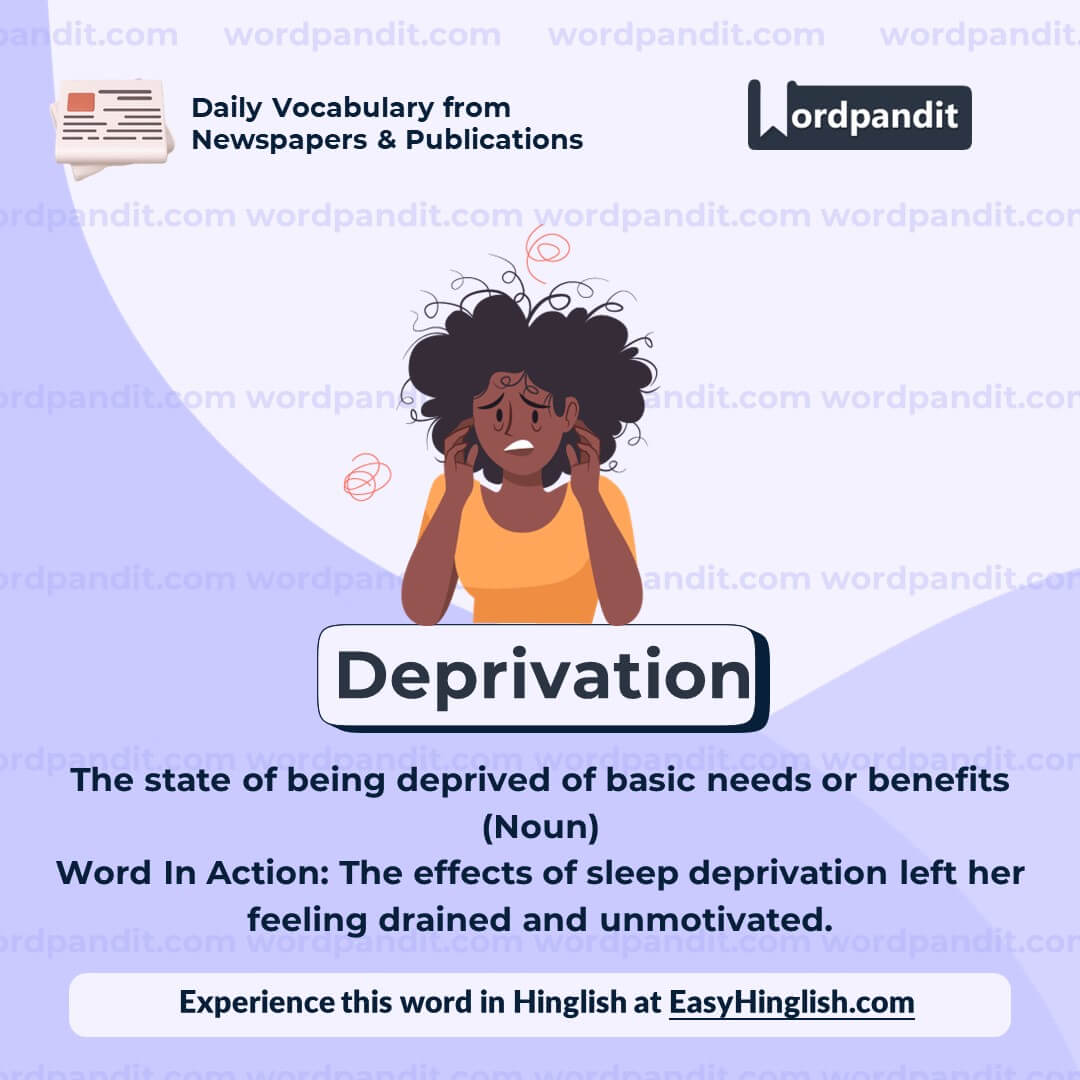
WORD-2: Deprivation
Context:
"Argue that this more accurately reflects ‘the challenges of deprivation’ than the conventional measure of poverty. While they conclude that both measures have ‘pros and cons’ and they are not stating a preference." - The Wire
Explanatory Paragraph:
"Deprivation" refers to a state of not having something that is considered essential or necessary. This can be material, like lacking food, shelter, or income, or emotional, such as being deprived of love or care. The term is commonly used in discussions about social inequality, poverty, and well-being, where it highlights the absence of resources that allow a person to live with dignity and opportunity.
Meaning: The condition of lacking basic necessities or comforts of life (Noun)
Pronunciation: dep-ri-VAY-shun
Difficulty Level: ⭐⭐⭐ Intermediate
Etymology: From Latin "deprivare" meaning "to deprive," formed from "de-" (entirely) + "privare" (to rob).
Prashant Sir's Notes:
"Deprivation" is a critical word in socio-political and psychological discussions. It shifts focus from just income levels (poverty) to the broader concept of lacking essentials that allow people to function in society. Watch for its use in phrases like "sleep deprivation," "economic deprivation," or "emotional deprivation."
Synonyms & Antonyms:
Synonyms: hardship, poverty, destitution, lack, scarcity
Antonyms: abundance, wealth, luxury, plenty, affluence
Usage Examples:
- Children raised in conditions of deprivation often struggle in school.
- The war led to severe food deprivation among the affected communities.
- Emotional deprivation during childhood can impact mental health in adulthood.
- The study measured deprivation using indicators like housing quality and healthcare access.
Cultural Reference:
"Sleep deprivation was a common technique used during interrogations at Guantanamo Bay." - Human Rights Watch Report
Think About It:
Is it possible to experience deprivation in a wealthy society? What forms might it take?
Quick Activity:
List three types of deprivation—physical, emotional, and social—and give one real-life example of each.
Memory Tip:
Think of “deprive” as “take away.” So "deprivation" is what you feel or experience when something essential has been taken away.
Real-World Application:
Understanding "deprivation" is important in careers related to social work, development studies, psychology, and public health, as it helps identify areas where interventions are most needed.
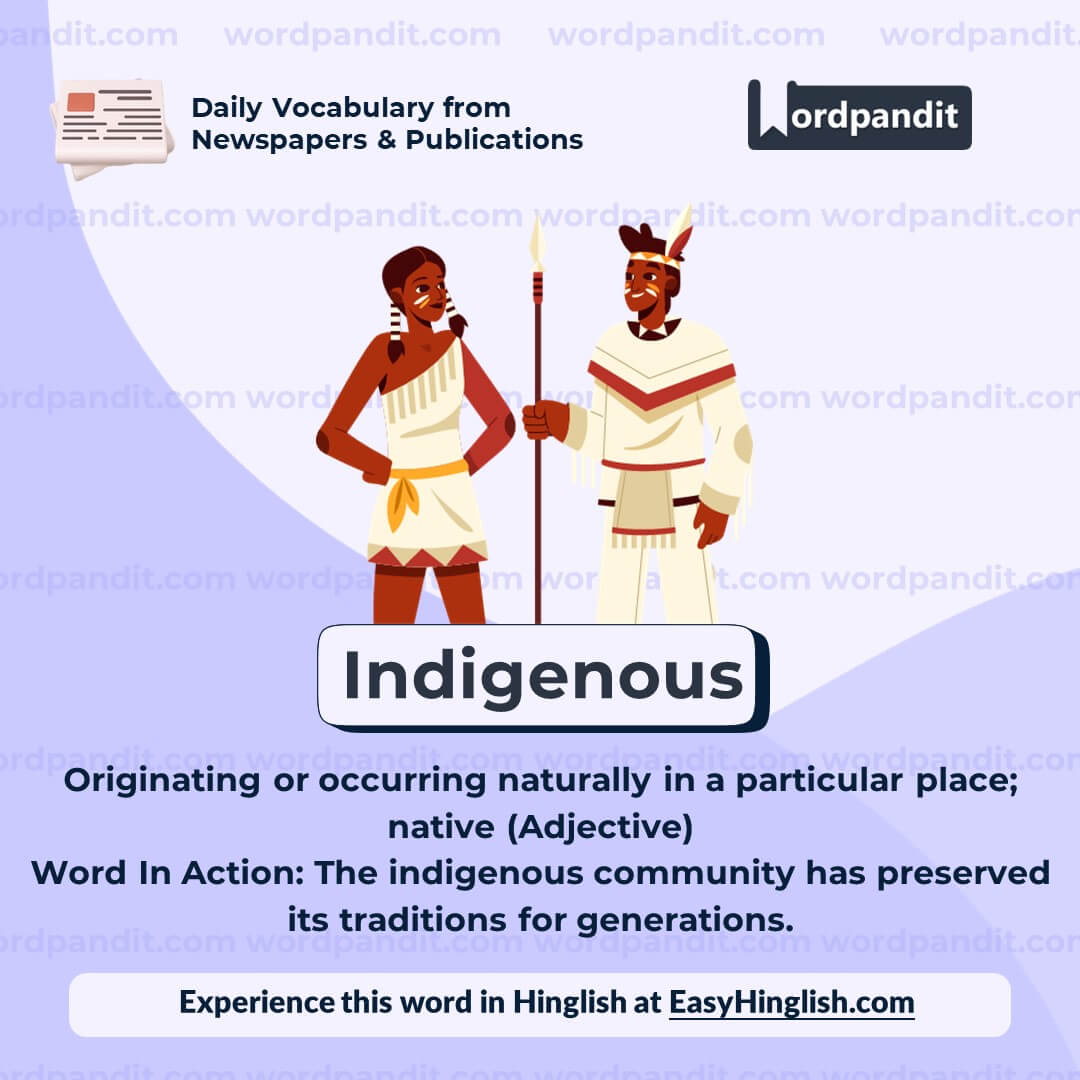
WORD-3: Indigenous
Context:
"The steps that should be followed are to study the PLA in detail; decide on technologies to be built indigenously and those to be procured from friendly nations." - The Wire
Explanatory Paragraph:
"Indigenous" refers to something or someone that originates naturally in a particular region or environment. It often describes native people, cultures, plants, or products that are original to a specific place. In a broader modern context, it is also used to refer to goods, ideas, or technologies that are developed locally, without relying on foreign input. The term emphasizes authenticity, originality, and connection to local roots or origins.
Meaning: Originating or occurring naturally in a particular place; native (Adjective)
Pronunciation: in-DIJ-uh-nus
Difficulty Level: ⭐⭐⭐ Intermediate
Etymology: From Latin "indigenus" meaning "born in a country, native", from "indi-" (in) + "gignere" (to beget or produce).
Prashant Sir's Notes:
While "indigenous" is often used in discussions about native peoples or cultures (like Indigenous tribes), it is increasingly used in political and economic contexts to mean “locally developed,” especially in terms like “indigenous technology” or “indigenous manufacturing.” Watch how the context shifts the focus of the word.
Synonyms & Antonyms:
Synonyms: native, local, homegrown, domestic, original
Antonyms: foreign, imported, alien, non-native, external
Usage Examples:
- The indigenous tribes of the Amazon have lived in harmony with nature for centuries.
- The government has launched a new program to promote indigenous defense technologies.
- Many countries are now focusing on building indigenous capabilities in the pharmaceutical sector.
- Indigenous plants are better adapted to the local climate and require less maintenance.
Cultural Reference:
"Indigenous Peoples’ Day" in the United States celebrates the history and contributions of Native American communities, often in place of Columbus Day. - NPR
Think About It:
In an increasingly globalized world, why is it important to preserve indigenous knowledge and practices?
Quick Activity:
Name one indigenous community, one indigenous plant, and one indigenous technology from your country. Briefly describe each.
Memory Tip:
Break it as “in-digenous” — think of “in the region” to remember that it refers to something native or local to a specific area.
Real-World Application:
The term "indigenous" is crucial in areas like environmental science, social justice, manufacturing, and public policy. It is used to advocate for local innovation, promote self-reliance, and protect native rights and heritage.
WORD-4: Aggrieved
Context:
"In promoting a ‘religious nationalism’ propped by BJP alliances with ‘upper caste Hindus, aggrieved middle class, the business community,’ ‘governance is not the point’ for the ‘partisan, ideological formation that is the Hindutva project.’" - The Wire
Explanatory Paragraph:
"Aggrieved" is used to describe someone who feels a sense of injustice, resentment, or hurt—typically because they believe they have been wronged or treated unfairly. This feeling may be personal, social, or political in nature. In the context of politics, groups that are described as "aggrieved" often feel overlooked, exploited, or marginalized, and this emotional state can fuel political ideologies or movements.
Meaning: Feeling resentment or anger due to a perceived injustice or unfair treatment (Adjective)
Pronunciation: uh-GREEVD
Difficulty Level: ⭐⭐⭐ Intermediate
Etymology: From Old French "agrever" (to make worse), based on Latin "ad-" (to) + "gravis" (heavy), implying a burden or grievance.
Prashant Sir's Notes:
Aggrieved isn’t just about feeling sad—it involves a deeper sense of unfairness. It’s a powerful word often used in politics and law. You’ll see it used to describe communities or individuals who feel wronged and want redress, which can influence voting, protests, and public sentiment.
Synonyms & Antonyms:
Synonyms: resentful, offended, hurt, disgruntled, wronged
Antonyms: content, satisfied, pleased, appeased, gratified
Usage Examples:
- The aggrieved employee filed a complaint about workplace discrimination.
- Many aggrieved citizens took to the streets to protest the unfair policies.
- She felt aggrieved by the way her concerns were dismissed by the committee.
- The aggrieved communities demanded compensation for years of neglect.
Cultural Reference:
In literature and film, aggrieved characters often become central figures in stories of rebellion and justice—for example, Katniss Everdeen in *The Hunger Games* is aggrieved by the Capitol’s oppression. - Scholarly reading of dystopian narratives
Think About It:
Can being aggrieved lead to positive social change, or does it always result in conflict?
Quick Activity:
Write a short paragraph describing a situation (real or imagined) where a group or person might feel aggrieved. Highlight what caused the feeling and what action followed.
Memory Tip:
Think of "aggrieved" as someone who is "grieving" because of an "aggravating" injustice—aggrieved = aggravated + grieved.
Real-World Application:
The word "aggrieved" is frequently used in legal contexts (e.g., "an aggrieved party") and political discourse to identify individuals or groups seeking justice or compensation for perceived wrongs.

WORD-5: Complacency
Context:
"Over time, however, the nation slips back into complacency, awaiting another incident to reignite its fury. From Mathura, to Nirbhaya to R.G. Kar, the cycle of tragedy remains unbroken." - The Wire
Explanatory Paragraph:
"Complacency" refers to a self-satisfied state of mind where a person or group becomes too comfortable or indifferent, often ignoring potential dangers or the need for improvement. It suggests a false sense of security and a lack of urgency, even when serious issues still exist. In the context of social problems or injustice, complacency can prevent meaningful change from happening because people become numb or passive.
Meaning: A feeling of smug or uncritical satisfaction with oneself or one’s situation, often while ignoring potential risks or issues (Noun)
Pronunciation: kum-PLAY-sen-see
Difficulty Level: ⭐⭐⭐ Intermediate
Etymology: From Latin "complacere" meaning "to please greatly," with the sense evolving to “being overly content” or satisfied.
Prashant Sir's Notes:
Complacency is a dangerous comfort zone. It often creeps in when things seem to be going well, but it makes us blind to lingering or growing problems. Whether it's in society, personal life, or institutions, complacency stalls growth and blocks accountability. Use this word when addressing a lack of vigilance.
Synonyms & Antonyms:
Synonyms: smugness, self-satisfaction, indifference, apathy, contentment
Antonyms: vigilance, concern, dissatisfaction, awareness, urgency
Usage Examples:
- The manager warned the team against complacency after a few early wins.
- Public complacency about climate change is one of the biggest obstacles to real action.
- Her complacency about her grades eventually led to a steep decline in performance.
- Social complacency allows systemic issues to persist without challenge or reform.
Cultural Reference:
In *1984* by George Orwell, the government maintains control partly through the public's complacency—citizens accept surveillance and lies because they’ve grown too indifferent to resist. - Literary analysis of dystopian control
Think About It:
When does comfort become complacency, and how can individuals or societies recognize that tipping point?
Quick Activity:
Write down two situations from your life or surroundings where complacency may be holding back progress. What small step could counter it?
Memory Tip:
Think: "Complacency comes when you're too pleased (pleased = placere in Latin) to notice problems." It’s being “pleasantly blind” to real issues.
Real-World Application:
Understanding complacency is important in leadership, activism, and personal development. It helps identify when enthusiasm or accountability is waning, prompting timely intervention or change.


