

Daily Vocabulary from Indian Newspapers and Publications
Welcome to Wordpandit’s Indian Vocabulary Hub
At Wordpandit, we understand the importance of staying rooted in the local context while expanding your language skills. This section focuses on enriching your vocabulary with words and phrases drawn from India’s leading newspapers and publications, ensuring you're learning vocabulary that is practical, relevant, and uniquely Indian.
Why Indian Sources Matter
We believe that the best way to master any language is by immersing yourself in local content. That’s why we carefully curate vocabulary from top Indian publications, including:
- The Hindu
- The Times of India
- The Economic Times
- Hindustan Times
- Live Mint
- The Indian Express
- And many others...
Stay Updated, Stay Relevant
With daily updates from Indian news sources, you’ll be consistently learning words that reflect the trends and shifts in Indian society and culture. Our focus is to provide vocabulary that enhances your understanding of the language in an Indian context.
How Wordpandit Supports Your Goals
Whether you’re preparing for exams, aiming to improve your professional communication, or simply want to stay connected with the latest Indian vocabulary, Wordpandit is here to guide you every step of the way.
Learn with a Practical Approach
Our interactive learning methodology includes real-world examples, engaging activities, and context-specific usage to ensure that every word becomes part of your active vocabulary.
Dive into Indian Vocabulary Today!
Why Choose Wordpandit?
Practical Learning: Focus on words you'll actually encounter in real-world reading, enhancing your comprehension and communication skills.
Diverse Content: From current affairs to scientific breakthroughs, our varied sources expose you to vocabulary across multiple domains.
Effortless Integration: Make Wordpandit a part of your daily routine. Just a few minutes each day can significantly boost your lexicon over time.
Your Path to Vocabulary Mastery
- Visit our Daily Vocabulary section regularly
- Explore new words and their usage in context
- Practice incorporating these words into your own writing and speech
- Track your progress as your vocabulary expands
Start Your Journey Today
Embark on your vocabulary enhancement journey with Wordpandit. By consistently engaging with our daily posts, you'll build a robust vocabulary that serves you well in academic, professional, and personal contexts.
Remember, a word a day keeps linguistic limitations at bay. Make Wordpandit your daily companion in the quest for vocabulary excellence!

WORD-1: Conventional
Context:
"Their practices 'to accurately measure the conventional notion of poverty'." - The Wire
Explanatory Paragraph:
"Conventional" refers to something that follows established norms, customs, or widely accepted practices. When an idea or method is described as conventional, it usually means it aligns with traditional ways of thinking or doing things, rather than being innovative or unconventional. In the context of measuring poverty, the phrase suggests reliance on traditional definitions or metrics rather than newer or alternative approaches.
Meaning: Based on or in accordance with what is generally done or believed (Adjective)
Pronunciation: kun-VEN-shun-uhl
Difficulty Level: ⭐⭐ Beginner
Etymology: From Late Latin *conventionalis*, from Latin *conventio* meaning “a meeting or agreement.”
Prashant Sir's Notes:
This word is frequently used in essays and reports, especially when contrasting traditional and modern approaches. When used in exams, it often appears in the context of values, wisdom, norms, or institutions.
Synonyms & Antonyms:
Synonyms: traditional, standard, ordinary, accepted, mainstream
Antonyms: unconventional, innovative, radical, nontraditional, avant-garde
Usage Examples:
- She wore a conventional black dress to the formal dinner.
- The conventional wisdom suggests saving at least 20% of your income.
- His methods may seem unconventional, but they produce results.
- Critics argue that conventional farming harms the environment more than organic methods.
Cultural Reference:
"Don’t be satisfied with stories, how things have gone with others. Unfold your own myth." - Rumi (challenging the conventional paths of life)
Think About It:
In what situations might following conventional wisdom actually hinder progress?
Quick Activity:
List three conventional practices in your daily routine. Then, next to each, write one unconventional alternative.
Memory Tip:
Think of a "convention" as a formal meeting where people agree on norms. "Conventional" things are those that follow such agreed-upon norms.
Real-World Application:
Understanding the term "conventional" is essential in debates, essays, and professional discussions where comparisons between traditional and modern practices are common—like in education, economics, or technology.
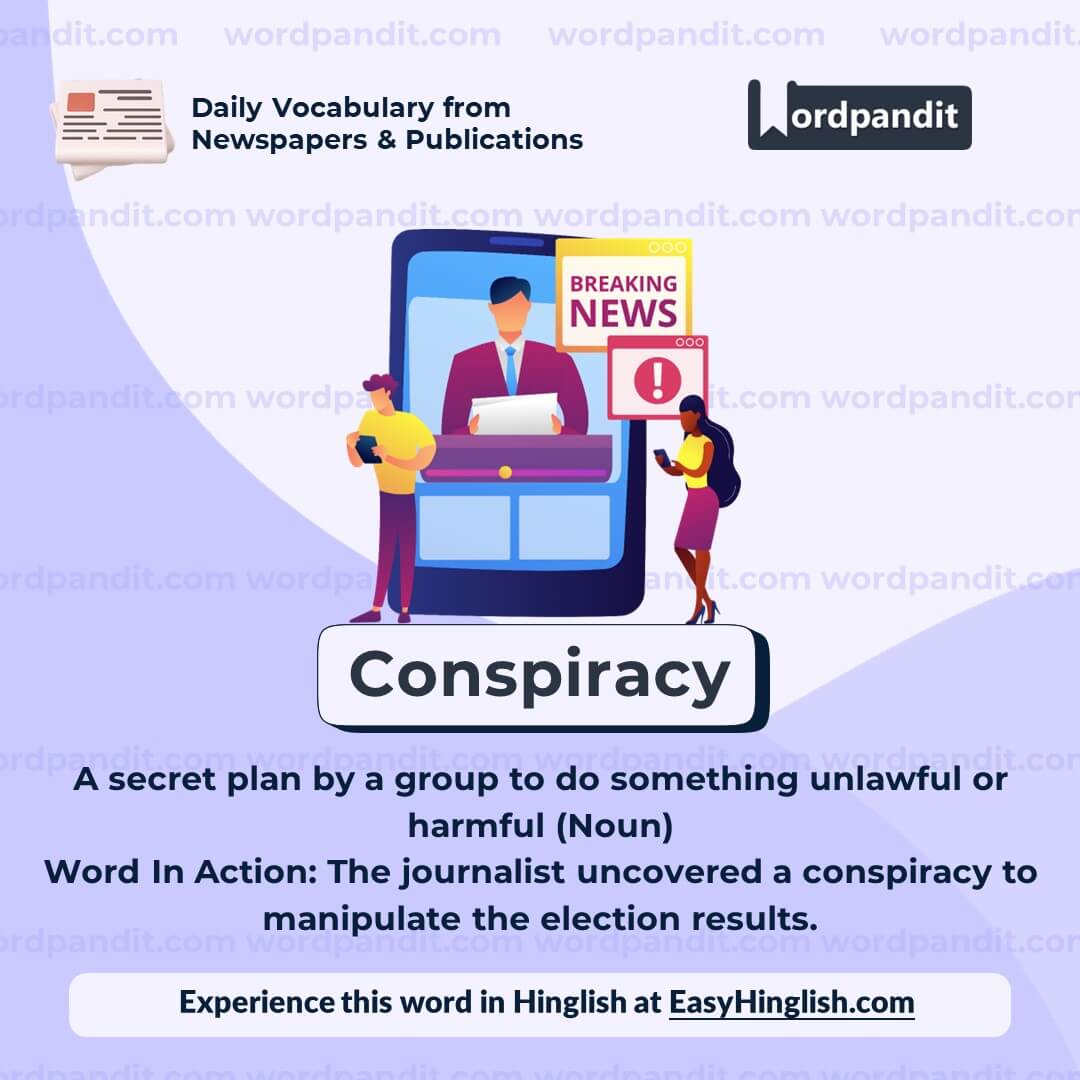
WORD-2: Conspiracy
Context:
"EU’s 'conspiracy of silence on human rights.' They conclude that the EU and India 'must centre their expanding relationship on human rights and discuss their human rights record' if not, the EU’s growing relationship with India will have 'feet of clay'." - The Wire
Explanatory Paragraph:
"Conspiracy" refers to a secret plan by a group of people to do something harmful or illegal. It often involves collusion and secrecy, particularly when power or influence is used to suppress the truth. In the given context, "conspiracy of silence" suggests that powerful entities (like the EU) are deliberately choosing not to speak out about human rights issues, implying quiet agreement or complicity through silence.
Meaning: A secret plan by a group to do something unlawful or harmful (Noun)
Pronunciation: kuhn-SPIH-ruh-see
Difficulty Level: ⭐⭐⭐ Intermediate
Etymology: From Latin *conspirare*, meaning “to plot” or “to breathe together.”
Prashant Sir's Notes:
This word is often used in politics, history, and media. Watch how it shifts in tone—sometimes it denotes real secret plots, while other times it may suggest paranoia or baseless theories. The phrase "conspiracy of silence" is a strong rhetorical tool—great for critical writing.
Synonyms & Antonyms:
Synonyms: plot, scheme, collusion, intrigue, secret plan
Antonyms: honesty, openness, transparency, truthfulness
Usage Examples:
- The officials were arrested for conspiracy to commit fraud.
- He believes there's a conspiracy behind the government's inaction.
- A conspiracy of silence surrounded the issue, preventing real dialogue.
- Many conspiracy theories emerged after the leader’s mysterious disappearance.
Cultural Reference:
"The greatest trick the Devil ever pulled was convincing the world he didn't exist." — *The Usual Suspects* (a film heavily centered on conspiracy and deception)
Think About It:
Can silence by powerful institutions be as harmful as active wrongdoing? Where should we draw the line between caution and complicity?
Quick Activity:
Think of a historical event where a conspiracy was later proven true. Write a two-line summary about it using the word “conspiracy.”
Memory Tip:
Break it down: “Con” (together) + “Spire” (breathe). When people “breathe together” in secret—they are usually plotting something. That's a conspiracy!
Real-World Application:
The word "conspiracy" is essential when discussing political scandals, courtroom dramas, historical cover-ups, or analyzing modern disinformation. Being able to critically interpret its use is key in media literacy.
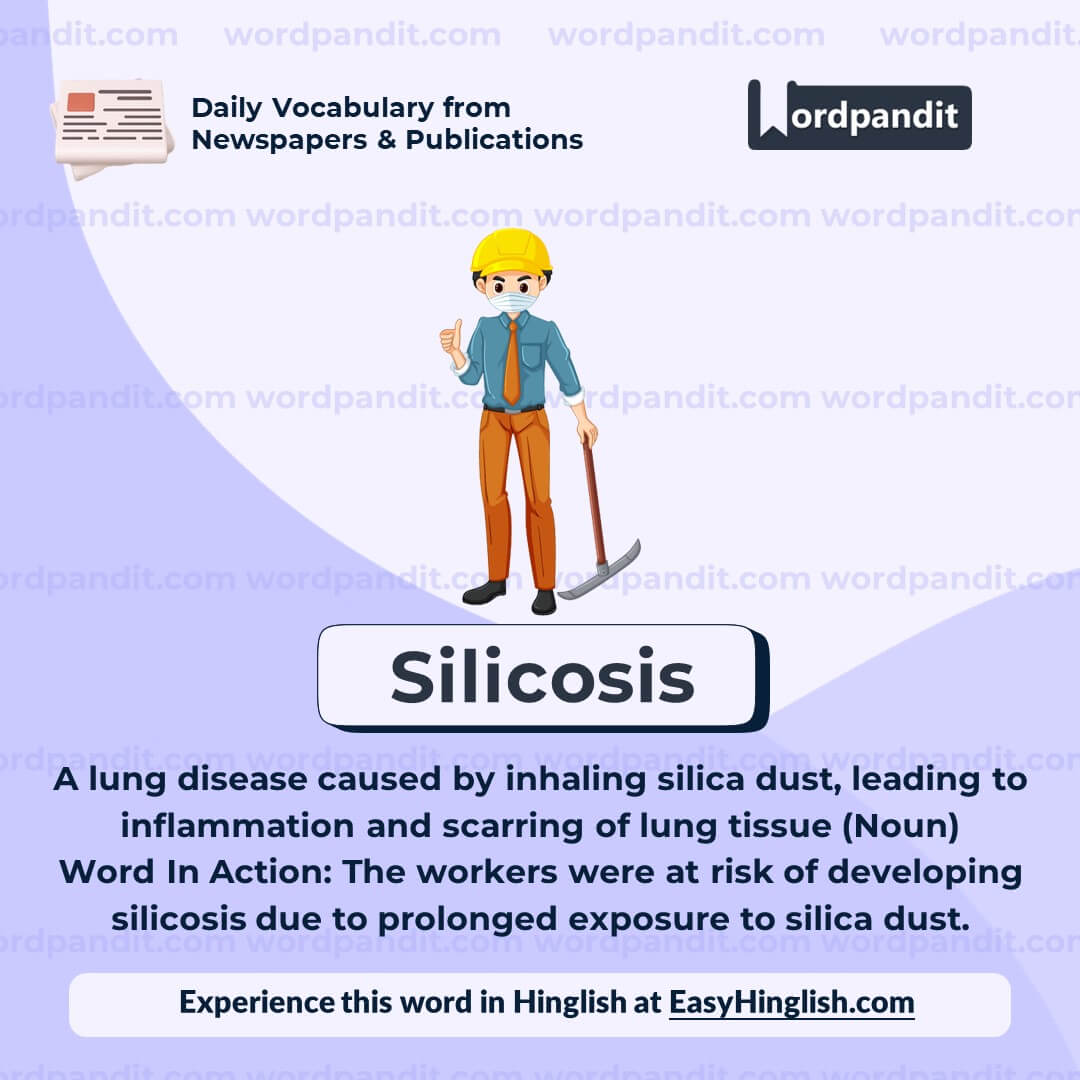
WORD-3: Silicosis
Context:
"Several studies link long exposure to construction activities...can cause diseases like cancers, silicosis, lung impairment, and fibrosis." - The Wire
Explanatory Paragraph:
Silicosis is a serious and often irreversible lung disease caused by inhaling fine particles of silica dust, which is commonly found in construction and mining environments. Prolonged exposure to this dust damages the lungs, leading to inflammation and scarring that restricts breathing. It is one of the most common occupational diseases in industries that deal with stone cutting, sandblasting, or concrete work. Because the effects often appear after years of exposure, it can go undetected until it becomes severe.
Meaning: A lung disease caused by prolonged inhalation of silica dust (Noun)
Pronunciation: sil-uh-KOH-sis
Difficulty Level: ⭐⭐⭐ Intermediate
Etymology: From Latin *silica* (flint) + Greek *-osis* (condition); literally "condition caused by silica."
Prashant Sir's Notes:
This is a highly relevant word in discussions of environmental health, workers’ rights, and occupational safety. Make sure to remember that it is disease-specific and linked to construction, mining, and industrial labor sectors.
Synonyms & Antonyms:
Synonyms: dust-induced lung disease, pneumoconiosis (general category), occupational lung disease
Antonyms: healthy lungs, normal respiratory function (contextual antonyms)
Usage Examples:
- The workers were diagnosed with silicosis after years of unprotected exposure to quartz dust.
- Silicosis is a preventable disease if proper safety measures are in place.
- Activists are pushing for compensation for miners suffering from silicosis.
- Repeated inhalation of fine sand particles can silently lead to silicosis over time.
Cultural Reference:
“The slow death of India’s sandstone miners highlights the neglected epidemic of silicosis.” — Investigative features from *Al Jazeera* and *The Guardian* have brought attention to this deadly disease in developing nations.
Think About It:
Why do you think silicosis continues to affect so many workers despite being a preventable disease?
Quick Activity:
Search for two occupations at risk for silicosis and list one safety measure that can help reduce the risk in each.
Memory Tip:
“Silicosis” = “Silica” + “-osis” (disease) → Disease caused by silica dust. Think of it as lungs choking silently on stone dust.
Real-World Application:
Silicosis is frequently referenced in public health campaigns, labor rights discussions, and government regulations on construction and mining industries. Understanding this term is essential for raising awareness about occupational health hazards.
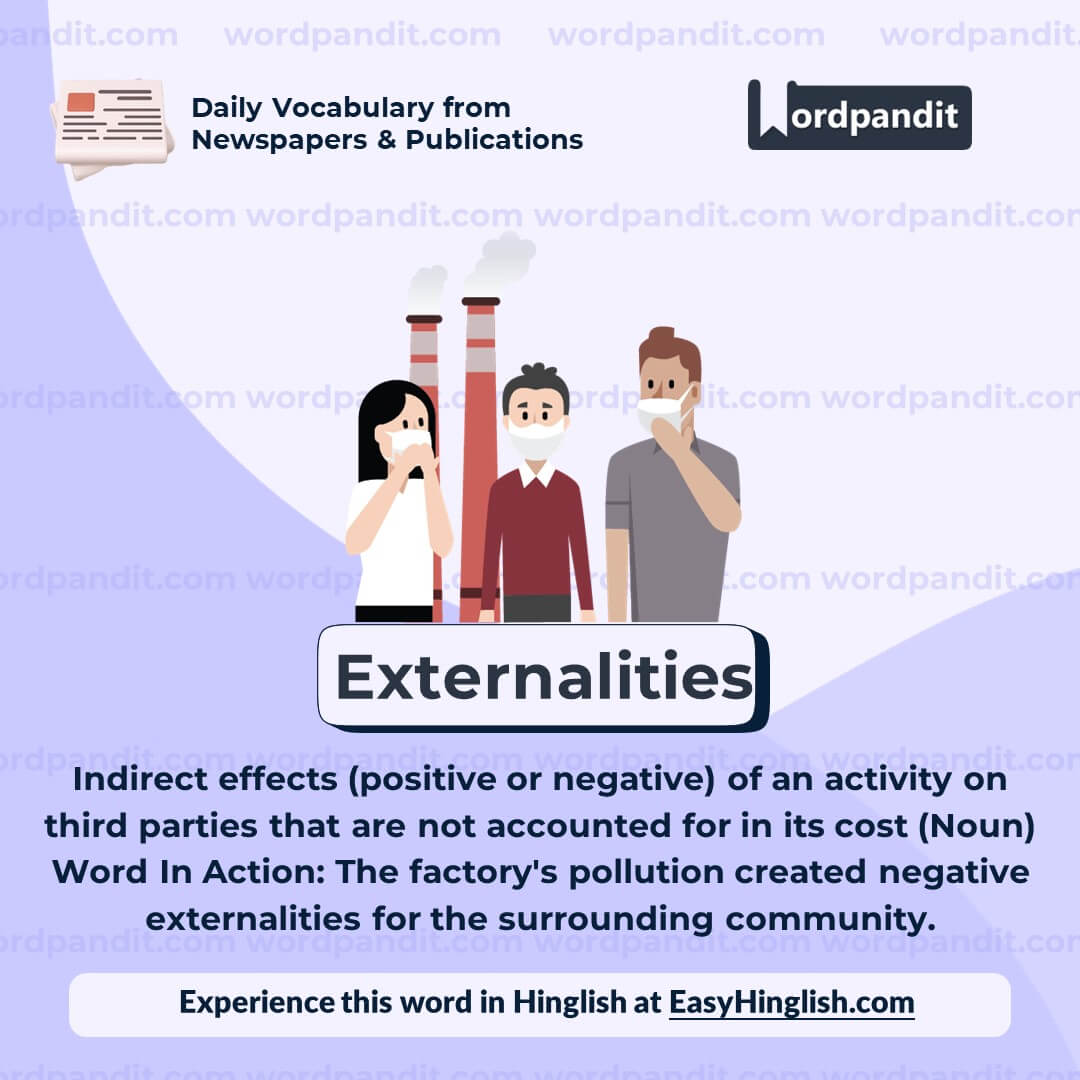
WORD-4: Externalities
Context:
"This construction activity, which creates negative externalities by increasing air, noise and water pollution." - The Wire
Explanatory Paragraph:
“Externalities” are side effects or consequences of an activity that affect other people or the environment, without being reflected in the cost of that activity. These can be positive (like education benefiting society) or negative (like pollution harming public health). In this context, construction leads to “negative externalities” by polluting the environment—costs that society bears even though they are not directly included in the price of construction projects.
Meaning: Unintended side effects of an economic activity that affect others not directly involved in it (Noun, plural)
Pronunciation: ek-ster-NAL-uh-teez
Difficulty Level: ⭐⭐⭐ Intermediate
Etymology: From Latin *externus* meaning “outside,” related to things occurring outside the immediate system or transaction.
Prashant Sir's Notes:
This term is crucial in economics, especially environmental and developmental economics. Focus on how externalities shift the burden of cost or benefit to society. Learn the distinction between positive and negative externalities—this comes up often in policy-based discussions and essays.
Synonyms & Antonyms:
Synonyms: side effects, spillover effects, unintended consequences, indirect impacts
Antonyms: direct effects, internal costs, contained impacts
Usage Examples:
- Negative externalities from the factory include toxic runoff and air pollution.
- Education creates positive externalities by producing a more informed and productive society.
- Governments often regulate activities that cause harmful externalities.
- Taxing carbon emissions is one way to address environmental externalities.
Cultural Reference:
In his influential book *Capitalism and Freedom*, Milton Friedman discusses how externalities justify some level of government intervention, especially in environmental regulation.
Think About It:
Should companies be legally responsible for the externalities they produce, even if they’re not directly profiting from them?
Quick Activity:
List two examples each of a positive and a negative externality you observe in your neighborhood or city.
Memory Tip:
“Externalities” are effects that happen *externally*—outside the transaction or activity itself. Think: You do something, but *others* are affected.
Real-World Application:
Understanding externalities is essential in public policy, urban planning, and environmental activism. It helps in creating fair laws that internalize costs (like pollution taxes) and promote benefits (like subsidies for clean energy).

WORD-5: Subsidies
Context:
"The discussions surrounding potential solutions for pollution caused by construction...while ignoring their working conditions, which includes the intergenerational impact on their families, is an indicator that neither are they seen as equal stakeholders, nor are they given anything more than subsistence." - The Wire
Explanatory Paragraph:
“Subsidies” refer to financial assistance or support extended by the government to individuals, groups, or industries to promote economic and social policies. These are often used to lower the cost of basic goods or services, such as food, fuel, or housing, or to encourage specific economic activities like farming or renewable energy production. In this context, the lack of meaningful subsidies suggests that construction workers are only surviving at subsistence levels, without additional support or empowerment.
Meaning: Financial aid provided by a government to reduce the cost of services or support an economic activity (Noun, plural)
Pronunciation: SUB-sih-deez
Difficulty Level: ⭐⭐ Beginner
Etymology: From Latin *subsidium* meaning “assistance, support.”
Prashant Sir's Notes:
Subsidies are a staple term in economics and governance. Be mindful of the dual nature—they can be helpful or distortionary depending on how they’re applied. In exams, this word often appears in discussions about inequality, agriculture, industry, and welfare schemes.
Synonyms & Antonyms:
Synonyms: grant, financial aid, support, allowance, assistance
Antonyms: tax, penalty, fine, burden
Usage Examples:
- The government provides subsidies on LPG cylinders to make cooking fuel affordable for low-income families.
- Farmers in many countries receive agricultural subsidies to ensure food security and price stability.
- Critics argue that fossil fuel subsidies harm the environment by encouraging overuse of nonrenewable energy.
- The housing project was made possible through state subsidies aimed at urban development.
Cultural Reference:
“Subsidies often help the poor, but can also enrich the powerful.” — A recurring theme in development economics and policy critiques, notably in Nobel laureate Amartya Sen’s writings on equity and distribution.
Think About It:
Can subsidies promote long-term dependence rather than empowerment? How should they be designed to avoid this?
Quick Activity:
List two sectors where subsidies are commonly given in your country. Then note one potential benefit and one potential drawback for each.
Memory Tip:
Think: *Subsidies* help you “subside” your expenses—make costs go down. They provide support, especially when income is low or costs are high.
Real-World Application:
Understanding subsidies is essential when analyzing government budgets, policy debates, and welfare programs. They influence prices, consumption, and economic behavior at both individual and national levels.


