

Daily Vocabulary from Indian Newspapers and Publications
Welcome to Wordpandit’s Indian Vocabulary Hub
At Wordpandit, we understand the importance of staying rooted in the local context while expanding your language skills. This section focuses on enriching your vocabulary with words and phrases drawn from India’s leading newspapers and publications, ensuring you're learning vocabulary that is practical, relevant, and uniquely Indian.
Why Indian Sources Matter
We believe that the best way to master any language is by immersing yourself in local content. That’s why we carefully curate vocabulary from top Indian publications, including:
- The Hindu
- The Times of India
- The Economic Times
- Hindustan Times
- Live Mint
- The Indian Express
- And many others...
Stay Updated, Stay Relevant
With daily updates from Indian news sources, you’ll be consistently learning words that reflect the trends and shifts in Indian society and culture. Our focus is to provide vocabulary that enhances your understanding of the language in an Indian context.
How Wordpandit Supports Your Goals
Whether you’re preparing for exams, aiming to improve your professional communication, or simply want to stay connected with the latest Indian vocabulary, Wordpandit is here to guide you every step of the way.
Learn with a Practical Approach
Our interactive learning methodology includes real-world examples, engaging activities, and context-specific usage to ensure that every word becomes part of your active vocabulary.
Dive into Indian Vocabulary Today!
Why Choose Wordpandit?
Practical Learning: Focus on words you'll actually encounter in real-world reading, enhancing your comprehension and communication skills.
Diverse Content: From current affairs to scientific breakthroughs, our varied sources expose you to vocabulary across multiple domains.
Effortless Integration: Make Wordpandit a part of your daily routine. Just a few minutes each day can significantly boost your lexicon over time.
Your Path to Vocabulary Mastery
- Visit our Daily Vocabulary section regularly
- Explore new words and their usage in context
- Practice incorporating these words into your own writing and speech
- Track your progress as your vocabulary expands
Start Your Journey Today
Embark on your vocabulary enhancement journey with Wordpandit. By consistently engaging with our daily posts, you'll build a robust vocabulary that serves you well in academic, professional, and personal contexts.
Remember, a word a day keeps linguistic limitations at bay. Make Wordpandit your daily companion in the quest for vocabulary excellence!
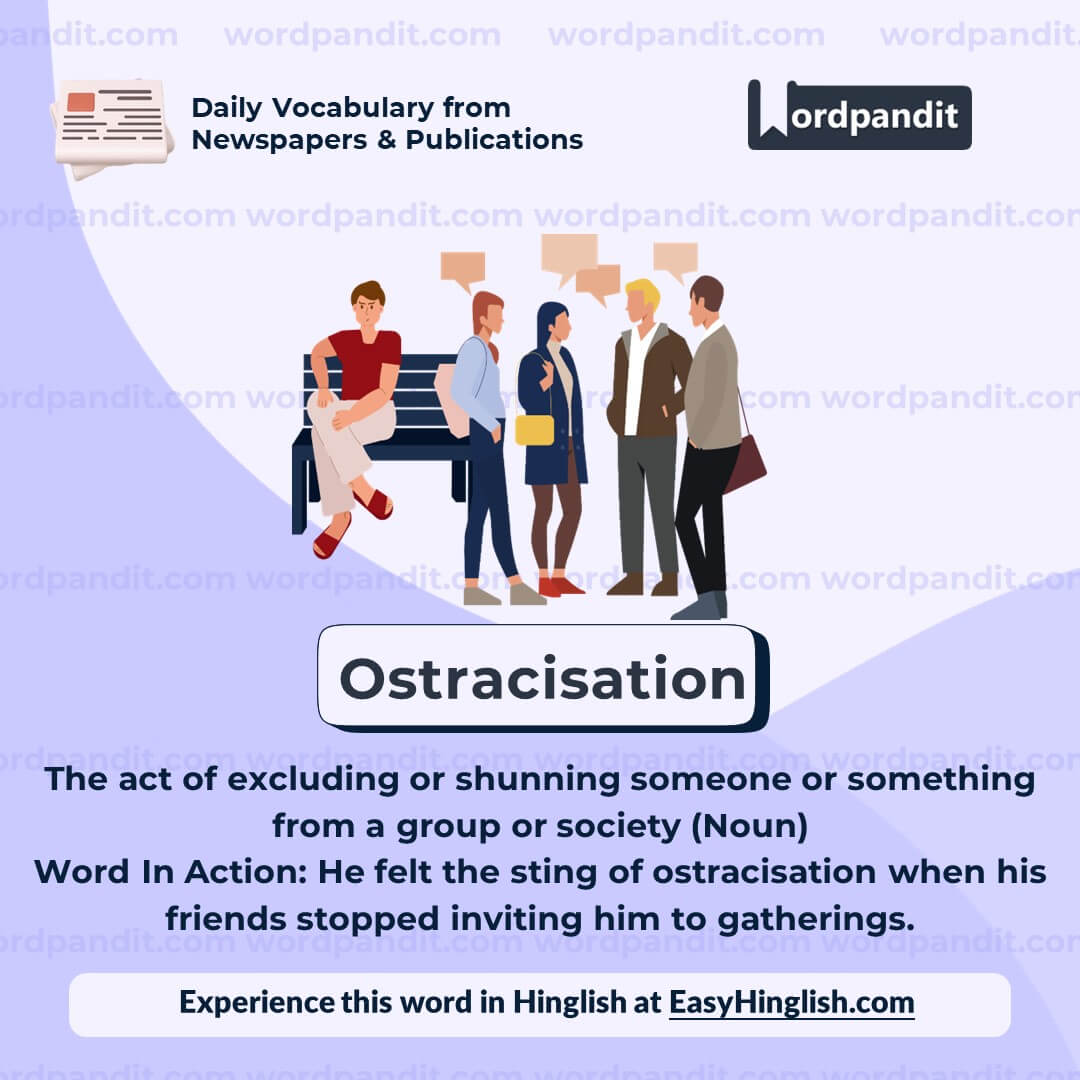
WORD-1: Ostracisation
Context:
"After the whistleblower came forward with allegations, he faced immediate ostracisation from his colleagues, who feared association might put their own positions at risk." - The Guardian
Explanatory Paragraph:
Ostracisation refers to the act of excluding someone from a group or community, often as a form of punishment or social rejection. It can be subtle or overt and is typically driven by fear, disapproval, or disagreement. This exclusion can take place in schools, workplaces, or even within families and social circles, and it can have serious emotional and psychological consequences for the person being ostracised.
Meaning: The act of excluding someone from a group or society (Noun)
Pronunciation: os-truh-sai-ZAY-shun
Difficulty Level: ⭐⭐⭐ Intermediate
Etymology: Derived from the Greek word "ostrakizein," meaning "to banish by voting with pottery shards." The term entered English via Latin and French.
Prashant Sir's Notes:
Remember that "ostracisation" is a noun describing a social penalty—being pushed out or shunned. Historically linked with ancient Greek practices, but today more psychological and social in nature. Watch how it's used in political and corporate environments especially.
Synonyms & Antonyms:
Synonyms: exclusion, shunning, rejection, alienation, boycott
Antonyms: inclusion, acceptance, embrace, welcome, integration
Usage Examples:
- Her outspoken views led to her gradual ostracisation from the local community group.
- The ostracisation of minorities in some societies reflects deeper systemic issues.
- Ostracisation can be more damaging than physical punishment, especially for adolescents.
- After the scandal, the politician suffered complete ostracisation from his party.
Cultural Reference:
"In ancient Athens, ostracisation was a formal process where citizens could vote to banish a person deemed dangerous to democracy for ten years." - History Channel
Think About It:
How does ostracisation impact a person’s sense of identity and belonging in today's hyper-connected world?
Quick Activity:
Think of a character from a book or movie who was ostracised. Write 3-4 sentences about how it affected their behavior or life choices.
Memory Tip:
Think: “Ostrich + Isolation” – Imagine an ostrich being isolated from the flock. Ostracisation = being pushed away or left out.
Real-World Application:
Understanding ostracisation is important in psychology, workplace ethics, and social justice. It helps HR professionals, educators, and community leaders recognize and address harmful exclusionary behavior.
WORD-2: Neocolonial
Context:
"Worse still, India is also widely perceived as a neocolonial power, more interested in exploiting Bangladesh than in promoting its people’s welfare." - The Wire
Explanatory Paragraph:
Neocolonial refers to a modern form of domination where a powerful country influences or controls another, especially economically, politically, or culturally, without direct political rule. Unlike historical colonialism, neocolonialism operates through indirect mechanisms such as trade imbalances, foreign investments, debt dependency, and political interference. It is often used critically to describe how former colonial powers or global powers continue to exert control over less developed countries.
Meaning: Relating to the use of economic, political, cultural, or other pressures to control or influence a country, especially a former colony (Adjective)
Pronunciation: nee-oh-koh-LOH-nee-uhl
Difficulty Level: ⭐⭐⭐⭐ Advanced
Etymology: From "neo-" meaning "new" and "colonial," referring to modern versions of colonialism without formal territorial control. Gained usage in the mid-20th century during decolonization debates.
Prashant Sir's Notes:
Think of "neocolonial" as colonialism 2.0—no more armies or empires, but still the same power imbalance. It’s a term often used in global political discourse to critique how powerful nations exert indirect influence. Be alert when you hear this word in international affairs and economics.
Synonyms & Antonyms:
Synonyms: exploitative, imperialistic, hegemonic, domineering
Antonyms: sovereign, independent, egalitarian, autonomous
Usage Examples:
- Many activists accuse multinational corporations of having a neocolonial influence in Africa.
- The term "neocolonial" is often used to describe the global lending practices of powerful nations.
- Some critics view foreign military bases as a form of neocolonial control.
- Environmental degradation caused by foreign companies is frequently cited as evidence of neocolonial exploitation.
Cultural Reference:
"Neocolonialism is the worst form of imperialism. For those who practice it, it means power without responsibility." - Kwame Nkrumah, First President of Ghana
Think About It:
Can economic aid ever be truly altruistic, or does it often mask neocolonial interests?
Quick Activity:
Research a modern-day example of neocolonialism and write 2-3 sentences explaining how it operates in that case.
Memory Tip:
Neo = new, Colonial = old empire rule. Neocolonial means "new way of ruling like a colonizer"—without direct control, but still controlling.
Real-World Application:
Understanding the concept of neocolonialism is essential in global studies, international relations, and economic policy discussions. It helps evaluate how global powers interact with developing nations beyond traditional warfare or occupation.
WORD-3: Mainstreaming
Context:
"Despite adversity, the FN turned the tide, seizing the opportunity of departing factions to label them as racist and extreme, thus initiating a process of normalisation or mainstreaming of the party." - The Wire
Explanatory Paragraph:
Mainstreaming refers to the process of integrating something or someone into the dominant or widely accepted norms, practices, or culture of a society. It often implies making an idea, group, or policy more acceptable or palatable to the general public. In politics, mainstreaming can involve softening rhetoric or adjusting positions to appeal to a broader audience, while in other fields like education or social policy, it can refer to the inclusion of marginalized groups into the broader system.
Meaning: The act of making something part of the dominant or accepted norm (Noun/Verb – used as gerund)
Pronunciation: MAYN-streem-ing
Difficulty Level: ⭐⭐ Basic to Intermediate
Etymology: From "mainstream," which refers to the prevailing trend or accepted norms in society, combined with the suffix "-ing" to indicate an ongoing process or action.
Prashant Sir's Notes:
“Mainstreaming” is a process word—focus on the idea of something moving from the fringe to the center. Often used in political, educational, or social contexts. Watch how it's applied to ideologies, minority groups, or even policies that were once considered radical or unconventional.
Synonyms & Antonyms:
Synonyms: integration, normalization, inclusion, assimilation
Antonyms: marginalization, exclusion, segregation, isolation
Usage Examples:
- The mainstreaming of environmental concerns has led to major policy reforms worldwide.
- Inclusive education focuses on the mainstreaming of students with disabilities into regular classrooms.
- Some critics argue that the mainstreaming of extremist views threatens democratic values.
- Mainstreaming gender equality into corporate policy requires more than just symbolic actions.
Cultural Reference:
"The mainstreaming of hip-hop in the 1990s marked a cultural shift where previously marginalized voices became central to global music." – Rolling Stone Magazine
Think About It:
Is mainstreaming always a positive process, or can it dilute the original identity or intent of a group or idea?
Quick Activity:
Pick a social issue (e.g., climate change, LGBTQ+ rights). Write 2 sentences describing how it has been mainstreamed in recent years.
Memory Tip:
Think: “Mainstream” = popular or common. So mainstreaming = making something common or widely accepted.
Real-World Application:
Mainstreaming is key in policy development, education reform, diversity training, and media strategy. Understanding it helps track how public opinion evolves and how once-radical ideas become normalized in society.
WORD-4: Misleadingly
Context:
"The misleadingly named ‘Baku Climate Unity Pact’ promised unity but left the nations more divided than ever." - The Wire
Explanatory Paragraph:
Misleadingly is an adverb used to describe something done in a way that creates a false impression or misleads others. It usually refers to actions, statements, or labels that appear truthful or accurate on the surface but are actually deceptive or incorrect. The word often highlights a gap between appearance and reality, drawing attention to subtle forms of dishonesty or manipulation.
Meaning: In a way that gives the wrong idea or impression; deceptively (Adverb)
Pronunciation: mis-LEED-ing-lee
Difficulty Level: ⭐⭐ Basic to Intermediate
Etymology: From “mislead” (Middle English: misleden), formed by the prefix “mis-” (wrongly) and “lead” (to guide), plus “-ly” to form the adverb.
Prashant Sir's Notes:
When something is “misleadingly” named or presented, there’s a trap in perception. The surface might look attractive or accurate, but you need to think critically. Spotting such language is key to good reading comprehension and media literacy.
Synonyms & Antonyms:
Synonyms: deceptively, falsely, inaccurately, dishonestly
Antonyms: truthfully, clearly, accurately, honestly
Usage Examples:
- The product was misleadingly advertised as “natural,” even though it contained synthetic chemicals.
- He misleadingly claimed to be an expert, though he had no real credentials.
- The headline misleadingly suggested the politician had resigned, but the article clarified otherwise.
- Statistics can be misleadingly presented to support almost any argument.
Cultural Reference:
"Misleadingly packaged foods are a major concern for consumer rights groups, who argue that terms like ‘organic’ or ‘light’ are often used loosely." – Consumer Reports
Think About It:
Why do you think people or institutions choose to label things misleadingly rather than honestly?
Quick Activity:
Identify a misleading product or headline you’ve recently seen. Write a corrected version of its label or title in 1–2 sentences.
Memory Tip:
Break it down: “Mis-” (wrong) + “leadingly” (guiding) → Misleadingly = wrongly guiding you. Think of a sign pointing the wrong way!
Real-World Application:
Understanding “misleadingly” helps in media analysis, advertising scrutiny, and critical reading. It encourages people to question surface-level appearances and dig deeper for the truth.
WORD-5: Juggernaut
Context:
"Bengal chief minister Mamata Banerjee has made a disruptive intervention in oppositional politics by offering to lead INDIA (Indian National Developmental Inclusive Alliance) ostensibly to make up for Congress’s deficient leadership against the Narendra Modi juggernaut." - The Wire
Explanatory Paragraph:
The word “juggernaut” refers to a powerful, overwhelming force or institution that crushes anything in its path. It is often used to describe political movements, corporations, military forces, or even cultural trends that are seen as unstoppable. While the term originally had religious origins, in modern usage it typically conveys an image of relentless momentum, making resistance seem futile or ineffective.
Meaning: A huge, powerful, and overwhelming force or institution (Noun)
Pronunciation: JUG-er-nawt
Difficulty Level: ⭐⭐⭐ Intermediate
Etymology: From Hindi “Jagannath,” a title of the Hindu god Vishnu meaning “Lord of the Universe.” It entered English in the 17th century after British colonial encounters with India, where massive religious processions involving large chariots inspired the metaphor for unstoppable forces.
Prashant Sir's Notes:
Think of a juggernaut as a force that just keeps moving—big, powerful, and hard to stop. It can be a political party, a tech company, or even an idea. In this context, Modi’s political campaign or influence is being described as something too massive for weaker forces to oppose alone.
Synonyms & Antonyms:
Synonyms: powerhouse, behemoth, steamroller, giant, colossus
Antonyms: underdog, weakling, pushover, lightweight
Usage Examples:
- Amazon has become an e-commerce juggernaut, dominating markets across the globe.
- The military juggernaut advanced rapidly, leaving little room for negotiation.
- The film studio has turned into a juggernaut of global entertainment.
- The political juggernaut crushed opposition in every state it contested.
Cultural Reference:
"In Marvel Comics, Juggernaut is a supervillain known for his unstoppable strength, metaphorically reinforcing the word's association with an invincible force." – Marvel Universe
Think About It:
When does a juggernaut shift from being admired for its power to being feared for its dominance?
Quick Activity:
List one company, one political movement, and one cultural trend you would describe as a “juggernaut.” Explain why in 1–2 sentences each.
Memory Tip:
Think: “Juggernaut = Giant truck that flattens everything.” Imagine a force so massive and fast-moving, nothing can stand in its way.
Real-World Application:
The term “juggernaut” is commonly used in political analysis, business journalism, and tech discussions to describe forces or entities that have massive influence and face little opposition. Understanding this word sharpens your grasp of power dynamics in the real world.


