

Daily Vocabulary from Indian Newspapers and Publications
Welcome to Wordpandit’s Indian Vocabulary Hub
At Wordpandit, we understand the importance of staying rooted in the local context while expanding your language skills. This section focuses on enriching your vocabulary with words and phrases drawn from India’s leading newspapers and publications, ensuring you're learning vocabulary that is practical, relevant, and uniquely Indian.
Why Indian Sources Matter
We believe that the best way to master any language is by immersing yourself in local content. That’s why we carefully curate vocabulary from top Indian publications, including:
- The Hindu
- The Times of India
- The Economic Times
- Hindustan Times
- Live Mint
- The Indian Express
- And many others...
Stay Updated, Stay Relevant
With daily updates from Indian news sources, you’ll be consistently learning words that reflect the trends and shifts in Indian society and culture. Our focus is to provide vocabulary that enhances your understanding of the language in an Indian context.
How Wordpandit Supports Your Goals
Whether you’re preparing for exams, aiming to improve your professional communication, or simply want to stay connected with the latest Indian vocabulary, Wordpandit is here to guide you every step of the way.
Learn with a Practical Approach
Our interactive learning methodology includes real-world examples, engaging activities, and context-specific usage to ensure that every word becomes part of your active vocabulary.
Dive into Indian Vocabulary Today!
Why Choose Wordpandit?
Practical Learning: Focus on words you'll actually encounter in real-world reading, enhancing your comprehension and communication skills.
Diverse Content: From current affairs to scientific breakthroughs, our varied sources expose you to vocabulary across multiple domains.
Effortless Integration: Make Wordpandit a part of your daily routine. Just a few minutes each day can significantly boost your lexicon over time.
Your Path to Vocabulary Mastery
- Visit our Daily Vocabulary section regularly
- Explore new words and their usage in context
- Practice incorporating these words into your own writing and speech
- Track your progress as your vocabulary expands
Start Your Journey Today
Embark on your vocabulary enhancement journey with Wordpandit. By consistently engaging with our daily posts, you'll build a robust vocabulary that serves you well in academic, professional, and personal contexts.
Remember, a word a day keeps linguistic limitations at bay. Make Wordpandit your daily companion in the quest for vocabulary excellence!

WORD-1: Stewardship
Context:
"The lack of stewardship in Delhi has once again pushed Modi to lead the BJP, even as his party has deployed multiple strategies to offset its weaknesses." - The Wire
Explanatory Paragraph:
"Stewardship" refers to the responsible management and oversight of something, typically something valuable or important, such as a government, organization, or natural resource. In the context of leadership or governance, it implies a duty to guide and protect with care and foresight. When someone shows good stewardship, they act as a caretaker, making wise and ethical decisions for the long-term benefit of all stakeholders involved.
Meaning: The act of managing or taking care of something responsibly (Noun)
Pronunciation: STOO-ərd-ship
Difficulty Level: ⭐⭐⭐ Intermediate
Etymology: From Old English "stiweard" (house guardian), later evolving through Middle English into "stewardship", meaning the duties of a steward.
Prashant Sir's Notes:
This word is often used in the context of leadership, governance, and environmental care. It carries a sense of ethical responsibility and long-term vision. Understanding its moral undertone is key to using it effectively in writing and speech.
Synonyms & Antonyms:
Synonyms: guardianship, management, oversight, supervision, care
Antonyms: negligence, mismanagement, disregard, irresponsibility
Usage Examples:
- Under her stewardship, the company saw a remarkable turnaround in profits and employee satisfaction.
- The nonprofit organization emphasizes environmental stewardship as one of its core values.
- Poor stewardship of public funds led to widespread criticism of the local government.
- He was praised for his ethical stewardship of the university's endowment fund.
Cultural Reference:
"Good stewardship is not about control, but about care and responsibility." – A recurring theme in many TED Talks on leadership and sustainability
Think About It:
Can true leadership exist without a deep sense of stewardship? Why or why not?
Quick Activity:
Write a short paragraph about a leader (historical or current) you believe demonstrated strong stewardship. What actions made them a good steward?
Memory Tip:
Think of a "stew" in a pot being carefully watched by a "steward"—just like a steward watches over something valuable with care. Stewardship is about responsible watching and guiding.
Real-World Application:
The concept of stewardship is widely used in business ethics, public administration, and environmental sustainability. For instance, CEOs are expected to show stewardship over company culture, and citizens are urged to practice environmental stewardship by reducing waste and conserving resources.
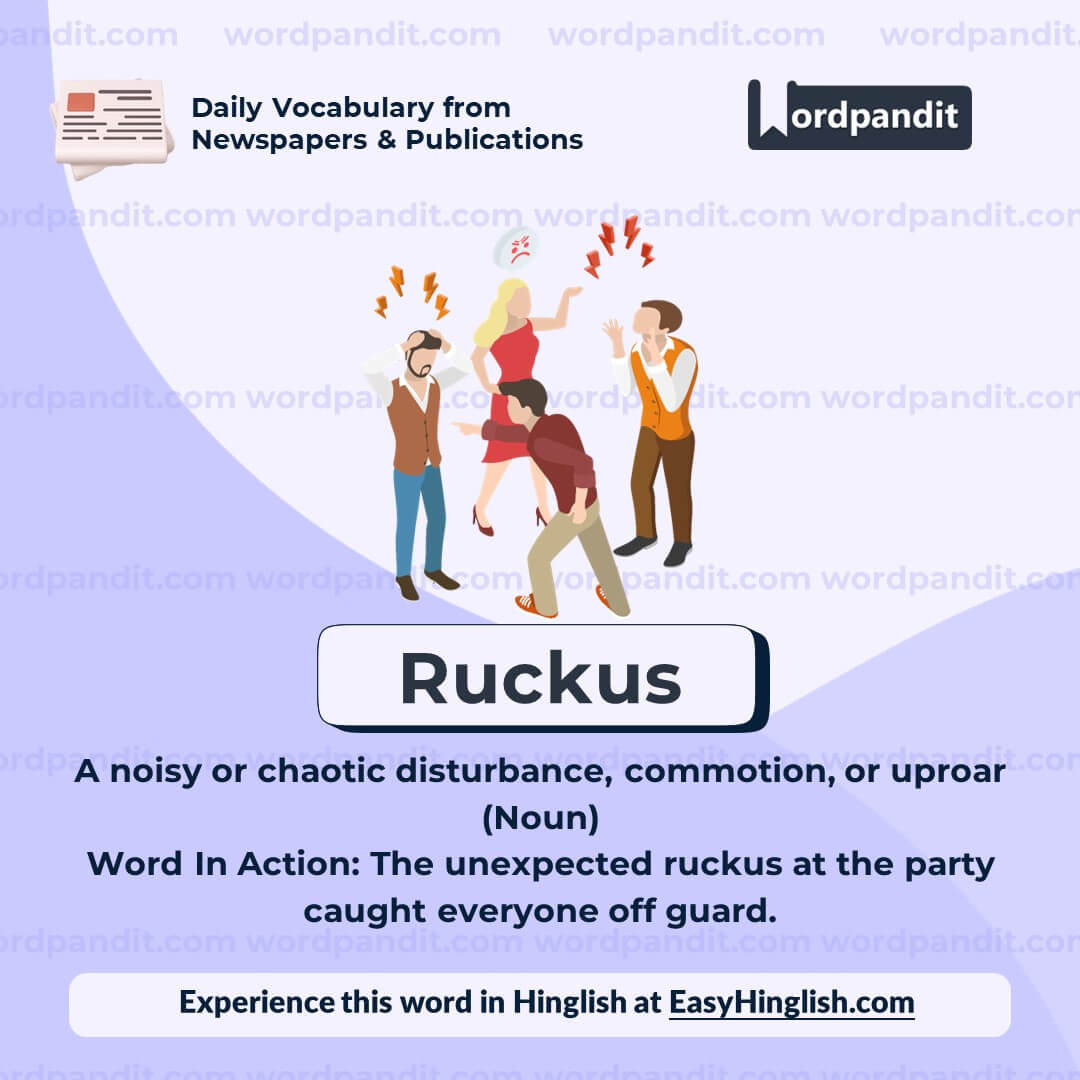
WORD-2: Ruckus
Context:
"He contended that only opposition legislators were singled out for such a shaming exercise, while those in the treasury benches who created similar ruckus had been let off easily." - The Wire
Explanatory Paragraph:
"Ruckus" refers to a noisy, chaotic, or disruptive situation. It is typically used to describe a scene where people are arguing, shouting, or creating a disturbance. In politics or public discourse, it can imply an uproar or commotion that disrupts proceedings. The term often carries a slightly informal tone and can describe anything from a mild argument to a loud protest.
Meaning: A noisy commotion, uproar, or disturbance (Noun)
Pronunciation: RUH-kuhs
Difficulty Level: ⭐⭐ Basic
Etymology: Probably a blend of "ruction" (a disturbance or quarrel) and "rumpus"; American English origin, first recorded in the late 19th century.
Prashant Sir's Notes:
This word is great for describing loud, disruptive scenes—especially in political, classroom, or protest settings. It's informal, so be cautious about using it in formal writing unless the tone allows for it.
Synonyms & Antonyms:
Synonyms: commotion, uproar, chaos, disturbance, fracas
Antonyms: calm, peace, quiet, order, stillness
Usage Examples:
- The classroom erupted into a ruckus when the fire alarm accidentally went off.
- There was a huge ruckus outside the stadium after the controversial match ended.
- The security guard intervened to stop the ruckus at the mall entrance.
- The parliamentary session was interrupted by a ruckus among rival party members.
Cultural Reference:
"A little ruckus never hurt anyone." – A common phrase in teen and action movies, reflecting youthful rebellion or mischief.
Think About It:
When does creating a ruckus become a necessary form of protest, and when does it become counterproductive?
Quick Activity:
List three places where a ruckus would be considered inappropriate and three where it might be expected or even welcomed. Explain why.
Memory Tip:
“Ruckus” sounds like “ruck” (rough) + “us”—imagine a rough crowd causing a scene around us. That’s a ruckus!
Real-World Application:
The term "ruckus" is commonly used by journalists, police reports, and event coordinators to describe disruptive events. Understanding the word helps in interpreting news reports, especially those covering protests, political debates, or sports riots.

WORD-3: Exhortation
Context:
"Despite the exhortations of the union leaders, the workers voted not to strike." - The Wire
Explanatory Paragraph:
"Exhortation" refers to a strong urging or encouragement to do something. It is often used when someone earnestly advises, persuades, or pleads with others to take a particular action. The word carries a tone of seriousness and moral pressure, often seen in speeches, public appeals, or calls to collective action. In the given context, union leaders were trying hard to convince the workers, but their appeals were ultimately unsuccessful.
Meaning: A strong urging, encouragement, or appeal to act (Noun)
Pronunciation: eg-zor-TAY-shun
Difficulty Level: ⭐⭐⭐ Intermediate
Etymology: From Latin "exhortationem" meaning encouragement or incitement; derived from "exhortari" (to encourage).
Prashant Sir's Notes:
Remember: 'exhortation' is not casual advice. It's usually forceful, passionate, and often public. Think of a leader making a speech urging people to act—that's an exhortation in action.
Synonyms & Antonyms:
Synonyms: urging, appeal, encouragement, plea, persuasion
Antonyms: discouragement, dissuasion, silence, indifference
Usage Examples:
- The coach’s passionate exhortation before the match inspired the team to give their best.
- Despite the mayor’s exhortation to evacuate, many residents chose to stay behind.
- His exhortations for peace were met with applause by the international community.
- Parents often use exhortation to instill discipline and values in their children.
Cultural Reference:
“Ask not what your country can do for you – ask what you can do for your country.” – John F. Kennedy's famous exhortation to American citizens in his 1961 inaugural address.
Think About It:
Can repeated exhortations lose their power over time? What makes an exhortation truly effective?
Quick Activity:
Write a short exhortation urging people to recycle and protect the environment. Keep it passionate and persuasive!
Memory Tip:
Think of “exhortation” as “EXpressing + urge + acTION” — someone expressing a strong urge for action.
Real-World Application:
Exhortation is commonly used in speeches, sermons, motivational talks, and political campaigns. Understanding it helps analyze persuasive communication and public discourse more critically.

WORD-4: Groupuscules
Context:
"In the aftermath, the French far right disintegrated into a patchwork of groupuscules, political and militaristic formations, social movements and publications." - The Wire
Explanatory Paragraph:
"Groupuscules" refers to very small, often fringe political groups or sects, usually with radical views or limited influence. The word is typically used in political analysis to describe splinter groups that break away from a larger movement. These groups may not have much mainstream power but can still be ideologically intense or even dangerous due to their extremist positions. In the context above, it describes how the French far right fragmented into numerous minor factions after a period of collapse or reorganization.
Meaning: Small, often radical political factions or splinter groups (Noun – plural)
Pronunciation: groop-uh-skools
Difficulty Level: ⭐⭐⭐⭐ Advanced
Etymology: From French "groupuscule", a diminutive of "groupe" (group); literally means "a tiny group". First used in political discourse in the 20th century, particularly in France.
Prashant Sir's Notes:
This is a specialized word often used in political science or journalism. It suggests a sense of fragmentation, extremism, and marginal influence. Very useful when describing niche ideological groups, especially in historical or sociopolitical contexts.
Synonyms & Antonyms:
Synonyms: factions, sects, cliques, cells, splinter groups
Antonyms: mainstream parties, coalitions, majorities, alliances
Usage Examples:
- After the revolution, the movement splintered into countless groupuscules, each with its own doctrine.
- Many groupuscules operate underground, often spreading radical propaganda online.
- The security agencies keep a close watch on extremist groupuscules suspected of planning violence.
- Groupuscules, while small in size, can influence political discourse through social media amplification.
Cultural Reference:
The term “groupuscules” became popular in French political commentary in the post-1968 era, particularly as leftist and far-right groups splintered and reorganized. It often features in academic texts on European radicalism.
Think About It:
How can tiny groupuscules with few members have an outsized impact on public discourse or national security?
Quick Activity:
Think of a major political party in your country. Can you identify any groupuscules that have broken away from it in the last decade? Briefly describe one.
Memory Tip:
“Groupuscule” sounds like “group + minuscule” — it literally means a tiny group. Use that to remember its meaning!
Real-World Application:
Understanding "groupuscules" is important in journalism, political science, and security studies, where tracking the emergence and ideology of such micro-groups can help assess sociopolitical threats or trends.
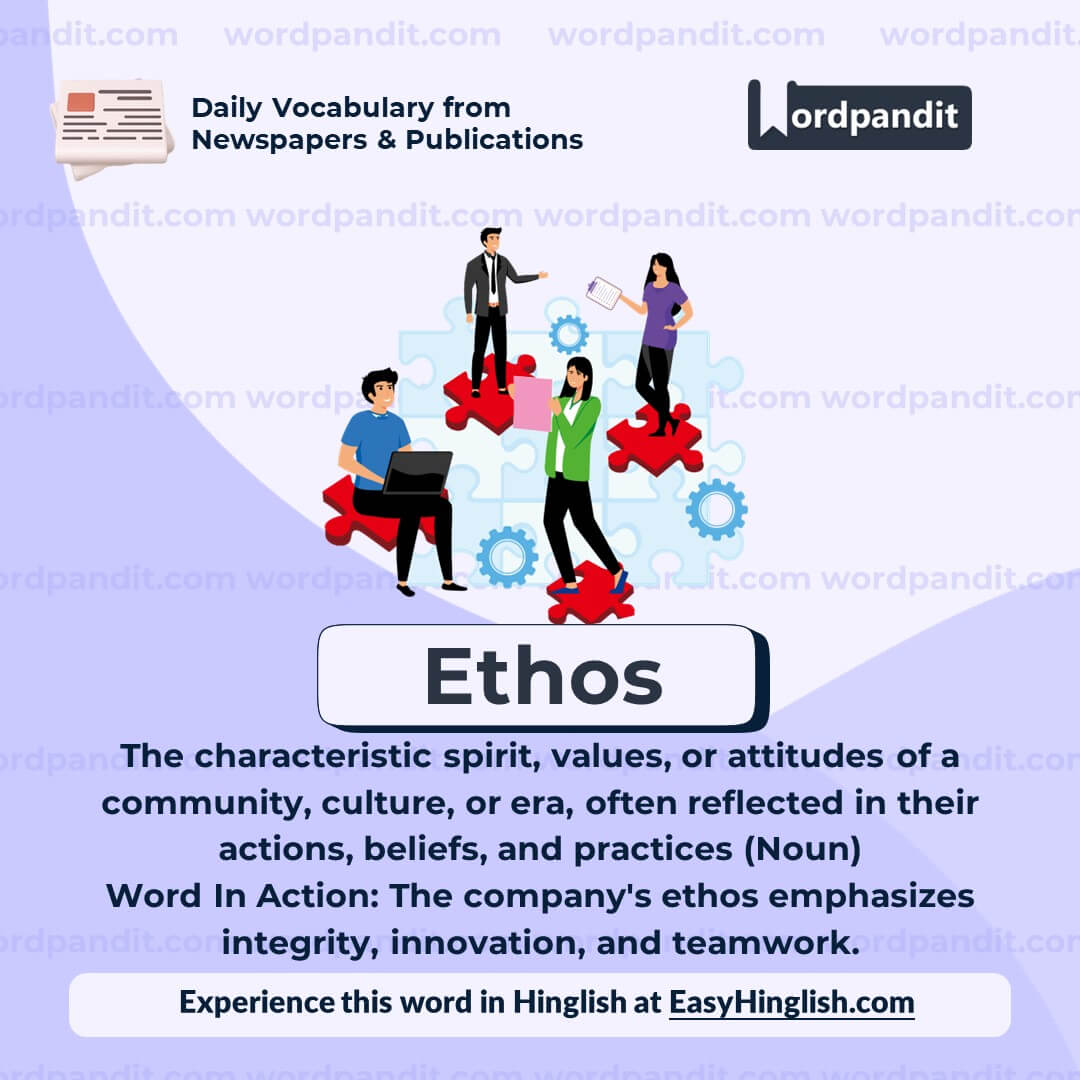
WORD-5: Ethos
Context:
"The contribution of Shailendra and Abbas was crucial. Both were attuned to the ethos of the times..." - The Wire
Explanatory Paragraph:
"Ethos" refers to the characteristic spirit, values, beliefs, or moral nature of a community, era, or individual. It encompasses the guiding ideals that shape behavior, art, politics, or culture. In the context of the sentence, it means that Shailendra and Abbas were deeply in tune with the cultural and emotional atmosphere of their era, allowing them to create work that resonated with people at the time.
Meaning: The fundamental spirit, character, or values of a person, group, or time period (Noun)
Pronunciation: EE-thos
Difficulty Level: ⭐⭐⭐ Intermediate
Etymology: From Greek "ēthos" meaning character, custom, or disposition. Used in rhetoric and philosophy since classical antiquity to describe moral character and persuasive credibility.
Prashant Sir's Notes:
This is a powerful word often used in literature, sociology, politics, and even marketing. Think of "ethos" as the emotional and cultural DNA of a group or era. It helps explain *why* people act the way they do at a certain time in history.
Synonyms & Antonyms:
Synonyms: spirit, culture, character, philosophy, values
Antonyms: lawlessness, immorality, chaos, amorality
Usage Examples:
- The company's ethos is centered on innovation and integrity.
- Gandhi’s life reflected the ethos of non-violence and simplicity.
- The novel beautifully captures the ethos of rural India in the 1940s.
- Artists must understand the ethos of their audience to truly connect with them.
Cultural Reference:
In classical rhetoric, Aristotle identified “ethos” as one of the three key modes of persuasion, alongside “pathos” (emotion) and “logos” (logic). Ethos referred to the credibility and ethical appeal of the speaker.
Think About It:
How does the ethos of your generation differ from that of your parents or grandparents? What defines it?
Quick Activity:
Pick a famous brand or movement and describe its ethos in one or two sentences. Try to capture its core values.
Memory Tip:
Think of “ethos” as related to “ethics”—both deal with what a group believes is right or important. "Ethos" = "ethics of a society."
Real-World Application:
Understanding the ethos of a workplace, culture, or era is essential in communication, marketing, leadership, and writing. It allows one to tailor messages that resonate deeply with the intended audience.


