

Daily Vocabulary from Indian Newspapers and Publications
Welcome to Wordpandit’s Indian Vocabulary Hub
At Wordpandit, we understand the importance of staying rooted in the local context while expanding your language skills. This section focuses on enriching your vocabulary with words and phrases drawn from India’s leading newspapers and publications, ensuring you're learning vocabulary that is practical, relevant, and uniquely Indian.
Why Indian Sources Matter
We believe that the best way to master any language is by immersing yourself in local content. That’s why we carefully curate vocabulary from top Indian publications, including:
- The Hindu
- The Times of India
- The Economic Times
- Hindustan Times
- Live Mint
- The Indian Express
- And many others...
Stay Updated, Stay Relevant
With daily updates from Indian news sources, you’ll be consistently learning words that reflect the trends and shifts in Indian society and culture. Our focus is to provide vocabulary that enhances your understanding of the language in an Indian context.
How Wordpandit Supports Your Goals
Whether you’re preparing for exams, aiming to improve your professional communication, or simply want to stay connected with the latest Indian vocabulary, Wordpandit is here to guide you every step of the way.
Learn with a Practical Approach
Our interactive learning methodology includes real-world examples, engaging activities, and context-specific usage to ensure that every word becomes part of your active vocabulary.
Dive into Indian Vocabulary Today!
Why Choose Wordpandit?
Practical Learning: Focus on words you'll actually encounter in real-world reading, enhancing your comprehension and communication skills.
Diverse Content: From current affairs to scientific breakthroughs, our varied sources expose you to vocabulary across multiple domains.
Effortless Integration: Make Wordpandit a part of your daily routine. Just a few minutes each day can significantly boost your lexicon over time.
Your Path to Vocabulary Mastery
- Visit our Daily Vocabulary section regularly
- Explore new words and their usage in context
- Practice incorporating these words into your own writing and speech
- Track your progress as your vocabulary expands
Start Your Journey Today
Embark on your vocabulary enhancement journey with Wordpandit. By consistently engaging with our daily posts, you'll build a robust vocabulary that serves you well in academic, professional, and personal contexts.
Remember, a word a day keeps linguistic limitations at bay. Make Wordpandit your daily companion in the quest for vocabulary excellence!

WORD-1: Seismic
Context:
"For someone like me, shaped by the rituals of deference and the rigid hierarchies of the Indian education system, this was more than surprising – it was seismic." - The Wire
Explanatory Paragraph:
“Seismic” typically relates to earthquakes and ground movements, but in a metaphorical sense, it is used to describe something of great impact or significance—something so powerful that it shakes up existing structures, ideas, or norms. In the context above, the word “seismic” conveys a moment or realization that was profoundly transformative or disruptive, especially to the speaker’s worldview shaped by tradition and structure.
Meaning: Having a powerful or earth-shaking impact; relating to or caused by an earthquake (Adjective)
Pronunciation: size-mik
Difficulty Level: ⭐⭐⭐ Intermediate
Etymology: From Greek "seismos" meaning “earthquake,” from "seiein," meaning “to shake.”
Prashant Sir's Notes:
“Seismic” is a word that has traveled from the world of geology into everyday language. When you hear something described as “seismic,” think about a foundational shake—something that shifts the very ground under your feet metaphorically. It's excellent for describing change that disrupts norms.
Synonyms & Antonyms:
Synonyms: monumental, earth-shattering, groundbreaking, disruptive, momentous
Antonyms: insignificant, trivial, minor, negligible
Usage Examples:
- The resignation of the prime minister had seismic consequences on the nation’s political stability.
- The introduction of smartphones was a seismic shift in how people communicate and work.
- Her decision to leave a secure job for her startup was seen as seismic by her conservative family.
- The discovery of the manuscript brought a seismic change in the understanding of medieval literature.
Cultural Reference:
"The 9/11 attacks were a seismic event in modern history, altering global geopolitics and security perceptions forever." - Common historical analysis
Think About It:
Can a “seismic” event in your personal life be as impactful as a societal or global shift? What might that look like?
Quick Activity:
Write down three personal or global events you consider to be “seismic.” Briefly explain why they qualify as such.
Memory Tip:
Think “seismic” = “seismograph” = “earthquake” = “huge impact.” When something is seismic, it shakes things up—just like an earthquake.
Real-World Application:
“Seismic” is used in journalism, business, and everyday speech to describe changes or events that are transformative, whether it’s a market crash, a leadership shift, or a cultural revolution.
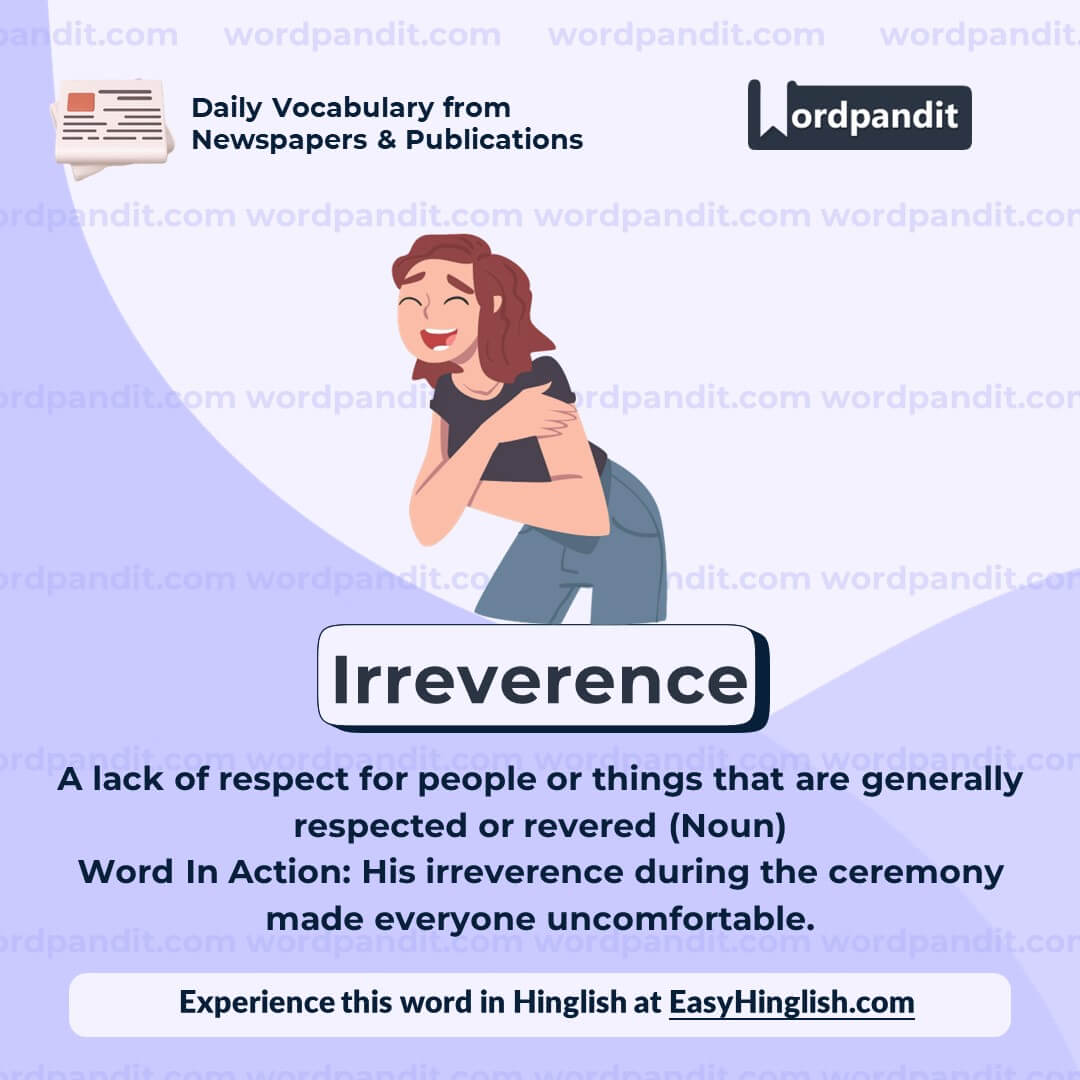
WORD-2: Irreverence
Context:
"What struck me in those American classrooms was not irreverence or disorder but a different kind of respect – one which, unlike in India, was not conferred by title or demanded through hierarchy but earned through substance." - The Wire
Explanatory Paragraph:
“Irreverence” refers to a lack of respect for people or things that are usually given admiration or reverence, especially in formal or traditional settings. It doesn't necessarily mean rudeness—it can suggest humor, skepticism, or a questioning attitude towards authority or sacred ideas. In the context above, the author clarifies that what they experienced was not irreverence (as one might expect when hierarchy is absent), but rather a more genuine form of respect based on merit rather than status.
Meaning: A lack of respect for people or things that are generally taken seriously (Noun)
Pronunciation: ih-rev-er-uhns
Difficulty Level: ⭐⭐⭐ Intermediate
Etymology: From Latin “irreverentia,” combining “in-” (not) + “reverentia” (awe, respect)
Prashant Sir's Notes:
Irreverence is not always negative. In modern education and art, irreverence can signal critical thinking, creativity, or a willingness to challenge stale traditions. The key is whether it's constructive or simply mocking. In vocabulary, words like this are nuanced—context matters deeply.
Synonyms & Antonyms:
Synonyms: disrespect, mockery, impertinence, insolence, cheekiness
Antonyms: reverence, respect, veneration, admiration
Usage Examples:
- The comedian’s irreverence toward politics made the audience laugh, but also think deeply.
- Her irreverence in the boardroom shook up the old guard, but led to innovative changes.
- The novel’s irreverence toward traditional storytelling gave it a fresh and modern feel.
- Some viewed his irreverence as offensive, while others saw it as a bold critique of outdated norms.
Cultural Reference:
"The Simpsons has been praised for its clever irreverence, poking fun at politics, religion, and social norms alike." - Popular Culture Commentary
Think About It:
Can irreverence be a form of higher respect—by challenging authority to live up to its ideals?
Quick Activity:
List three famous personalities known for their irreverence. For each, explain whether their attitude led to positive or negative outcomes.
Memory Tip:
Break it down: “Ir-” (not) + “reverence” (respect). Irreverence = not showing usual respect. Think of a student who jokes in class—not rude, but bold.
Real-World Application:
Irreverence often appears in satire, comedy, innovation, and protest. It helps question norms and can lead to breakthroughs—if done thoughtfully and responsibly.
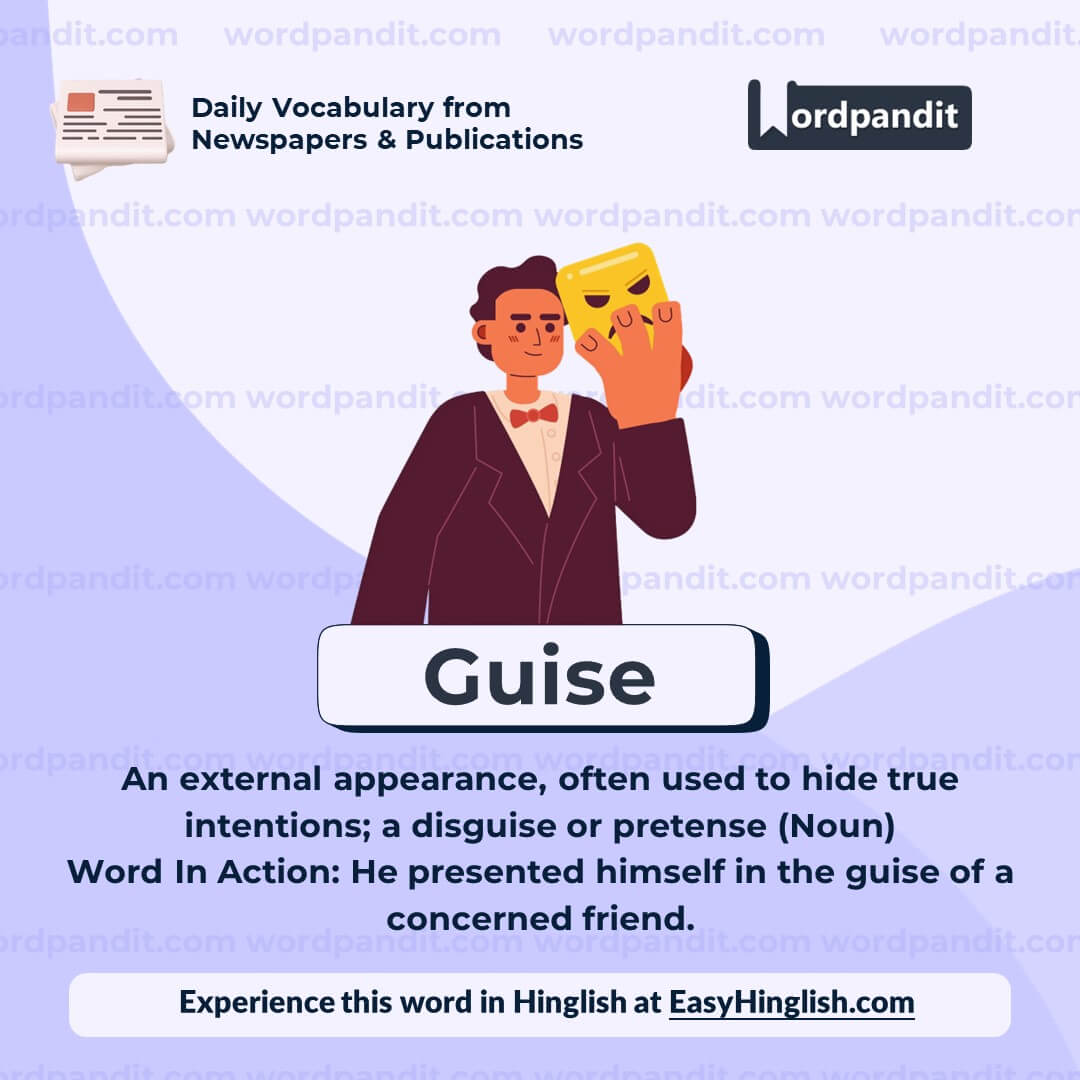
WORD-3: Guise
Context:
"Under the guise of friendship, he sought to undermine their plans and promote his own interests." - Original Example
Explanatory Paragraph:
“Guise” refers to an outward appearance or manner that is typically intended to hide the true nature of something. When someone does something "under the guise of" something else, they are pretending or disguising their real motive or identity. In the example above, the person pretended to be a friend, but their real intention was manipulation and self-interest. The word often carries a negative or deceptive connotation, suggesting that appearances can be misleading.
Meaning: An external form, appearance, or manner of presentation, typically concealing the true nature of something (Noun)
Pronunciation: gyz (rhymes with "wise")
Difficulty Level: ⭐⭐ Basic to Intermediate
Etymology: From Old French “guise” meaning “manner, fashion,” of Germanic origin; related to “wise” in the sense of a way or method.
Prashant Sir's Notes:
“Guise” is a classic example of a word that signals hidden intention. It’s a favorite in formal writing, especially in contexts involving manipulation, disguise, or pretense. Watch for it in legal, political, and psychological discussions. When you see "under the guise of," be alert—something might not be what it seems.
Synonyms & Antonyms:
Synonyms: pretense, disguise, façade, mask, cover
Antonyms: reality, truth, authenticity, honesty
Usage Examples:
- She arrived at the event under the guise of a reporter, but she was really gathering intelligence.
- The policy was introduced under the guise of public safety, though it limited freedom of speech.
- He offered help under the guise of concern, but his intentions were purely selfish.
- Marketing often comes in the guise of entertainment in today’s digital age.
Cultural Reference:
"In Shakespeare’s plays, characters often act under the guise of another identity, creating dramatic irony and tension." - Literary Analysis
Think About It:
Can operating under a guise ever be morally justifiable—such as disguising one’s identity for a noble cause?
Quick Activity:
Write two sentences using “guise”—one in a negative context (deception) and one in a positive or neutral context (e.g., protecting identity).
Memory Tip:
“Guise” sounds like “disguise”—and that’s exactly what it often is: a cover or false appearance. Think of someone wearing a mask to hide their real face.
Real-World Application:
“Guise” is used in legal and political discourse to question hidden motives—e.g., when actions are taken under the guise of law, safety, or morality but serve different ends.
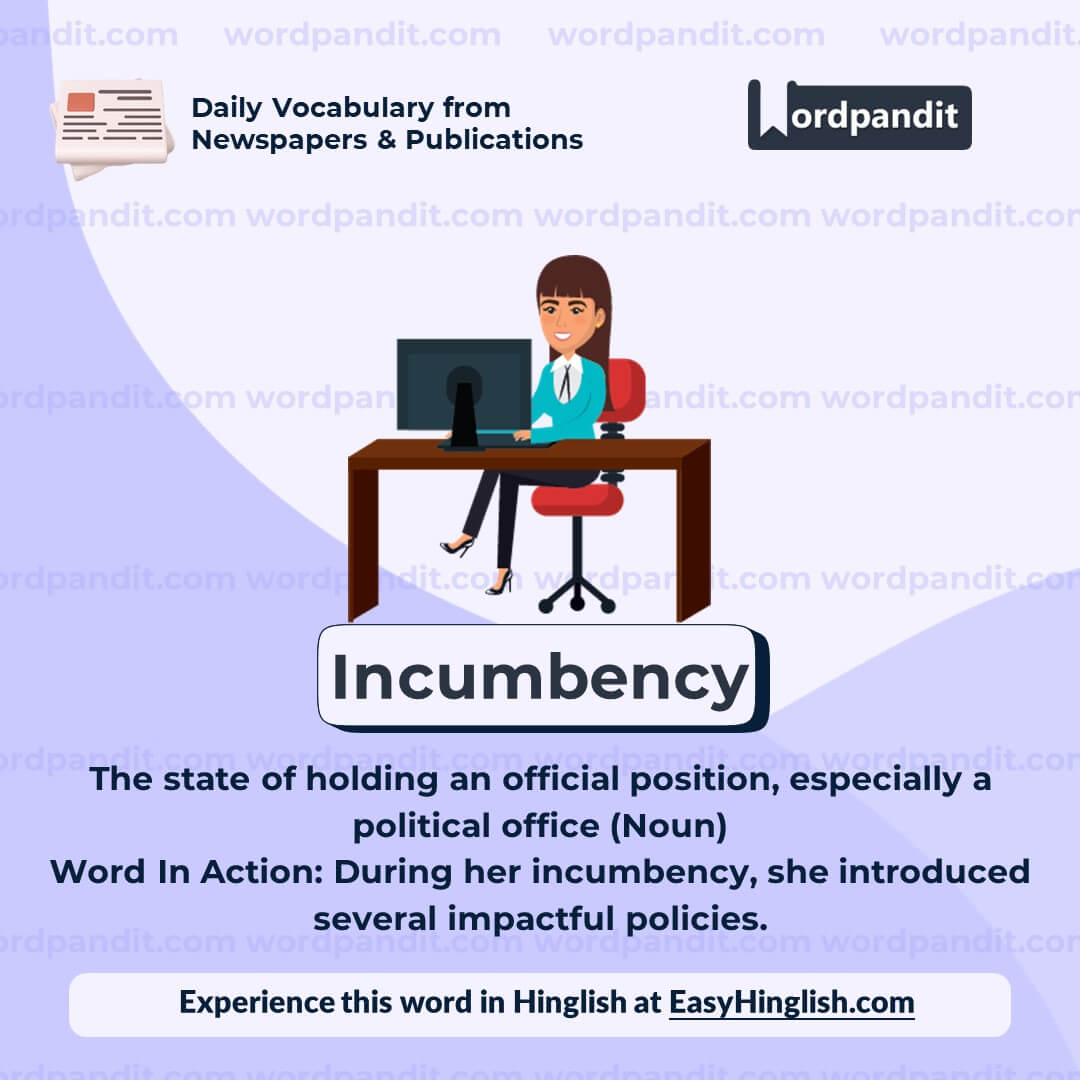
WORD-4: Incumbency
Context:
"The saffron party is thus relying on Brand Modi, caste and faith-based polarisation, and anti-incumbency sentiment to upstage the AAP in absence of a leader who can steer the party." - The Wire
Explanatory Paragraph:
“Incumbency” refers to the state of currently holding a political office or position of authority. In political discussions, the term is often used to describe the advantages or disadvantages that come with being in power. For example, “anti-incumbency” sentiment arises when the public becomes dissatisfied with the ruling government and seeks change. In the context above, the ruling party is being challenged partly due to this negative sentiment against those in power.
Meaning: The period during which someone holds a particular office or position (Noun)
Pronunciation: in-kum-buhn-see
Difficulty Level: ⭐⭐⭐ Intermediate
Etymology: From Latin “incumbere,” meaning “to lie upon,” later evolving in usage to refer to those currently occupying an office or duty.
Prashant Sir's Notes:
In Indian political discourse, "incumbency" and "anti-incumbency" are frequently used terms. While incumbency gives visibility and access to power, it also opens the door to criticism. The longer a party or leader stays in office, the higher the risk of public discontent—a key idea behind “anti-incumbency.” Keep an eye out for this in election news.
Synonyms & Antonyms:
Synonyms: tenure, term, office-holding, authority
Antonyms: candidacy, retirement, opposition, successor
Usage Examples:
- The chief minister’s long incumbency became a double-edged sword—bringing experience, but also public fatigue.
- Anti-incumbency waves have unseated many popular leaders in democratic elections.
- Her incumbency was marked by economic reforms and infrastructural development.
- Voters often weigh the performance during an incumbent's term before casting their ballots.
Cultural Reference:
"Incumbency advantage" is a well-documented phenomenon in U.S. politics, where sitting members of Congress often have a higher chance of re-election due to name recognition and access to resources. - Political Science Textbooks
Think About It:
Should long incumbency be seen as a sign of stability and experience, or a barrier to fresh leadership and innovation?
Quick Activity:
Think of a recent election you followed. Was the outcome influenced by pro-incumbency or anti-incumbency sentiment? Write one sentence explaining why.
Memory Tip:
Remember: “Incumbent” is the one currently *in* office, so “incumbency” is the *state* of being in office. Both start with “in-” — hinting at someone *inside* the system.
Real-World Application:
Understanding “incumbency” is crucial for analyzing elections, leadership transitions, and governance. It shapes public perception and often decides political strategy, especially in democracies like India or the U.S.
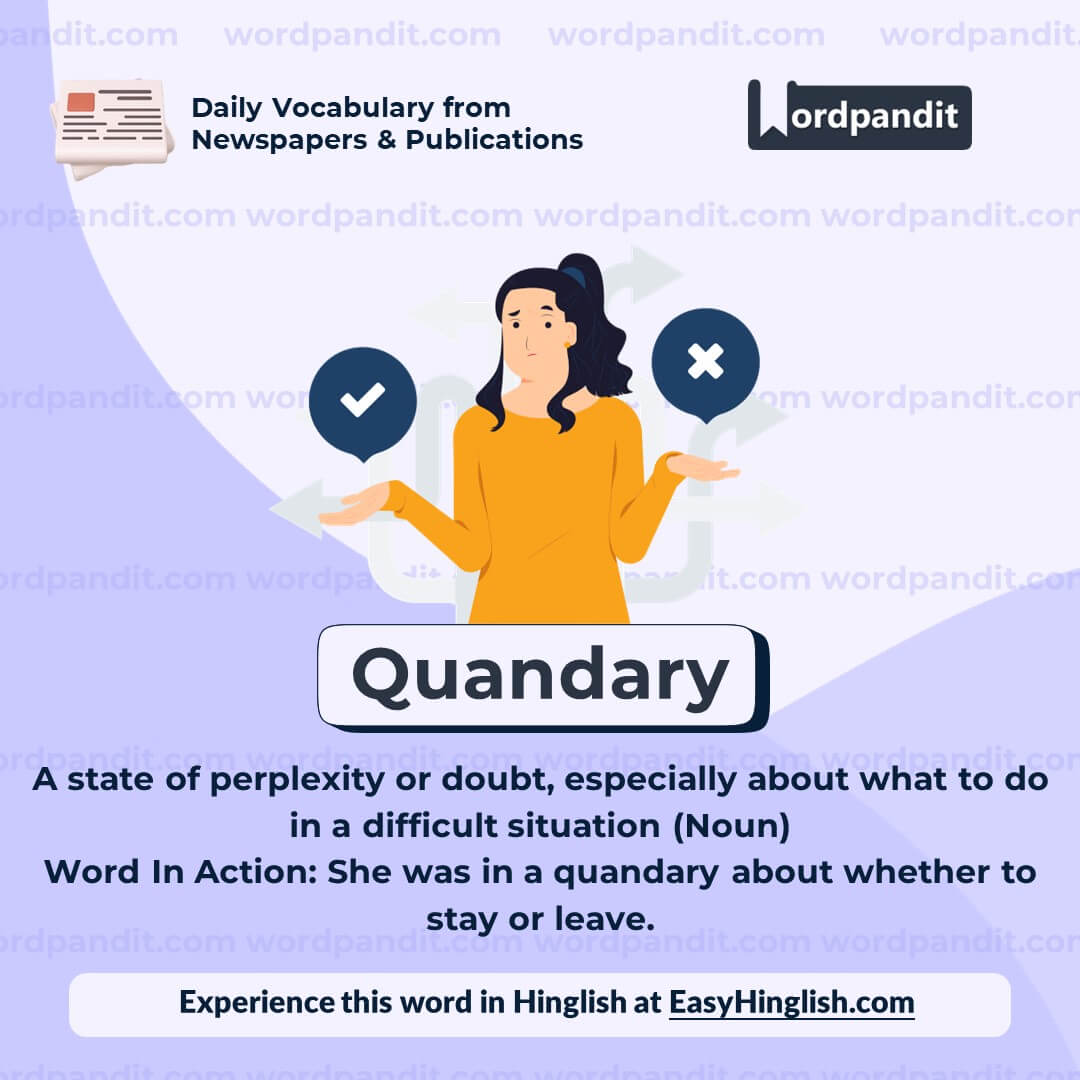
WORD-5: Quandary
Context:
"Barely has the BJP found itself in such a quandary where it hopes for the revival of its biggest political rival." - The Wire
Explanatory Paragraph:
“Quandary” refers to a state of confusion or uncertainty, especially when trying to make a difficult decision. It describes a mental or strategic dilemma where none of the available options seem clearly right or favorable. In the context above, the BJP is facing an unusual and ironic dilemma—finding itself in a situation where it must indirectly root for the return of its main political rival, which is counter to its usual goals.
Meaning: A state of perplexity or doubt; a difficult situation where a decision must be made (Noun)
Pronunciation: kwan-duh-ree
Difficulty Level: ⭐⭐⭐ Intermediate
Etymology: Origin uncertain; possibly from Latin “quando” meaning “when,” indicating uncertainty about timing or choice.
Prashant Sir's Notes:
Quandary is a great word to describe dilemmas—whether personal, political, or moral. It adds depth to your vocabulary when you're trying to express that “stuck between a rock and a hard place” feeling. Use it when you want to sound thoughtful without being overly dramatic.
Synonyms & Antonyms:
Synonyms: dilemma, predicament, puzzle, uncertainty, confusion
Antonyms: solution, certainty, clarity, resolution
Usage Examples:
- She was in a quandary about whether to accept the high-paying job or pursue her passion.
- The government faced a quandary: support an unpopular ally or risk international backlash.
- After losing the key, he found himself in a quandary outside his locked apartment.
- The principal was in a moral quandary over how to punish a student who broke the rules for a good cause.
Cultural Reference:
"Hamlet's quandary—'To be or not to be'—has become one of literature’s most famous reflections on indecision and inner turmoil." - Shakespearean Literature
Think About It:
Have you ever faced a personal quandary where either choice carried a cost? How did you decide?
Quick Activity:
Write down a short paragraph describing a fictional character’s quandary. Try to show their internal struggle clearly.
Memory Tip:
Think “Q” for “Question” and “U” for “Uncertainty.” When you're in a quandary, you're questioning and unsure—stuck at a confusing crossroad.
Real-World Application:
“Quandary” is useful in journalism, storytelling, and everyday conversation to describe complex situations—be it in politics, relationships, or career decisions—where choices are tough and clarity is lacking.


