Daily Vocabulary from Indian Newspapers and Publications
Welcome to Wordpandit’s Indian Vocabulary Hub
At Wordpandit, we understand the importance of staying rooted in the local context while expanding your language skills. This section focuses on enriching your vocabulary with words and phrases drawn from India’s leading newspapers and publications, ensuring you're learning vocabulary that is practical, relevant, and uniquely Indian.
Why Indian Sources Matter
We believe that the best way to master any language is by immersing yourself in local content. That’s why we carefully curate vocabulary from top Indian publications, including:
- The Hindu
- The Times of India
- The Economic Times
- Hindustan Times
- Live Mint
- The Indian Express
- And many others...
Stay Updated, Stay Relevant
With daily updates from Indian news sources, you’ll be consistently learning words that reflect the trends and shifts in Indian society and culture. Our focus is to provide vocabulary that enhances your understanding of the language in an Indian context.
How Wordpandit Supports Your Goals
Whether you’re preparing for exams, aiming to improve your professional communication, or simply want to stay connected with the latest Indian vocabulary, Wordpandit is here to guide you every step of the way.
Learn with a Practical Approach
Our interactive learning methodology includes real-world examples, engaging activities, and context-specific usage to ensure that every word becomes part of your active vocabulary.
Dive into Indian Vocabulary Today!
Why Choose Wordpandit?
Practical Learning: Focus on words you'll actually encounter in real-world reading, enhancing your comprehension and communication skills.
Diverse Content: From current affairs to scientific breakthroughs, our varied sources expose you to vocabulary across multiple domains.
Effortless Integration: Make Wordpandit a part of your daily routine. Just a few minutes each day can significantly boost your lexicon over time.
Your Path to Vocabulary Mastery
- Visit our Daily Vocabulary section regularly
- Explore new words and their usage in context
- Practice incorporating these words into your own writing and speech
- Track your progress as your vocabulary expands
Start Your Journey Today
Embark on your vocabulary enhancement journey with Wordpandit. By consistently engaging with our daily posts, you'll build a robust vocabulary that serves you well in academic, professional, and personal contexts.
Remember, a word a day keeps linguistic limitations at bay. Make Wordpandit your daily companion in the quest for vocabulary excellence!
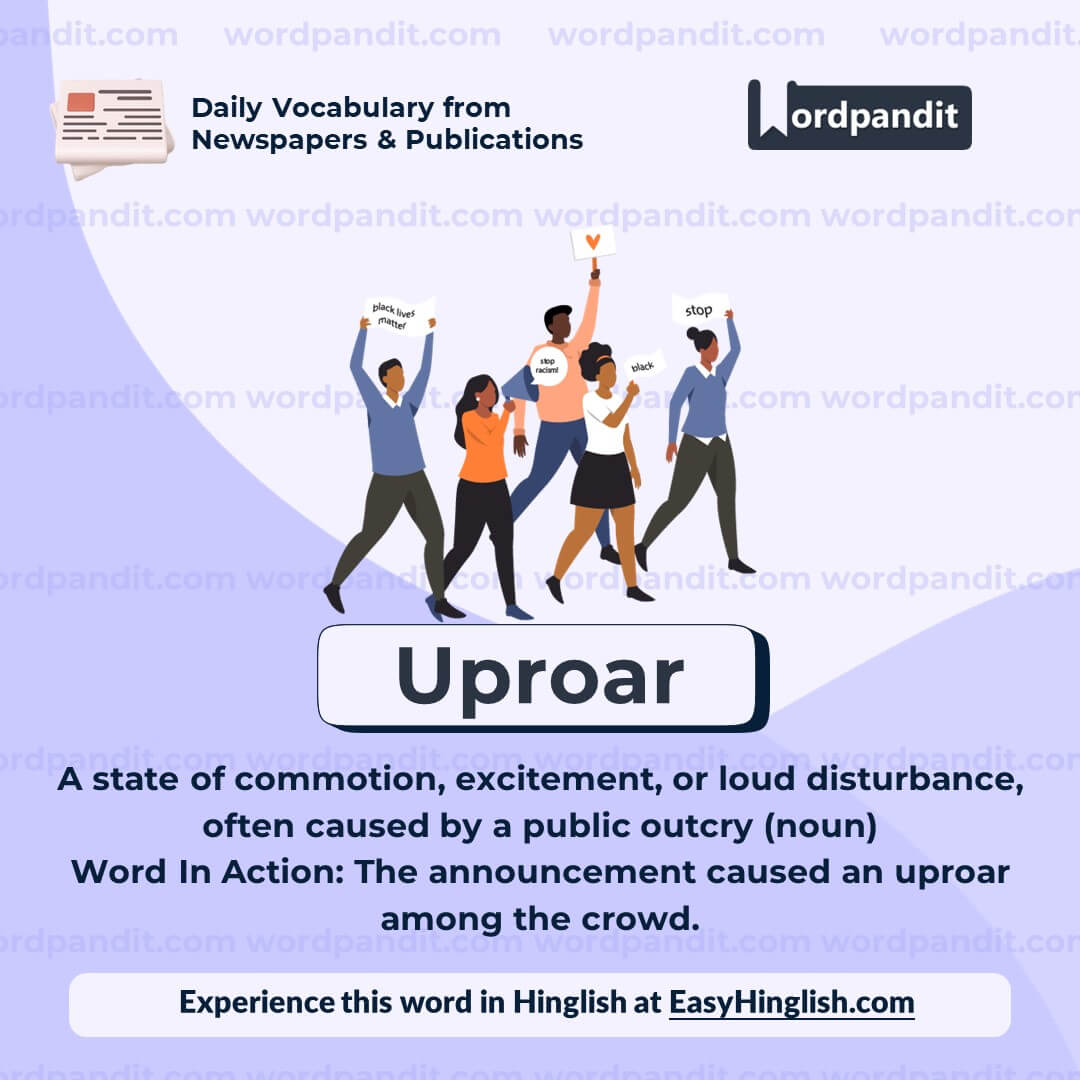
WORD-1: Uproar
Context:
"In a move that not only echoes but intensifies the uproar sparked by INFOSYS chairman Narayana Murthy’s controversial suggestion of a 70-hour work week..." - The Wire
Explanatory Paragraph:
The word "uproar" refers to a loud and impassioned reaction from the public, often involving protest, outrage, or emotional intensity. It usually follows an event or statement that is seen as controversial or unjust. In the context of the article, the term is used to describe the heated response from the public and media after Narayana Murthy’s statement advocating a 70-hour work week, which many perceived as excessive or out of touch.
Meaning: A loud and impassioned noise or disturbance caused by a strong public reaction (Noun)
Pronunciation: UP-roar
Difficulty Level: ⭐⭐ Easy
Etymology: Derived from the Dutch word "oproer," meaning “tumult, sedition,” which combines "op" (up) and "roer" (roar or disturbance).
Prashant Sir's Notes:
Use "uproar" when describing public outrage, mass protests, or viral backlash moments. It often signals emotional volume and disruption. Think of news headlines or social media storms.
Synonyms & Antonyms:
Synonyms: outcry, commotion, furor, turmoil, pandemonium
Antonyms: silence, calm, peace, tranquility, order
Usage Examples:
- The politician's remarks caused an uproar in the parliament.
- There was an uproar in the auditorium when the host announced the wrong winner.
- Her decision to resign amid the scandal triggered a media uproar.
- The new policy led to public uproar due to its perceived unfairness.
Cultural Reference:
"The release of the final season of *Game of Thrones* caused an uproar among fans due to its controversial ending." - Entertainment Weekly (paraphrased)
Think About It:
Can an uproar ever lead to meaningful change, or does it only serve to vent public frustration without real impact?
Quick Activity:
List three recent news events that caused a public uproar. What common traits do they share?
Memory Tip:
Think of "uproar" as a combination of "up" and "roar" — a rising roar of voices protesting or reacting emotionally.
Real-World Application:
"Uproar" is commonly used in media reporting, political commentary, and public opinion pieces to describe collective backlash or unrest, especially after controversial actions or statements.
WORD-2: Glorify
Context:
"Advocating for a 90-hour work week, Subrahmanyan’s remarks glorify excessive labour and normalise gendered division of labour." - The Wire
Explanatory Paragraph:
The word "glorify" means to praise or present something as admirable or noble, often ignoring its downsides or complexities. It’s commonly used in a critical tone when someone exaggerates the virtues of something potentially harmful or controversial. In the context above, the author is suggesting that Subrahmanyan’s statement makes overwork seem virtuous, while ignoring its negative impacts, especially how such attitudes may reinforce unequal roles at home or in the workplace.
Meaning: To praise or present something as admirable or noble, often undeservedly (Verb)
Pronunciation: GLOR-uh-fy
Difficulty Level: ⭐⭐⭐ Intermediate
Etymology: From Latin "glorificare" – "gloria" meaning "glory" + "facere" meaning "to make"
Prashant Sir's Notes:
Be cautious of when "glorify" is used. It can mean sincere praise, but in modern usage, it often carries a negative undertone — as in making something harmful seem heroic or admirable. Use in debates about ethics, media, or social commentary.
Synonyms & Antonyms:
Synonyms: praise, exalt, celebrate, idolize, commend
Antonyms: criticize, condemn, denounce, disapprove, vilify
Usage Examples:
- The film was accused of glorifying violence and toxic masculinity.
- She glorified her struggles to inspire others, even though the journey was painful.
- Advertisements often glorify luxury lifestyles that are unrealistic for most people.
- Historical dramas sometimes glorify empires while ignoring their oppressive policies.
Cultural Reference:
"Many war movies have been criticized for glorifying conflict rather than portraying its tragic consequences." - Film Critique Weekly (paraphrased)
Think About It:
Is there a fine line between honoring someone's hard work and glorifying harmful work cultures?
Quick Activity:
Write down three situations where glorifying something could be harmful. Explain why it might be problematic.
Memory Tip:
Think of "glorify" as “give glory to” — even when that glory may not be deserved. It's like putting a spotlight on something to make it shine, whether it should or not.
Real-World Application:
"Glorify" is often used in journalism, education, and social criticism to challenge how certain actions or ideologies are portrayed. It helps assess whether something is being praised blindly or critically examined.
WORD-3: Derision
Context:
"Obviously, during BJP’s decade-long rule since 2014 under the leadership of Narendra Modi, the opposition has been treated with aggressive derision." - The Wire
Explanatory Paragraph:
"Derision" refers to mockery or ridicule — a way of speaking or behaving that expresses deep contempt or scorn. When someone is treated with derision, they are not just opposed; they are dismissed, belittled, or laughed at in a disrespectful way. In the context of the article, the term suggests that political opponents have not only been criticized but also openly scorned or humiliated in speech and behavior by those in power.
Meaning: Contemptuous ridicule or mockery (Noun)
Pronunciation: duh-RIH-zhun
Difficulty Level: ⭐⭐⭐ Intermediate
Etymology: From Latin "deridere" — "de" (down) + "ridere" (to laugh), meaning "to laugh down at."
Prashant Sir's Notes:
"Derision" is a powerful word used in contexts where contempt is expressed through laughter or mockery. It’s stronger than mere disagreement. Think of public shaming, sarcastic dismissal, or making someone feel small in debates or media.
Synonyms & Antonyms:
Synonyms: ridicule, mockery, scorn, contempt, sneering
Antonyms: respect, admiration, praise, approval, honor
Usage Examples:
- The speaker's proposals were met with open derision from the audience.
- Social media often turns thoughtful debates into platforms of derision and trolling.
- His creative ideas were initially treated with derision, but later gained widespread acclaim.
- The comedian’s derision of political leaders drew both laughs and criticism.
Cultural Reference:
"Satirical shows like *The Daily Show* and *Last Week Tonight* often use humor to highlight issues, walking a fine line between critique and derision." - Media Literacy Journal (paraphrased)
Think About It:
Is derision a valid form of protest, or does it shut down meaningful dialogue by replacing logic with mockery?
Quick Activity:
Think of a time you witnessed someone being treated with derision. Write down how it made the situation better or worse, and why.
Memory Tip:
Derision sounds like "de-ridicule" — think of "de-" as putting someone down and "ridicule" as mocking — together: "to mock someone harshly."
Real-World Application:
"Derision" is commonly used in political analysis, social commentary, and literature to describe a dismissive or contemptuous attitude toward individuals or groups. It highlights the tone of discourse in public debates or power dynamics.
WORD-4: Redoubtable
Context:
"But as an Orchids-mad research student, I was fortunate that I was in the company of my Guruji, the redoubtable and now late Professor KS Manilal, while making my forays into the Silent Valley in the early eighties." - The Indian Express
Explanatory Paragraph:
The word "redoubtable" is used to describe someone who commands respect — often due to their achievements, authority, or formidable presence. While it can imply a certain level of intimidation, it's largely meant as praise. In this context, the author refers to Professor KS Manilal as a redoubtable figure, highlighting his deep knowledge, strong character, and lasting impact in the field of botany, particularly during their shared research experiences in Silent Valley.
Meaning: Formidable, especially as an opponent; commanding respect or awe (Adjective)
Pronunciation: ree-DOW-tuh-buhl
Difficulty Level: ⭐⭐⭐⭐ Advanced
Etymology: From Old French "redouter" meaning "to dread," from Latin "re-" (again) + "dubitare" (to doubt or fear)
Prashant Sir's Notes:
"Redoubtable" is a sophisticated word often used in formal or literary contexts. It conveys deep respect, sometimes mixed with awe or fear. Use it when referring to someone powerful, authoritative, or intellectually imposing — like a revered professor, a stern leader, or a legendary opponent.
Synonyms & Antonyms:
Synonyms: formidable, awe-inspiring, impressive, daunting, mighty
Antonyms: unimpressive, weak, insignificant, unremarkable
Usage Examples:
- The redoubtable lawyer dismantled the prosecution’s case with surgical precision.
- She faced her redoubtable opponent in the debate with both courage and respect.
- The redoubtable general was both feared and admired by his troops.
- He was mentored by a redoubtable scholar whose books shaped the field for decades.
Cultural Reference:
"In British history, Winston Churchill is often remembered as a redoubtable wartime leader — resolute, articulate, and unyielding." - BBC History Magazine (paraphrased)
Think About It:
What makes someone truly redoubtable — is it their achievements, their personality, or how others perceive them?
Quick Activity:
List three people (famous or personal) you would describe as redoubtable. Note what qualities they have in common.
Memory Tip:
Think of "redoubtable" as someone who makes you "doubt" yourself again because they’re so powerful, brilliant, or impressive.
Real-World Application:
"Redoubtable" is often used in profiles, biographies, and speeches to highlight the legacy or strength of influential people. It’s a respectful way to acknowledge someone's intellectual or authoritative presence.
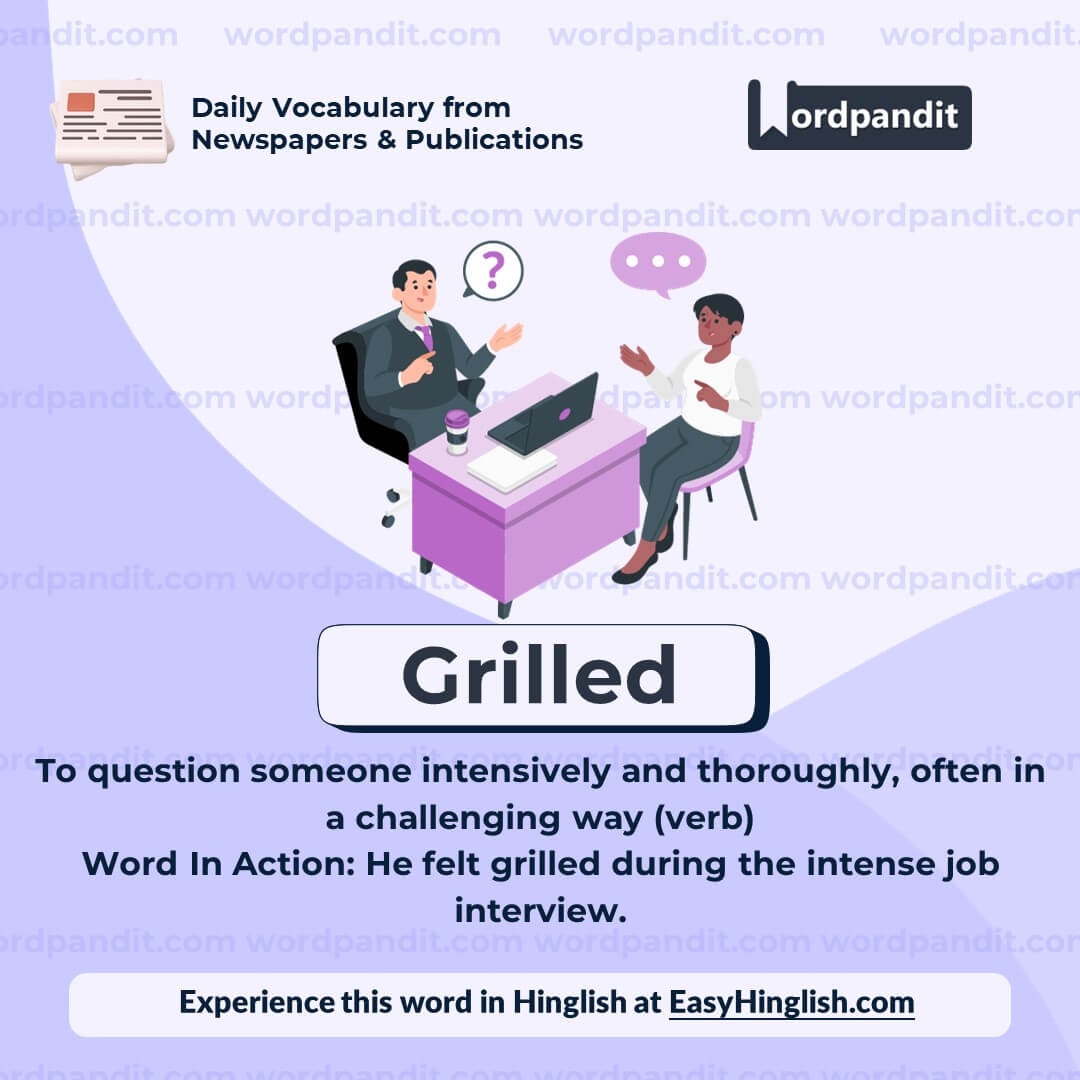
WORD-5: Grilled
Context:
"During the interview, I was really grilled but MT who was on the panel did not ask me any question." - The Indian Express
Explanatory Paragraph:
The word "grilled" in this context is used informally to describe a situation where someone is questioned in an intense, persistent, and often uncomfortable way — like being put under heat. It originates from cooking, where grilling involves exposing food to direct high heat. Similarly, in conversation or questioning, to be "grilled" means to be put under pressure through tough or probing questions, often in interviews, investigations, or interrogations. Here, the speaker is saying they were asked many difficult questions, implying a stressful experience.
Meaning: To question someone intensely and persistently (Verb - informal usage)
Pronunciation: grild
Difficulty Level: ⭐⭐ Easy
Etymology: Originally from the literal act of "grilling" food, this figurative use emerged in the early 20th century to describe putting someone under verbal or emotional heat.
Prashant Sir's Notes:
"Grilled" is often used to describe high-pressure situations involving questioning — especially interviews or police interrogations. It’s informal and vivid, making it a favorite in both journalism and storytelling.
Synonyms & Antonyms:
Synonyms: interrogate, quiz, cross-examine, bombard, probe
Antonyms: comfort, soothe, ignore, overlook, reassure
Usage Examples:
- She was grilled by the board for over an hour during the job interview.
- The police grilled the suspect until he finally confessed.
- He grilled his children about their whereabouts the night before.
- Reporters grilled the minister on the latest corruption allegations.
Cultural Reference:
"In popular TV shows like *Law & Order*, suspects are often grilled in intense interrogation scenes, reflecting real-life investigative techniques." - TV Tropes Archive (paraphrased)
Think About It:
Does grilling someone with tough questions always lead to the truth, or can it sometimes backfire and cause stress or dishonesty?
Quick Activity:
Recall your last interview or exam. Were you grilled at any point? Write down two questions that made you feel pressured and how you handled them.
Memory Tip:
Imagine being grilled like food on a hot flame — you're under pressure, feeling the heat, and being "cooked" with tough questions!
Real-World Application:
"Grilled" is commonly used in informal conversation, journalism, and fiction to describe tough interviews, courtroom scenes, or parental questioning. It conveys pressure and intensity effectively.