

Daily Vocabulary from Indian Newspapers and Publications
Welcome to Wordpandit’s Indian Vocabulary Hub
At Wordpandit, we understand the importance of staying rooted in the local context while expanding your language skills. This section focuses on enriching your vocabulary with words and phrases drawn from India’s leading newspapers and publications, ensuring you're learning vocabulary that is practical, relevant, and uniquely Indian.
Why Indian Sources Matter
We believe that the best way to master any language is by immersing yourself in local content. That’s why we carefully curate vocabulary from top Indian publications, including:
- The Hindu
- The Times of India
- The Economic Times
- Hindustan Times
- Live Mint
- The Indian Express
- And many others...
Stay Updated, Stay Relevant
With daily updates from Indian news sources, you’ll be consistently learning words that reflect the trends and shifts in Indian society and culture. Our focus is to provide vocabulary that enhances your understanding of the language in an Indian context.
How Wordpandit Supports Your Goals
Whether you’re preparing for exams, aiming to improve your professional communication, or simply want to stay connected with the latest Indian vocabulary, Wordpandit is here to guide you every step of the way.
Learn with a Practical Approach
Our interactive learning methodology includes real-world examples, engaging activities, and context-specific usage to ensure that every word becomes part of your active vocabulary.
Dive into Indian Vocabulary Today!
Why Choose Wordpandit?
Practical Learning: Focus on words you'll actually encounter in real-world reading, enhancing your comprehension and communication skills.
Diverse Content: From current affairs to scientific breakthroughs, our varied sources expose you to vocabulary across multiple domains.
Effortless Integration: Make Wordpandit a part of your daily routine. Just a few minutes each day can significantly boost your lexicon over time.
Your Path to Vocabulary Mastery
- Visit our Daily Vocabulary section regularly
- Explore new words and their usage in context
- Practice incorporating these words into your own writing and speech
- Track your progress as your vocabulary expands
Start Your Journey Today
Embark on your vocabulary enhancement journey with Wordpandit. By consistently engaging with our daily posts, you'll build a robust vocabulary that serves you well in academic, professional, and personal contexts.
Remember, a word a day keeps linguistic limitations at bay. Make Wordpandit your daily companion in the quest for vocabulary excellence!
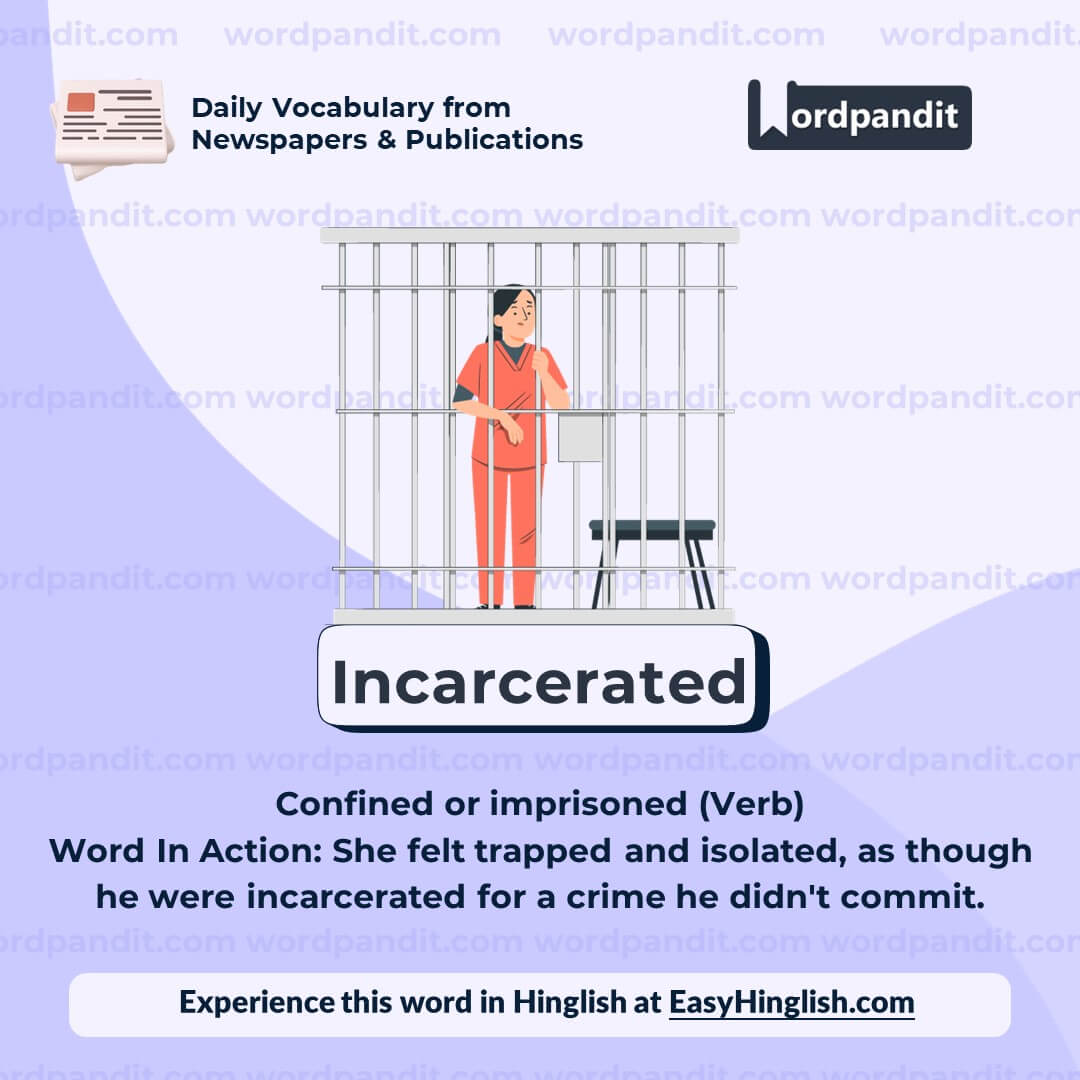
WORD-1: Incarcerated
Context:
"Rana, 63, has been incarcerated in a Los Angeles prison since the extradition request by India was accepted by the U.S." - The Hindu
Explanatory Paragraph:
The word "incarcerated" refers to being confined or imprisoned, typically as a result of legal punishment. When someone is incarcerated, they are kept in a jail or prison, usually because they have been accused or convicted of a crime. It’s a formal term often used in legal and journalistic contexts to describe imprisonment. In this context, the person mentioned has been officially detained in a prison facility due to international legal proceedings.
Meaning: Imprisoned or confined (Verb – past participle)
Pronunciation: in-KAHR-suh-ray-tid
Difficulty Level: ⭐⭐⭐ Intermediate
Etymology: Derived from Medieval Latin 'incarceratus', past participle of 'incarcerare', meaning 'to imprison'; from Latin 'in-' (in) + 'carcer' (prison).
Prashant Sir's Notes:
"Incarcerated" is often used in media reports, legal writing, and formal discourse. Always remember that it's more than just physical imprisonment — it can also suggest social or psychological confinement in some literary uses.
Synonyms & Antonyms:
Synonyms: imprisoned, confined, detained, jailed, locked up
Antonyms: released, freed, discharged, liberated
Usage Examples:
- He was incarcerated for ten years before new evidence proved his innocence.
- Activists protested against the unjustly incarcerated political prisoners.
- The documentary explores the lives of women incarcerated for non-violent crimes.
- Though physically free, she felt emotionally incarcerated by her past traumas.
Cultural Reference:
"Mass incarceration is not just a policy issue — it's a human rights crisis." - Michelle Alexander, author of *The New Jim Crow*
Think About It:
How might incarceration affect an individual's identity, relationships, and opportunities after release?
Quick Activity:
Write a short paragraph using both "incarcerated" and its noun form "incarceration" to describe a real or fictional case.
Memory Tip:
Think of “carcer” as “cell” — "Incarcerated" = “in a cell” → imprisoned.
Real-World Application:
Understanding the term "incarcerated" is essential when reading legal news, criminal justice reports, or discussions about prison reform. It frequently appears in media, legal documentation, and political discourse.

WORD-2: Ceasefire
Context:
"Hezbollah has warned that it could resume the fighting if Israel doesn't withdraw from Lebanon in accordance with the ceasefire." - The Hindu
Explanatory Paragraph:
The word "ceasefire" refers to a temporary or permanent halt in fighting between conflicting parties, often agreed upon during war or armed conflict. A ceasefire does not necessarily mean the end of a conflict, but it pauses hostilities, allowing for negotiations, humanitarian aid, or troop withdrawal. In the given context, the ceasefire is a formal agreement that both sides are expected to honor, with the potential for renewed conflict if terms are violated.
Meaning: A temporary suspension of fighting, typically by mutual agreement (Noun)
Pronunciation: SEES-fy-uhr
Difficulty Level: ⭐⭐ Basic
Etymology: Formed from "cease" (to stop) + "fire" (use of weapons); first used in early 20th-century military and political contexts.
Prashant Sir's Notes:
"Ceasefire" is especially common in news reports on conflicts and wars. It's helpful to remember that a ceasefire can be fragile — breaking one often leads to escalations. Be sure to associate it with diplomacy and temporary peace.
Synonyms & Antonyms:
Synonyms: truce, armistice, suspension of hostilities, peace agreement
Antonyms: conflict, war, hostilities, combat
Usage Examples:
- Both sides agreed to a 72-hour ceasefire to allow humanitarian aid into the conflict zone.
- The ceasefire was violated just hours after it was announced.
- International mediators are pushing for a permanent ceasefire agreement.
- The fragile ceasefire brought a brief period of calm to the war-torn region.
Cultural Reference:
"The Christmas Truce of 1914 during World War I is a historic example of a spontaneous ceasefire, where soldiers on both sides laid down arms to celebrate Christmas together." - Historical Accounts
Think About It:
Can a ceasefire lead to lasting peace, or is it just a pause in inevitable violence?
Quick Activity:
Find a recent global news article mentioning a "ceasefire." Summarize in two lines what caused the ceasefire and what risks exist if it's broken.
Memory Tip:
Break "ceasefire" into “cease” (stop) + “fire” (shooting) → stop firing → pause in battle.
Real-World Application:
The term "ceasefire" is essential in understanding news about international conflicts, peace talks, and military negotiations. It signals a critical moment that could lead to diplomacy or renewed violence.
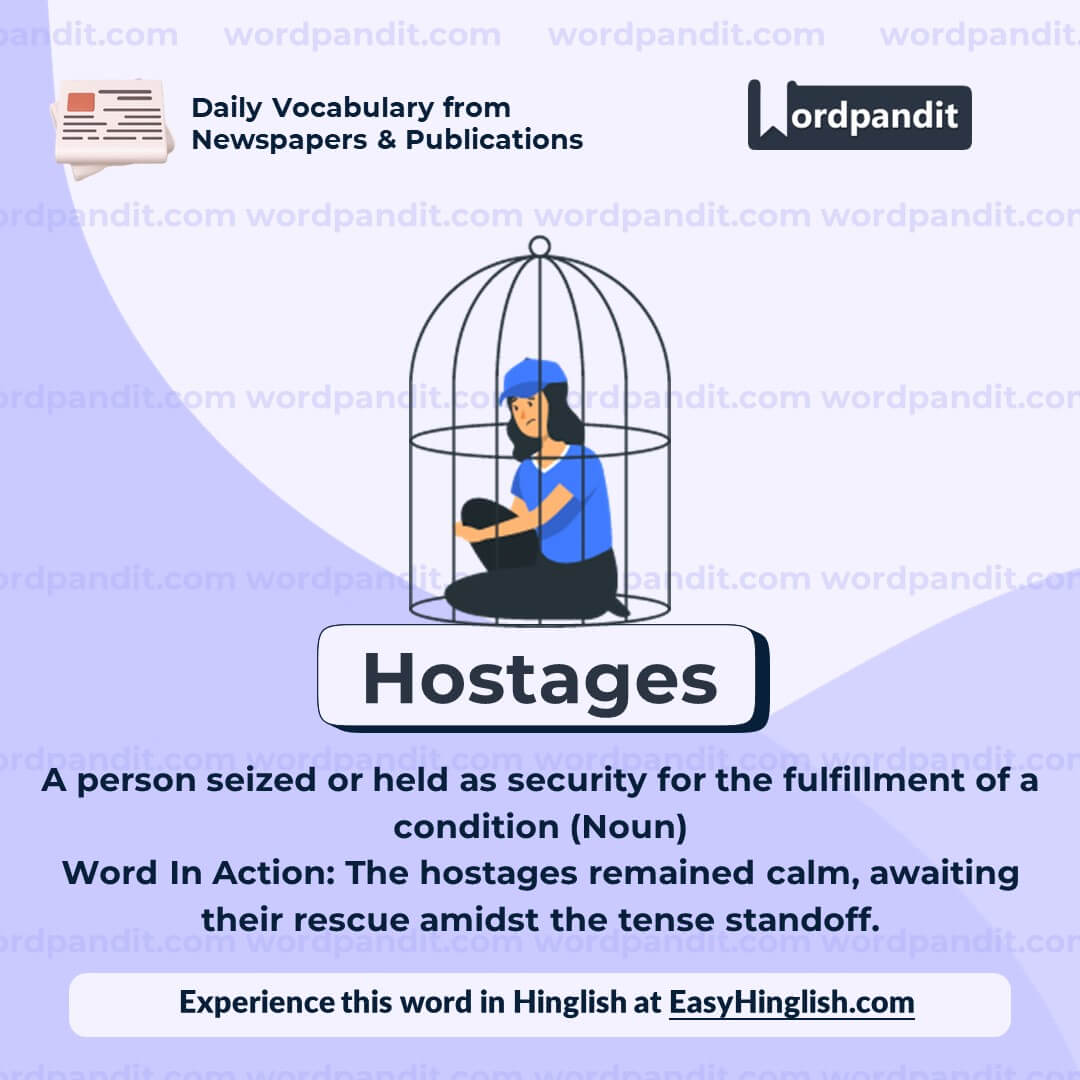
WORD-3: Hostages
Context:
"Israeli Prime Minister Benjamin Netanyahu said early on Sunday (January 19, 2025) that the ceasefire in Gaza will not begin until Israel has received a list of the hostages set to be released from Hamas." - The Hindu
Explanatory Paragraph:
"Hostages" refers to individuals who are captured and held against their will, typically by a group or individual, as leverage to demand something in return. Hostages are often used in situations of conflict, kidnapping, or terrorism, where their captors seek to negotiate terms such as ransom, political demands, or prisoner exchanges. In the context of international conflict, hostage situations can be emotionally and politically charged, involving complex negotiations.
Meaning: People held captive to force others to meet certain demands (Noun – plural)
Pronunciation: HOS-tij-iz
Difficulty Level: ⭐⭐⭐ Intermediate
Etymology: From Old French ‘hostage’, based on Latin ‘obsidatus’ from ‘obses’ meaning 'pledge' or 'security'. Originally used in political contexts to ensure agreements were honored.
Prashant Sir's Notes:
The word "hostages" often signals a high-stakes negotiation or crisis. Always connect it with terms like "ransom", "rescue", or "demand". It's frequently used in political and media coverage, and knowing it helps decode international relations and terrorism news.
Synonyms & Antonyms:
Synonyms: captives, prisoners, abductees, detainees
Antonyms: liberators, rescuers, free persons
Usage Examples:
- The kidnappers released two hostages after their demands were partially met.
- Negotiators are working to ensure the safe return of all hostages.
- Taking civilians as hostages is a violation of international law.
- The hostage crisis lasted for over a week, drawing global media attention.
Cultural Reference:
"Argo", the Oscar-winning film, is based on the real-life 1979 Iran hostage crisis where American diplomats were held for 444 days.
Think About It:
Why do you think hostage-taking remains a common tactic in modern conflicts, despite global condemnation?
Quick Activity:
Match each term to its correct usage: Hostage, Captive, Prisoner, Detainee — write one sentence for each, showing their slight differences.
Memory Tip:
Think: a "hostage" is someone “hosted” by force — they’re stuck in a place they don’t want to be until a demand is met.
Real-World Application:
Understanding the term "hostages" is essential when reading about international conflicts, terrorism, or diplomatic negotiations. It helps interpret news reports and humanitarian issues accurately and critically.
WORD-4: Consequential
Context:
"This is just the second ceasefire in the war, longer and more consequential than the weeklong pause over a year ago, with the potential to end the fighting for good." - The Hindu
Explanatory Paragraph:
The word "consequential" refers to something that has significant impact or importance. It suggests that the action or event leads to serious or meaningful results. In this context, the ceasefire is described as more consequential than a previous one—meaning it carries greater weight, influence, or long-term effect, especially in terms of possibly bringing lasting peace. It’s the opposite of something trivial or insignificant.
Meaning: Having important consequences; significant or influential (Adjective)
Pronunciation: kon-suh-KWEN-shuhl
Difficulty Level: ⭐⭐⭐ Intermediate
Etymology: From Latin 'consequentia' meaning 'a following closely', derived from 'consequi' – 'con-' (together) + 'sequi' (to follow). The English form developed in the 17th century.
Prashant Sir's Notes:
“Consequential” is often used in analysis and commentary to describe events, actions, or decisions that carry significant weight. Always ask yourself: What is the consequence of this? If it’s big or far-reaching, it's likely consequential. Don’t confuse it with “consequently” (an adverb).
Synonyms & Antonyms:
Synonyms: significant, important, momentous, impactful, weighty
Antonyms: trivial, insignificant, minor, negligible
Usage Examples:
- The treaty was one of the most consequential agreements in modern diplomacy.
- Her decision to study abroad proved to be highly consequential for her career.
- The judge delivered a consequential ruling that could set a national precedent.
- In retrospect, that meeting was far more consequential than we initially thought.
Cultural Reference:
"Barack Obama called the 2008 financial crisis one of the most consequential moments in recent U.S. history, shaping global economic policies for years to come." - Presidential Memoirs
Think About It:
What events in your own life do you consider most consequential, and why?
Quick Activity:
List three global events you believe were consequential in the past 50 years. Write a sentence explaining the impact of each.
Memory Tip:
Think: "Consequential = consequence-full" — something full of consequences or importance.
Real-World Application:
"Consequential" is commonly used in journalism, academia, and leadership to describe impactful events or decisions. Understanding this word helps in evaluating the weight and importance of developments in politics, science, and personal life.
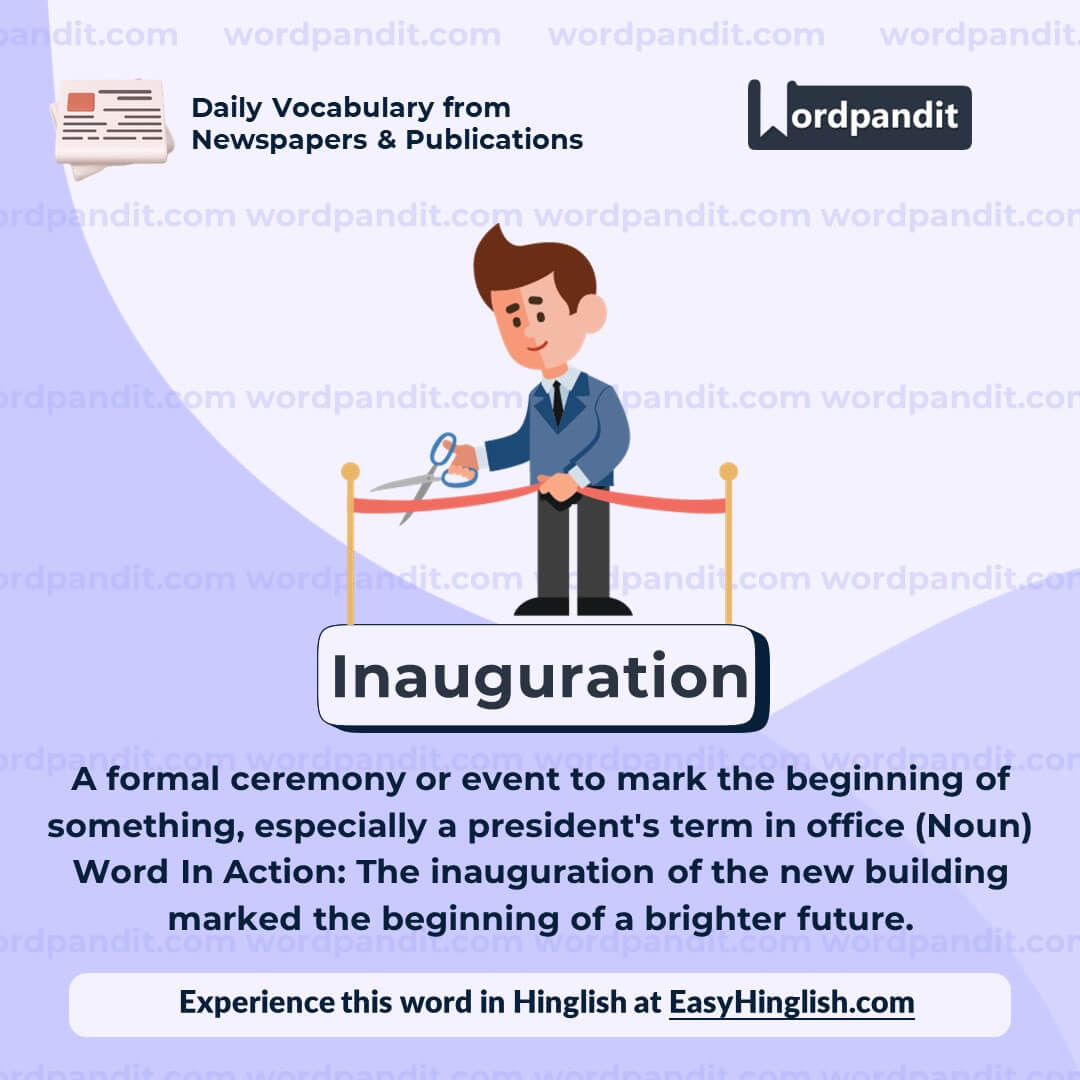
WORD-5: Inauguration
Context:
"The warring sides were under pressure from both the outgoing Biden administration and President-elect Donald Trump to achieve a deal before the U.S. presidential inauguration on Monday." - The Hindu
Explanatory Paragraph:
"Inauguration" refers to a formal ceremony that marks the beginning or introduction of something significant, especially a person’s official entry into a position of authority—such as a presidency. In political contexts, it usually involves a swearing-in ceremony, speeches, and public celebrations. The word can also refer more generally to the launch or opening of a building, event, or era. In this sentence, it highlights the importance of timing a political agreement around the transition of presidential power in the United States.
Meaning: A formal ceremony to mark the beginning of something, especially an official’s assumption of office (Noun)
Pronunciation: in-aw-gyuh-RAY-shun
Difficulty Level: ⭐⭐ Basic
Etymology: From Latin 'inauguratio' meaning 'consecration', rooted in the Roman practice of augury (interpreting omens). It came into English via Old French in the 17th century.
Prashant Sir's Notes:
“Inauguration” is closely tied to politics, especially in democracies like the U.S., where presidential inaugurations are landmark events. Remember that it isn’t limited to politics—you can also have the inauguration of a museum, bridge, or project.
Synonyms & Antonyms:
Synonyms: commencement, initiation, opening, launch, swearing-in
Antonyms: conclusion, termination, closure, ending
Usage Examples:
- The inauguration of the new president drew millions of viewers from around the world.
- The art gallery held a grand inauguration for its modern exhibition wing.
- He gave his inaugural address shortly after the official inauguration ceremony.
- The company celebrated the inauguration of its first international office in Tokyo.
Cultural Reference:
"Barack Obama’s 2009 presidential inauguration was historic, marking the swearing-in of America’s first Black president and drawing a record-breaking crowd." - U.S. National Archives
Think About It:
Why do you think societies place so much emphasis on formal inaugurations? What purpose do they serve beyond symbolism?
Quick Activity:
Write a short paragraph describing an inauguration you attended (real or imagined)—include details like who was inaugurated, where, and how it felt.
Memory Tip:
Link it with “initial” and “augury” — Inauguration = the official start marked with meaning and ceremony.
Real-World Application:
The term "inauguration" is frequently encountered in news, political science, and civic life. Recognizing its meaning enhances understanding of government transitions, historical moments, and formal event launches in public and private sectors.


