

Daily Vocabulary from Indian Newspapers and Publications
Welcome to Wordpandit’s Indian Vocabulary Hub
At Wordpandit, we understand the importance of staying rooted in the local context while expanding your language skills. This section focuses on enriching your vocabulary with words and phrases drawn from India’s leading newspapers and publications, ensuring you're learning vocabulary that is practical, relevant, and uniquely Indian.
Why Indian Sources Matter
We believe that the best way to master any language is by immersing yourself in local content. That’s why we carefully curate vocabulary from top Indian publications, including:
- The Hindu
- The Times of India
- The Economic Times
- Hindustan Times
- Live Mint
- The Indian Express
- And many others...
Stay Updated, Stay Relevant
With daily updates from Indian news sources, you’ll be consistently learning words that reflect the trends and shifts in Indian society and culture. Our focus is to provide vocabulary that enhances your understanding of the language in an Indian context.
How Wordpandit Supports Your Goals
Whether you’re preparing for exams, aiming to improve your professional communication, or simply want to stay connected with the latest Indian vocabulary, Wordpandit is here to guide you every step of the way.
Learn with a Practical Approach
Our interactive learning methodology includes real-world examples, engaging activities, and context-specific usage to ensure that every word becomes part of your active vocabulary.
Dive into Indian Vocabulary Today!
Why Choose Wordpandit?
Practical Learning: Focus on words you'll actually encounter in real-world reading, enhancing your comprehension and communication skills.
Diverse Content: From current affairs to scientific breakthroughs, our varied sources expose you to vocabulary across multiple domains.
Effortless Integration: Make Wordpandit a part of your daily routine. Just a few minutes each day can significantly boost your lexicon over time.
Your Path to Vocabulary Mastery
- Visit our Daily Vocabulary section regularly
- Explore new words and their usage in context
- Practice incorporating these words into your own writing and speech
- Track your progress as your vocabulary expands
Start Your Journey Today
Embark on your vocabulary enhancement journey with Wordpandit. By consistently engaging with our daily posts, you'll build a robust vocabulary that serves you well in academic, professional, and personal contexts.
Remember, a word a day keeps linguistic limitations at bay. Make Wordpandit your daily companion in the quest for vocabulary excellence!
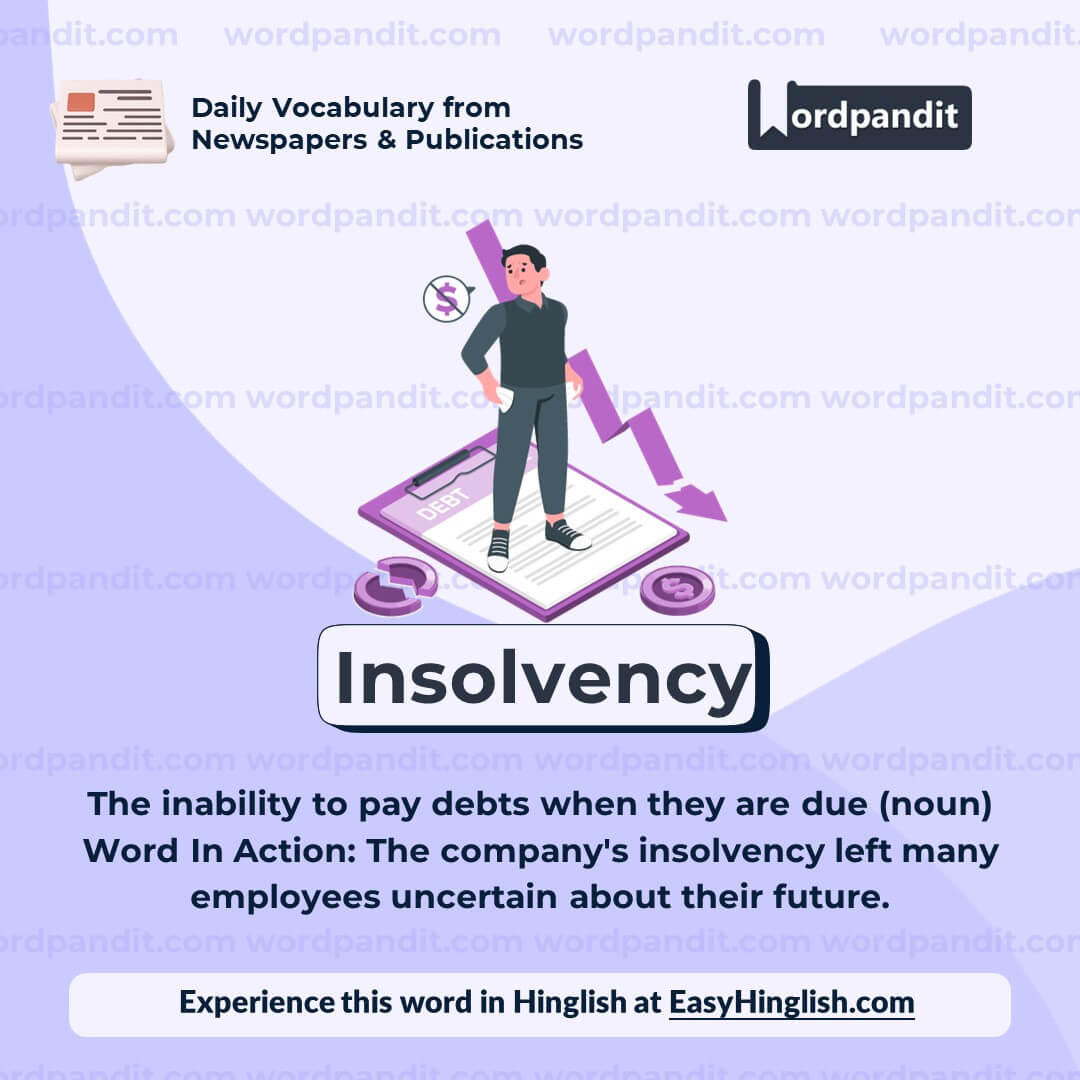
WORD-1: Insolvency
Context:
"Resolving India’s NPA crisis requires a multi-pronged approach – strengthening the Insolvency and Bankruptcy Code to expedite recoveries, improving risk assessment practices, and ensuring greater accountability in loan write-offs are essential steps." - The Wire
Explanatory Paragraph:
Insolvency is a financial condition where a person or entity can no longer meet their debt obligations on time. It typically indicates that liabilities exceed assets, making it impossible to repay creditors without legal intervention. Insolvency doesn't automatically mean bankruptcy, but it is often a step that leads to formal bankruptcy proceedings if not resolved. The term is frequently used in economic and legal contexts, especially when dealing with failing companies or national financial crises.
Meaning: The state of being unable to pay one's debts (Noun)
Pronunciation: in-SOL-vuhn-see
Difficulty Level: ⭐⭐⭐ Intermediate
Etymology: From Late Latin *insolventia*, from *in-* (not) + *solvere* (to loosen, to pay)
Prashant Sir's Notes:
The term is key in finance and law. Not all insolvency leads to bankruptcy, but it's a red flag. Understand its implications in business, policy, and law reform.
Synonyms & Antonyms:
Synonyms: bankruptcy, default, financial ruin, liquidation, failure
Antonyms: solvency, affluence, wealth, creditworthiness
Usage Examples:
- The company declared insolvency after failing to pay off its mounting debts.
- Governments worldwide created new frameworks to handle corporate insolvency more efficiently.
- Her business narrowly escaped insolvency thanks to a timely investment.
- Understanding the early signs of insolvency is crucial for investors and stakeholders.
Cultural Reference:
"The Insolvency and Bankruptcy Code (IBC) introduced in India in 2016 revolutionized how companies handle debt and recovery." - Ministry of Corporate Affairs, India
Think About It:
What systemic reforms could prevent widespread insolvency during global economic downturns?
Quick Activity:
List three industries where insolvency is a recurring risk and explain why. Then, think of one measure each industry could take to prevent it.
Memory Tip:
Think: “In-Solve” = Not able to “solve” your money problems — you’re out of funds.
Real-World Application:
Understanding insolvency helps professionals in finance, law, and public policy assess risks, structure rescue plans, and support regulatory reforms.
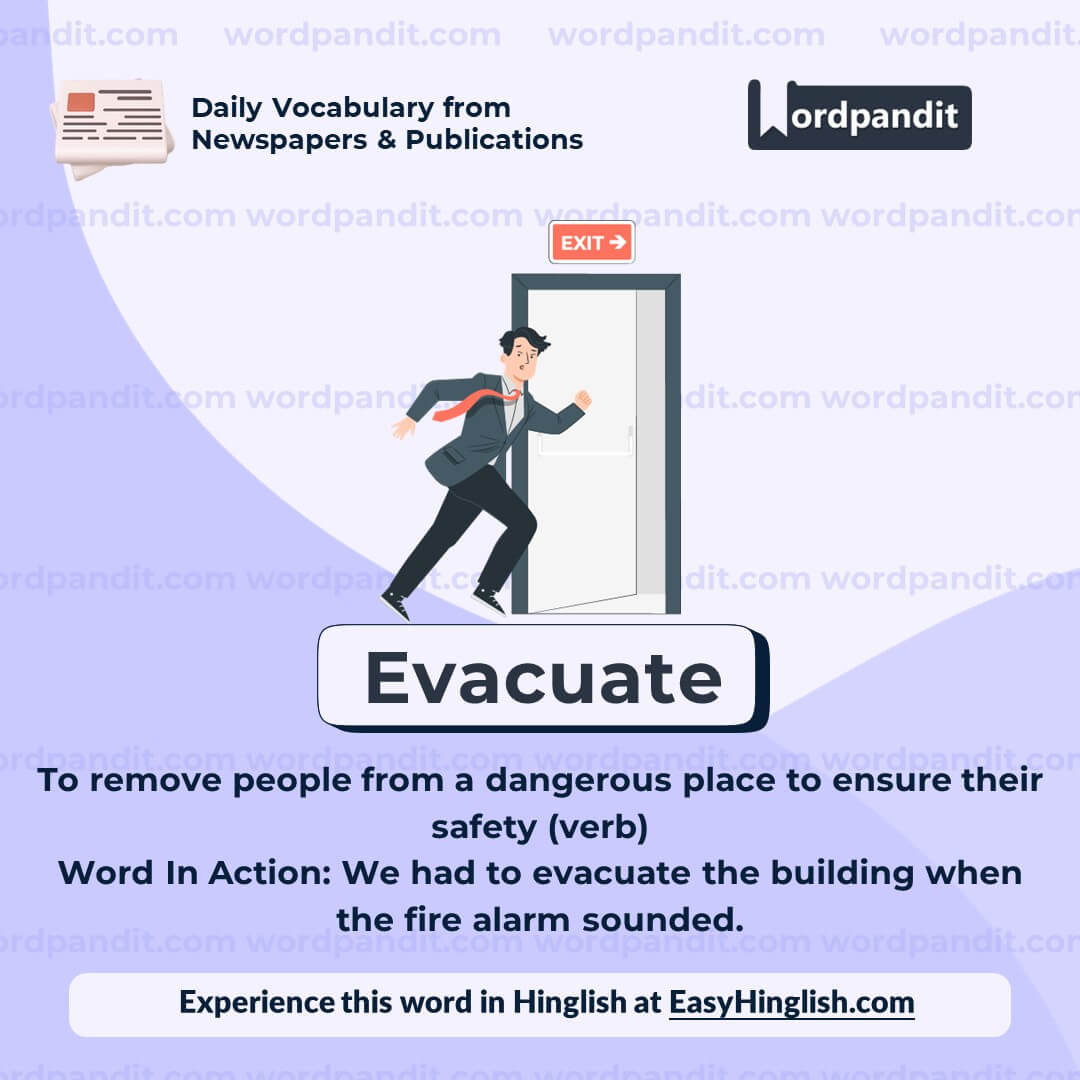
WORD-2: Evacuate
Context:
"In fact, our medical personnel and patients were forced to evacuate hospitals and health facilities 17 times, often in desperate attempts to save their own lives." - The New Indian Express
Explanatory Paragraph:
To evacuate means to leave or remove people from a dangerous or potentially harmful place. This can happen during emergencies like natural disasters, wars, or fires when remaining in a certain area poses serious risks to life or health. Evacuation may be planned or sudden, but the goal is always to ensure safety by moving people to a safer location. The term is commonly used in emergency management, healthcare, and military contexts.
Meaning: To remove or leave a place, especially for safety reasons (Verb)
Pronunciation: ee-VAK-yoo-ate
Difficulty Level: ⭐⭐ Basic
Etymology: From Latin *evacuare*, meaning "to empty out," from *e-* (out) + *vacuare* (to make empty)
Prashant Sir's Notes:
This is a practical and emotionally charged word, often linked with urgency and danger. It’s especially relevant in news reports about conflict zones or disasters. Always link it to “safety” in your mind.
Synonyms & Antonyms:
Synonyms: withdraw, flee, escape, abandon, vacate
Antonyms: enter, stay, occupy, remain
Usage Examples:
- Authorities ordered residents to evacuate the coastal town ahead of the hurricane.
- Soldiers helped evacuate civilians from the conflict zone.
- The school had to evacuate after a fire alarm was triggered.
- Volunteers assisted elderly patients during the hospital evacuation.
Cultural Reference:
"During World War II, children in Britain were evacuated from cities to the countryside to protect them from air raids." - BBC History Archives
Think About It:
What are the ethical responsibilities of a government when ordering a mass evacuation?
Quick Activity:
Imagine your city is under flood threat. Write 3-4 steps you would take to evacuate your home safely and help others in your neighborhood.
Memory Tip:
Think of “vacate” inside “evacuate” — when you evacuate, you “vacate” a dangerous place quickly.
Real-World Application:
Evacuate is a crucial term in disaster response plans, used by emergency services, governments, and international aid organizations to coordinate life-saving actions.
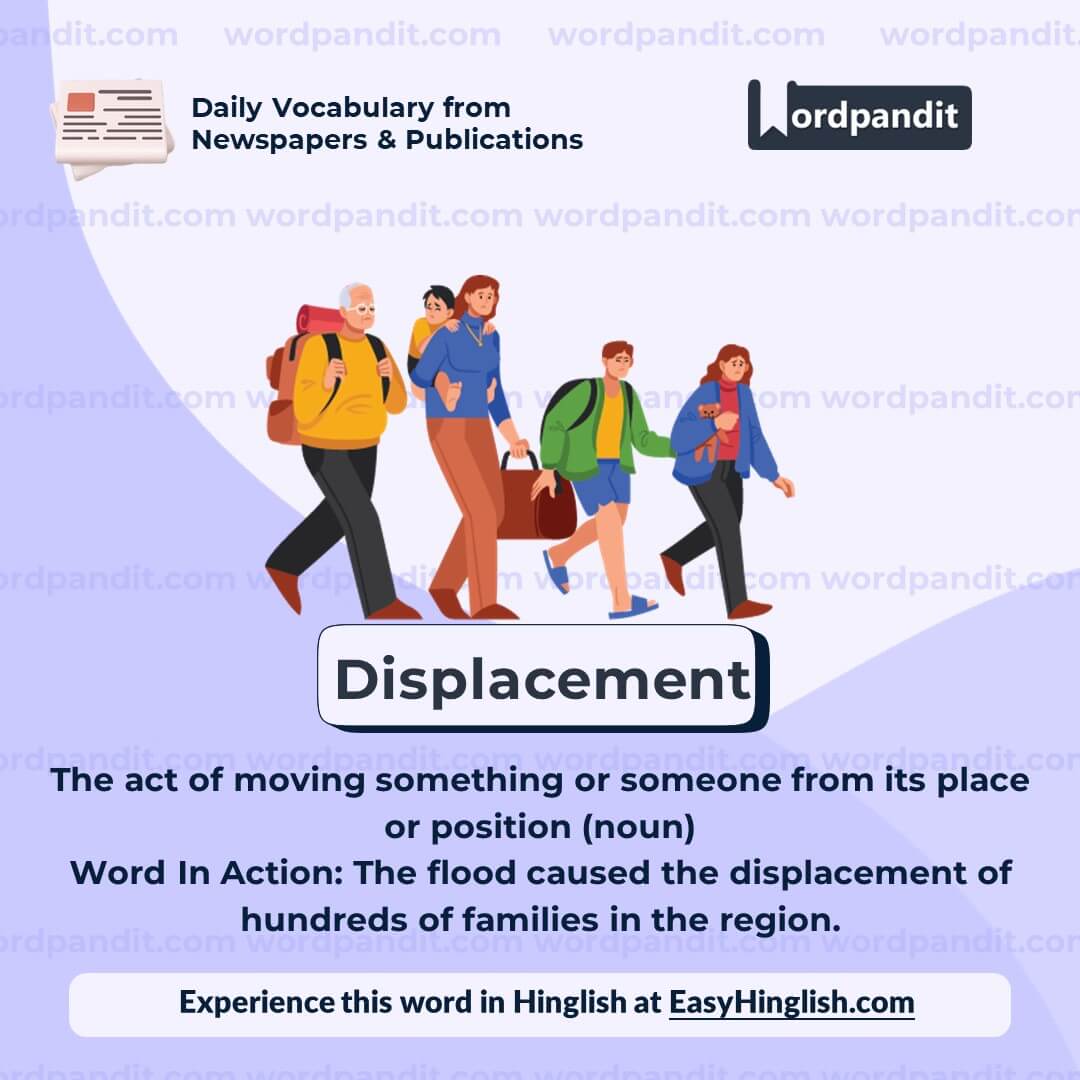
WORD-3: Displacement
Context:
"The ongoing devastation—including mass killings, severe physical and mental health injuries, forced displacement, and impossible conditions of life" - The New Indian Express
Explanatory Paragraph:
Displacement refers to the condition of being forced to move from one’s home, typically because of war, natural disasters, violence, or persecution. It involves people losing not just their physical shelter, but also a sense of belonging, community, and often their livelihood. The term is widely used in humanitarian and geopolitical discussions, especially in reference to refugees and internally displaced persons (IDPs). Displacement can be temporary or long-term, and it carries deep emotional, economic, and psychological consequences.
Meaning: The forced movement of people from their home or country, often due to conflict or disaster (Noun)
Pronunciation: dis-PLAYS-muhnt
Difficulty Level: ⭐⭐⭐ Intermediate
Etymology: From French *déplacement*, from *déplacer* meaning “to displace”; Latin roots *dis-* (apart) + *placere* (to place)
Prashant Sir's Notes:
This word shows up often in news articles about war, migration, and environmental crises. Always associate it with being “forcibly moved” — it carries both physical and emotional weight. Link it with empathy.
Synonyms & Antonyms:
Synonyms: relocation, expulsion, migration, eviction, uprooting
Antonyms: settlement, return, stability, establishment
Usage Examples:
- The civil war led to the displacement of thousands of families.
- Environmental disasters are a growing cause of global displacement.
- The aid agency provided shelter and food to victims of displacement.
- Her novel captures the trauma and hope tied to forced displacement.
Cultural Reference:
"The Partition of India in 1947 caused one of the largest mass displacements in human history, with over 10 million people forced to migrate." - History Today
Think About It:
What long-term effects do you think displacement has on the identity and culture of communities?
Quick Activity:
Research one modern-day refugee crisis and summarize how displacement has impacted the affected population’s education and livelihood.
Memory Tip:
Think: “Displacement” = “Dis” + “placement” → out of place. When someone is displaced, they’re literally out of their usual place or home.
Real-World Application:
Understanding displacement is essential for anyone involved in international law, humanitarian aid, environmental studies, or migration policy-making.
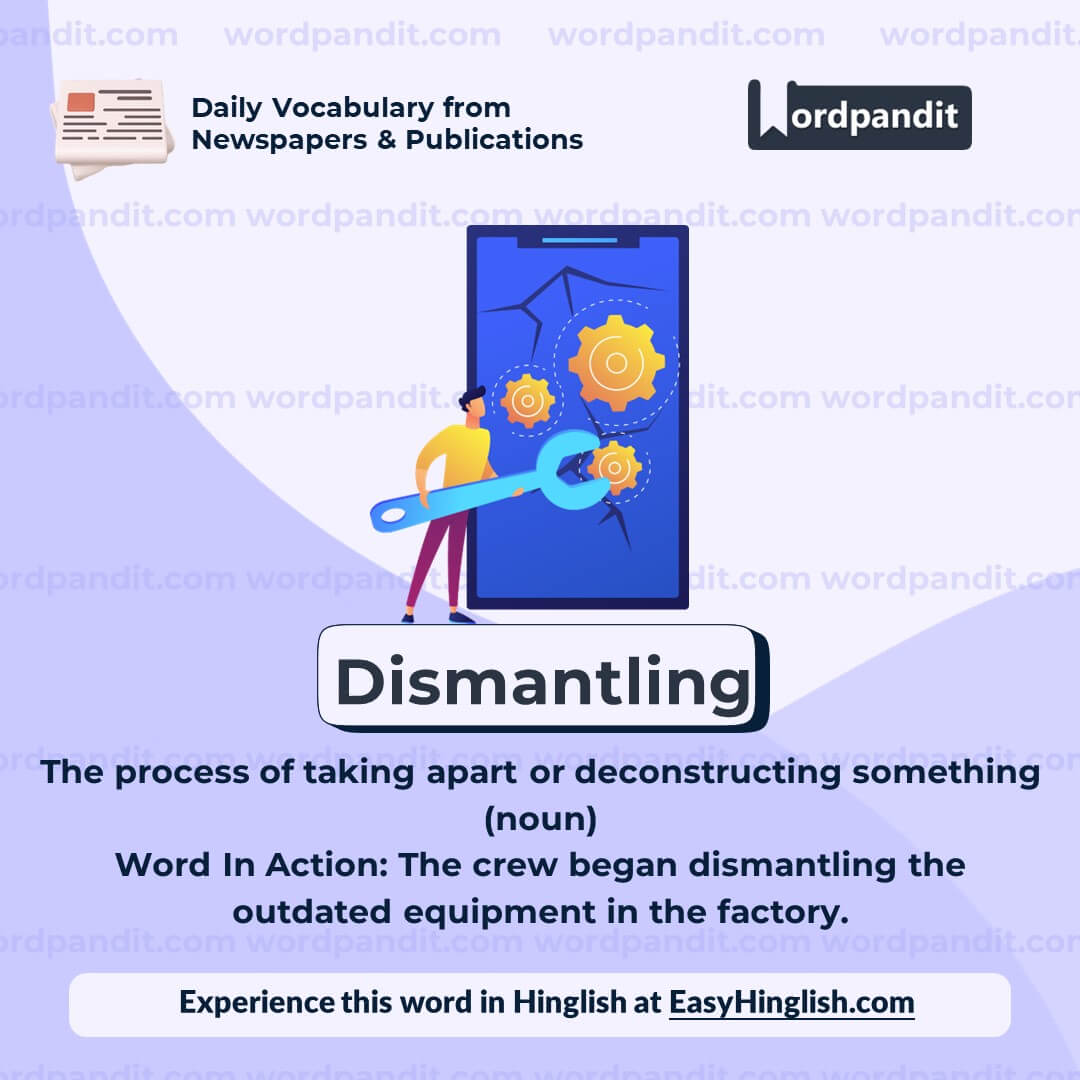
WORD-4: Dismantling
Context:
"Have seen my fair share of humanitarian crises. But what is unfolding in Gaza is beyond anything I have encountered in my career—a systematic dismantling of an entire society." - The New Indian Express
Explanatory Paragraph:
Dismantling refers to the act of taking something apart, piece by piece—whether physically, structurally, or metaphorically. It can apply to buildings, machines, systems, institutions, or even ideologies. In a broader and more serious sense, dismantling can describe the deliberate breakdown of social, political, or cultural systems. In humanitarian and political contexts, it often conveys destruction with intent or purpose, such as the erosion of rights, institutions, or communities.
Meaning: The process of taking apart or breaking down something into its parts (Noun – gerund form of the verb "dismantle")
Pronunciation: dis-MAN-tl-ing
Difficulty Level: ⭐⭐⭐ Intermediate
Etymology: From French *desmanteler* meaning “to raze a fort,” from *des-* (reverse) + *manteler* (to cloak or cover)
Prashant Sir's Notes:
Dismantling is often used metaphorically to talk about the deliberate breakdown of systems, laws, or structures—especially in social and political discourse. Think of it as “taking something apart with intent.”
Synonyms & Antonyms:
Synonyms: deconstruction, breakdown, demolition, removal, disassembly
Antonyms: construction, assembly, establishment, creation
Usage Examples:
- The dismantling of outdated machinery took several weeks.
- Activists protested against the dismantling of the public healthcare system.
- The dismantling of colonial structures was a slow but necessary process.
- The company announced the dismantling of its overseas operations due to losses.
Cultural Reference:
"The dismantling of apartheid in South Africa marked a historic shift in global civil rights movements." - Nelson Mandela Foundation Archives
Think About It:
When does dismantling a system signify progress, and when does it signal destruction?
Quick Activity:
List two institutions or systems that have been dismantled in recent history. Were the outcomes positive or negative? Reflect in two lines each.
Memory Tip:
Think: “dis” (reverse) + “mantle” (cover/protect) = removing the cover, breaking down the structure.
Real-World Application:
Dismantling is often used in global reports, legal discourse, and media to describe the collapse of institutions, governments, or infrastructure during conflict or reform.
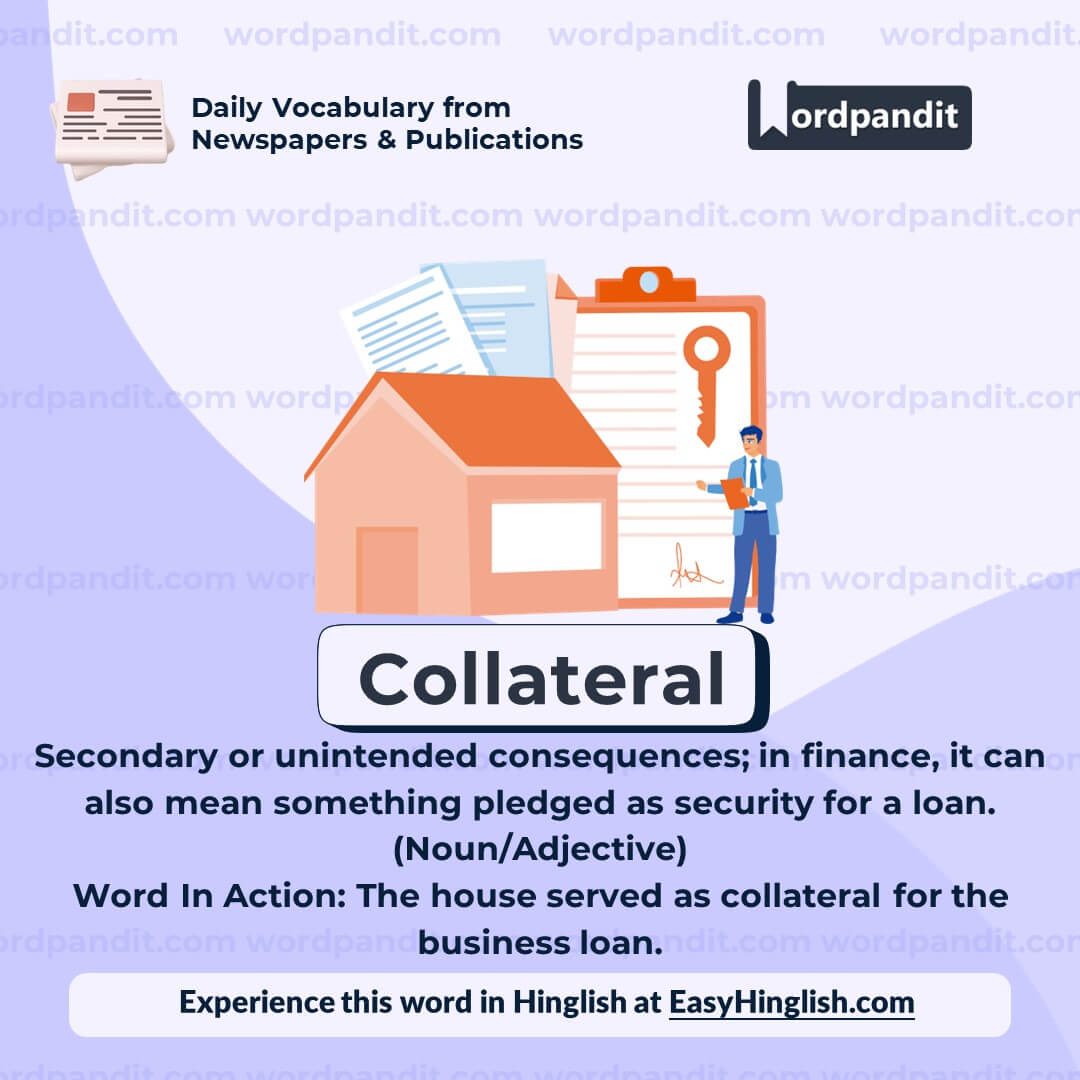
WORD-5: Collateral
Context:
"We are seeing is not just the collateral damage of war, but a deliberate strategy to make life unliveable in Gaza." - The New Indian Express
Explanatory Paragraph:
Collateral, in this context, refers to unintended or secondary consequences of a primary action—most often used in the phrase "collateral damage" to describe civilian harm or destruction that occurs as a byproduct of military operations. Although the main target is strategic or combat-related, collateral effects are those that impact innocent lives or non-military infrastructure. The word can also refer to assets pledged as security in financial contexts, but here it carries a more somber tone, highlighting the human cost of conflict.
Meaning: Unintended damage or casualties occurring as a byproduct of an action, especially in war (Adjective/Noun)
Pronunciation: kuh-LAT-er-uhl
Difficulty Level: ⭐⭐⭐ Intermediate
Etymology: From Medieval Latin *collateralis*, from *com-* (together) + *lateralis* (of the side); literally meaning "side by side"
Prashant Sir's Notes:
In war reporting or political analysis, "collateral" is often a euphemism to soften the perception of civilian suffering. Always examine the context—it's a powerful word when used critically.
Synonyms & Antonyms:
Synonyms: incidental, secondary, unintended, indirect
Antonyms: direct, intentional, primary, deliberate
Usage Examples:
- Several homes were destroyed as collateral damage during the airstrike.
- The government justified the losses as collateral, not intentional harm.
- In war, the line between military targets and collateral impact often blurs.
- Beyond its military use, "collateral" also refers to assets pledged for a loan.
Cultural Reference:
"Collateral damage" became a widely used phrase during the Gulf War, often criticized for minimizing the real human costs of conflict. - The Guardian
Think About It:
Does using the term "collateral damage" distance us from the reality of human suffering? Why or why not?
Quick Activity:
Find a news article using the term "collateral damage." Analyze whether it is being used to justify or critique the consequences of an action. Write a 3-line reflection.
Memory Tip:
Think: “Co” + “lateral” → something that happens “on the side” of a main action—unintended but connected.
Real-World Application:
Understanding “collateral” is key in military ethics, international law, journalism, and even banking—each field gives the term a slightly different but crucial meaning.


