

Daily Vocabulary from Indian Newspapers and Publications
Welcome to Wordpandit’s Indian Vocabulary Hub
At Wordpandit, we understand the importance of staying rooted in the local context while expanding your language skills. This section focuses on enriching your vocabulary with words and phrases drawn from India’s leading newspapers and publications, ensuring you're learning vocabulary that is practical, relevant, and uniquely Indian.
Why Indian Sources Matter
We believe that the best way to master any language is by immersing yourself in local content. That’s why we carefully curate vocabulary from top Indian publications, including:
- The Hindu
- The Times of India
- The Economic Times
- Hindustan Times
- Live Mint
- The Indian Express
- And many others...
Stay Updated, Stay Relevant
With daily updates from Indian news sources, you’ll be consistently learning words that reflect the trends and shifts in Indian society and culture. Our focus is to provide vocabulary that enhances your understanding of the language in an Indian context.
How Wordpandit Supports Your Goals
Whether you’re preparing for exams, aiming to improve your professional communication, or simply want to stay connected with the latest Indian vocabulary, Wordpandit is here to guide you every step of the way.
Learn with a Practical Approach
Our interactive learning methodology includes real-world examples, engaging activities, and context-specific usage to ensure that every word becomes part of your active vocabulary.
Dive into Indian Vocabulary Today!

Why Choose Wordpandit?
Practical Learning: Focus on words you'll actually encounter in real-world reading, enhancing your comprehension and communication skills.
Diverse Content: From current affairs to scientific breakthroughs, our varied sources expose you to vocabulary across multiple domains.
Effortless Integration: Make Wordpandit a part of your daily routine. Just a few minutes each day can significantly boost your lexicon over time.
Your Path to Vocabulary Mastery
- Visit our Daily Vocabulary section regularly
- Explore new words and their usage in context
- Practice incorporating these words into your own writing and speech
- Track your progress as your vocabulary expands
Start Your Journey Today
Embark on your vocabulary enhancement journey with Wordpandit. By consistently engaging with our daily posts, you'll build a robust vocabulary that serves you well in academic, professional, and personal contexts.
Remember, a word a day keeps linguistic limitations at bay. Make Wordpandit your daily companion in the quest for vocabulary excellence!
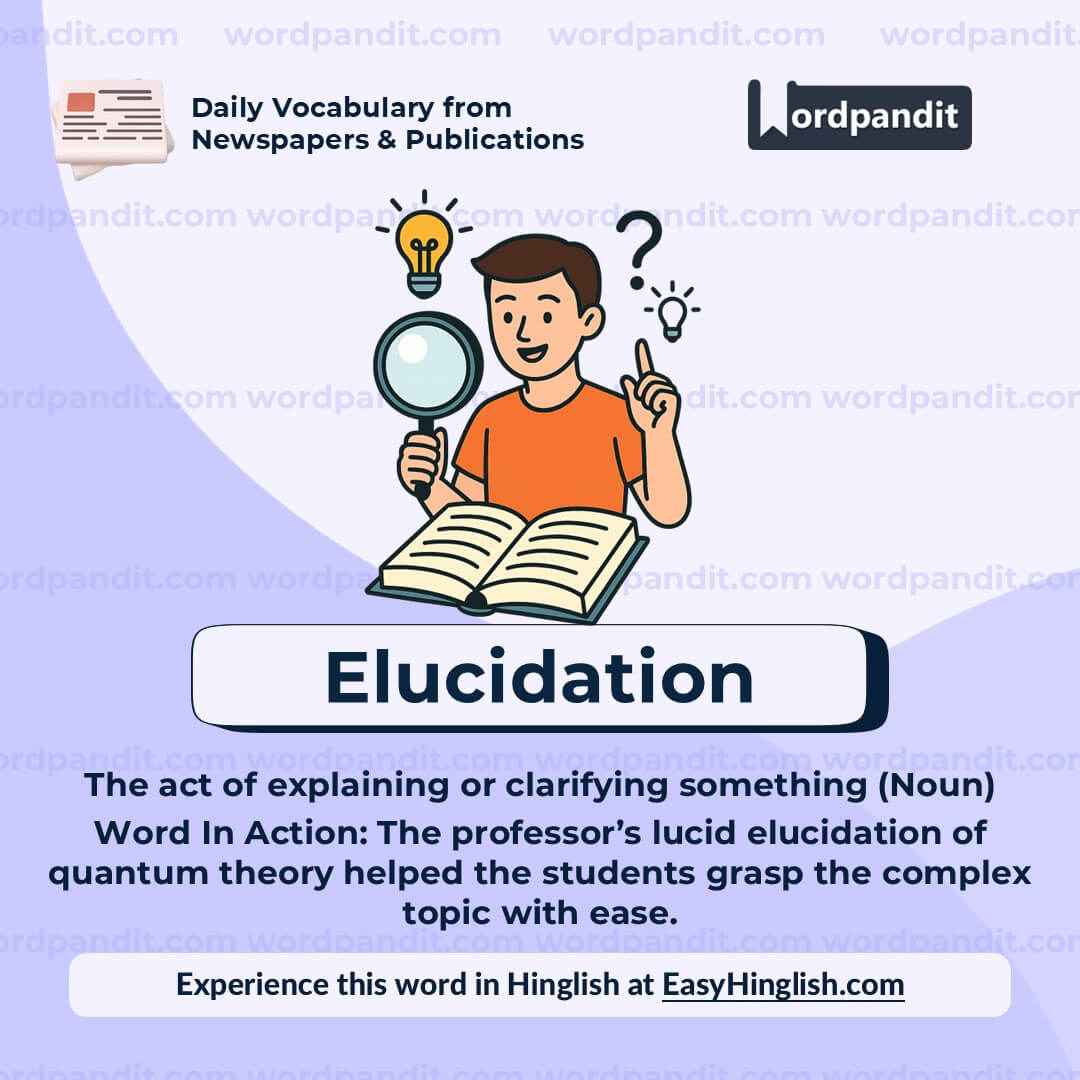
WORD-1: Elucidation
Context:
"Importantly, Patanjali’s elucidation of Ishvar is not sectarian. Ishvar is not bound to a name, form, or religious identity." - The Times Of India
Explanatory Paragraph:
"Elucidation" refers to the act of explaining something clearly or making it easier to understand. When someone provides an elucidation, they are shedding light on a concept or idea, often by breaking it down into simpler parts. In the sentence, Patanjali's elucidation of Ishvar means his explanation or interpretation of what Ishvar represents — and it emphasizes that his view is universal, not tied to any specific religion.
Meaning: The act of explaining or clarifying something (Noun)
Pronunciation: eh-loo-sih-DAY-shun
Difficulty Level: ⭐⭐⭐ Intermediate
Etymology: From Latin *elucidare* meaning "to make clear", formed from *e-* (out) + *lucidus* (bright, clear)
Prashant Sir's Notes:
"Elucidation" is often used in academic and intellectual writing. It's a powerful word to use when you are discussing explanations or interpretations of abstract or complex topics. Use it when you're breaking something down for better understanding — in debates, essays, or philosophical discussions.
Synonyms & Antonyms:
Synonyms: clarification, explanation, interpretation, exposition, illumination
Antonyms: confusion, obscurity, ambiguity, vagueness
Usage Examples:
- The professor's elucidation of quantum mechanics made the concept less intimidating.
- Her elucidation of the poem revealed layers of meaning we had previously missed.
- During the meeting, Rahul's elucidation of the new policy helped calm the team’s concerns.
- Without proper elucidation, the terms of the contract may lead to misinterpretation.
Cultural Reference:
"The task of the modern educator is not to cut down jungles but to irrigate deserts." This quote by C.S. Lewis resonates with the concept of elucidation — bringing clarity and nourishment to arid areas of misunderstanding. - Referenced in educational discourse
Think About It:
Why do some topics remain obscure or misunderstood even after repeated elucidation?
Quick Activity:
Choose a difficult topic (e.g., black holes, cryptocurrency, or a philosophical idea) and write a 3-sentence elucidation of it in your own words.
Memory Tip:
Think of “elucidation” as “shedding light” on something dark or unclear — imagine a flashlight (lucid = light) turning on in a dark room full of confusion.
Real-World Application:
Elucidation is widely used in legal, academic, and spiritual contexts. Lawyers elucidate contracts, teachers elucidate complex theories, and spiritual leaders elucidate philosophical beliefs — helping people understand nuanced or technical ideas in simpler terms.
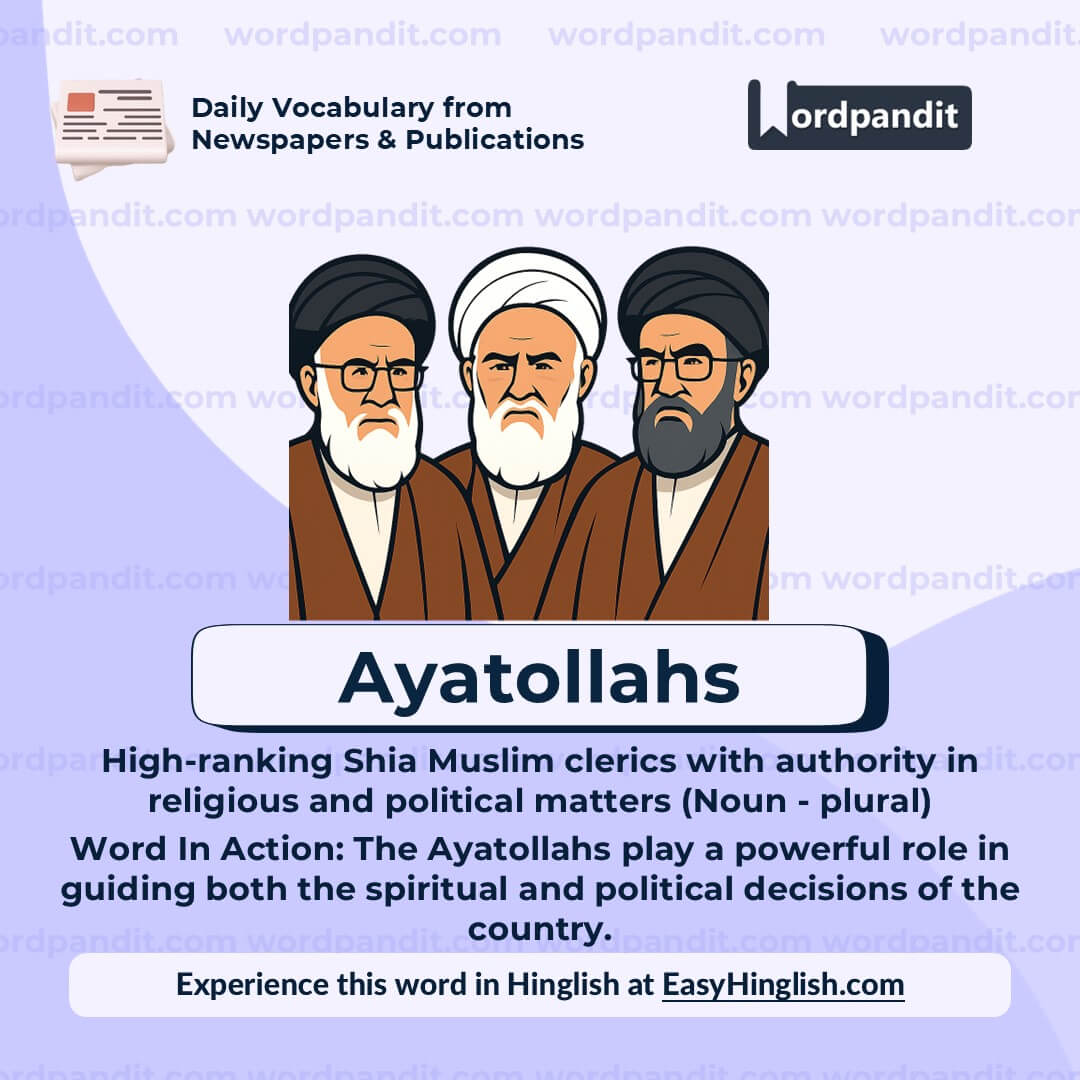
WORD-2: Ayatollahs
Context:
"But if the strikes were meant to be a harsh message to the Ayatollahs, they may end up having the opposite effect – Tehran could accelerate a nuclear weapons programme and quit NPT." - The Times Of India
Explanatory Paragraph:
"Ayatollahs" are high-ranking Shia Muslim clerics, particularly in Iran, who wield significant religious and political influence. The title is used to denote scholars who are deeply versed in Islamic theology and jurisprudence. In Iran’s political system, Ayatollahs are not just spiritual leaders but also play major roles in governance, often influencing national policies and decisions. In the given context, "Ayatollahs" refers to the leadership in Iran, particularly those with theocratic authority, who could react strongly to perceived external threats.
Meaning: High-ranking Shia Muslim clerics with authority in religious and political matters (Noun - plural)
Pronunciation: ah-yah-TOH-luhz
Difficulty Level: ⭐⭐⭐⭐ Advanced
Etymology: From Persian *āyatollāh*, meaning "sign of God", derived from Arabic *āyat* (sign) and *Allāh* (God)
Prashant Sir's Notes:
This term is deeply rooted in religious and political contexts, especially relating to Iran. Use "Ayatollahs" with cultural sensitivity — it’s often used in global news when discussing Iran’s leadership. It’s not a generic term for clerics but specifically denotes a high level of authority.
Synonyms & Antonyms:
Synonyms: religious leader, cleric, spiritual authority, Islamic jurist
Antonyms: layperson, secular official, atheist
Usage Examples:
- The Ayatollahs in Iran wield immense power over both religious and political matters.
- During the revolution, the Ayatollahs mobilized public sentiment through powerful sermons.
- Western leaders often try to interpret the intentions of the Ayatollahs when it comes to nuclear negotiations.
- Not all Iranians agree with the Ayatollahs' interpretations of Islamic law.
Cultural Reference:
"Ayatollah Khomeini was the founding figure of the Islamic Republic of Iran and led the country after the 1979 revolution." - Historical reference
Think About It:
How does religious authority influence political decisions in the modern world, particularly in countries like Iran?
Quick Activity:
Research the difference between an Ayatollah and a Grand Ayatollah. Write two sentences explaining how each role functions within Iran's system.
Memory Tip:
Think “Ayatollah = Allah’s scholar” — both words begin with “A”, and Ayatollahs are seen as signs of God in Shia Islam.
Real-World Application:
"Ayatollahs" often appear in international political discourse, especially regarding Iran’s nuclear policy, religious rulings (fatwas), or responses to sanctions and foreign diplomacy. Understanding the term helps in interpreting Middle East geopolitics more accurately.

WORD-3: Inauthentic
Context:
"To hold one opinion but voice another, is this inauthentic? To conduct oneself as if one is being permanently surveilled, does that help democratic life?" - The Times Of India
Explanatory Paragraph:
"Inauthentic" describes something that is not genuine, real, or true to its nature. It refers to behavior, expression, or even objects that lack sincerity, originality, or honesty. When someone is being inauthentic, they might be hiding their true beliefs, feelings, or identity, often to conform or avoid judgment. In the provided context, the word challenges the idea of living or speaking in a way that does not reflect one’s true thoughts—questioning the impact of such behavior on democratic society.
Meaning: Not genuine, not true to one's character or beliefs; fake or insincere (Adjective)
Pronunciation: in-aw-THEN-tik
Difficulty Level: ⭐⭐ Beginner to Intermediate
Etymology: From Latin *inauthenticus*, via Greek *authentikos* (genuine), with the prefix *in-* meaning "not"
Prashant Sir's Notes:
This word is especially useful in discussions around self-expression, leadership, relationships, or branding. Inauthentic behavior often leads to mistrust, and recognizing it is key to evaluating integrity—whether in people, communication, or media.
Synonyms & Antonyms:
Synonyms: fake, false, insincere, phony, deceptive
Antonyms: genuine, sincere, real, truthful, authentic
Usage Examples:
- Her apology felt inauthentic, as if she was only saying it to avoid criticism.
- The influencer was called out for promoting inauthentic content just for brand deals.
- Inauthentic leadership can damage trust within a team.
- Wearing a mask to hide your opinions might protect you temporarily, but it breeds an inauthentic life.
Cultural Reference:
"To be nobody but yourself in a world which is doing its best night and day to make you everybody else means to fight the hardest battle." — e.e. cummings. This resonates with the idea of resisting inauthenticity and embracing true identity.
Think About It:
What are the social or professional pressures that can lead someone to behave inauthentically, and how can one resist them?
Quick Activity:
Write down two examples from your own life where you felt pressured to be inauthentic. Reflect on what you could do differently next time.
Memory Tip:
Break it down: "In" (not) + "Authentic" = Not real or true. Think of an "inauthentic smile"—it looks forced and fake.
Real-World Application:
Being able to identify inauthenticity is essential in evaluating political speeches, marketing campaigns, or even social media personas. It's also important for personal growth—living authentically leads to stronger relationships and better mental well-being.
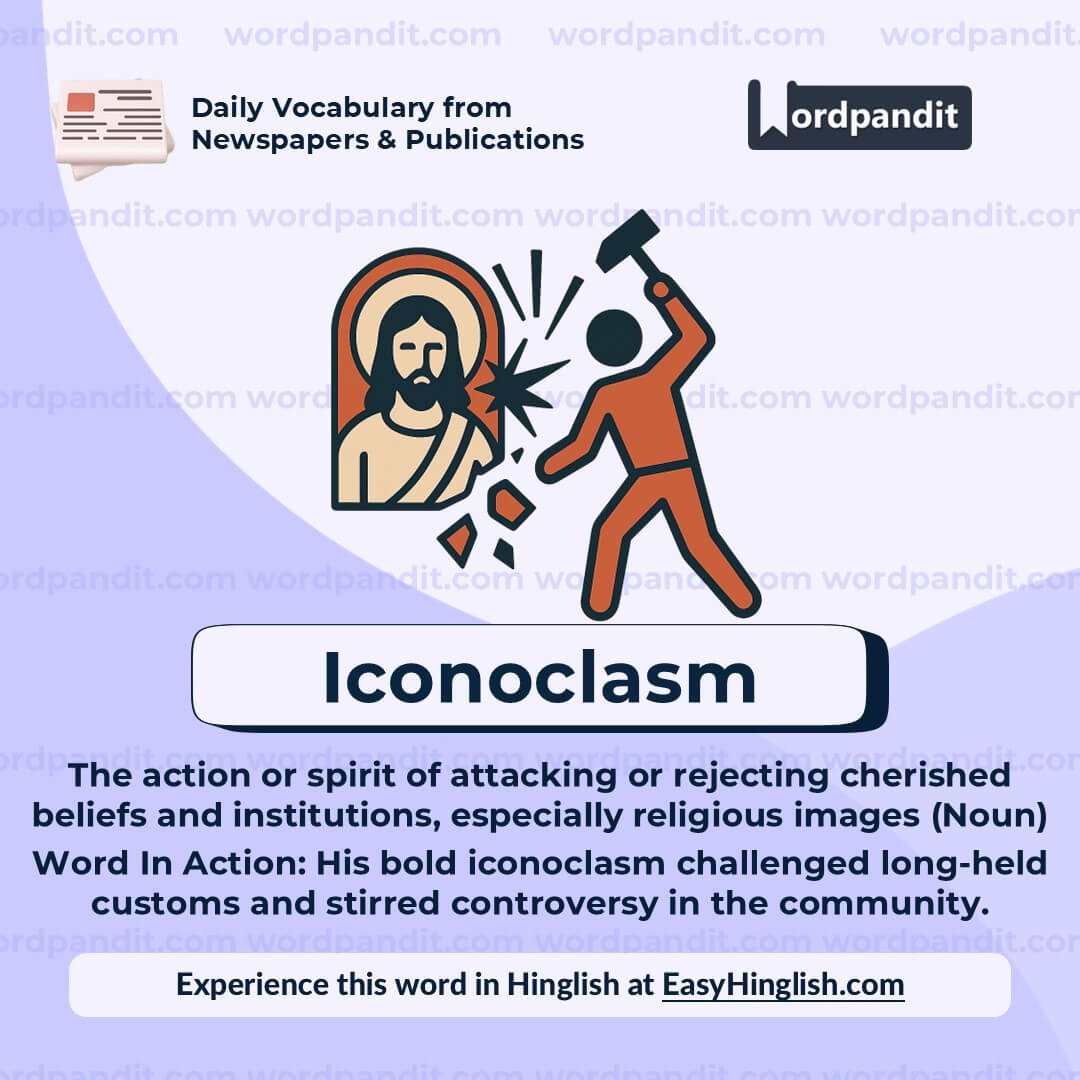
WORD-4: Iconoclasm
Context:
"Spark of conscience | From the Protestant iconoclasm of Martin Luther to the extensive adventurism of Henry VIII, the 16th century germinated the independence of ‘inward things’ from traditional authority." - The Times Of India
Explanatory Paragraph:
"Iconoclasm" refers to the rejection or destruction of established beliefs, values, or symbols—especially those considered sacred or traditional. Historically, the term is associated with the physical destruction of religious icons, especially during the Protestant Reformation. However, in a broader sense, it has come to signify opposition to conventional ideas and practices. In the given context, it points to Martin Luther’s challenge to the traditional religious structures of the time, which marked a radical shift in spiritual and intellectual thought.
Meaning: The action or spirit of attacking or rejecting cherished beliefs and institutions, especially religious images (Noun)
Pronunciation: eye-KON-uh-klaz-um
Difficulty Level: ⭐⭐⭐⭐ Advanced
Etymology: From Greek *eikonoklastēs*, meaning "image breaker", from *eikōn* (image) + *klastes* (breaker)
Prashant Sir's Notes:
"Iconoclasm" is a powerful word for describing not just literal destruction of images but also ideological rebellion. It is often used in political, philosophical, and cultural discussions to highlight a break from tradition or norm-shattering behavior. Think of it as rebellion with a purpose—often to reshape thought.
Synonyms & Antonyms:
Synonyms: heresy, dissent, irreverence, revolution, nonconformity
Antonyms: orthodoxy, conformity, traditionalism, reverence
Usage Examples:
- The artist’s work was celebrated for its iconoclasm, challenging the norms of classical aesthetics.
- Martin Luther’s theses were an act of religious iconoclasm that changed the course of history.
- Modern intellectuals often engage in ideological iconoclasm, questioning long-standing beliefs.
- The regime viewed any form of cultural iconoclasm as a threat to national unity.
Cultural Reference:
"The Protestant Reformation was one of the most significant episodes of iconoclasm in Western history, where religious images were destroyed and traditional authority was questioned." - Historical reference
Think About It:
Can iconoclasm be constructive, or does it always imply destruction? When is it necessary to challenge deeply rooted beliefs?
Quick Activity:
Name a modern public figure who you think embodies iconoclastic traits. Write one sentence explaining why.
Memory Tip:
Break the word into "icon" (image) + "clasm" (clash/crash). Think: "crashing the icons" — breaking or rebelling against established symbols.
Real-World Application:
"Iconoclasm" is useful when discussing major cultural shifts, innovation, reform movements, or individuals who challenge the status quo—whether in religion, politics, or art. Recognizing iconoclastic trends helps in understanding social change.

WORD-5: Fulminating
Context:
"We heard speeches from the socialist, Raj Narain, wearing a green bandana, fulminating against all Nehrus, dead, alive, and unborn; from Jawaharlal Nehru’s sister, Vijaya Lakshmi Pandit, as elegantly turned out as in her days of glory as our ambassador in Washington and Moscow, now come here from her retreat in Dehradun to demand the restoration of civil liberties and an end to her niece‘s autocracy; from several student leaders (none from my college); and from the Jana Sangh ideologue, Atal Bihari Vajpayee, in cultured and euphonious Hindi, wisecracks and witticisms aplenty." - The Telegraph Online
Explanatory Paragraph:
"Fulminating" refers to speaking or expressing something with intense force and anger, especially in criticism or protest. It captures the image of someone passionately denouncing a person or idea, often in a fiery or dramatic tone. In the given context, Raj Narain is described as angrily and vigorously condemning all members of the Nehru family—using his speech as a vehicle for explosive criticism. The term evokes strong emotions and is commonly used in political or ideological contexts.
Meaning: Expressing vehement protest or criticism; speaking with thunderous intensity (Verb - present participle)
Pronunciation: FULL-muh-nay-ting
Difficulty Level: ⭐⭐⭐⭐ Advanced
Etymology: From Latin *fulminare*, meaning “to strike with lightning,” related to *fulmen* (lightning)
Prashant Sir's Notes:
This is a powerful word for describing impassioned speech or explosive protest. It can be used in both political and personal contexts, though it tends to lean toward dramatic or rhetorical language. Great for describing speeches, social media rants, or political declarations filled with fire and fury.
Synonyms & Antonyms:
Synonyms: ranting, railing, denouncing, blasting, berating
Antonyms: praising, supporting, lauding, commending, endorsing
Usage Examples:
- The activist was fulminating against government corruption during the protest rally.
- He spent the entire dinner fulminating about the state of modern education.
- Social media was filled with users fulminating about the new policy changes.
- Her article fulminating against corporate greed quickly went viral.
Cultural Reference:
"The people began fulminating against Marie Antoinette long before the Revolution reached her palace gates." - A reference to public outrage during the French Revolution
Think About It:
Does passionate criticism always help bring about change, or can fulminating speeches sometimes deepen division?
Quick Activity:
Write a short, 2-sentence mock speech in which someone is fulminating against something trivial (like slow Wi-Fi or pineapple on pizza). Try to exaggerate the tone humorously.
Memory Tip:
Think of “fulminating” as “full of lightning” — someone talking like thunder and lightning, loud and angry!
Real-World Application:
"Fulminating" is useful when describing political speeches, heated debates, and critical commentaries — especially where emotion and intensity dominate logic or diplomacy.


