

Daily Vocabulary from Indian Newspapers and Publications
Welcome to Wordpandit’s Indian Vocabulary Hub
At Wordpandit, we understand the importance of staying rooted in the local context while expanding your language skills. This section focuses on enriching your vocabulary with words and phrases drawn from India’s leading newspapers and publications, ensuring you're learning vocabulary that is practical, relevant, and uniquely Indian.
Why Indian Sources Matter
We believe that the best way to master any language is by immersing yourself in local content. That’s why we carefully curate vocabulary from top Indian publications, including:
- The Hindu
- The Times of India
- The Economic Times
- Hindustan Times
- Live Mint
- The Indian Express
- And many others...
Stay Updated, Stay Relevant
With daily updates from Indian news sources, you’ll be consistently learning words that reflect the trends and shifts in Indian society and culture. Our focus is to provide vocabulary that enhances your understanding of the language in an Indian context.
How Wordpandit Supports Your Goals
Whether you’re preparing for exams, aiming to improve your professional communication, or simply want to stay connected with the latest Indian vocabulary, Wordpandit is here to guide you every step of the way.
Learn with a Practical Approach
Our interactive learning methodology includes real-world examples, engaging activities, and context-specific usage to ensure that every word becomes part of your active vocabulary.
Dive into Indian Vocabulary Today!

Why Choose Wordpandit?
Practical Learning: Focus on words you'll actually encounter in real-world reading, enhancing your comprehension and communication skills.
Diverse Content: From current affairs to scientific breakthroughs, our varied sources expose you to vocabulary across multiple domains.
Effortless Integration: Make Wordpandit a part of your daily routine. Just a few minutes each day can significantly boost your lexicon over time.
Your Path to Vocabulary Mastery
- Visit our Daily Vocabulary section regularly
- Explore new words and their usage in context
- Practice incorporating these words into your own writing and speech
- Track your progress as your vocabulary expands
Start Your Journey Today
Embark on your vocabulary enhancement journey with Wordpandit. By consistently engaging with our daily posts, you'll build a robust vocabulary that serves you well in academic, professional, and personal contexts.
Remember, a word a day keeps linguistic limitations at bay. Make Wordpandit your daily companion in the quest for vocabulary excellence!
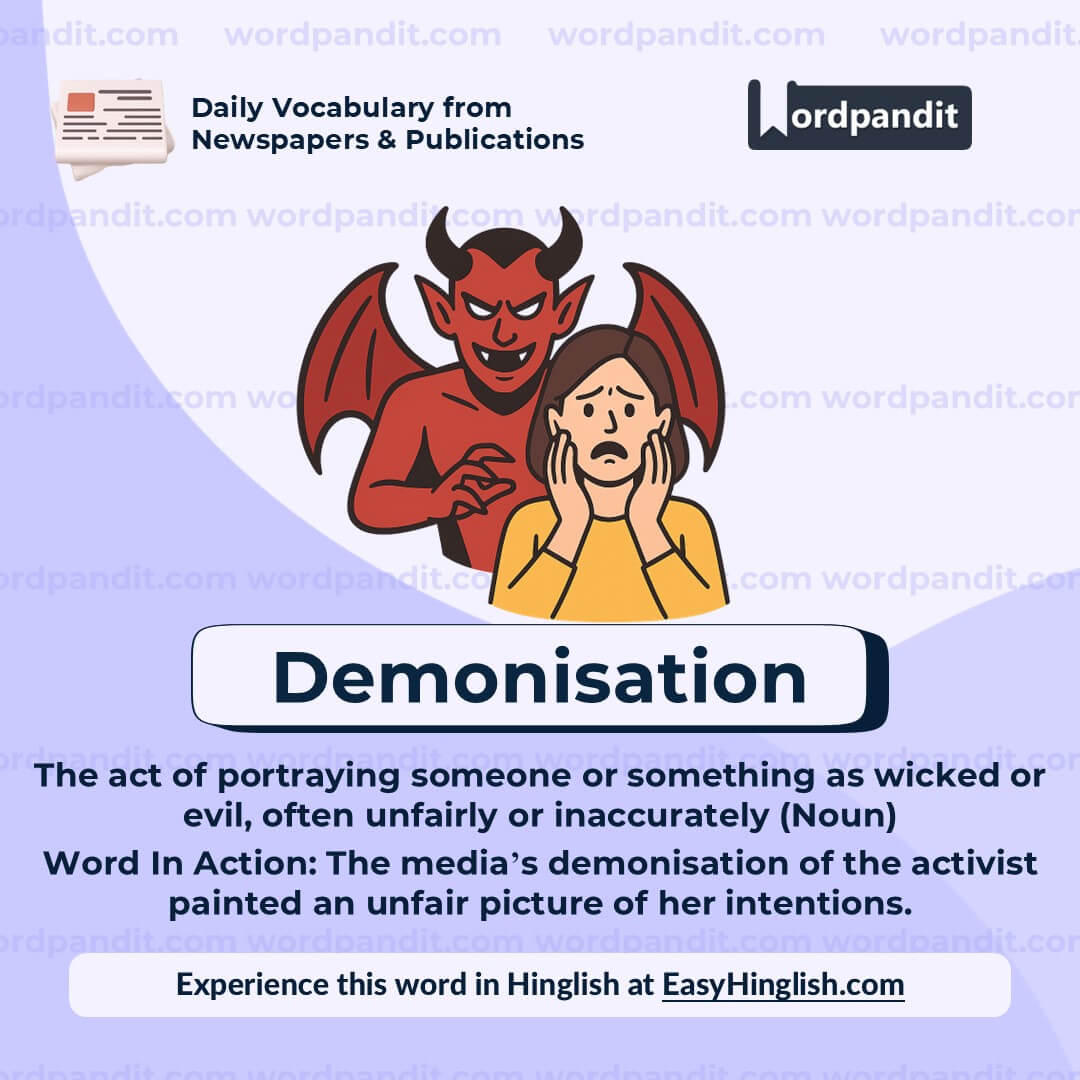
WORD-1: Demonisation
Context:
"Until his wife’s arrest, the public discourse around the Indore man’s murder predictably saw the demonisation of Meghalaya, and the Northeast as a whole, as “non-tourism-friendly”, “unsafe for outsiders”, “crime-prone”, “jungalee” and “brainwashed by Christian missionaries”." - The Wire
Explanatory Paragraph:
“Demonisation” refers to portraying a person, group, or place as wicked, dangerous, or evil, often through exaggeration, stereotypes, or propaganda. In the context above, it highlights how certain regions or communities can be unfairly stigmatized or blamed in the media and public opinion, especially after a controversial or tragic event.
Meaning: The act of portraying someone or something as wicked or evil, often unfairly or inaccurately (Noun)
Pronunciation: dee-muh-nuh-zay-shun
Difficulty Level: ⭐⭐⭐ Intermediate
Etymology: From the verb “demonise”, which comes from Greek *daimon* (spirit or deity), evolving in usage to refer to evil portrayal, especially in modern political or media contexts.
Prashant Sir's Notes:
This word is powerful in critical thinking and socio-political analysis. It often appears in discussions of media bias, marginalization, or xenophobia. It’s crucial to recognize when narratives move from critique to demonisation, as this shift can fuel division and prejudice.
Synonyms & Antonyms:
Synonyms: vilification, defamation, stigmatization, condemnation, slander
Antonyms: praise, glorification, admiration, endorsement, validation
Usage Examples:
- The media's demonisation of protestors led to public backlash against their movement.
- He warned against the demonisation of immigrants in political campaigns.
- Historical narratives often reflect the demonisation of colonized populations.
- The documentary explored how fear and misunderstanding contribute to the demonisation of certain cultures.
Cultural Reference:
"The demonisation of minorities is a classic tactic of authoritarian regimes." - A recurring theme in George Orwell’s *1984*
Think About It:
How does the demonisation of a group in media influence public policy and societal attitudes toward that group?
Quick Activity:
Find a news article or social media post. Identify if any group is being demonised. Note the language used and how it could be rewritten to reflect a more balanced perspective.
Memory Tip:
Think of “demonisation” as turning someone into a "demon" in people's eyes — through unfair words and portrayals.
Real-World Application:
Understanding the concept of demonisation is essential in media literacy, political science, and intercultural studies. It helps individuals recognize bias, avoid prejudice, and engage in more ethical communication and debate.
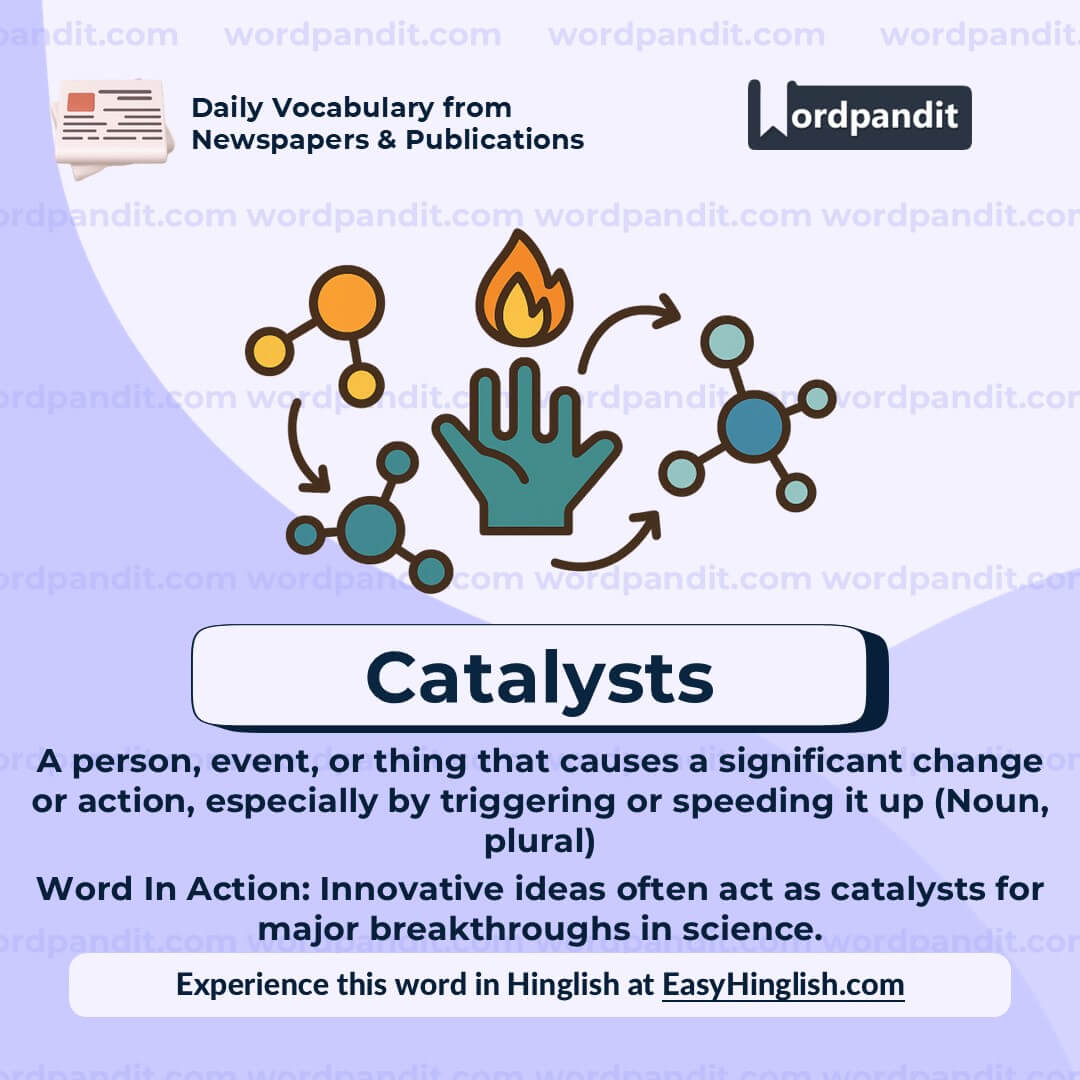
WORD-2: Catalysts
Context:
"This is one of the catalysts of dissent amongst various peoples of the Northeast against the Indian state itself." - The Wire
Explanatory Paragraph:
“Catalysts” are agents or events that cause or speed up significant change, often without being changed themselves. In a social or political context, a catalyst might be a policy, incident, or symbol that intensifies existing tensions or sparks movements. In the example above, a specific action or event has served as a powerful trigger for widespread dissent or protest in the Northeast region.
Meaning: A person, event, or thing that causes a significant change or action, especially by triggering or speeding it up (Noun, plural)
Pronunciation: ka-tuh-lists
Difficulty Level: ⭐⭐ Basic to Intermediate
Etymology: From the word “catalyst”, originally used in chemistry (Greek *katalusis* meaning “dissolution”), later expanded to describe agents of change in general life and society.
Prashant Sir's Notes:
“Catalysts” is a powerful metaphor when used outside science. It captures the idea of a spark or a trigger — something that speeds up transformation. Especially useful in describing social, political, or personal shifts. In essays and analysis, identifying catalysts gives clarity to cause-effect relationships.
Synonyms & Antonyms:
Synonyms: trigger, spark, impetus, driver, instigator
Antonyms: deterrent, obstacle, barrier, hindrance, suppressor
Usage Examples:
- The incident served as a catalyst for the nationwide protests.
- Education is often a catalyst for social mobility and empowerment.
- His resignation acted as a catalyst for organizational reform.
- The economic crisis was a catalyst that exposed underlying inequalities.
Cultural Reference:
"The assassination of Archduke Franz Ferdinand was a catalyst for World War I." - Common reference in history education
Think About It:
Can individuals serve as catalysts for major societal changes, or are large-scale movements always needed?
Quick Activity:
Think of a moment in your life that led to a big change. Write a short paragraph describing that moment as a "catalyst" and what it triggered.
Memory Tip:
Think of a “catalyst” as a “cat” that leaps in and stirs things up — it doesn’t stay, but things are never the same after!
Real-World Application:
In business, innovation often acts as a catalyst for growth. In science, enzymes are biological catalysts. In politics, public anger can be a catalyst for revolution. Recognizing catalysts helps us understand how and why change occurs.
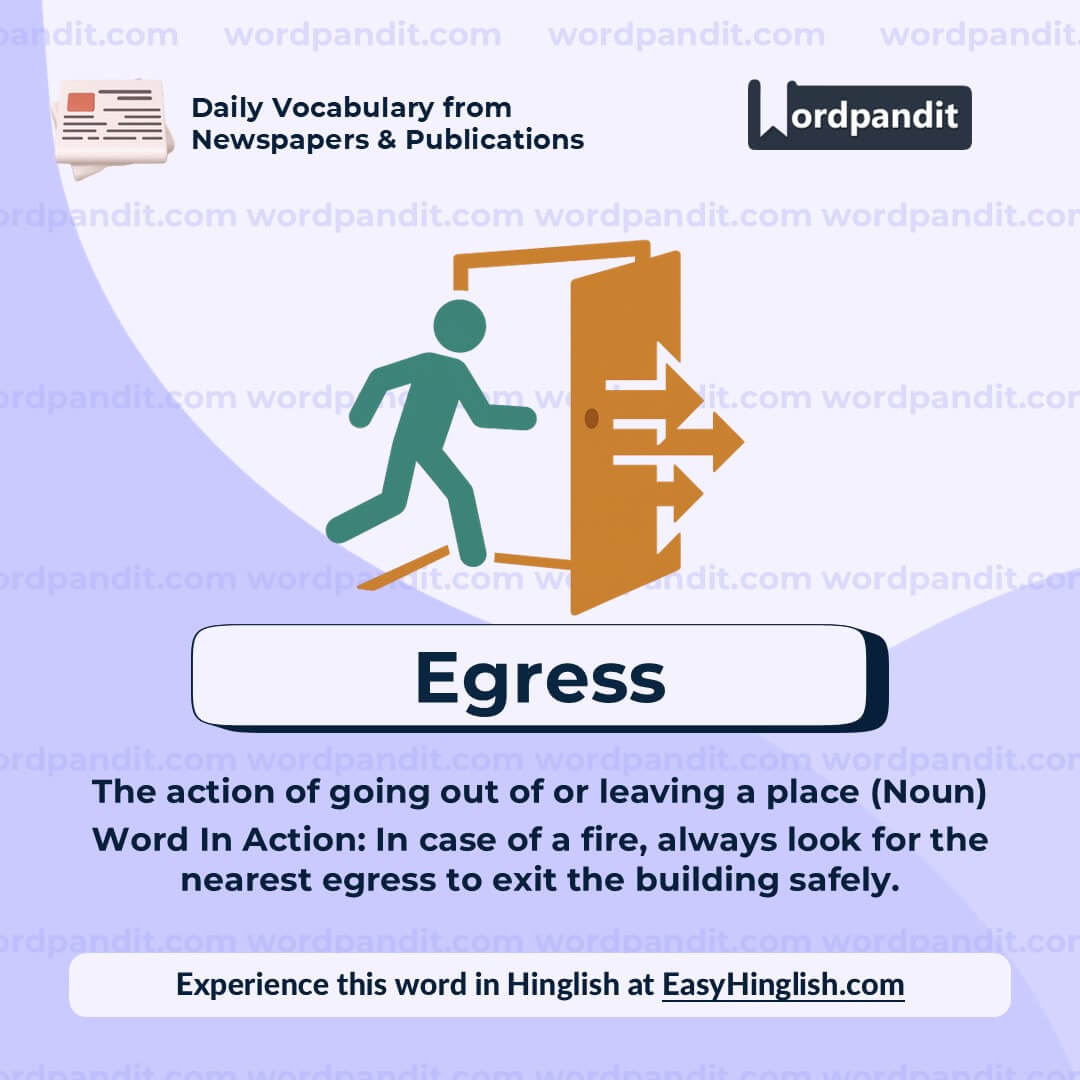
WORD-3: Egress
Context:
"In Meghalaya, these include demands for an Inner Line Permit (ILP) system that makes the tracking of entry and egress of non-residents of the state a more transparent (and perhaps complicated) process." - The Wire
Explanatory Paragraph:
“Egress” refers to the act of going out or leaving a place. It is the opposite of “entry” and is often used in formal or legal contexts, such as regulations, architecture, or security. In the context above, it relates to tracking people who leave the state of Meghalaya, emphasizing the importance of monitoring not just who enters, but also who exits, as part of administrative control.
Meaning: The action of going out of or leaving a place (Noun)
Pronunciation: ee-gres
Difficulty Level: ⭐⭐⭐ Intermediate
Etymology: From Latin *egressus*, meaning “a going out,” from *egredi* — “to go out.” Related to “exit.”
Prashant Sir's Notes:
Though not commonly used in everyday speech, “egress” appears often in formal writing, government policy, and building codes. It’s especially useful when paired with “entry” to describe the movement of people or information. In exams, this word can stand out for its specificity and formal tone.
Synonyms & Antonyms:
Synonyms: exit, departure, withdrawal, exodus, emergence
Antonyms: entry, ingress, arrival, entrance, admission
Usage Examples:
- The emergency plan requires clear paths for both entry and egress in case of fire.
- Officials monitored the egress of tourists from the national park after the alert.
- Building codes mandate multiple points of egress in public structures for safety.
- Regulations around the egress of sensitive data have become stricter in recent years.
Cultural Reference:
"Ingress and egress" is a common legal phrase in real estate documents, referring to the rights of entering and exiting a property. - Legal Usage
Think About It:
Why might governments or institutions place as much importance on monitoring egress as they do on entry?
Quick Activity:
Write a sentence using both “entry” and “egress” to describe movement in a building, city, or system.
Memory Tip:
“Egress” sounds like “exit-gress”—think of “gress” as “go” and remember it means going out.
Real-World Application:
Understanding the term “egress” is crucial in fields like architecture, law, security, and policy-making, where the controlled movement of people or data is vital for safety, compliance, or administration.
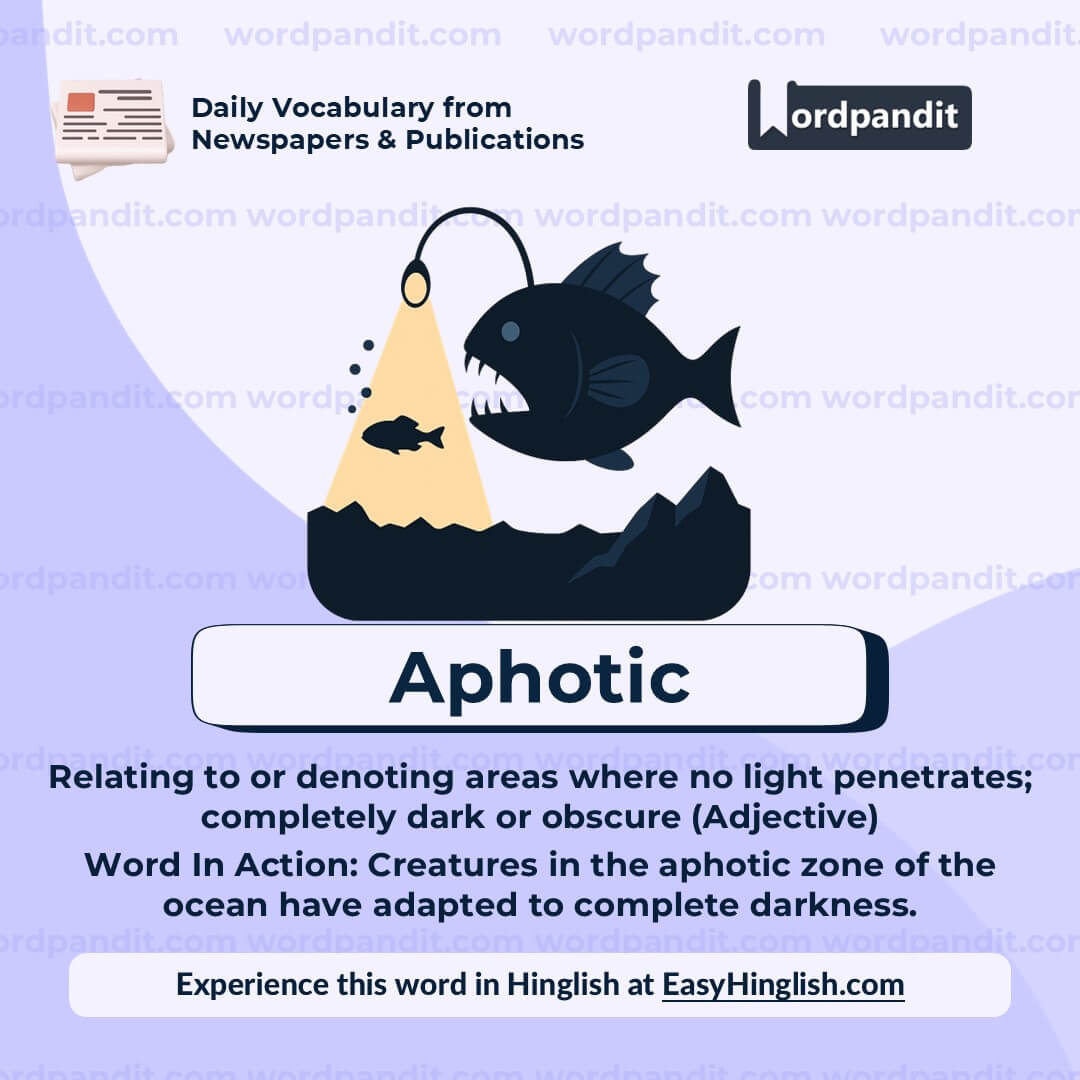
WORD-4: Aphotic
Context:
"Hidden gems” and “secret spots” are unveiled and “tourist spots” are manufactured in the aphotic parts of the region. This is, of course, also facilitated by private tour operators presenting sanitised clips of “must visit” spots in the region as “alternatives to international destinations”." - The Wire
Explanatory Paragraph:
“Aphotic” refers to areas that are without light or very dimly lit. Originally a scientific term used to describe deep ocean zones where sunlight cannot reach, it has also gained metaphorical usage to describe places that are obscure, hidden, or unexplored. In the context above, “aphotic parts of the region” refers to areas that were previously unknown or ignored by mainstream tourism but are now being promoted and commercialized.
Meaning: Relating to or denoting areas where no light penetrates; completely dark or obscure (Adjective)
Pronunciation: ay-foh-tik
Difficulty Level: ⭐⭐⭐⭐ Advanced
Etymology: From Greek *a-* meaning “without” + *phōs* meaning “light” — literally “without light”. Commonly used in marine biology and metaphorical writing.
Prashant Sir's Notes:
“Aphotic” is an excellent word to elevate your vocabulary, especially in descriptive or metaphorical writing. It can describe not just physical darkness, but also emotional, social, or cultural obscurity. In essay writing or fiction, using it adds a poetic and layered tone.
Synonyms & Antonyms:
Synonyms: dark, lightless, obscure, shadowy, unlit
Antonyms: illuminated, bright, visible, lit, radiant
Usage Examples:
- Marine creatures in the aphotic zone have evolved to survive without sunlight.
- The village remained aphotic to outsiders until recent development projects brought attention to it.
- Her novel explores the aphotic corners of the human mind where secrets lie buried.
- Tourism now shines light on once aphotic regions, altering their cultural balance.
Cultural Reference:
In documentaries like *The Blue Planet*, the aphotic zone of the ocean is portrayed as mysterious, teeming with strange, glowing life forms in complete darkness. - BBC Earth
Think About It:
What are the cultural consequences of exposing “aphotic” regions to global tourism and commercialization?
Quick Activity:
Describe a place you’ve visited or read about that felt “aphotic” — either physically dark or metaphorically hidden from the world.
Memory Tip:
“Aphotic” = “A” (without) + “photic” (light) → no light. Think of a cave or the deep ocean to recall its meaning.
Real-World Application:
“Aphotic” is useful in fields like ecology, marine biology, creative writing, and cultural commentary. It captures the essence of hidden, unlit, or unexplored spaces—whether literal or symbolic.
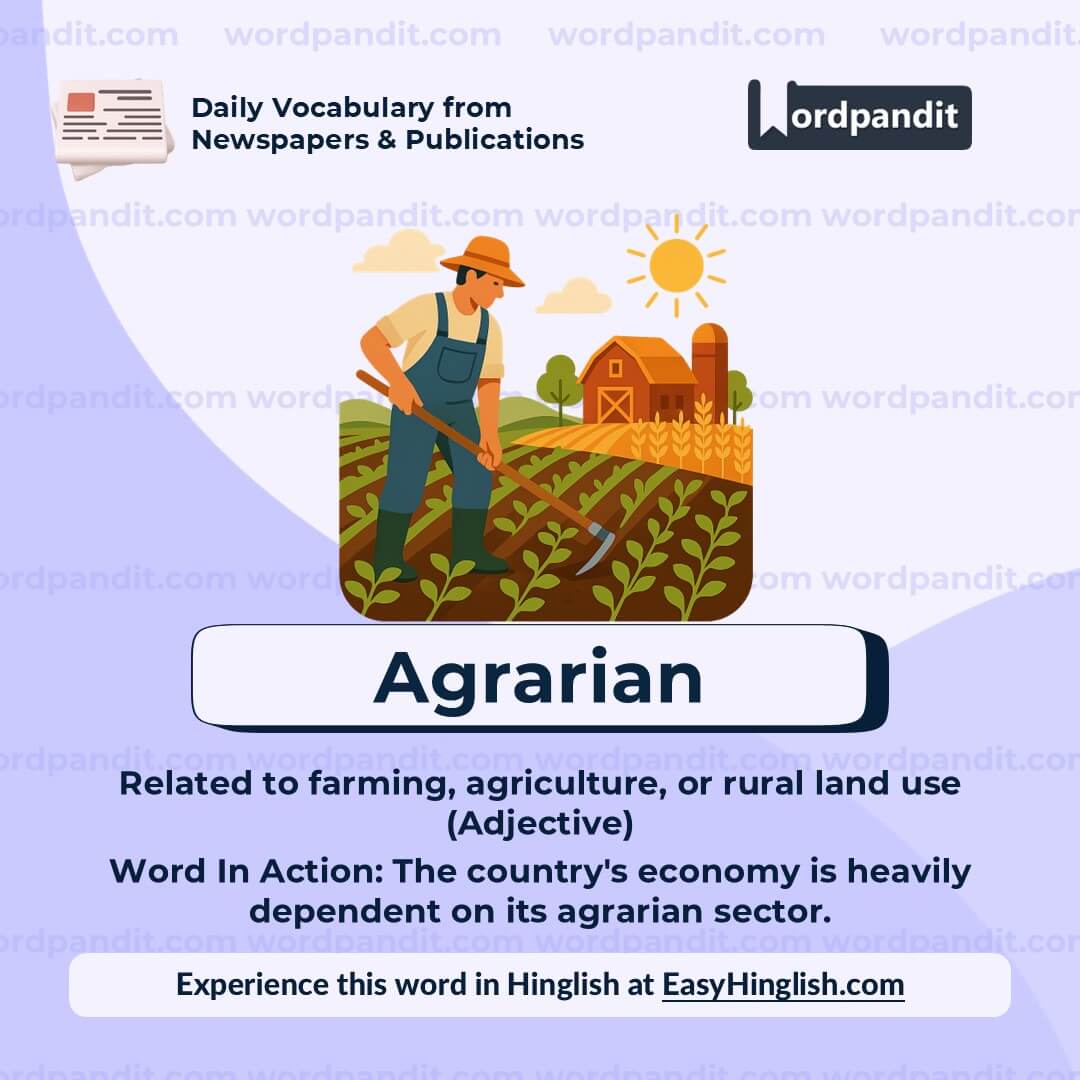
WORD-5: Agrarian
Context:
"Unintended consequences of this are microcosmic shifts from agrarian or natural resource-based economies in these places, to the more unpredictable and “tourist-dependent” models of income." - The Wire
Explanatory Paragraph:
“Agrarian” refers to anything related to agriculture, farming, or rural land use. It describes societies, economies, or ways of life that depend primarily on cultivating land and raising crops or livestock. In the context above, the word highlights a shift away from traditional farming-based economies to less stable income sources like tourism, raising concerns about sustainability and long-term livelihoods.
Meaning: Related to farming, agriculture, or rural land use (Adjective)
Pronunciation: uh-grare-ee-uhn
Difficulty Level: ⭐⭐ Basic to Intermediate
Etymology: From Latin *agrarius*, from *ager* meaning “field” — originally referring to land use and farming-related matters.
Prashant Sir's Notes:
This is a very important word in social science, economics, and geography. Use “agrarian” when talking about rural lifestyles, traditional livelihoods, or policies affecting farmers. It often appears in essays on development, sustainability, and rural transformation.
Synonyms & Antonyms:
Synonyms: farming-related, agricultural, rural, pastoral, rustic
Antonyms: urban, industrial, nonagricultural, metropolitan
Usage Examples:
- The agrarian economy of the region was disrupted by sudden industrialization.
- Many political movements in history have roots in agrarian struggles and land reforms.
- Her research focuses on agrarian societies and their response to climate change.
- The decline in agrarian practices has led to increased urban migration.
Cultural Reference:
“The Agrarian Question” is a recurring theme in Marxist and postcolonial theory, referring to the role of agriculture in the development of capitalism and modern society. - Academic Discourse
Think About It:
What are the long-term consequences of abandoning agrarian lifestyles in favor of tourism-based economies?
Quick Activity:
List three challenges that agrarian communities face in today’s world, and one solution for each.
Memory Tip:
“Agrarian” sounds like “agriculture” — both deal with farming and land. Remember the root *agr-* means “field.”
Real-World Application:
Understanding “agrarian” is key in debates about food security, land reform, rural policy, and environmental sustainability. It helps frame discussions about how modern economies impact traditional livelihoods.


