

Daily Vocabulary from Indian Newspapers and Publications
Welcome to Wordpandit’s Indian Vocabulary Hub
At Wordpandit, we understand the importance of staying rooted in the local context while expanding your language skills. This section focuses on enriching your vocabulary with words and phrases drawn from India’s leading newspapers and publications, ensuring you're learning vocabulary that is practical, relevant, and uniquely Indian.
Why Indian Sources Matter
We believe that the best way to master any language is by immersing yourself in local content. That’s why we carefully curate vocabulary from top Indian publications, including:
- The Hindu
- The Times of India
- The Economic Times
- Hindustan Times
- Live Mint
- The Indian Express
- And many others...
Stay Updated, Stay Relevant
With daily updates from Indian news sources, you’ll be consistently learning words that reflect the trends and shifts in Indian society and culture. Our focus is to provide vocabulary that enhances your understanding of the language in an Indian context.
How Wordpandit Supports Your Goals
Whether you’re preparing for exams, aiming to improve your professional communication, or simply want to stay connected with the latest Indian vocabulary, Wordpandit is here to guide you every step of the way.
Learn with a Practical Approach
Our interactive learning methodology includes real-world examples, engaging activities, and context-specific usage to ensure that every word becomes part of your active vocabulary.
Dive into Indian Vocabulary Today!

Why Choose Wordpandit?
Practical Learning: Focus on words you'll actually encounter in real-world reading, enhancing your comprehension and communication skills.
Diverse Content: From current affairs to scientific breakthroughs, our varied sources expose you to vocabulary across multiple domains.
Effortless Integration: Make Wordpandit a part of your daily routine. Just a few minutes each day can significantly boost your lexicon over time.
Your Path to Vocabulary Mastery
- Visit our Daily Vocabulary section regularly
- Explore new words and their usage in context
- Practice incorporating these words into your own writing and speech
- Track your progress as your vocabulary expands
Start Your Journey Today
Embark on your vocabulary enhancement journey with Wordpandit. By consistently engaging with our daily posts, you'll build a robust vocabulary that serves you well in academic, professional, and personal contexts.
Remember, a word a day keeps linguistic limitations at bay. Make Wordpandit your daily companion in the quest for vocabulary excellence!
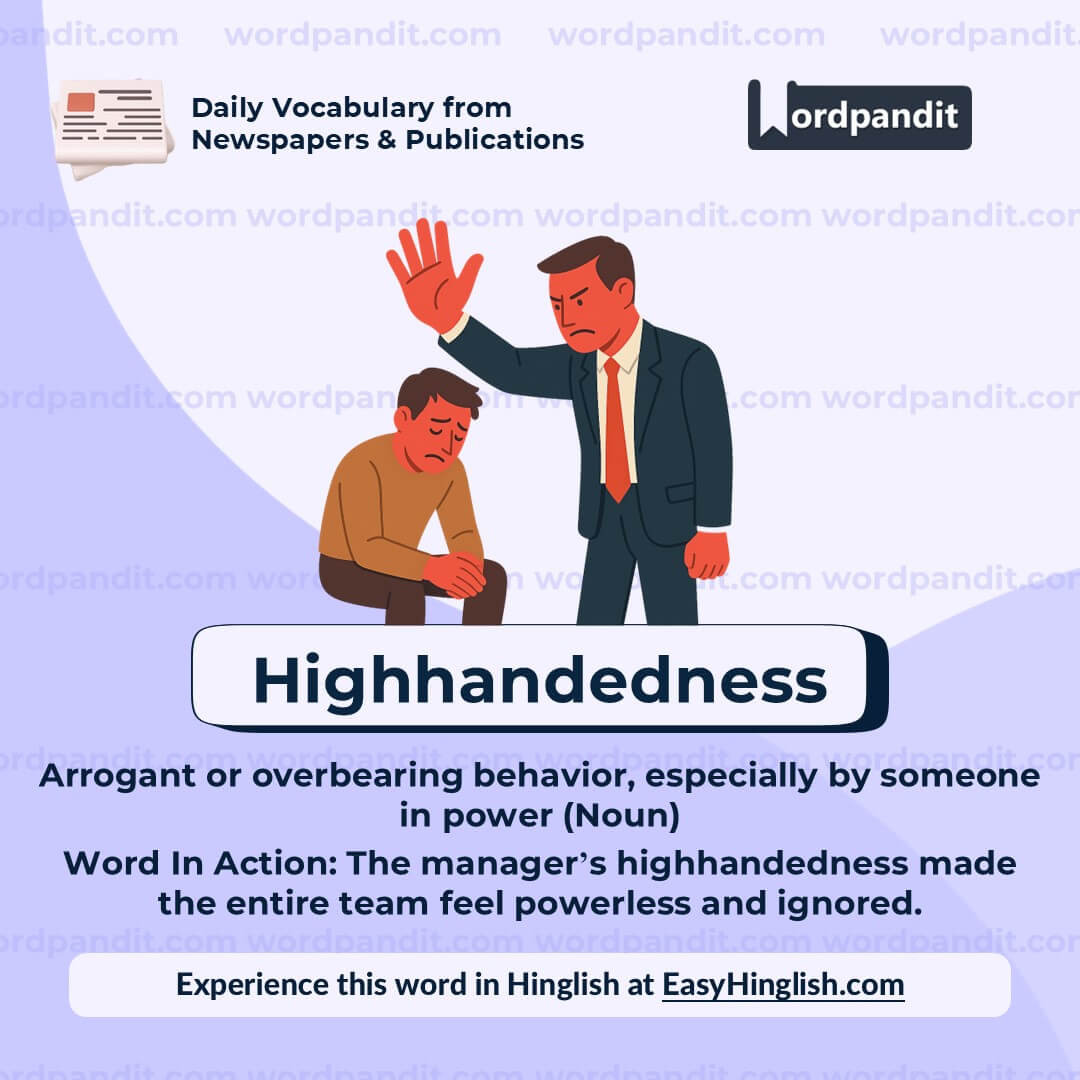
WORD-1: Highhandedness
Context:
"Whether or not it is, and will be a tourist destination—and to what extent it will—depends significantly on the consent and mandate of its people, and not only on government policy and state highhandedness." - The Wire
Explanatory Paragraph:
The word "highhandedness" refers to a behavior or attitude that is arrogant, overbearing, or authoritarian—often involving the use of power or authority in a way that ignores others' opinions or rights. When someone acts with highhandedness, they typically impose decisions without seeking input or showing concern for fairness. In the context of governance or leadership, it reflects a dismissive and forceful approach to decision-making.
Meaning: Arrogant or overbearing behavior, especially by someone in power (Noun)
Pronunciation: high-HAN-did-ness
Difficulty Level: ⭐⭐⭐ Intermediate
Etymology: Derived from the phrase “high-handed,” which originated in the 17th century, where “high” implied superiority and “hand” indicated action or control.
Prashant Sir's Notes:
This is a powerful word to describe abuse of power, particularly in governance or administration. Use it to highlight unjust or authoritarian practices. It has a negative connotation and works well in both academic and editorial writing.
Synonyms & Antonyms:
Synonyms: authoritarianism, despotism, tyranny, arbitrariness, overbearingness
Antonyms: humility, fairness, consideration, diplomacy, respectfulness
Usage Examples:
- The manager's highhandedness led to widespread dissatisfaction among employees.
- The protesters rallied against the government’s highhandedness in enforcing the new laws.
- Her highhandedness in organizing the event alienated most of the volunteers.
- Critics accused the council of highhandedness in ignoring local community concerns.
Cultural Reference:
"Highhandedness in politics rarely wins the hearts of the people—it only deepens mistrust." - A paraphrase commonly used in political commentary.
Think About It:
Can a leader ever justify highhandedness if it leads to effective and rapid decision-making? Where should the line be drawn?
Quick Activity:
Write a short paragraph about a fictional school principal who runs the school with highhandedness. How do the teachers and students react?
Memory Tip:
Think of a person raising their hand "high" to assert control — *highhandedness* equals overbearing authority.
Real-World Application:
Understanding and using the word "highhandedness" allows you to critically discuss power dynamics in politics, workplaces, or institutions where authority is exercised without fairness or inclusion.

WORD-2: Delegation
Context:
"The latest flashpoint in the Tharoor-Congress saga erupted after the Modi government’s controversial move to appoint him as head of an all-party delegation to explain India’s position abroad following Operation Sindoor." - The Wire
Explanatory Paragraph:
"Delegation" can refer either to the act of assigning responsibility or authority to someone else or to a group of representatives sent on a mission. In the context of the sentence above, the word refers to a group of people—typically officials or representatives—sent to represent a larger body or country. Delegations are commonly formed for diplomatic, political, or business missions, and they play an important role in communication and decision-making across institutions or nations.
Meaning: A group of people officially chosen to represent others; or the act of assigning responsibility to someone else (Noun)
Pronunciation: del-uh-GAY-shun
Difficulty Level: ⭐⭐ Beginner to Intermediate
Etymology: From Latin *delegatio*, meaning "a sending away," from *delegare* (to send as a deputy).
Prashant Sir's Notes:
“Delegation” is a highly useful word in both organizational and political contexts. It shows up in exams and essays when discussing teamwork, leadership, or international affairs. Remember the two meanings—sending people (a group) and assigning tasks (responsibility).
Synonyms & Antonyms:
Synonyms: representation, deputation, envoy group, assignment, commission
Antonyms: centralization, concentration, retention, withholding
Usage Examples:
- The prime minister sent a delegation to the UN to discuss the resolution.
- Effective managers understand the importance of delegation in increasing productivity.
- A student delegation met with the dean to present their concerns.
- Without proper delegation, the project was delayed and poorly executed.
Cultural Reference:
"Delegations have played crucial roles in global diplomacy—from the Paris Peace Conference of 1919 to modern UN Climate Summits." - A paraphrased historical reference
Think About It:
Why do some leaders struggle with delegation? Is it a matter of trust, control, or fear of being outperformed?
Quick Activity:
List three areas of your life (school, home, work) where delegation could help reduce your workload. Who could you delegate tasks to, and why?
Memory Tip:
Think: “DELEGATE to a group = DELEGATION.” Visualize a delegate handing over files to a group preparing for a mission abroad.
Real-World Application:
In workplaces, effective delegation is crucial for team efficiency and leadership development. In politics, delegations represent national interests in international forums, negotiations, or peacekeeping missions.
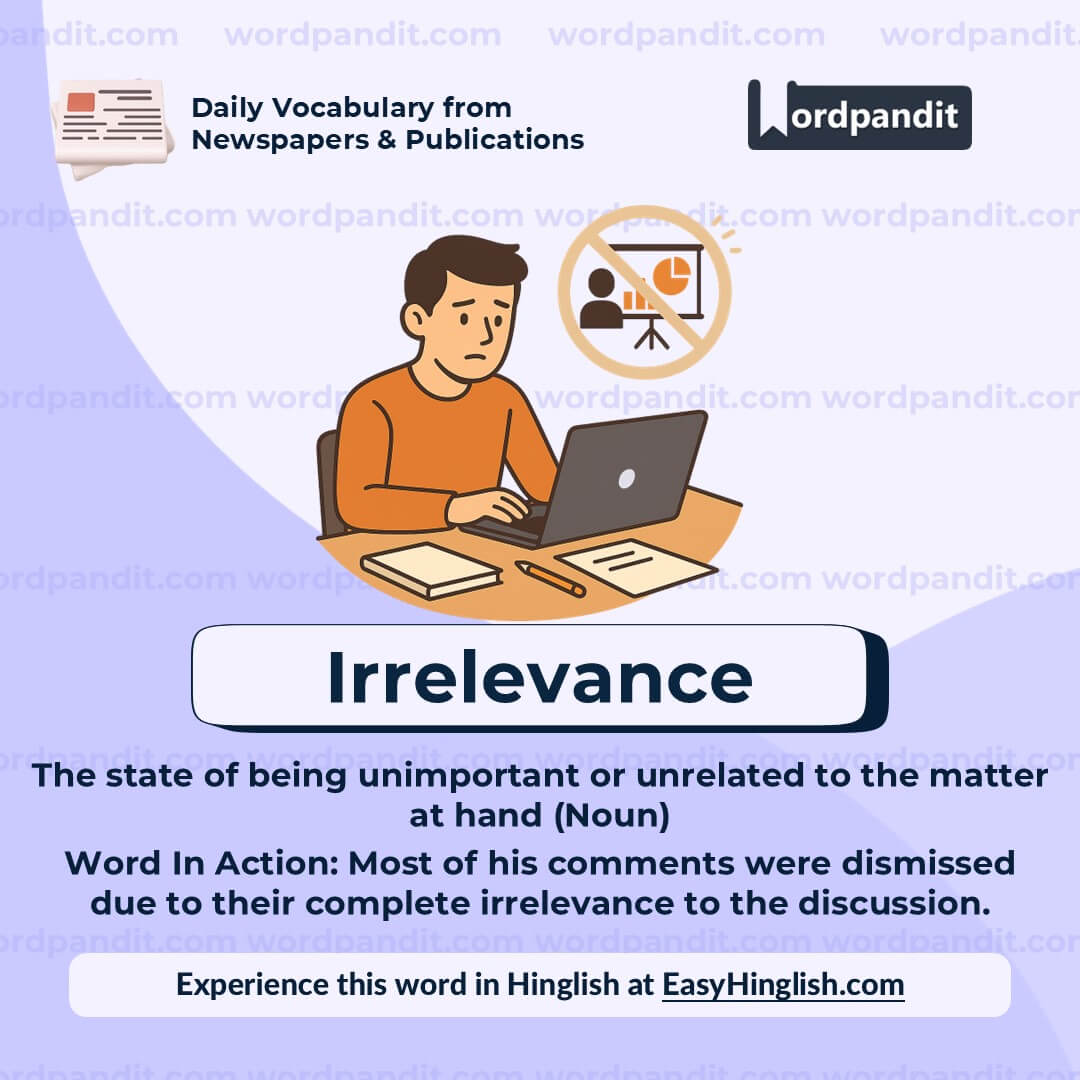
WORD-3: Irrelevance
Context:
"Another defeat could spell irrelevance not only for the Congress but also for many of its allies, particularly the Indian Union Muslim League (IUML), a major UDF ally." - The Wire
Explanatory Paragraph:
"Irrelevance" refers to the state of being unimportant, insignificant, or no longer connected to current matters or issues. When something or someone loses influence or meaning in a particular context, they become irrelevant. In the example from The Wire, "irrelevance" suggests the political fading or decreasing importance of a party or group in public or electoral affairs due to repeated failures.
Meaning: The state of being unimportant or unrelated to the matter at hand (Noun)
Pronunciation: ih-REL-uh-vuns
Difficulty Level: ⭐⭐ Beginner to Intermediate
Etymology: From Latin *irrelevans*, meaning "not relating" or "not important"; formed by adding the prefix *ir-* (not) to *relevare* (to raise, make light).
Prashant Sir's Notes:
“Irrelevance” is a great abstract noun to describe when a person, idea, or group loses value or connection to current concerns. It is particularly useful in political analysis, media discussions, and debates on trends or priorities.
Synonyms & Antonyms:
Synonyms: insignificance, unimportance, triviality, marginality
Antonyms: relevance, importance, significance, pertinence
Usage Examples:
- With the rise of digital media, many print publications fear slipping into irrelevance.
- The actor made a strong comeback after years of professional irrelevance.
- Technology evolves so quickly that today's innovations can fall into irrelevance tomorrow.
- He kept bringing up points that had total irrelevance to the discussion.
Cultural Reference:
"In politics, nothing fails like irrelevance—it’s the one defeat from which there's no recovery." - A paraphrased quote often used in political commentary.
Think About It:
Is irrelevance always negative, or can stepping out of the spotlight sometimes be a conscious and positive choice?
Quick Activity:
Think of a trend, idea, or product that was once popular but is now irrelevant. Write one sentence explaining why it lost relevance.
Memory Tip:
Break it down: “IR-” (not) + “RELEVANCE” (importance) = not important. Imagine an outdated floppy disk labeled “irrelevance” to remember something that no longer matters.
Real-World Application:
Understanding “irrelevance” is essential in media literacy, politics, business strategy, and academic debates, where determining what is or isn't significant can shape powerful decisions and narratives.
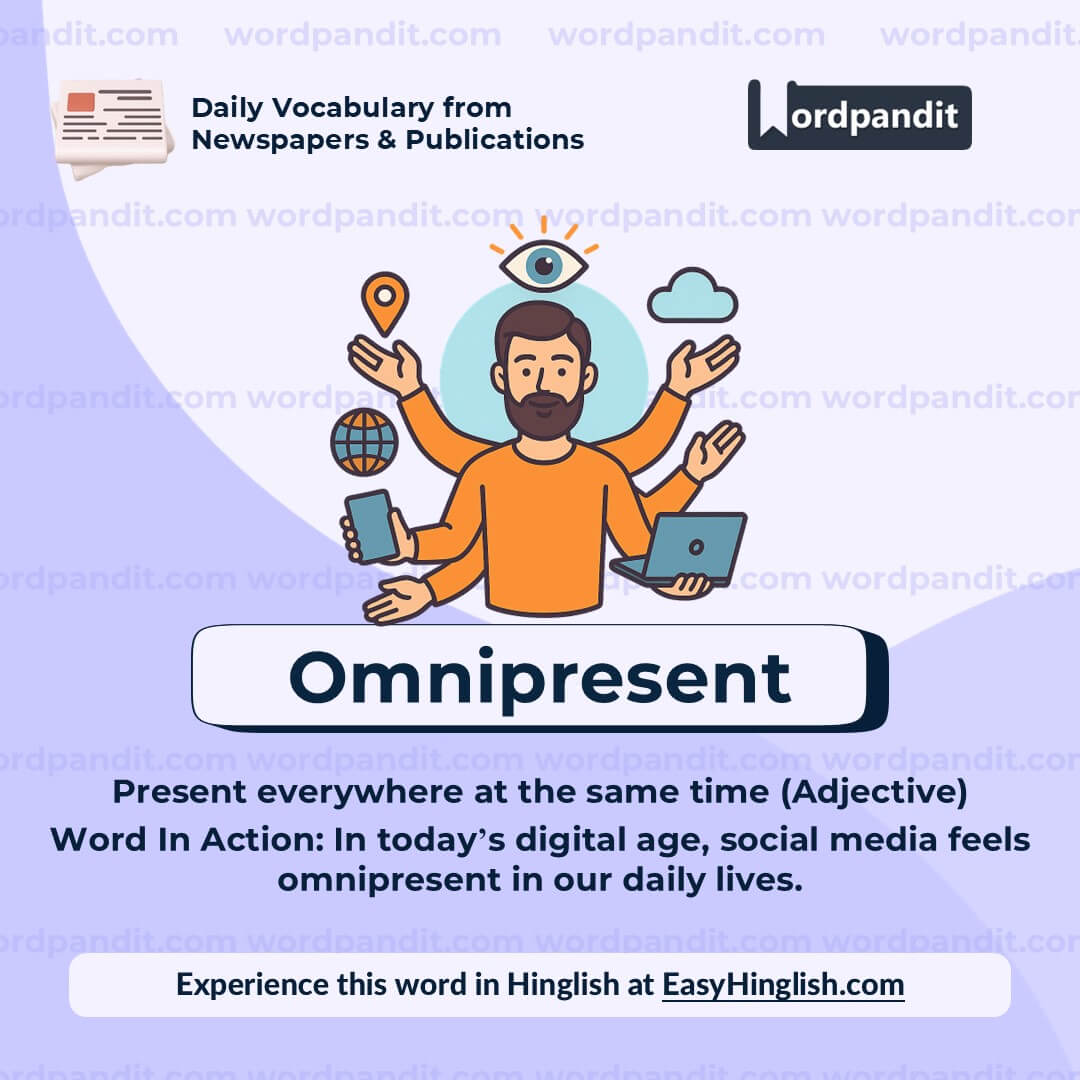
WORD-4: Omnipresent
Context:
"How many times have we chosen to quietly contemplate the glory of the omniscient and omnipresent almighty, who is the creator of everything?" - The Times of India
Explanatory Paragraph:
The word "omnipresent" refers to being present everywhere at the same time. It is often used in spiritual or religious contexts to describe a divine being—like God—who is believed to exist everywhere simultaneously. Beyond religious usage, the word can also describe something so widespread or universal that it seems to be everywhere, such as social media or surveillance in today’s world.
Meaning: Present everywhere at the same time (Adjective)
Pronunciation: om-nee-PREZ-uhnt
Difficulty Level: ⭐⭐⭐ Intermediate
Etymology: From Latin *omni-* (all) + *praesens* (present), literally meaning “all-present.”
Prashant Sir's Notes:
This is a great descriptive adjective, especially in philosophical, theological, or even technological discussions. It’s commonly paired with concepts like God, the internet, or modern surveillance systems. Use it to emphasize presence without limits.
Synonyms & Antonyms:
Synonyms: ubiquitous, all-pervading, ever-present, universal
Antonyms: absent, scarce, limited, rare
Usage Examples:
- The belief in an omnipresent deity offers comfort to many people around the world.
- In today’s digital age, surveillance cameras seem almost omnipresent.
- The brand’s logo was omnipresent at the sports event—on banners, uniforms, and even snacks.
- She felt her late father's presence was omnipresent in the house they once shared.
Cultural Reference:
"God is not only omnipotent and omniscient but omnipresent—watching over all creation." - A recurring idea in many religious scriptures.
Think About It:
In an age of constant connectivity, has technology become our modern-day omnipresent force? What are the implications of that?
Quick Activity:
List three things in modern life you believe are "omnipresent" in a metaphorical sense (e.g., advertisements, notifications, etc.).
Memory Tip:
“Omni” means “all” and “present” means “here.” So, *omnipresent* = present everywhere. Picture Wi-Fi signals—unseen, but all around you!
Real-World Application:
Understanding "omnipresent" is useful when discussing religion, philosophy, global brands, or modern digital culture, where presence and influence extend across all spaces—physical or virtual.
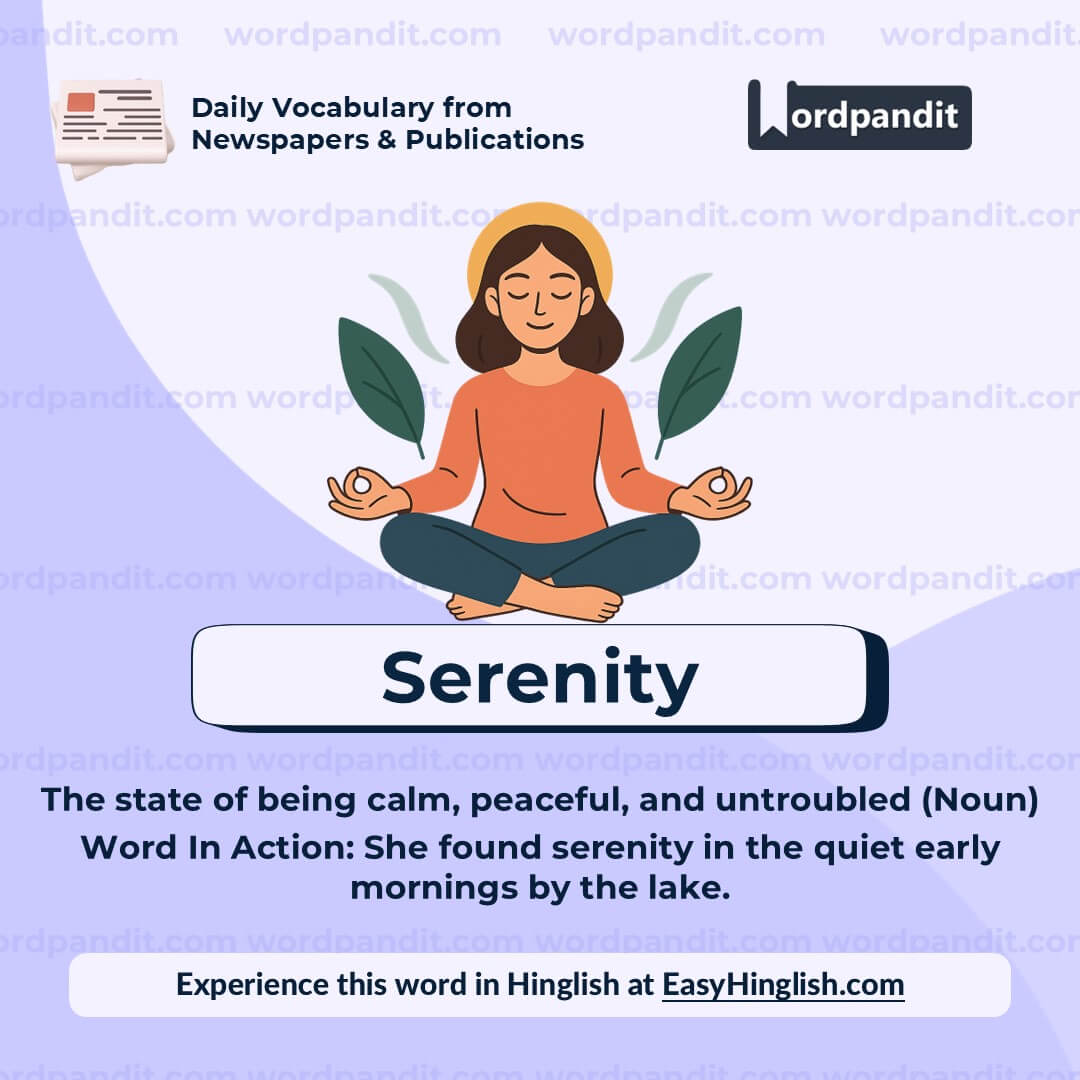
WORD-5: Serenity
Context:
"The eternal quest of the evolved man is the exploration for the oasis of Sakinah – a state of inner peace, tranquillity, and serenity. It’s a state of calmness and reassurance, a feeling of being grounded and at peace with oneself and the world." - The Times Of India
Explanatory Paragraph:
"Serenity" refers to a deep state of calm, peace, and clarity. It describes a condition where the mind is undisturbed by stress, noise, or worry. Often associated with spiritual practices, nature, or reflective moments, serenity is a cherished emotional state that allows people to feel balanced and centered. In the context above, serenity is part of the broader goal of inner peace and spiritual stillness that many seek in a busy and often chaotic world.
Meaning: The state of being calm, peaceful, and untroubled (Noun)
Pronunciation: suh-REN-ih-tee
Difficulty Level: ⭐⭐ Beginner to Intermediate
Etymology: From Latin *serenus*, meaning “clear, calm.” The word entered English in the 15th century via Old French *sérénité*.
Prashant Sir's Notes:
“Serenity” is one of those beautiful, meditative words that carries emotional weight. Use it in essays or conversations about mindfulness, nature, or mental well-being. It's also common in philosophical and poetic writing.
Synonyms & Antonyms:
Synonyms: tranquility, calmness, peace, stillness, composure
Antonyms: chaos, turmoil, anxiety, agitation, disturbance
Usage Examples:
- After the storm passed, a sense of serenity settled over the landscape.
- She meditated every morning to invite serenity into her busy life.
- The mountain view brought him a rare moment of pure serenity.
- Despite the chaos around her, she maintained an inner serenity that was inspiring.
Cultural Reference:
"Grant me the serenity to accept the things I cannot change…" — The Serenity Prayer, widely used in spiritual and recovery communities.
Think About It:
What brings you serenity in a world filled with noise and distraction? Can serenity be cultivated or must it be discovered?
Quick Activity:
Write down three things, places, or practices that help you feel serene. Try to engage with one of them this week for at least 10 minutes.
Memory Tip:
Think of “serenity” as the serene sky—clear, blue, and undisturbed. Serenity = sky-like peace.
Real-World Application:
Understanding and pursuing serenity is essential in mental health practices, meditation, wellness routines, and conflict resolution. It's also a valuable concept in designing peaceful spaces and lifestyles.


