

Daily Vocabulary from Indian Newspapers and Publications
Welcome to Wordpandit’s Indian Vocabulary Hub
At Wordpandit, we understand the importance of staying rooted in the local context while expanding your language skills. This section focuses on enriching your vocabulary with words and phrases drawn from India’s leading newspapers and publications, ensuring you're learning vocabulary that is practical, relevant, and uniquely Indian.
Why Indian Sources Matter
We believe that the best way to master any language is by immersing yourself in local content. That’s why we carefully curate vocabulary from top Indian publications, including:
- The Hindu
- The Times of India
- The Economic Times
- Hindustan Times
- Live Mint
- The Indian Express
- And many others...
Stay Updated, Stay Relevant
With daily updates from Indian news sources, you’ll be consistently learning words that reflect the trends and shifts in Indian society and culture. Our focus is to provide vocabulary that enhances your understanding of the language in an Indian context.
How Wordpandit Supports Your Goals
Whether you’re preparing for exams, aiming to improve your professional communication, or simply want to stay connected with the latest Indian vocabulary, Wordpandit is here to guide you every step of the way.
Learn with a Practical Approach
Our interactive learning methodology includes real-world examples, engaging activities, and context-specific usage to ensure that every word becomes part of your active vocabulary.
Dive into Indian Vocabulary Today!

Why Choose Wordpandit?
Practical Learning: Focus on words you'll actually encounter in real-world reading, enhancing your comprehension and communication skills.
Diverse Content: From current affairs to scientific breakthroughs, our varied sources expose you to vocabulary across multiple domains.
Effortless Integration: Make Wordpandit a part of your daily routine. Just a few minutes each day can significantly boost your lexicon over time.
Your Path to Vocabulary Mastery
- Visit our Daily Vocabulary section regularly
- Explore new words and their usage in context
- Practice incorporating these words into your own writing and speech
- Track your progress as your vocabulary expands
Start Your Journey Today
Embark on your vocabulary enhancement journey with Wordpandit. By consistently engaging with our daily posts, you'll build a robust vocabulary that serves you well in academic, professional, and personal contexts.
Remember, a word a day keeps linguistic limitations at bay. Make Wordpandit your daily companion in the quest for vocabulary excellence!
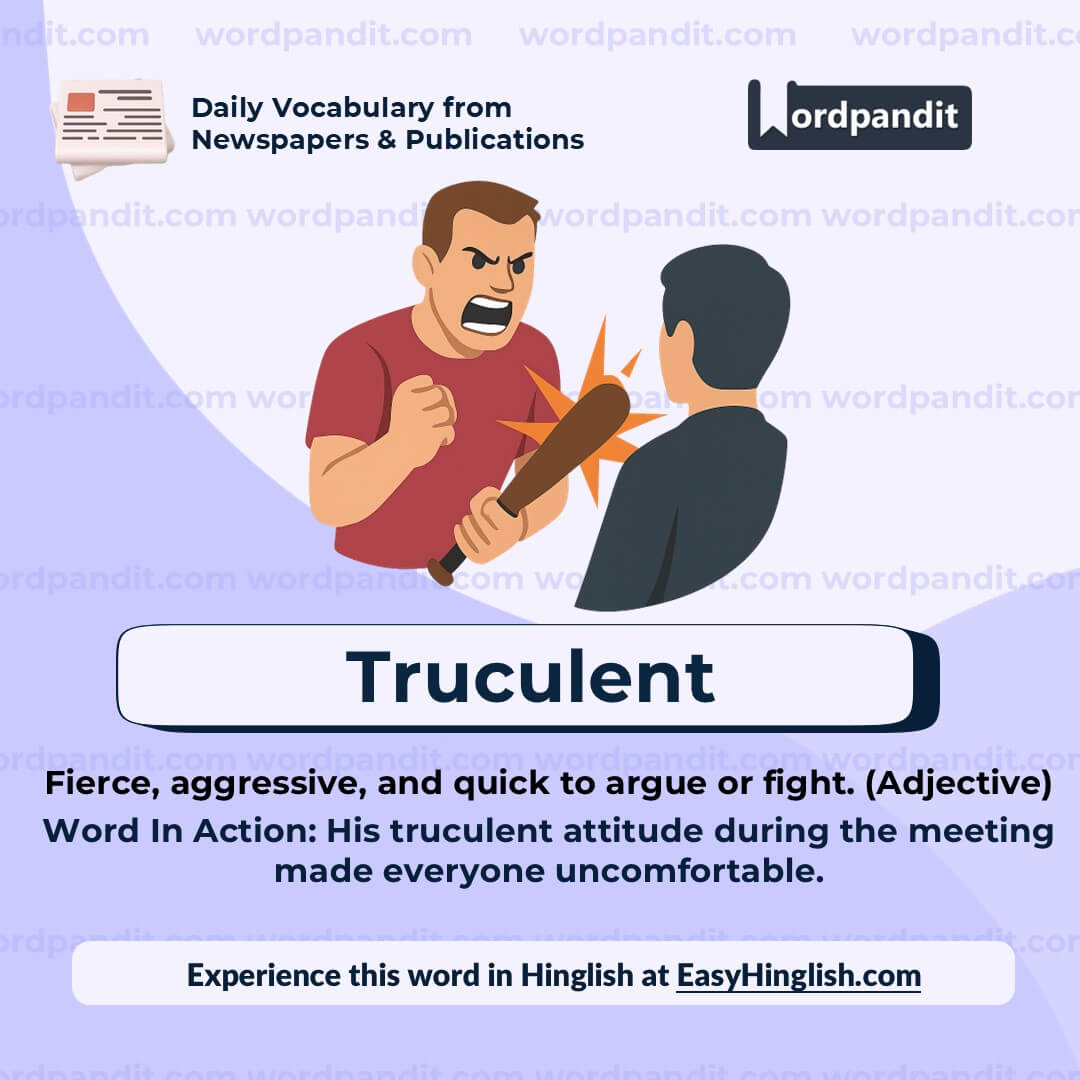
WORD-1: Truculent
Context:
"The minister's truculent behavior during parliamentary questioning did little to address the substance of the allegations." - The Caravan
Explanatory Paragraph:
“Truculent” is a strong word used to describe someone who is aggressively defiant or hostile. When someone acts truculently, they’re not just defensive—they’re often combative and eager to argue or fight. In the context of political or public behavior, this attitude can come across as dismissive or even disrespectful, often overshadowing the actual issues at hand.
Meaning: Aggressively defiant or hostile (Adjective)
Pronunciation: TRUH-kyuh-luhnt
Difficulty Level: ⭐⭐⭐ Intermediate
Etymology: From Latin truculentus, meaning "fierce" or "savage," from trux, meaning "wild or rough."
Prashant Sir's Notes:
Remember this word in contexts of aggressive speeches or defensive people in authority. It's often used to describe someone more interested in confrontation than resolution.
Synonyms & Antonyms:
Synonyms: combative, belligerent, aggressive, defiant, hostile
Antonyms: peaceful, calm, gentle, conciliatory
Usage Examples:
- The player’s truculent response to the referee’s decision led to a yellow card.
- Her truculent tone made it hard for anyone to approach her with feedback.
- Despite his truculent attitude, the panel continued the discussion calmly.
- The article criticized the CEO’s truculent dismissal of shareholder concerns.
Cultural Reference:
"Truculence is the language of those who feel cornered, not confident." — An interpretation of political commentary on aggressive leadership styles.
Think About It:
Can truculence ever be a strength in leadership, or does it always undermine constructive dialogue?
Quick Activity:
Write down a recent situation where someone acted in a truculent manner. How could the situation have been handled more constructively?
Memory Tip:
Think: “Truculent truck”—imagine a huge truck aggressively speeding down the road, pushing everyone aside. That’s truculent behavior!
Real-World Application:
In interviews or debates, truculent responses can damage reputations. Understanding this word helps in analyzing public figures’ behavior critically and accurately.
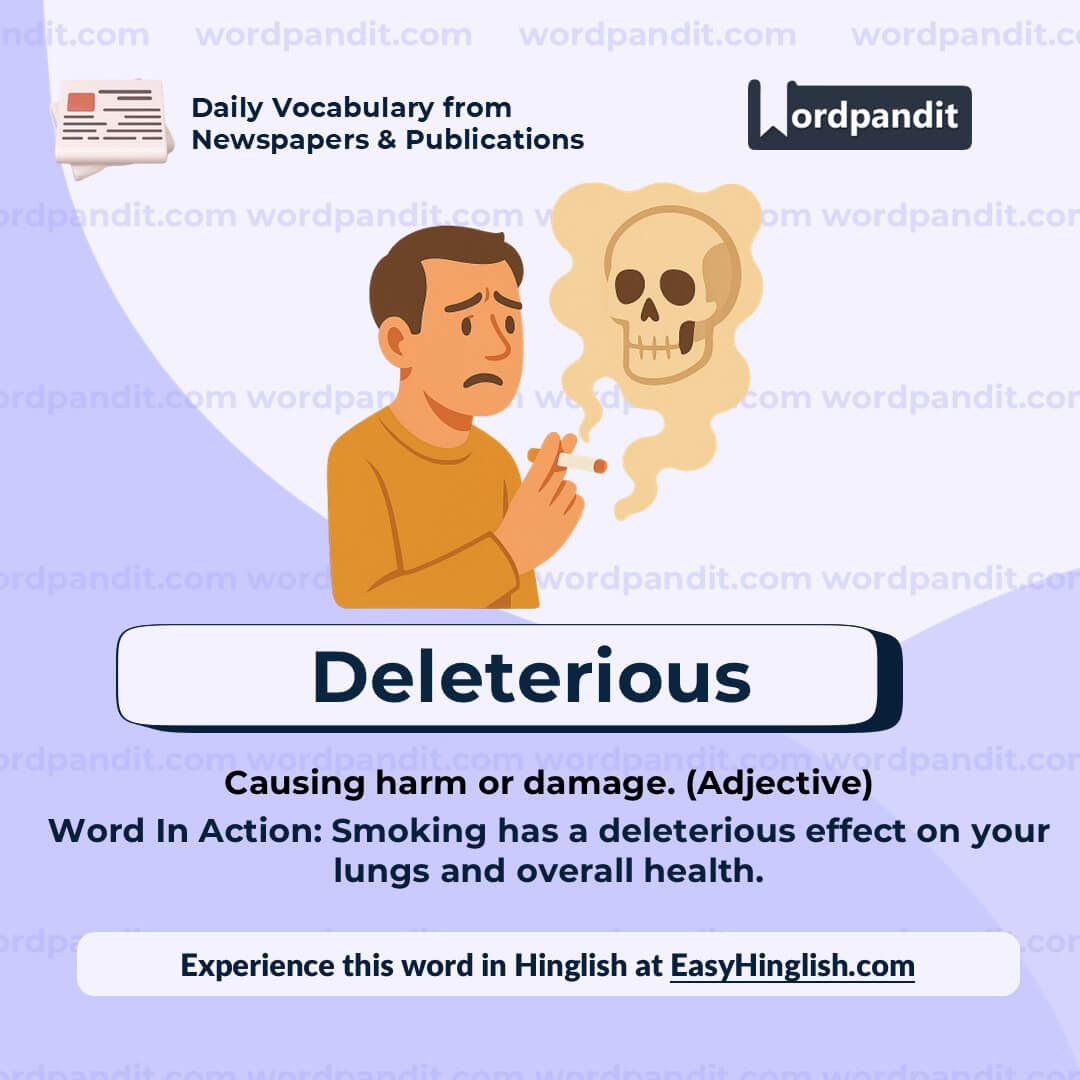
WORD-2: Deleterious
Context:
"Researchers have documented the deleterious impact of industrial waste on the river ecosystem and surrounding agricultural land." - India Today
Explanatory Paragraph:
“Deleterious” refers to something that causes harm or damage, especially in a subtle or long-term way. It’s often used in scientific or formal writing to describe effects that are not immediately obvious but are deeply harmful over time. In this context, the word highlights the harmful consequences of pollution, particularly how industrial waste can damage ecosystems and farmlands.
Meaning: Causing harm or damage (Adjective)
Pronunciation: del-uh-TEER-ee-uhs
Difficulty Level: ⭐⭐⭐ Intermediate
Etymology: From Latin deleterius, from Greek dēlētērios, meaning "noxious" or "destructive."
Prashant Sir's Notes:
Use “deleterious” in place of “harmful” when writing essays or formal content—it adds precision and sophistication to your language. It's especially powerful in academic or policy contexts.
Synonyms & Antonyms:
Synonyms: harmful, damaging, injurious, detrimental, adverse
Antonyms: beneficial, helpful, advantageous, wholesome
Usage Examples:
- The prolonged exposure to loud noise had a deleterious effect on his hearing.
- Social media can be deleterious to mental health if not used mindfully.
- Some chemicals in cleaning products have been found to be deleterious to the environment.
- Ignoring work-life balance can have deleterious effects on both health and productivity.
Cultural Reference:
"The deleterious consequences of environmental neglect are no longer a distant threat—they’re a daily reality." — A paraphrased statement from the 2023 UN Climate Report.
Think About It:
Why do you think people continue practices that are clearly deleterious to the environment or their health?
Quick Activity:
List three things you’ve encountered in daily life that could be considered deleterious. Suggest a possible alternative or solution for each.
Memory Tip:
Deleterious sounds like “delete” — think of something so harmful it deletes or destroys what’s around it!
Real-World Application:
This word is highly relevant in academic writing, especially in fields like environmental science, healthcare, and psychology. Knowing it helps in articulating nuanced arguments about long-term harm.
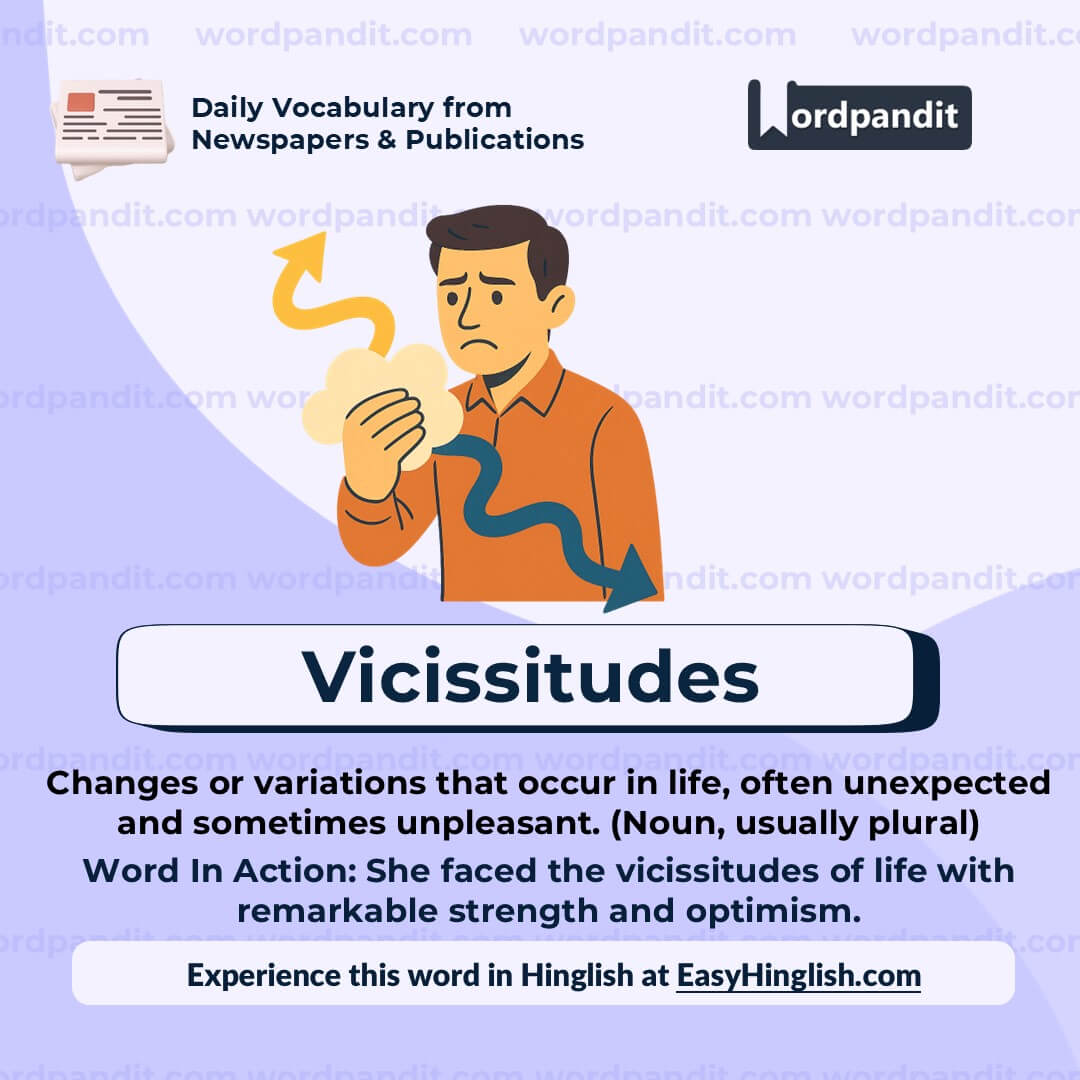
WORD-3: Vicissitudes
Context:
"The autobiography candidly recounts the vicissitudes of his career, from spectacular success to devastating failure and back again." - Outlook
Explanatory Paragraph:
“Vicissitudes” refers to the unexpected and often unpredictable changes, especially the ups and downs, that occur in life or fortune. It’s a powerful word used to capture the emotional and situational fluctuations we all go through. In the given context, the author is talking about a journey filled with dramatic highs and lows—a rollercoaster of experiences that shaped the person’s life and career.
Meaning: Changes or variations occurring in the course of something, often referring to the ups and downs of life (Noun, usually plural)
Pronunciation: vih-SIS-ih-toods
Difficulty Level: ⭐⭐⭐⭐ Advanced
Etymology: From Latin vicissitudo, meaning "change" or "alternation," derived from vicis meaning "turn" or "exchange."
Prashant Sir's Notes:
This is a classic word used in autobiographies, philosophical writing, and literary essays. It reflects the depth of human experience and change. Use it in place of "ups and downs" to elevate your expression.
Synonyms & Antonyms:
Synonyms: fluctuations, shifts, changes, variations, twists and turns
Antonyms: stability, constancy, uniformity, permanence
Usage Examples:
- She remained resilient through the vicissitudes of her business journey.
- The vicissitudes of weather in the mountains can be dangerous for unprepared hikers.
- Artists often find inspiration in the vicissitudes of their emotional lives.
- He spoke eloquently about the vicissitudes of life that shaped his worldview.
Cultural Reference:
"The vicissitudes of fortune, which spares no man, had not overlooked even the mightiest emperors." — Inspired by Edward Gibbon’s *The History of the Decline and Fall of the Roman Empire*
Think About It:
How do the vicissitudes of life help shape a person’s character and resilience?
Quick Activity:
Write a short paragraph (3-4 lines) describing a moment in your life where you faced sudden change. Use the word “vicissitudes” in your writing.
Memory Tip:
Think of “vicissitudes” as “vicious + attitudes” — the changing (and sometimes cruel) twists life throws at us.
Real-World Application:
Understanding this word is especially useful in literature, psychology, and reflective writing. It helps describe life’s unpredictability with elegance and precision.
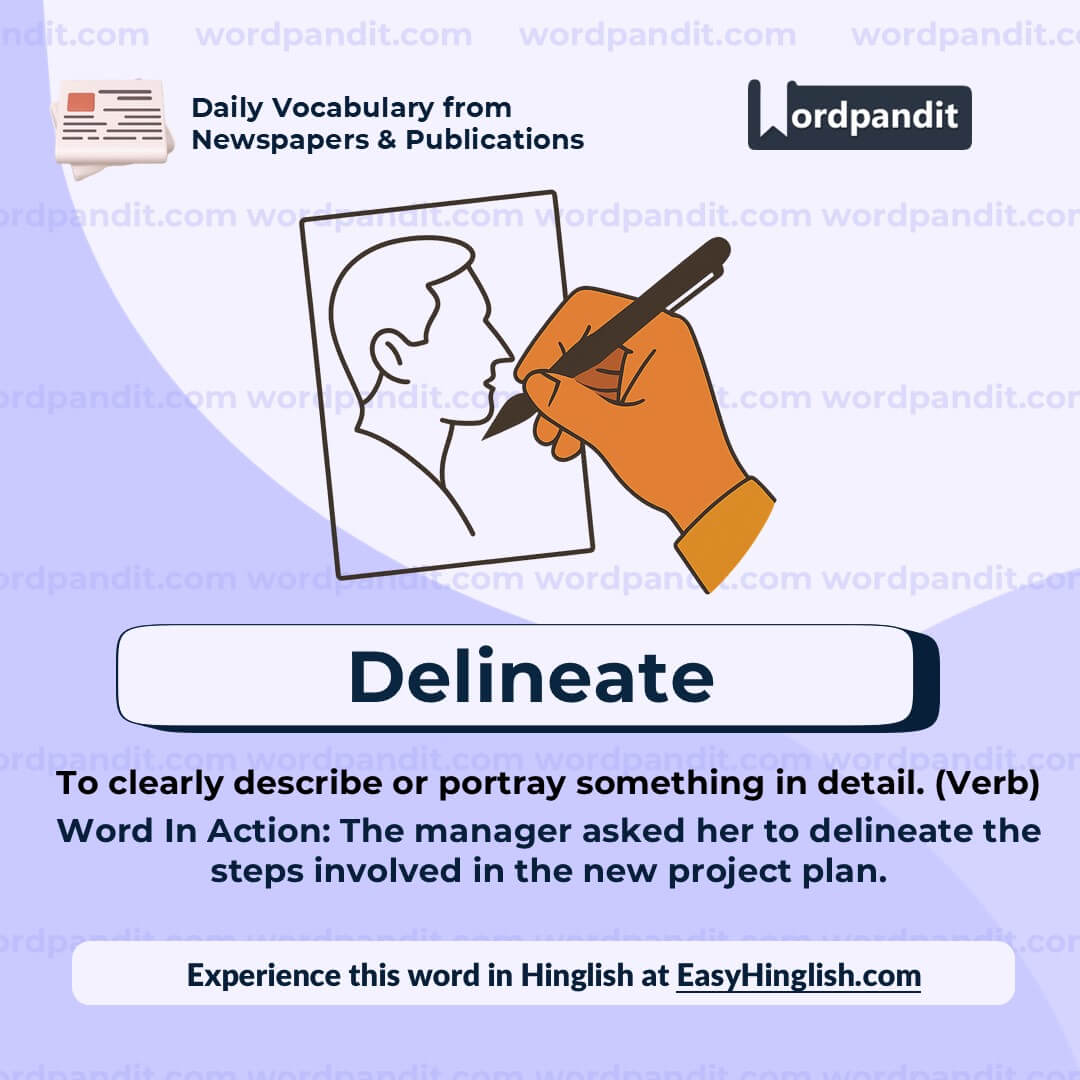
WORD-4: Delineate
Context:
"The Supreme Court's ruling attempts to delineate the boundaries between free speech and incitement in the digital age." - Bar and Bench
Explanatory Paragraph:
“Delineate” means to clearly describe or define something—especially boundaries, roles, or ideas. It often appears in legal, academic, and analytical writing when precision is key. In the context of the Supreme Court's ruling, the word signifies an attempt to draw a clear and precise line between acceptable speech and unlawful provocation in the digital space.
Meaning: To describe, portray, or define something clearly and precisely (Verb)
Pronunciation: dih-LIN-ee-ate
Difficulty Level: ⭐⭐⭐ Intermediate
Etymology: From Latin delineare, meaning “to sketch or outline,” from de- (completely) + lineare (to draw lines).
Prashant Sir's Notes:
This is a great word for essay writing and legal contexts. Use it when you're explaining frameworks, setting boundaries, or laying out complex ideas in a structured way.
Synonyms & Antonyms:
Synonyms: outline, define, describe, portray, map out
Antonyms: confuse, obscure, distort, blur
Usage Examples:
- The architect used detailed drawings to delineate the layout of the building.
- The contract clearly delineates the responsibilities of both parties.
- The documentary delineates the rise and fall of the political movement.
- In her speech, she delineated the vision of a more inclusive society.
Cultural Reference:
In modern constitutional debates, courts often attempt to delineate the thin line between rights and restrictions—especially concerning freedom of expression on social media platforms.
Think About It:
In an age of blurred digital boundaries, who should have the power to delineate what qualifies as free speech?
Quick Activity:
Pick a complex issue (e.g., privacy, freedom, responsibility) and write one sentence that uses “delineate” to define or clarify the concept.
Memory Tip:
Think: “draw the line”—“delineate” sounds like “draw a line,” which is exactly what it means: to define clearly.
Real-World Application:
Useful in legal, academic, business, and policy contexts, “delineate” helps you express clarity in rules, responsibilities, and boundaries. Great for professional communication and structured writing.
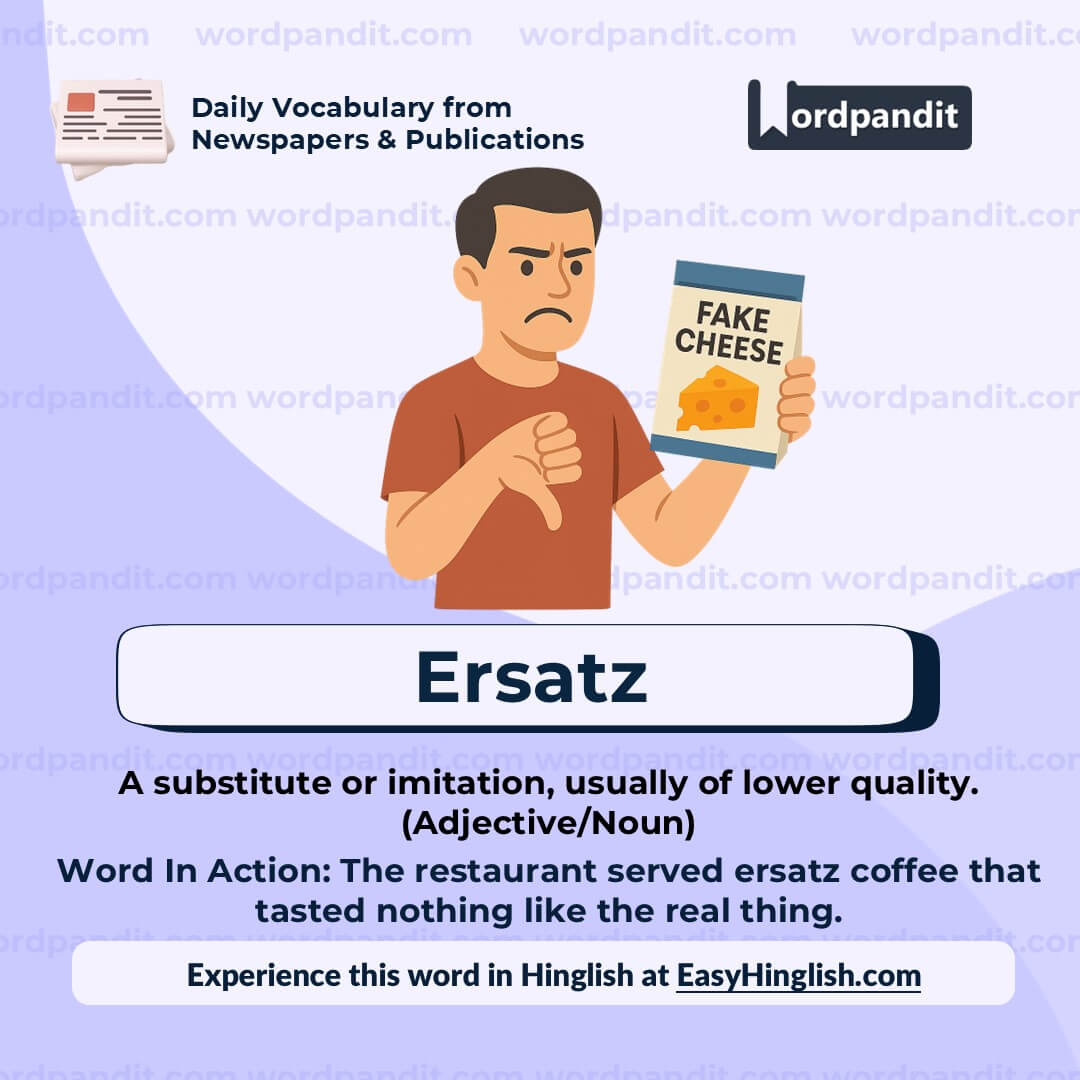
WORD-5: Ersatz
Context:
"The cultural festival offered merely an ersatz version of traditional practices, prioritizing spectacle over authenticity." - The Tribune
Explanatory Paragraph:
“Ersatz” refers to something made or used as a substitute, typically of inferior quality. It’s often used in a critical or disapproving tone to point out that something is a poor imitation of the real thing. In this context, the festival is being criticized for showcasing a version of tradition that’s inauthentic, flashy, and lacking depth—an ersatz experience rather than a genuine cultural one.
Meaning: A substitute or imitation, usually of lower quality; not genuine (Adjective/Noun)
Pronunciation: UR-sahts or AIR-sahts
Difficulty Level: ⭐⭐⭐⭐ Advanced
Etymology: Borrowed from German, where "ersatz" literally means "replacement" or "substitute."
Prashant Sir's Notes:
This word is particularly useful in critiques—whether cultural, artistic, or social. When you want to point out that something is a superficial copy lacking true value, “ersatz” is your word.
Synonyms & Antonyms:
Synonyms: fake, imitation, substitute, counterfeit, bogus
Antonyms: authentic, genuine, real, original
Usage Examples:
- The cafe served an ersatz version of Italian espresso that left coffee lovers unimpressed.
- He wore an ersatz designer watch to impress his colleagues.
- Some modern music is criticized as being an ersatz form of earlier, more soulful genres.
- Her smile seemed ersatz—polite but lacking any real warmth.
Cultural Reference:
During World War II, many countries used ersatz goods—like coffee substitutes made from roasted grains—due to rationing and shortages, which is how the term entered English with its current connotation.
Think About It:
In today’s world of fast consumerism and mass production, how do you distinguish between authentic experiences and ersatz ones?
Quick Activity:
Think of three things in your daily life (e.g., food, media, relationships) that could be considered ersatz. How could you replace them with something more authentic?
Memory Tip:
“Ersatz” sounds like “our-sauce”—but imagine it’s a poor knock-off of real sauce. That’s how ersatz things feel: off-brand and disappointing!
Real-World Application:
“Ersatz” is commonly used in reviews, critiques, and discussions of quality—whether in art, food, products, or even behavior. It helps convey a strong sense of artificiality or lack of authenticity.


