

Daily Vocabulary from Indian Newspapers and Publications
Welcome to Wordpandit’s Indian Vocabulary Hub
At Wordpandit, we understand the importance of staying rooted in the local context while expanding your language skills. This section focuses on enriching your vocabulary with words and phrases drawn from India’s leading newspapers and publications, ensuring you're learning vocabulary that is practical, relevant, and uniquely Indian.
Why Indian Sources Matter
We believe that the best way to master any language is by immersing yourself in local content. That’s why we carefully curate vocabulary from top Indian publications, including:
- The Hindu
- The Times of India
- The Economic Times
- Hindustan Times
- Live Mint
- The Indian Express
- And many others...
Stay Updated, Stay Relevant
With daily updates from Indian news sources, you’ll be consistently learning words that reflect the trends and shifts in Indian society and culture. Our focus is to provide vocabulary that enhances your understanding of the language in an Indian context.
How Wordpandit Supports Your Goals
Whether you’re preparing for exams, aiming to improve your professional communication, or simply want to stay connected with the latest Indian vocabulary, Wordpandit is here to guide you every step of the way.
Learn with a Practical Approach
Our interactive learning methodology includes real-world examples, engaging activities, and context-specific usage to ensure that every word becomes part of your active vocabulary.
Dive into Indian Vocabulary Today!

Why Choose Wordpandit?
Practical Learning: Focus on words you'll actually encounter in real-world reading, enhancing your comprehension and communication skills.
Diverse Content: From current affairs to scientific breakthroughs, our varied sources expose you to vocabulary across multiple domains.
Effortless Integration: Make Wordpandit a part of your daily routine. Just a few minutes each day can significantly boost your lexicon over time.
Your Path to Vocabulary Mastery
- Visit our Daily Vocabulary section regularly
- Explore new words and their usage in context
- Practice incorporating these words into your own writing and speech
- Track your progress as your vocabulary expands
Start Your Journey Today
Embark on your vocabulary enhancement journey with Wordpandit. By consistently engaging with our daily posts, you'll build a robust vocabulary that serves you well in academic, professional, and personal contexts.
Remember, a word a day keeps linguistic limitations at bay. Make Wordpandit your daily companion in the quest for vocabulary excellence!
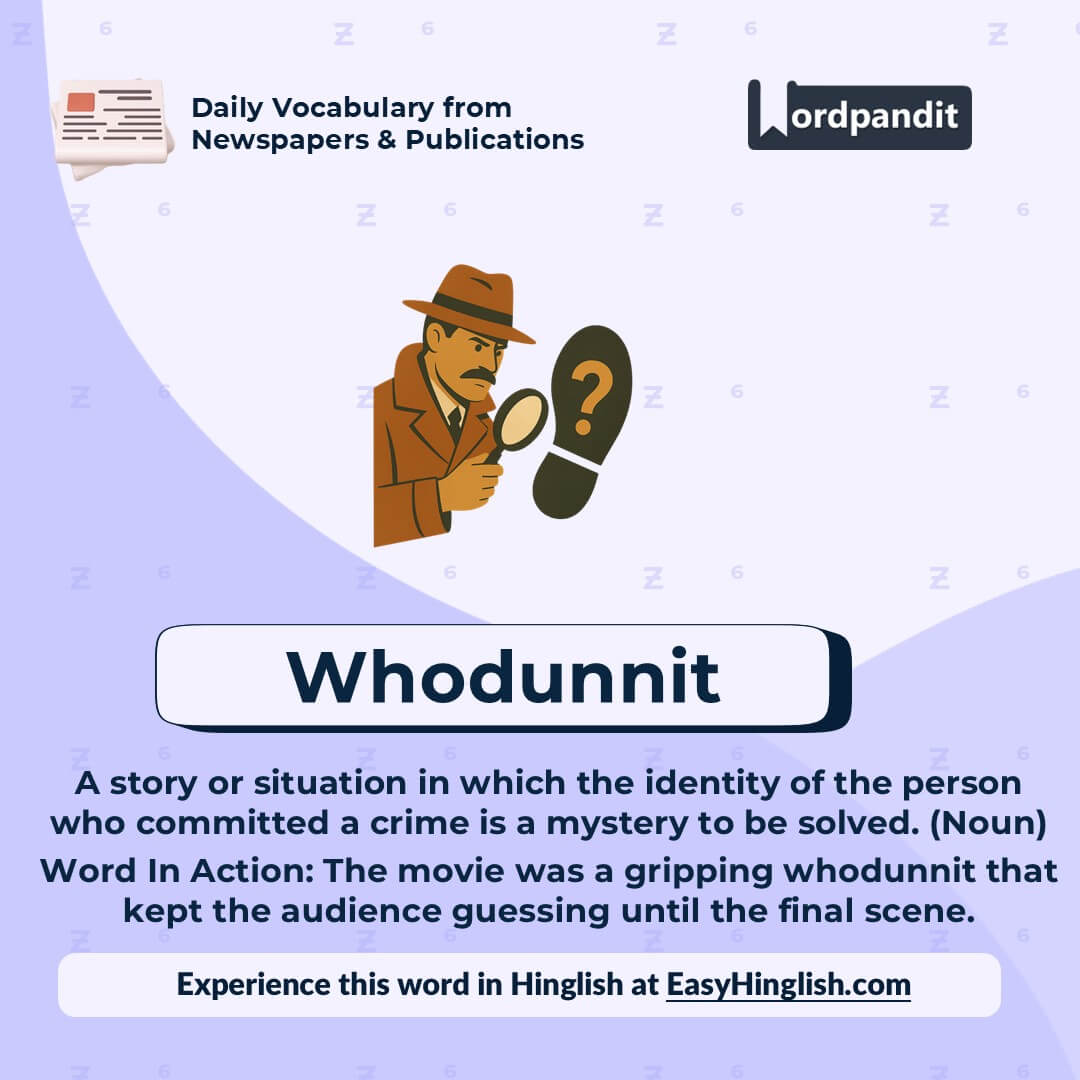
WORD-1: Whodunnit
Context:
"Every successful corporation, mission, or nation, is a whodunnit. Who made it a success? The simple, obvious answer – many people working together, making small contributions to the whole – has no takers because most people tend to be heroes at heart." - The Times of India
Explanatory Paragraph:
The term "whodunnit" is a playful variation of “Who (has) done it?” and refers to a mystery or detective story where the identity of the culprit is not revealed until the end. In the sentence above, it is used metaphorically to describe how successful outcomes often become puzzles of attribution—who was really responsible for the success? Instead of recognizing collective effort, people often look for a single hero, much like identifying the criminal in a detective novel. This usage broadens the term to sociological or organizational analysis, beyond just crime fiction.
Meaning: A story or situation in which the identity of the person who committed a crime is a mystery to be solved. (Noun)
Pronunciation: hoo-DUN-it
Difficulty Level: ⭐⭐ Easy
Etymology: Coined in the 1930s as a colloquial contraction of “Who has done it?”, popularized by American critic Donald Gordon to describe detective novels.
Prashant Sir's Notes:
Although it began in the world of crime fiction, "whodunnit" is increasingly used in other contexts to describe any situation where people are trying to figure out who is responsible — for success, failure, or any outcome. Great word for creative comparisons!
Synonyms & Antonyms:
Synonyms: mystery, detective story, crime novel, thriller
Antonyms: disclosure, revelation, open narrative
Usage Examples:
- The novel was a classic whodunnit that kept readers guessing until the final page.
- The office theft turned into a real-life whodunnit, with everyone suspecting each other.
- Trying to trace the origin of that idea is like solving a corporate whodunnit.
- Her speech about the project's success felt more like a whodunnit than a celebration.
Cultural Reference:
Agatha Christie’s novels are iconic examples of the “whodunnit” genre, particularly works like *Murder on the Orient Express* and *The Murder of Roger Ackroyd*, which masterfully conceal the culprit until the end.
Think About It:
Why do humans have a natural tendency to look for a single hero or culprit, instead of recognizing the role of many contributors?
Quick Activity:
Write a 3-line mystery story ending with a surprising reveal — a mini whodunnit! Try to mislead the reader with a twist.
Memory Tip:
Break it down: “Who done it?” becomes “whodunnit” — just like in detective stories where everyone’s asking that question.
Real-World Application:
“Whodunnit” is used beyond literature to discuss accountability in workplaces, politics, history, and group projects — especially when success or failure is hard to attribute to a single individual.
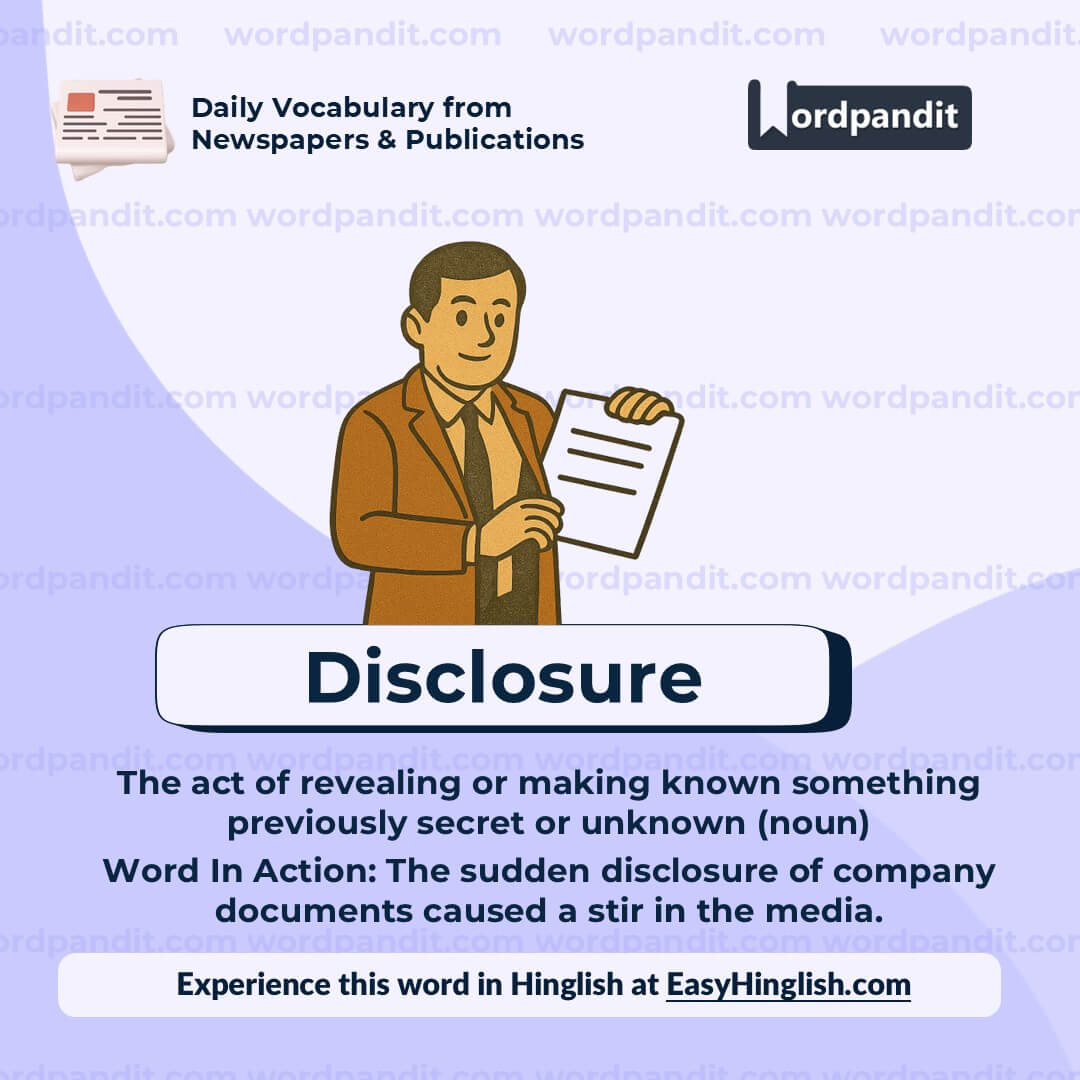
WORD-2: Disclosure
Context:
"Democratising success pulls us off our imaginary equestrian statues. That’s why credit for collective success is always pinned on an individual – on Steve Jobs at Apple, on Lee Kuan Yew in Singapore, on Newton, despite his full disclosure about seeing further by 'standing on the shoulders of giants'." - The Times of India
Explanatory Paragraph:
"Disclosure" refers to the act of revealing or making something known that was previously hidden or unknown. It often involves the sharing of important information, whether personal, legal, or professional. In the context above, it refers to Newton’s candid acknowledgment that his achievements were built upon the contributions of others—a humble and honest admission that challenges the myth of individual genius. The word thus conveys transparency, truth, and acknowledgment.
Meaning: The act of revealing or making known something previously secret or unknown (noun)
Pronunciation: dis-KLOH-zher
Difficulty Level: ⭐⭐ Easy
Etymology: From Middle English *disclos*, from Old French *desclos*, based on Latin *discludere*, meaning "to open" or "unclose". The suffix “-ure” was later added to form the noun.
Prashant Sir's Notes:
“Disclosure” is a powerful word that pops up in legal, ethical, financial, and even philosophical contexts. It emphasizes honesty and accountability. The Newton reference is a brilliant example of intellectual humility — one of the noblest forms of disclosure.
Synonyms & Antonyms:
Synonyms: revelation, exposure, declaration, confession
Antonyms: concealment, secrecy, suppression, cover-up
Usage Examples:
- The whistleblower’s disclosure led to a full investigation of the corruption scandal.
- Full financial disclosure is mandatory before signing the contract.
- The autobiography includes personal disclosures that were never made public before.
- Newton’s disclosure about his intellectual influences reveals great humility.
Cultural Reference:
Corporate transparency laws often require the disclosure of financial interests to prevent insider trading or fraud. Famous cases like the Enron scandal highlight the dangers of lack of disclosure in business ethics.
Think About It:
Can full disclosure ever backfire? Are there situations where withholding information is more ethical or beneficial than revealing it?
Quick Activity:
List three things that are often not disclosed in public life or media. What might change if they were openly revealed?
Memory Tip:
“Dis-close” = the opposite of “close” or hide — think of opening a box to show what's inside. That’s disclosure.
Real-World Application:
Disclosure is essential in fields like journalism, law, medicine, and corporate governance. Whether it’s revealing conflicts of interest, medical risks, or financial information, the concept is rooted in trust and transparency.
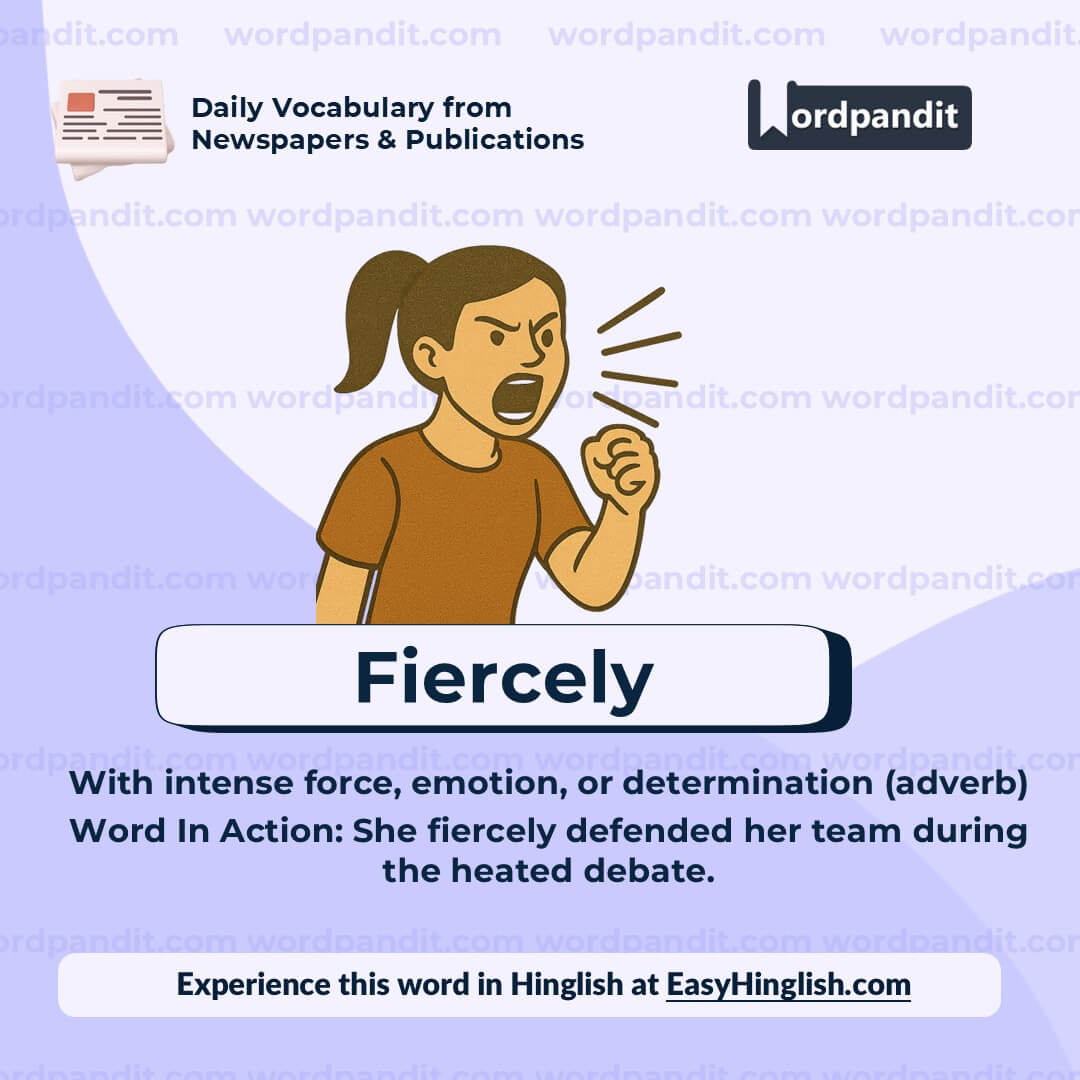
WORD-3: Fiercely
Context:
"At a time when the dispute between the judiciary and the executive is growing — sometimes even spilling out into the public — Justice B R Gavai takes the reins. Gavai is widely considered by the bar as a “fiercely independent” judge. As he takes oath as the second Dalit Chief Justice of India, decades after till-now-the-only-Dalit Chief Justice K G Balakrishnan, the task before him is monumental. There are three aspects of his responsibilities: Administrative, judicial and as the head of the SC collegium." - The Indian Express
Explanatory Paragraph:
The adverb "fiercely" intensifies a quality or action, showing strength, passion, or intensity. In this context, "fiercely independent" suggests that Justice Gavai is deeply and unwaveringly committed to his autonomy and principles, particularly in upholding the independence of the judiciary. The word adds emotional weight and conviction, indicating a strong, determined stance rather than a passive or mild one.
Meaning: With intense force, emotion, or determination (adverb)
Pronunciation: FEERSS-lee
Difficulty Level: ⭐⭐ Easy
Etymology: From Middle English *ferce*, from Old French *fiers* meaning “proud, fierce,” from Latin *ferus* meaning “wild, untamed.” The adverb form “fiercely” evolved to describe actions done with intensity or vigor.
Prashant Sir's Notes:
“Fiercely” is a great word to bring intensity and strength into your writing. Whether describing independence, loyalty, or even competition, it signals commitment and emotional energy. It’s perfect for persuasive and descriptive writing!
Synonyms & Antonyms:
Synonyms: intensely, passionately, aggressively, vehemently, vigorously
Antonyms: mildly, gently, calmly, passively
Usage Examples:
- She defended her team fiercely during the board meeting.
- The journalist is known for being fiercely objective in her reporting.
- They competed fiercely for the top prize in the tournament.
- He remained fiercely loyal to his friends even under pressure.
Cultural Reference:
In literature and politics, leaders like Mahatma Gandhi or Rosa Parks are often described as “fiercely principled” or “fiercely determined,” underscoring their unshakable commitment to values in the face of adversity.
Think About It:
Is being “fierce” always a strength? In what situations might fierceness become a liability rather than a virtue?
Quick Activity:
Complete the sentence using “fiercely”: “She __________ believed in the importance of speaking the truth.” Then write one more sentence using a different context (e.g., sport, friendship, politics).
Memory Tip:
Think of a lion defending its territory — “fiercely” shows powerful, passionate, unstoppable action.
Real-World Application:
“Fiercely” is widely used in journalism, legal writing, literature, and everyday speech to describe determined behavior. It’s effective for emphasizing strong emotions or actions in leadership, advocacy, and resistance.
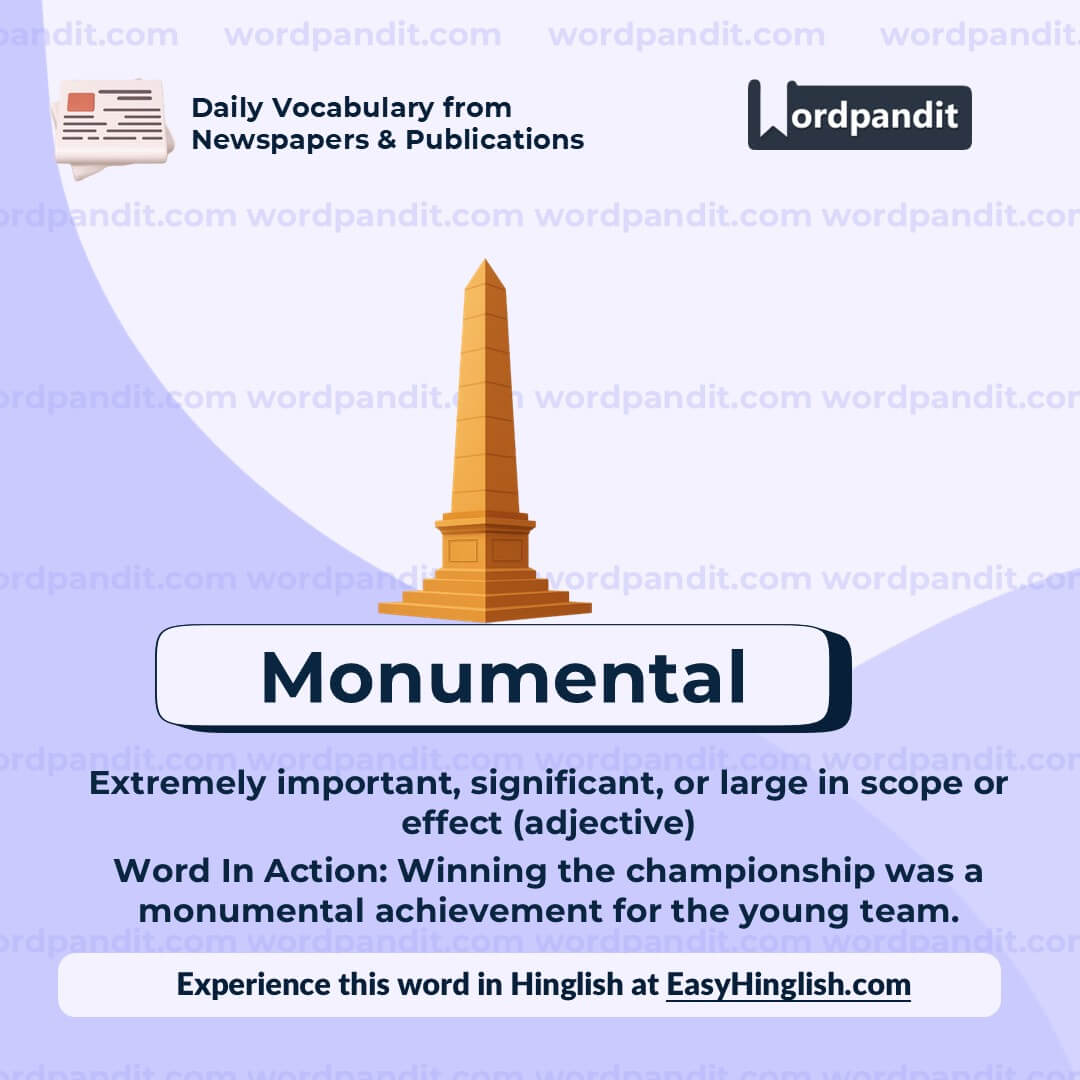
WORD-4: Monumental
Context:
"At a time when the dispute between the judiciary and the executive is growing — sometimes even spilling out into the public — Justice B R Gavai takes the reins. Gavai is widely considered by the bar as a “fiercely independent” judge. As he takes oath as the second Dalit Chief Justice of India, decades after till-now-the-only-Dalit Chief Justice K G Balakrishnan, the task before him is monumental. There are three aspects of his responsibilities: Administrative, judicial and as the head of the SC collegium." - The Indian Express
Explanatory Paragraph:
The word "monumental" is used to describe something of great importance, significance, or size. In the context provided, it emphasizes the gravity and historical weight of the responsibility Justice Gavai is assuming. It is not just a routine appointment—it is a moment of great consequence in the judiciary’s history. “Monumental” often conveys a sense of both challenge and honor, making it ideal for describing tasks or decisions that could leave a lasting impact.
Meaning: Extremely important, significant, or large in scope or effect (adjective)
Pronunciation: mon-yuh-MEN-tuhl
Difficulty Level: ⭐⭐ Easy
Etymology: From Latin *monumentum* meaning “a memorial” or “reminder.” The word evolved to describe not just physical structures, but also figuratively significant acts or events.
Prashant Sir's Notes:
Use “monumental” to elevate the tone of your writing when describing something historic, impactful, or incredibly difficult. It's a word that carries gravitas and can help convey the true scale of importance in essays, speeches, or news writing.
Synonyms & Antonyms:
Synonyms: historic, momentous, colossal, enormous, epic
Antonyms: trivial, minor, insignificant, negligible
Usage Examples:
- The signing of the agreement was a monumental achievement for international diplomacy.
- Her contributions to science have had a monumental impact on modern medicine.
- Climbing Mount Everest is a monumental challenge that few attempt.
- The judgment marked a monumental shift in constitutional interpretation.
Cultural Reference:
Martin Luther King Jr.’s “I Have a Dream” speech is often described as a *monumental moment* in the American civil rights movement — a turning point that reshaped history.
Think About It:
What makes a task or event truly “monumental”? Is it the immediate impact, the historical significance, or how long its effects last?
Quick Activity:
List three events in your life or in recent history that you would describe as “monumental.” Explain why they qualify for this description.
Memory Tip:
Think of a giant monument—something towering, unforgettable, and historic. “Monumental” carries that same weight and scale in meaning.
Real-World Application:
“Monumental” is often used in journalism, academic writing, and speeches to describe events or decisions that shape history. It adds rhetorical power to moments of significance, making them stand out as pivotal.
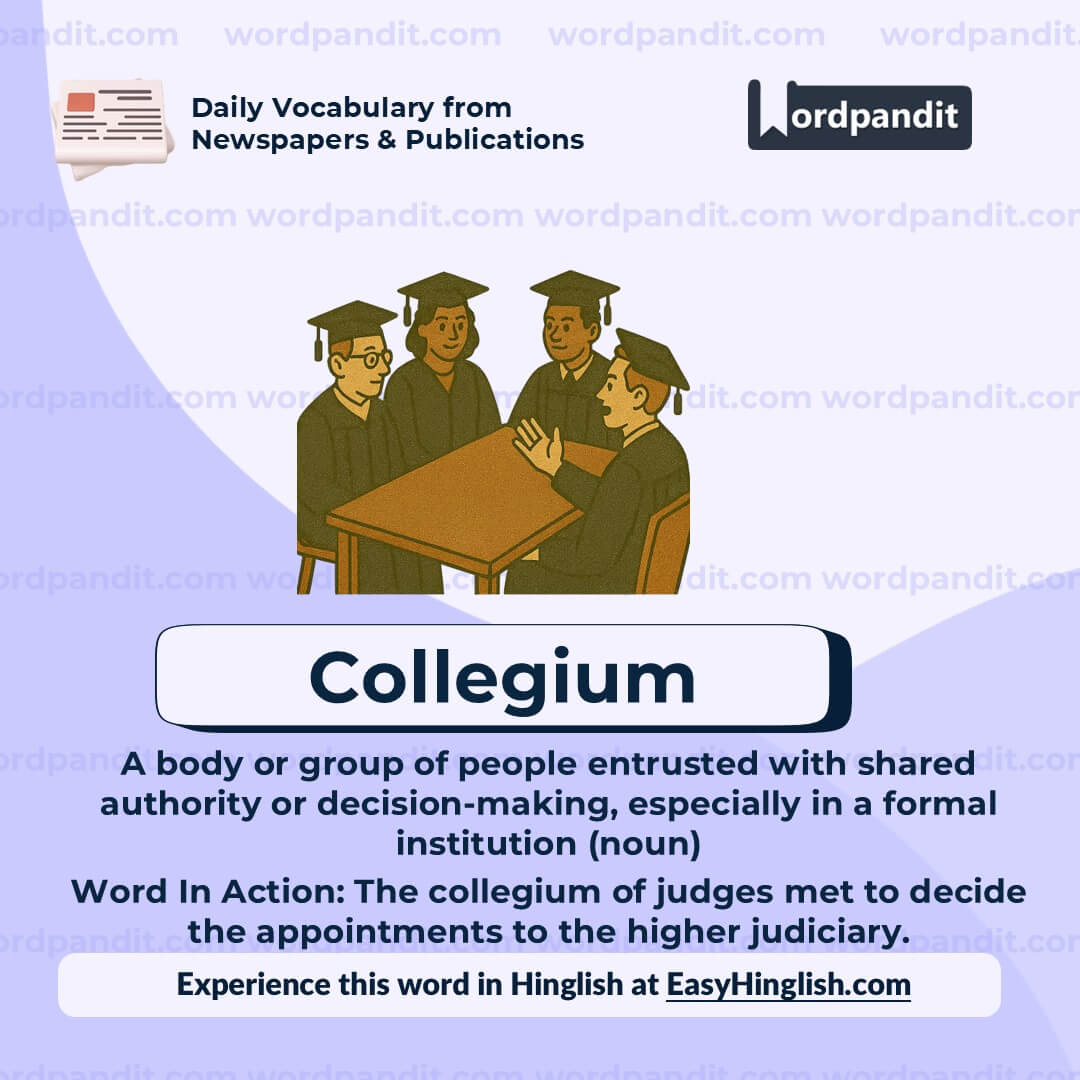
WORD-5: Collegium
Context:
"At a time when the dispute between the judiciary and the executive is growing — sometimes even spilling out into the public — Justice B R Gavai takes the reins. Gavai is widely considered by the bar as a “fiercely independent” judge. As he takes oath as the second Dalit Chief Justice of India, decades after till-now-the-only-Dalit Chief Justice K G Balakrishnan, the task before him is monumental. There are three aspects of his responsibilities: Administrative, judicial and as the head of the SC collegium." - The Indian Express
Explanatory Paragraph:
The word “collegium” refers to a group of people with shared responsibilities or authority, particularly in formal or official capacities. In the Indian judiciary, the term has a very specific meaning—it refers to the system by which judges of the Supreme Court and High Courts are appointed and transferred. The collegium consists of the Chief Justice of India and a forum of the four senior-most judges of the Supreme Court. This system underscores judicial independence, as it reduces government interference in judicial appointments. In the context above, Justice Gavai’s role as the head of the SC collegium is highlighted as one of his monumental responsibilities.
Meaning: A body or group of people entrusted with shared authority or decision-making, especially in a formal institution (noun)
Pronunciation: kuh-LEE-jee-um
Difficulty Level: ⭐⭐⭐ Intermediate
Etymology: From Latin *collegium*, meaning “society, guild, or group of colleagues.” The term was originally used in ancient Rome to refer to associations or official councils.
Prashant Sir's Notes:
In India, “collegium” is more than just a word—it’s a legal and political concept central to the structure of the judiciary. Knowing its meaning is crucial for understanding debates around judicial appointments, reforms, and the separation of powers.
Synonyms & Antonyms:
Synonyms: council, panel, committee, board
Antonyms: individual, autocracy, sole authority
Usage Examples:
- The Supreme Court collegium recommended three judges for elevation.
- The collegium system has been both praised and criticized for its transparency and secrecy.
- Unlike many other democracies, India’s judiciary uses a collegium to appoint its judges.
- Disagreements within the collegium can delay crucial judicial appointments.
Cultural Reference:
India’s collegium system was established by the Supreme Court through a series of landmark judgments known as the *Three Judges Cases*, marking a shift in judicial independence from executive control.
Think About It:
Should a collegium—a non-elected body—have full control over judicial appointments in a democracy? What are the pros and cons?
Quick Activity:
Write a one-sentence explanation of the collegium system to someone who knows nothing about Indian law. Try to make it clear and simple.
Memory Tip:
Think of "college" as a group of peers. A “collegium” is similar—a council of equals making important decisions together.
Real-World Application:
The term "collegium" is key to discussions about the Indian legal system, especially in debates about transparency, meritocracy, and judicial independence. It’s a core concept for law students, civil services aspirants, and engaged citizens alike.


