

Daily Vocabulary from Indian Newspapers and Publications
Welcome to Wordpandit’s Indian Vocabulary Hub
At Wordpandit, we understand the importance of staying rooted in the local context while expanding your language skills. This section focuses on enriching your vocabulary with words and phrases drawn from India’s leading newspapers and publications, ensuring you're learning vocabulary that is practical, relevant, and uniquely Indian.
Why Indian Sources Matter
We believe that the best way to master any language is by immersing yourself in local content. That’s why we carefully curate vocabulary from top Indian publications, including:
- The Hindu
- The Times of India
- The Economic Times
- Hindustan Times
- Live Mint
- The Indian Express
- And many others...
Stay Updated, Stay Relevant
With daily updates from Indian news sources, you’ll be consistently learning words that reflect the trends and shifts in Indian society and culture. Our focus is to provide vocabulary that enhances your understanding of the language in an Indian context.
How Wordpandit Supports Your Goals
Whether you’re preparing for exams, aiming to improve your professional communication, or simply want to stay connected with the latest Indian vocabulary, Wordpandit is here to guide you every step of the way.
Learn with a Practical Approach
Our interactive learning methodology includes real-world examples, engaging activities, and context-specific usage to ensure that every word becomes part of your active vocabulary.
Dive into Indian Vocabulary Today!

Why Choose Wordpandit?
Practical Learning: Focus on words you'll actually encounter in real-world reading, enhancing your comprehension and communication skills.
Diverse Content: From current affairs to scientific breakthroughs, our varied sources expose you to vocabulary across multiple domains.
Effortless Integration: Make Wordpandit a part of your daily routine. Just a few minutes each day can significantly boost your lexicon over time.
Your Path to Vocabulary Mastery
- Visit our Daily Vocabulary section regularly
- Explore new words and their usage in context
- Practice incorporating these words into your own writing and speech
- Track your progress as your vocabulary expands
Start Your Journey Today
Embark on your vocabulary enhancement journey with Wordpandit. By consistently engaging with our daily posts, you'll build a robust vocabulary that serves you well in academic, professional, and personal contexts.
Remember, a word a day keeps linguistic limitations at bay. Make Wordpandit your daily companion in the quest for vocabulary excellence!
WORD-1: Invoke
Context:
"War’s advocates often invoke old myths of honor and heroism. For centuries, young minds were fed the idea that battlefield glory is the ultimate proof of ‘manhood’ and patriotism. But these myths have been shattered repeatedly by those who have experienced war’s reality." - The Times of India
Explanatory Paragraph:
The word "invoke" in this context refers to the act of calling upon something—such as an idea, image, or concept—for support, justification, or inspiration. When someone invokes myths of heroism, they are referring to them in a way that attempts to inspire or justify an action, like going to war. It suggests appealing to something emotionally powerful or traditional to influence opinion or behavior.
Meaning: To call on (a concept, principle, authority, or spirit) for support or inspiration (Verb)
Pronunciation: in-vohk
Difficulty Level: ⭐⭐⭐ Intermediate
Etymology: From Latin *invocare*, meaning "to call upon" (*in-* meaning "upon" + *vocare* meaning "to call").
Prashant Sir's Notes:
Think of "invoke" as summoning or appealing to something greater—whether it’s an idea, tradition, or even a supernatural force. It's often used in speeches, literature, and discussions that involve persuasion or deep emotions.
Synonyms & Antonyms:
Synonyms: cite, appeal to, refer to, summon, call upon
Antonyms: ignore, dismiss, overlook
Usage Examples:
- The politician invoked the Constitution to support his claims.
- In times of crisis, leaders often invoke the spirit of unity and resilience.
- She invoked her right to remain silent during the interrogation.
- The ritual began by invoking the blessings of the ancestors.
Cultural Reference:
"We invoke the past not to dwell on sorrow but to find strength in resilience." – Barack Obama (Inaugural Address, 2009)
Think About It:
Why do societies often invoke heroic myths to justify war or conflict, even when reality paints a different picture?
Quick Activity:
Write a short paragraph where you invoke a famous person or historical event to support an argument or opinion.
Memory Tip:
Think of "inVOKE" as “in-VOKE” — you're *calling in* a voice or idea to support you.
Real-World Application:
"Invoke" is commonly used in legal, political, and literary discussions to refer to calling on rules, ideas, or values to make a point. For instance, lawyers invoke laws, authors invoke themes, and activists invoke principles of justice.
WORD-2: Myths
Context:
"War’s advocates often invoke old myths of honor and heroism. For centuries, young minds were fed the idea that battlefield glory is the ultimate proof of ‘manhood’ and patriotism. But these myths have been shattered repeatedly by those who have experienced war’s reality." - The Times of India
Explanatory Paragraph:
“Myths” in this context refer to widely held but false or exaggerated beliefs or ideas. While traditionally myths are stories passed down through generations explaining natural or social phenomena, here they represent glorified but unrealistic narratives about war, courage, and patriotism. The sentence critiques how these romanticized ideas have long been used to influence young minds, only to be debunked by real-life experiences of war.
Meaning: Widely held but false beliefs or traditional stories, especially those involving supernatural beings or events (Noun)
Pronunciation: miths
Difficulty Level: ⭐⭐ Basic
Etymology: From Greek *mythos*, meaning "speech, tale, or story". Originally referred to traditional stories about gods and heroes.
Prashant Sir's Notes:
Myths are not always about ancient gods or creatures; in modern language, they often represent falsehoods that are accepted without question. They can shape our views—positively or negatively—so it's crucial to examine them critically.
Synonyms & Antonyms:
Synonyms: legend, fallacy, misconception, fiction, fable
Antonyms: fact, truth, reality, actuality
Usage Examples:
- The myth that lightning never strikes the same place twice is completely false.
- Ancient myths often try to explain natural disasters and cosmic events.
- Many cultural myths contain moral lessons passed down through generations.
- Social media can spread new-age myths faster than ever before.
Cultural Reference:
"The myth of Icarus warns against excessive ambition." - Common retelling of Greek mythology
Think About It:
What are some modern myths we believe today, and how might they be influencing our decisions and worldview?
Quick Activity:
List three common myths you've heard growing up and do a quick fact check to see if they are true or false.
Memory Tip:
Think of “myth” as something you might *mistakenly* think is true—“My-think” is false!
Real-World Application:
Understanding myths—both ancient and modern—helps develop critical thinking. In education, media, and politics, it’s important to identify when myths are used to manipulate opinions or sustain traditions.
WORD-3: Patriotism
Context:
"War’s advocates often invoke old myths of honor and heroism. For centuries, young minds were fed the idea that battlefield glory is the ultimate proof of ‘manhood’ and patriotism. But these myths have been shattered repeatedly by those who have experienced war’s reality." - The Times of India
Explanatory Paragraph:
“Patriotism” refers to the deep love, loyalty, and devotion one feels toward their country. In the context of war, it is often linked with the idea of sacrifice and valor. However, the article questions the traditional view of patriotism by highlighting how its association with war and manhood may be rooted in myths that ignore the grim truths of combat. True patriotism, it suggests, may be more complex than mere battlefield glory.
Meaning: Love for or devotion to one’s country (Noun)
Pronunciation: PAY-tree-uh-tiz-uhm
Difficulty Level: ⭐⭐⭐ Intermediate
Etymology: From Greek *patrios* (“of one’s fathers”) via Latin *patriota* (“fellow countryman”) and French *patriotisme*.
Prashant Sir's Notes:
Patriotism isn’t just about waving flags or fighting wars. It’s about contributing to the well-being of your nation—through honesty, civic duty, and social responsibility. Be wary of narrow definitions that glorify only physical sacrifice.
Synonyms & Antonyms:
Synonyms: nationalism, loyalty, devotion, allegiance, civic pride
Antonyms: treason, betrayal, disloyalty, apathy
Usage Examples:
- His patriotism was evident in his tireless work for veterans’ rights.
- Debates continue about the fine line between patriotism and nationalism.
- She expressed her patriotism by voting and volunteering in her community.
- Blind patriotism can sometimes cloud one’s judgment of a nation’s flaws.
Cultural Reference:
"Patriotism is supporting your country all the time, and your government when it deserves it." – Mark Twain
Think About It:
Can patriotism be expressed through protest or dissent, or must it always align with government policy?
Quick Activity:
Write two sentences: one showing patriotic action through service, and another showing blind patriotism that ignores truth.
Memory Tip:
Remember: “Patriotism” has “patri-” like “father”—think of it as the love for the land of your forefathers.
Real-World Application:
Patriotism appears in national celebrations, civil service, political discourse, and even debates on social justice. Understanding it helps you navigate discussions on governance, duty, and identity.
WORD-4: Non-conventional
Context:
"Pakistan sought non-conventional ways to challenge India’s dominance—especially in Kashmir after losing wars to India in 1947, 1965, and 1971. Supporting insurgency and militant groups became a “low-cost, high-impact” strategy to internationalise the Kashmir issue." - The Times of India
Explanatory Paragraph:
“Non-conventional” refers to methods, ideas, or strategies that are not traditional, typical, or widely accepted. In the context of conflict or diplomacy, non-conventional approaches include tactics outside of direct warfare, such as psychological operations, insurgency support, or cyber attacks. Here, the term describes how Pakistan used alternative strategies instead of traditional military confrontations to exert pressure and influence regarding the Kashmir issue.
Meaning: Not based on or conforming to what is traditionally done or accepted (Adjective)
Pronunciation: non-kun-VEN-shuh-nuhl
Difficulty Level: ⭐⭐⭐ Intermediate
Etymology: Prefix “non-” meaning “not” + “conventional” from Latin convenire (“to come together”), implying something that does not follow standard customs or traditions.
Prashant Sir's Notes:
“Non-conventional” is a power-packed descriptor often used in military, political, and even business contexts. It signals out-of-the-box thinking or strategies. When you see it, think: alternative, unexpected, or non-traditional approaches.
Synonyms & Antonyms:
Synonyms: unconventional, alternative, irregular, unorthodox
Antonyms: conventional, standard, traditional, orthodox
Usage Examples:
- The general advocated non-conventional tactics to counter the guerrilla insurgency.
- Her non-conventional career path included working as a musician, coder, and therapist.
- The startup disrupted the market with a non-conventional subscription model.
- In modern warfare, non-conventional threats like cyberattacks are increasingly common.
Cultural Reference:
The phrase “non-conventional warfare” became prominent during the Cold War and Vietnam War, referring to strategies like sabotage, subversion, and support for insurgent groups rather than open combat.
Think About It:
When do non-conventional approaches offer more power than traditional ones? Can too much reliance on them lead to instability?
Quick Activity:
List 3 non-conventional strategies used in any area (e.g., warfare, business, education). What made them effective or risky?
Memory Tip:
“Non-conventional” = “not conventional.” Just flip the meaning—anything not normal or traditional. Easy to decode!
Real-World Application:
This word is essential for discussions in international relations, defense, strategy, and innovation. Recognizing non-conventional thinking helps understand tactics in warfare, politics, startups, and beyond.
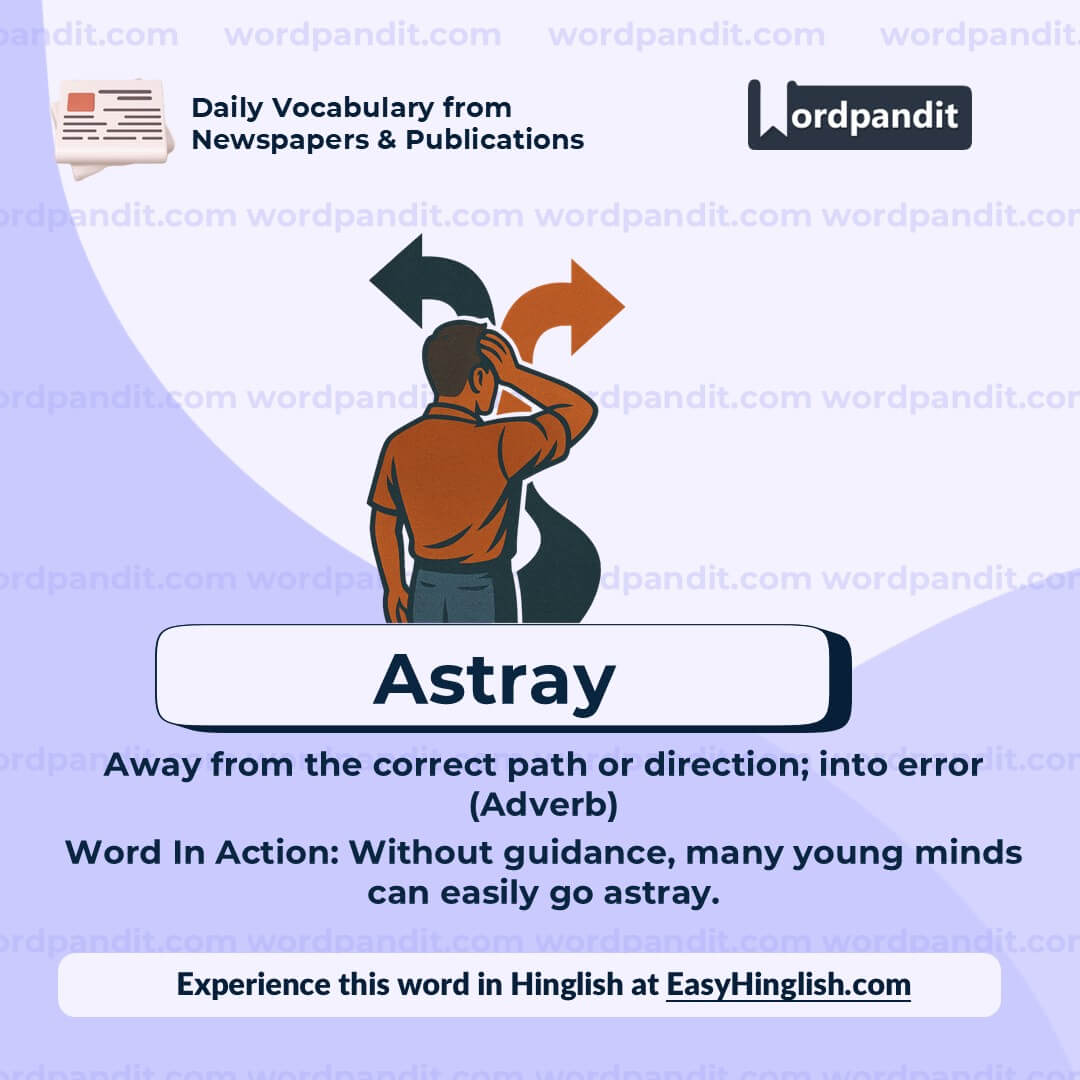
WORD-5: Astray
Context:
"It is time to demystify the false glory of war and recognize these myths for what they are – pernicious illusions that lead nations astray." - The Times of India
Explanatory Paragraph:
The word “astray” means off the correct path or away from what is right or true. In this sentence, it implies that the harmful myths about war misguide entire nations, leading them into error, destruction, or poor decisions. The word suggests a deviation not just from a physical path, but also from truth, wisdom, or moral direction.
Meaning: Away from the correct path or direction; into error (Adverb)
Pronunciation: uh-STRAY
Difficulty Level: ⭐⭐ Basic
Etymology: From Middle English *astreie*, from Anglo-French *estraier* meaning “to stray” or “wander”.
Prashant Sir's Notes:
“Astray” is used both literally (e.g., getting lost) and metaphorically (e.g., being misled by false ideas). In vocabulary learning, it’s a useful word to describe any kind of moral, intellectual, or behavioral deviation.
Synonyms & Antonyms:
Synonyms: off-course, misguided, lost, diverted, misled
Antonyms: on track, guided, directed, focused
Usage Examples:
- The hiker went astray and had to be rescued from the forest.
- Her good intentions went astray when she started lying to protect her friend.
- A nation can go astray when it places pride above justice.
- He warned that greed could lead society astray from its core values.
Cultural Reference:
"All we like sheep have gone astray; we have turned every one to his own way." – Isaiah 53:6, The Bible
Think About It:
What factors in today’s world are leading individuals or entire societies astray?
Quick Activity:
Write two sentences: one using “astray” in a literal sense and one in a metaphorical sense.
Memory Tip:
Think of “a-stray” as “a stray dog” that has lost its way—“astray” means to wander off the path.
Real-World Application:
“Astray” is useful when discussing personal decisions, societal trends, or even government policies that deviate from ethical or intended goals. It captures the idea of being led in the wrong direction, often subtly or unknowingly.


