

Daily Vocabulary from Indian Newspapers and Publications
Welcome to Wordpandit’s Indian Vocabulary Hub
At Wordpandit, we understand the importance of staying rooted in the local context while expanding your language skills. This section focuses on enriching your vocabulary with words and phrases drawn from India’s leading newspapers and publications, ensuring you're learning vocabulary that is practical, relevant, and uniquely Indian.
Why Indian Sources Matter
We believe that the best way to master any language is by immersing yourself in local content. That’s why we carefully curate vocabulary from top Indian publications, including:
- The Hindu
- The Times of India
- The Economic Times
- Hindustan Times
- Live Mint
- The Indian Express
- And many others...
Stay Updated, Stay Relevant
With daily updates from Indian news sources, you’ll be consistently learning words that reflect the trends and shifts in Indian society and culture. Our focus is to provide vocabulary that enhances your understanding of the language in an Indian context.
How Wordpandit Supports Your Goals
Whether you’re preparing for exams, aiming to improve your professional communication, or simply want to stay connected with the latest Indian vocabulary, Wordpandit is here to guide you every step of the way.
Learn with a Practical Approach
Our interactive learning methodology includes real-world examples, engaging activities, and context-specific usage to ensure that every word becomes part of your active vocabulary.
Dive into Indian Vocabulary Today!

Why Choose Wordpandit?
Practical Learning: Focus on words you'll actually encounter in real-world reading, enhancing your comprehension and communication skills.
Diverse Content: From current affairs to scientific breakthroughs, our varied sources expose you to vocabulary across multiple domains.
Effortless Integration: Make Wordpandit a part of your daily routine. Just a few minutes each day can significantly boost your lexicon over time.
Your Path to Vocabulary Mastery
- Visit our Daily Vocabulary section regularly
- Explore new words and their usage in context
- Practice incorporating these words into your own writing and speech
- Track your progress as your vocabulary expands
Start Your Journey Today
Embark on your vocabulary enhancement journey with Wordpandit. By consistently engaging with our daily posts, you'll build a robust vocabulary that serves you well in academic, professional, and personal contexts.
Remember, a word a day keeps linguistic limitations at bay. Make Wordpandit your daily companion in the quest for vocabulary excellence!
WORD-1: Historic
Context:
"Four labour codes passed by the Government of India in recent years are due for implementation. These codes mark a historic step in governing labour in contemporary India." - The Times of India
Explanatory Paragraph:
The word “historic” is used to describe events, decisions, or changes that are significant and likely to be remembered as important milestones in history. In this context, the labour codes are seen as a major reform—something that will have lasting impact on how labour is governed in India. “Historic” often carries a positive connotation, suggesting that the moment is groundbreaking or transformational.
Meaning: Famous or important in history, or likely to be remembered as significant (Adjective)
Pronunciation: hi-STAWR-ik
Difficulty Level: ⭐⭐ Basic
Etymology: From Greek *historikos* (“historical”), through Latin *historicus*, and later adapted into Old French and Middle English.
Prashant Sir's Notes:
Be careful not to confuse “historic” with “historical.” “Historic” refers to something momentous or significant in history, while “historical” simply means related to history. For example, the signing of the Constitution is a historic event; studying ancient artifacts is part of historical research.
Synonyms & Antonyms:
Synonyms: momentous, significant, landmark, epoch-making, monumental
Antonyms: trivial, ordinary, unimportant, forgettable
Usage Examples:
- The moon landing was a historic achievement for humankind.
- The Supreme Court’s decision marked a historic shift in legal rights.
- The peace treaty was hailed as a historic agreement between long-time rivals.
- Her election as the first woman president was a truly historic moment.
Cultural Reference:
"I have a dream that one day this nation will rise up..." – Martin Luther King Jr., delivering his historic speech during the March on Washington in 1963.
Think About It:
What makes an event “historic” in your view? Is it public recognition, long-term impact, or something else?
Quick Activity:
List three events from your country’s history that you consider truly historic. Briefly explain why.
Memory Tip:
“Historic” has the word “story” hidden in it—think of it as something that becomes part of our *his*story books!
Real-World Application:
Use “historic” to describe impactful events—political changes, scientific breakthroughs, social revolutions—that shape the future. It’s especially relevant in speeches, journalism, and writing about significant milestones.
WORD-2: Codification
Context:
"This codification is critical in ensuring that the informal workers of the country, who make up the majority of the workforce, receive due recognition and welfare." - The Times of India
Explanatory Paragraph:
“Codification” refers to the process of collecting and systematizing laws, rules, or regulations into an organized and written code. In the given context, it relates to the government's efforts to formally arrange labour laws in a way that ensures better coverage and protection for informal workers. Codification brings clarity, consistency, and enforceability to rules that might otherwise be scattered or ambiguous.
Meaning: The process of arranging and systematizing laws or rules into a formal code (Noun)
Pronunciation: koh-duh-fuh-KAY-shun
Difficulty Level: ⭐⭐⭐ Intermediate
Etymology: From Latin *codex* meaning “book of laws” + *-fication*, indicating the act or process of making.
Prashant Sir's Notes:
Think of codification as taking scattered rules or laws and putting them neatly into one big, organized file. It's like converting scattered notes into a well-structured chapter. It brings order where there was once confusion.
Synonyms & Antonyms:
Synonyms: systematization, arrangement, organization, compilation
Antonyms: disorganization, chaos, scattering
Usage Examples:
- The codification of civil rights laws helped ensure equal treatment under the law.
- Legal experts support the codification of environmental policies for better enforcement.
- Without codification, the rules remained unclear and subject to misinterpretation.
- Codification made it easier for employees to understand their rights and benefits.
Cultural Reference:
"The Napoleonic Code was one of the earliest and most influential codifications of civil law." - Legal History Textbooks
Think About It:
In what areas of society or governance do you think codification is most urgently needed today?
Quick Activity:
Pick a topic you know (e.g., school rules, home chores) and try writing a simple codified version—a short list of clear, numbered rules.
Memory Tip:
Think of "codification" as turning rules into a **codebook**—organizing chaos into clarity!
Real-World Application:
Codification is essential in law, policy, and organizational management. Whether it’s labour laws, IT protocols, or ethics guidelines, codification ensures people follow consistent and fair standards.
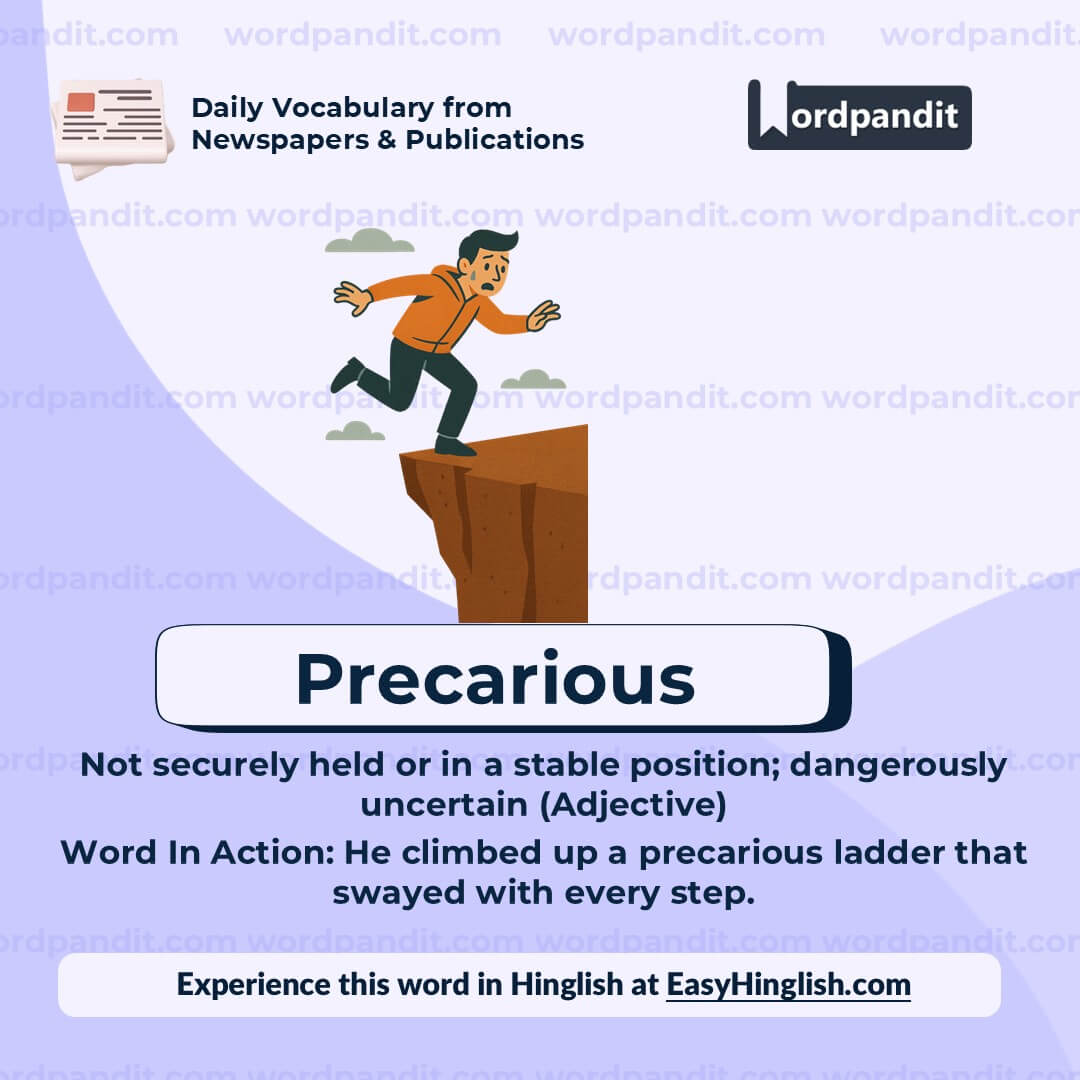
WORD-3: Precarious
Context:
"The informal sector and the significant number of people employed in it are not new concerns in India. However, the labour codes offer policymakers an opportunity to rethink existing legislation and introduce changes that can offer relief to those who have been working in precarious occupations. India has one of the world’s largest informal working populations." - The Times of India
Explanatory Paragraph:
“Precarious” refers to something that is unstable, insecure, or likely to collapse or fail. In the context of employment, it describes jobs that lack security, benefits, or protection—common in the informal sector. People in precarious occupations often face irregular income, unsafe conditions, and the constant risk of losing their livelihood. The word highlights the vulnerability and uncertainty of such work situations.
Meaning: Not securely held or in a stable position; dangerously uncertain (Adjective)
Pronunciation: pri-KAIR-ee-us
Difficulty Level: ⭐⭐⭐ Intermediate
Etymology: From Latin *precarius*, meaning "obtained by entreaty or prayer," suggesting dependence on uncertain circumstances or favor.
Prashant Sir's Notes:
Use “precarious” to describe not just physical things like ladders or ledges, but also abstract situations like employment, finances, or health. If it feels like it could collapse at any moment—it’s precarious!
Synonyms & Antonyms:
Synonyms: unstable, insecure, risky, uncertain, hazardous
Antonyms: secure, stable, safe, reliable
Usage Examples:
- Many gig workers live in precarious conditions with no job security or health benefits.
- The ladder was balanced precariously on the edge of the roof.
- Her financial situation became precarious after the unexpected medical expenses.
- Peace in the region remains precarious despite the ceasefire agreement.
Cultural Reference:
"Precarity has become the new normal for millions in the global gig economy." – Contemporary labor studies and journalism
Think About It:
How does working in a precarious job affect a person’s mental well-being and sense of dignity?
Quick Activity:
List two jobs or occupations that might be considered precarious and explain why. Then, suggest one policy that could improve their stability.
Memory Tip:
Think: *“precarious = scary for us”*—if something feels risky or unsafe, it’s precarious.
Real-World Application:
“Precarious” is widely used in discussions about labor rights, public health, and international diplomacy. It describes situations that require urgent attention and reform to avoid collapse or harm.
WORD-4: Attritable
Context:
"Attritable weapons that are cheaper and more expendable, such as various kinds of unmanned aerial vehicles, appear to be playing a key role. Aerial combat and attacks that were once spearheaded by sophisticated combat aircraft have now evolved to make room for the humble drone." - The Indian Express
Explanatory Paragraph:
The word “attritable” refers to military assets that are designed to be used in conflict with the expectation that they can be lost without severe strategic or financial consequences. Unlike high-value, complex systems that must be preserved, attritable weapons—such as inexpensive drones—are built to be expendable. This makes them especially useful in modern warfare, where risk must be minimized while maintaining tactical effectiveness.
Meaning: Designed to be expendable or replaceable; can be lost in action without major loss (Adjective)
Pronunciation: uh-TRI-tuh-buhl
Difficulty Level: ⭐⭐⭐⭐ Advanced (Technical/Military Use)
Etymology: Derived from “attrition” (Latin *atterere* meaning "to wear down") + suffix “-able”, meaning “capable of being.”
Prashant Sir's Notes:
“Attritable” is a modern term mainly used in military and defense circles. Think of it as describing tools that are *meant* to be used and possibly lost in battle—opposite of precious, one-of-a-kind systems. In future warfare, attritability will influence design choices for cost-effective resilience.
Synonyms & Antonyms:
Synonyms: expendable, replaceable, sacrificial, low-cost
Antonyms: irreplaceable, essential, high-value, premium
Usage Examples:
- Defense manufacturers are focusing on developing attritable drones for rapid deployment.
- Attritable systems allow militaries to engage without risking billion-dollar aircraft.
- The new UAV program focuses on creating small, attritable aircraft for frontline use.
- Attritable strategies are reshaping airpower by reducing dependency on elite fighter jets.
Cultural Reference:
"The future of warfare may lie not in dominance through complexity, but through attritable, swarm-based systems." – Defense Technology Conference Panel, 2024
Think About It:
What are the ethical implications of using attritable weapons that lower the cost of engaging in war?
Quick Activity:
Identify two examples of real-world military tools or technologies that could be considered attritable. Write a sentence about how each is used.
Memory Tip:
Link “attritable” with “attrition”—if something can be worn down or lost without big consequences, it's attritable!
Real-World Application:
“Attritable” is commonly used in military and defense industries to describe equipment designed for repeated, cost-effective deployment. It reflects a shift toward scalable, less risky combat tools in modern and asymmetric warfare.
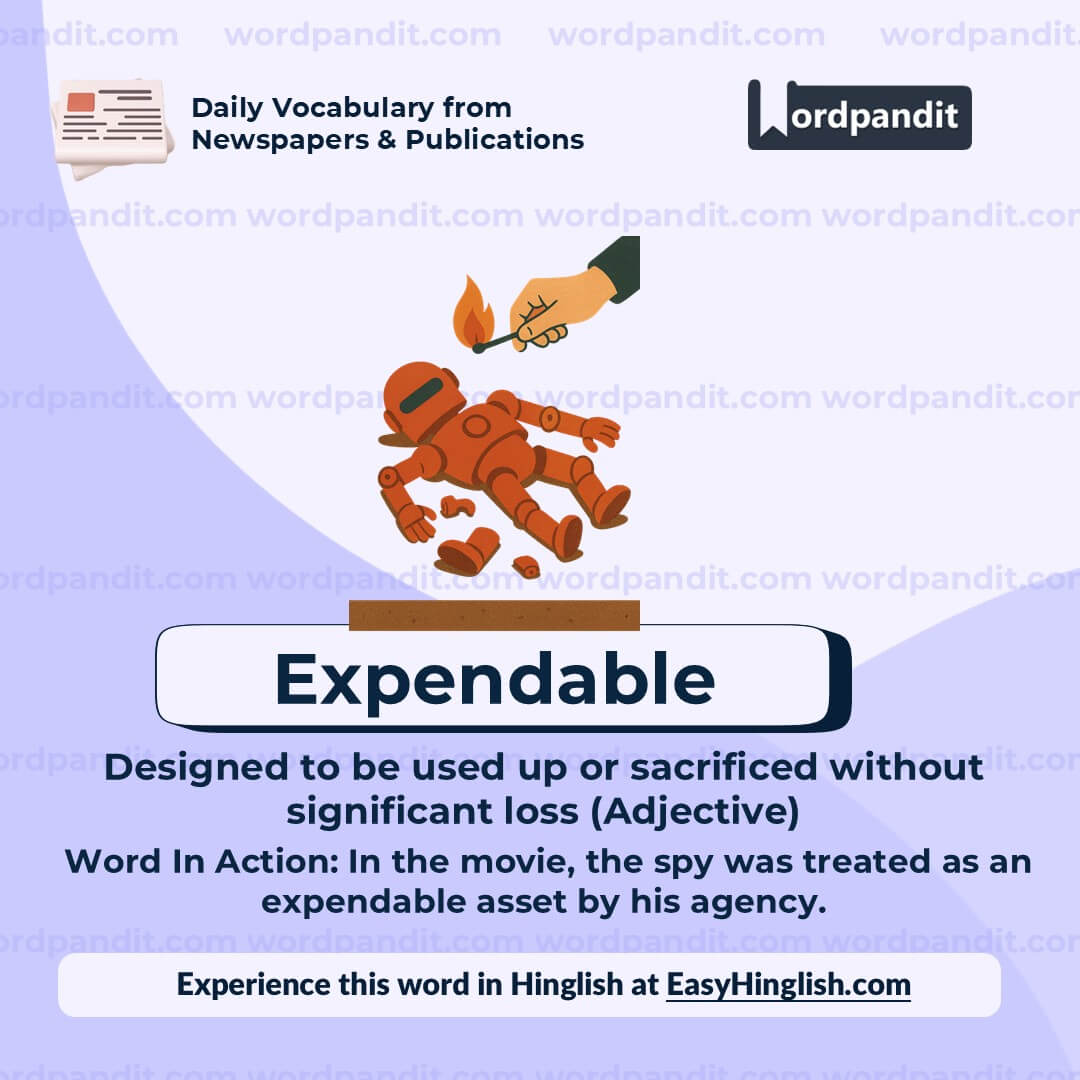
WORD-5: Expendable
Context:
"Attritable weapons that are cheaper and more expendable, such as various kinds of unmanned aerial vehicles, appear to be playing a key role. Aerial combat and attacks that were once spearheaded by sophisticated combat aircraft have now evolved to make room for the humble drone." - The Indian Express
Explanatory Paragraph:
“Expendable” refers to something—or someone—that is considered suitable to be used up or sacrificed, especially in situations where loss is expected or acceptable. In military contexts, expendable weapons or equipment are designed for one-time or short-term use without the need for retrieval. Here, the word highlights how modern warfare increasingly relies on low-cost, unmanned systems that can be lost without major strategic or financial consequences.
Meaning: Designed to be used up or sacrificed without significant loss (Adjective)
Pronunciation: ek-SPEN-duh-buhl
Difficulty Level: ⭐⭐⭐ Intermediate
Etymology: From Latin *expendere*, meaning "to weigh out or pay," implying something that can be spent or used up.
Prashant Sir's Notes:
“Expendable” is a powerful word—be careful with its use when referring to people. It implies disposability and lack of value, which can be controversial. In technical fields, it's used more neutrally, especially in logistics, military, and space missions.
Synonyms & Antonyms:
Synonyms: disposable, replaceable, sacrificial, nonessential
Antonyms: indispensable, essential, necessary, vital
Usage Examples:
- The military ordered hundreds of expendable drones for reconnaissance missions.
- In the movie, the hero refused to treat his teammates as expendable assets.
- The spacecraft carried several expendable instruments that were not meant to return.
- Some corporations treat temporary workers as expendable, offering them few benefits.
Cultural Reference:
*"The Expendables"* is a popular action film franchise where the title ironically refers to elite mercenaries considered disposable by their employers.
Think About It:
How does the idea of something—or someone—being "expendable" reflect societal values or priorities?
Quick Activity:
Write one sentence where “expendable” refers to an object, and another where it refers (carefully) to a person or role. Reflect on the difference in tone.
Memory Tip:
“Expendable” sounds like “spendable”—think of something you can spend or lose without worrying too much about it.
Real-World Application:
“Expendable” is often used in military, industrial, and space contexts where tools or people are viewed in terms of cost-efficiency and risk tolerance. Understanding its use can lead to deeper discussions about ethics, value, and utility.


