

Daily Vocabulary from Indian Newspapers and Publications
Welcome to Wordpandit’s Indian Vocabulary Hub
At Wordpandit, we understand the importance of staying rooted in the local context while expanding your language skills. This section focuses on enriching your vocabulary with words and phrases drawn from India’s leading newspapers and publications, ensuring you're learning vocabulary that is practical, relevant, and uniquely Indian.
Why Indian Sources Matter
We believe that the best way to master any language is by immersing yourself in local content. That’s why we carefully curate vocabulary from top Indian publications, including:
- The Hindu
- The Times of India
- The Economic Times
- Hindustan Times
- Live Mint
- The Indian Express
- And many others...
Stay Updated, Stay Relevant
With daily updates from Indian news sources, you’ll be consistently learning words that reflect the trends and shifts in Indian society and culture. Our focus is to provide vocabulary that enhances your understanding of the language in an Indian context.
How Wordpandit Supports Your Goals
Whether you’re preparing for exams, aiming to improve your professional communication, or simply want to stay connected with the latest Indian vocabulary, Wordpandit is here to guide you every step of the way.
Learn with a Practical Approach
Our interactive learning methodology includes real-world examples, engaging activities, and context-specific usage to ensure that every word becomes part of your active vocabulary.
Dive into Indian Vocabulary Today!

Why Choose Wordpandit?
Practical Learning: Focus on words you'll actually encounter in real-world reading, enhancing your comprehension and communication skills.
Diverse Content: From current affairs to scientific breakthroughs, our varied sources expose you to vocabulary across multiple domains.
Effortless Integration: Make Wordpandit a part of your daily routine. Just a few minutes each day can significantly boost your lexicon over time.
Your Path to Vocabulary Mastery
- Visit our Daily Vocabulary section regularly
- Explore new words and their usage in context
- Practice incorporating these words into your own writing and speech
- Track your progress as your vocabulary expands
Start Your Journey Today
Embark on your vocabulary enhancement journey with Wordpandit. By consistently engaging with our daily posts, you'll build a robust vocabulary that serves you well in academic, professional, and personal contexts.
Remember, a word a day keeps linguistic limitations at bay. Make Wordpandit your daily companion in the quest for vocabulary excellence!
WORD-1: Oxymoron
Context:
"Once considered a fantastical oxymoron, the one-person unicorn has emerged as a provocative symbol of the AI era—a startup with a valuation of $1 billion or more, built and run (at least on the surface) by a single founder." - The Times of India
Explanatory Paragraph:
An "oxymoron" is a figure of speech where contradictory or opposite terms are combined to create an expressive phrase. It's often used to highlight irony, absurdity, or the complexity of an idea. In this context, "fantastical oxymoron" refers to the seemingly impossible idea of a single person creating a billion-dollar company, which challenges our traditional understanding of what it takes to build such ventures.
Meaning: A phrase that combines contradictory terms (Noun)
Pronunciation: ok-see-mor-on
Difficulty Level: ⭐⭐⭐ Intermediate
Etymology: Derived from the Greek words "oxys" meaning "sharp" and "moros" meaning "foolish," suggesting a "pointedly foolish" statement.
Prashant Sir's Notes:
Oxymorons are fantastic tools in literature and everyday language to express paradoxes or nuanced contradictions. They prompt deeper reflection and often carry layers of meaning.
Synonyms & Antonyms:
Synonyms: paradox, contradiction, incongruity
Antonyms: tautology, truism, certainty
Usage Examples:
- The phrase "deafening silence" is a classic oxymoron used to describe a tense quiet.
- He referred to the concept of "virtual reality" as an oxymoron during his lecture.
- Calling it a "minor crisis" was an oxymoron that confused everyone at the meeting.
- The term "seriously funny" is an oxymoron often used to describe dark humor.
Cultural Reference:
"Parting is such sweet sorrow" – This famous line from Shakespeare’s *Romeo and Juliet* is a poetic oxymoron, reflecting the complex emotions of love and loss. - William Shakespeare
Think About It:
Why do you think oxymorons are so effective in literature and media? How do they shape our perception of reality?
Quick Activity:
Write three original oxymorons and explain what each one conveys about the idea or situation it describes.
Memory Tip:
Think of “oxymoron” as "oxy" (sharp) + "moron" (foolish) — a sharply foolish or contradictory idea!
Real-World Application:
Oxymorons are frequently used in branding, marketing, and journalism to grab attention and highlight contrast, such as “bittersweet,” “open secret,” or “organized chaos.”
WORD-2: Unicorn
Context:
"Once considered a fantastical oxymoron, the one-person unicorn has emerged as a provocative symbol of the AI era—a startup with a valuation of $1 billion or more, built and run (at least on the surface) by a single founder." - The Times of India
Explanatory Paragraph:
In modern business jargon, a "unicorn" refers to a startup company that has reached a valuation of $1 billion or more while still being privately held. The term evokes the mythical creature to emphasize how rare such companies are. Interestingly, in the context of the AI era, this term has evolved to highlight an even more exceptional phenomenon: the one-person unicorn. This refers to a startup built and seemingly managed by just one individual, empowered by technology and AI tools to scale like a large team would. This signals a fundamental shift in how innovation and entrepreneurship are perceived today.
Meaning: A privately held startup company valued at $1 billion or more (Noun)
Pronunciation: YOO-nih-korn
Difficulty Level: ⭐⭐ Beginner
Etymology: Derived from the Latin word unicornis, meaning "one-horned." In 2013, venture capitalist Aileen Lee coined the business usage to describe rare startups with $1 billion+ valuations.
Prashant Sir's Notes:
This word beautifully shows how language evolves with industry trends. Once a fantasy figure, "unicorn" now symbolizes startup success and rarity. With AI tools enabling solo founders to achieve massive scale, the term's relevance and intrigue have only deepened in today's world.
Synonyms & Antonyms:
Synonyms: billion-dollar startup, rare tech startup, high-growth company
Antonyms: small business, early-stage startup, traditional firm
Usage Examples:
- After years of innovation, her fintech startup finally became a unicorn.
- AI is enabling more solo entrepreneurs to chase the dream of building a one-person unicorn.
- Investors are increasingly looking for the next unicorn in the health tech sector.
- The term “unicorn” symbolizes both financial success and rarity in the startup world.
Cultural Reference:
"The unicorn club is growing fast, but the true unicorns—the ones disrupting entire industries—are still few and far between." - A common sentiment in startup and VC circles.
Think About It:
Can the rise of one-person unicorns lead to a future where large companies are built without large teams?
Quick Activity:
Research two current unicorn startups. What sectors are they in, and what makes them stand out?
Memory Tip:
Just like spotting a unicorn in a forest would be rare and amazing, a unicorn startup is something rare and extraordinary in the business world!
Real-World Application:
Knowing what a unicorn is helps in understanding tech trends, startup culture, and investment lingo. It's especially useful if you're exploring entrepreneurship, product management, or venture capital.
WORD-3: Provocative
Context:
"Once considered a fantastical oxymoron, the one-person unicorn has emerged as a provocative symbol of the AI era—a startup with a valuation of $1 billion or more, built and run (at least on the surface) by a single founder." - The Times of India
Explanatory Paragraph:
The word "provocative" refers to something that causes a strong reaction—whether it's curiosity, excitement, controversy, or even discomfort. In the context of the one-person unicorn, it highlights how surprising and stimulating this idea is. It challenges conventional norms about startup building and stirs public debate about the evolving role of AI and automation in entrepreneurship.
Meaning: Causing thought, excitement, controversy, or strong reaction; stimulating (Adjective)
Pronunciation: pruh-VAH-kuh-tiv
Difficulty Level: ⭐⭐⭐ Intermediate
Etymology: From Latin provocativus, from provocare meaning “to call forth or challenge.” First used in English in the 15th century to refer to actions or words that provoke.
Prashant Sir's Notes:
“Provocative” is a great word to use when describing ideas or people that spark debate or grab attention. It doesn’t always mean negative—it can also mean intellectually stimulating or innovative. Learn its nuances!
Synonyms & Antonyms:
Synonyms: stimulating, controversial, inflammatory, thought-provoking, inciting
Antonyms: dull, uninteresting, calming, soothing
Usage Examples:
- The speaker made several provocative remarks that sparked a lively debate.
- Her provocative artwork challenges traditional notions of beauty.
- The book presents a provocative take on the future of human evolution.
- His provocative style of teaching pushes students to think deeply.
Cultural Reference:
"Provocative doesn’t always mean offensive—it often means brave." - A common interpretation in art and social commentary discussions.
Think About It:
Can something be provocative and inspiring at the same time? Where do you draw the line between provocation and disruption?
Quick Activity:
Write 2 sentences—one where "provocative" has a positive connotation and one where it has a negative connotation.
Memory Tip:
Think of “provocative” as a word that “provokes” thought or reaction—it starts with “provoke”!
Real-World Application:
Whether in media, politics, fashion, or literature, the word “provocative” helps describe things that break norms or inspire intense responses. It’s useful in both academic writing and daily conversation.
WORD-4: Decentralized
Context:
"Thanks to rapid advances in generative AI, automation tools, and decentralized workflows, the barrier to entry for entrepreneurship has never been lower—and the ceiling, never higher." - The Times of India
Explanatory Paragraph:
"Decentralized" refers to a system or process where control and decision-making are distributed rather than concentrated in a single point or authority. In the context of workflows, it means that tasks, responsibilities, or data management are spread across multiple people, locations, or technologies. This makes operations more flexible and scalable. In today’s digital economy—especially with AI and automation—decentralization empowers individuals and small teams to operate independently and efficiently, breaking traditional hierarchies and enabling innovation.
Meaning: Distributed away from a central authority or location (Adjective)
Pronunciation: dee-SEN-truh-lyzd
Difficulty Level: ⭐⭐⭐ Intermediate
Etymology: From Latin roots “de-” meaning “away from” and “centralis” meaning “center.” The term gained popularity in governance and tech contexts during the 20th century.
Prashant Sir's Notes:
This is a key word in today’s tech vocabulary. Whether you're discussing blockchain, remote work, or startup models, “decentralized” captures the spirit of distributed control and autonomy. It's critical for understanding modern innovation.
Synonyms & Antonyms:
Synonyms: distributed, dispersed, non-hierarchical, flat-structured
Antonyms: centralized, concentrated, hierarchical, controlled
Usage Examples:
- Blockchain technology is based on a decentralized network of computers.
- The company adopted a decentralized model to support its global remote teams.
- Decentralized finance (DeFi) is reshaping the banking industry.
- A decentralized approach can foster innovation by reducing bottlenecks in decision-making.
Cultural Reference:
"Power to the people"—a phrase often echoed in the ethos of decentralized movements, especially in blockchain and open-source communities.
Think About It:
Can a fully decentralized organization still maintain cohesion and accountability? Where is the balance between freedom and structure?
Quick Activity:
List 2 benefits and 2 challenges of a decentralized work model. Discuss with a peer or reflect in writing.
Memory Tip:
Think of a "centralized" system as a tree with one trunk, while a "decentralized" system is like a web—many points connected without a single center.
Real-World Application:
Decentralization is key to understanding modern systems like blockchain, remote work structures, and digital governance. It’s used in fields from tech and finance to education and healthcare delivery.
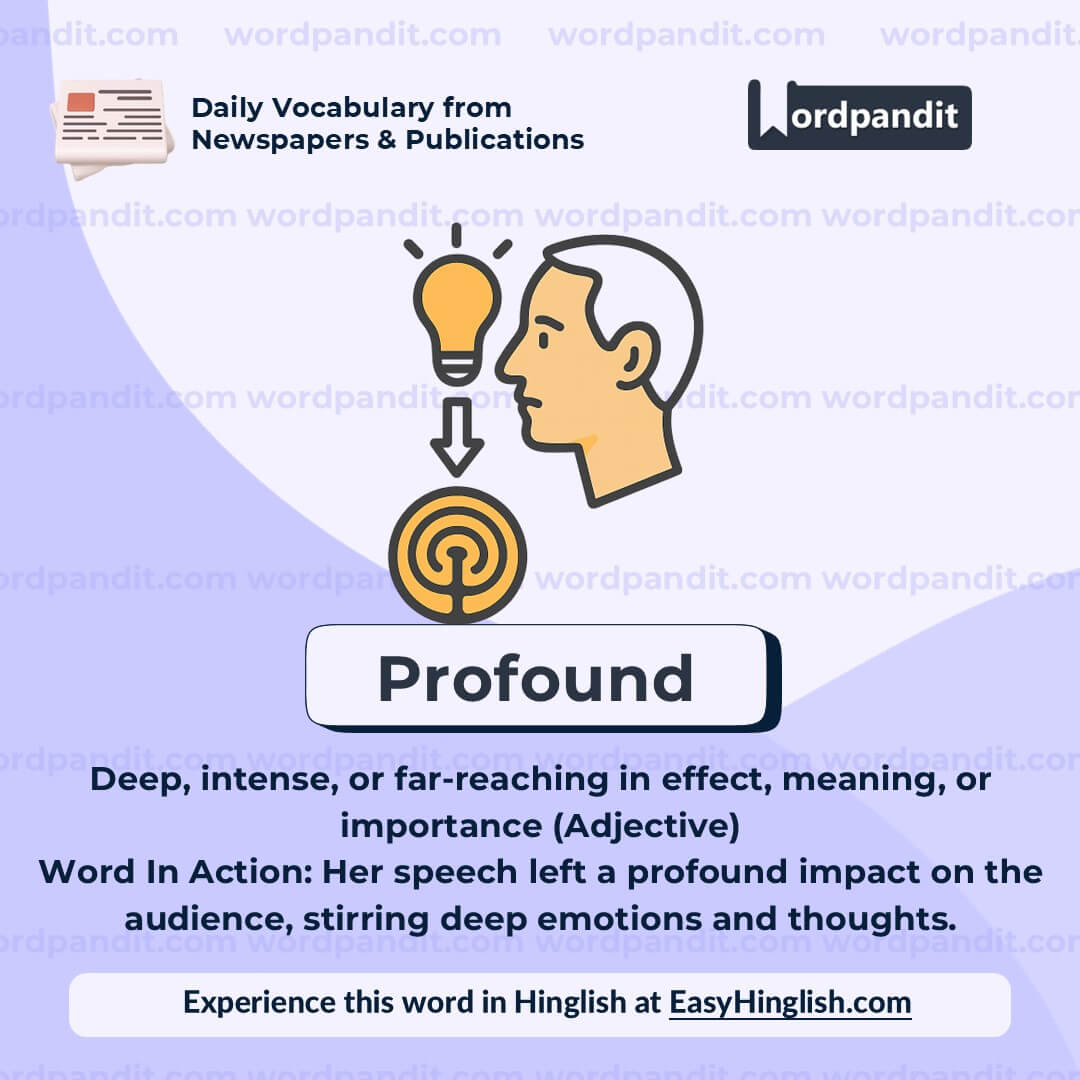
WORD-5: Profound
Context:
"Sam Altman, CEO of OpenAI, has predicted the rise of fully operational one-person companies reaching unicorn valuations, calling it one of the most profound shifts in the entrepreneurial economy." - The Times of India
Explanatory Paragraph:
“Profound” is used to describe something that is deep, intense, or highly significant. It often relates to emotions, thoughts, insights, or events that cause major impact or deep understanding. In this context, Sam Altman is referring to the rise of one-person unicorn startups as a transformation that will deeply affect the economy and the way we think about entrepreneurship—indicating it’s not just big, but meaningful and far-reaching in consequence.
Meaning: Deep, intense, or far-reaching in effect, meaning, or importance (Adjective)
Pronunciation: proh-FOWND
Difficulty Level: ⭐⭐⭐ Intermediate
Etymology: From Latin profundus meaning "deep", originally used to describe deep waters, later extended to intellectual and emotional depth.
Prashant Sir's Notes:
This is a power word. Use it when you want to emphasize depth—whether in feelings, impact, or understanding. “Profound” adds weight to your expression. It’s commonly used in academic writing, speeches, and thoughtful reflections.
Synonyms & Antonyms:
Synonyms: deep, intense, meaningful, significant, thoughtful
Antonyms: superficial, shallow, trivial, light
Usage Examples:
- The speech had a profound effect on the audience, moving many to tears.
- Her writing reveals a profound understanding of human emotions.
- The shift to AI-led entrepreneurship is seen as a profound economic development.
- He made a profound statement that stayed with me for days.
Cultural Reference:
"Only the shallow know themselves." – Oscar Wilde. A provocative quote that implies true self-awareness is profound and rare.
Think About It:
What has been the most profound change or realization in your life so far—and why?
Quick Activity:
Write a short paragraph describing a profound experience you’ve had. Use the word "profound" naturally within the paragraph.
Memory Tip:
“Profound” comes from “pro” (forward) + “found” (foundation/depth) — something that goes deeply forward into thought or impact.
Real-World Application:
“Profound” is often used in academic, professional, and emotional contexts—whether discussing climate change, philosophy, technological shifts, or personal insights. It’s a word that signals depth and consequence.


