

Daily Vocabulary from Indian Newspapers and Publications
Welcome to Wordpandit’s Indian Vocabulary Hub
At Wordpandit, we understand the importance of staying rooted in the local context while expanding your language skills. This section focuses on enriching your vocabulary with words and phrases drawn from India’s leading newspapers and publications, ensuring you're learning vocabulary that is practical, relevant, and uniquely Indian.
Why Indian Sources Matter
We believe that the best way to master any language is by immersing yourself in local content. That’s why we carefully curate vocabulary from top Indian publications, including:
- The Hindu
- The Times of India
- The Economic Times
- Hindustan Times
- Live Mint
- The Indian Express
- And many others...
Stay Updated, Stay Relevant
With daily updates from Indian news sources, you’ll be consistently learning words that reflect the trends and shifts in Indian society and culture. Our focus is to provide vocabulary that enhances your understanding of the language in an Indian context.
How Wordpandit Supports Your Goals
Whether you’re preparing for exams, aiming to improve your professional communication, or simply want to stay connected with the latest Indian vocabulary, Wordpandit is here to guide you every step of the way.
Learn with a Practical Approach
Our interactive learning methodology includes real-world examples, engaging activities, and context-specific usage to ensure that every word becomes part of your active vocabulary.
Dive into Indian Vocabulary Today!

Why Choose Wordpandit?
Practical Learning: Focus on words you'll actually encounter in real-world reading, enhancing your comprehension and communication skills.
Diverse Content: From current affairs to scientific breakthroughs, our varied sources expose you to vocabulary across multiple domains.
Effortless Integration: Make Wordpandit a part of your daily routine. Just a few minutes each day can significantly boost your lexicon over time.
Your Path to Vocabulary Mastery
- Visit our Daily Vocabulary section regularly
- Explore new words and their usage in context
- Practice incorporating these words into your own writing and speech
- Track your progress as your vocabulary expands
Start Your Journey Today
Embark on your vocabulary enhancement journey with Wordpandit. By consistently engaging with our daily posts, you'll build a robust vocabulary that serves you well in academic, professional, and personal contexts.
Remember, a word a day keeps linguistic limitations at bay. Make Wordpandit your daily companion in the quest for vocabulary excellence!
WORD-1: Transcendence
Context:
"...we too must imagine him happy – finding dignity and freedom not in escape, but in living fully despite the absurd." — suggests transcendence, rising above suffering." - Article by Tapan Susheel
Explanatory Paragraph:
Transcendence meaning in English is 'the act of rising above or going beyond ordinary limits, especially spiritual or intellectual boundaries.' This word is used when describing someone or something that overcomes normal constraints or reaches a higher state of being or understanding. How to use transcendence appears frequently in philosophical discussions, spiritual contexts, literary analysis, and competitive exam passages where abstract concepts about human potential and consciousness are explored.
Meaning: The act of rising above or going beyond normal limits; surpassing ordinary experience (Noun)
Pronunciation: tran-SEN-dens
Difficulty Level: ⭐⭐⭐ Advanced
Etymology: Transcendence comes from Latin 'transcendere' meaning 'to climb over or beyond,' formed from 'trans-' (across, beyond) and 'scandere' (to climb). The word entered English through medieval philosophy and theology, where it described the divine nature exceeding human understanding. Over time, its meaning expanded to include any experience or achievement that goes beyond ordinary human limitations, whether spiritual, intellectual, or emotional.
Prashant Sir's Notes:
Many students confuse transcendence with 'excellence' or 'superiority'—the difference between transcendence and excellence is that transcendence specifically means going beyond limitations entirely, while excellence just means doing something very well. For CAT and GRE aspirants, transcendence frequently appears in philosophy-heavy RC passages discussing human consciousness, spirituality, or existential themes. How to use transcendence correctly: it always implies movement beyond boundaries, not just improvement within them. In Indian English newspapers, you'll see phrases like "transcendence of caste barriers" or "spiritual transcendence"—watch for this pattern where transcendence is followed by 'of' plus the limitation being overcome.
Synonyms & Antonyms:
Synonyms: elevation, sublimity, supremacy, superiority, exaltation, ascendancy, surpassing, going beyond, rising above, spiritual awakening
Antonyms: limitation, confinement, mundaneness, ordinariness, restriction, earthliness
Usage Examples:
- The Bhagavad Gita speaks of transcendence as liberation from the cycle of birth and death through spiritual knowledge.
- Priya's art reflected a transcendence of traditional boundaries, blending classical Bharatanatyam with contemporary themes of urban alienation.
- The philosopher argued that true transcendence of suffering comes not from avoiding pain but from finding meaning within it.
- Sachin Tendulkar's career represented transcendence of individual achievement, becoming a symbol of national hope and aspiration for millions.
Cultural Reference:
"In moments of deep meditation, yogis speak of experiencing transcendence—a state where individual consciousness merges with universal awareness, going beyond the limitations of the physical body and mind." - Concept from Indian spiritual traditions
Think About It:
Can true transcendence be achieved while still living in the material world, or does it require complete withdrawal from society like the sanyasis of ancient India?
Quick Activity:
Write two sentences describing a personal experience or historical moment that represented transcendence—going beyond normal human limitations in sports, art, science, or personal growth.
Memory Tip:
Think of 'Transcendence' as 'TRAN-SEND-DANCE'—imagine sending your consciousness to dance beyond normal boundaries, rising above everyday limitations like a dancer leaping into the air, moving beyond the ground's constraints.
Real-World Application:
Transcendence is commonly used in philosophical essays, spiritual literature, literary criticism, and academic writing to describe experiences, ideas, or achievements that go beyond ordinary human limitations. In CAT and GRE reading comprehension passages, identifying when authors discuss transcendence helps you understand themes about human potential, spiritual awakening, or overcoming societal constraints. Business leaders also use this term when describing innovations that transcend industry boundaries or organizational transformations that move beyond conventional thinking.
WORD-2: Metaphor
Context:
"...Sisyphus as a symbol." — represents the metaphor of human struggle and meaninglessness." - Article by Tapan Susheel
Explanatory Paragraph:
Metaphor meaning in English is 'a figure of speech that describes something by comparing it to something else without using "like" or "as," suggesting they are alike in a significant way.' This word is used when explaining how writers and speakers create deeper meaning by presenting one thing as if it were another. How to use metaphor appears constantly in literary analysis, creative writing, exam essays, and everyday communication where abstract ideas are made concrete through comparison. Understanding metaphors is essential for CAT, GRE, and UPSC aspirants tackling reading comprehension passages.
Meaning: A figure of speech in which a word or phrase is applied to something it doesn't literally denote, suggesting comparison (Noun)
Pronunciation: MET-uh-for
Difficulty Level: ⭐⭐ Basic to Intermediate
Etymology: Metaphor comes from Greek 'metaphora' meaning 'a transfer,' formed from 'meta-' (beyond, over) and 'pherein' (to carry, bear). The ancient Greeks saw metaphor as carrying meaning from one domain to another, transferring qualities between unlike things. This linguistic device became fundamental to poetry, philosophy, and rhetoric, eventually spreading through Latin into English where it remains central to both literary and everyday language.
Prashant Sir's Notes:
Students often ask: what is the difference between metaphor and simile? While both compare things, metaphor usage in sentences directly states one thing IS another ("life is a journey"), while similes use "like" or "as" ("life is like a journey"). For GRE and CAT aspirants, recognizing metaphors in RC passages is crucial because they reveal the author's deeper meaning and tone. In Indian English newspapers, you'll frequently see political metaphors—"Modi's chess game with opposition" or "economy walking on a tightrope"—where complex situations are expressed through familiar images. Many students confuse metaphor with symbol, but the difference is that metaphors create direct comparison while symbols represent broader abstract concepts.
Synonyms & Antonyms:
Synonyms: figure of speech, analogy, symbol, imagery, comparison, allegory, trope, symbolic representation, figurative language
Antonyms: literal statement, plain speech, direct description, factual expression, literalness
Usage Examples:
- The cricket pitch became a metaphor for life in Rahul Dravid's farewell speech, where patience and perseverance determine success.
- Bollywood uses the metaphor of rain to represent both romance and emotional release in countless memorable film sequences.
- The river Ganga serves as a powerful metaphor in Indian literature, representing continuity, purification, and the flow of time.
- Anjali's presentation used the metaphor of a chai stall to explain how startups must blend different ingredients perfectly to succeed.
Cultural Reference:
"In the film 'Zindagi Na Milegi Dobara,' the road trip becomes a metaphor for breaking free from societal expectations and discovering one's true self—each adventure representing a personal fear conquered." - Popular Bollywood cinema analysis
Think About It:
Why do Indian politicians and leaders rely so heavily on metaphors during speeches—does comparing policies to family relationships or journeys make complex ideas more accessible to diverse audiences?
Quick Activity:
Create two original metaphors that describe your preparation for competitive exams without using the words "like" or "as"—for example, "CAT preparation is a marathon, not a sprint."
Memory Tip:
Think of 'Metaphor' as 'META-FOR'—'meta' means beyond, so metaphor goes beyond literal meaning FOR deeper understanding. Remember: if you can replace it with "is literally," it's probably a metaphor—"Time is money" doesn't mean time literally equals currency!
Real-World Application:
Metaphor is essential in literary analysis, essay writing, advertising copy, business presentations, and political speeches where abstract concepts need concrete expression. In CAT and GRE reading comprehension, identifying metaphors helps decode the author's intended meaning beyond surface-level text. Indian business leaders frequently use cricket metaphors in corporate communication—"hitting it out of the park" or "playing a defensive innings"—making complex strategies relatable. Academic writing for UPSC requires understanding how historical events are often discussed through metaphorical frameworks like "the melting pot" or "the iron curtain."
WORD-3: Existential
Context:
"Camus described suicide as a deeply personal existential problem." — relating to human existence and its meaning." - Article by Tapan Susheel
Explanatory Paragraph:
Existential meaning in English is 'relating to existence, especially human existence, and the fundamental questions about meaning, purpose, freedom, and choice in life.' This word is used when discussing deep philosophical concerns about why we exist, what gives life meaning, and how we should live. Existential is commonly used in psychology, philosophy, literature, and competitive exam passages exploring themes of human consciousness, anxiety, freedom, and the search for meaning in an uncertain world.
Meaning: Relating to existence and the experience of being human, especially concerning life's fundamental questions and meaning (Adjective)
Pronunciation: eg-zis-TEN-shul
Difficulty Level: ⭐⭐⭐ Advanced
Etymology: Existential comes from Late Latin 'existentialis,' derived from 'existere' meaning 'to come into being, to exist,' formed from 'ex-' (out) and 'sistere' (to stand). The philosophical usage emerged in the 19th century with Kierkegaard and later Sartre, who explored human freedom, choice, and the anxiety of creating meaning in a world without inherent purpose. The word gained prominence in post-World War II intellectual discourse when questions about human existence became central to philosophy and psychology.
Prashant Sir's Notes:
Many students confuse existential with 'essential'—the difference between existential and essential is that existential relates to existence and life's meaning, while essential means necessary or fundamental. For CAT, GRE, and UPSC aspirants, existential frequently appears in philosophy-based RC passages discussing human consciousness, freedom, and meaning. How to use existential correctly: it typically precedes words like 'crisis,' 'question,' 'dread,' or 'anxiety.' In Indian English newspapers, you'll see phrases like "existential threat" (threatening survival itself) or "existential crisis" (questioning life's purpose)—particularly in articles about climate change, unemployment, or mental health. Watch for this pattern: existential + abstract noun usually signals deep, fundamental concerns about existence itself.
Synonyms & Antonyms:
Synonyms: philosophical, fundamental, ontological, experiential, being-related, life-defining, essential to existence, consciousness-related, phenomenological
Antonyms: superficial, trivial, inconsequential, unimportant, peripheral, mundane
Usage Examples:
- The pandemic triggered an existential crisis for many young Indians, forcing them to question career choices and life priorities.
- Climate activists argue that global warming poses an existential threat to coastal cities like Mumbai and Chennai.
- Rohan's existential anxiety increased after graduation when he confronted the freedom to choose any path without clear guidance.
- The film 'Anand' explores existential themes about finding joy and meaning even when facing mortality and suffering.
Cultural Reference:
"In the web series 'Kota Factory,' students face existential questions about whether their identity is defined by exam success, struggling with the meaning of their lives beyond IIT preparation." - Commentary on modern Indian youth culture
Think About It:
Do social media and constant connectivity intensify existential anxiety among Indian youth by exposing them to endless life choices and comparisons, or do they provide meaningful connections that reduce existential isolation?
Quick Activity:
Write two sentences describing an existential question you've personally faced—a moment when you questioned the meaning, purpose, or direction of your life or career choices.
Memory Tip:
Think of 'Existential' as 'EXIST-TEN-SHUL'—imagine asking TEN questions about why you EXIST: Why am I here? What's my purpose? What should I do? These fundamental questions about existence itself are existential questions.
Real-World Application:
Existential is commonly used in psychology articles discussing mental health, philosophy essays exploring human consciousness, political analysis describing survival threats, and literary criticism examining themes of meaning and purpose. In GRE and CAT reading comprehension passages, recognizing existential themes helps you identify the author's focus on fundamental human concerns rather than practical issues. News reporting uses "existential threat" to describe dangers to survival itself—whether discussing Pakistan's water crisis, small businesses during lockdown, or indigenous languages facing extinction. Understanding existential versus practical concerns is crucial for UPSC essay writing and ethics papers.
WORD-4: Condemned
Context:
"...gods condemned him to a futile, eternal punishment." — sentenced to suffer punishment." - Article by Tapan Susheel
Explanatory Paragraph:
Condemned meaning in English is 'sentenced to a particular punishment, especially death, or forced to endure something unpleasant; also means to express strong disapproval of something.' This word is used when someone is officially punished by authority, forced into an undesirable situation, or when something is strongly criticized as wrong or unacceptable. How to use condemned appears frequently in legal contexts, news reports about court verdicts, social commentary, and literary passages describing fate or harsh judgment.
Meaning: Declared to be wrong, guilty, or unfit for use; strongly disapproved of. (Verb/Adjective)
Pronunciation: kun-DEMD
Difficulty Level: ⭐⭐ Intermediate
Etymology: Condemned comes from Latin 'condemnare' meaning 'to sentence, doom,' formed from 'com-' (intensive prefix) and 'damnare' (to inflict loss or damage). The word entered English through Old French 'condamner' in the 14th century, initially used in legal contexts for passing judgment and sentencing. Over time, its meaning expanded beyond courts to include moral disapproval, being forced into unfortunate circumstances, and declaring buildings or property unfit for use.
Prashant Sir's Notes:
Many students confuse condemned with 'criticized'—while both express disapproval, the difference between condemned and criticized is that condemned carries much stronger, absolute rejection, often with legal or moral authority behind it. For CAT and GRE aspirants, condemned frequently appears in passages about social justice, legal systems, or moral judgment. Condemned usage in sentences typically follows three patterns: "condemned to [punishment]" (sentenced), "condemned for [action]" (disapproved), or "condemned [building/property]" (declared unfit). In Indian English newspapers, you'll see "human rights groups condemned the violence" or "prisoners condemned to death row"—notice how condemned signals strong, official disapproval rather than mild criticism. The word carries weight and finality that 'criticized' lacks.
Synonyms & Antonyms:
Synonyms: sentenced, doomed, damned, denounced, censured, criticized severely, declared unfit, forced to endure, punished, disapproved strongly
Antonyms: praised, commended, approved, pardoned, acquitted, exonerated, freed, endorsed
Usage Examples:
- The Supreme Court condemned the accused to life imprisonment for his role in the financial scam that destroyed thousands of families.
- Political leaders across parties condemned the violent attack on the Delhi university campus, calling for immediate action against perpetrators.
- The old municipal building in Kolkata was condemned as unsafe after engineers found severe structural damage during inspection.
- Meera felt condemned to repeat her father's mistakes, trapped by family expectations and limited opportunities in her small town.
Cultural Reference:
"In the Mahabharata, Karna was condemned by circumstances of his birth to fight on the wrong side, despite his nobility and warrior skills—a tragic hero trapped by fate and social hierarchy." - Commentary on Indian epic literature
Think About It:
Are people born into poverty in India condemned to remain poor due to systemic barriers, or can education and opportunity truly break this cycle of disadvantage?
Quick Activity:
Write two sentences using 'condemned' in different contexts—one describing legal punishment or strong disapproval, and another describing someone forced into an unfortunate situation by circumstances.
Memory Tip:
Think of 'Condemned' as 'CON-DAMNED'—when you're condemned, you're DAMNED by authority (CON can remind you of conviction). Imagine a judge's gavel coming down—that final, heavy sound represents the absolute nature of condemnation.
Real-world Application:
Condemned is commonly used in legal reporting about court verdicts and death sentences, news articles about international reactions to human rights violations, real estate contexts describing unsafe buildings, and literary analysis discussing characters' fates. In Indian newspapers, you'll frequently see "government condemned the terrorist attack" or "activist condemned to prison"—recognizing these patterns helps CAT and GRE students understand tone and intensity in RC passages. The word appears in UPSC ethics papers when discussing moral judgment and in political science when analyzing international relations and diplomatic statements. Understanding when to use condemned versus milder terms like 'criticized' or 'disapproved' is essential for precise communication in formal writing.
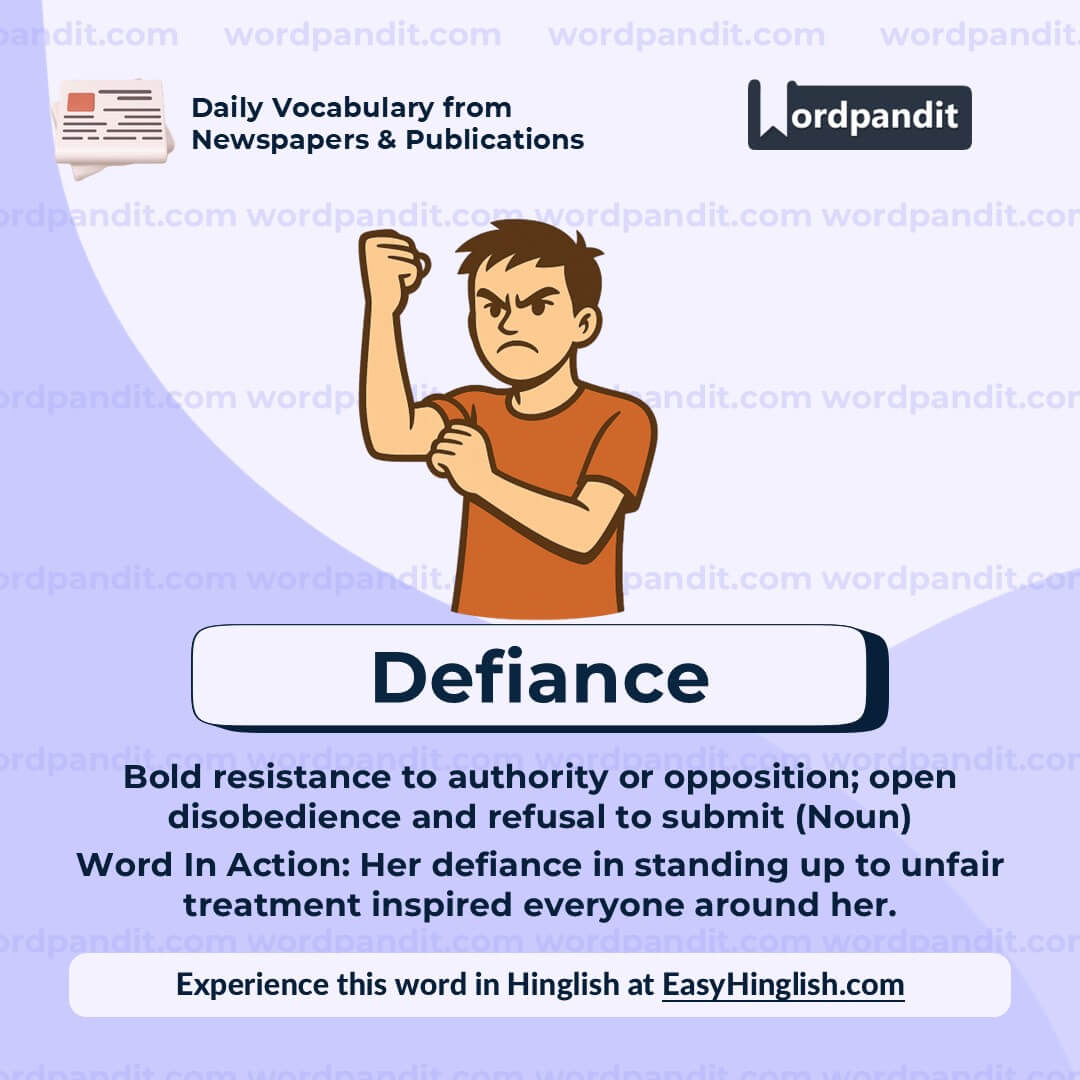
WORD-5: Defiance
Context:
"...true defiance lies in embracing the struggle itself." — open resistance; bold disobedience." - Article by Tapan Susheel
Explanatory Paragraph:
Defiance meaning in English is 'open resistance or bold disobedience to authority, opposition, or convention; refusing to obey or submit despite consequences.' This word is used when describing acts of courage or rebellion against power, rules, or expectations that someone considers unjust or limiting. Defiance is commonly used in political discourse, historical narratives, social movements, and competitive exam passages exploring themes of individual freedom, resistance, and standing up against oppression or conformity.
Meaning: Bold resistance to authority or opposition; open disobedience and refusal to submit (Noun)
Pronunciation: dih-FY-uns
Difficulty Level: ⭐⭐ Intermediate
Etymology: Defiance comes from Old French 'defiance' meaning 'challenge, declaration of war,' derived from 'defier' (to challenge, defy), which traces back to Latin 'dis-' (away from) and 'fidare' (to trust). Originally, defiance meant renouncing allegiance or trust, essentially declaring you no longer recognize someone's authority. The word evolved through medieval times when knights would throw down gauntlets in defiance, challenging opponents to combat. Today, it retains that spirit of bold challenge but applies to any open resistance against authority or convention.
Prashant Sir's Notes:
Students often ask: what is the difference between defiance and rebellion? While both involve resistance, defiance usage in sentences emphasizes the attitude of bold refusal rather than organized action—rebellion suggests systematic opposition while defiance focuses on the spirit of not submitting. For GRE and CAT aspirants, defiance frequently appears in passages about social movements, individual courage, or characters who refuse to conform. In Indian English newspapers, you'll see "in defiance of court orders" or "defiance of social norms"—the pattern 'in defiance of' is crucial to recognize. Many students confuse defiance with 'disobedience,' but defiance carries an element of courage and boldness that simple disobedience lacks—it's not just breaking rules, it's openly challenging authority with full awareness of consequences.
Synonyms & Antonyms:
Synonyms: resistance, disobedience, rebellion, insubordination, opposition, confrontation, challenge, refusal to submit, boldness, audacity
Antonyms: obedience, compliance, submission, conformity, acquiescence, surrender, deference, respect for authority
Usage Examples:
- In defiance of British colonial laws, Gandhi led the Dandi Salt March, encouraging millions to make their own salt peacefully.
- Malala Yousafzai's defiance of Taliban threats to pursue education made her a global symbol of courage and girls' rights.
- The farmers continued their protest in defiance of government warnings, camping at Delhi borders for over a year.
- Priya wore jeans to the traditional family wedding in quiet defiance of outdated expectations about women's clothing choices.
Cultural Reference:
"In the film 'Dangal,' Geeta and Babita's pursuit of wrestling careers represented defiance of patriarchal village norms that deemed wrestling inappropriate for girls—their father Mahavir's support of their dreams challenged generations of convention." - Analysis of Bollywood's social themes
Think About It:
Is defiance of unjust rules always heroic, or are there times when defiance of authority creates chaos that harms society more than it helps bring change?
Quick Activity:
Write two sentences about an act of defiance you've witnessed or read about—one from Indian history and one from contemporary society—that challenged unfair rules or expectations.
Memory Tip:
Think of 'Defiance' as 'DE-FY-ANTS'—imagine ANTS refusing to obey (DE-FY means to refuse), marching in their own direction despite someone trying to control them. Small but bold, they openly resist authority, just like defiance means open, bold resistance.
Real-World Application:
Defiance is commonly used in journalism covering protests and social movements, historical writing about independence struggles and civil rights, political analysis of opposition to government policies, and literary criticism examining characters who challenge societal norms. In CAT and GRE reading comprehension passages, identifying defiance helps you understand character motivation and conflict dynamics. Indian newspapers frequently use phrases like "in defiance of Supreme Court orders" or "defiance of social customs"—recognizing this pattern is crucial for UPSC aspirants studying governance and social issues. In business contexts, "defiance of market expectations" describes companies taking unconventional approaches, while in personal essays, discussing moments of defiance can powerfully illustrate courage and personal growth.


