

Daily Vocabulary from Indian Newspapers and Publications
Welcome to Wordpandit’s Indian Vocabulary Hub
At Wordpandit, we understand the importance of staying rooted in the local context while expanding your language skills. This section focuses on enriching your vocabulary with words and phrases drawn from India’s leading newspapers and publications, ensuring you're learning vocabulary that is practical, relevant, and uniquely Indian.
Why Indian Sources Matter
We believe that the best way to master any language is by immersing yourself in local content. That’s why we carefully curate vocabulary from top Indian publications, including:
- The Hindu
- The Times of India
- The Economic Times
- Hindustan Times
- Live Mint
- The Indian Express
- And many others...
Stay Updated, Stay Relevant
With daily updates from Indian news sources, you’ll be consistently learning words that reflect the trends and shifts in Indian society and culture. Our focus is to provide vocabulary that enhances your understanding of the language in an Indian context.
How Wordpandit Supports Your Goals
Whether you’re preparing for exams, aiming to improve your professional communication, or simply want to stay connected with the latest Indian vocabulary, Wordpandit is here to guide you every step of the way.
Learn with a Practical Approach
Our interactive learning methodology includes real-world examples, engaging activities, and context-specific usage to ensure that every word becomes part of your active vocabulary.
Dive into Indian Vocabulary Today!

Why Choose Wordpandit?
Practical Learning: Focus on words you'll actually encounter in real-world reading, enhancing your comprehension and communication skills.
Diverse Content: From current affairs to scientific breakthroughs, our varied sources expose you to vocabulary across multiple domains.
Effortless Integration: Make Wordpandit a part of your daily routine. Just a few minutes each day can significantly boost your lexicon over time.
Your Path to Vocabulary Mastery
- Visit our Daily Vocabulary section regularly
- Explore new words and their usage in context
- Practice incorporating these words into your own writing and speech
- Track your progress as your vocabulary expands
Start Your Journey Today
Embark on your vocabulary enhancement journey with Wordpandit. By consistently engaging with our daily posts, you'll build a robust vocabulary that serves you well in academic, professional, and personal contexts.
Remember, a word a day keeps linguistic limitations at bay. Make Wordpandit your daily companion in the quest for vocabulary excellence!
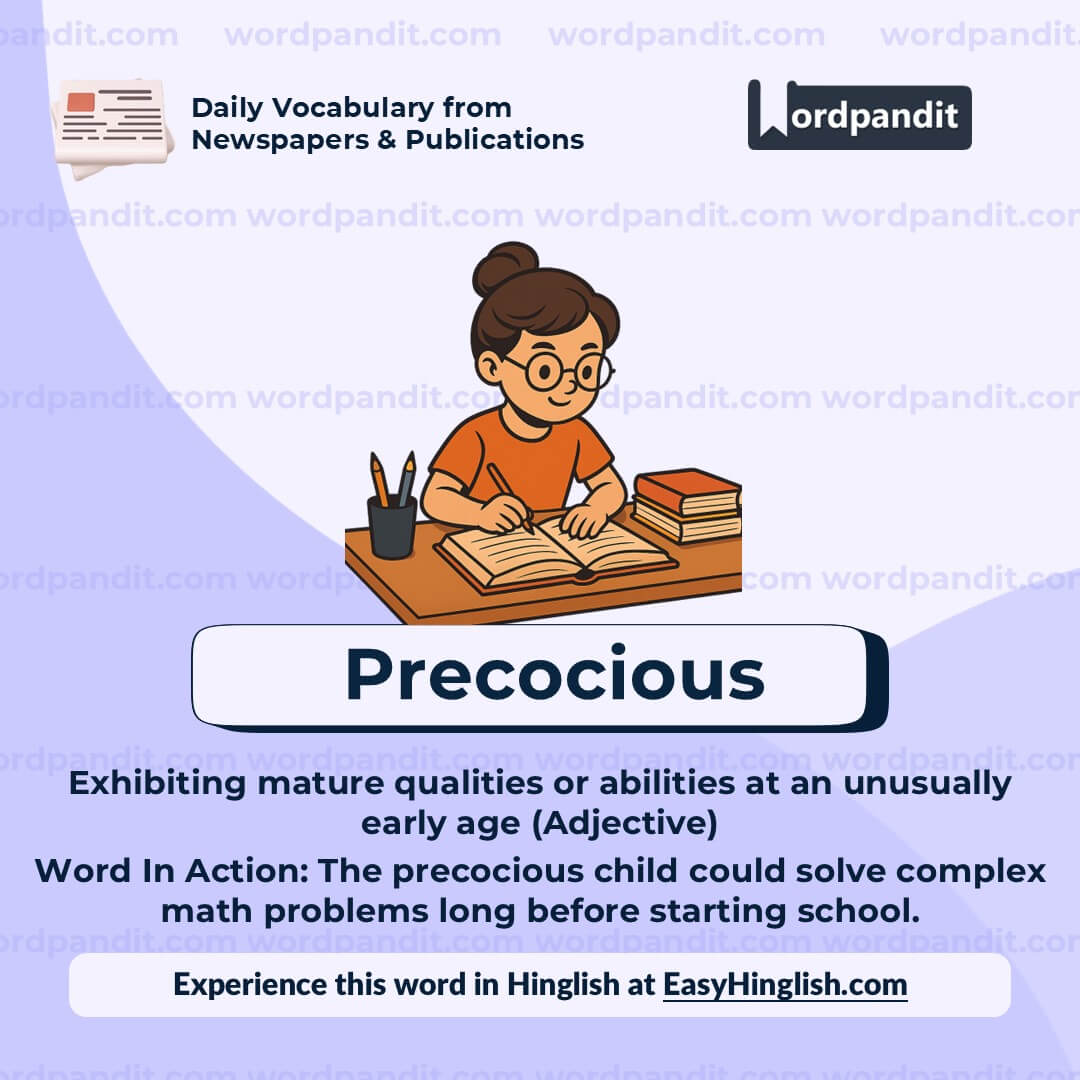
WORD-1: Precocious
Context:
"The idiot savant reinforced these class stereotypes: even their talents, no matter how precocious, were useless." - The Wire
Explanatory Paragraph:
Precocious meaning in English is 'showing advanced development or maturity at an unusually early age.' This word is used when describing children or young individuals who demonstrate abilities, intelligence, or behaviors far beyond what is typical for their age group. How to use precocious correctly is important in formal writing, psychological assessments, educational contexts, and competitive exam passages where character descriptions highlight exceptional early development. You'll find precocious commonly appearing in CAT Reading Comprehension passages about child prodigies, education systems, or developmental psychology.
Meaning: Exhibiting mature qualities or abilities at an unusually early age (Adjective)
Pronunciation: prih-KOH-shus
Difficulty Level: ⭐⭐⭐ Intermediate
Etymology: Precocious comes from Latin 'praecox' meaning 'ripening early,' derived from 'prae' (before) and 'coquere' (to ripen or cook). The word originally described fruits that ripened earlier than expected, and later evolved to describe children who matured intellectually or socially ahead of their peers. This botanical origin beautifully captures the essence of early blooming potential.
Prashant Sir's Notes:
Many students confuse precocious with merely 'intelligent'—the difference between precocious and intelligent is that precocious specifically emphasizes unusually early development for one's age, not just high ability. For CAT and GRE aspirants, precocious frequently appears in passages discussing childhood development, education systems, or biographical sketches of exceptional individuals. In Indian English newspapers, you'll often see precocious used when describing child artists, young chess champions like Praggnanandhaa, or students who crack competitive exams at remarkably young ages. Remember: precocious usage in sentences always includes an element of surprise at how early the talent or maturity appeared.
Synonyms & Antonyms:
Synonyms: advanced, gifted, mature, exceptional, prodigious, forward, ahead of one's years, unusually developed, ahead of the curve, remarkably talented
Antonyms: immature, backward, delayed, underdeveloped, slow, age-appropriate
Usage Examples:
- The precocious seven-year-old from Mumbai solved complex mathematics problems that challenged students twice her age.
- Aarav's precocious understanding of classical music impressed the maestro, who rarely accepted students under twelve years old.
- The novelist's precocious talent was evident when she published her first critically acclaimed book at just sixteen.
- My neighbor's precocious daughter discusses geopolitics with such insight that adults forget she's only ten years old.
Cultural Reference:
"Like the precocious chess prodigies who master complex strategies while their peers play video games, true talent reveals itself early and unmistakably." - Commentary on India's young sporting champions
Think About It:
Is being precocious always an advantage, or does early maturity sometimes rob children of their carefree childhood years?
Quick Activity:
Think of three precocious individuals from Indian history, cinema, or sports. Write one sentence explaining what made each person precocious rather than simply talented.
Memory Tip:
Think of precocious as "PRE-COOK-ious"—imagine a fruit that got cooked (ripened) BEFORE its time. Just like mangoes that ripen early in the season, a precocious child develops abilities earlier than expected.
Real-World Application:
Precocious is commonly used in educational reports, psychological assessments, parenting articles, and biographical writing to describe individuals who demonstrate exceptional abilities at young ages. In journalism, the word appears frequently when profiling child prodigies, young entrepreneurs, or students who achieve remarkable academic success early. Understanding how to use precocious correctly helps in writing character analyses for competitive exam essays and crafting nuanced descriptions in formal communication.
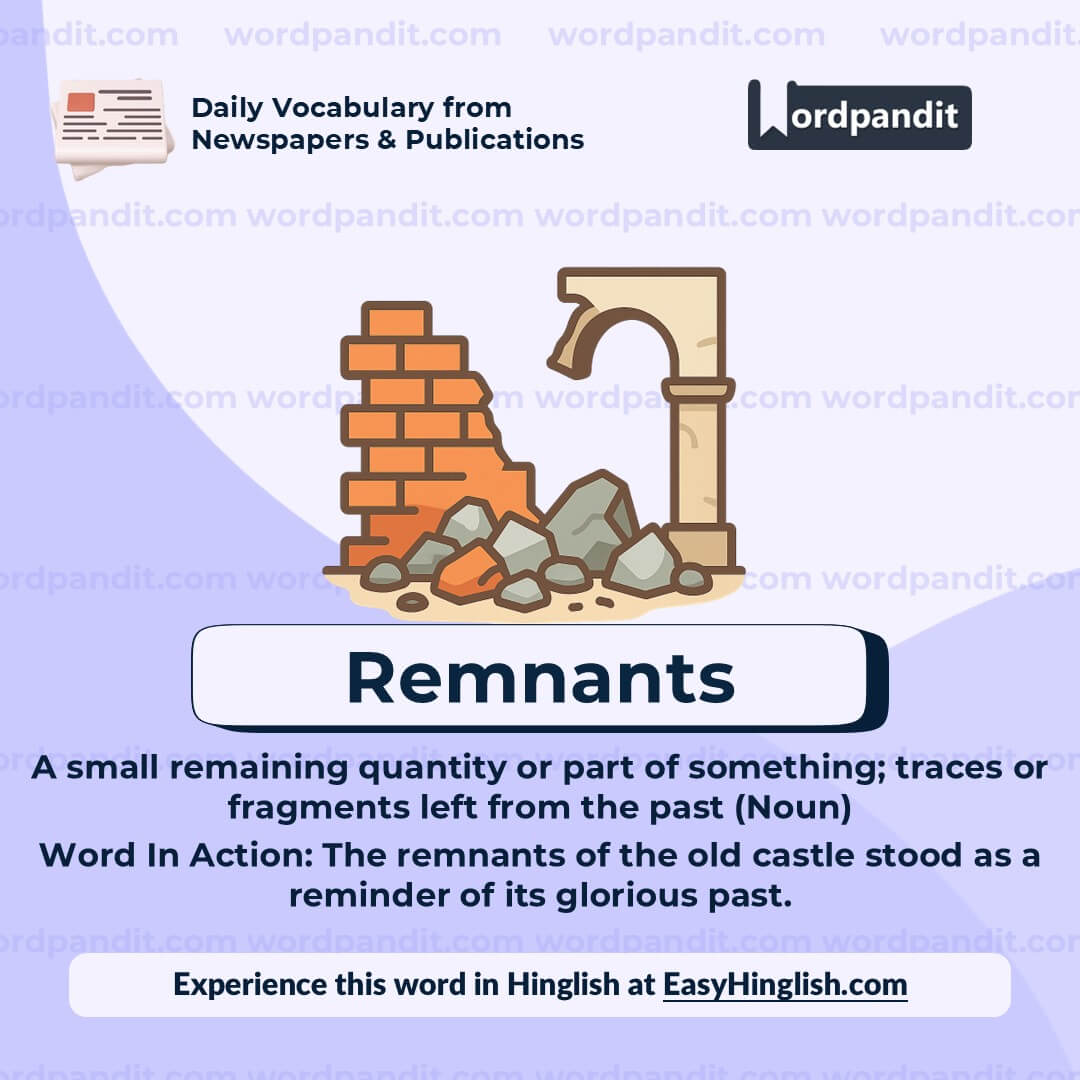
WORD-2: Remnants
Context:
"Today, however, they are recognised as the remnants of an advanced African society known as Great Zimbabwe." - The Wire
Explanatory Paragraph:
Remnants meaning in English is 'small remaining parts or traces of something that once existed in larger or more complete form.' This word is used when describing what is left after the majority of something has been destroyed, used up, or disappeared over time. Remnants commonly appears in historical writing, archaeology reports, news articles about heritage sites, and competitive exam passages discussing civilizations, traditions, or physical remains. How to use remnants effectively is crucial when writing about archaeological discoveries, cultural heritage, or anything that survives from the past.
Meaning: A small remaining quantity or part of something; traces or fragments left from the past (Noun)
Pronunciation: REM-nunts
Difficulty Level: ⭐⭐ Basic to Intermediate
Etymology: Remnants comes from Old French 'remenant' meaning 'remaining,' derived from Latin 'remanere' where 're-' means 'back' and 'manere' means 'to stay or remain.' The word originally referred to leftover pieces of cloth in medieval textile trade, but evolved to describe anything that remains after the main part is gone. This historical connection to fabric remnants still influences how we use the word today when describing leftover pieces.
Prashant Sir's Notes:
Students often ask: what is the difference between remnants and remains? While both refer to what's left over, remnants usage in sentences typically emphasizes scattered fragments or traces, whereas 'remains' suggests more substantial parts. For UPSC and CAT aspirants, remnants frequently appears in passages about archaeological sites, historical civilizations, or cultural practices that survive in modified forms. In Indian newspapers, you'll see remnants used when discussing colonial architecture, ancient Harappan artifacts, or the last traces of traditional crafts. Pro tip: remnants almost always appears in plural form when referring to physical objects, making it distinct from the singular 'remnant' used in fabric shopping contexts.
Synonyms & Antonyms:
Synonyms: remains, fragments, traces, leftovers, vestiges, relics, scraps, residue, ruins, survivors, pieces
Antonyms: whole, entirety, completeness, totality, bulk, majority
Usage Examples:
- The archaeological team discovered remnants of ancient pottery and tools at the Indus Valley excavation site in Gujarat.
- After the devastating cyclone, only remnants of the coastal village's fishing boats lay scattered across the beach.
- Priya found remnants of her grandmother's traditional recipes scribbled on yellowed paper tucked inside an old cookbook.
- The last remnants of British colonial architecture in Delhi are now protected as heritage monuments by the government.
Cultural Reference:
"Like the remnants of ancient temples scattered across Hampi, our cultural traditions survive in fragments, waiting to be understood and preserved by future generations." - Reflections on Indian heritage conservation
Think About It:
What remnants of India's pre-independence era do you encounter in your daily life—whether in language, architecture, food, or social customs?
Quick Activity:
Look around your home or neighborhood and identify three remnants of the past—old buildings, forgotten traditions, or family heirlooms. Write one sentence explaining what each remnant tells us about history.
Memory Tip:
Think of remnants as "RE-MIND-ants"—like tiny ants carrying small pieces away, remnants are the small pieces that REMIND us something bigger once existed. The "RE-" prefix itself means 'back' or 'again,' reminding you these are pieces looking back to the past.
Real-World Application:
Remnants is commonly used in historical documentation, archaeological reports, heritage conservation articles, and museum descriptions to describe surviving fragments from past civilizations or eras. In journalism and academic writing, the word appears when discussing cultural traditions that partially survive, architectural ruins, or physical evidence of historical events. For competitive exam essays on history, culture, or preservation topics, using remnants accurately demonstrates sophisticated vocabulary while describing what survives from bygone times.
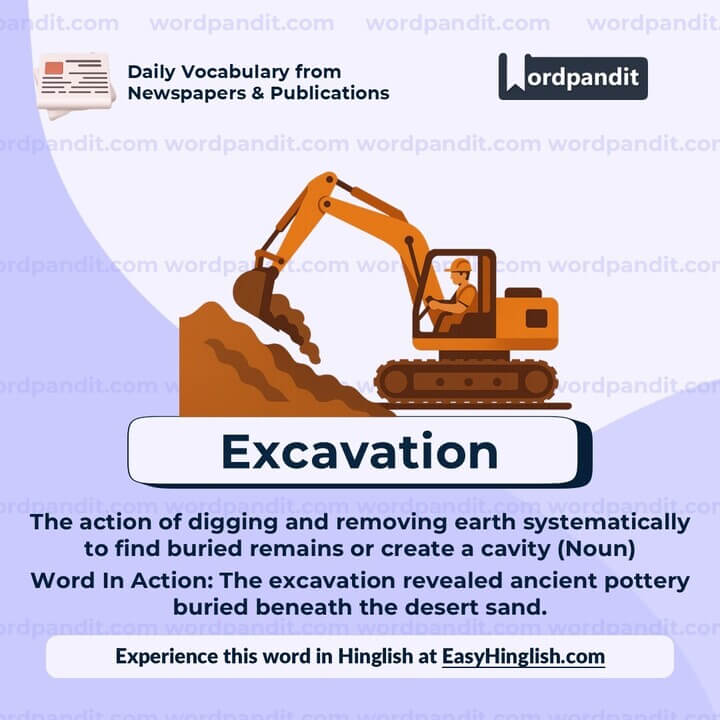
WORD-3: Excavation
Context:
"It also reveals what scholars have learned through preservation and excavation, as well as the mysteries that remain." - The Wire
Explanatory Paragraph:
Excavation meaning in English is 'the process of carefully digging and removing earth to uncover buried structures, artifacts, or remains.' This word is used when describing systematic digging operations, whether for archaeological discoveries, construction projects, or mining activities. Excavation is commonly used in archaeology reports, historical research, engineering documents, and competitive exam passages about ancient civilizations or infrastructure development. How to use excavation correctly is essential when writing about scientific discoveries, heritage sites, or any context involving methodical digging and recovery of buried materials.
Meaning: The action of digging and removing earth systematically to find buried remains or create a cavity (Noun)
Pronunciation: eks-kuh-VAY-shun
Difficulty Level: ⭐⭐ Basic to Intermediate
Etymology: Excavation comes from Latin 'excavare,' where 'ex-' means 'out' and 'cavare' means 'to hollow or make hollow,' derived from 'cavus' meaning 'hollow or cavity.' The word entered English through French in the 16th century, initially referring to any act of hollowing out or digging. Over time, it became specifically associated with archaeological and scientific digging, emphasizing the careful, methodical nature of uncovering what lies beneath the surface.
Prashant Sir's Notes:
Many students confuse excavation with simple 'digging'—the difference between excavation and digging is that excavation implies systematic, careful, scientific removal of earth with a specific purpose, usually to uncover or discover something. For UPSC aspirants, excavation frequently appears in history and geography sections discussing Harappan sites, Buddhist stupas, or infrastructure projects. In Indian English newspapers, you'll encounter excavation when reading about Archaeological Survey of India (ASI) projects at sites like Rakhigarhi, Dholavira, or new metro construction in Delhi that uncovers ancient artifacts. Excavation usage in formal writing always suggests methodical work—never use it for casual digging in your garden!
Synonyms & Antonyms:
Synonyms: digging, unearthing, uncovering, extraction, mining, dig, archaeological dig, exploration, exhumation, dredging
Antonyms: burial, covering, filling, concealment, interment, burying
Usage Examples:
- The excavation at the Keezhadi site in Tamil Nadu revealed evidence of urban civilization dating back over 2,000 years.
- During the metro excavation near Connaught Place, workers accidentally discovered remnants of British-era water channels and ancient pottery.
- Professor Sharma led the excavation team that uncovered a complete Buddhist monastery buried under centuries of sediment in Bihar.
- The Archaeological Survey of India halted the construction project to conduct a thorough excavation after coins from the Gupta period were found.
Cultural Reference:
"Every excavation in India is like opening a time capsule—beneath our cities lie layers of Mughal, Sultanate, and ancient Hindu civilizations, each telling stories waiting to be discovered." - Common sentiment among Indian archaeologists
Think About It:
With rapid urbanization and metro projects across Indian cities, how can we balance infrastructure development with the need to protect and excavate potential archaeological treasures buried beneath?
Quick Activity:
Research one famous excavation site in India (like Lothal, Sanchi, or Nalanda) and write three sentences about what archaeologists discovered there and why the excavation was significant.
Memory Tip:
Break excavation into "EX-CAVE-ation"—think of creating a CAVE by digging OUT (EX = out). Imagine archaeologists creating cave-like pits to discover ancient treasures hidden underground. The 'cave' connection reminds you that excavation involves hollowing out earth.
Real-World Application:
Excavation is commonly used in archaeological reports, historical research papers, engineering project documentation, and construction industry communications to describe systematic digging operations. In journalism, the word appears when covering heritage discoveries, infrastructure development projects, or scientific research involving buried materials. For competitive exam essays on history, archaeology, or urban development, using excavation demonstrates precise vocabulary when discussing methods of uncovering the past or creating foundations for the future.
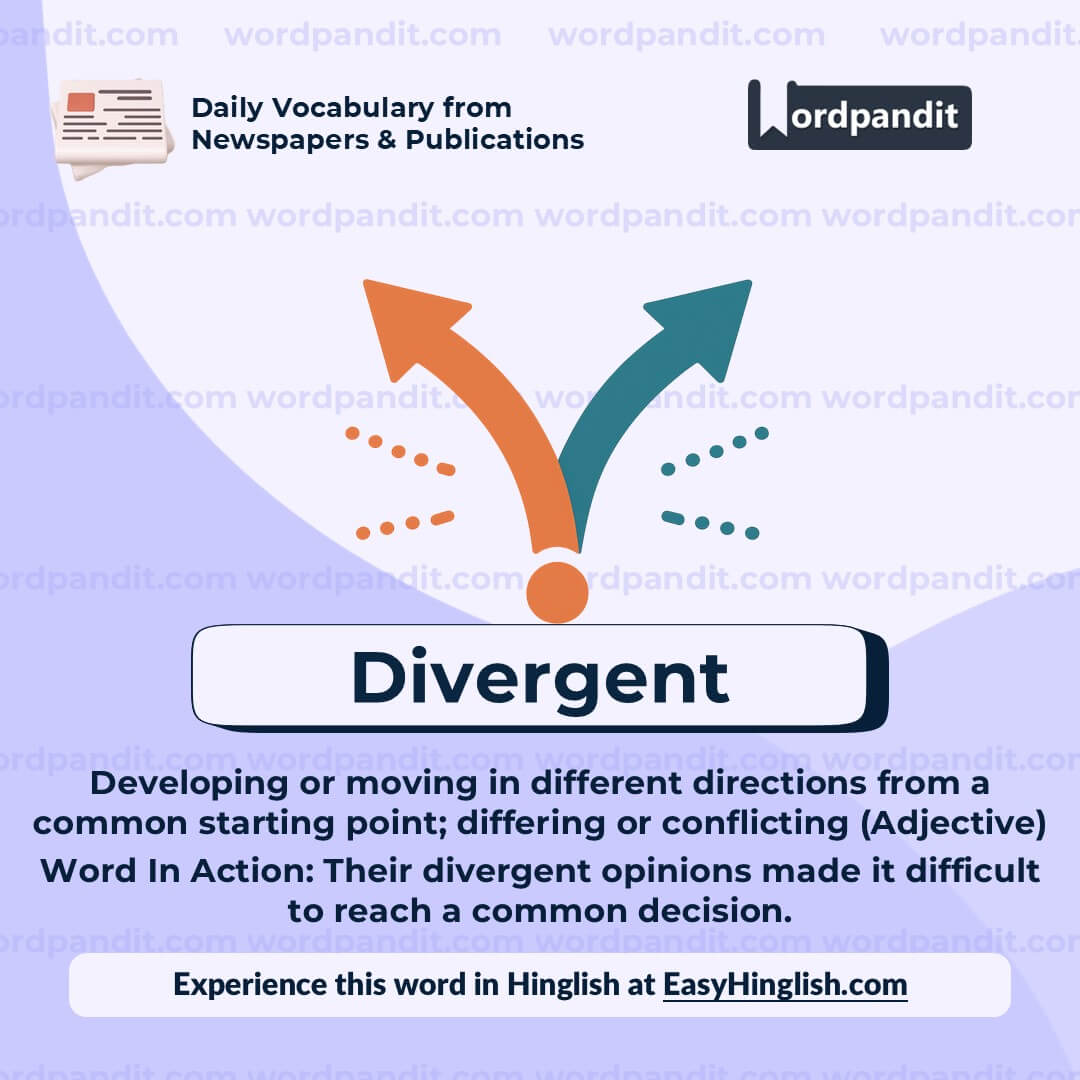
WORD-4: Divergent
Context:
"An accomplished portrait of place stretched across generations, the piece makes for a nuanced look at the enduring ripples of Soviet-era politics, and how deeply divergent beliefs can be born of similar experiences and emotions." - Times of India
Explanatory Paragraph:
Divergent meaning in English is 'moving or developing in different directions from a common point; differing or deviating from each other.' This word is used when describing ideas, opinions, paths, or trends that branch away from each other or from a standard position. Divergent is commonly used in academic writing, analytical essays, scientific discussions, and CAT or GRE reading comprehension passages where contrasting viewpoints, methods, or outcomes need to be highlighted. How to use divergent effectively helps express the concept of growing differences or opposing directions in formal communication.
Meaning: Developing or moving in different directions from a common starting point; differing or conflicting (Adjective)
Pronunciation: dih-VUR-junt or dy-VUR-junt
Difficulty Level: ⭐⭐⭐ Intermediate
Etymology: Divergent comes from Latin 'divergere,' where 'di-' (variant of 'dis-') means 'apart' and 'vergere' means 'to bend or turn.' The word entered English in the late 17th century through scientific and mathematical discourse, initially describing lines or paths that move away from each other. Over time, its usage expanded to describe any situation where things that once shared commonality begin moving in opposite or different directions—whether ideas, beliefs, evolutionary paths, or life trajectories.
Prashant Sir's Notes:
Students often ask: what is the difference between divergent and different? While both suggest lack of similarity, divergent specifically emphasizes the process of moving apart from a common origin—things weren't always different, they became different. For CAT and GRE aspirants, divergent frequently appears in RC passages discussing contrasting theories, opposing political views, or evolutionary biology where species branch off. In Indian English newspapers, you'll see divergent used when analyzing differing economic policies between states, contrasting approaches to the same problem, or how siblings from the same family develop completely different worldviews. Remember: divergent usage in sentences often involves comparison—"divergent views," "divergent paths," "divergent interpretations"—always showing two or more things moving away from each other.
Synonyms & Antonyms:
Synonyms: differing, conflicting, contrasting, deviating, separating, dissimilar, disagreeing, opposing, branching, variant, disparate
Antonyms: convergent, similar, parallel, agreeing, uniform, identical, harmonious, consistent
Usage Examples:
- Despite growing up in the same household in Mumbai, Ravi and his brother developed deeply divergent political views by the time they reached adulthood.
- The committee members held divergent opinions on the budget allocation, making consensus impossible during the three-hour meeting.
- India's education policies show divergent approaches across states, with some emphasizing technology while others focus on traditional methods.
- The two economists presented divergent forecasts for inflation—one predicting stability while the other warned of significant increases ahead.
Cultural Reference:
"Like the divergent paths taken by India and Pakistan after Partition despite their shared history, sometimes the closest neighbors develop the most contrasting identities." - Reflections on post-colonial South Asian history
Think About It:
Why do people who share the same upbringing, education, and early experiences sometimes develop such divergent worldviews and life philosophies?
Quick Activity:
Identify two divergent approaches to solving the same problem in Indian society—such as poverty alleviation, education reform, or environmental conservation. Write three sentences comparing how these divergent methods differ in their fundamental assumptions.
Memory Tip:
Think of divergent as "DI-VERGE-ent"—imagine two paths at a VERGE (edge or point) going in different directions with a "DI" (two) prefix. Visualize the symbol "Y" where two branches DIVERGE from one stem, like two roads diverging in a yellow wood, as in Robert Frost's famous poem.
Real-World Application:
Divergent is commonly used in analytical writing, research papers, business strategy documents, and scientific literature to describe contrasting theories, opposing viewpoints, or different developmental paths. In journalism and opinion pieces, the word appears when discussing political polarization, conflicting policy approaches, or competing interpretations of events. For competitive exam essays requiring comparison and contrast—especially in CAT, GRE, or UPSC—using divergent demonstrates sophisticated vocabulary when analyzing how similar starting points can lead to vastly different outcomes or perspectives.
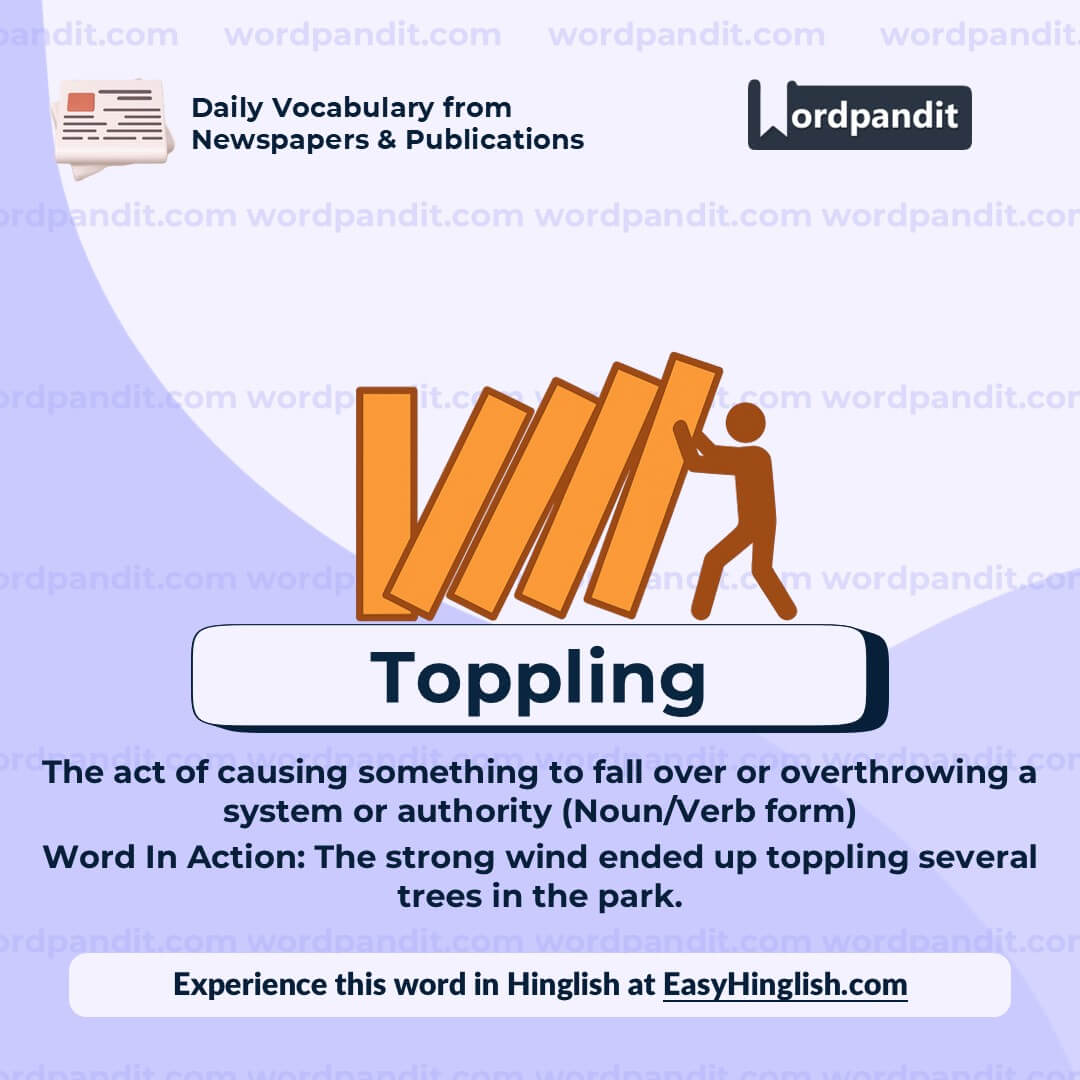
WORD-5: Toppling
Context:
"The thoughtful documentary by the Danish director Benjamin Kodboel draws parallels between these two women – especially Zhana's grief for her father, who died of a heart attack during Russia's occupation of Gori in 2008, and Nasi's sadness over the toppling of statues of Stalin across former Soviet countries and the death of her own father during the Second World War." - Times of India
Explanatory Paragraph:
Toppling meaning in English is 'causing something to fall over or collapse, especially something tall or in a position of power or authority.' This word is used when describing the physical act of knocking down structures like statues or buildings, or metaphorically when referring to the overthrow of governments, leaders, or established systems. Toppling commonly appears in news reports about political upheavals, protests, historical events, and competitive exam passages discussing revolutions or symbolic acts of defiance. How to use toppling correctly is important when writing about both literal physical collapse and figurative downfall of power structures.
Meaning: The act of causing something to fall over or overthrowing a system or authority (Noun/Verb form)
Pronunciation: TOP-ling
Difficulty Level: ⭐⭐ Basic to Intermediate
Etymology: Toppling comes from the verb 'topple,' which originated in the mid-16th century, possibly derived from 'top' combined with the frequentative suffix '-le,' suggesting repeated or ongoing action. The word initially described something falling from its top-heavy position, like a tower or tall structure losing balance. It evolved to include both literal meanings (physical collapse) and powerful metaphorical uses (political overthrow), particularly gaining prominence during descriptions of revolutions and regime changes throughout history.
Prashant Sir's Notes:
Many students confuse toppling with simple 'falling'—the difference between toppling and falling is that toppling emphasizes a tall or prominent thing losing its balance and crashing down, often with dramatic impact. For UPSC and GRE aspirants, toppling frequently appears in passages about historical revolutions, protest movements, or symbolic destruction of monuments. In Indian newspapers, you'll see toppling used when discussing statue controversies (like the removal of colonial-era statues), political upheavals, or even metaphorically when governments lose power. Toppling usage in sentences carries strong visual imagery—it's never used for small objects but for significant structures or systems. Pro tip: when you see toppling in RC passages, it often signals themes of power, resistance, or historical transformation.
Synonyms & Antonyms:
Synonyms: overthrowing, collapsing, falling, tumbling, overturning, bringing down, unseating, deposing, demolishing, upsetting, knocking down
Antonyms: erecting, establishing, building, stabilizing, strengthening, supporting, propping up, maintaining
Usage Examples:
- The toppling of colonial statues across Indian cities sparked nationwide debates about how we remember and represent our history.
- Activists celebrated the toppling of the corrupt regime after years of peaceful protests and civil disobedience movements.
- Strong monsoon winds caused the toppling of several billboards and temporary structures along Mumbai's Eastern Express Highway.
- The documentary captured the emotional moment of statue toppling in Eastern Europe, symbolizing freedom from decades of authoritarian rule.
Cultural Reference:
"The toppling of Saddam Hussein's statue in Baghdad became one of the defining images of the Iraq War, much like how the fall of the Berlin Wall symbolized the end of the Cold War—single moments that represented massive historical shifts." - Reflections on symbolic acts in modern history
Think About It:
When protesters topple statues of controversial historical figures, are they erasing history or rewriting it to reflect contemporary values and truths?
Quick Activity:
Write two sentences using toppling—one describing a literal physical collapse and another describing a metaphorical overthrow of power or authority. Notice how the word works in both contexts.
Memory Tip:
Think of toppling as "TOP-falling"—imagine something so TOP-heavy that it cannot stay balanced and comes FALLING down dramatically. Visualize a tall jenga tower or a statue on a pedestal tipping from its TOP position and crashing to the ground. The word itself sounds like something tumbling: "top-pull-ing."
Real-World Application:
Toppling is commonly used in news reporting about political revolutions, protest movements, natural disasters, and heritage controversies to describe both physical destruction and metaphorical overthrow. In historical analysis and political commentary, the word appears when discussing regime changes, the fall of empires, or symbolic acts of resistance. For competitive exam essays on history, politics, or social movements—especially in UPSC and CAT—using toppling demonstrates nuanced vocabulary when describing dramatic changes in power structures or the literal destruction of monuments representing oppressive systems.


