

Daily Vocabulary from Indian Newspapers and Publications
Welcome to Wordpandit’s Indian Vocabulary Hub
At Wordpandit, we understand the importance of staying rooted in the local context while expanding your language skills. This section focuses on enriching your vocabulary with words and phrases drawn from India’s leading newspapers and publications, ensuring you're learning vocabulary that is practical, relevant, and uniquely Indian.
Why Indian Sources Matter
We believe that the best way to master any language is by immersing yourself in local content. That’s why we carefully curate vocabulary from top Indian publications, including:
- The Hindu
- The Times of India
- The Economic Times
- Hindustan Times
- Live Mint
- The Indian Express
- And many others...
Stay Updated, Stay Relevant
With daily updates from Indian news sources, you’ll be consistently learning words that reflect the trends and shifts in Indian society and culture. Our focus is to provide vocabulary that enhances your understanding of the language in an Indian context.
How Wordpandit Supports Your Goals
Whether you’re preparing for exams, aiming to improve your professional communication, or simply want to stay connected with the latest Indian vocabulary, Wordpandit is here to guide you every step of the way.
Learn with a Practical Approach
Our interactive learning methodology includes real-world examples, engaging activities, and context-specific usage to ensure that every word becomes part of your active vocabulary.
Dive into Indian Vocabulary Today!

Why Choose Wordpandit?
Practical Learning: Focus on words you'll actually encounter in real-world reading, enhancing your comprehension and communication skills.
Diverse Content: From current affairs to scientific breakthroughs, our varied sources expose you to vocabulary across multiple domains.
Effortless Integration: Make Wordpandit a part of your daily routine. Just a few minutes each day can significantly boost your lexicon over time.
Your Path to Vocabulary Mastery
- Visit our Daily Vocabulary section regularly
- Explore new words and their usage in context
- Practice incorporating these words into your own writing and speech
- Track your progress as your vocabulary expands
Start Your Journey Today
Embark on your vocabulary enhancement journey with Wordpandit. By consistently engaging with our daily posts, you'll build a robust vocabulary that serves you well in academic, professional, and personal contexts.
Remember, a word a day keeps linguistic limitations at bay. Make Wordpandit your daily companion in the quest for vocabulary excellence!

WORD-1: Strive
Context:
"Everyone has the right to promote and strive for the protection and realization of human rights." - The Wire
Explanatory Paragraph:
Strive meaning in English is 'to make great effort or struggle to achieve something.' This word is used when describing determined and continuous attempts to reach a goal or overcome difficulties. How to use strive effectively is important for competitive exam essays, formal speeches, and motivational contexts where you need to express dedicated effort and persistence toward meaningful objectives.
Meaning: To make great efforts to achieve or obtain something; to struggle or fight vigorously (Verb)
Pronunciation: STRYV
Difficulty Level: ⭐⭐ Basic to Intermediate
Etymology: Strive comes from Old French 'estriver' meaning 'to quarrel or compete,' which itself came from a Germanic root meaning 'to struggle.' Over time, the word evolved from its original sense of conflict to today's meaning of making earnest efforts toward a goal, though it still retains the sense of effort and persistence required to overcome obstacles.
Prashant Sir's Notes:
Many students confuse 'strive' with 'try'—the difference between strive and try is that strive always implies sustained, determined effort over time, while try can be a single attempt. For UPSC essay writing and CAT RC passages, strive usage appears frequently in contexts about social justice, personal development, and organizational goals. How to use strive correctly: it must be followed by 'to' (strive to succeed) or 'for' (strive for excellence), never 'at' or 'toward.' In Indian English newspapers, especially editorial sections, you'll see 'strive for equality' or 'strive to achieve' when discussing national development goals and constitutional values.
Synonyms & Antonyms:
Synonyms: endeavor, struggle, attempt, try hard, work toward, labor, fight, aim, aspire, make efforts, pursue vigorously
Antonyms: neglect, ignore, abandon, give up, quit, surrender
Usage Examples:
- The government must strive for transparency in all its dealings to rebuild public trust after recent corruption scandals.
- Priya strives to balance her demanding corporate job with quality family time, though the challenge exhausts her daily.
- Educational institutions should strive to provide equal opportunities regardless of students' socioeconomic backgrounds or geographic locations.
- Despite multiple setbacks in his startup journey, Arjun continues to strive for success with unwavering determination and resilience.
Cultural Reference:
"We must strive to build an India where every citizen has access to education, healthcare, and dignity." - Common theme in Independence Day speeches and national policy documents
Think About It:
What's the difference between striving for perfection and striving for excellence? Is one healthier than the other in the Indian competitive environment?
Quick Activity:
Write two sentences about what you personally strive for in your academic or professional life, and identify one obstacle you must overcome in that striving.
Memory Tip:
Think of 'Strive' as 'STRIVE = Strong Tries In Various Efforts.' Imagine a cricket player like Virat Kohli striving for runs—not just trying once, but making continuous, determined efforts ball after ball, match after match.
Real-World Application:
In formal essays, mission statements, and motivational speeches, 'strive' is the preferred word to express commitment to goals. Corporate vision statements often use "we strive to..." to communicate organizational values. In competitive exam essays for UPSC or CAT, using 'strive' instead of simple 'try' demonstrates sophisticated vocabulary and adds gravitas to your arguments about social change, personal development, or institutional reform.

WORD-2: Delegitimising
Context:
"They should be protecting them, but instead they are delegitimising their efforts and message, exposing them to threats and physical attacks, and subjecting them to arbitrary arrest and detention." - The Wire
Explanatory Paragraph:
Delegitimising meaning in English is 'to remove or undermine the legitimacy, validity, or credibility of something or someone.' This word is used when describing actions that make a person, institution, movement, or idea appear invalid or unworthy of recognition. Delegitimising is commonly used in political discourse, news analysis, and competitive exam passages discussing power dynamics, social movements, and institutional credibility.
Meaning: To cause something or someone to be perceived as not legitimate, valid, or credible; to undermine authority or acceptance (Verb, present participle)
Pronunciation: dee-luh-JIT-ih-my-zing
Difficulty Level: ⭐⭐⭐ Intermediate
Etymology: Delegitimising is formed by adding the prefix 'de-' (meaning removal or reversal) to 'legitimise,' which comes from Latin 'legitimus' meaning 'lawful.' The word gained prominence in 20th-century political discourse to describe systematic efforts to undermine the authority or credibility of governments, movements, or individuals by questioning their right to exist or operate.
Prashant Sir's Notes:
Students often ask: what is the difference between delegitimising and criticizing? While criticism targets specific actions or ideas, delegitimising usage in formal writing means attacking the fundamental right or authority of something to exist. For UPSC and CAT aspirants, delegitimising frequently appears in RC passages about civil society, protests, and institutional power—recognizing this word helps identify tone and authorial stance. In Indian English newspapers, particularly political commentary, you'll see phrases like "delegitimising dissent" or "delegitimising democratic institutions" when discussing threats to constitutional values. The British spelling uses 's' (delegitimising) while American spelling uses 'z' (delegitimizing)—both are acceptable in Indian English.
Synonyms & Antonyms:
Synonyms: undermine, discredit, invalidate, delegitimize (American spelling), weaken authority, challenge validity, erode credibility, call into question, strip legitimacy
Antonyms: legitimise, validate, authorize, authenticate, endorse, sanction, recognize, support
Usage Examples:
- The government's tactics of delegitimising environmental activists have made it difficult for genuine concerns about pollution to reach policymakers.
- Social media campaigns deliberately delegitimising fact-checking organizations have contributed to the spread of misinformation across Indian digital platforms.
- By constantly delegitimising the judiciary's independence, certain political groups are weakening public faith in constitutional institutions.
- Rohan realized that his manager was systematically delegitimising his contributions in meetings to prevent his promotion to senior positions.
Cultural Reference:
"When those in power start delegitimising the voices of the marginalized, democracy itself is at stake." - Common theme in Indian civil rights discourse and activist movements
Think About It:
In the age of social media, how easy has it become to delegitimise genuine expertise and scientific consensus? What are the long-term consequences for society?
Quick Activity:
Identify three recent news stories where someone or something was being delegitimised. What tactics were used, and what was the intended outcome?
Memory Tip:
Break 'Delegitimising' into 'DE-LEGIT-IMISING'—think "DE (remove) + LEGIT (legitimate) + IMISING (making)." Imagine someone trying to make something that's legit appear not legit anymore. Picture a valid ticket being declared fake—that's delegitimising in action.
Real-World Application:
Delegitimising is essential vocabulary for political science essays, media analysis, and editorial writing. In UPSC mains answers on governance and polity, using 'delegitimising' demonstrates sophisticated understanding of power dynamics. Journalists use this term when analyzing how authorities respond to criticism, protests, or opposition. In corporate contexts, understanding delegitimising tactics helps identify workplace politics where colleagues or competitors attempt to undermine your credibility or authority systematically rather than through fair competition.
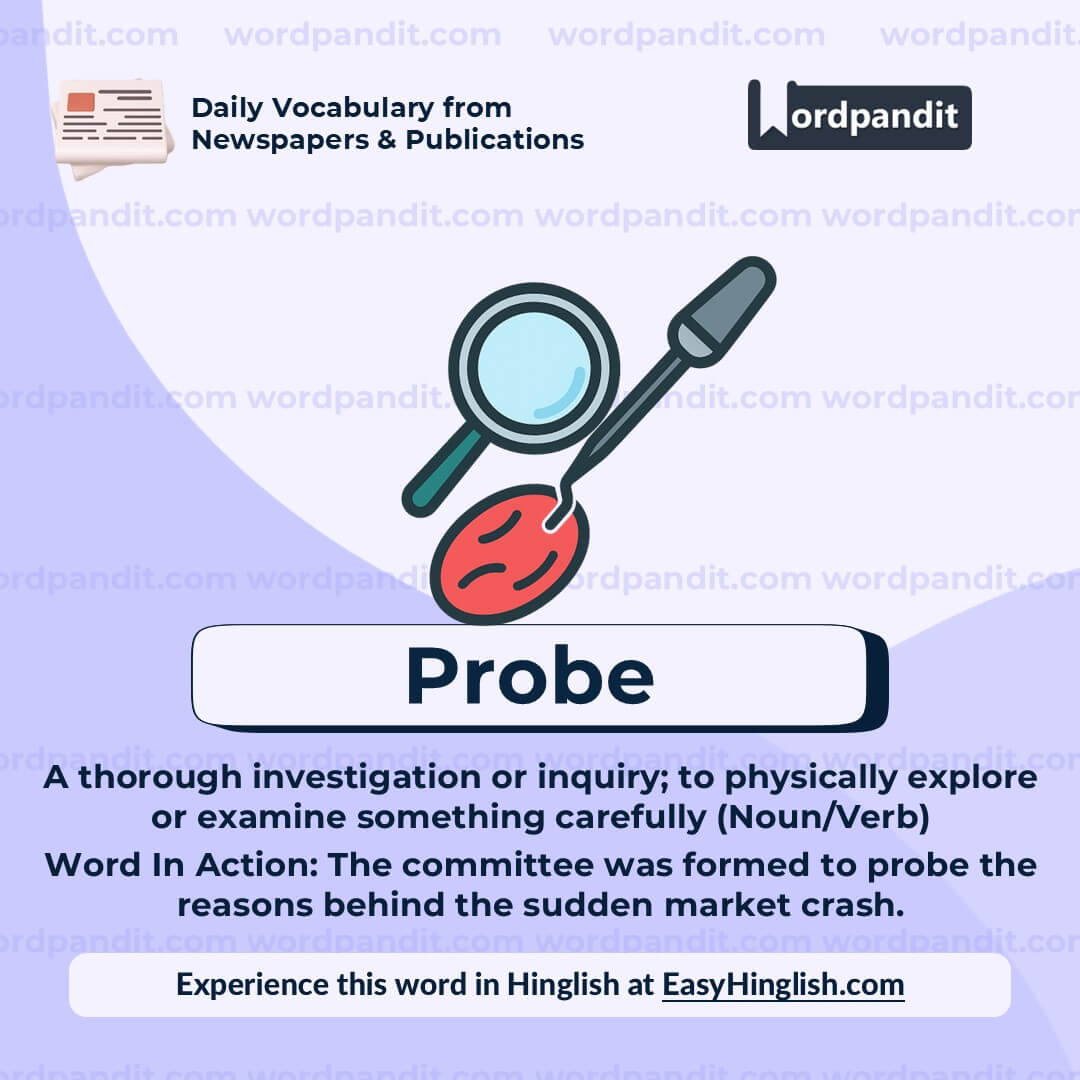
WORD-3: Probe
Context:
"Speaking to the media on Tuesday, Rohtak superintendent of police (SP) Surinder Singh Bhoria described the deceased ASI as a hardworking and honest employee and said that a probe was underway to ascertain the facts." - The Wire
Explanatory Paragraph:
Probe meaning in English is 'a thorough investigation or inquiry into something, or to investigate something deeply and carefully.' This word is used when describing official examinations, searches for truth, or detailed explorations of issues. How to use probe is important for understanding news reports, official statements, and competitive exam passages where investigations, inquiries, or detailed examinations are discussed.
Meaning: A thorough investigation or inquiry; to physically explore or examine something carefully (Noun/Verb)
Pronunciation: PROHB
Difficulty Level: ⭐⭐ Basic to Intermediate
Etymology: Probe comes from Latin 'probare' meaning 'to test or prove,' through Medieval Latin 'proba' meaning 'examination.' Originally used in medical contexts for surgical instruments used to explore wounds, the word expanded to mean any thorough investigation. By the 16th century, it had evolved to describe both physical exploration and abstract investigations into matters requiring careful examination.
Prashant Sir's Notes:
Many students confuse 'probe' with 'investigation'—the difference between probe and investigation is subtle but important: probe suggests a more focused, targeted inquiry, while investigation is broader. For CAT RC and GRE passages, probe usage typically appears in journalistic and scientific contexts. In Indian English newspapers, especially crime and political reporting, you'll constantly encounter phrases like "CBI probe," "judicial probe," or "probe ordered"—this is standard terminology for official inquiries. How to use probe correctly: as a noun, it's countable ("a probe," "several probes"); as a verb, it takes 'into' ("probe into the matter") or can be used transitively ("probe the allegations"). For competitive exam aspirants, recognizing 'probe' in RC passages helps identify investigative or analytical sections.
Synonyms & Antonyms:
Synonyms: investigation, inquiry, examination, exploration, scrutiny, inquest, study, inspection, research, look into
Antonyms: ignore, overlook, neglect, disregard, gloss over, accept superficially
Usage Examples:
- The Income Tax department launched a probe into the company's financial transactions after suspicious offshore transfers were detected last month.
- During the interview, the journalist asked probing questions that made the minister visibly uncomfortable about the infrastructure project delays.
- Scientists are using advanced satellites to probe the depths of the ocean and discover new marine species in unexplored regions.
- Meera's probing analysis of the quarterly reports revealed discrepancies that the accounting team had missed for three consecutive quarters.
Cultural Reference:
"ED probe, CBI probe, judicial probe—in Indian news headlines, the word 'probe' has become synonymous with accountability and the quest for truth in matters of public interest." - Common observation in Indian media discourse
Think About It:
Why do official investigations in India often use the term 'probe' rather than simply 'investigation'? Does the word choice affect public perception of seriousness?
Quick Activity:
Find three news headlines from today's newspaper that use the word 'probe.' Note what type of situations typically warrant a probe rather than a simple inquiry.
Memory Tip:
Think of 'Probe' as 'PRO + BE'—imagine a PROfessional BEing sent to investigate deeply. Or visualize a doctor's probe instrument that goes deep to find the problem—just like an investigation probes deeply to find the truth.
Real-World Application:
Probe is essential vocabulary for reading Indian newspapers, where it appears daily in crime, political, and business reporting. In formal writing and UPSC essays on governance, using 'probe' appropriately demonstrates understanding of institutional mechanisms. For GRE and CAT reading comprehension, recognizing 'probe' helps you quickly identify investigative or analytical passages. In professional contexts, 'probing questions' is a valued phrase in interviews, audits, and strategic discussions where deep inquiry is required to uncover hidden issues or validate assumptions.
WORD-4: Aide
Context:
"Hours before IPS officer died by suicide, his aide held on bribery charges." - Indian Express
Explanatory Paragraph:
Aide meaning in English is 'an assistant or helper, especially one who works for someone in an official or professional capacity.' This word is used when describing someone who provides support to a senior official, politician, executive, or other authority figure. Aide is commonly used in political reporting, administrative contexts, and news articles about government officials, where understanding hierarchies and support staff is essential.
Meaning: An assistant or helper to an important person, especially in official or political positions (Noun)
Pronunciation: AYD
Difficulty Level: ⭐⭐ Basic to Intermediate
Etymology: Aide comes from French 'aide' meaning 'helper,' which itself derives from Latin 'adiutare' meaning 'to help or assist.' The word entered English in the 18th century primarily through military usage, referring to officers who assisted commanding generals. It has since expanded to political, administrative, and corporate contexts, always retaining the sense of someone providing assistance to a person in authority.
Prashant Sir's Notes:
Students often confuse 'aide' with 'aid'—this is critical for spelling in competitive exams! The difference between aide and aid is that 'aide' (with an 'e') is always a person who helps, while 'aid' (no 'e') means help itself or assistance. For UPSC aspirants reading administrative and political passages, aide usage appears frequently in contexts like "personal aide," "senior aide," or "aide to the minister." In Indian English newspapers, especially political reporting, you'll see "the CM's aide" or "bureaucratic aide" referring to support staff who work closely with officials. How to use aide correctly: it's always a noun referring to a person, never a verb—you cannot "aide someone" (that would be "aid someone"). Another common confusion is with 'aid' as in foreign aid or financial aid, which is completely different.
Synonyms & Antonyms:
Synonyms: assistant, helper, associate, deputy, right-hand person, supporter, attendant, adjutant (military context), personal assistant
Antonyms: superior, boss, chief, principal, leader, commander, head
Usage Examples:
- The minister's trusted aide was responsible for coordinating all official meetings and managing communication with various government departments.
- Rajesh worked as a senior aide to the Chief Secretary for five years before receiving his own posting as District Magistrate.
- The CEO's aide discreetly informed board members about the emergency meeting scheduled for early morning regarding the acquisition deal.
- Political aides often work behind the scenes, managing schedules, drafting speeches, and liaising with media representatives during election campaigns.
Cultural Reference:
"In Indian bureaucracy, an aide to a senior IAS officer often becomes the bridge between policy decisions at the top and implementation at ground level." - Common observation in administrative circles
Think About It:
How much power do aides to powerful politicians and bureaucrats actually wield in India? Can they influence decisions beyond their official capacity?
Quick Activity:
Write two sentences: one using 'aide' (the person) and another using 'aid' (the help). This will help you remember the spelling difference permanently.
Memory Tip:
Remember 'Aide' with the 'E' at the end stands for 'Employee' or 'pErson'—an aide is always a person who helps. Think of it as "A-ID-E" where 'ID' reminds you of identification—an aide has an identity, they're a specific person. Meanwhile, 'aid' without the 'e' is just abstract help, not a person.
Real-World Application:
Aide is crucial vocabulary for reading Indian political and administrative news, appearing in headlines and reports about government functioning. In UPSC preparation, understanding the role of aides in bureaucracy helps comprehend administrative hierarchies. For professional communication, knowing when to use 'aide' versus 'aid' prevents embarrassing spelling errors in formal emails and reports. In CAT and GRE reading comprehension, passages about politics, government, or corporate leadership frequently use 'aide,' and recognizing it quickly helps you understand organizational dynamics and power structures being discussed.

WORD-5: Blitz
Context:
"Trump's Tariff Blitz and China's Rare Earth Curbs Push Trade War to the Brink." - The Wire
Explanatory Paragraph:
Blitz meaning in English is 'a sudden, intensive, and overwhelming campaign or attack carried out with great speed and force.' This word is used when describing rapid, aggressive actions that happen in quick succession, often catching opponents off guard. Blitz is commonly used in military contexts, sports commentary, business strategy discussions, and news headlines about intensive campaigns, making it essential vocabulary for competitive exam passages and current affairs.
Meaning: A sudden, intensive attack or campaign; to carry out such an attack (Noun/Verb)
Pronunciation: BLITS
Difficulty Level: ⭐⭐⭐ Intermediate
Etymology: Blitz is shortened from German 'Blitzkrieg,' meaning 'lightning war,' a military tactic used by Nazi Germany in World War II involving sudden, overwhelming attacks. The word 'Blitz' literally means 'lightning' in German. It entered English during WWII, particularly after the 'Blitz' bombing campaign against Britain in 1940-41. The term has since expanded beyond military usage to describe any sudden, intensive effort in sports, business, politics, or advertising.
Prashant Sir's Notes:
Many students confuse 'blitz' with simply 'attack'—the difference between blitz and attack is that blitz specifically emphasizes speed, intensity, and overwhelming force happening rapidly. For CAT and GRE aspirants, blitz usage appears frequently in business and sports contexts beyond just military scenarios. In Indian English newspapers, especially business and sports sections, you'll see "marketing blitz," "media blitz," or "advertising blitz" referring to intensive promotional campaigns. How to use blitz correctly: as a verb, you can say "they blitzed the market" (meaning they attacked aggressively and quickly); as a noun, "a blitz of reforms" or "a blitz on corruption." In cricket commentary, you might hear "bowling blitz" when a team takes multiple quick wickets. The word always carries connotations of surprise, speed, and intensity—never use it for slow, gradual processes.
Synonyms & Antonyms:
Synonyms: assault, onslaught, bombardment, barrage, offensive, raid, intensive campaign, overwhelming attack, lightning strike, rush
Antonyms: retreat, withdrawal, gradual approach, slow campaign, defense, patience, restraint
Usage Examples:
- The government launched a media blitz to promote its new digital payment initiative, flooding television channels and social media with advertisements.
- Flipkart's marketing blitz during the festive season included celebrity endorsements, massive discounts, and round-the-clock promotional campaigns across platforms.
- The opposition party conducted a nationwide blitz against the ruling government's economic policies, organizing rallies in fifty cities simultaneously.
- Indian cricket team's batting blitz in the final session saw them score 120 runs in just 15 overs, completely changing the match dynamics.
Cultural Reference:
"When Virat Kohli goes on a blitz in the death overs, bowlers know they're in for a torrid time—boundaries come fast and furiously." - Cricket commentary describing aggressive batting
Think About It:
In the age of social media, political parties can launch opinion blitzes within hours. Does this speed of campaign hurt or help democratic deliberation?
Quick Activity:
Identify three different contexts where you've heard 'blitz' used recently—was it in sports, business, politics, or military contexts? Write one sentence for each context showing how the intensity and speed remain constant across uses.
Memory Tip:
Think of 'Blitz' as 'BL-ITZ' where 'BL' sounds like 'BLAST' and the whole word sounds sharp and quick—just like lightning. Imagine Dhoni's lightning-fast stumpings or a thunder BLAST—that's the speed and intensity of a blitz. The word itself sounds fast when you say it!
Real-World Application:
Blitz is essential vocabulary for understanding modern business strategy, military affairs, and sports analysis. In MBA essays and CAT reading comprehension, recognizing 'marketing blitz' or 'competitive blitz' helps you understand aggressive business strategies. For UPSC aspirants, the term appears in international relations and defense passages. In corporate presentations, phrases like "sales blitz" or "recruitment blitz" are common when describing intensive, time-bound campaigns. Indian newspapers use 'blitz' extensively in headlines because it's short, punchy, and immediately conveys urgency and intensity—perfect for describing everything from anti-corruption drives to promotional campaigns.


